


Claude Opus 5 costs $5 per million input tokens and $25 per million output tokens, unchanged from Opus 4.8, with the full 1M context window included at no premium. The Batch API halves both numbers, cache reads drop input to $0.50, and fast mode doubles everything to $10 and $50.
The sticker price is the least interesting part, and the launch-week argument proves it. Opus 5 is the first Opus that runs adaptive thinking by default, and thinking tokens bill at the output rate, so developers running matched-effort comparisons are reporting roughly 2x the output tokens of Opus 4.8 on the same task. Same rate card, bigger bill. The effort setting, not the model choice, is what actually moves the number.
I build integrations at eesel, and I have watched more than one technical customer leave to wire up the Claude API themselves, then discover the token bill was the easy part. If what you actually want is tickets answered rather than tokens metered, eesel sells that as a fixed monthly credit plan (1 credit per ticket or chat, from $299 a month for 500 credits) with the model spend already inside it.
Claude Opus 5 pricing at a glance
Claude Opus 5 launched on July 24, 2026, described by Anthropic as a model that "comes close to the frontier intelligence of Claude Fable 5 at half the price." The API rate is the same one the Opus line has carried since Opus 4.5.
| What you pay for | Claude Opus 5 rate |
|---|---|
| Input tokens | $5 per million |
| Output tokens (including thinking) | $25 per million |
| 5-minute cache write | $6.25 per million |
| 1-hour cache write | $10 per million |
| Cache read | $0.50 per million |
| Batch API input / output | $2.50 / $12.50 per million |
| Fast mode input / output | $10 / $50 per million |
US-only inference (inference_geo) | 1.1x every token category |
Every figure above comes from Anthropic's pricing docs. A few specs that shape the bill more than the rate does:
- The model ID is
claude-opus-5on the Claude API,anthropic.claude-opus-5on Bedrock. - Context is 1M tokens in, 128k tokens out, rising to 300k output on the Batch API with a beta header.
- The reliable knowledge cutoff is May 2026.
- Opus 5 sits in its own rate-limit bucket. Opus 4.8, 4.7, 4.6 and 4.5 share a combined pool and Opus 5 does not draw from it, so moving traffic across does not free headroom.
If you are pricing this against the previous generation, our Opus 4.5 pricing guide and the Opus 4.6 breakdown carry the same rate, which makes the version-to-version comparison unusually clean.
What you are actually billed for
Here is the part that catches people migrating from Opus 4.8. On 4.8, a request that omitted the thinking field ran without thinking. On Opus 5, the same request runs adaptive thinking, and every thinking token is billed as output at $25 per million.
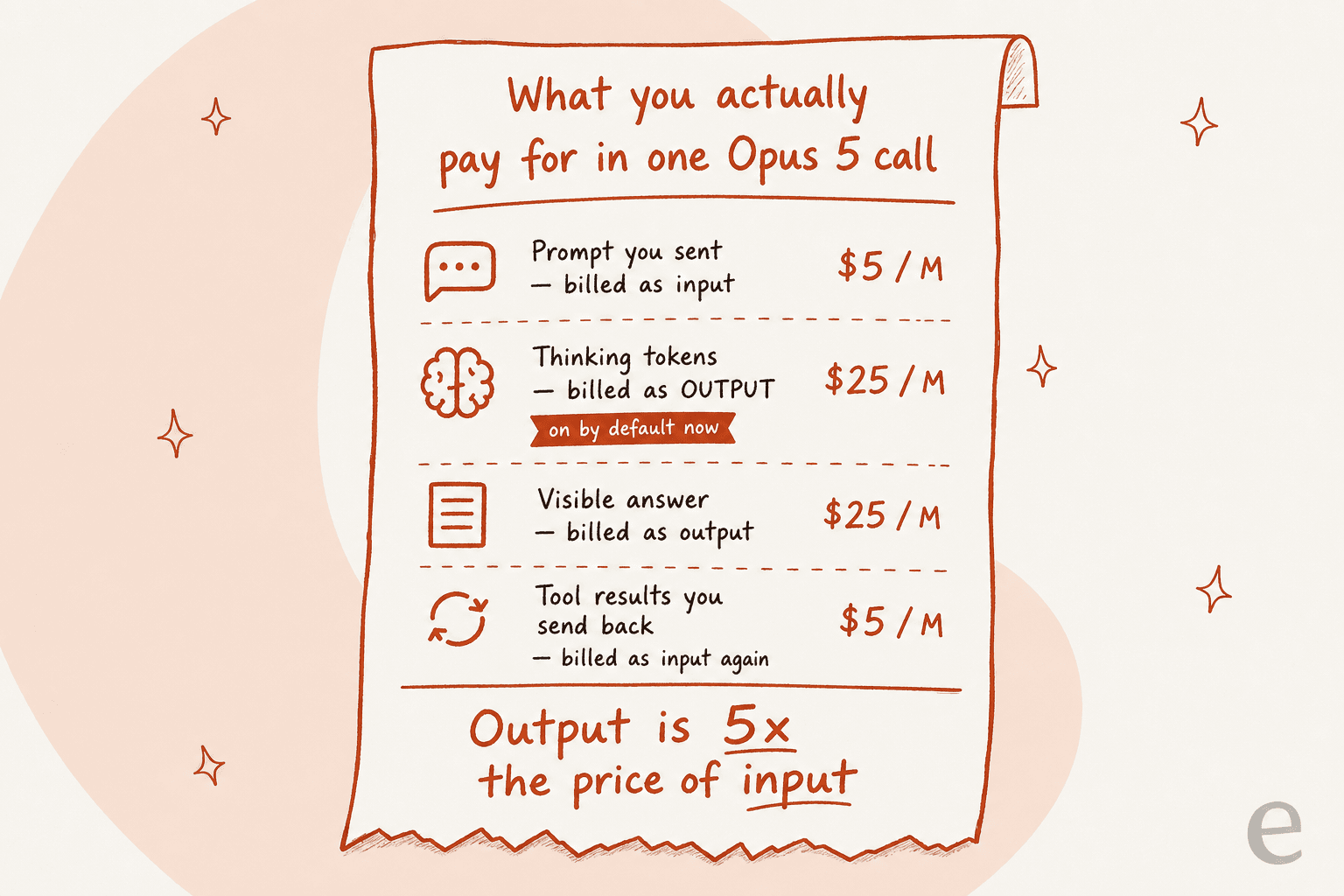
Two knock-on effects worth budgeting for:
max_tokensnow covers thinking and the answer together. A ceiling you tuned tightly around the visible response on 4.8 can truncate mid-answer on Opus 5. Anthropic's migration guide suggests at least 64k as a starting point at xhigh or max effort.- Opus 5 writes longer by default. The migration guide is blunt that visible responses and written deliverables both run longer than on 4.8, and that lowering effort reduces thinking volume without reliably shortening the visible answer. Length has to be prompted for, not dialled for.
There is a third bill line people forget in agentic loops: every tool result you hand back re-enters as input on the next turn. A 30-step agent run pays for the same growing transcript over and over, which is exactly why caching matters more here than in chat. If your loop pulls context through MCP tools or Claude Skills, each of those results lands on the input side of the same invoice.
One model, four prices
The same weights and the same model ID can bill at four different rates depending purely on how you call them.
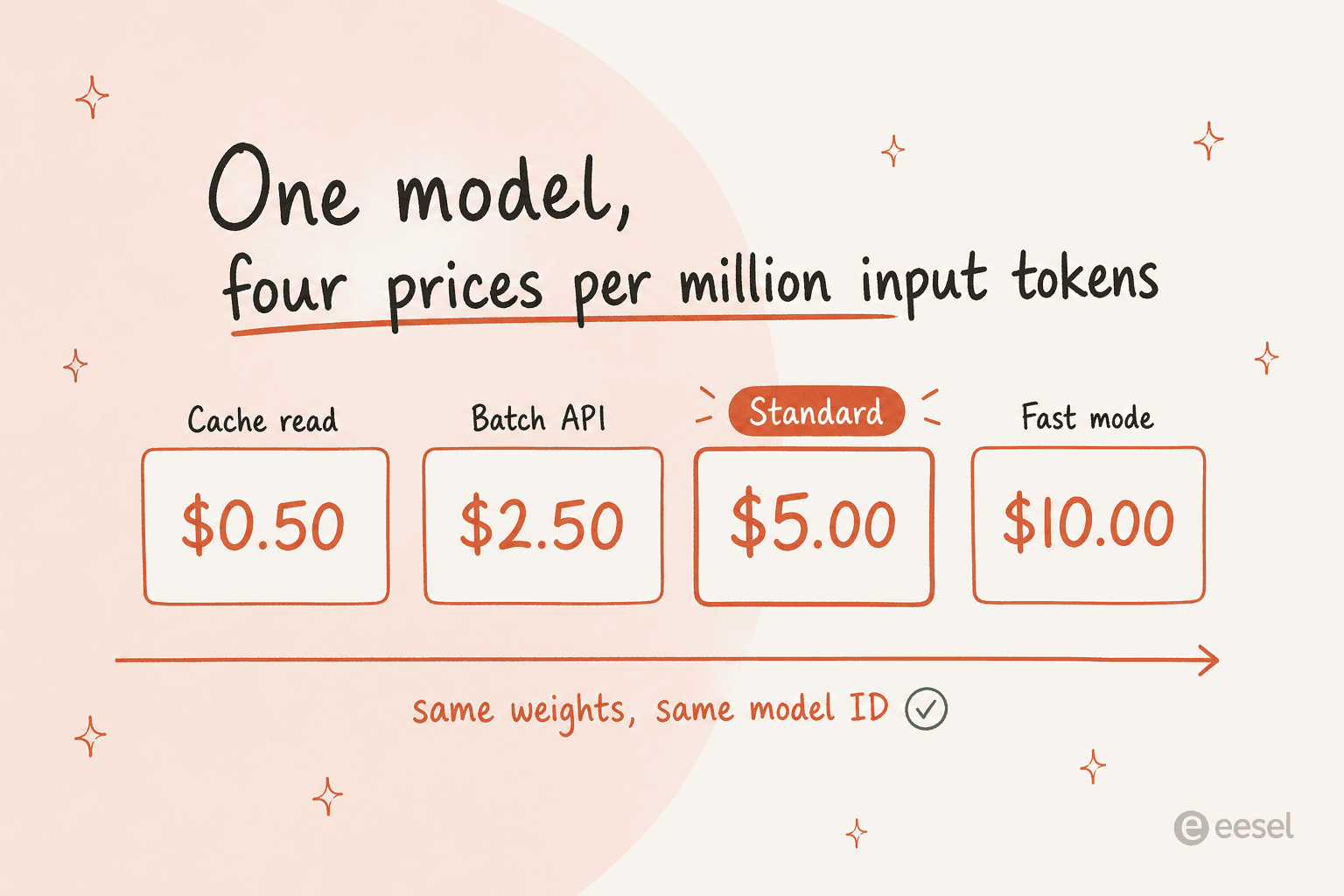
Prompt caching is the biggest lever for anything with a stable prefix. Writes cost 1.25x base input on the 5-minute cache and 2x on the 1-hour cache, and reads cost 0.1x. The quiet upgrade on Opus 5 is the floor: the minimum cacheable prefix drops to 512 tokens, down from 1,024 on 4.8 and 4,096 on Opus 4.6. System prompts that were silently uncacheable before now cache with no code change at all.
Batch takes 50% off both directions, and it stacks with caching. If your workload tolerates a queue, this is free money.
Fast mode goes the other way. Per the fast mode docs it delivers up to 2.5x higher output tokens per second for exactly double the price, and the trade is worth naming precisely: at $10 and $50, fast-mode Opus 5 costs the same per token as standard Claude Fable 5. It is also a research preview on the first-party API only, and does not work with Batch.
US-only inference adds a flat 1.1x on every token category, which works out to $5.50 and $27.50.
Effort is the real price knob
This is the section I would read twice if I were sizing a budget. Opus 5 supports five effort levels, and the guidance flipped from the 4.x era: where 4.7 and 4.8 told you to start at xhigh for agentic work, Opus 5 says start at the default high and reach down.
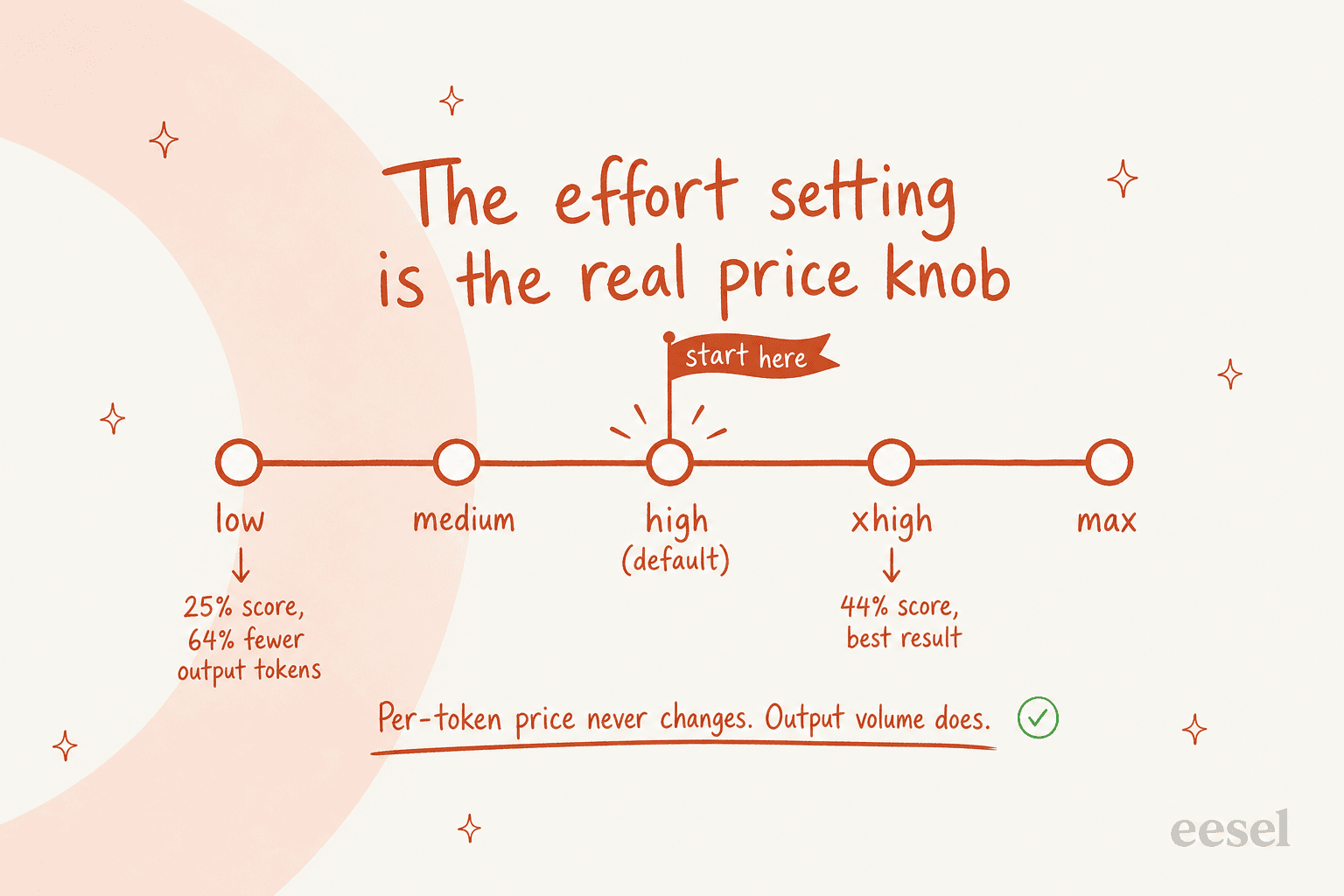
The numbers behind that advice come from Anthropic's own Frontier-Bench v0.1 run, a 74-task terminal benchmark that succeeded Terminal-Bench 2.1:
| Effort | Frontier-Bench score | Token note |
|---|---|---|
| low | 25% | 64% fewer output tokens |
| high | 39% | 19% fewer output tokens |
| xhigh | 44.4% | best result |
| max | ~43% | more spend, slightly worse |
Two things jump out. Max effort scored worse than xhigh while costing more, and low effort delivered well over half the score for roughly a third of the output tokens. Anthropic explains the max-effort dip on FrontierCode 1.1 as the model making "more changes than the task requires," which the grader penalises.
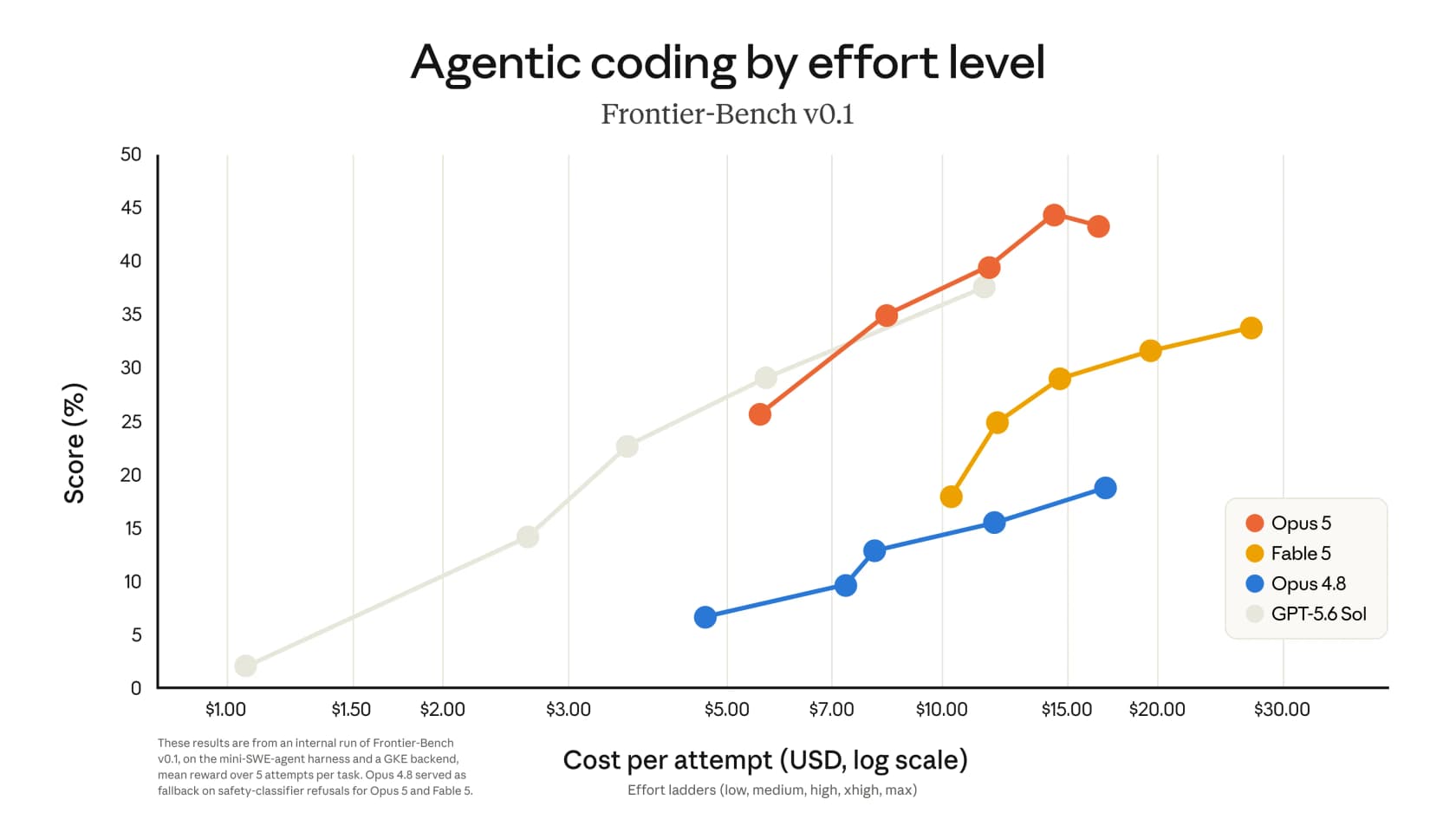
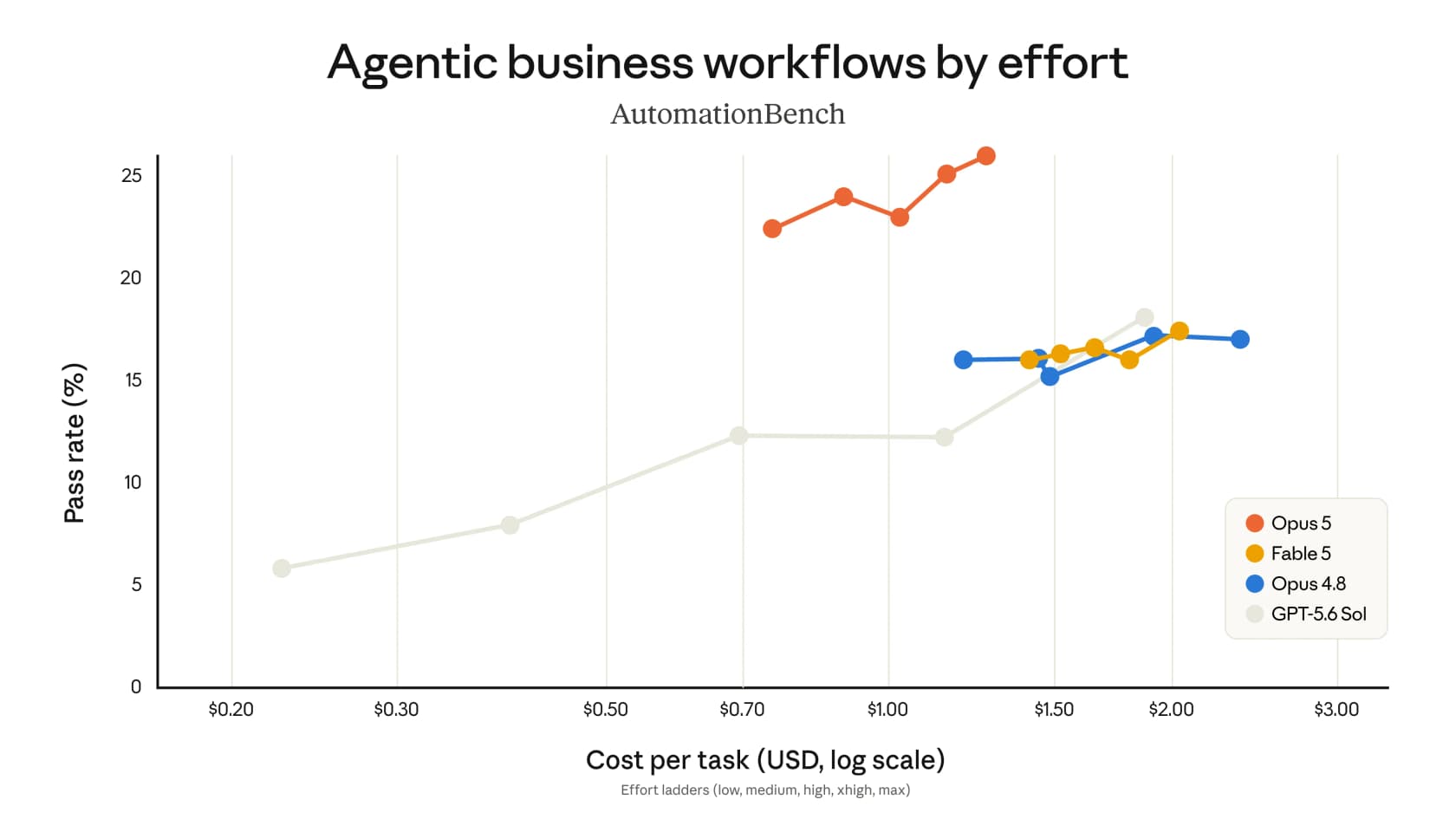
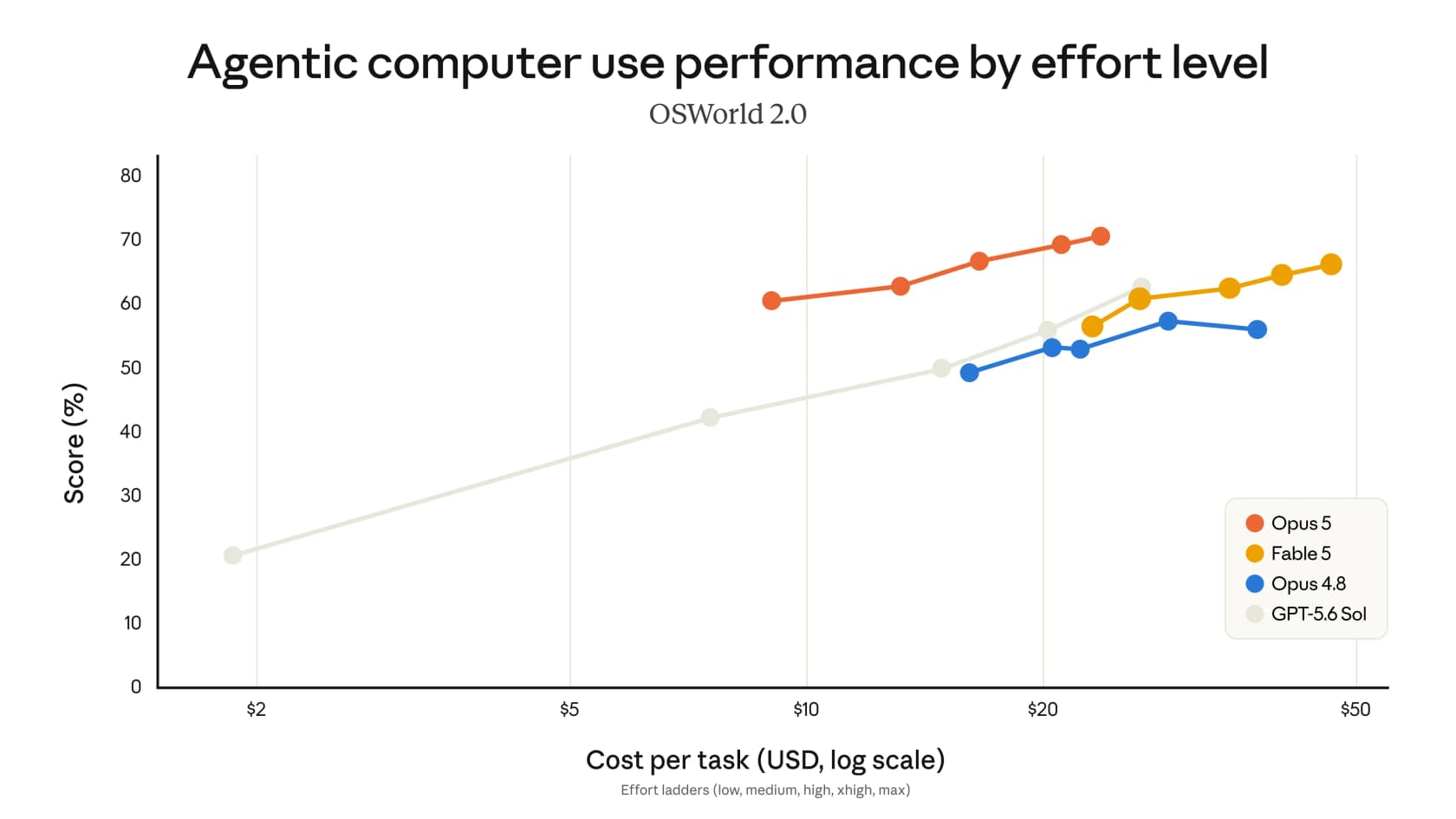
Read that chart as a pricing chart, not a leaderboard. Opus 5's whole cost argument is that its curve sits above and to the left of Fable 5's: it reaches a higher score at a lower cost per attempt. That is a more useful claim than any single benchmark number, and it is the same shape Anthropic reports on CursorBench, where Opus 5 lands "within 0.5% of Fable 5's peak score, but at half the cost per task."
Work out your own monthly bill
Sticker rates only become real once you put your own volume against them. Plug in a month of usage and see what the levers do.
One caveat the calculator cannot model: token counts are not comparable across generations. Anthropic notes that Claude 4.7 and later tokenize the same text into roughly 30% more tokens than Sonnet 4.6 and earlier, so a flat per-million comparison against an older model understates the real bill.
How Opus 5 prices against the rest of the lineup
| Model | Input / MTok | Output / MTok | Context | Where it fits |
|---|---|---|---|---|
| Claude Fable 5 | $10 | $50 | 1M | The capability ceiling |
| Claude Opus 5 | $5 | $25 | 1M | Agentic coding, enterprise work |
| Claude Opus 4.8 | $5 | $25 | 1M | Priority Tier, web fetch |
| Claude Sonnet 5 | $2 (then $3) | $10 (then $15) | 1M | Volume work |
| Claude Sonnet 4.6 | $3 | $15 | 1M | Previous workhorse |
| Claude Haiku 4.5 | $1 | $5 | 200K | Classification, routing |
Anthropic's own steer is to start with Opus 5 and step up to Fable 5 only when you need the ceiling.
Against the rest of the market, our comparisons of Gemini pricing and GPT-5.6 pricing put Opus 5 in the expensive-but-efficient bracket. The head-to-head reads in Gemini 3 Pro and Codex vs Opus 4.6 still describe the shape of that trade, and the three-way API comparison is the fastest way to sanity-check a switch.
Two things Opus 4.8 keeps that Opus 5 drops, and they matter for planning: per the migration notes, web fetch is not available on Opus 5 and Priority Tier is not supported. If you hold a Priority Tier commitment, that capacity does not follow you across.
What real workloads actually cost
Rates are abstract. These are not.
One coding session. Anthropic's own worked example puts a one-hour Opus 5 session at 50,000 input and 15,000 output tokens: $0.25 plus $0.375 plus $0.08 of Managed Agents runtime, or $0.705. Turn caching on for 40,000 of those input tokens and the same session lands at $0.525, a 25% cut for no behavioural change.
One business workflow. On Zapier's AutomationBench, Opus 5 scored 24% at medium effort for $0.89 per task, which Anthropic notes is "significantly outperforming both Claude Opus 4.8 and Fable 5 at less than half the cost."
One full evaluation suite. At the other extreme, Artificial Analysis publishes what it spent running its own index:
"In total, it cost $3835.51 to evaluate Claude Opus 5 (Adaptive Reasoning, Max Effort) on the Intelligence Index."
That figure is the honest counterweight to every cost-per-task chart above. Opus 5 tops the same index at 61 points, ranked first of 190 models, but it burned 100M output tokens getting there against a 63M median. Efficiency per completed task and total spend are different questions, and Opus 5 answers them differently.
Several early-access customers put numbers on the same effect. A legal-agent team reported 26% fewer tokens for similar performance versus Opus 4.8 at max reasoning, and a trading benchmark landed at "roughly a seventh of the reasoning tokens and under half the latency." Those are vendor-supplied and unnamed, so weigh them accordingly, but the direction is consistent across six separate accounts.
Claude Pro, Max, Team and Enterprise
Not everyone reaches for the API. Per the launch post, Opus 5 is the new default model on Claude Max and the strongest model on Claude Pro.
| Plan | Monthly | Annual | Opus 5 access |
|---|---|---|---|
| Free | $0 | $0 | No, Sonnet and Haiku only |
| Pro | $20 | $17/mo, $200 up front | Yes, plus Fable via credits |
| Max 5x | $100 | Monthly only | Yes, default model |
| Max 20x | $200 | Monthly only | Yes, default model |
| Team (standard) | $25/seat | $20/seat | Yes |
| Team (premium) | $125/seat | $100/seat | Yes, 5x standard usage |
| Enterprise | - | $20/seat plus usage | Yes, 500k context |
Prices are from the Claude pricing page. Two details that trip up buyers:
- Limits are session-based, not message-based. They reset on a rolling five-hour window with weekly caps on top, and web, desktop, mobile and Claude Code all draw from one pool. There is no message count to plan against.
- Paid plans spill into API rates. Hit a limit and you can enable usage credits to keep working at standard rates, which is where the $5 and $25 above start applying to a subscription seat.
That session model is producing wildly different experiences on the same release, and the split tracks the plan tier almost perfectly. A Max 20x user:
"I have now been using Opus 5 only (since I'm out of Fable) for about 7 hours and it drained about 6% of my weekly usage."

And a Pro user on the same week:
"I'm only on the Pro plan but a single prompt with Opus 5 w/ high thinking used 100% of my 5-hour usage limit."
Both can be true, because a session limit is a token pool and Opus 5 spends from it faster at high effort. On a $20 Pro seat that pool is small enough for one thinking-heavy prompt to clear it. The practical fix people have landed on is not a plan upgrade: it is dropping effort for routine work and reserving high for the tasks that need it.
For teams weighing the subscription route against raw API spend, our Claude Code pricing guide and the enterprise Claude Code walkthrough cover the seat math. Model configuration in Claude Code is where you pin Opus 5 rather than letting it pick, and the model selection guide covers when to let it drop to a cheaper tier. If you are still deciding whether the whole ecosystem fits, our Claude review and Claude Cowork pricing guide are the wider view.
Bedrock, Vertex, Foundry and the CCU wrinkle
Opus 5 is available on all platforms from day one, but the billing is not identical.
- Amazon Bedrock and Google Cloud are partner-operated. The cloud provider invoices you, and Anthropic points at Bedrock pricing and Vertex AI pricing as the source of truth rather than publishing rates itself.
- Regional endpoints carry a 10% premium over global ones on both clouds.
- Claude Platform on AWS and Microsoft Foundry bill in Claude Consumption Units, rated in USD at standard per-model rates then converted at $0.01 per CCU with hourly metering. Your invoice shows one CCU line item, not a token breakdown.
- Fast mode is first-party only. It does not exist on Bedrock, Google Cloud, or Foundry.
If your finance team is reconciling an AWS bill against a per-token model, the CCU conversion is where the two stop lining up.
What developers are saying
The launch-week reaction split almost immediately into two camps, and the split is entirely about tokens, not rates. The first camp ran the numbers and found the flat price hiding a real increase.
"At the same levels of thinking it's appears that Opus 5 in it's current form uses about 2x the amount of output tokens to do similar tasks. So per token is the same, but the models don't use the same amount of tokens to do the same task."
One developer spent real money settling it. Running the same task across effort levels, they logged Opus 5 at $0.41514 on low and $0.801965 on medium, against $0.210415 for Opus 4.8 on low:
"At matched effort, Opus 5 spends roughly 2x the output tokens of 4.8."
Third-party leaderboards picked up the same signal from a different angle:
"Vals Index Opus 4.8 > 5.0 goes from $2.90 to $8.54, for 4% gain ... That is a massive cost increase. Sure, 20% cheaper then Fable, but that is a 3x price increase compared to Opus 4.8 in that test."

The mechanism people keep describing is scope creep, which is the same behaviour Anthropic's own docs warn about when they tell you to delete carried-over verification instructions because Opus 5 verifies its work unprompted:
"it just reviews every minor change with unnecessary checks that would take a couple minutes to check manually, it wants to spend an hour and spend $25 of tokens"
The counterargument is fair and worth holding onto. Total tokens burned is the wrong denominator if the model finishes work the cheaper one abandons:
"When we look at some benchmarks that publish the cost per successful task, Claude seems to be way cheaper than I expected. For example on https://livebench.ai/
here the cost per successful task for Opus 5 is lower than Sol."u/suamai, Reddit
And plenty of people are simply happy with the swap:
"I switched from 4.8 to 5 yesterday and I'd have to say that I've noticed an improvement, though not hugely perceptible, the model seems to want to do more work per turn, possibly a tiny bit faster, and little less verbose when it isnt necessary to be so."
My read: both camps are right, and the disagreement is really about which denominator you bill against. If you meter tokens, Opus 5 got more expensive. If you meter finished tasks, it got cheaper. Which one describes your business is the actual question this pricing page cannot answer for you.
Is Claude Opus 5 worth $5 and $25?
For long-horizon agentic work, yes, and the argument is not really about the rate. Opus 5 charges what Opus 4.8 charged while scoring 96.0% on SWE-bench Verified and more than doubling 4.8 on Frontier-Bench. When a run costs $0.89 and finishes rather than $0.40 and fails twice, the cheaper per-token model was never cheaper.
Three honest caveats before you standardise on it:
- It is verbose, and verbosity is billed at $25. Artificial Analysis calls it "particularly expensive when comparing to other models of similar price" and "notably slow and very verbose." Budget prompt engineering time for length control, because effort alone will not do it.
- Hallucination went slightly the wrong way. The system card states plainly that the model "hallucinates factual claims slightly more than Opus 4.8, despite being more accurate overall."
- Cheaper models still win a lot of work. For classification, routing, and bulk drafting, Claude Sonnet 5 at 40% of the price is the better buy, and Haiku is better still. If you are shopping around, our Opus 4.6 alternatives roundup and the earlier Opus 4.5 alternatives cover the field, with Mistral pricing and Groq pricing at the cheaper end.
Where the model lands in a real toolchain is a separate question from the rate card. Our roundups of AI coding assistants, Claude developer tools and Cursor are where that gets decided in practice.
For the record, my own default on internal tooling is high effort with 1-hour caching on the system prompt and Batch for anything that can wait. That combination lands most jobs somewhere between a quarter and a half of the naive standard-rate bill.
Where the token bill stops being your problem
Everything above assumes you want to own the plumbing: the retry logic, the effort tuning, the cache invalidation, the fallback when a safety classifier declines a request. That is a real engineering project, and I have watched several technical customers leave eesel to build exactly that on the Claude API directly.
Some of them are perfectly happy. Others end up where this customer did:
"We could try to write our own LLM application but we didn't want to invest our time into that. We wanted something that we would not have to maintain."
Karel, GENERAL BYTES
That is the actual decision behind a Claude Opus 5 pricing page. If you want a frontier model answering support tickets, the token rate is maybe a fifth of the work. The rest is grounding it in your help centre and past tickets, keeping it quiet on the questions it should not touch, and knowing what it will do before it touches a live queue.

eesel is that layer, sold as a fixed monthly credit plan (1 credit per ticket or chat, from $299 a month for 500 credits) with the model spend already inside it, so you budget it up front rather than explaining a token invoice. You can simulate it against your own historical tickets before it replies to anyone, and connect it in a few minutes. Try eesel free.
If content rather than support is your use case, the same logic drives our AI blog writer, and the guides to the best LLM for blogging and making AI sound human are the place to start.