
If you're a content creator in 2026, you're likely using Large Language Models (LLMs) in your work. With a crowded market, it can be challenging to find a tool that consistently produces high-quality, engaging text that performs well in search engines.
This raises the question: what is the best tool for the job? The ideal solution should go beyond simple text generation, helping to create complete, publish-ready articles that appeal to both readers and search engines.
Specialized tools like the eesel AI blog writer are designed to address this challenge by streamlining the content creation process. For instance, at eesel AI, using such a tool helped grow our blog from 700 to over 750,000 daily impressions in three months. This guide provides a rundown of the top LLMs for blog writing based on extensive testing.
What exactly is an LLM for blog writing?
When we talk about a Large Language Model (LLM), we're talking about an AI that has been trained on a staggering amount of text from the internet. This training allows it to understand language, context, and all the little nuances, which is why it can generate writing that sounds surprisingly human.
For anyone creating content, an LLM can be more than just a writing buddy. It can be your researcher, outliner, first-drafter, and even your SEO specialist. But it's good to know the difference between a general-purpose LLM (like the models behind ChatGPT or Claude) and a platform built specifically for blogging.
Platforms like the eesel AI blog writer use powerful LLMs as their engine but wrap them in a workflow designed for one job: creating high-quality, SEO-friendly blog posts. The "best" model really comes down to what you need, whether that's brainstorming ideas or scaling up a full-blown content strategy.
Criteria for choosing the best LLM for blog writing
To make this comparison fair and genuinely useful, I focused on what really matters when you're trying to create content that performs. The following infographic breaks down the four key areas I used to judge each model.
- Output quality & tone: How human does it sound? Is the content engaging and accurate, or does it have that generic, robotic "AI voice" we all know and can't stand?
- SEO & AEO capabilities: Does the tool naturally structure content for search engines and AI Overviews? Can it weave in keywords and figure out search intent without you having to write a massive prompt?
- Features & completeness: Does it just dump a wall of text on you, or does it deliver a publish-ready article with assets like images, embedded videos, and proper internal and external links?
- Workflow efficiency: How much time and effort does it really save? Is it a genuine shortcut from topic to finished post, or does it just create a new pile of editing work for you?
A comparison of top LLMs for blog writing
Here’s a quick look at how the top five contenders stack up against each other.
| Feature | eesel AI blog writer | Claude 3.5 Sonnet | GPT-4o | Llama 3.1 | Gemini 3 Pro |
|---|---|---|---|---|---|
| Best For | SEO Content Scaling | Creative & Nuanced Prose | Versatile All-Rounder | Custom Open-Source Workflows | Multimodal Research & Synthesis |
| Generates Assets | Yes (Images, Videos, Quotes) | No (Text & Code Artifacts) | No | No | No |
| SEO Optimized | Built-in | Manual Prompting | Manual Prompting | Manual Prompting | Manual Prompting |
| Ease of Use | Very Easy | Easy | Easy | Requires Setup | Easy |
| Free Access | Yes (First blog free) | Yes (Limited) | Yes (Limited) | Open Source | Yes (Limited via AI Studio) |
5 best LLMs for blog writing
Now for the deep dive. Based on my hands-on testing, here’s the breakdown of each model’s strengths, weaknesses, and who it’s really for.
1. eesel AI blog writer

The eesel AI blog writer is a specialized platform built to turn a single keyword into a complete, SEO-optimized blog post that’s ready to publish. It’s designed from the ground up to solve the workflow problem, not just the writing problem.
Pros: Its biggest advantage is that it creates a full content package, not just a block of text. It has context-aware research that pulls in relevant details for your topic, and it automatically generates assets like AI images, tables, and infographics. It even embeds relevant YouTube videos and real Reddit quotes to add social proof and credibility. Plus, it has built-in optimization for both traditional search engines (SEO) and the new AI Answer Engines (AEO).
Cons: It’s a purpose-built tool. If you're looking for an AI to write poetry, fiction, or just have a general chat with, this isn't it. Its entire focus is on one thing: efficiently creating high-quality, rankable blog content.
Pricing:
- It's free to try for your first blog post.
- The Early Bird plan is $99 for 50 blog credits, with no recurring subscription needed.
Our Verdict: For marketers, SEOs, and any business focused on driving organic growth, this tool is a strong contender. It automates many time-consuming parts of blog creation, making it an efficient solution for scaling content designed to rank.
2. Claude 3.5 Sonnet
Claude 3.5 Sonnet is Anthropic's latest model, and it's getting a lot of attention for its nuanced, natural, and human-sounding writing. It actually outperforms their previous model, Claude 3 Opus, and does it at twice the speed.
Pros: What really makes Claude stand out is its ability to produce text that rarely feels like it was written by an AI, which is perfect for storytelling and thought leadership pieces. It also introduced a neat feature called Artifacts, a dynamic workspace where you can edit generated content like code snippets in real-time. Anthropic also claims it's their strongest vision model yet, so it's great at interpreting charts and graphs.
Cons: It's a text and code generator. To get a full blog post, you still have to do a lot of the heavy lifting yourself: adding assets, handling SEO, finding media, and formatting. While it's powerful, some users have noted that it can be a bit overly aggressive in shortening text when you ask it to edit something.
Pricing:
- A free tier is available on claude.ai with usage limits.
- The Pro Plan is $20 per month for more usage.
- API access costs $3 per million input tokens and $15 per million output tokens.
Our Verdict: A suitable option for writers who want an AI partner to draft creative prose and are comfortable managing the research, formatting, and SEO manually.
3. GPT-4o
GPT-4o (the "o" stands for "omni") is OpenAI's flagship model, and it's a true jack-of-all-trades. It’s genuinely multimodal, meaning it can understand and generate content using a mix of text, audio, image, and video.
Pros: GPT-4o is incredibly fast, easy to access, and can pull real-time information from the web, which is a big plus. Its ability to process different types of media makes it a fantastic brainstorming partner. It's a reliable workhorse for generating structured outlines and solid first drafts on pretty much any topic you throw at it.
Cons: The output can often feel a bit generic without some serious prompt engineering. Like Claude, it’s a text generator first and foremost, so all the asset creation, linking, and final SEO optimization falls on you. Its massive popularity also means its writing style can sometimes feel a bit overused and recognizable.
Pricing:
- Free access is available with some limitations.
- ChatGPT Plus is $20 per month for higher limits and faster access.
- API access pricing varies, but the specific
gpt-4o-2024-08-06model is cheaper at $2.50 per million input tokens.
Our Verdict: A useful general-purpose tool for creating quick drafts and outlines. It is versatile but does not specialize in the end-to-end workflow of blog writing.
4. Llama 3.1
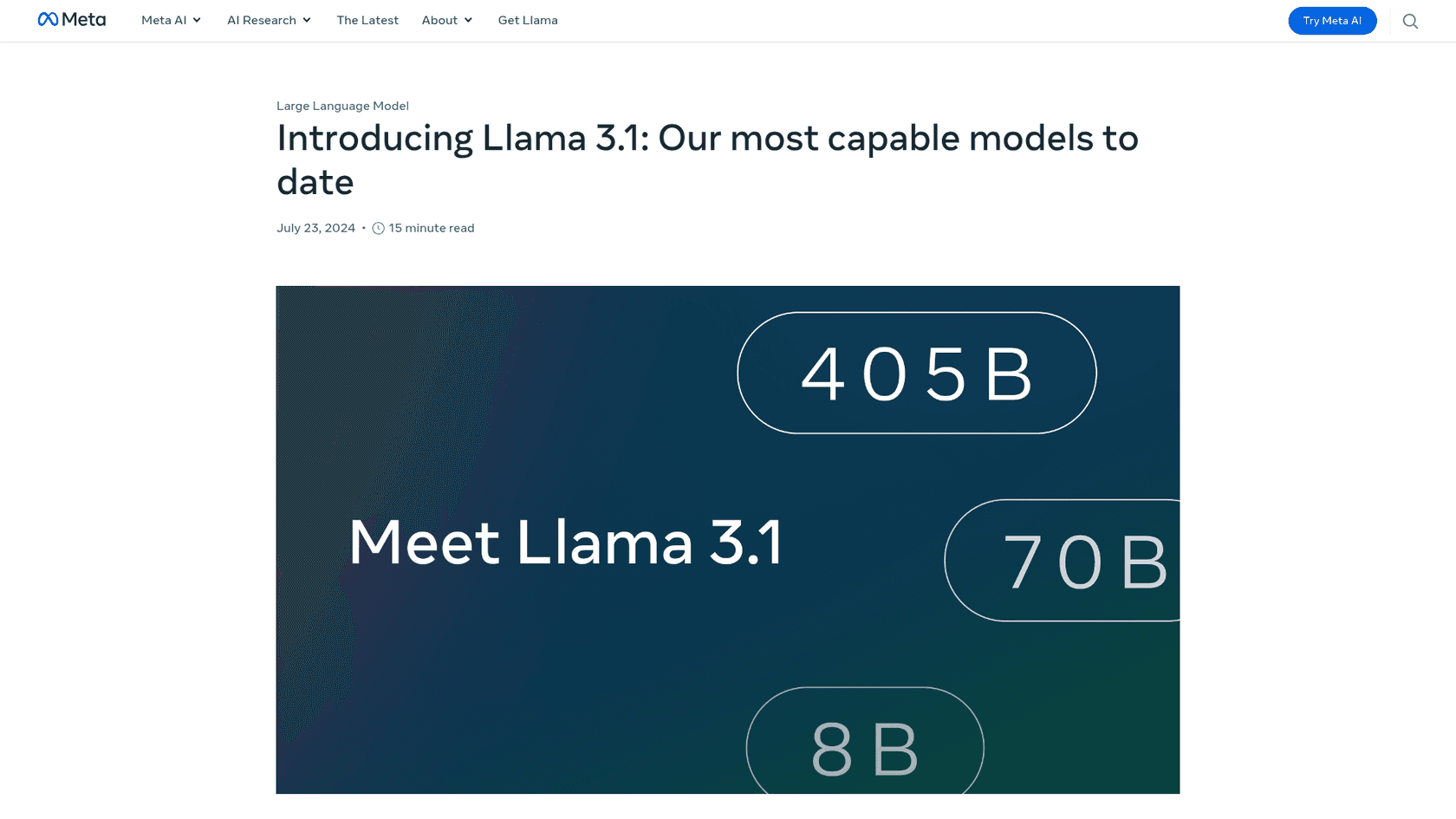
Llama 3.1 is Meta AI's powerful family of open-source models, and it’s a favorite in the developer community for its impressive performance and customizability. The family includes several sizes, with the largest 405B model rivaling some closed-source models.
Pros: Because it's open-source, you get unparalleled control. You can fine-tune it on your own data, customize its behavior, and host it locally for maximum data privacy. It has a massive 128K context window and excellent multilingual support, making it great for generating structured, long-form content.
Cons: This is not a plug-and-play solution. You need some technical skills to get it set up and running. It doesn't have native web access or the built-in multimodal features you find in other models. Every part of the blog creation process, from research to visuals, is completely manual.
Pricing:
- It's free to download and use, but you'll need your own hardware to run it.
- API access is available through various cloud providers like AWS, Google Cloud, and Hugging Face.
Our Verdict: A good choice for developers, technical users, or businesses that want to build a custom, in-house content workflow. It offers significant control but requires hands-on effort.
5. Gemini 3 Pro
Gemini 3 Pro is Google DeepMind's flagship model, and it's engineered for complex tasks and reasoning. Its real strength is its ability to synthesize information from a huge variety of sources, thanks to its world-class multimodal understanding.
Pros: This is where Gemini really shines. Its ability to process and distill information from text, images, video, and audio is a huge help for creating research-heavy blog posts. If you need to turn a dense academic paper or a long video into a coherent blog section, Gemini is a great tool for the job.
Cons: While it's a research powerhouse, its creative writing can feel less nuanced than some alternatives. And just like most others on this list, it's a text-only generator. You're still on the hook for creating all visuals, handling SEO, and formatting the final post.
Pricing:
- You can use it for free via Google AI Studio, with usage limits.
- API pricing for Gemini 3 Pro starts at $2.00 per million input tokens and $12.00 per million output tokens.
Our Verdict: A highly effective tool for the research phase of content creation. It serves as a powerful research assistant, but its output requires further work to become a finished article.
Getting the most from your LLM for blog writing
No matter which model you choose, a few good habits can dramatically improve the quality of your content.
- Give it good context: The better the input, the better the output. Always give the AI clear guidelines on your brand voice, target audience, and the goal of the post. Tools like the eesel AI blog writer make this easier by automatically pulling context from your website.
- Structure your prompts: Think like an editor. Instead of asking for a full blog post at once, ask for an outline first. Once you're happy with the structure, ask the model to flesh out each section. This gives you far more control over the final product.
- Treat it like a partner, not a magic button: Think of LLMs as powerful assistants. The best content comes from human-AI collaboration. Let the AI handle the heavy lifting (like drafting and research), so you can focus your time on editing, adding unique insights, and ensuring factual accuracy.
- Always fact-check and edit: This is non-negotiable. All LLMs can "hallucinate" or generate incorrect information. Always verify any claims, especially statistics and quotes, before you hit publish.
Choosing the right LLM for your needs
After all this testing, it's clear there's no single "best" LLM for everyone. It all comes down to what you need.
The truth is that all 3 of the big models are good writers but none of them are great. And all 3 generally make similar rhetorical and stylistic choices. If you’re confident in your own writing, I’d really recommend using AI to create an outline or plan, and I’d do all the real writing myself. It’s almost impossible to get rid of the AI voice when you’re having it actually write for you.

- For pure creative writing and a human touch, Claude 3.5 Sonnet is hard to beat.
- For a reliable and versatile all-rounder, GPT-4o is a safe bet.
- For custom, in-house solutions, Llama 3.1 gives you ultimate control.
- For deep, multimodal research, Gemini 3 Pro is in a league of its own.
However, if your goal is to efficiently create high-quality, SEO-optimized blog content at scale, a specialized tool can offer a more streamlined workflow than a general-purpose one.
The eesel AI blog writer is designed for this purpose. It combines the power of a top-tier LLM with a smart workflow that automates research, asset creation, and optimization, which can be an effective choice for businesses focused on growth.
To see these tools in action, it's helpful to watch direct comparisons. The video below offers a head-to-head test of several top AI models, giving you a better sense of their real-world output for blogging tasks.
Next steps
Exploring a tool that handles the entire workflow, from keyword to publish-ready post, can be a valuable next step. If you're ready to see how a specialized platform can streamline your process, you can try the eesel AI blog writer for free and generate your first article.