The world of AI is moving at a wild pace, and if you’re paying attention, you’ve heard two names pop up again and again: Google’s Gemini and Anthropic’s Claude. These aren’t just your run-of-the-mill chatbots. They're heavy-duty models designed to solve real business problems.
But picking the right one isn’t about finding the highest score on a leaderboard. It’s about matching the model to what you actually need to do, whether that’s automating customer support, writing tricky code, or sifting through a mountain of data. The best choice depends on what you care about most: raw power, cost, safety, or a specific skill set.
This guide is a straightforward, practical look at Gemini 3 Pro and Claude Opus 4.6. We’ll cut through the hype and focus on the real-world differences that matter when you’re putting these tools to work.
An overview of the AI titans
Before we get into a side-by-side, let's get to know the two models. Both are built for complex, professional work, but they come from different schools of thought that shape their strengths.
What is Gemini 3 Pro?
Gemini 3 Pro is Google's top model, built from the ground up to understand more than just text. Think of it as an engine that gets the world in a much richer way.
Its biggest claim to fame is its native ability to process a bunch of different inputs in a single go. You can give it text, images, audio, and video, and it can reason across all of them at once. This isn't just a cool party trick; it opens up entirely new ways for businesses to use AI.
It’s also deeply connected to the Google Cloud ecosystem, making it a natural fit for companies already on platforms like Vertex AI. This is where Google adds its enterprise-level security, data governance, and other controls. It's positioned as the go-to model for creating smart agents, trying out "vibe coding" (we'll get to that), and handling tasks that need a massive context window of over a million tokens.
What is Claude Opus 4.6?
Claude Opus 4.6 is the smartest model from Anthropic, a company founded with a serious focus on AI safety and reliability. Its development is guided by a unique framework called "Constitutional AI". The idea isn't just to follow a rigid set of rules, but to teach the AI a set of principles so it can develop good judgment and make more helpful, honest, and harmless choices.
This safety-first approach makes Claude Opus 4.6 particularly good at complex, multi-step tasks that need careful planning. It really shines in what are called "agentic workflows," where the AI has to perform a series of actions to reach a goal, especially when dealing with large codebases or dense documents.
While it can handle images, its real strength is in its sophisticated grasp of text and code. Developers and researchers often prefer it for jobs where accuracy, nuance, and reliability are top priorities.
Performance and capabilities: A head-to-head comparison
Benchmarks are a decent starting point, but they don’t tell the whole story. How these models handle real, messy, day-to-day work is what really matters. Here’s how they stack up on the things businesses actually care about.
Reasoning and problem-solving
Both models are sharp, but they have different strengths.
Claude Opus 4.6 is often the favorite for tasks that require deep, consistent reasoning over a long, winding conversation. It's great at keeping track of context and nuance, which is perfect for complex planning. For instance, if you were mapping out a business strategy or analyzing a tricky legal document with a lot of interconnected parts, Claude's ability to hold a coherent line of thought is a major plus.
I prefer Claude because I mostly use it for creative writing and Gemini's guardrail's are sky-high.

Gemini 3 Pro, on the other hand, has a standout feature: it can back up its responses with real-time Google Search results. This makes it a powerhouse for research, fact-checking, and answering questions that need the latest information. It can pull from current events, recent studies, and all corners of the web to give you a well-rounded answer.
So, the choice really depends on the job. For deeply analytical or creative work that builds on itself, Claude's steady reasoning is highly effective. For research that needs to be current and broad, Gemini's search integration gives it a clear advantage.
Coding and development
When it comes to writing and fixing code, the race is incredibly close. On the SWE-bench Verified leaderboard, an independent test of a model's ability to solve real bugs from GitHub, the scores are practically a tie. Claude Opus 4.6 (listed as Claude 4.5 Opus) scored 74.40%, just barely ahead of Gemini 3 Pro's 74.20%.
Claude Opus 4.6 gets a lot of praise from developers for its performance in "agentic coding." One developer on Reddit noted how it excels at managing sub-agents and crawling through codebases for high-context tasks, making it a dependable partner for complex software projects.
Claude 3.5 is best for programming and coding realated stuff.
Gemini 3 Pro is being promoted as a great "vibe-coding" model. This is the idea of giving it a high-level prompt, like "build me a to-do list app with user authentication," and letting it generate the whole thing. It’s especially powerful when you need to mix different types of media, like creating a user interface based on a quick sketch you provide.
Multimodality: A key differentiator for Gemini
This is where Gemini 3 Pro has a clear and significant lead. It wasn't just trained on text with other media types tacked on later; it was built from day one to be natively multimodal.
It can understand and reason across text, images, audio, and video all in the same prompt. This unlocks some pretty futuristic possibilities. For example, you could ask Gemini to: "Watch this 10-minute product demo video, read the attached technical spec PDF, and then write a one-page sales summary for a non-technical audience."
While Claude Opus 4.6 can process images and does it well, its main focus remains text and code. For any workflow that depends on understanding video or audio, Gemini 3 Pro is the more suitable choice.
Key differentiators: Context, cost, and access
Beyond raw performance, the practical details, like cost, how much information it can handle at once, and how you access it, are often what determine a project's success. These factors are vital for any business planning to use these models at scale.
Context window comparison
The "context window" is basically the model's short-term memory. It determines how much information (text, code, etc.) it can process in one go. A bigger window means you can feed it more info for more complex jobs.
Gemini 3 Pro comes with a standard 1,048,576 token context window. That's huge. It's big enough to analyze an entire code repository, a long novel, or a year's worth of financial reports in a single pass.
Claude Opus 4.6 offers a 200,000 token context window. While that’s still very large and more than enough for most tasks, it's about a fifth of what Gemini offers.
For the specific job of analyzing one gigantic file, Gemini has a clear advantage. However, it's worth remembering that for most conversations and agent-based tasks, 200,000 tokens is more than enough room to work with.
Pricing breakdown
Price is a big deal, and there's a noticeable difference between the two. Anthropic has positioned Claude Opus 4.6 as a premium, top-tier model, and it's priced that way. Google has priced Gemini 3 Pro more competitively, making it a more approachable option for high-volume use.
Pro tip
Don't just look at the per-token cost. A more efficient model might solve your problem with fewer tokens, which could end up being cheaper even if the per-token rate is higher. The only way to know for sure is to test both on your specific tasks.
| Model | Input Price (per 1M tokens) | Output Price (per 1M tokens) |
|---|---|---|
| Google Gemini 3 Pro | $2.00 | $12.00 |
| Anthropic Claude Opus 4.6 | $5.00 | $25.00 |
If you build your own AI solution, you're responsible for managing these variable token costs. An AI teammate platform like eesel AI simplifies this process. It offers predictable, interaction-based pricing that bundles the power of these models into a simple, fixed-cost solution for your business.
Platform and API access
How you can actually use these models also differs.
Gemini 3 Pro is available through the Gemini API and Google AI Studio, but it's most deeply integrated into Google Cloud's Vertex AI platform. This is a big advantage for teams already in the Google ecosystem, as it comes with a full suite of enterprise controls for security and management.
Claude Opus 4.6 is available directly through Anthropic's API and is also accessible on major cloud providers like Amazon Bedrock and Google Vertex AI. This multi-cloud approach gives companies more flexibility and helps them avoid getting locked into a single vendor.
Practical applications
Understanding the philosophy behind each model helps you pick the right tool for the job. Let's look at their sweet spots and how they approach safety.
Building agentic workflows
AI agents that can handle multi-step tasks are one of the coolest things you can do with AI right now, and both of these models were built for it.
Claude Opus 4.6 is designed for long-running, reliable agents that work within complex technical systems. Customer testimonials often highlight its ability to break down complicated requests into smaller steps, execute them methodically, and deliver a polished final result. This makes it a great fit for high-stakes tasks like automated code refactoring, generating detailed reports, or even helping with production incidents where you can't afford a mistake.
Gemini 3 Pro excels when it comes to agent workflows that use its unique multimodal skills and search capabilities. Imagine a research agent that can read a scientific paper (PDF), watch a related presentation on YouTube, search the web for recent updates, and then pull all of that into a complete, easy-to-understand report.
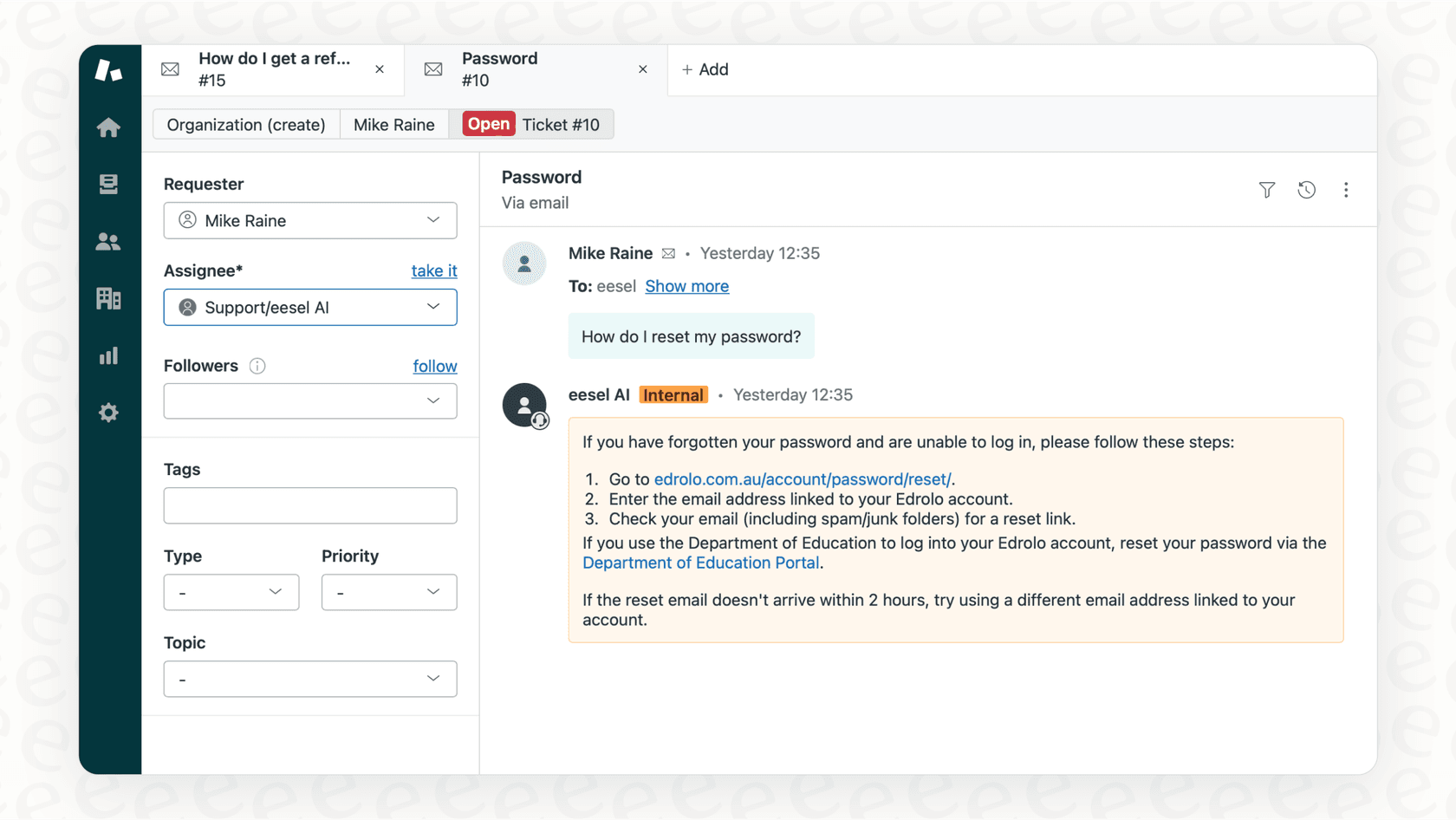
But building a reliable AI agent takes more than just a powerful model. You need a way to train it, supervise its work, and help it get better over time. The "AI teammate" model from eesel provides this out of the box. You "hire" an AI that learns from your existing knowledge, starts with human supervision, and can be promoted to work on its own when you're ready, all controlled with simple, plain-English instructions.
Enterprise safety and governance
Safety is a huge concern for any business adopting AI, and the two companies have slightly different takes on it.
Anthropic puts a major emphasis on safety at the model level. Their "Constitutional AI" approach is all about building a model that is inherently more aligned with human values and less likely to produce harmful or unhelpful responses. They've also developed advanced safety features like Constitutional Classifiers++ to add an extra layer of protection against misuse.
Google focuses more on providing enterprise-grade governance at the platform level through Vertex AI. This includes strong controls over where your data is stored (data residency), who can access it (IAM), and advanced encryption options like Customer-Managed Encryption Keys (CMEK). These are must-have features for large organizations with strict security and compliance needs.
Your choice here often comes down to what you're more concerned about: the model's built-in behavior and safety (Claude) or platform-level controls and data governance (Gemini on Vertex AI).
Which model should you choose?
After digging into the comparison, it's clear there's no single "winner." The best model is the one that fits your specific needs, budget, and priorities.
Here’s a simple breakdown to help you decide:
- Choose Gemini 3 Pro if: Your work involves a lot of multimodal content like video or audio, you need the biggest possible context window for analyzing single documents, cost is a major factor, or your company is already heavily invested in the Google Cloud ecosystem.
- Choose Claude Opus 4.6 if: Your top priority is high-quality reasoning for complex text and code, you need a very reliable agent for critical workflows, and its premium price is justified by its noted accuracy and consistency.
A decision-making infographic to help choose between Gemini 3 Pro vs Claude Opus 4.6 based on specific business needs and priorities.
Watching these models in action can provide a different perspective. The video below offers a hands-on comparison, testing both Gemini and Claude on a variety of tasks to see how they perform in real-world scenarios.
Go beyond the model with an AI teammate
Picking a foundational model like Gemini or Claude is just the first step. The real challenge, and where the real value is, is turning that raw intelligence into a reliable, efficient part of your business.
That’s where eesel AI comes in. We handle the heavy lifting. Eesel acts as a ready-to-work AI teammate that plugs directly into the tools you already use, like Zendesk, Intercom, and Slack. It learns your business, your tone, and your processes in minutes by reading your existing knowledge, no manual training needed.
Instead of giving you a powerful brain that you have to figure out how to build with, eesel delivers a complete, business-ready solution that starts working alongside your human team from day one.