Anthropic just released its newest model, Claude Opus 4.6, on February 5, 2026, and it’s already making waves, especially for people working with complex code and "agentic" workflows (which is just AI that can manage tasks on its own).
Whenever a new model like this launches, there's a ton of buzz. But after the initial excitement wears off, businesses are usually left with two big questions: What can this thing "actually" do for me, and what’s it going to cost?
That’s what we’re here to clear up. This post is a no-fluff guide to Claude Opus 4.6, giving you a straight look at its new features and a complete, transparent overview of the Claude Opus 4.6 pricing model.
What is Claude Opus 4.6?
At its core, Opus 4.6 is Anthropic's most advanced AI, which they call a "hybrid reasoning model." In plain English, that means it’s built for the really tough, professional-grade tasks that need deep thinking and the ability to work independently.
It's the next evolution from its predecessor, Opus 4.5, and it comes with some important upgrades. Specifically, it's better at planning complex tasks, handling massive codebases without getting confused, and spotting and fixing bugs.
Key improvements and focus areas
Anthropic’s announcement pointed to a few core areas where Opus 4.6 really stands out:
- Advanced Coding: It’s designed to work with huge codebases and handle long, sustained coding sessions. The idea is for it to deliver production-ready code with minimal oversight, acting more like a senior developer you can hand tasks off to.
- AI Agents: The model is more autonomous. It can manage longer and more complex chains of tasks with less hand-holding, making it a better fit for building AI agents that can complete multi-step goals on their own.
- Enterprise Workflows: It has improved skills relevant to business, like financial analysis, deep research, and working with documents such as spreadsheets and presentations.
- Long Context: This is a huge deal. It's the first Opus-level model with a massive 1 million token context window (currently in beta). This lets it process and reason over enormous amounts of information, like an entire novel or a giant codebase, all at once.
You can get your hands on Opus 4.6 through the Claude API, on claude.ai for subscribers, and on major cloud platforms like Microsoft Foundry, AWS Bedrock, and Google Vertex AI.
Key features and performance benchmarks
A model's spec sheet is one thing, but its real value is in how it performs on tasks that actually matter. Let's look at some of the technical features and benchmark results that show what Opus 4.6 can do.
Performance benchmarks
According to Anthropic's announcement data, Opus 4.6 is at the top of the charts on several key industry tests. This isn't just for show; these benchmarks measure skills that are directly useful for businesses.
Here are a few of the standouts:
- Terminal-Bench 2.0: This test checks how well an AI can act as a coding agent. Opus 4.6 scored a leading 65.4%, demonstrating its strength in autonomous coding.
- GDPval-AA: This one evaluates performance on economically valuable work, like finance and legal tasks. It outperformed GPT-5.2 by a noticeable margin.
- BrowseComp: A test of the model's ability to find information online effectively.
- Humanity’s Last Exam: This benchmark tests complex, multidisciplinary reasoning skills.
Here’s a quick comparison of how it stacks up against the competition and its previous version:
| Benchmark | Claude Opus 4.6 Score | GPT-5.2 Score | Claude Opus 4.5 Score |
|---|---|---|---|
| GDPval-AA (Elo) | 1364 | 1220 | 1174 |
| Terminal-Bench 2.0 (%) | 65.4 | 55.2 | 48.1 |
| BrowseComp (%) | 82.5 | 74.3 | 68.9 |
| Humanity's Last Exam (%) | 72.1 | 68.5 | 66.3 |
The score is very impressive. But now the big question is, is this benchmark measuring anything meaningful? Also, we don't know if Anthropic is being just as deceptive, but GPT5.2 advertises a 53% ARC-AGI2 score, but practically no one has access to the maximum compute model that achieved this score. Most users are stuck with a GPT5.2 variant that scored 17% on it. Will regular users have access to the Opus 4.6 variant that scored 68%?

New API features and developer controls
For developers wanting to build on top of Opus 4.6, Anthropic has added some powerful new controls, as listed on the announcement page:
- Adaptive thinking: This lets the model decide for itself when to engage in deeper, more complex reasoning. It's a smart way to get high performance for tough problems while being faster and cheaper for simple ones.
- Effort controls: Developers can now pick from four effort levels (low, medium, high, max). This gives you precise control over the trade-off between intelligence, speed, and cost for any task.
- Context compaction (beta): A clever feature for long-running agent tasks. It lets the model summarize older parts of a conversation to stay within the context window, almost like taking notes to remember what happened earlier.
- 1M token context (beta): The ability to process and reason over huge documents or codebases.
- 128k output tokens: Allows the model to generate extremely long responses in one go, which is useful for things like writing detailed reports or entire code files.
For developers, these controls are fantastic. But if you're not looking to build an entire application from scratch, they also show how much work is involved. For specific jobs like customer service, platforms like eesel AI do the heavy lifting for you. They use this powerful tech to deliver an AI teammate that's ready to go, so you can "hire" an expert instead of building one.
A detailed breakdown of Claude Opus 4.6 pricing
Understanding the pricing is essential before you commit to using a model this powerful. It’s not always simple, with different factors affecting your final bill. Here’s a full, transparent breakdown based on Anthropic's official information.
Base model and batch processing costs
The good news is that the standard API pricing for Claude Opus 4.6 is the same as for Opus 4.5. The cost is based on "tokens," which are small pieces of words. You pay one rate for the input you send to the model and a different rate for the output it generates.
Here's the standard pricing:
| Model | Input Price (per 1M tokens) | Output Price (per 1M tokens) |
|---|---|---|
| Claude Opus 4.6 | $5.00 | $25.00 |
Anthropic also offers a Batch API, which gives you a 50% discount if you can process your requests asynchronously. This is great for large, non-urgent jobs where you can submit a big batch of requests and get the results later.
Here's the Batch API pricing:
| Model | Batch Input (per 1M tokens) | Batch Output (per 1M tokens) |
|---|---|---|
| Claude Opus 4.6 | $2.50 | $12.50 |
Long context and US-only inference costs
Things get a bit more expensive when you start using the new, super-sized context window. For any prompts that go over 200,000 tokens (using the beta 1M context window), there's a premium price. This is because of the extra computational power needed to handle that much information.
Here’s how that pricing breaks down:
| Context Window | Input Price (per 1M tokens) | Output Price (per 1M tokens) |
|---|---|---|
| ≤ 200k tokens | $5.00 | $25.00 |
| > 200k tokens | $10.00 | $37.50 |
On top of that, for businesses with strict data residency rules, Anthropic offers US-only inference. This makes sure your data is processed only within the United States, and it comes with a 1.1x price multiplier.
Third-party platform pricing variations
As mentioned, Opus 4.6 is also available on platforms like Microsoft Foundry, AWS Bedrock, and Google Vertex AI.
It’s important to know that pricing on these platforms might be different from Anthropic's direct API pricing. You'll need to check their official pricing pages for the exact rates. One key detail to watch for with AWS and Google is that using regional endpoints has a 10% premium over global ones. This guarantees your data is routed and processed within a specific region, like the EU.
Practical use cases and limitations
Now that we know what it can do and what it costs, let's talk about where you should actually use it, and where you might not want to. This section covers the best applications for a model this powerful and the practical things to keep in mind before you dive in.
Where Claude Opus 4.6 excels
This model is built for high-stakes, complex work. Anthropic and its partners are pointing to a few key areas:
- Autonomous Coding: Senior engineers can confidently hand off massive tasks. One example given was a "multi-million-line codebase migration," a job that would normally take a team of humans months to complete.
- Sophisticated AI Agents: It's capable of managing complex workflows that involve multiple tools and steps with very little human input. One partner noted it could manage the codebase of a "50-person organization across 6 repositories."
- High-Stakes Enterprise Workflows: Think deep financial modeling, complex legal document review (it scored 90.2% on the BigLaw Bench), and detailed cybersecurity investigations where accuracy is everything.
Limitations and implementation challenges
Despite its power, using a frontier model directly through an API isn't always the best approach. There are some practical hurdles to think about.
- Cost for Simple Tasks: As Anthropic points out, the model's deep reasoning can add unnecessary cost and latency for simple questions. It can "overthink" basic problems, making it less efficient than a smaller, faster model for everyday tasks like classifying an email.
- Implementation Overhead: Building a reliable, production-ready application on a raw API is a big project. It requires a lot of engineering resources, deep expertise in prompt engineering, and a plan for ongoing maintenance.
- Harnessing its Power: Just having API access doesn't automatically create business value. You need a system to ground the model in your company's specific knowledge, connect it to your tools, and fit it into your workflows.
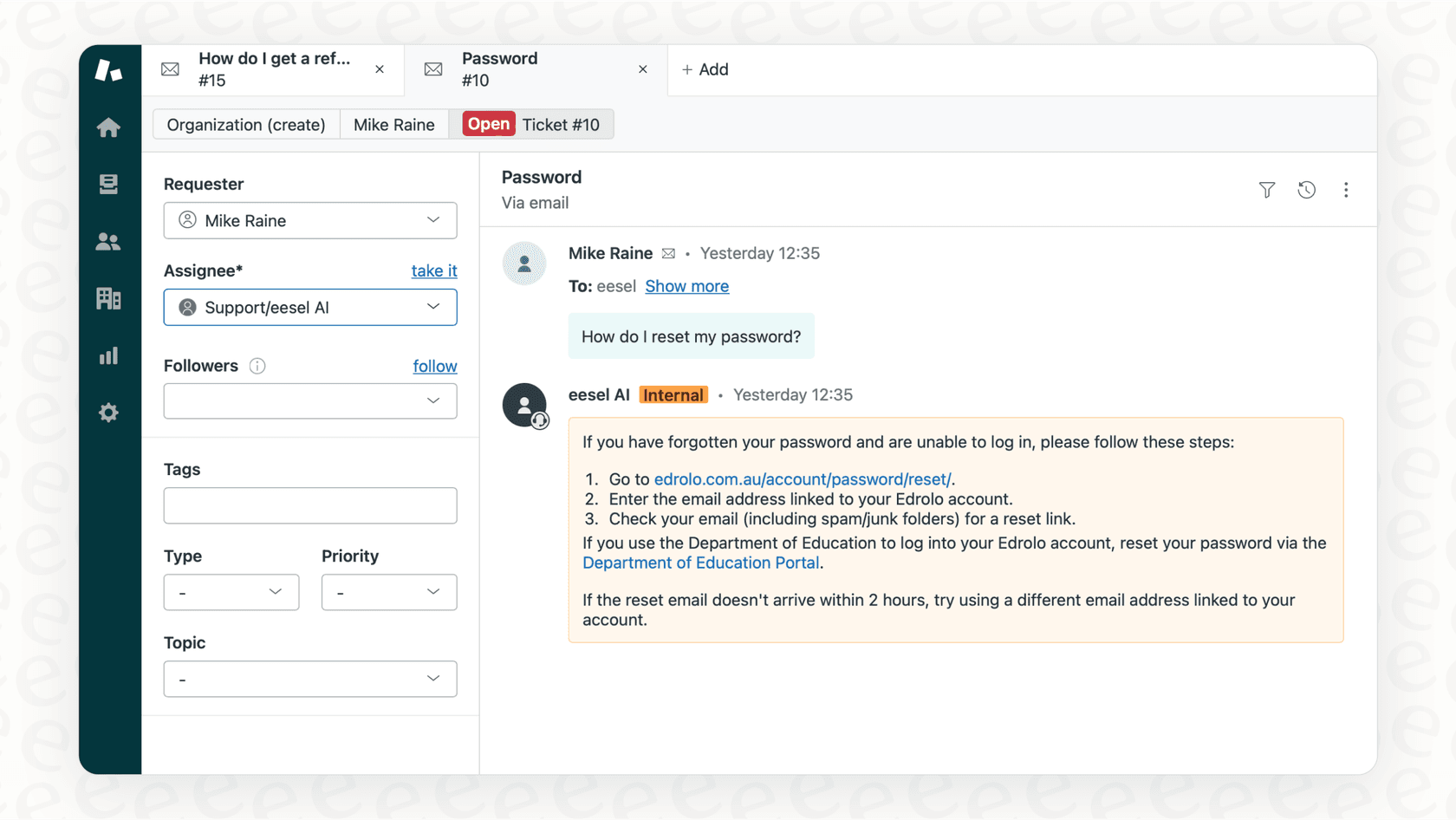
This is where pre-built solutions come in. An AI teammate like eesel's AI Agent solves these problems by design. It uses powerful models like Claude's but is already built for business tasks like customer support. Eesel handles all the complex engineering and workflow integration by learning directly from your past tickets, help center, and internal docs. This lets you "hire" a pre-trained expert instead of taking on the massive project of building one yourself.
For those interested in exploring this new model in more detail, watching a hands-on demonstration can be incredibly insightful. The video below offers a full breakdown of Claude Opus 4.6, showcasing real examples of its capabilities in action, which provides a practical perspective beyond just the numbers and benchmarks.
Is Claude Opus 4.6 right for your business?
Claude Opus 4.6 is an incredibly powerful model that's pushing the boundaries of what AI can do, especially in complex areas like autonomous coding, agent workflows, and high-stakes analysis.
The pricing reflects this power. While the base cost is the same as its predecessor, new features like the 1 million token context window come with a premium. It’s a tool designed for jobs where its deep reasoning provides a massive return on investment.
But that power comes with a trade-off. The model's complexity makes it overkill for simpler needs, and building a custom solution with its API is a major project. For many businesses, the real challenge isn't just getting access to the model, but using its intelligence to solve a specific problem effectively.
If you're looking to apply this level of AI power to customer service without the engineering headache, consider an AI teammate. eesel AI connects to your help desk in minutes and starts working as an autonomous agent—handling tickets, taking actions, and delivering results from day one. See how it works with a free trial.