
GPT-5.6 pricing at a glance
These are the current Standard-tier rates, per 1M tokens, straight from the OpenAI API pricing page. Note that GPT-5.6 now carries separate short-context and long-context columns, which it did not at launch.
| Model | Model ID | Input | Cached input | Cache writes | Output |
|---|---|---|---|---|---|
| GPT-5.6 Sol (flagship) | gpt-5.6-sol | $5.00 | $0.50 | $6.25 | $30.00 |
| GPT-5.6 Terra (balanced) | gpt-5.6-terra | $2.00 | $0.20 | $2.50 | $12.00 |
| GPT-5.6 Luna (fastest) | gpt-5.6-luna | $0.20 | $0.02 | $0.25 | $1.20 |
| GPT-5.5 | gpt-5.5 | $5.00 | $0.50 | not published | $30.00 |
| GPT-5.5 Pro | gpt-5.5-pro | $30.00 | not published | not published | $180.00 |
| GPT-5.4 | gpt-5.4 | $2.50 | $0.25 | not published | $15.00 |
Two structural things fell out of the July cut. Terra now undercuts GPT-5.4 at $2.00 / $12.00 against $2.50 / $15.00, so the old "Terra equals 5.4 pricing" shorthand is dead. And Luna is now the cheapest model in the flagship table, roughly 4x under gpt-5.4-mini at $0.75 / $4.50. If you are still reasoning from June's numbers, the whole ladder has moved under you. The full family breakdown lives in the GPT-5.6 explainer.
The cut the community expected to go the other way
This is my favourite part of the story, because the forum consensus in the weeks before GA was that prices were about to rise. The fear was reasonable: 5.5 had already doubled 5.4's output rate. From the r/codex thread that ran on exactly this question:
"5.5's price had already doubled relative to 5.4, jumping from $15 to $30 per million output tokens... So are we about to get a new frontier model, 5.6 Pro, at $60, going head to head with Fable?"

What actually landed was the opposite at two of three tiers, and a hold at the third. There is still no GPT-5.6 Pro, so the priciest thing OpenAI sells remains GPT-5.5 Pro at $30 / $180. The market read is roughly the one a commenter left on the launch thread:
"AI is turning out to be a fairly competitive but 'normal' product. Companies carving out niches on cost, quality, and speed."

That is exactly what a 25x internal spread is. OpenAI is not racing one headline price to zero, it is carving three cost-quality-speed corners and letting you route between them. Whether that beats the field on value is the question the GPT-5.6 alternatives roundup takes on.
Four service tiers, and the multiplier nobody quotes
Here is the thing the "how much does GPT-5.6 cost" answer usually skips. The same model, on the same tokens, has a 4x price spread depending on which service tier you send the request to. Per the pricing page, Priority Processing was renamed Fast mode on July 30, and you can pass either service_tier: "priority" or service_tier: "fast".
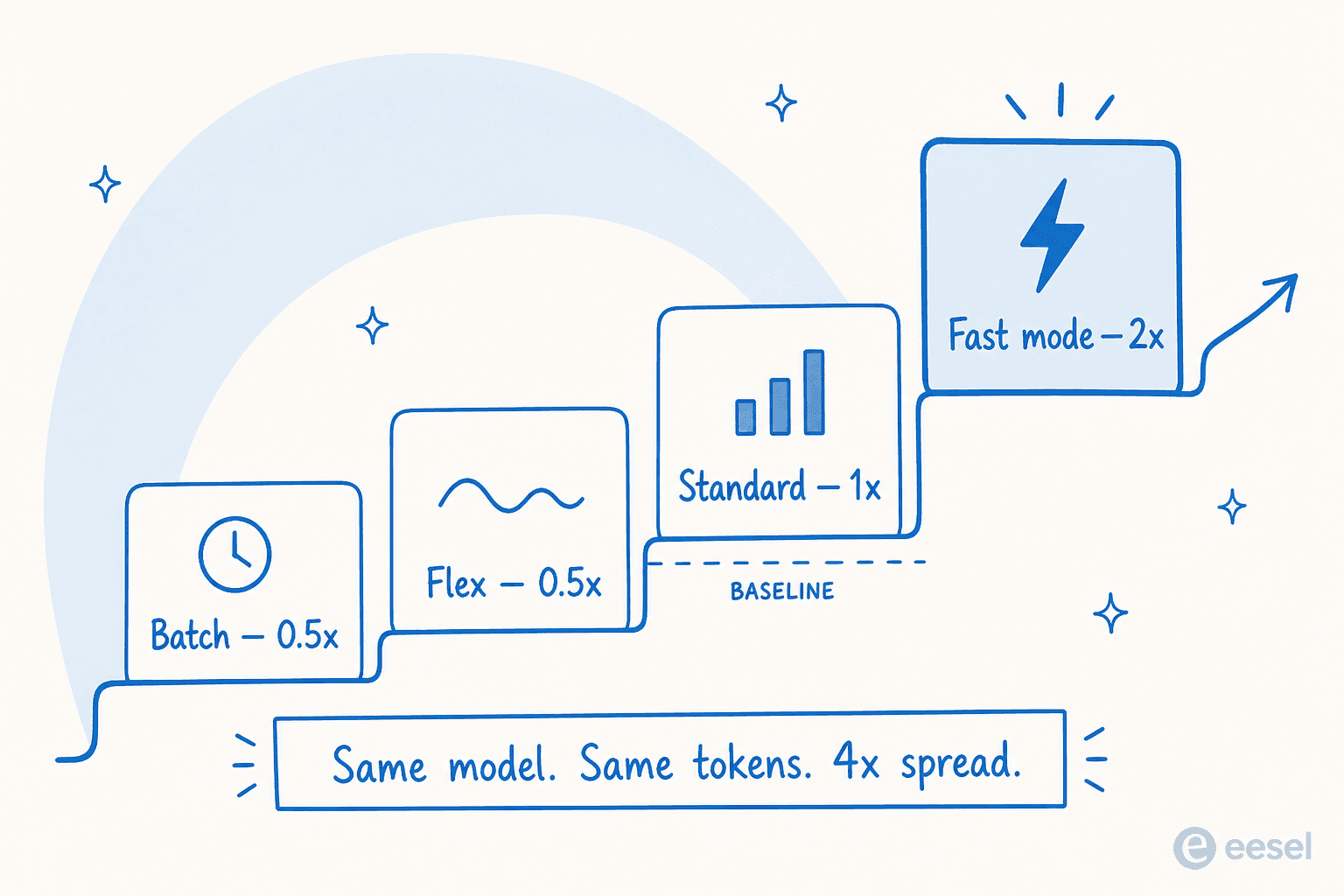
Short-context rates, per 1M tokens, across all four rungs:
| Service tier | Multiplier | Sol in / out | Terra in / out | Luna in / out |
|---|---|---|---|---|
| Batch | 0.5x | $2.50 / $15.00 | $1.00 / $6.00 | $0.10 / $0.60 |
| Flex | 0.5x | $2.50 / $15.00 | $1.00 / $6.00 | $0.10 / $0.60 |
| Standard | 1x | $5.00 / $30.00 | $2.00 / $12.00 | $0.20 / $1.20 |
| Fast mode | 2x | $10.00 / $60.00 | $4.00 / $24.00 | $0.40 / $2.40 |
What you are buying with Fast mode is latency, and OpenAI is specific about it: on Sol it "delivers up to 2.5x faster speeds than Standard processing at twice the price, with no change in intelligence," per the price-performance post. That is an honest trade and worth taking for an interactive coding session. It is a bad trade for a nightly summarisation job, where Batch at half price and no deadline is obviously right.
Batch and Flex land on identical rates, and the difference is shape rather than price. Batch runs as a queued job against a published per-tier queue limit, which is why every model page lists one. Either way you are trading response time for the discount, so for a support queue you rarely want either, because a customer is waiting, which is the same reasoning behind how AI escalation management gets designed around response-time targets.
The 272K multiplier that stacks on top of everything
This is the surcharge that catches people, and it is new since launch. Every GPT-5.6 model page carries the same sentence, for example on the Sol model page:
"Prompts with >272K input tokens are priced at 2x input and 1.5x output for the full request."
Read "for the full request" twice. Crossing 272,000 input tokens does not price the overflow at a premium, it re-prices the entire call. A 273,000-token prompt on Sol is billed at $10.00 / $45.00, not $5.00 / $30.00 with a small surcharge on the last 1,000 tokens. All three tiers share the same 1,050,000-token context window, and all three share the same 272K threshold, so this applies whichever one you route to.
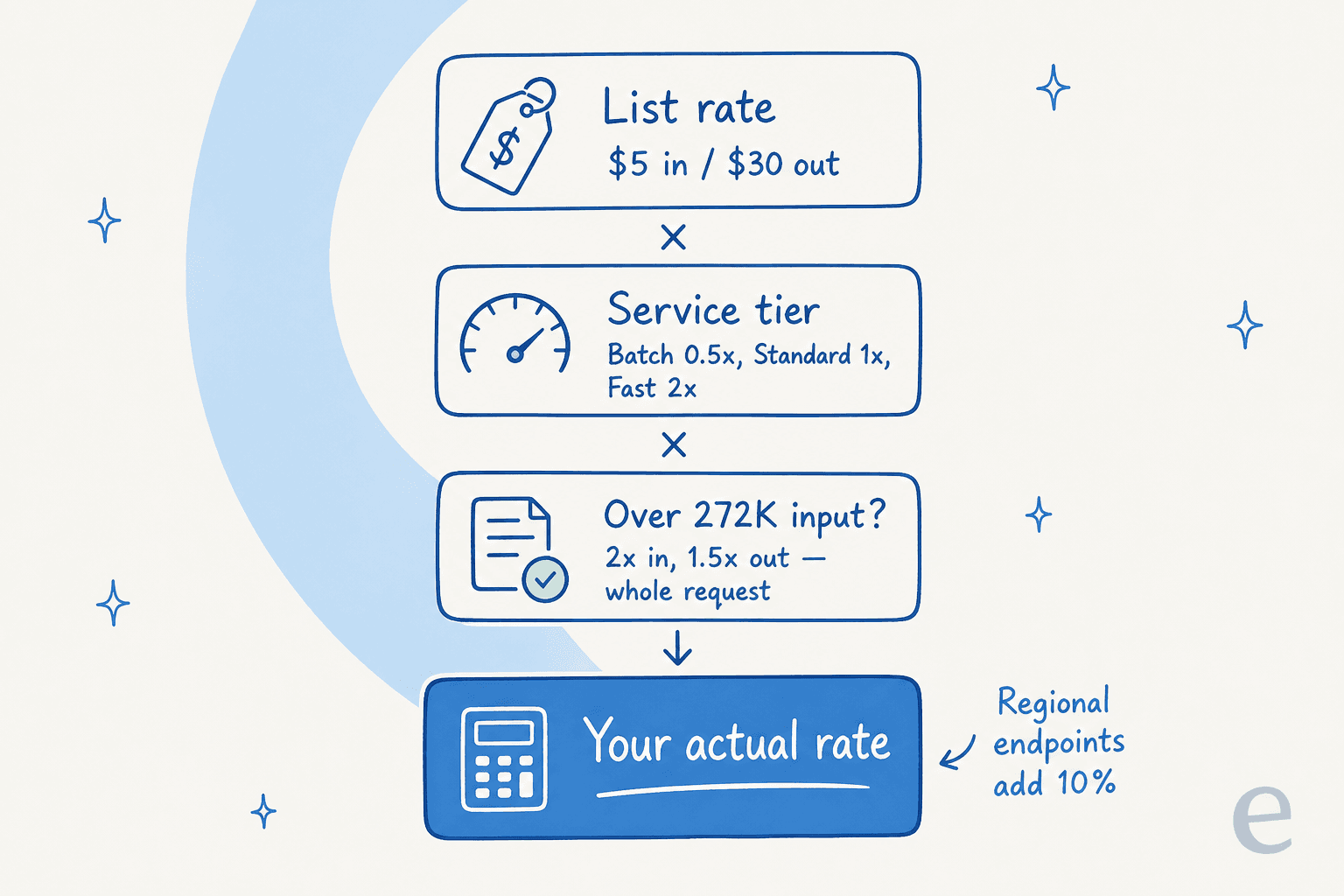
The multipliers compound, and that is the whole point of the diagram above. Sol on Fast mode with a long-context prompt is 2x from the service tier and 2x again on input from the surcharge, so $20.00 per 1M input against a $5.00 list rate. Output lands at $90.00 against $30.00. Nothing about that is hidden, but nothing about it is on the number you remember either.
The practical read: treat 272K as your real budget ceiling and design retrieval to stay under it. If your context really does need to run past a million tokens, that is a moment to price-check the field, because rivals meter long context differently. Kimi K3 pricing and Qwen3.8-Max pricing are the two closest comparisons on window size.
Prompt caching: the one lever that actually moves the input half
Caching mechanics did not change on July 30, only the base rates under them, which means the absolute cached figures dropped for Terra and Luna. Two numbers to hold:
- Cached input reads are 90% off. Sol's input goes from $5.00 to $0.50 per 1M, Terra's from $2.00 to $0.20, Luna's from $0.20 to $0.02.
- Cache writes cost 1.25x the uncached input rate. Sol's write is $6.25, Terra's $2.50, Luna's $0.25. You pay a small premium once to save 90% on every subsequent read.
The help center article documents explicit cache breakpoints and a 30-minute minimum cache life. That combination is why caching is worth engineering around rather than hoping for: a long stable system prompt plus a fixed knowledge base is exactly the prefix shape that pays off, and it is the same architecture a knowledge-base chatbot already wants.
There is a real number on this from OpenAI's own customer list, and it is the most useful data point in the whole announcement:
"Luna moved us from a single structured-output call to a full tool-calling agent loop, increasing prompt-cache reuse from 24% to 90%. Across thousands of production calls, Luna handles 2.2x more context with 8.5x fewer output tokens - at 87% lower cost than GPT-5.4 mini."
Sid Pardeshi, CTO + Co-Founder, Blitzy
Note what did the work there. The tier change helped, but the 24% to 90% cache-reuse jump is an architecture change, and it is available to you on any tier. Notion reported the same direction more plainly, saying GPT-5.6 "delivered comparable quality to GPT-5.5 at half the cost per task and in 60% less time" in their own evaluations.
Work out your own GPT-5.6 bill
Rates per million tokens are abstract until you put your own volume in them. This runs the full stack: list rate, service tier, the 272K surcharge, your cache hit rate, and the regional uplift.
Two defaults worth playing with. Drop the model tier from Sol to Luna at the same volume and the bill falls 25x. Push the cache hit rate to 90%, the number Blitzy reported hitting, and watch the input line nearly vanish while output stays exactly where it was. That asymmetry is the real lesson: caching fixes input, and only routing fixes output.
Two places your bill diverges from the price card
Regional processing adds 10%. If you need data residency, the pricing page states that regional endpoints "are charged a 10% uplift for models released on or after March 5, 2026." GPT-5.6 qualifies. It is a small number that compounds with every other multiplier, and it is easy to leave out of a forecast because it lives in a different part of the docs than the rate table.
Bedrock bills separately. OpenAI is explicit that models accessed through Amazon Bedrock "are billed through AWS and may differ from direct OpenAI pricing." The July 30 cut rolled out to AWS on its own schedule too. If your procurement runs through AWS, verify the rates in the AWS console rather than assuming parity with the numbers above.
Rate limits are the third thing to check before you commit, because they cap what you can spend as much as what you can serve. Sol and Terra share one table; Luna's are materially higher, which makes sense given what OpenAI is pitching it at. At Tier 5, Luna gets 180,000,000 TPM against Sol's 40,000,000, and 30,000 RPM against 15,000, per the Luna model page. If you plan to run Luna at real volume, that headroom is part of the value.
Where GPT-5.6 sits against the rest of the field
Price only means something next to capability, so here is the blended-cost view from Artificial Analysis. Their Intelligence Index v4.1 runs nine evaluations, and their blended price accounts for how verbose each model actually is.
| Model | AA Intelligence Index | Blended price / 1M | Output speed |
|---|---|---|---|
| GPT-5.6 Sol (max) | 59 | $4.35 | 67.7 t/s |
| GPT-5.6 Terra (max) | 55 | $1.74 | 138.0 t/s |
| GPT-5.6 Luna (max) | 51 | $0.17 | 177.8 t/s |
Two honest caveats on those numbers, both from AA's own pages. Sol's 137.84s time-to-first-token is far above the 2.76s median for its price tier, which is a reasoning-model artifact but sits awkwardly next to any "fast" framing unless you are actually paying for Fast mode. And Luna is verbose: 130M output tokens to run the index against a 62M median, which eats into a chunk of its rate advantage. The 25x list-price gap is real, the 25x cost-per-task gap is not.
On the index itself Sol ranks third, behind Claude Opus 5 and Claude Fable 5. Human-preference boards split the other way, with qwen3.8-max beating Sol on LMArena Text and WebDev. If you want that fight in detail, the Qwen3.8-Max comparison goes deeper than I can here.
For the rest of the market's rate cards, Grok 4.5 pricing and Mistral AI pricing each meter differently enough that a straight per-token comparison misleads, and Gemini 3.6 Flash pricing covers the cheap end of the field.
ChatGPT and Codex: what the cut did and did not change
If you came here for subscription pricing, the July 30 answer is short. Per the announcement: "ChatGPT and Codex subscription prices and quota budgets remain unchanged, while Terra and Luna usage now consumes fewer credits." So you pay the same monthly fee and get more work out of it, provided you pick the cheaper tiers.
| Tier | Price | GPT-5.6 access |
|---|---|---|
| Free | $0/mo | Codex serves Terra |
| Go | $8/mo | Codex serves Terra |
| Plus | $20/mo | All three in ChatGPT Work and Codex |
| Pro | $100-$200/mo | All three in ChatGPT Work and Codex |
| Business | $20/user/mo annual | All three in ChatGPT Work and Codex |
The one wrinkle that still trips people up: Terra and Luna are not selectable in standard ChatGPT conversations at all, only in ChatGPT Work and Codex, per the help center. That is why GA day produced a run of "I'm on Pro and I can't find Terra" replies. It is a surfacing decision, not an entitlement bug, but the announcement does not make it obvious.
The unit problem: why token pricing breaks on a support queue
Everything above assumes you know your token volume. On a coding agent you roughly do. On a support queue you do not, and this is the part I see up close.
Token use per ticket swings with three things you do not control: how much the customer writes, how much history and knowledge the model reads to answer, and how many tool calls it fires before it is confident. Two tickets that both close resolved can differ severalfold in cost. That is not a modelling problem you can solve with a better spreadsheet, it is the billing unit being wrong for the job, which is the same reason AI customer service cost conversations stall on forecasting rather than on price.
I see the anxiety land the same way every time. One buyer, a European email-security company scaling toward 20,000 tickets a year, hit 200 interactions in a single test day and immediately started asking what that meant at 9,000 interactions a month. Another, a budget-conscious buyer who had watched a previous vendor's price more than double, wanted contractual price locks before signing anything. Neither was asking for a lower rate. Both were asking for a number that would hold.
Seasonality makes it sharper. A queue that does 1,000 tickets in March can do 4,000 in the week around Black Friday. On a metered unit that is a 4x bill in your worst-staffed month, and it arrives without warning. Planning around that is the whole reason AI support cost savings get measured per resolution rather than per call.
There is also a quality dimension that shows up on the invoice. Reasoning effort is a cost lever, not a free upgrade: more effort means more output tokens, and output is the expensive half. So the temptation on a metered bill is to dial effort down, right where you least want to, on the hard tickets. Getting that trade right is what hallucination prevention and agent handoff design are actually for.
The build-versus-buy fork lands about here. As Karel from GENERAL BYTES put it in a build-versus-buy conversation:
"We could try to write our own LLM application but we didn't want to invest our time into that. We wanted something that we would not have to maintain."
That is the trade, stated plainly. You can wire GPT-5.6 into your helpdesk, own the token meter, build the guardrails and maintain the upgrade path when 5.7 lands. Or you can buy the outcome and let someone else own the model layer. Neither is wrong; they are just different jobs, and the implementation guide walks the first path if that is the one you want.
Try eesel
If you are reading a GPT-5.6 pricing page because you want AI answering support tickets, this is the relevant part. eesel runs frontier models like the GPT-5.x family, but you never touch a token meter: it is priced per resolved ticket, so the bill tracks outcomes you can forecast rather than how verbose a conversation got. Black Friday costs more because you resolved more, not because the model read more context.
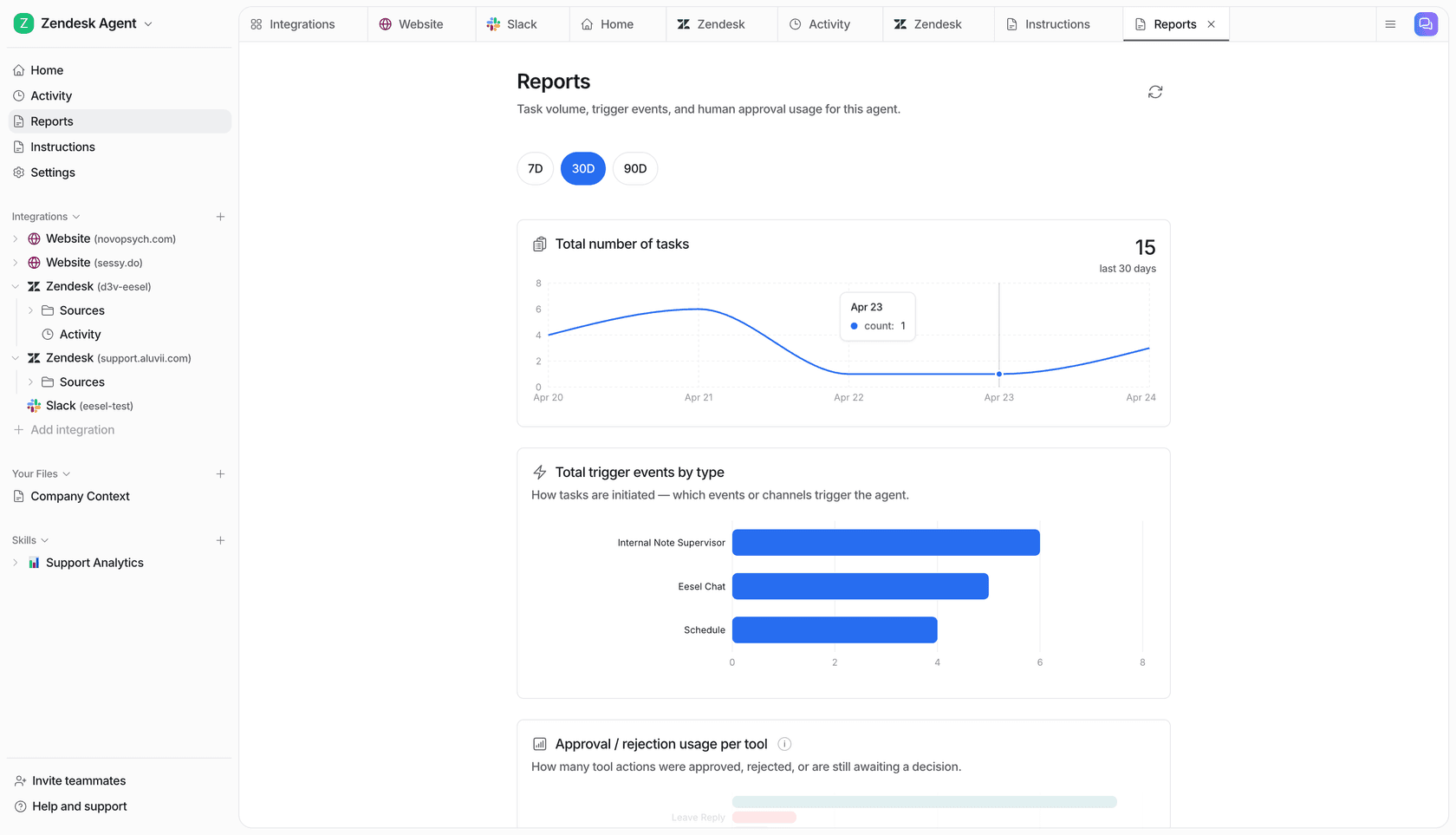
It plugs into the helpdesk you already run, Zendesk or Front included, learns from your past tickets and knowledge base, and lets you simulate on past tickets before it replies to a single customer. You see the resolution rate and the cost before you commit to either. Free to try, and no OpenAI account rep required.
Worth a look alongside how the native tools price the same work. Zendesk AI and Gorgias AI both meter differently again, as does Freshdesk's AI agent.
And if you are still deciding what kind of tool you need before you compare any rate card, customer service automation covers where each billing unit actually fits, with AI agent examples for the shapes that work.
Frequently Asked Questions
How much does GPT-5.6 cost?
On the Standard tier at short context, per 1M tokens: Sol is $5.00 input / $30.00 output, Terra is $2.00 / $12.00, and Luna is $0.20 / $1.20. Those are list rates, and the service tier you pick multiplies them, from 0.5x on Batch up to 2x on Fast mode. For how the same math looks on rival models, compare Claude Opus 5 pricing.
What is GPT-5.6's pricing for a small team?
A small team is almost always a Luna or Terra team. At 20M input and 4M output tokens a month, Luna runs about $8.80 and Terra about $88.00 on Standard, before any prompt caching. Route only the hard requests to Sol and the bill stays in that band. The same routing logic underpins AI customer service cost planning.
Did GPT-5.6 pricing go down?
Two of the three tiers did, on July 30, 2026. Terra dropped 20% to $2.00 / $12.00 and Luna dropped 80% to $0.20 / $1.20. Sol's headline rate did not move. That makes the spread between the cheapest and priciest tier 25x, up from 5x at launch, so GPT-5.6 tier choice matters more now than it did in June.
Is GPT-5.6 cheaper than GPT-5.5?
At the flagship level, no. Sol matches GPT-5.5's $5.00 / $30.00 exactly, so there is no generational cut at the top. Everything below it is cheaper: Terra now undercuts GPT-5.4, and Luna is the cheapest model in the flagship table. The GPT-5.6 review covers whether the capability gain justifies the unchanged flagship rate.
What is the GPT-5.6 long-context surcharge?
Prompts over 272,000 input tokens are billed at 2x input and 1.5x output for the full request, not just the overflow. On Sol that turns $5.00 / $30.00 into $10.00 / $45.00. It stacks on top of your service tier, so Fast mode plus long context is 4x the Standard short-context input rate. Teams hitting that ceiling often look at GPT-5.6 alternatives.
How does GPT-5.6 prompt caching affect the bill?
Cached input reads get a 90% discount, so Sol's input drops to $0.50 per 1M. Cache writes cost 1.25x the uncached input rate, and the minimum cache life is 30 minutes. If your prompts share a long stable prefix, caching is the biggest single lever on the input half of the bill, which is exactly how a helpdesk AI setup with a fixed knowledge base should be built.
Is GPT-5.6 available in ChatGPT?
Partly. Sol, Terra and Luna are all selectable in ChatGPT Work for Plus, Pro, Business and Enterprise, and Codex serves Terra on Free and Go plus all three on paid plans. Terra and Luna are not selectable in standard ChatGPT conversations. Subscription prices did not change with the July 30 cut, though Terra and Luna usage now burns fewer credits. See the GPT-5.6 Terra breakdown for the tier detail.
What does GPT-5.6 pricing mean for customer support?
It means your support bill moves with how chatty each customer is, which is the wrong unit to budget against. Token counts per ticket swing with conversation length, retrieved knowledge and tool calls, so two tickets that both close resolved can cost very different amounts. eesel runs frontier models but bills per resolved ticket, and you can simulate against past tickets before going live.


Article by
Riellvriany Indriawan
Riell is a designer and writer at eesel AI with about two years of experience researching CX platforms, AI chatbots, and helpdesk software. She combines her design background with a sharp eye for how these tools actually look and feel in practice — making her comparisons unusually visual and user-focused.