

What GPT-5.6 Luna actually is
I build the AI agents at eesel, and I have spent the last three-plus years watching what a cheaper, faster model does (and does not) change once it is answering real support tickets, not benchmark prompts. So when OpenAI shipped a brand-new low-cost tier, the first question I had was not "how smart is it" but "smart enough for what, and at what speed."
GPT-5.6 is not one model. OpenAI previewed it on June 26, 2026 and took it to general availability on July 9 as a family of three capability tiers. The number, 5.6, is the generation. The names are durable tiers that, in OpenAI's framing, "can advance on their own cadence":
- Sol, the flagship, for long-horizon coding and agentic work.
- Terra, the balanced everyday tier.
- Luna, the fastest and most cost-efficient, for high-volume, well-defined tasks.
Luna's model ID is gpt-5.6-luna. OpenAI's developer post describes it as bringing "speed to well-defined, high-volume work," which is a polite way of saying: this is the tier you reach for when you are running the same kind of request thousands of times and you care about cost and response latency more than deep reasoning. It replaces the old mini/nano-style suffixes from earlier generations with something a bit more legible.
Where Luna fits: Sol vs Terra vs Luna
The cleanest way to think about the family is a price-and-capability ladder. Sol sits at the top and costs the most; Luna sits at the bottom and costs the least.
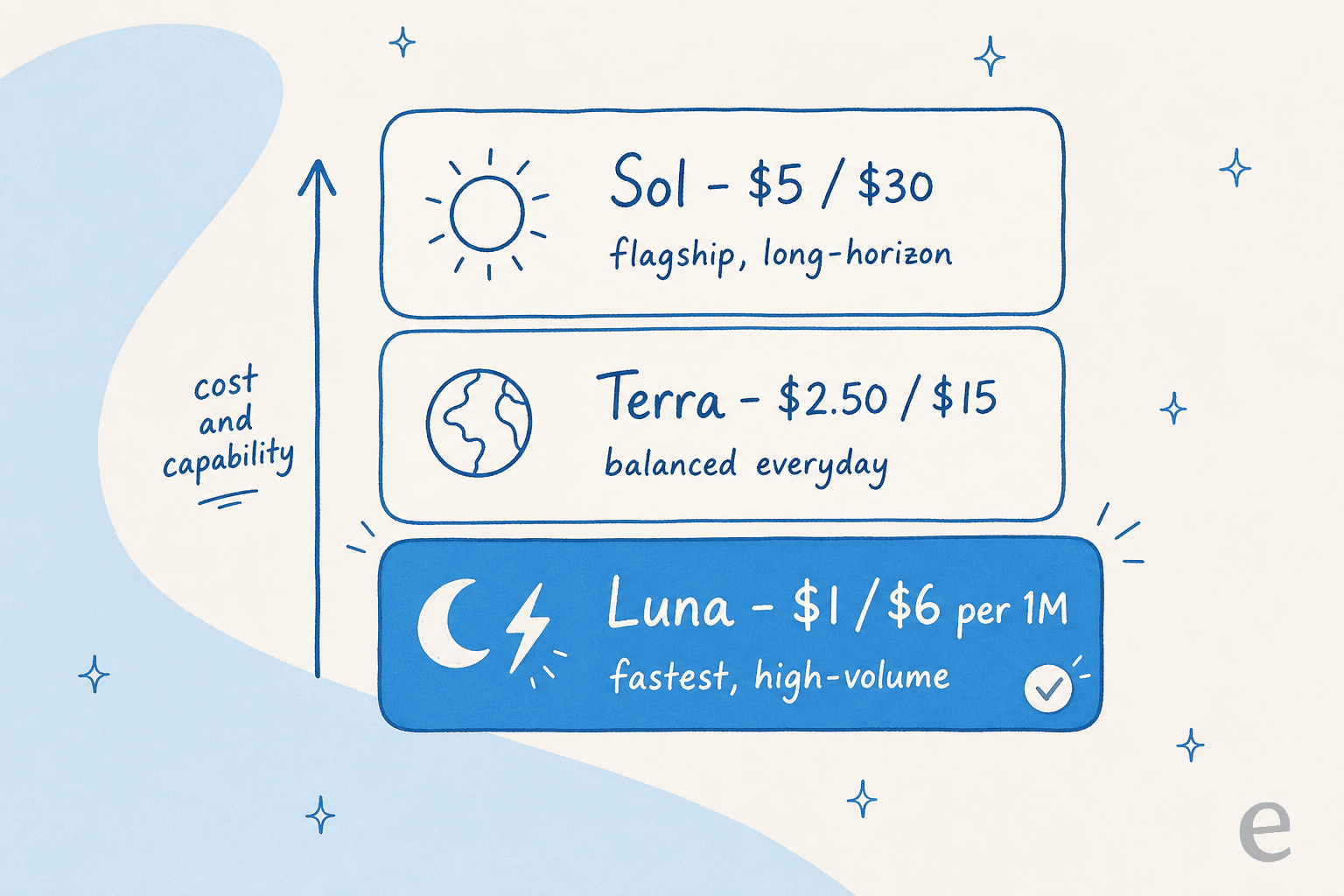
Here is the same split as a table, with the job each tier is really for:
| Tier | Model ID | Input / output (per 1M) | Best for |
|---|---|---|---|
| Sol | gpt-5.6-sol | $5.00 / $30.00 | Long-horizon coding, planning, agentic work |
| Terra | gpt-5.6-terra | $2.50 / $15.00 | Balanced everyday tasks |
| Luna | gpt-5.6-luna | $1.00 / $6.00 | High-volume, well-defined, latency-sensitive work |
If you have read my wider GPT-5.6 overview or the pricing deep-dive, the pattern will look familiar: Sol matches GPT-5.5's flagship price exactly, and Terra reuses GPT-5.4's price point. Luna is the one new slot in the family, a low-cost frontier-family tier that lands between the old GPT-5.4 and GPT-5.4-mini prices.
What Luna costs
At $1 in and $6 out per million tokens, Luna is the cheapest way into the 5.6 generation. Two details matter beyond the sticker price.
First, prompt caching. GPT-5.6 introduced explicit cache breakpoints and a 30-minute minimum cache life. Cache reads keep the standard 90% cached-input discount, so repeated context on Luna costs roughly $0.10 per 1M tokens. Cache writes are billed at 1.25x the uncached input rate. If your workload reuses a big system prompt or knowledge base on every call, that discount is where the real savings live.
Second, there is no separate long-context surcharge. Unlike GPT-5.5, which charges more for prompts over about 272K tokens, GPT-5.6 quotes a single flat rate per model, still true at GA.
A quick worked example. Say you send 2M input and 500K output tokens a day through Luna. That is roughly $2 for input plus $3 for output, so about $5 a day before any caching discount. Run the same volume through Sol and you are closer to $25 a day. For a repetitive, high-volume pipeline, that difference compounds fast, which is exactly why teams doing tier-1 ticket automation care about the cheapest capable tier.
The benchmark that got people talking
Here is the part that made Luna the most-discussed tier for a lot of developers. On Terminal-Bench 2.1, OpenAI's command-line and agentic coding benchmark, Luna scores 84.3%. That is not flagship-level, but look at who it is sitting next to.
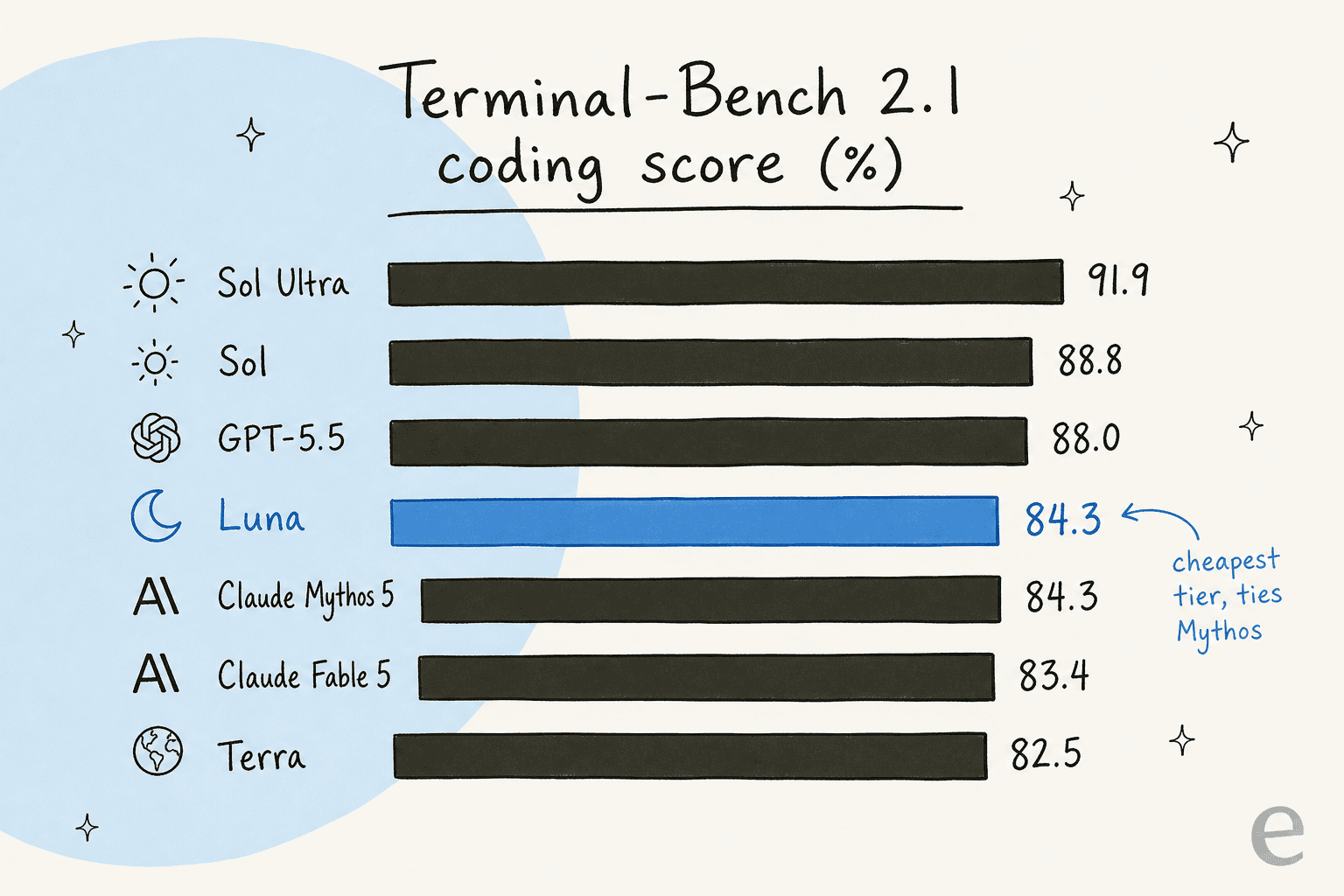
Luna ties Claude Mythos 5 (84.3%), beats Claude Fable 5 (83.4%), and even edges out its own more expensive sibling Terra (82.5%) on this particular chart. OpenAI's developer team also claims Luna "nearly matches GPT-5.5's peak performance at well under half the estimated API cost."
The honest caveat: this is a single benchmark, published by the vendor, and one benchmark rarely predicts day-to-day behavior. Plenty of developers said as much (more on that below). But it does undercut the usual assumption that the cheapest tier is a toy. For narrow, repetitive tasks, Luna is a real contender, not a fallback.
Where you can actually use Luna right now
This is the detail that caused the most confusion on launch day, so it is worth being blunt about it. GPT-5.6 is "in ChatGPT" now, but Luna is not.
Per OpenAI's help center, only Sol is selectable in standard ChatGPT conversations (via the Medium, High, and Extra High reasoning picks on Plus, Pro, Business, and Enterprise). GPT-5.5 Instant is still the default for everyday chat. Terra and Luna are not selectable in normal ChatGPT chat at all. Where they do live:
- ChatGPT Work (Plus, Pro, Business, Enterprise) gets all three tiers.
- Codex gets all three for paid plans; Terra also reaches Free and Go users there.
- The OpenAI API exposes Sol, Terra, and Luna directly.
- GitHub Copilot added all three tiers on July 9, per GitHub's changelog, with Luna on Pro, Pro+, Max, Business, and Enterprise SKUs.
So if you opened ChatGPT hoping to click "Luna," that option is not there by design. Luna is a developer and workflow model, reached through the API, Codex, or Copilot, not a chat-picker option. That gap is what drove the GA-day "where is it" replies to OpenAI's own announcement.
What developers are saying
The community reaction split along a familiar line: excitement about the price-to-performance ratio, tempered by "wait for real-world tests." The price angle is where Luna won the most goodwill.
"Although GPT 5.6 Sol seems like a great improvement, imo GPT 5.6 [Luna] seems like the most significant improvement due to the price."

OpenAI's own framing put Luna in the same "high-volume, low-cost" bucket that practitioners latched onto:
"Luna brings speed to well-defined, high-volume work... GPT-5.6 Luna nearly matches GPT-5.5's peak performance at well under half the estimated API cost."
There is skepticism too, and it is fair. One widely-shared Hacker News comment argued the whole Sol/Terra/Luna rename maps cleanly onto the old full/mini/nano split, reading Luna as essentially the "nano" tier with a nicer name. Whether or not that is right, it is a useful reminder: a legible name is not the same as a bigger model. Judge Luna on your own task, not on the marketing tier it sits in.
What a cheap, fast model tier means for customer support
Here is where I will be opinionated, because this is the part I actually work on. A cheaper, faster model tier is good news for AI customer service: support is the textbook high-volume, well-defined workload Luna was built for, and cost per interaction is the number that decides whether automation pencils out. Cheaper tokens move the cost-savings math in your favor.
But I have watched a confident-sounding bot quietly give wrong answers to real customers, which is why every rollout I run gets simulated against historical tickets before it touches a live queue. That experience taught me the uncomfortable truth: swapping to a cheaper model almost never fixes a support agent that is answering badly, and swapping to a more expensive one rarely fixes it either. The model is one swappable part of a much larger system.
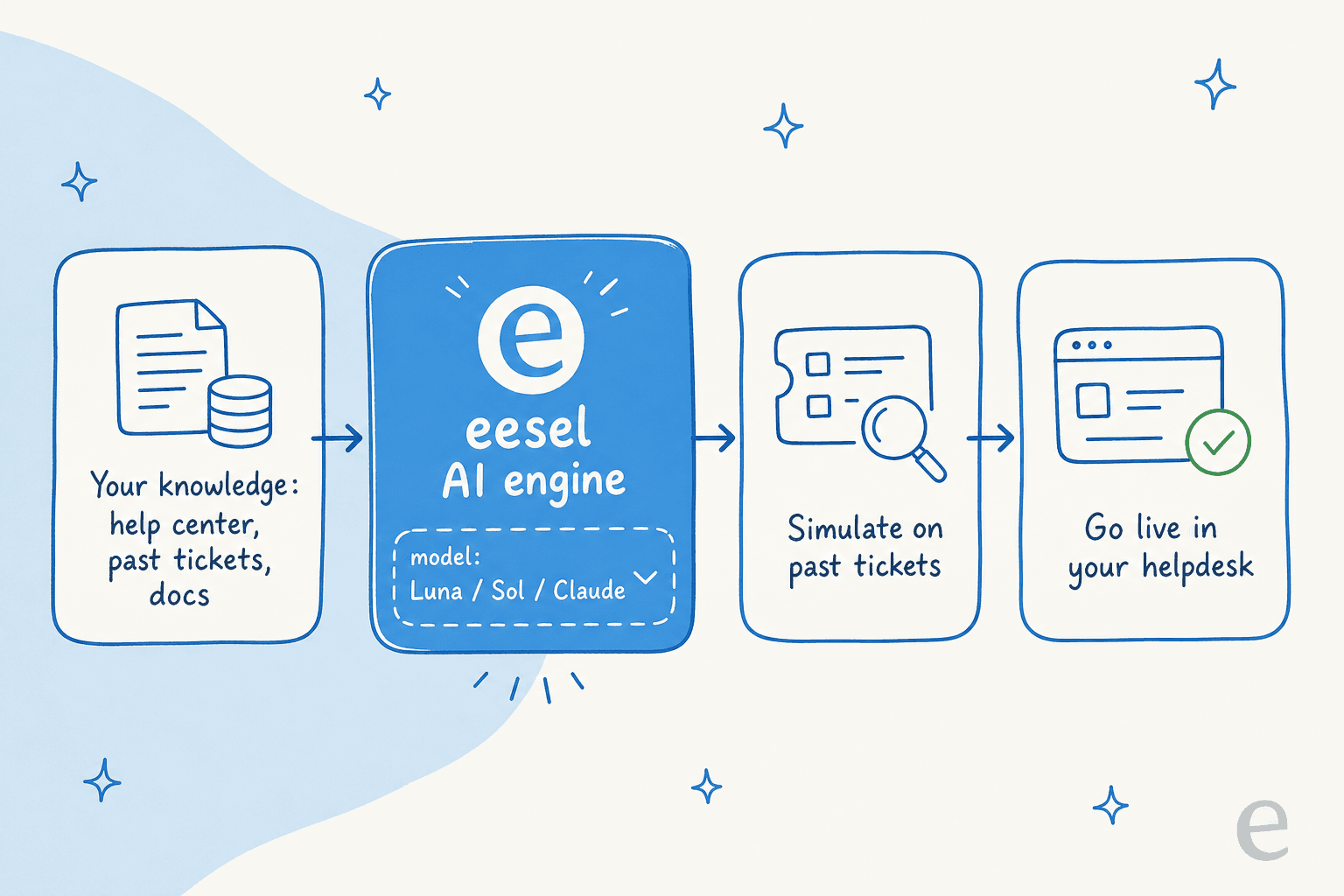
What actually decides whether an AI answer is right is the layer around the model: what knowledge it can retrieve, how well it is grounded in your help center and past tickets, and what guardrails stop it from hallucinating an answer when it should escalate. Get that layer right and a model like Luna is plenty. Get it wrong and even Sol will confidently mislead your customers. This is the same reason a domain-specific setup usually beats a raw frontier model for support, and why deflection rate depends far more on retrieval quality than on which tier you picked.
Try eesel
If you are excited about cheaper, faster models because you want to automate support, the model is the easy part. eesel is the layer that turns a model like GPT-5.6 Luna into an AI support agent that actually stays accurate: it trains on your past tickets and help center, lets you simulate the agent against thousands of historical conversations before it ever replies to a real customer, and plugs into your existing helpdesk software in minutes rather than a quarter-long project.

The pitch is simple: you should not have to re-architect your support stack every time OpenAI ships a new tier. eesel stays model-flexible, so you get the benefit of a cheaper, faster Luna without betting your customer experience on a single vendor's roadmap. It is free to try, and you can see how it handles your real tickets before committing to anything.
Frequently Asked Questions
What is GPT-5.6 Luna?
gpt-5.6-luna and it runs at $1 input and $6 output per 1M tokens.How much does GPT-5.6 Luna cost?
Can I use GPT-5.6 Luna in ChatGPT?
Is GPT-5.6 Luna good enough for customer service?
How does GPT-5.6 Luna compare to Sol and Terra?


Article by
Kira
Kira is a writer at eesel AI with a Computer Science background and over a year of hands-on experience evaluating AI-powered customer service tools. She focuses on breaking down how helpdesk platforms and AI agents actually work so that support teams can make better buying decisions.