


Two vendors, the same shape
Here's the thing that jumps out once you stop reading the marketing pages side by side and start using both: OpenAI and Anthropic have quietly converged on nearly identical product architecture.
Both ship a family, not a model. Both give you a compute dial (OpenAI's reasoning effort plus the new max setting; Claude's effort parameter running low through max, with xhigh new to Sonnet 5). Both anchor around a 1M-token context window at the top tiers. And both use a naming convention where the number is the generation and the name is the durable tier.
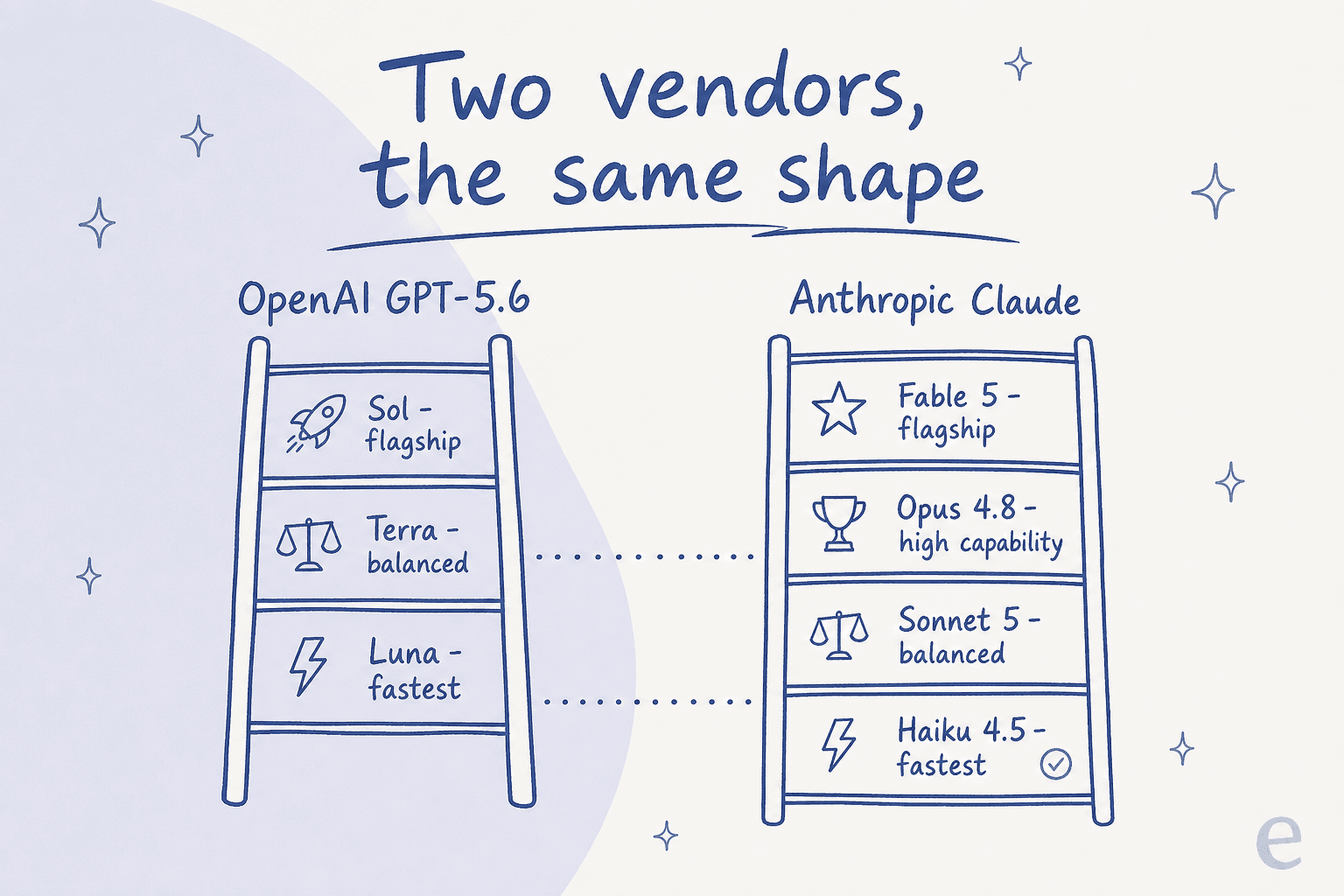
Line them up and the tiers almost rhyme. GPT-5.6 Sol sits against Claude's flagship class; Terra maps onto Sonnet 5 as the balanced everyday model; Luna maps onto Haiku 4.5 as the fast, cheap workhorse. The one asymmetry worth knowing early: Anthropic has a rung OpenAI doesn't. Claude's real ceiling is Claude Fable 5 at $10/$50 per million tokens, with the invitation-only Mythos 5 above it, while GPT-5.6 has no "Pro" tier yet, so OpenAI's most expensive frontier option is still the older GPT-5.5 Pro at $30/$180.
So this isn't a one-model-versus-one-model fight. It's two ladders, and the interesting question is which rung you actually need.
GPT-5.6: the OpenAI side
GPT-5.6 went generally available on July 9, 2026, rolling out globally over 24 hours after a limited, government-vetted preview that started back in late June. The three tiers are Sol, Terra and Luna, and OpenAI's framing is straightforward: "Sol handles long-horizon coding and agentic work... Terra balances performance and cost for everyday work... Luna brings speed to well-defined, high-volume work."
The headline capability is agentic coding, and OpenAI leaned hard on it. Sol tops OpenAI's own Terminal-Bench 2.1 chart at 91.9% in its ultra multi-agent mode (88.8% for base Sol). Two new compute controls ship with the family: a max reasoning-effort setting and an ultra mode that spins up subagents to work in parallel.
At general availability, OpenAI finally published Terra's benchmark numbers, which it had held back during the preview. Terra scores 87.4% on Terminal-Bench 2.1, 63.4% on SWE-Bench Pro, and 77.4 on the Artificial Analysis Coding Agent Index, edging out GPT-5.5's 76.4 at roughly half the price. That's the genuine story of this release: the mid-tier got a real upgrade without a price hike.
But it's not a clean sweep, and the community caught the seams fast. Terra trails GPT-5.5 on FrontierMath Tier 4 (68.3% vs 72.5%), and one widely-shared Hacker News comment argued Terra is really a distilled "mini" wearing a bigger name:
GPT-5.6 Terra actually scores worse than GPT-5.5 on many benchmarks. It's not GPT-5.5 trained with more compute; it's basically GPT-5.6-mini that's been distilled from GPT-5.6 full size.

OpenAI's published numbers partly rebut this (Terra does beat GPT-5.5 on most coding evals), but the skepticism is a useful reminder to test on your own workload rather than trust the launch chart. There's also a real access wrinkle: despite "GPT-5.6 is in ChatGPT" headlines, only Sol is selectable in standard ChatGPT chat. Terra and Luna aren't selectable in normal ChatGPT conversations at all - they live in ChatGPT Work, Codex, and the API, per OpenAI's own help center. If you want Terra, you're going through the API or Codex, full stop.
Claude: the Anthropic side
Anthropic's lineup is broader and, frankly, less confusing to buy. The current ladder, top to bottom: Claude Fable 5 and the limited Mythos 5 at the frontier, then Claude Opus 4.8 as the high-capability Opus tier, then Claude Sonnet 5 as the balanced everyday model, then Claude Haiku 4.5 as the fast option.
Opus 4.8, released May 28, 2026, is the one to compare against GPT-5.6 Sol. Anthropic positions it for "complex reasoning, long-horizon agentic coding, and high-autonomy work," and its standout published number isn't a coding score - it's honesty. Anthropic reports Opus 4.8 is around four times less likely than its predecessor to let flaws in its own code pass unremarked, and it scored 84% on the Online-Mind2Web computer-use benchmark, which Anthropic calls "a meaningful jump over both Opus 4.7 and GPT-5.5." For anyone putting a model in front of customers, a model that flags its own uncertainty is worth more than one extra point on a coding leaderboard.
The genuinely interesting new arrival is Claude Sonnet 5, launched June 30, 2026. Anthropic's pitch is "near-Opus quality at Sonnet cost": its performance is "close to that of Opus 4.8, but at lower prices," and at higher effort it can match Opus 4.8 on some tasks. Unlike Terra's awkward gating, Sonnet 5 is the default model for Free and Pro users on Claude.ai and shipped day-one on the Claude API, AWS, Google Cloud and Microsoft Foundry. That "available everywhere, no hunting for it" story is a real edge over the GPT-5.6 rollout confusion.
One caveat that bites on the cost side: Claude's newer tokenizer (used by Sonnet 5, Opus 4.8 and Fable 5) produces roughly 30% more tokens for the same text (1.0-1.35x depending on content). So sticker price parity doesn't mean per-request cost parity. The third-party aggregator Artificial Analysis even found that at standard pricing, a high-effort Sonnet 5 run can cost more per task than Opus 4.8 because it generates so many thinking tokens. Model cost math in 2026 is genuinely harder than reading a $/token number.
Benchmarks: who's actually ahead?
Honest answer: it's split, and you should distrust anyone who says otherwise. A blunt but accurate summary of the whole matchup came from a developer on Reddit:
Fable is the better base by a large margin, but GPT is the stronger exponent.

That captures it: Claude's frontier base may be stronger, but GPT tends to reward users who drive it hard. On the numbers we can actually verify, here's the shape:
| Signal | GPT-5.6 | Claude |
|---|---|---|
| Top coding benchmark | Sol Ultra 91.9% Terminal-Bench 2.1 | Numbers published as image tables; Sonnet 5 "close to Opus 4.8" per Anthropic |
| Coding Agent Index (Artificial Analysis) | Terra 77.4, Sol 80 | Fable 5 77.2 |
| Computer use | Not headlined | Opus 4.8 84% Online-Mind2Web |
| Honesty / self-review | Not headlined | Opus 4.8 ~4x fewer unflagged code flaws |
| Context window | Not published (flat, no long-context tier) | 1M confirmed (Opus 4.8, Sonnet 5, Fable 5) |
Two things to flag honestly. First, Anthropic publishes most of Claude's headline scores as images inside the launch posts and system cards, not machine-readable text, so precise SWE-bench numbers for Sonnet 5 need to be read straight off the source before you quote them. Second, OpenAI still hasn't published a plain context-window number for GPT-5.6, so we're not going to invent one. The takeaway isn't a scoreboard winner - it's that the two families trade blows depending on which eval you weight, which is exactly why locking your product to one of them is a bet you don't need to make.
Pricing: the balanced tiers are nearly a tie
Price is where the "just pick one" instinct really breaks down, because the tier you'll run most is priced almost identically across both vendors.
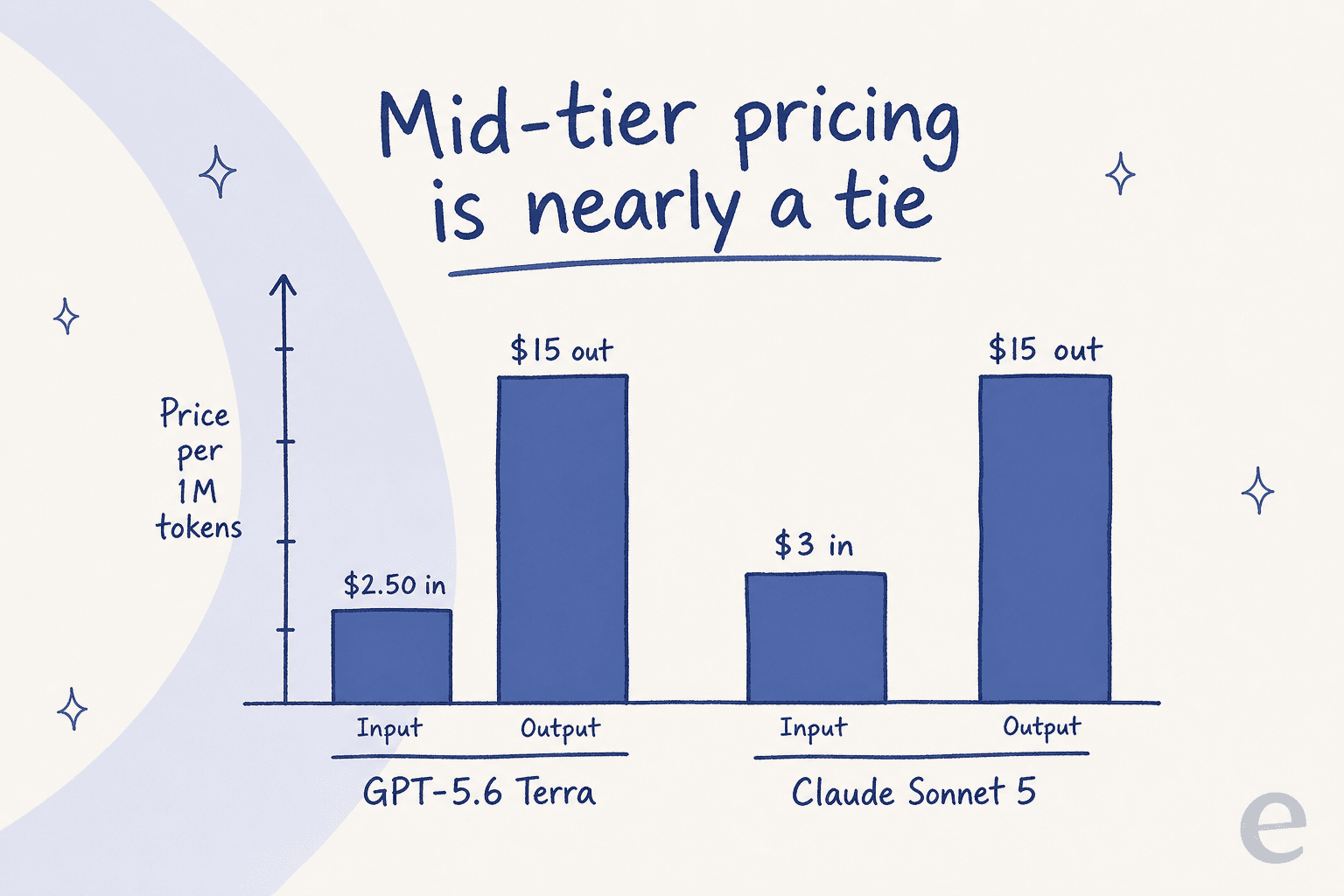
Here's the full ladder, per million tokens:
| Tier | GPT-5.6 | Claude |
|---|---|---|
| Flagship | Sol - $5 / $30 | Fable 5 - $10 / $50 |
| High capability | (no separate tier) | Opus 4.8 - $5 / $25 |
| Balanced | Terra - $2.50 / $15 | Sonnet 5 - $3 / $15 ($2 / $10 intro to Aug 31) |
| Fast / cheap | Luna - $1 / $6 | Haiku 4.5 - $1 / $5 |
A few reads on this. At the balanced tier, Terra's $2.50 input undercuts Sonnet 5's $3, but output is a flat $15 tie - and once you factor Claude's ~30% token inflation, the real per-request gap narrows or flips depending on how chatty your prompts are. At the flagship tier, GPT-5.6 Sol matches Claude Opus 4.8 on input ($5) and is slightly pricier on output ($30 vs $25); Claude's true frontier model, Fable 5, costs double but has no GPT-5.6 equivalent to compare against yet. At the cheap tier, Luna and Haiku 4.5 are within a dollar of each other.
For a fuller cost picture, we've broken each family down in the GPT-5.6 pricing guide and the Claude Sonnet 5 pricing guide. But the pattern is clear: nobody is winning this on sticker price. The differences show up in token accounting, caching behavior, and which tier you route each job to - not in the headline number.
Which one for an AI support agent?
This is where we actually have skin in the game. We've spent years running AI on live support queues, and we've watched a confident-sounding model quietly give a wrong answer to a real customer, which is why we now simulate every rollout against historical tickets before it goes live. From that seat, the GPT-5.6-vs-Claude question is almost the wrong one.
Here's why. A support queue is not one workload - it's three. Password resets and "where's my order" get answered thousands of times a day and want the cheapest fast model. Everyday "how do I do X" tickets that need to read a knowledge base and call a tool want the balanced tier. And the gnarly, multi-step, angry-customer edge cases want the flagship. No single model is the right answer to all three.
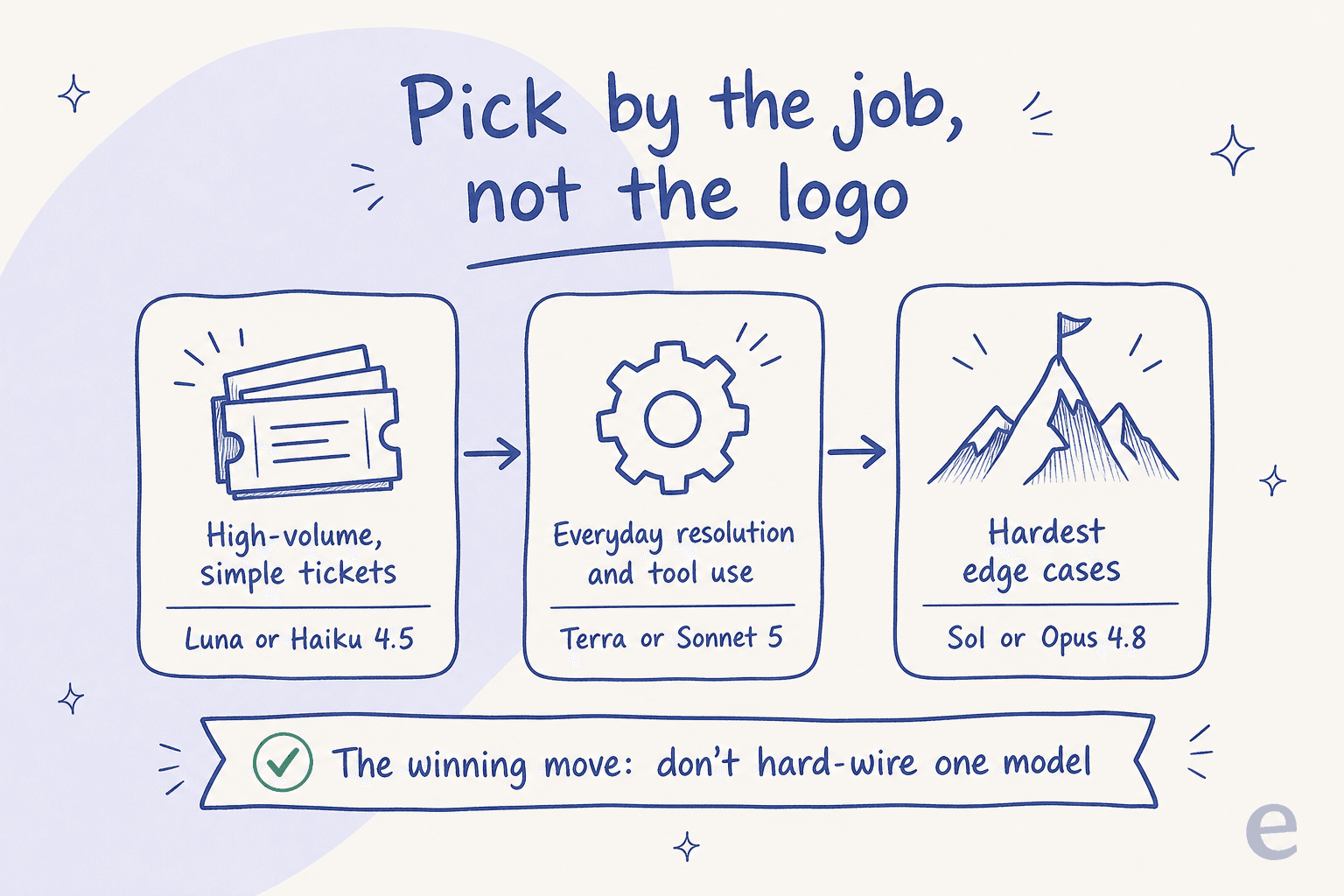
So the useful mental model isn't "GPT or Claude." It's "match the tier to the job, and keep the option to swap." A tool routed to Luna today should be trivially movable to Haiku 4.5 tomorrow if Anthropic ships a better price/performance point - or vice versa. If your AI agent is hard-wired to one vendor's API, you're re-plumbing your whole stack every time the leaderboard shifts, which in 2026 is roughly monthly.
The other thing that matters far more than the base model for support specifically: whether you can trust it in front of customers. That's less about which model tops Terminal-Bench and more about grounding it in your real knowledge, preventing hallucinations, and testing behavior before go-live. A slightly-less-clever model that's been simulated against 10,000 of your past tickets will out-resolve a benchmark champion you switched on blind.
Try eesel for AI support
If you're comparing GPT-5.6 and Claude because you want to automate support, eesel is built for exactly the conclusion above: you shouldn't have to bet your helpdesk on one model. eesel plugs into your existing helpdesk in minutes, learns from your past tickets and knowledge base, and handles the model choice for you - routing tickets to the right tier and letting you move between the best available models as they change, without touching your setup.
The part we care most about, from years of watching bots get this wrong: before eesel answers a single live customer, you can simulate it against your historical tickets to see exactly what it would have said and what it would have resolved. You pick your rollout on evidence, not on whose launch chart looked best this week. It's free to try, so you can point it at your own queue and see the resolution rate before you commit.
Because whichever way the GPT-5.6-vs-Claude benchmark race swings next quarter, the teams that win are the ones who didn't hard-wire the answer.
Frequently Asked Questions
Is GPT-5.6 better than Claude?
How much does GPT-5.6 cost compared to Claude?
What is the difference between GPT-5.6 Sol, Terra and Luna?
Which AI model is best for customer support?
Can I use GPT-5.6 and Claude for the same AI support agent?


Article by
Kurnia Kharisma
Kurnia is a software engineer and writer at eesel AI with two years of SEO experience, writing about AI tools, helpdesk software, and customer support. He pairs a developer's understanding of how these products are built with search-driven research into what actually ranks and resonates with the people searching for them.