

Two vendors, two very different shapes
The first thing that jumps out, once you stop reading the launch posts and start reading the API docs, is that OpenAI and Google have built these two families with completely opposite philosophies.
GPT-5.6 is disciplined. It went generally available on July 9, 2026, and it's exactly three tiers, all sharing one generation number: Sol, Terra, Luna. The number is the generation, the name is the durable tier. Clean.
Gemini 3 is a patchwork. Google's DeepMind model page now leads with "Gemini 3.5," but the only model actually on 3.5 is the Flash tier. The Pro tier is still Gemini 3.1 Pro, the reasoning tier is Gemini 3.1 Deep Think, and the cheap tier is Gemini 3.1 Flash-Lite. There's a "3.5 Pro coming soon" tag on the page, but as of this writing it isn't shipped. So Google's "flagship" is a Flash model, and its Pro model is a generation behind its own flagship.
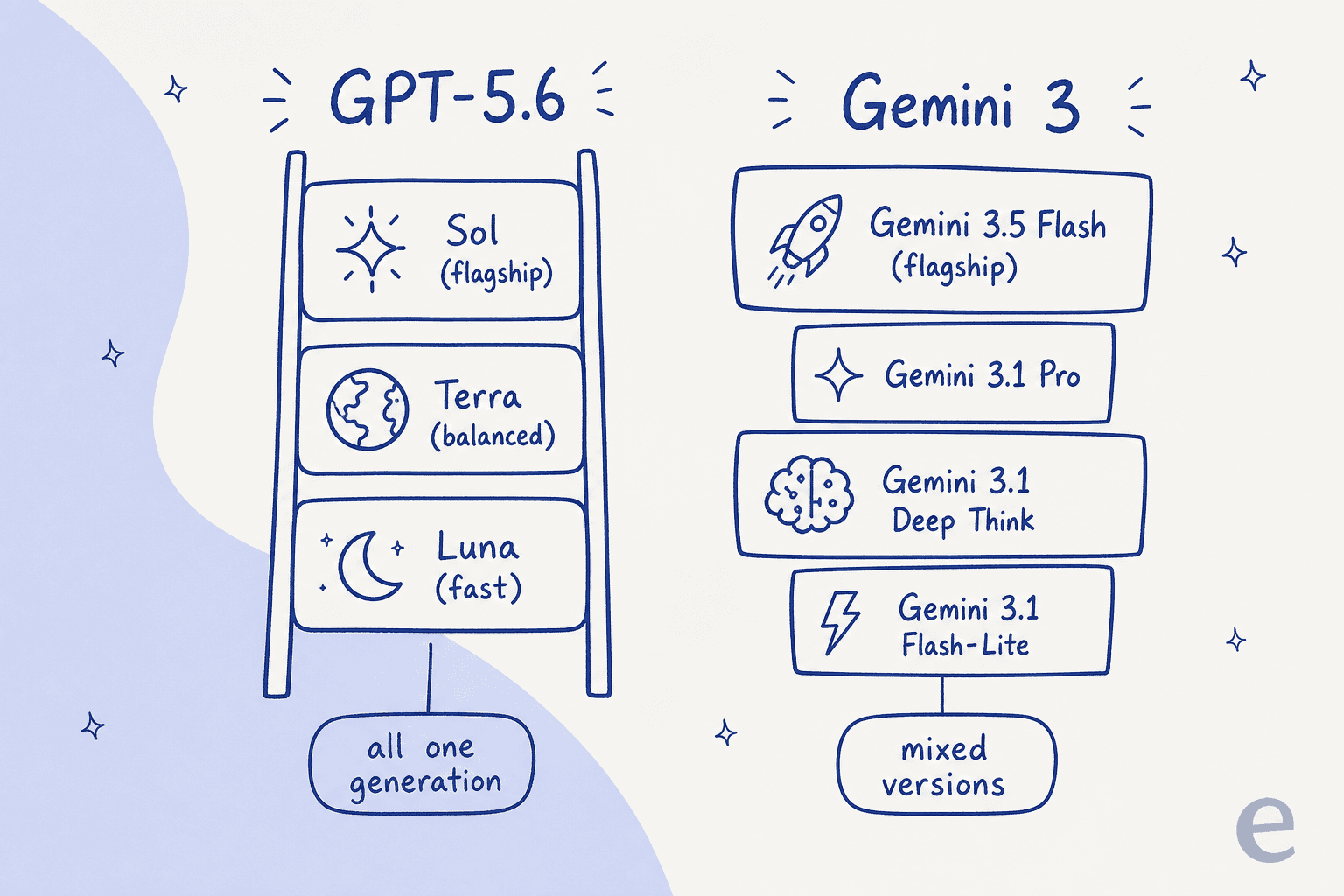
Why does this matter beyond trivia? Because the shape decides how you buy. With GPT-5.6, you pick a rung by how hard your job is. With Gemini 3, you have to know that the newest, most capable model is confusingly the one labelled "Flash," and that the "Pro" you'd instinctively reach for is the older architecture. That's a real trap for anyone provisioning a model by name.
GPT-5.6: the OpenAI side
GPT-5.6's three tiers are Sol, Terra and Luna, and OpenAI's framing is refreshingly plain: "Sol handles long-horizon coding and agentic work... Terra balances performance and cost for everyday work... Luna brings speed to well-defined, high-volume work."
The headline capability is agentic coding, and OpenAI leaned on it hard. Sol tops OpenAI's own Terminal-Bench 2.1 chart at 91.9% in its ultra multi-agent mode (88.8% for base Sol). Two new compute controls ship with the family: a max reasoning-effort setting and an ultra mode that spins up subagents to work in parallel. If you want the deeper breakdown of those modes, we covered them in the GPT-5.6 Sol review and the Luna writeup.
At general availability, OpenAI finally published Terra's benchmark numbers, which it had held back during the preview. Terra scores 87.4% on Terminal-Bench 2.1, 63.4% on SWE-Bench Pro, and 77.4 on the Artificial Analysis Coding Agent Index, edging out GPT-5.5's 76.4 at roughly half the price. The genuine story of the release is that the mid-tier got a real upgrade without a price hike.
It's not a clean sweep, though, and the community found the seams fast. Terra trails GPT-5.5 on FrontierMath Tier 4 (68.3% vs 72.5%), and one widely-shared Hacker News comment argued Terra is really a distilled "mini" wearing a bigger name:
GPT-5.6 Terra actually scores worse than GPT-5.5 on many benchmarks. It's not GPT-5.5 trained with more compute; it's basically GPT-5.6-mini that's been distilled from GPT-5.6 full size.

There's also a real access wrinkle worth knowing before you plan around it. Despite the "GPT-5.6 is in ChatGPT" headlines, only Sol is selectable in standard ChatGPT chat. Terra and Luna aren't selectable in normal ChatGPT conversations at all; they live in ChatGPT Work, Codex, and the API, per OpenAI's help center. If you want Terra, you're going through the API, full stop. For the full plan-by-plan picture, we broke it down in the GPT-5.6 overview.
Gemini 3: the Google side
Google's pitch is breadth. Gemini 3 isn't just a chat model, it's the engine behind Search, Workspace, and a growing pile of agentic products. The current flagship, Gemini 3.5 Flash, is billed as Google's "most intelligent" model and is tuned for "sustained frontier performance on agentic and coding tasks." It carries a 1,048,576-token (roughly 1M) context window and now supports computer use in preview, meaning it can see a screen and take UI actions.
The reason to keep calling it "Flash" and not just "the flagship" is that the naming has real consequences for what you get elsewhere in the family. Gemini 3.1 Pro also carries the ~1M-token window and Google's "better thinking, improved token efficiency" claims, but it's a version behind and priced higher. The reasoning-heavy Gemini 3.1 Deep Think is gated to the top consumer plan. And around the core models sit the extras Google is betting on: Nano Banana 2 for images, Gemini Omni Flash for video, and Gemini 3.5 Live Translate across 70-plus languages.
Google backs the flagship claim with a few customer proof points on its model page: Box reports Gemini 3.5 Flash beat the previous Gemini 3 Flash by 19.6% on its enterprise-work eval set, and a security partner reports 42% better long-range multi-turn performance with 68% better token efficiency versus the prior Flash.
Community sentiment leans positive on quality, especially for research and math. One applied-math student put the everyday difference well:
As an applied math student, I've noticed Gemini is way better with math expressions. GPT makes dumb mistakes with operators and coefficients all the time-like it's smart with words but sloppy with symbols. Gemini just gets the notation right.

But the consumer experience has been rockier than the benchmarks suggest. A recurring complaint is paid features quietly vanishing:
I subscribed to Gemini AI Pro back in December 2025, lured by the launch of Gemini 3 Pro. The first month was great, but since February 1st, 2026, my experience has turned into a technical nightmare. The 'Pro' mode has completely disappeared from my UI on both Desktop and Android.
The lesson for both families is the same: launch numbers and API stability are different things, which is exactly why you want to test on your own workload before committing.
Benchmarks: who's actually ahead?
Here's the honest caveat that most "GPT-5.6 vs Gemini 3" content skips: Google's own benchmark table compares Gemini 3 against GPT-5.5, not GPT-5.6. GPT-5.6 doesn't appear on any Google page or current third-party aggregator. So the cleanest verifiable head-to-head we actually have is Gemini 3.5 Flash against GPT-5.5, and everything about GPT-5.6 has to come off OpenAI's separate charts. Anyone selling you a tidy scoreboard is quietly papering over that gap.
With that flagged, here's the shape from each vendor's published numbers:
| Signal | Gemini 3.5 Flash | OpenAI side |
|---|---|---|
| Terminal-Bench 2.1 (agentic coding) | 76.2% | GPT-5.5 78.2%; Sol Ultra 91.9% |
| MCP Atlas (multi-step tool use) | 83.6% | GPT-5.5 75.3% |
| MMMU-Pro (multimodal) | 83.6% | GPT-5.5 81.2% |
| Finance Agent v2 | 57.9% | GPT-5.5 51.8% |
| MRCR v2 (long-context recall) | 77.3% | GPT-5.5 94.8% |
| ARC-AGI-2 (abstract reasoning) | 72.1% | GPT-5.5 84.6% |
| Coding Agent Index (Artificial Analysis) | not on this table | Terra 77.4, Sol 80 |
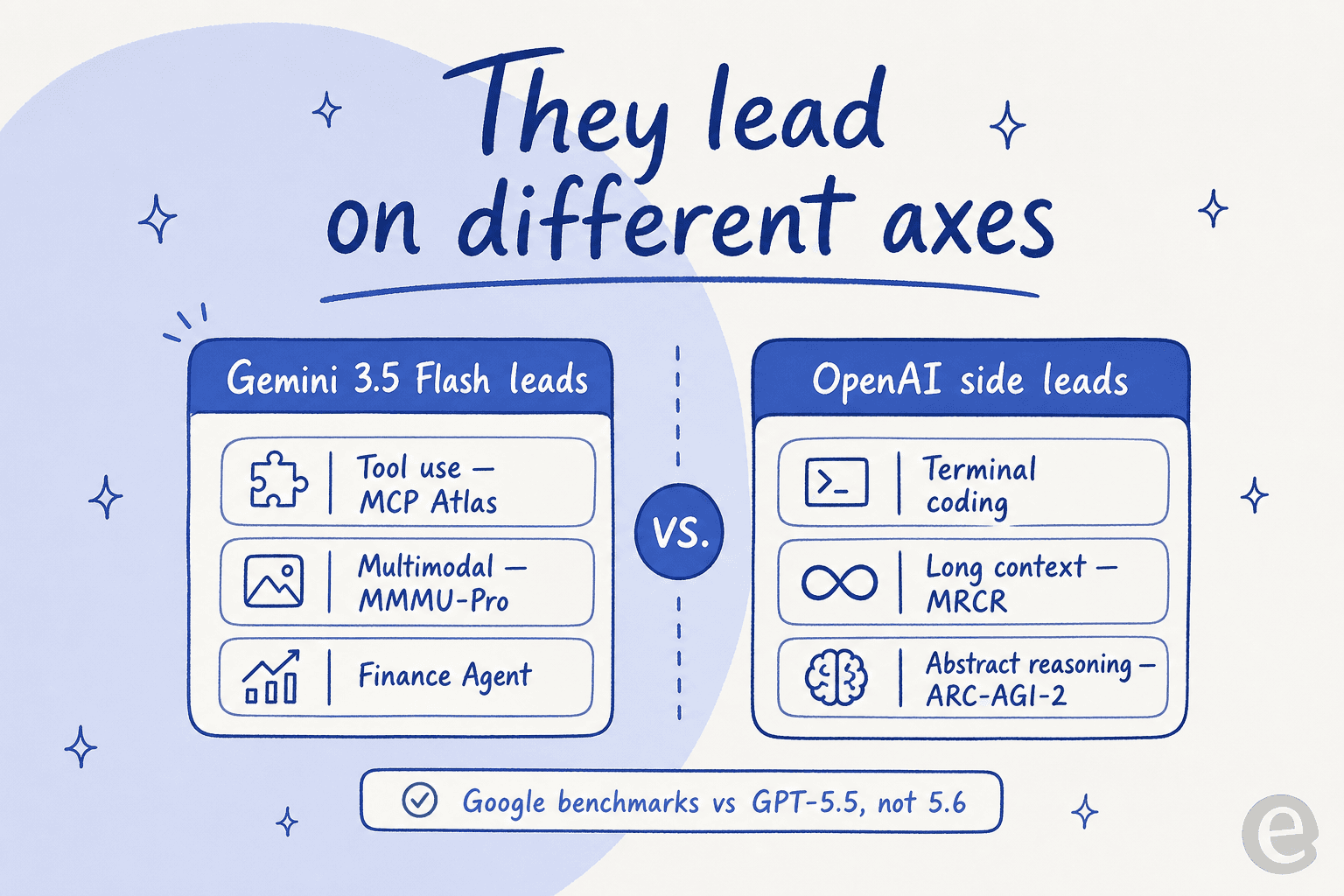
The read: Gemini 3.5 Flash wins the tool-and-agent and multimodal suites Google cares most about, while the OpenAI side wins raw terminal coding, long-context recall (by a large margin, 94.8% vs 77.3%), and abstract reasoning. That long-context gap is the one I'd weigh heaviest for real agent work; a model that loses the thread across a big prompt is a model that fumbles multi-turn tickets. It's the same split we found putting GPT-5.6 against Claude, where the two families traded blows eval by eval. The takeaway isn't a scoreboard winner, it's that the two families trade blows depending on which eval you weight, which is exactly why locking your product to one of them is a bet you don't need to make.
Pricing: Gemini's flagship undercuts everything
Price is where Gemini 3 makes its most aggressive move, and it's easy to miss because of the naming.
| Role | GPT-5.6 | Gemini 3 |
|---|---|---|
| Current flagship | Sol - $5 / $30 | Gemini 3.5 Flash - $1.50 / $9 |
| Pro / high capability | (no separate tier) | Gemini 3.1 Pro - $2 / $12 (≤200k) |
| Balanced | Terra - $2.50 / $15 | (Flash 3.5 fills this) |
| Fast / cheap | Luna - $1 / $6 | Gemini 3.1 Flash-Lite - $0.25 / $1.50 |
Read the flagship row again. Google's most capable current model, Gemini 3.5 Flash, costs $1.50 in and $9 out, which is cheaper than GPT-5.6's balanced Terra tier ($2.50/$15) and a fraction of Sol ($5/$30). That's the genuinely surprising line in this whole comparison: Gemini's best model is priced like a mid-tier because it wears a "Flash" label.
Two caveats keep it from being a pure walkover. First, Gemini's Pro tier uses tiered pricing by prompt size: above 200k tokens, Gemini 3.1 Pro jumps to $4/$18, so long-context work costs more than the sticker. Second, Gemini's "output" price includes thinking tokens, so a heavy-reasoning request bills more output than you might expect. On the cheap end, Gemini 3.1 Flash-Lite at $0.25/$1.50 is the lowest floor in this matchup, well under GPT-5.6 Luna. For fuller cost math on each side, we broke it down in the GPT-5.6 pricing guide and Gemini pricing guide.
The pattern: Gemini wins the sticker-price fight at the top, GPT-5.6 wins the naming-clarity fight, and neither gap is big enough to justify hard-wiring your stack to one.
Which one for an AI support agent?
This is where I actually have skin in the game. We've spent years running AI on live support queues, and we've watched a confident-sounding model quietly give a wrong answer to a real customer, which is why we now simulate every rollout against historical tickets before it goes live. From that seat, the GPT-5.6-vs-Gemini-3 question is almost the wrong one.
Here's why. A support queue is not one workload, it's three. Password resets and "where's my order" get asked thousands of times a day and want the cheapest fast model. Everyday "how do I do X" tickets that need to read a knowledge base and call a tool want a solid mid-tier, the kind of work a customer service AI handles all day. And the gnarly, multi-step, angry-customer edge cases want the flagship. No single model is the right answer to all three, and no single vendor is either.
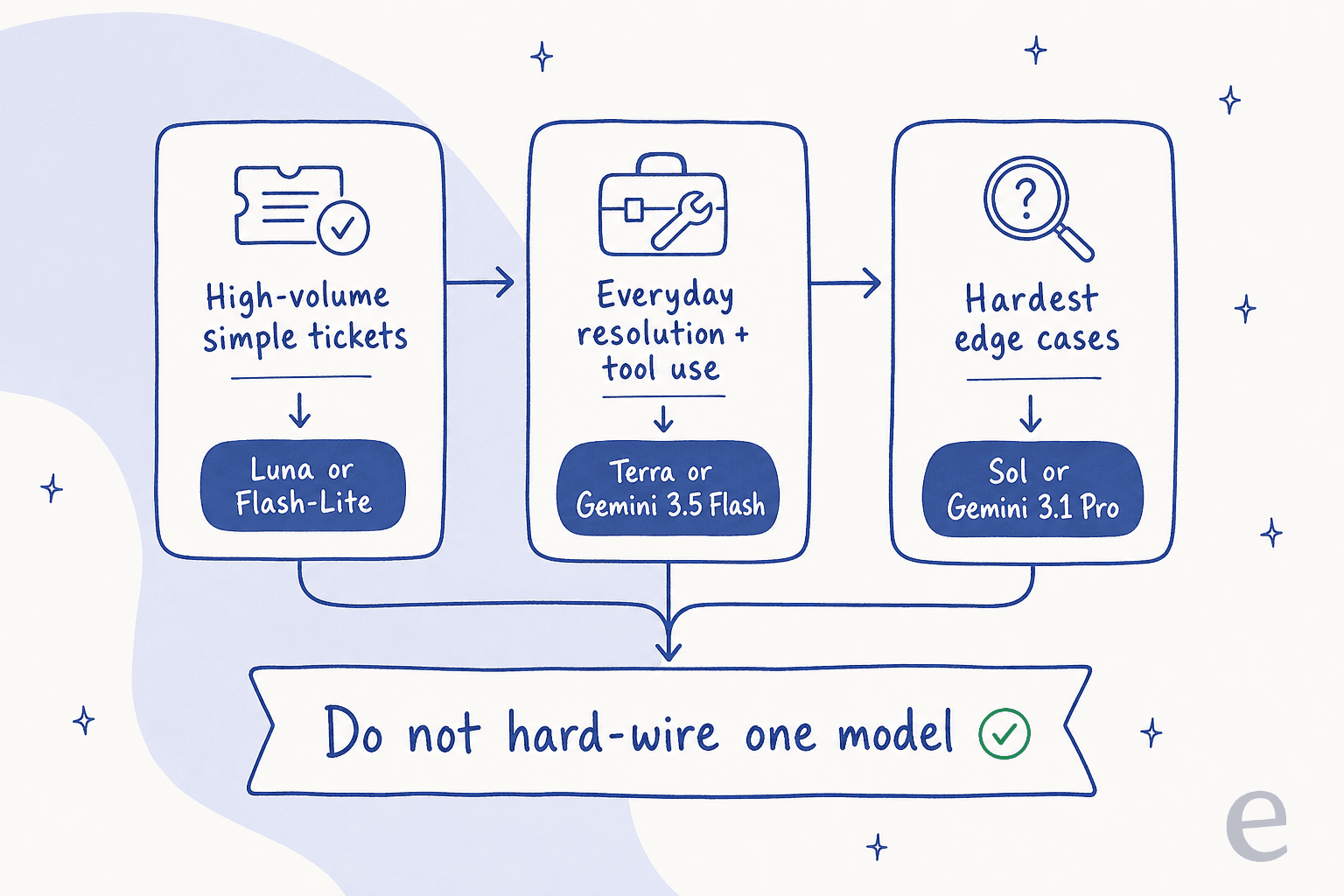
So the useful mental model isn't "GPT or Gemini." It's "match the model to the job, and keep the option to swap." A ticket routed to Gemini 3.1 Flash-Lite today should be trivially movable to Luna tomorrow if OpenAI ships a better price/performance point, or vice versa. If your AI agent is hard-wired to one vendor's API, you're re-plumbing your whole stack every time the leaderboard shifts.
The thing that matters far more than the base model for support specifically: whether you can trust it in front of customers. That's less about which model tops MCP Atlas and more about grounding it in your real knowledge, preventing hallucinations, and testing behavior before go-live. A slightly-less-clever model that's been simulated against 10,000 of your past tickets will out-resolve a benchmark champion you switched on blind. In our own numbers, that grounding is what took a new customer like Gridwise to 73% of tier-1 requests resolved in the first month, and the model underneath was never the interesting variable.
Try eesel for AI support
If you're comparing GPT-5.6 and Gemini 3 because you want to automate support, eesel is built for exactly the conclusion above: you shouldn't have to bet your helpdesk on one model. eesel plugs into your existing helpdesk in minutes, learns from your past tickets and knowledge base, and handles the model choice for you, routing each ticket to the right model and letting you move between the best available engines as they change, without touching your setup.
The part I care most about, as someone who's watched bots get this wrong: before eesel answers a single live customer, you can simulate it against your historical tickets to see exactly what it would have said and what it would have resolved. You pick your rollout on evidence, not on whose launch chart looked best this week. It's free to try, so you can point it at your own queue and see the resolution rate before you commit.
Because whichever way the GPT-5.6-vs-Gemini-3 race swings next quarter, the teams that win are the ones who didn't hard-wire the answer.
Frequently Asked Questions
Is GPT-5.6 better than Gemini 3?
How much does GPT-5.6 cost compared to Gemini 3?
What is Gemini 3's flagship model right now?
Which AI model is best for customer support?
Can I use GPT-5.6 and Gemini 3 for the same AI support agent?


Article by
Rama Adi
Rama is a software engineer at eesel AI with two years of experience writing about B2B SaaS, AI tools, and customer support technology. Based in Bali, Indonesia, he brings a developer's perspective to product comparisons — cutting through marketing copy to what the integrations and APIs actually do.