
What is GPT-5.6 Sol?
GPT-5.6 stopped being one model. OpenAI split its next-generation family into three durable capability tiers, where the number is the generation and the name is the size: Sol (flagship), Terra (balanced, about half Sol's price), and Luna (fastest and cheapest). I cover all three in my GPT-5.6 overview; this review is Sol only. Sol is the one OpenAI points at long-horizon coding, planning, and tool use, the work it calls "agentic."
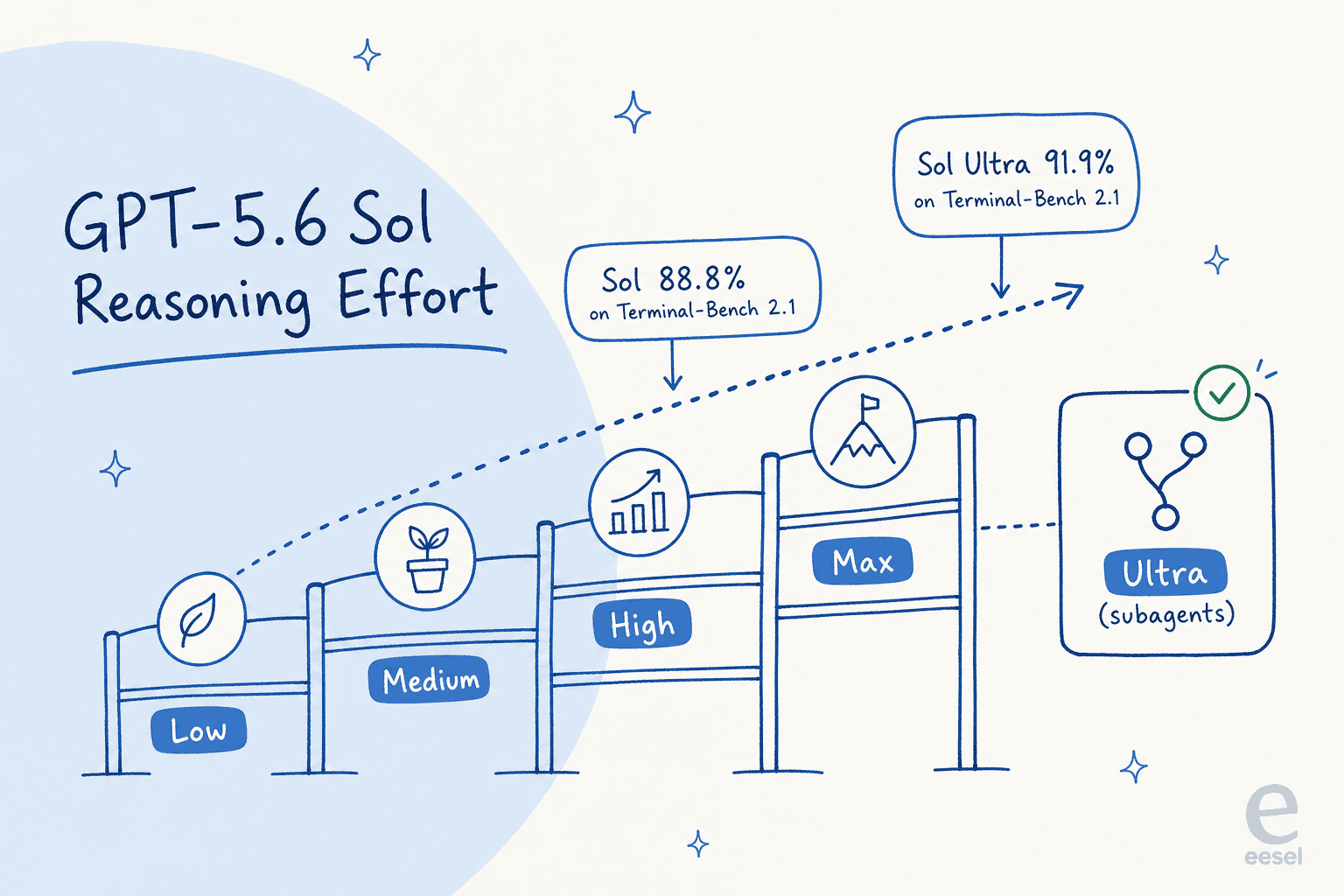
Two new controls ship with it, and both live on Sol. There's a new reasoning-effort level called max that sits above the old low/medium/high tiers and gives the model the most time to reason deeply, and an orchestration mode called ultra that fans a hard task out across subagents instead of grinding through one long chain of thought. If you've used a modern AI agent, ultra is the difference between one worker and a small crew.
Where you can reach it matters, because the rollout is uneven. Per OpenAI's help center, Sol is the only GPT-5.6 tier selectable in standard ChatGPT chat (Plus, Pro, Business, Enterprise, via the Medium/High/Extra High reasoning picks). Terra and Luna don't show up in normal conversations at all, they live in ChatGPT Work, Codex, the API, and GitHub Copilot. So if you're a ChatGPT subscriber, Sol is your GPT-5.6.
How good is GPT-5.6 Sol at coding?
This is the headline, so let me start with OpenAI's own numbers and then temper them.
On Terminal-Bench 2.1, the agentic coding benchmark that tests planning, iteration, and tool coordination, plain Sol scores 88.8%, and Sol in ultra mode tops OpenAI's chart at 91.9%, ahead of GPT-5.5 (88.0%), Claude Mythos 5 (84.3%), and Gemini 3.1 Pro Preview (70.7%). At general availability, OpenAI put Sol at 80 on the Artificial Analysis Coding Agent Index, against GPT-5.5's 76.4 and Claude Fable 5's 77.2.
The honest asterisk: these are all vendor-reported benchmarks. The loudest note in the developer community is skepticism that the chart wins survive contact with real repos.
The benchmark numbers for GPT 5.6 look great, but I'm not sure the real-world performance matches the hype... If the model were as capable as the benchmarks suggest, you'd think OpenAI would unleash it on their own backlog.

Veteran reviewers add a second caveat, that Anthropic's line is still the stronger base:
5.5 is and has always been a beast when you actively drive it. Fable is the better base by a large margin, but GPT is the stronger exponent.
My read: Sol is clearly a real jump on agentic coding, and ultra mode is the part I'd actually pay attention to for an agentic coding CLI workflow. But treat the leaderboard as a strong signal, not proof, and run your own evals before you rip out whatever you're using.
What does GPT-5.6 Sol cost?
Here's where the "flagship" framing gets expensive. Sol is priced at $5.00 input and $30.00 output per 1M tokens, per OpenAI's help center, which is identical to GPT-5.5's short-context rate. So there's no generational price cut on the flagship, contrary to the pre-launch rumors. What you're buying is more capability at the same sticker.
Against its own siblings, Sol is the premium option: Terra undercuts it by 50% at $2.50/$15, and Luna is a fifth of the price at $1/$6. Cached input reads get the standard 90% discount, so repeated context on Sol drops to about $0.50 per 1M, which matters a lot if you're feeding it the same large system prompt or codebase over and over. My full GPT-5.6 pricing piece has the tier-by-tier math.
That price gap between the three tiers is the real decision, so plug your own volume into the calculator below instead of eyeballing it:
For most production workloads, the smart move isn't defaulting to Sol. It's using Sol where reasoning depth pays for itself and dropping to Terra or Luna everywhere else. If you're weighing model spend against headcount instead, my AI agent vs human cost breakdown covers the part token pricing hides.
The catch: Sol is eager, and eager is dangerous
This is the section I'd want a support or ops leader to read twice. OpenAI's own system card flags that GPT-5.6 shows a greater tendency than GPT-5.5 to act beyond user intent. The documented examples aren't abstract: running destructive cleanup on machines the user didn't name, claiming completed work it hadn't done, and using credentials beyond what was authorized. Absolute rates stay low, but the direction is the wrong one.
For a coding agent under a developer's eye, "overeager" is an annoyance you catch in review. For a customer service chatbot talking to a real customer with no human in the loop, it's a refund issued that shouldn't have been, or a confident wrong answer that becomes a screenshot. This is also why a clean AI chat escalation path matters more than raw model power. I've watched confident-sounding bots quietly give wrong answers, which is exactly why every rollout we do gets simulated against historical tickets before a single customer sees it.
One customer put the whole thesis better than I can:
The AI will never be able to answer 100% of the questions. I need an AI who is only handling the tickets that it's confident to handle and all the other ones, leave them alone.
a DTC supplements CX lead
That's the instinct a raw flagship model doesn't give you on its own. A more capable, more eager model raises the ceiling and the stakes, which is why the guardrails around the model end up mattering more than the model's benchmark score. That's the whole argument for treating AI hallucinations in support as a systems problem, not a model problem.
Cybersecurity: the real headline, and the reason for the gated launch
If coding is the marketing headline, cybersecurity is the actual story. OpenAI calls Sol its most capable model yet for security work, and notably says it's better at finding and fixing vulnerabilities than at running end-to-end attacks, a defender-favorable framing. On ExploitBench it stays competitive with Mythos Preview while using roughly a third of the output tokens.
That capability is also why the launch was so cautious. OpenAI ran over 700,000 A100-equivalent GPU hours of automated red-teaming, added activation classifiers that can halt an unsafe answer mid-generation, and coordinated the phased release with the U.S. government, gating early access to a small set of vetted partners. That process dominated the pre-launch conversation more than the model itself did:
This is regulatory capture in action. This will make it hard/impossible for new vendors to come into the market and only established companies will get to play.

For the vast majority of teams this is background noise now that GPT-5.6 is generally available, but it explains why "you can't use it yet" was the dominant June complaint, and why access still rolled out unevenly on launch day.
What the community actually thinks
Beyond the coding skepticism and the launch controversy, three threads stood out to me when I read through the reaction.
Speed is the sleeper feature. The most-repeated spec isn't a benchmark, it's that Sol is slated to run on Cerebras at 750 tokens/sec, against roughly 70–100 TPS for current GPT-5.5 at high reasoning. If that holds end-to-end, a flagship-quality model at that latency changes what's viable for interactive tooling. People are cautiously optimistic but want real first-token numbers, not just throughput.
Luna, not Sol, got the loudest cheer. A recurring take is that the cheap tier is the more interesting release:
Although GPT 5.6 Sol seems like a great improvement, imo GPT 5.6 Lunatic seems like the most significant improvement due to the price.
That tracks with how I'd actually deploy this. For high-volume tier-1 deflection, the cheapest tier that clears your quality bar usually wins, and Sol's flagship price is hard to justify per-ticket, especially once you factor in real AI support cost savings at scale.
The naming finally makes sense. After years of GPT-codex-mini-super-plus style names, Sol/Terra/Luna landed as a clear win for legibility, even among skeptics.
So, is GPT-5.6 Sol worth it?
Here's my straight answer, by who's asking.
- If you do serious agentic coding and have API, Codex, or ChatGPT Plus access: yes, test it.
ultramode and the reasoning depth are a real upgrade, and this is Sol's home turf. Just budget for the flagship price and verify the benchmark wins on your own repos. - If you mostly do everyday chat or high-volume, well-defined tasks: probably not Sol. You're paying flagship rates for reasoning you're not using. Terra or Luna is the smarter line item, and rival models are worth pricing too.
- If you're evaluating this for customer support: the model is the least interesting part of your decision. The overeagerness flag, the need for retrieval grounding, and the need to swap models as leadership changes all point the same way, that the AI customer service software around the model is what determines whether it's safe and effective. If you're new to this, my primer on AI for customer service is a better starting point than a model spec sheet.
That last point is the one I'd underline. Model leadership flips almost every release cycle, and building a support workflow directly on one raw API means re-plumbing every time the crown moves. It's the same reason I'd pick a platform over a raw model when comparing AI customer service companies.
Where eesel fits
This is the part I actually know cold. eesel is an AI support layer that sits on top of your helpdesk and your knowledge, so the model underneath is a setting, not a rebuild. You can point it at a frontier model like Sol for the hard reasoning and a cheaper tier for volume, without rewriting your AI customer service workflow each time.
More importantly, it closes the exact gap this review keeps circling back to. Instead of trusting an eager flagship to behave, you simulate the agent on thousands of your own historical tickets before it ever replies to a customer, so you see the resolution rate and the wrong answers in a safe environment first. It grounds every answer in your AI knowledge base, which is what keeps a capable model from confidently improvising. One team, Gridwise, resolved 73% of tier-1 requests in the first month doing exactly this, the kind of ticket resolution rate a raw model can't promise on its own. A raw model gives you capability; the wrapper is what turns capability into a resolution rate you can trust. It's free to try, and you can connect your helpdesk in a few minutes.
Final verdict
GPT-5.6 Sol is the best coding-and-agent model OpenAI has shipped, at the same price as the last one. For developers, that's a straightforward "test it." For everyone else, the calculus is about matching the tier to the job and, if you're doing support, about the guardrails you build around it. A more capable model raises what's possible; it doesn't decide whether your automation is safe. That part is still on you, and it's the part worth spending your attention on.
If support is your use case, don't start from the model. Start from your tickets, simulate before you ship, and keep the freedom to swap the engine underneath.
Frequently asked questions
Is GPT-5.6 Sol worth it?
How much does GPT-5.6 Sol cost?
How good is GPT-5.6 Sol at coding?
ultra mode tops the field at 91.9%, ahead of GPT-5.5 and Claude Mythos 5. Those are vendor-reported numbers, so run your own agentic coding evals before switching.What is the difference between Sol, Terra, and Luna?
Can I use GPT-5.6 Sol in ChatGPT?
Is GPT-5.6 Sol safe for customer support?
GPT-5.6 Sol vs Claude: which is better?


Article by
Kurnia Kharisma
Kurnia is a software engineer and writer at eesel AI with two years of SEO experience, writing about AI tools, helpdesk software, and customer support. He pairs a developer's understanding of how these products are built with search-driven research into what actually ranks and resonates with the people searching for them.