


Claude Code pricing at a glance
Anthropic doesn't sell Claude Code as its own SKU. It ships as a feature of the Claude subscription and Enterprise plans, so "how much does Claude Code cost" really means "which Claude plan do I need." Here's the billable unit for each track: subscription plans charge a flat monthly fee for a usage allowance (reset on a rolling window), while the API and Enterprise usage-beyond-seat track charge per token, no allowance involved.
| Plan | Price | Claude Code included? | Billing unit |
|---|---|---|---|
| Free | $0/month | No | - |
| Pro | $17/month (annual) or $20/month | Yes | Session-based usage allowance |
| Max 5x | $100/month | Yes (5x Pro's usage) | Session-based usage allowance |
| Max 20x | $200/month (confirmed as of 2026-07-10) | Yes (20x Pro's usage) | Session-based usage allowance |
| Team – Standard | $20/seat/month (annual) or $25/seat/month | Yes | Per-seat allowance, more than Pro |
| Team – Premium | $100/seat/month (annual) or $125/seat/month | Yes (5x standard seat) | Per-seat allowance |
| Enterprise | $20/seat + usage | Yes | Seat + API token rate beyond allowance |
| Education | Contact sales | Yes | Custom, dedicated API credits |
That "$1,000 in credits for every seat that activates" promotion some Claude Code overview posts still mention has expired - it doesn't appear on Anthropic's pricing page as of this writing, and wasn't replaced. Enterprise also now splits into a self-serve track (no sales contact) and a sales-assisted track with a negotiated MSA, and a new Education tier appeared for universities that wasn't there a month ago.
Where Claude Code actually turns on
The step that trips people up: Claude Code isn't a checkbox you enable on the Free plan. It only unlocks once you're paying for Pro or above, and the jump from Free to Pro is where the real decision happens, not the jump between Max tiers.
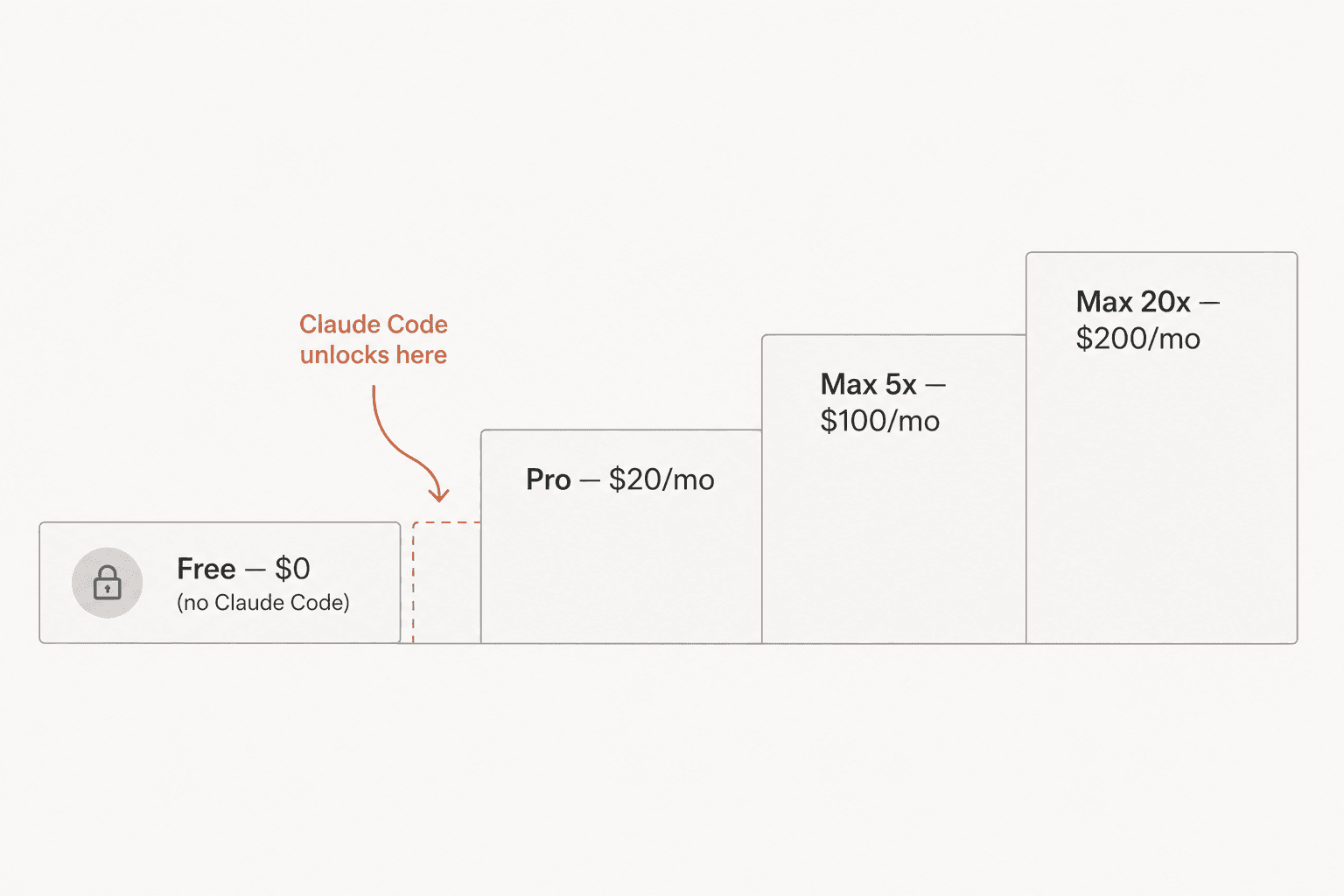
For an individual developer, Pro at $20/month is the floor. Reddit's r/ClaudeCode community is where the honest answer to "is Pro enough" actually lives, and it's mixed:
"I've been using Claude Code very heavily since early July... But right now, the $20 Pro plan feels almost meaningless. I hit my session limit just by chatting. After that, it started consuming my API credits... If I can't get any actual work done, have to wait 3 hours, and then still can't get meaningful work done again - what's the point?"
-- Direct_Librarian9737, r/ClaudeCode
Other users in the same thread on the same $20 plan report the opposite, hitting their limits rarely because they run a disciplined CLAUDE.md and use /compact between sessions. The variance is wide enough that the honest advice is: start on Pro, watch your first two weeks of usage logs, and only upgrade to Max 5x ($100/month) once you're actually hitting session limits mid-task, not before.
What model you're actually paying for
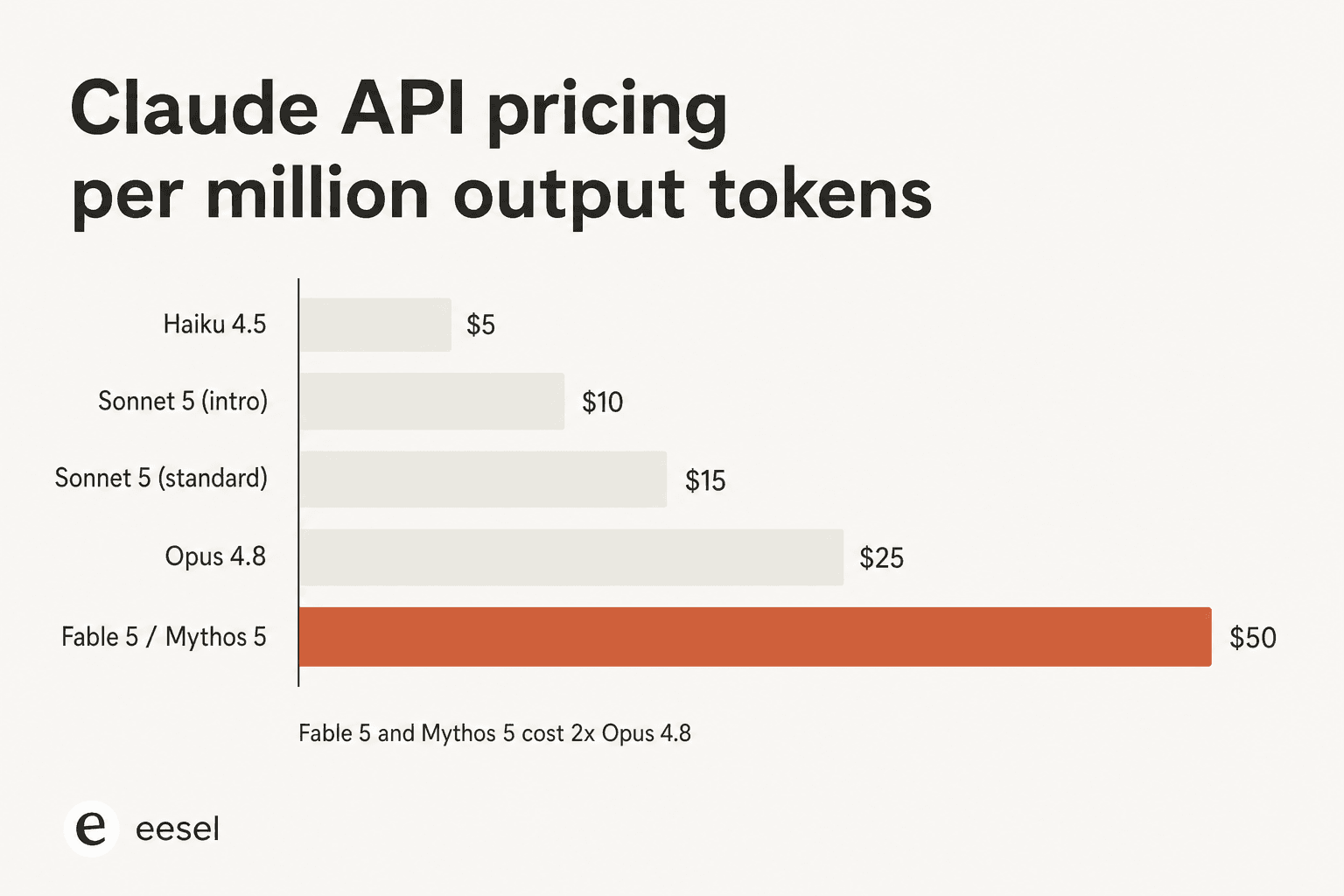
If you're on the API, Enterprise usage track, or just want to understand what's under the subscription hood, the model you route to changes the bill by up to 10x. The lineup shifted since June: Sonnet 5 is now the default coding model (introductory $2/$10 per million tokens through August 31, then $3/$15), and two new models - Fable 5 and Mythos 5 - launched at roughly double Opus 4.8's rate.
| Model | Input / MTok | Output / MTok | Notes |
|---|---|---|---|
| Haiku 4.5 | $1 | $5 | Cheapest; 200K context |
| Sonnet 5 (intro, through Aug 31) | $2 | $10 | Default coding model on Pro/Free |
| Sonnet 5 (standard, from Sep 1) | $3 | $15 | Same rate as Sonnet 4.6 |
| Sonnet 4.6 | $3 | $15 | Now legacy, unchanged price |
| Opus 4.8 | $5 | $25 | Highest-reasoning tier below Fable/Mythos |
| Fable 5 (new) | $10 | $50 | 2x Opus 4.8's rate |
| Mythos 5 (new, limited availability) | $10 | $50 | Invite-only |
Prompt caching applies the same multipliers across every model: a 5-minute cache write costs 1.25x the base input rate, a 1-hour write costs 2x, and a cache hit (read) costs just 0.1x. For a coding session that keeps re-reading the same files - which is most of them - cache reads are where the real savings live, not the base rate. Batch processing cuts both input and output by 50% for async, non-interactive workloads.
One workflow-shaping detail: many Claude Code best practices threads on Reddit recommend using Opus for planning and Sonnet for execution within the same session, via model configuration - you pay Opus rates only for the thinking, not the typing.
The two pricing numbers Anthropic hasn't reconciled
This is the part worth slowing down for, because it's the kind of detail that quietly wrecks a cost forecast built off the sticker rate alone.
The tokenizer catch. Sonnet 5, Fable 5, Mythos 5, and Opus 4.7+ all use a newer tokenizer that produces roughly 30% more tokens for the same text than the one Sonnet 4.6 and earlier models use. So even where the per-token rate looks flat - Sonnet 5's standard rate is identical to Sonnet 4.6's - the same prompt gets billed on more tokens. Anthropic's introductory discount ($2/$10 through August 31) is explicitly designed to offset this so the migration reads as "cost-neutral" while it's active; once standard pricing kicks in on September 1, that gap becomes a real increase.
The fast-mode discrepancy. Anthropic's general Messages API prices Opus 4.8 fast mode at $10/MTok input and $50/MTok output - 2x standard, for 2.5x the speed. But Claude Code's own product FAQ states something different:
"Fast mode is a high-speed configuration for Opus 4.8, making the model 2.5x faster at a higher cost per token... priced at $30/$150 per million tokens."
-- Anthropic, Claude Code product page
That $30/$150 figure is actually the general API's rate for the previous model, Opus 4.7, not 4.8. Both numbers come from Anthropic's own pages, so this isn't a rumor to dismiss - it's a live discrepancy in Anthropic's own materials. If you're budgeting fast mode into a Claude Code enterprise rollout, verify the rate your account is actually being charged before you model it at scale.
What Claude Code actually costs a real team
Anthropic now publishes its own usage-cost data, and it's a useful reality check against sticker-price budgeting:
- Average cost: ~$13 per developer per active day, or $150-250 per developer per month, across enterprise deployments.
- 90% of users stay under $30/active-day. The long tail is concentrated in a small share of heavy users.
- Agent teams - multiple Claude Code teammates running in parallel via subagents or multi-agent orchestration - use roughly 7x more tokens than a single-agent session, since each teammate keeps its own context window.
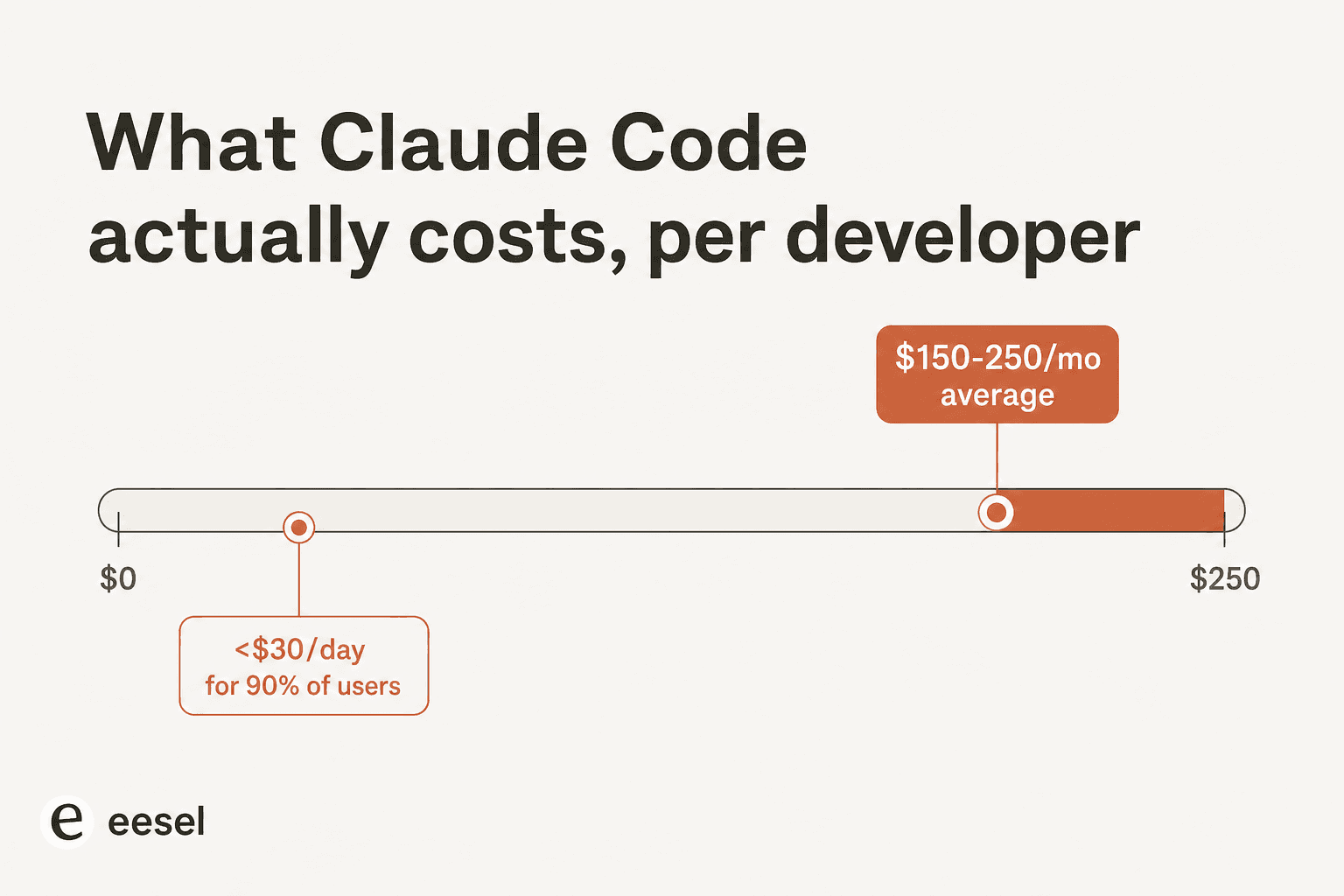
That $150-250/month range sits above a Max 5x seat ($100/month) for a meaningful share of users, which lines up with what shows up on G2 and Capterra: heavy users on the $20 Pro plan routinely overflow into consumption-based billing, and some report cancelling once the "predictable" subscription stopped feeling predictable. It's the same tension Claude Code's own usage analytics dashboard exists to help you catch before the invoice does.
Claude Code vs Cursor and GitHub Copilot on price
None of Claude Code's competitors price identically, which makes a straight seat-to-seat comparison misleading, but it's worth knowing where the entry points sit:
| Tool | Entry price | Notes |
|---|---|---|
| Claude Code (via Pro) | $17-$20/month | Usage-allowance model, no fixed request cap |
| Cursor | Lower entry tier | IDE-native; usage-based credits on top tiers |
| GitHub Copilot | Lower entry tier | Per-seat, request-capped on lower tiers |
| Cognition AI / Devin | Usage-based, no flat seat | Fully autonomous agent, priced per task |
Reviewers on both G2 and Reddit consistently frame the comparison as "autopilot vs copilot" rather than pure price: Claude Code is built for delegating a task end-to-end, while Cursor and GitHub Copilot lean toward interactive, in-editor assistance. That's a real product difference, and it means the honest price comparison isn't monthly fee versus monthly fee - it's cost per finished task, which none of the vendors publish cleanly.
"Claude Code and Codex do not replace Copilot and Cursor... Mode 1: AI writes the code, and the human copilots. Mode 2: The human writes the code, and AI copilots. These two are very different. One doesn't replace the other. Professional developers use both."
-- @svpino on X
The pricing question that actually matters if you're not shipping code
Here's where I want to zoom out, because the pattern in Claude Code's pricing is one I've seen play out in a completely different market: customer support. eesel's own philosophy for why we exist next to a tool like this is blunt: Claude Code is infrastructure; an AI teammate is the employee. Claude Code can theoretically do anything a developer can direct it to do, but turning that into a running, integrated, non-engineer-accessible product - hosting, wired-up integrations, approval flows, packaged skills for a specific job - is real work. That's true for coding, and it's just as true for support.
If the question that brought you here is really "should we build our own AI agent on Claude's API instead of buying one," the honest answer from someone who's spent years running AI on live support queues: the model was never the expensive part. It's the retrieval over your own docs and past tickets, the confidence-based routing, the actions inside your helpdesk, and the testing before it ever touches a real customer. I've watched a confident-sounding bot quietly give wrong answers, which is why eesel simulates every rollout against your historical tickets before it goes live, rather than finding out the failure mode in production.
Try eesel
If Claude Code's pitch made you wonder what the same "point it at your work and it just runs" idea looks like for customer support rather than code, that's exactly what eesel is. It plugs into your existing helpdesk, learns from your own knowledge base and closed tickets, and comes with packaged skills for the actual job - not a general-purpose agent you have to wire up yourself.
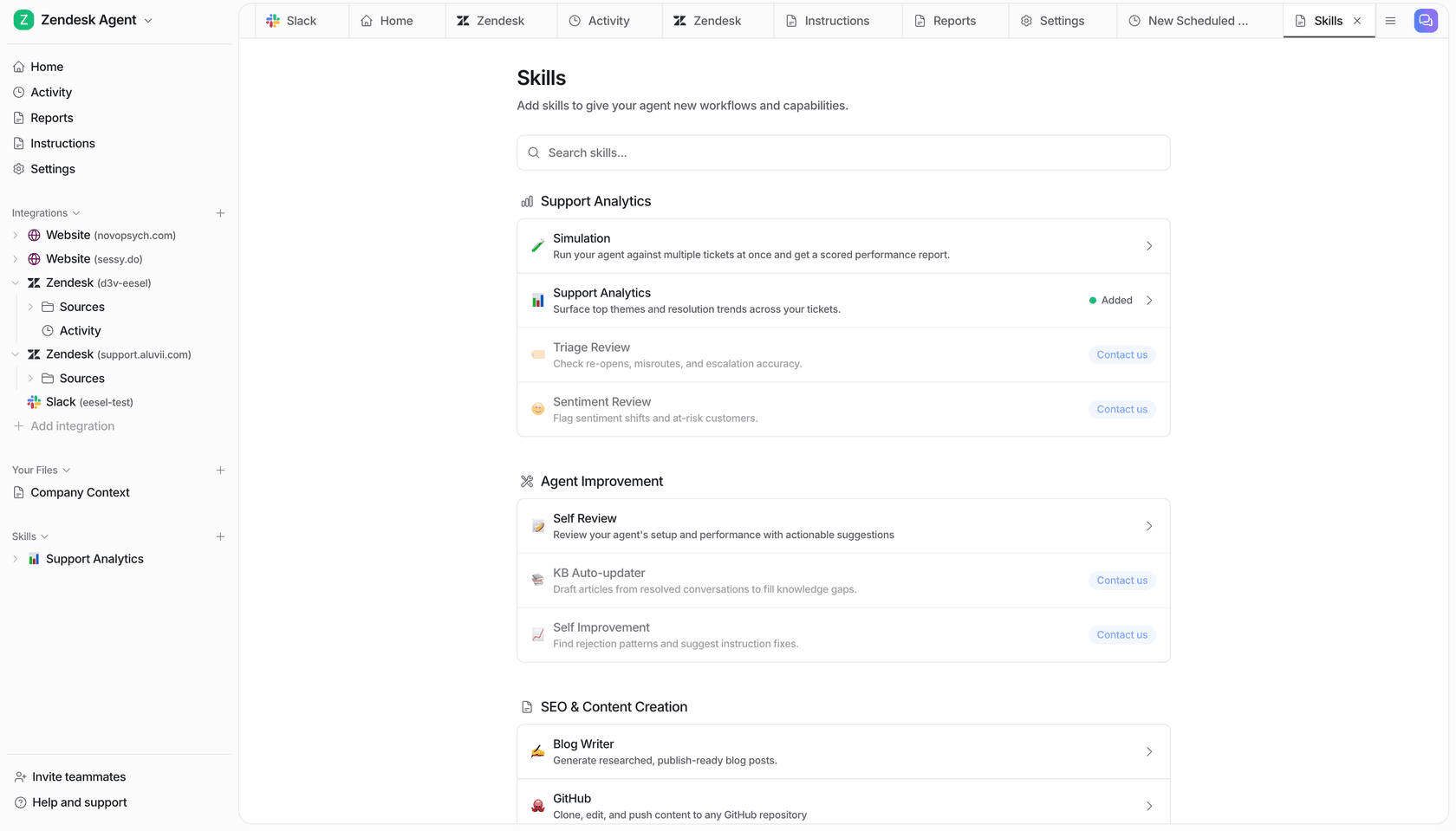
Pricing follows the same instinct of predictability that Claude Code's usage-based model gestures at but doesn't fully deliver on: eesel is one fixed monthly price sized to volume (from $299/month for 500 credits, 1 credit per ticket or chat), with no per-seat fee to budget around. It's free to try with 100 credits, and you can see your real resolution rate on your own tickets in a few minutes.