

What Kimi K2.7 Code actually is
Kimi K2.7 Code is Moonshot AI's "most capable coding model to date," per the official quickstart docs. It's built on top of Kimi K2.6, the company's prior flagship, and specialized for long-horizon software engineering rather than general conversation: planning, editing across files, running tools, and debugging across many steps in a single session.
Under the hood it's a Mixture-of-Experts model: 1 trillion total parameters, 32 billion activated per token, spread across 384 experts (8 selected per token, 1 shared), with a 256K-token context window and native INT4 quantization. It ships in two flavors, kimi-k2.7-code and a kimi-k2.7-code-highspeed variant tuned for roughly 180 tokens/sec (up to 260 tok/s in short contexts). Both are released under a Modified MIT license, covering the weights themselves, not just the wrapper code, so this is a genuinely open model, not an API-only product with an open-source label glued on.
One design choice is worth flagging up front: thinking mode cannot be disabled. Every request runs the model's full chain-of-thought whether you want it to or not, and the API errors if you try to override temperature, top_p, or the penalty parameters away from their fixed defaults. Moonshot frames this as a deliberate design decision that improves multi-step tool-calling reliability. It also means you have less control over the cost/latency dial than you'd get from most competing coding models.
The benchmarks, and where they actually land
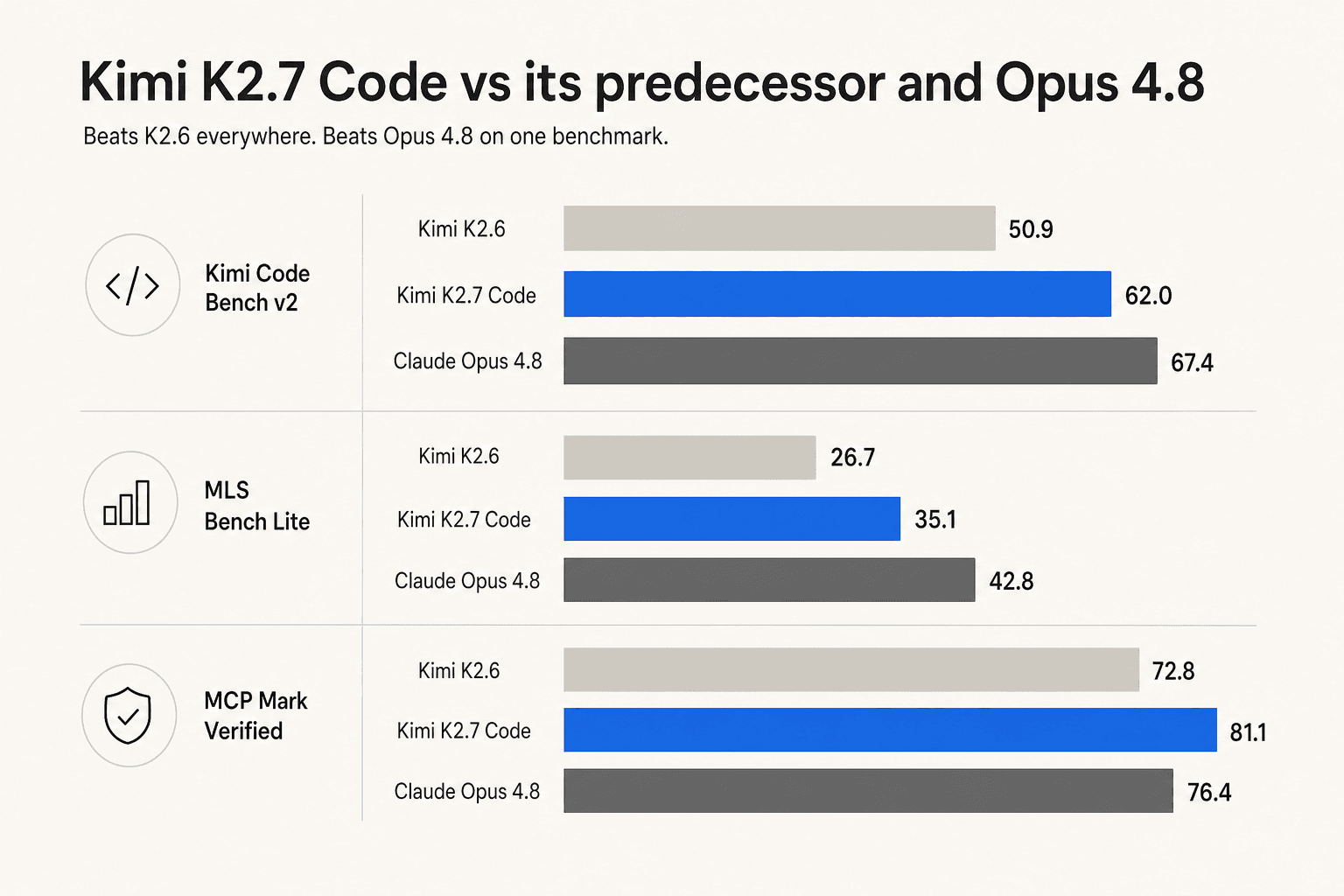
Moonshot published six benchmark comparisons against K2.6, GPT-5.5, and Claude Opus 4.8, each run in each model's own agent harness (Kimi Code CLI, Codex xhigh, Claude Code xhigh respectively):
| Benchmark | Kimi K2.6 | Kimi K2.7 Code | GPT-5.5 | Claude Opus 4.8 |
|---|---|---|---|---|
| Kimi Code Bench v2 | 50.9 | 62.0 | 69.0 | 67.4 |
| Program Bench | 48.3 | 53.6 | 69.1 | 63.8 |
| MLS Bench Lite | 26.7 | 35.1 | 35.5 | 42.8 |
| Kimi Claw 24/7 Bench | 42.9 | 46.9 | 52.8 | 50.4 |
| MCP Atlas | 69.4 | 76.0 | 79.4 | 81.3 |
| MCP Mark Verified | 72.8 | 81.1 | 92.9 | 76.4 |
K2.7 Code beats K2.6 on every single row, most notably +21.8% on Kimi Code Bench v2 (the largest absolute jump) and +31.5% on MLS Bench Lite (the largest percentage jump), per MarkTechPost's coverage of the release. But read the other two columns before you get excited: GPT-5.5 leads on five of six benchmarks, and Opus 4.8 leads on four of six. The one genuine win against Opus 4.8 is MCP Mark Verified, a tool-use benchmark measuring correct invocation through the Model Context Protocol, where K2.7 Code's 81.1 beats Opus 4.8's 76.4 outright.
The honest framing, and one MarkTechPost's own piece stresses, is that every number here is first-party. Moonshot ran these on its own harness with no independent leaderboard verification yet. That's not disqualifying, but it's the same caveat that applies to every vendor benchmark table, Grok 4.5's included: treat the launch numbers as "directionally credible," not gospel, until someone outside the company reproduces them.
Kimi K2.7 Code pricing
Official rates, confirmed on Moonshot's pricing page for the model and cross-checked against OpenRouter's provider table:
| Model | Input (cache hit) | Input (cache miss) | Output | Context |
|---|---|---|---|---|
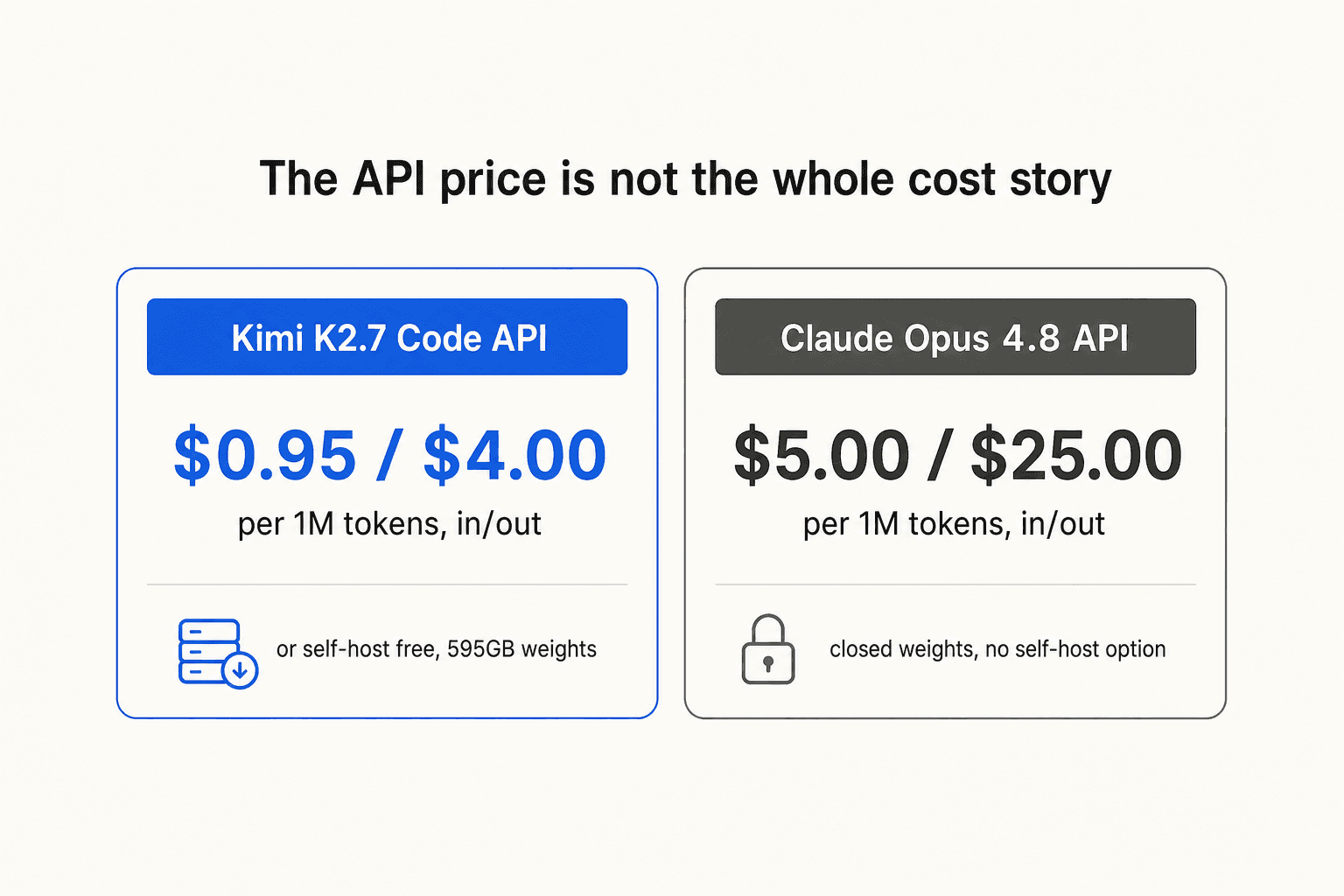
| kimi-k2.7-code | $0.19 /1M | $0.95 /1M | $4.00 /1M | 262,144 tokens |
| kimi-k2.7-code-highspeed | $0.38 /1M | $1.90 /1M | $8.00 /1M | 262,144 tokens |
| Claude Opus 4.8 (for reference) | - | $5.00 /1M | $25.00 /1M | 1M tokens |
There's no free API tier, exactly. A $1 minimum recharge unlocks the lowest rate limit tier (3 requests/min, 500K tokens/min), and limits scale up through five tiers based on cumulative spend, topping out at 10,000 RPM and 5M tokens/min once you've put in $3,000. Third-party hosts on OpenRouter (DeepInfra, Inceptron, and others) undercut Moonshot's own rate by roughly 20-25% on input tokens, generally at lower throughput and uptime than Moonshot's own endpoint, which itself runs a respectable 99.59% uptime.
The other path, and the one that matters most for a genuinely open-weight model, is self-hosting for the cost of your own hardware. The full BF16 weights run about 595GB, real server-class territory, needing multiple H200-class GPUs. Community quantization closes that gap fast: Unsloth's Dynamic 2-bit quant shrinks the model to roughly 325GB and runs at 40+ tokens/sec on well-specced local hardware. That's not a laptop deployment, but it's a real option for a team that already has GPU infrastructure and wants zero marginal cost per token.
The reasoning-token paradox: what Moonshot claims vs. what users report
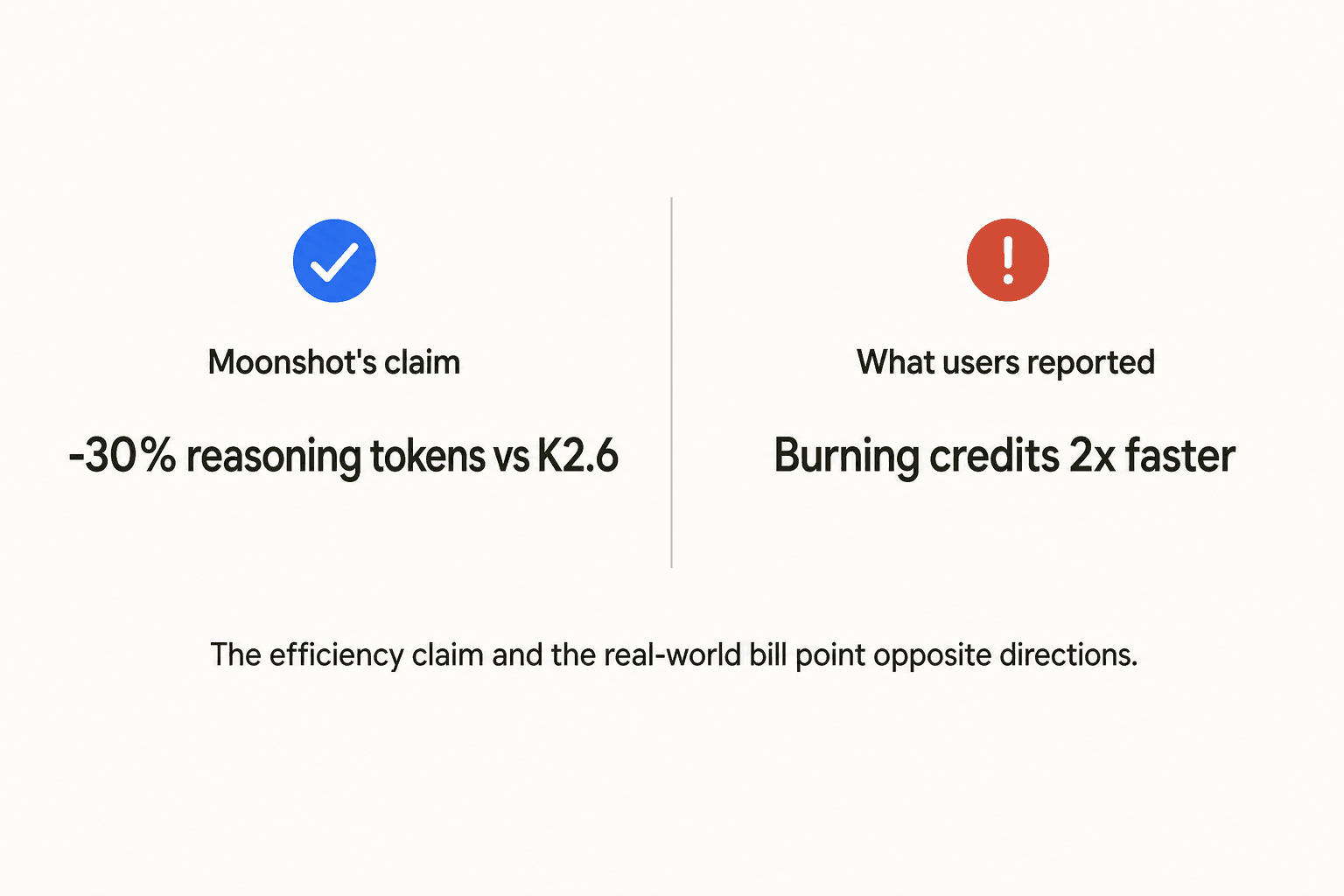
This is where the review turns from spec sheet to actual news. Moonshot's own launch materials lead with an efficiency pitch: K2.7 Code supposedly uses ~30% fewer reasoning tokens than K2.6 for the same work, "optimized reasoning efficiency," in the company's words, framed as less overthinking on problems that don't warrant it.
The community's read, gathered from the wider swarm of r/kimi, r/LLMDevs, and r/AI_Agents threads discussing the release (the official Reddit announcement thread itself was blocked to direct fetch, so this is drawn from the surrounding discussion it spawned), tells close to the opposite story:
"Kimi 2.7 Code is good, but it thinks forever and consumes way too much limit."

"Same for me: I'm spending tokens twice as fast."
"Is anyone else losing their mind with Kimi 2.7 lately? I explicitly tell it to stop, check-in, and ask for permission before moving to the next step, and it just keeps going."
Not every thread is negative, and the split matters. Some users, especially self-hosters running their own quantized copies, report a genuinely solid coding model: "Kimi is like slight worse than Claude, but with 5X the usage limits at maybe half the speed," read one r/kimi verdict thread, and another commenter on r/AI_Agents called it "a better default for long coding jobs that need to keep going" rather than a flashy leap. But the cost-consumption complaint is specific, recurring, and directly contradicts the headline claim, which is a different kind of criticism than the usual "it's not as smart as Claude" grumbling every coding model gets.
There's also a real, separate quality complaint running alongside the cost one: multiple threads report hallucinations and regressions relative to K2.6 on the exact kind of straightforward tasks the model should handle cleanly. One r/kimi thread put it bluntly: "Anyone else notice that K2.7 is making up a lot of shit versus what K2.6 used to do?" I've seen this exact shape of failure before in AI support deployments, a model performs beautifully in a demo and then confidently invents something on a real, messier input the demo never covered. It's the reason I never trust a vendor's efficiency or accuracy number until I've run it against real historical data first, not just the benchmark suite the vendor picked.
Kimi K2.7 Code pros and cons
What it's genuinely good at:
- Cheap, credible open-weight coding. $0.95/$4.00 per 1M tokens undercuts every closed frontier model, and the Modified MIT license means self-hosting is a real option, not marketing.
- A real win on tool-use. MCP Mark Verified's 81.1 beats Opus 4.8 outright, useful if your workload leans on structured tool calling (CI checks, ticket updates, file edits in one loop) more than raw reasoning depth.
- Universal improvement over K2.6. Every one of the six published benchmarks moved up, and the 256K context window comfortably holds a large diff, its tests, and related files in one prompt.
- A genuinely open self-host path. Community quantization already gets a 1T-parameter model down to ~325GB, running at usable speed on serious but attainable local hardware.
Where it falls short:
- The headline efficiency claim doesn't match the community's real-world bills. A -30% reasoning-token claim followed by a wave of "burning credits twice as fast" threads is the single biggest problem with this launch, and it's worth confirming on your own workload before committing budget.
- It's not the smartest coding model available. GPT-5.5 leads on five of six benchmarks and Opus 4.8 leads on four, including the two you'd weight heaviest for raw coding quality (Program Bench, MLS Bench Lite).
- Thinking mode is mandatory. You cannot trade reasoning depth for speed or cost the way you can with most competing models; the sampling parameters are locked too.
- Hallucination reports on straightforward tasks. Multiple users flag regressions versus K2.6 on exactly the kind of task that shouldn't need heavy reasoning at all.
Is Kimi K2.7 Code good outside of coding?
Kimi K2.7 Code is scoped narrowly, and that's mostly a strength: Moonshot itself says K2.6 is still the better pick for general tasks, which is a more honest positioning than most vendors manage. But the underlying lesson here reaches past coding, and it's one I run into constantly building AI for customer support: a vendor's efficiency number is not the same thing as your actual bill. Moonshot's own benchmark says -30% reasoning tokens. A meaningful slice of its own users report the opposite in production. That gap between a lab number and a live account is exactly why "the model is cheap per token" and "the model is cheap for your team" are two different claims, and only one of them is true until you've tested it on your own workload.
I've watched the identical pattern play out in support automation: a vendor quotes a deflection rate or a per-resolution price that looks great in a sales deck, and then real ticket volume behaves nothing like the benchmark set it was measured against. It's why eesel never ships a number we haven't run against a customer's actual historical tickets first, simulated before it ever touches a live queue, so you see the real resolution rate and the real cost on your own data rather than trusting a vendor benchmark, coding model or support AI, it's the same discipline either way.
The verdict
If you want a genuinely open-weight coding model at a fraction of frontier pricing, and you're prepared to either eat the API's usage-tier structure or take on self-hosting a 1T-parameter model, Kimi K2.7 Code is a real, credible option, especially for tool-heavy agentic workflows where its MCP Mark Verified win actually matters. If you need the single smartest model for hard coding problems, GPT-5.5 and Claude Opus 4.8 still lead on most of Moonshot's own benchmarks, at a real price premium. And if cost predictability matters to your team more than any single benchmark score, the gap between Moonshot's -30% reasoning-token claim and the community's "burning credits twice as fast" reports is the thing to test on your own account before you commit, not the thing to take on faith from a launch post. For the wider field of open-weight peers, Qwen3-Coder and Kimi K2.6 are both worth a look in the same evaluation pass.
Try eesel
I work on eesel AI, and the exact problem Kimi K2.7 Code's launch surfaced, a vendor's efficiency claim not matching what a real account actually spends, is the same problem I've watched play out in AI support tooling for years. Whichever model ends up powering your support automation, Kimi, GPT, Claude, or whatever ships next, the number that matters isn't the benchmark score, it's what your account actually spends resolving real tickets. eesel plugs into your existing helpdesk, whether that's Zendesk, Freshdesk, or Front, learns from your real ticket history, and runs a full simulation against your own historical tickets so you see the actual resolution rate and cost before anything goes live. Pricing is one fixed monthly plan, from $299/month for 500 credits (1 credit per ticket or chat, however long), no seat fees, so the number you're quoted is the number you pay. You can try eesel free with 100 credits, no self-hosting required.
Frequently Asked Questions
What is Kimi K2.7 Code?
How much does Kimi K2.7 Code cost?
Is Kimi K2.7 Code better than Claude Opus 4.8 or GPT-5.5 for coding?
Can I run Kimi K2.7 Code for free by self-hosting?
Does Kimi K2.7 Code really use fewer tokens than K2.6?


Article by
Rama Adi
Rama is a software engineer at eesel AI with two years of experience writing about B2B SaaS, AI tools, and customer support technology. Based in Bali, Indonesia, he brings a developer's perspective to product comparisons — cutting through marketing copy to what the integrations and APIs actually do.