

Moonshot AI's Kimi K2.5 has certainly made waves in the open-source AI community. It's a powerhouse, boasting a massive 1 trillion parameter architecture and "Agent Swarm" tech for tackling tough problems. It’s strong, budget-friendly, and developers are, quite rightly, pretty hyped about it.
But the most powerful tool isn't always the right tool. Kimi K2.5 is impressive, but it’s not a one-size-fits-all solution for every team or project. You might need something more specialized, easier to handle, or just built for a completely different job.
That's exactly why I've put this list together. I’m going to look at the best Kimi K2.5 alternatives out there, from raw open-source models for the tinkerers to ready-to-go AI platforms that business teams can start using right away.
What is Kimi K2.5?
Kimi K2.5, released by Moonshot AI in January 2026, is a pretty significant model. It's an open-source Mixture-of-Experts (MoE) model, which is a technical way of saying it's very efficient. While it has a mind-bending 1 trillion total parameters, it only fires up about 32 billion for any given task, which helps keep it fast and affordable.
Here’s a quick look at what makes it special:
- It’s natively multimodal, which means it was trained from the start on 15 trillion text and visual tokens. It understands both pictures and words.
- It has an ultra-long 256K token context window, so it can process and reason over huge documents or conversations.
- Its "Agent Swarm" tech is a big deal. It can coordinate up to 100 mini-agents at once to break down and solve complex problems up to 4.5 times faster.
- The "Coding with Vision" feature is pretty amazing. It can generate UI code just by looking at a mockup or watching a video of an app in action.
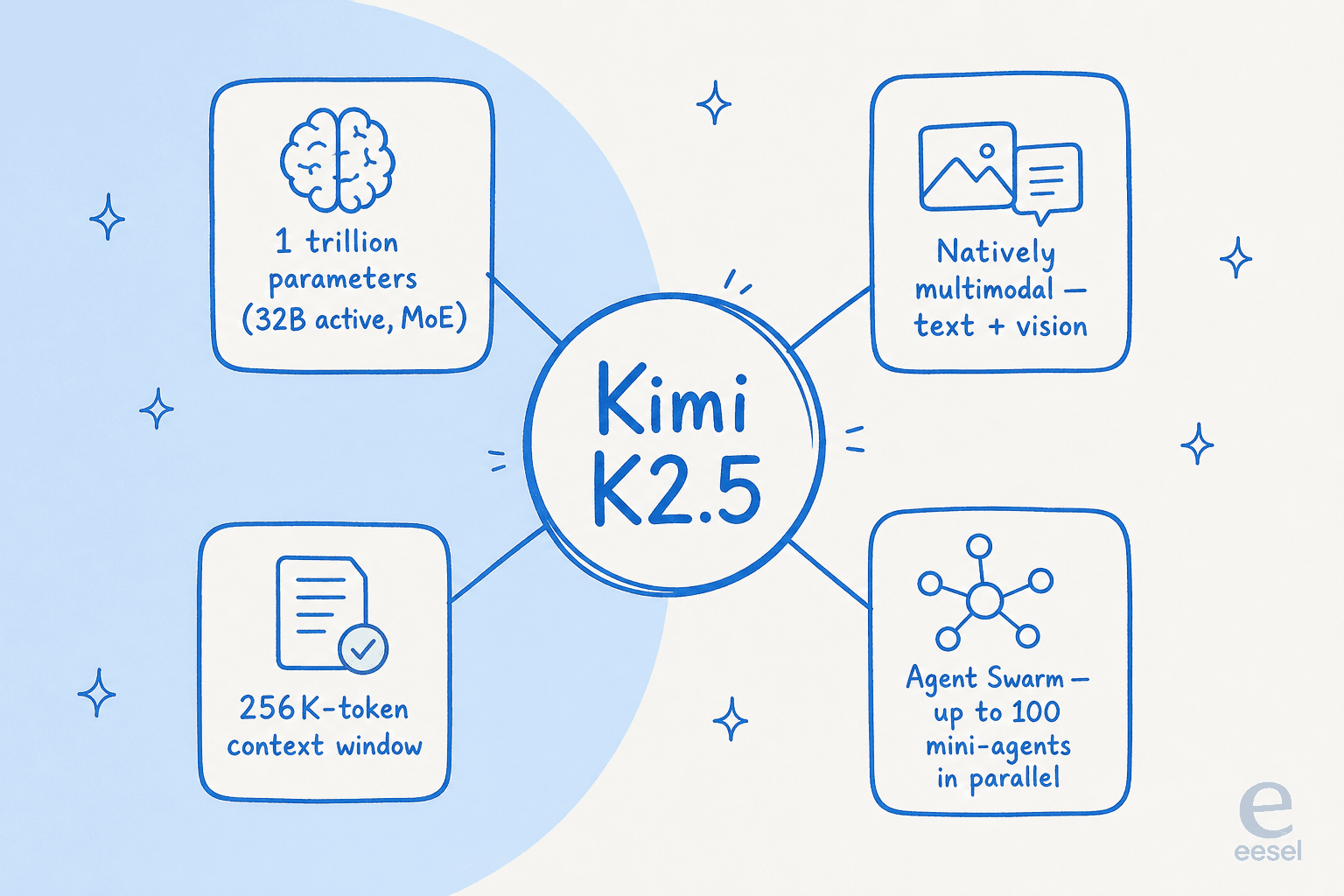
An infographic detailing the key features of Kimi K2.5, a powerful model and one of several Kimi K2.5 alternatives.
In short, it’s a beast for developers building custom AI applications. If you want the full cost picture, I broke it down in our Kimi K2.5 pricing guide. But it takes a lot of technical skill to deploy it and turn it into something a business can actually use.
Why look for Kimi K2.5 alternatives?
What makes an AI solution the "best" really depends on what you're trying to do. A raw, open-source model is like getting a world-class engine. You can build a phenomenal race car with it, but you still have to build the car.
Here are a few solid reasons why you might be looking for something other than Kimi K2.5:
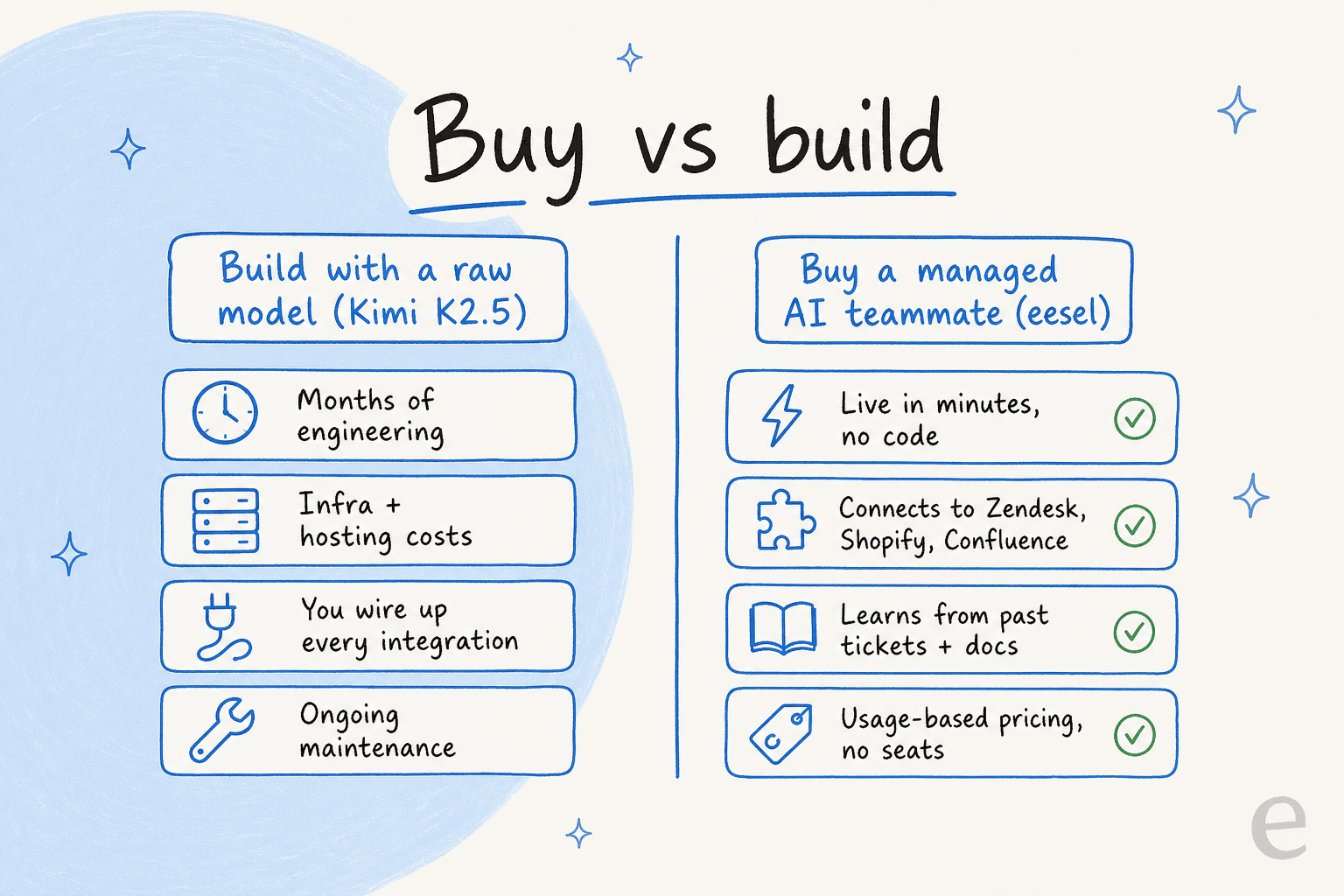
- You need something that just works. Building a production-ready app, like a customer support agent that can handle real questions, with an open-source model can take months. Most teams need a solution that’s ready to go now, not a huge DIY project.
- You have a specific business problem to solve. Kimi K2.5 is a generalist that's great at complex reasoning. But other platforms are built specifically for jobs like customer service automation or boosting sales. For example, a business with many support tickets can hire an AI teammate and have it resolving conversations in minutes, not months.
- You can't compromise on performance. For those critical tasks where accuracy is everything, the top-tier proprietary models like Anthropic's Claude Opus 4.8 still have an edge in some key industry benchmarks.
- You need enterprise-level support and compliance. If you're running a larger business, you probably need a solution from a provider that offers certifications like SOC 2 or HIPAA, plus a support team you can actually call. That’s not really the focus of an open-source project.
A quick comparison of Kimi K2.5 alternatives
Here’s a simple breakdown of the alternatives I'm about to cover.
| Tool | Best For | Pricing Model | Key Feature | Open Source? |
|---|---|---|---|---|
| eesel AI | Customer Service & Sales Teams | Usage-based (per task) | AI Teammate (No-Code Setup) | ❌ |
| Claude Opus 4.8 | Frontier Performance & Reasoning | Per Token (Premium) | State-of-the-art Accuracy & Compliance | ❌ |
| DeepSeek-V3.2 | Specialized Coding & Math | Per Token (Affordable) | Reasoning-first model | ✅ |
| GLM-4.7 | Agentic Workflows & UI Generation | Per Token (Affordable) | "Thinking before acting" logic | ✅ |
| Grok 4.1 Fast | Real-time Info & Massive Context | Per Token | 2M Token Context Window | ❌ |
| Devstral 2 | End-to-End Software Engineering | Per Token (Affordable) | Codebase-Aware Agent | ✅ |
A detailed look at 6 Kimi K2.5 alternatives
Let's dig into what makes each of these a solid choice, depending on what you need.
1. eesel AI
Instead of giving you a raw model and a toolbox, eesel AI is an "AI teammate" that you hire, not configure. It's a complete, managed platform for business teams that need to solve actual problems, like handling customer service, increasing e-commerce sales, or answering internal questions. You just connect it to the tools you already use (Zendesk, Shopify, Confluence, etc.), and it learns your business in minutes by reading your past tickets, help articles, and internal docs.
- Pros and Cons: The biggest advantage here is how quickly you see results. A company can have a fully functional AI agent handling real customer conversations in under an hour, without writing any code. Some setups see up to 81% of tickets resolved autonomously. That’s a world away from the months of development needed to build something similar with a raw model like Kimi K2.5. The trade-off is that it’s a platform built for specific jobs, not a general-purpose model for developers to build anything they can dream up.
- Pricing: eesel AI is usage-based — you pay for what the AI actually does, with no per-seat fees and no platform minimum.
- Pay-as-you-go: from $0.40 per ticket or chat resolved. One ticket counts as one task, no matter how many back-and-forth messages it takes.
- Free to start: $50 of usage with every feature unlocked, no credit card needed.
- Worked example: 1,000 tickets a month is about $400; if you only route 200 of them to the AI, you pay ~$80 and never get charged for tickets your humans handle.
- Enterprise: a $1,000/month flat platform fee adds a dedicated solutions engineer, SSO, HIPAA, and a signed BAA.
- Why I included it: It represents the "buy vs. build" decision perfectly. If your goal is to solve a business problem like high support volume, eesel AI is a much faster and more direct route to results than trying to build an agent swarm from the ground up. It's worth weighing how much AI saves before committing months of engineering time.
2. Claude Opus 4.8
Claude Opus 4.8 from Anthropic is one of the top closed-source models available, competing directly with the best from OpenAI and Google. It's known for its incredible skill in handling complex reasoning and agentic coding, and Anthropic positions it as its flagship for engineering and enterprise work. Through late 2025 and into 2026, community benchmark threads have consistently put the Opus line near the top for coding tasks.
I can confirm, I cancelled my $100 subscription due to the poor performance of the last weeks. Now I'm using Opencode with their Zen cloud service running Kimmi K2.5 and is far superior to Opus. This goes to all the ones that keep repeating that is a skill issue, Yes its a skill issue of the fucking Claude Model!

- Pros and Cons: Its main strength is its raw power and reliability for high-stakes work where you just need the best possible answer. Since it's a proprietary model, it's much pricier than open-source options, and you don't get the same transparency or customizability. For large companies, it’s a great choice because it comes with important compliance certifications like SOC 2 Type 2 and HIPAA readiness. If you're weighing the closed-source field, my Claude Opus alternatives roundup goes deeper.
- Pricing:
- API Pricing: $5/$25 per million tokens (input/output) — see the full Opus API costs breakdown.
- Claude Pro Plan: $20/month for web access, though it has usage limits.
- Why I included it: It’s the best-in-class proprietary alternative for teams that need top performance and enterprise-grade features, and have the budget for it. For a hands-on read, my Claude review covers a month of real use.
3. DeepSeek-V3.2
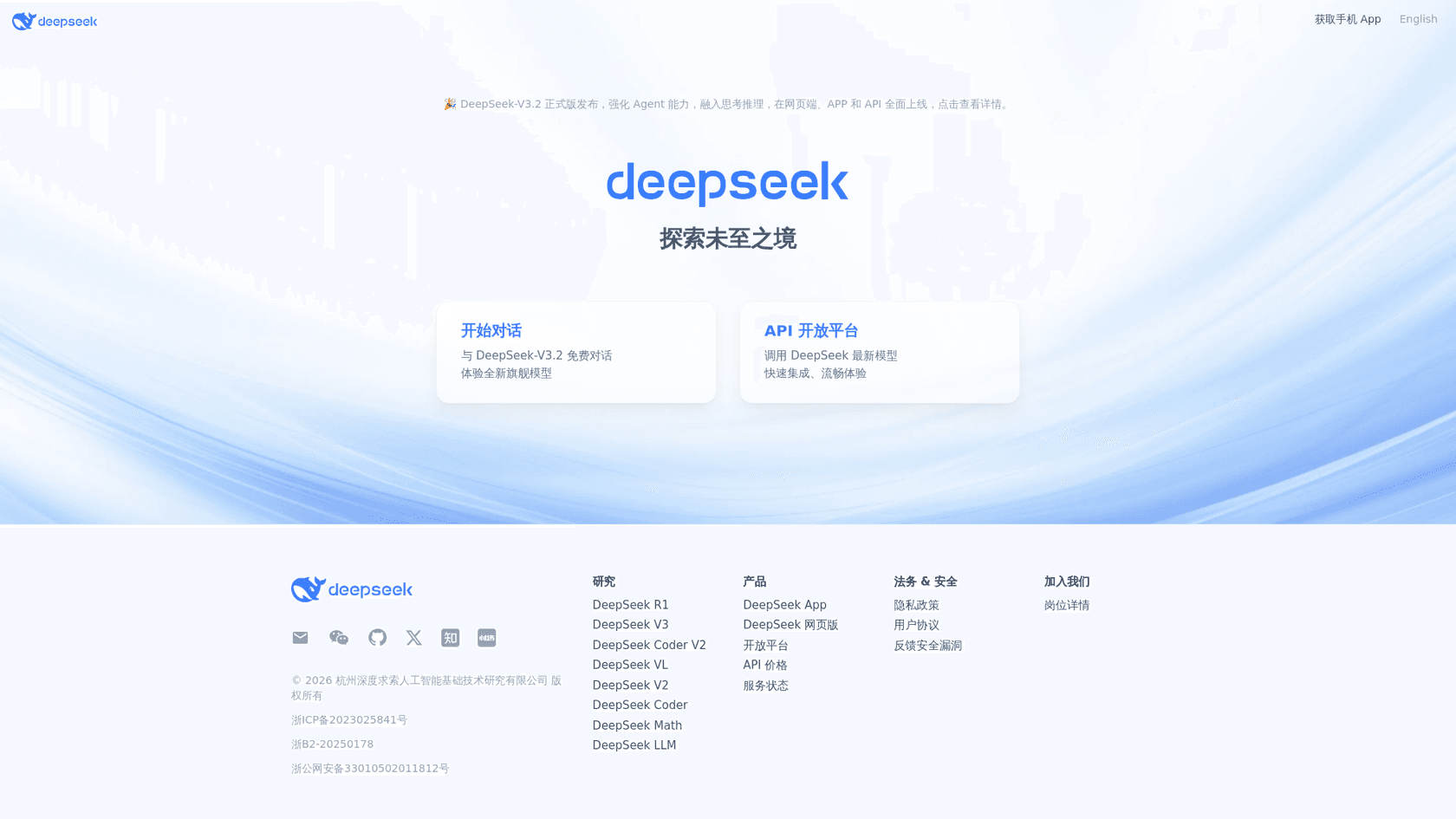
DeepSeek-V3.2 is a very impressive open-source model from Hangzhou DeepSeek AI that's built for complex problem-solving without costing a fortune. It comes in two versions: a standard "chat" mode and a "reasoner" mode that's excellent at step-by-step thinking, making it ideal for technical and logical tasks.
- Pros and Cons: DeepSeek’s biggest win is its sharp focus on reasoning at a very competitive price. As an MIT-licensed open-source model, it gives developers a lot of freedom to build on top of it. Of course, like any raw model, it's up to you to do the work to integrate it into a real-world business application.
- Pricing:
- API Access (Reasoner mode): Around $0.28 per million input tokens and $0.42 per million output tokens.
- Open-Source: It’s free to download and run on your own machines.
- Why I included it: It's a top-tier open-source competitor to Kimi K2.5 that excels at reasoning and technical tasks, offering a super cost-effective option for developers. It plays in the same value bracket as the best Qwen alternatives.
4. GLM-4.7
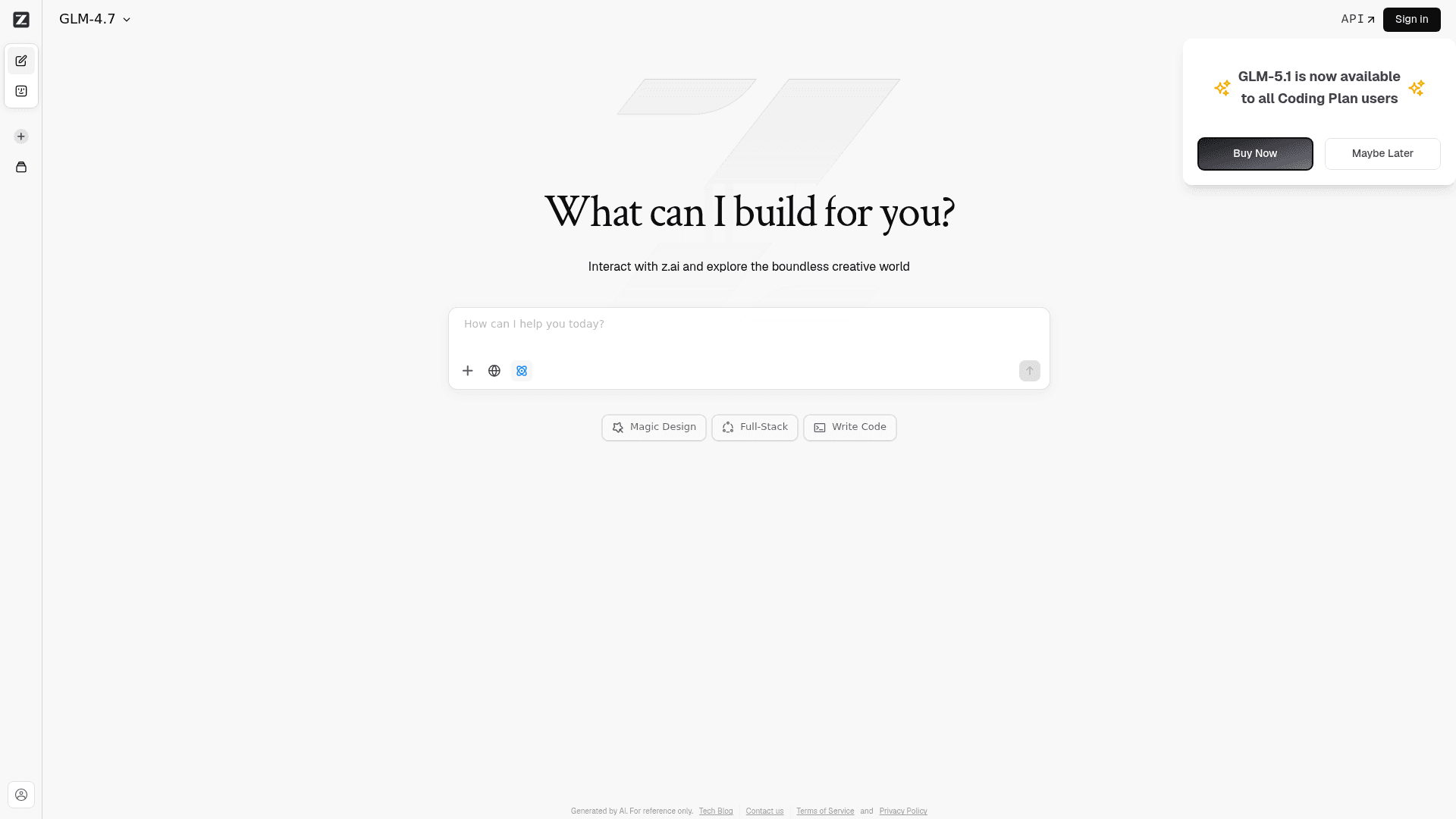
Coming from Zhipu AI, GLM-4.7 is an advanced open-source model that scores well across coding, agentic tasks, and reasoning. One of its neatest features is its ability to "think before acting," which helps it perform more reliably in complex, multi-step workflows. It’s also particularly good at generating UI and frontend code.
- Pros and Cons: GLM-4.7 is a fantastic all-around model for developers looking to build AI agents. Its strong tool-use and UI generation skills are a huge plus. On the other hand, its ecosystem isn't quite as developed as what you’d find with models from bigger names like Mistral or Meta, so you might find fewer community tutorials and resources.
- Pricing:
- API Access: You can access it through platforms like Fireworks and Novita for about $0.60 per million input tokens and $2.20 per million output tokens.
- Open-Source: The model weights are available under an MIT license for local use.
- Why I included it: It’s a highly capable open-source model that's great at creating the exact kind of agentic workflows that Kimi users are interested in, making it a direct and compelling alternative.
5. Grok 4.1 Fast
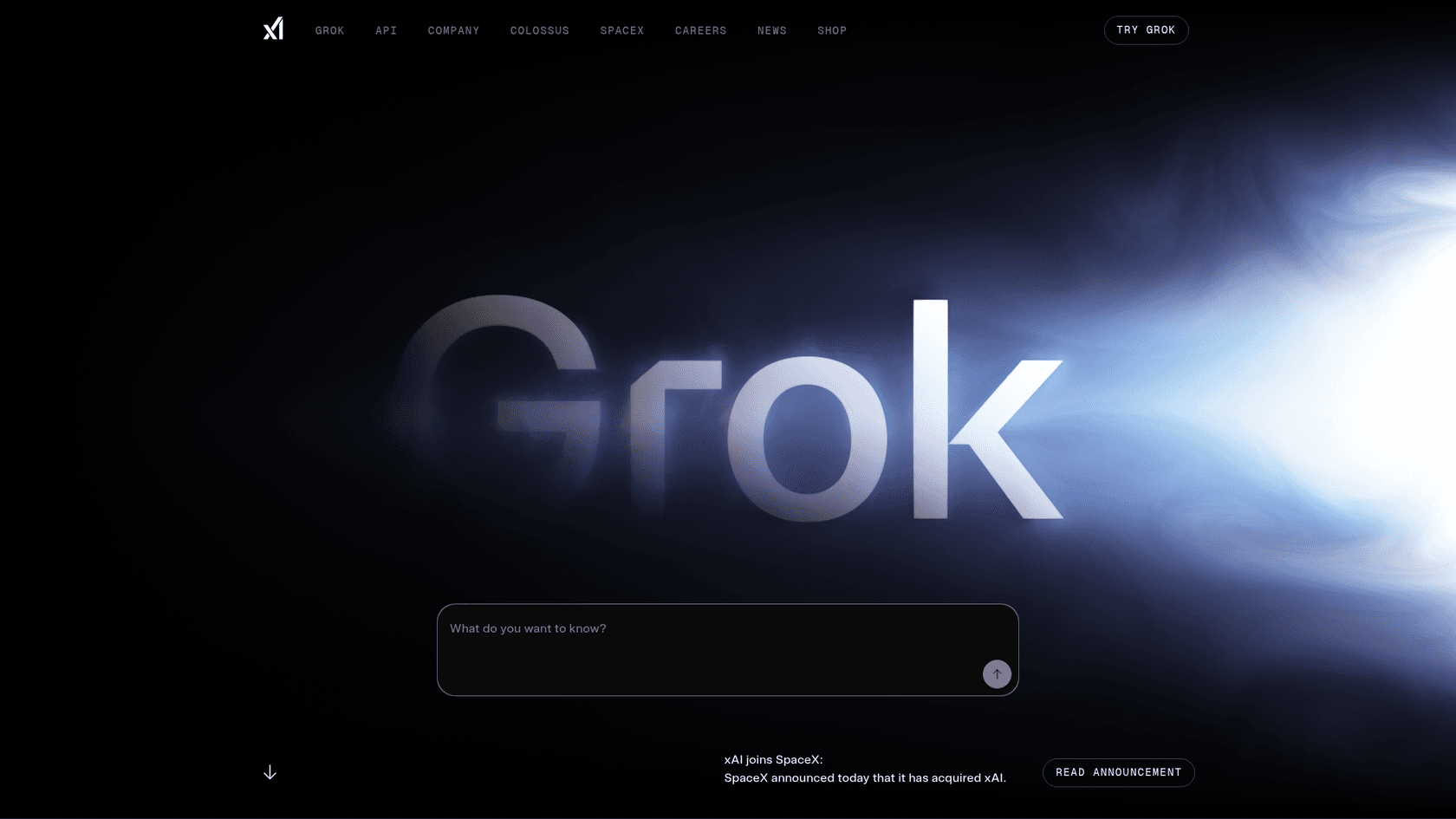
Grok 4.1 Fast is xAI's solution for anyone who needs speed, tool use, and a truly massive amount of context. Its standout feature is an almost unbelievable 2-million-token context window. This allows it to analyze entire codebases or huge collections of documents in one pass. It also connects to an Agent Tools API that lets it search the web and X (formerly Twitter) in real-time.
- Pros and Cons: That enormous context window is a game-changer for certain jobs, like sifting through huge legal contracts or a full code repository. But it's a closed-source model, and it comes with a distinct "edgy" personality that might not work in every professional environment. I dug into the wider xAI lineup in my Grok review and the Grok image tools writeup.
- Pricing:
- API Access: Available through platforms like OpenRouter and Oracle Cloud Infrastructure, with pricing based on token usage.
- Why I included it: It offers something unique that no other model on this list can. For those very specific, long-context tasks, Grok is in a class of its own.
6. Devstral 2
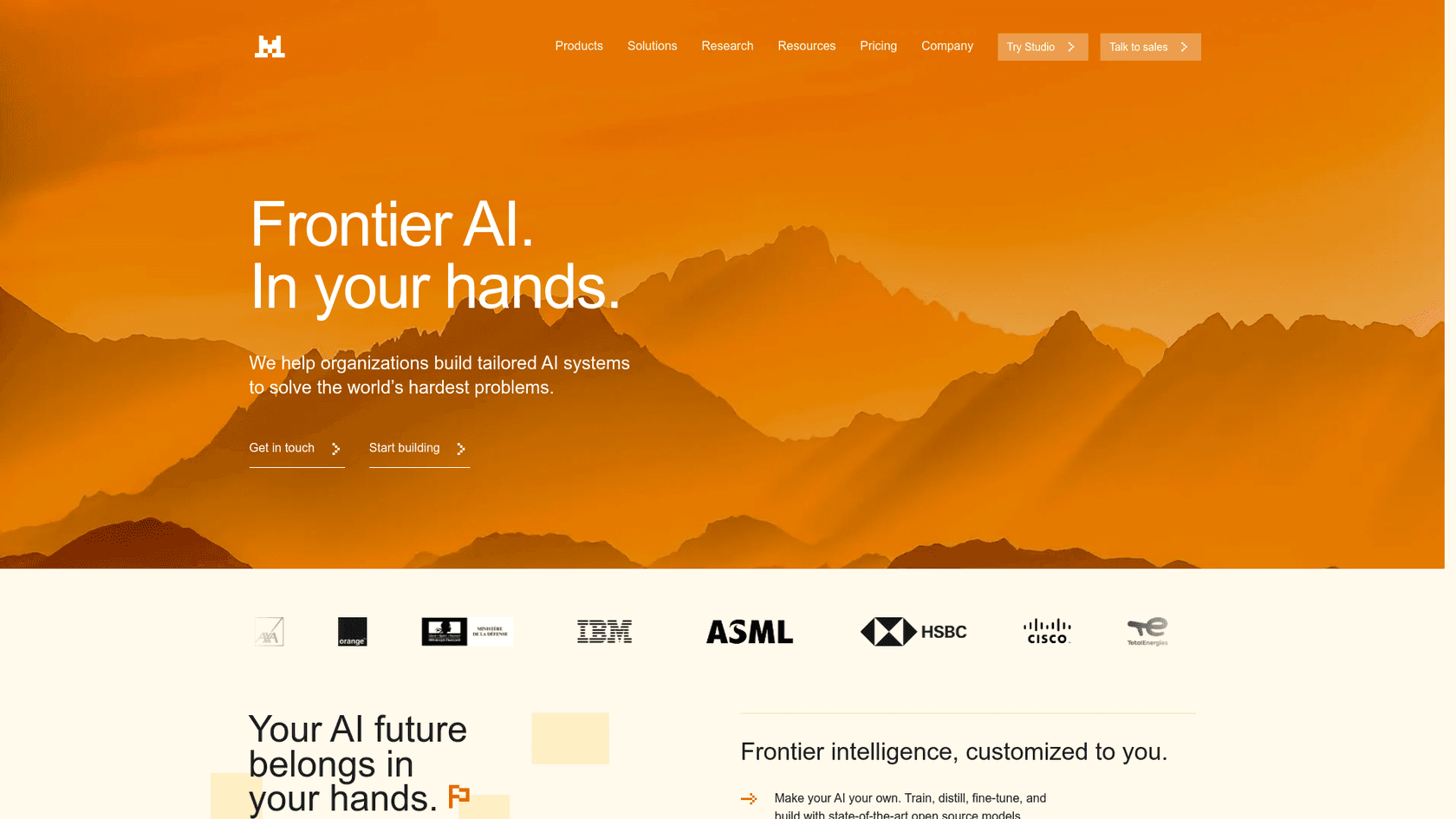
Developed by the team at Mistral AI, Devstral 2 is an open-source model built from the ground up for software engineering. It's an "agentic coding" model, meaning it doesn't just complete code; it understands and acts across entire codebases to perform multi-file edits and fix bugs. It has a 256K token context window and scores an impressive 72.2% on SWE-bench Verified.
- Pros and Cons: Its specialization makes it incredibly powerful for developers, taking it far beyond simple code completion. As an open-source model from a well-respected lab, it also has a strong community behind it. The only real downside is its narrow focus; it's not the generalist that Kimi or Claude are. If you want the broader picture of the lab's lineup, check the Mistral AI pricing guide and the Mistral vs Claude comparison.
- Pricing:
- API Access: It's currently free through Mistral's API, but future pricing is set at $0.40 per million input tokens and $2.00 per million output tokens.
- Open-Source: Free to download and run locally under a modified MIT license.
- Why I included it: It’s the best alternative for teams focused purely on software development. It offers specialized agentic capabilities that are exactly what developers exploring Kimi are looking for.
Watching these models in action can provide a clearer picture of their strengths and weaknesses. For a hands-on comparison of how models like Kimi K2.5, DeepSeek, and others handle complex tasks and tool calls, the video below offers a great technical deep dive.
How to choose the right Kimi K2.5 alternative
Feeling a bit overwhelmed? Here’s a simple way to think about it:
- If you're a developer building custom agents: You'll want the flexibility of open-source. Start with Devstral 2 if you’re all about coding, or DeepSeek-V3.2 for a great, cost-effective reasoning engine. They give you the most control.
- If you need best-in-class performance for critical tasks: Claude Opus 4.8 is your best bet. It costs more, but for top-tier accuracy, reasoning, and enterprise-grade compliance, it’s worth it.
- If your goal is to solve a business problem (like customer support) quickly: Think about the "buy vs. build" tradeoff. Instead of spending months of engineering time on a custom solution with a raw model, a platform like eesel AI can deliver a fully functional AI teammate in minutes, saving you a ton of time and money. It's the same logic behind the cheapest AI helpdesk apps I tested.
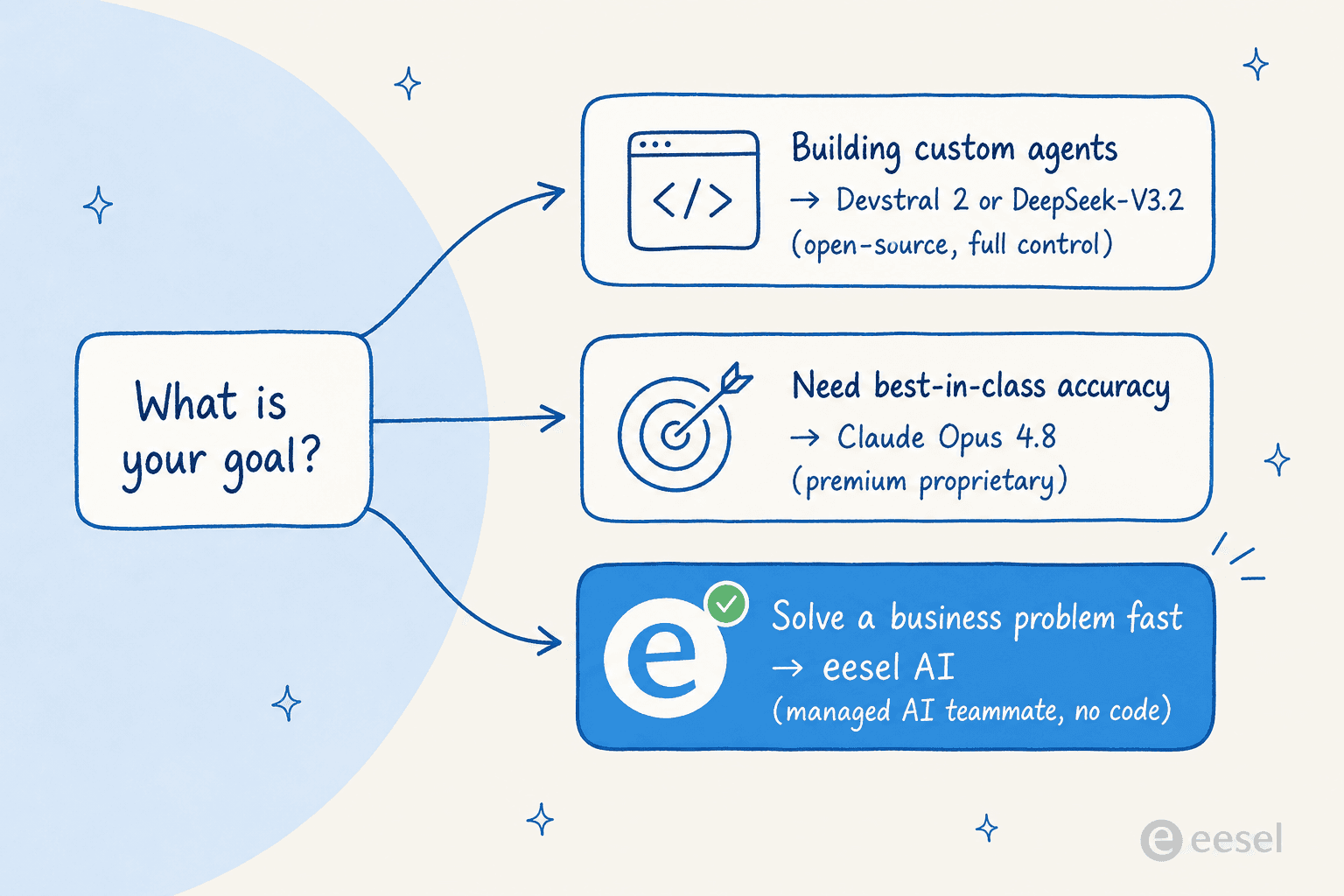
A flowchart infographic to help choose between different Kimi K2.5 alternatives based on user needs like development, performance, or business solutions.
Beyond the hype: Find the right tool for the job
Kimi K2.5 is an incredible piece of technology and a huge win for the open-source community. But the AI world is exploding with amazing alternatives built for all sorts of different needs, from Gemini alternatives to the broader Mistral alternatives field.
The real secret isn't finding the single "best" model. It's about matching the right tool, whether that's an open-source model, a premium API, or a managed AI platform, to the specific job you need to get done. For businesses looking to become more efficient and deliver better customer experiences without a massive engineering project, the answer might not be a model at all, but an AI teammate.
Ready to see how an AI teammate can transform your customer support? Try eesel and watch it resolve tickets in minutes, not months. It’s free to start — $50 of usage, every feature unlocked, no credit card.
Frequently Asked Questions
Are there any open-source Kimi K2.5 alternatives that are good for coding?
When should I choose a proprietary model over open-source Kimi K2.5 alternatives?
What makes Kimi K2.5 different from the Kimi K2.5 alternatives mentioned?
How do I decide which of the Kimi K2.5 alternatives is right for my project?
Are there any free Kimi K2.5 alternatives?


Article by
Kurnia Kharisma Agung Samiadjie
Kurnia is a software engineer and writer at eesel AI with two years of SEO experience, writing about AI tools, helpdesk software, and customer support. He pairs a developer's understanding of how these products are built with search-driven research into what actually ranks and resonates with the people searching for them.