

Whenever a new AI model hits the scene, it's easy to get swept up in the hype. But if you're actually looking to build with it, the questions that matter are always the same: What can it really do, and what's it going to cost me?
That's what I'm digging into today with Kimi K2.5, the latest model from Moonshot AI. I’ll skip the buzzwords and get straight to the point, breaking down its features, performance, and most importantly, the complete picture of Kimi K2.5 pricing.
What is Kimi K2.5?
Released in January 2026, Kimi K2.5 is a powerful new open-source model from the team at Moonshot AI. It's not just another chatbot, though. It was designed from the ground up to be a native multimodal and agentic model, which is just a way of saying it's built to handle complex, multi-step tasks all on its own, not just answer simple questions.
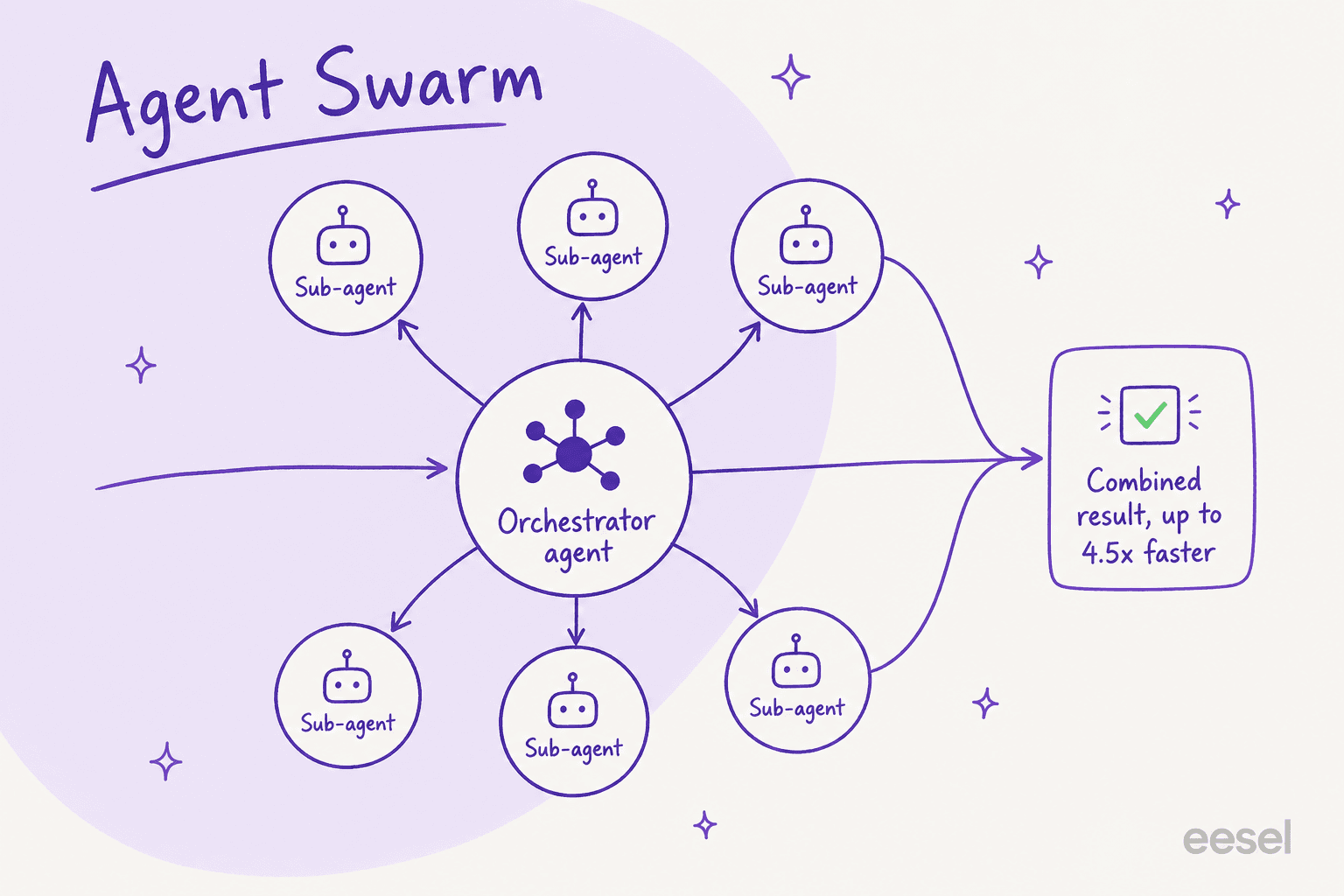
Its most talked-about feature is something called Agent Swarm technology. This lets it break down big problems and have a bunch of "sub-agents" work on different parts at once. Think of it like a project manager who can delegate tasks to a whole team instead of doing everything one step at a time.
In this guide, I'll give you a clear overview of Kimi K2.5’s architecture, what it can do, how it stacks up against the competition, and a detailed look at the Kimi K2.5 pricing structure.
The architecture behind Kimi K2.5
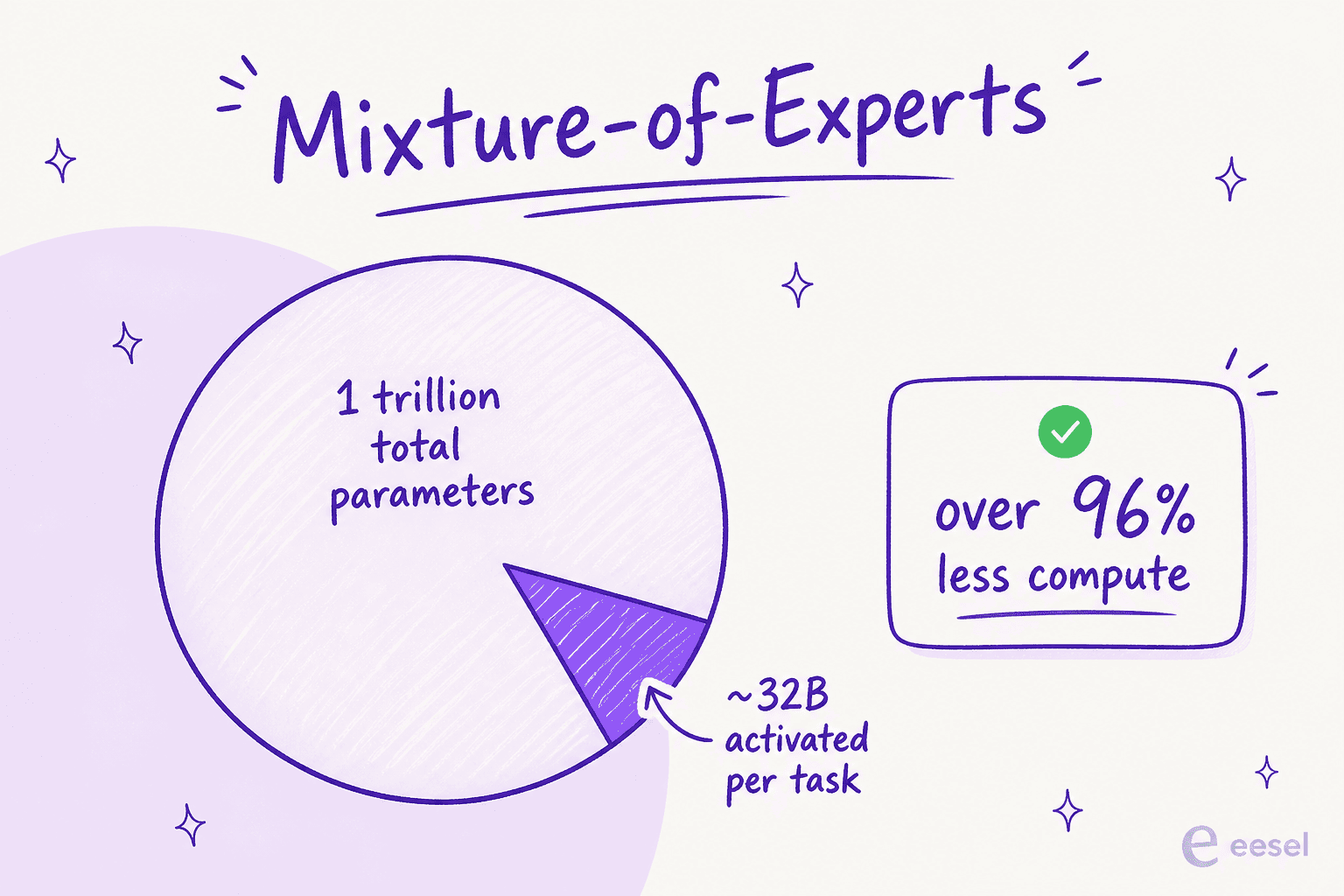
To really get what makes Kimi K2.5 tick, you have to look under the hood. It’s built on a Mixture-of-Experts (MoE) architecture with a massive one trillion total parameters. Now, that sounds incredibly expensive to run, but here's the clever part: for any given request, it only activates about 32 billion of those parameters. This trick slashes the amount of computation needed by over 96% while still letting the model tap into the massive knowledge of its full brain.
It’s also natively multimodal, meaning it was trained from day one on a huge dataset of about 15 trillion mixed visual and text tokens. Unlike models where vision capabilities are bolted on later, Kimi K2.5 learned to see and read at the same time. This makes it incredibly good at tasks that blend both, like turning a design mockup into functioning code.
Finally, it has a huge 256,000 token context window. This is a big deal because it allows the model to process and remember information from very long documents, entire codebases, or lengthy conversations in one go, without losing track of what’s happening.
Key features of Kimi K2.5
Kimi K2.5’s unique architecture gives it some standout features you don't see in every model. These aren't just small upgrades; they change how you can approach problem-solving with AI.
Agent Swarm technology
This is probably Kimi K2.5’s biggest claim to fame. Most AI models tackle tasks sequentially, one step after another. Kimi K2.5 uses a trainable "orchestrator agent" that looks at a complex request, breaks it into smaller, parallel subtasks, and then spins up as many as 100 specialized sub-agents to work on them all at the same time.
This process was trained using something called Parallel-Agent Reinforcement Learning (PARL) to make sure the agents work together efficiently. The result? Kimi K2.5 can reduce execution time by up to 4.5x. This is a huge advantage for big research projects, massive data extraction jobs, or any task that involves doing the same thing over and over across different inputs.
Native multimodal coding
Because Kimi K2.5 was trained on vision and text data from the very beginning, it has some seriously impressive visual skills. This isn't just about describing what's in a picture; it's about understanding and acting on visual information.
Here are a few practical things it can do:
- Generate code from images: You can give it a UI mockup or a design file, and it can write production-ready code (like React or HTML) to match it.
- Reconstruct websites from videos: Show it a video walkthrough of a website, and it can rebuild the site’s structure and code.
- Autonomous visual debugging: This one is pretty wild. It can write code, render a visual output of that code, compare it to the original design, spot the differences, and then go back and fix its own code until it matches perfectly.
Four distinct operational modes
Kimi K2.5 isn't a one-size-fits-all model. It has four different operational modes that use the same core intelligence but adjust their approach depending on the task.
- Instant: Perfect for when you need a quick, direct answer. Speed is the priority here.
- Thinking: For more complex problems where you want to see the model's step-by-step reasoning. It literally shows its work.
- Agent: This mode is for autonomous workflows that require using tools like a web browser to complete tasks over hundreds of sequential steps.
- Agent Swarm: The full-power mode for massive, parallel tasks coordinated by the orchestrator agent I mentioned earlier.
Kimi K2.5 performance benchmarks
Benchmarks are a standardized way to see how a model’s skills measure up against its rivals. All the scores below are based on tests run with Kimi K2.5’s "Thinking" mode enabled, which gives it the best shot at complex reasoning.
Coding and mathematical reasoning benchmarks
Kimi K2.5 is a strong coder. On a real-world test called SWE-Bench Verified, which involves fixing actual issues from GitHub, it scored an impressive 76.8%. It’s also a math whiz, achieving a 96.1% on the AIME 2025, an olympiad-level math competition.
That said, it trails slightly behind models like Claude Opus 4.5, which scored 80.9% on the same SWE-Bench test. This suggests that for highly specialized coding tasks, Claude might have a slight edge.
Agentic capabilities
This is where Kimi K2.5 really shines. In agentic tasks, which measure a model's ability to act autonomously, it leads the pack. It scored 74.9% on the BrowseComp benchmark, and when its Agent Swarm feature was activated, that score jumped to 78.4%.
Its multimodal scores are also top-tier. It achieved 78.5% on MMMU Pro (which tests understanding across many different subjects using images and text) and 86.6% on VideoMMMU, proving its vision capabilities are solid and deeply integrated.
A detailed breakdown of Kimi K2.5 pricing
Now for the big question: what does all this power cost? Understanding the Kimi K2.5 pricing model is key to figuring out if it's the right fit for your project's budget.
The official token-based pricing model
Like most large language models, Kimi K2.5 charges based on "tokens," which are small chunks of text (roughly 4 characters). You pay for the number of tokens you send to the model (input) and the number of tokens it generates in its response (output).
The pricing also has a neat feature for caching. A "cache miss" is when you send new, unique input, while a "cache hit" is for repeated input, which is much cheaper.
Here’s the official API pricing:
| Model | Unit | Input Price (Cache Hit) | Input Price (Cache Miss) | Output Price | Context Window |
|---|---|---|---|---|---|
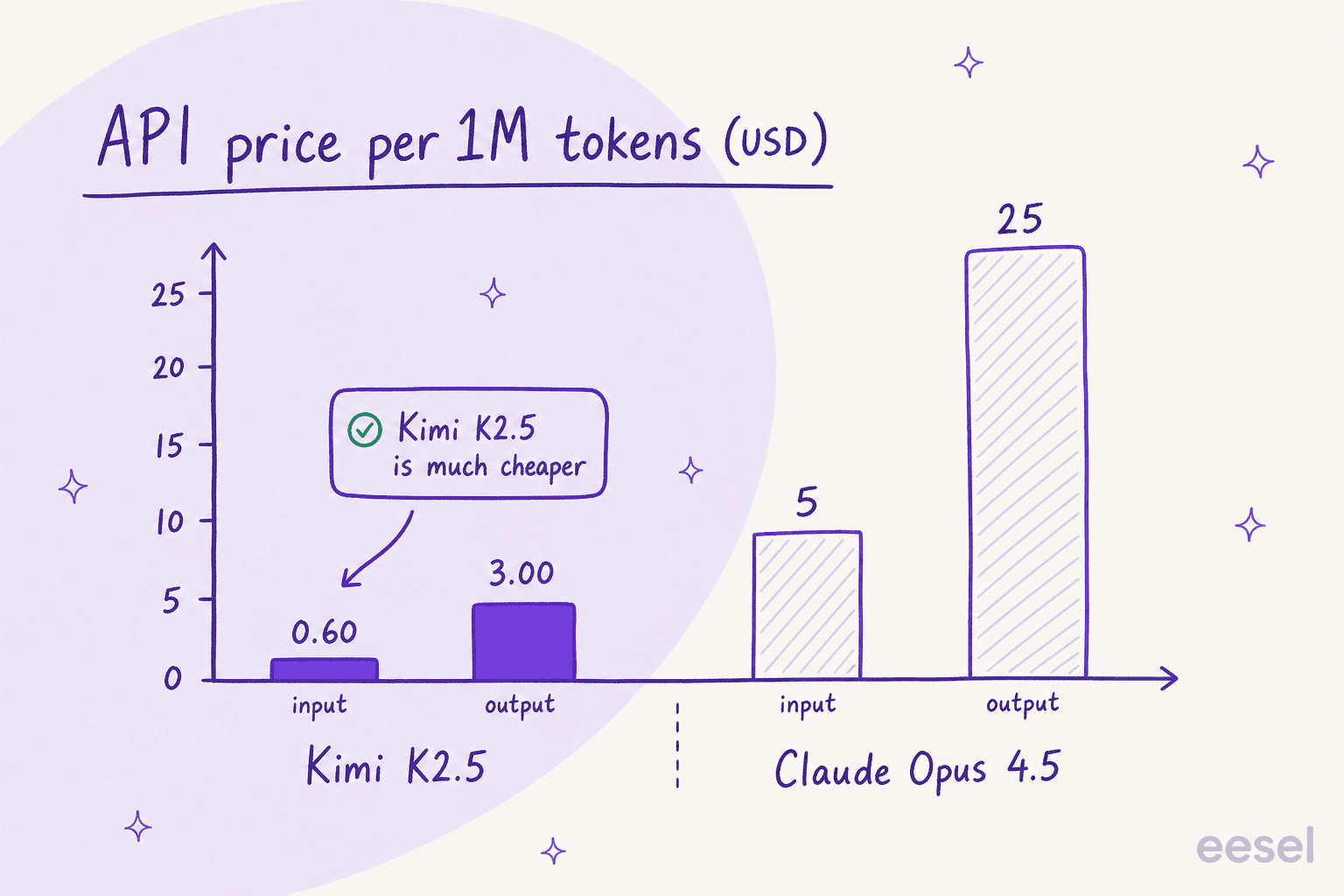
| kimi-k2.5 | 1M tokens | $0.10 | $0.60 | $3.00 | 262,144 tokens |
Source: Moonshot AI Official Pricing
How pricing compares to alternatives
At the API level, Kimi K2.5 is less expensive than other leading models. To put it in perspective, running a full suite of benchmark tests on Kimi K2.5 costs about $0.27, while that same suite on Claude Opus 4.5 runs around $1.14, roughly 76% cheaper.
Looking at the raw numbers, Claude Opus 4.5 pricing is $5 per million input tokens and $25 per million output tokens. That means Kimi K2.5’s API rates are roughly 9 times cheaper for similar tasks, a difference users on Reddit have noted as well.
Hidden costs beyond base pricing
However, API pricing is just the start of the story. The price tag on the model itself doesn't account for the cost of actually building a useful, production-ready application around it. That requires a lot of engineering resources for things like:
- Integrating the model with your existing business systems (like your help desk or CRM).
- Building user interfaces, escalation paths, and safety guardrails.
- Creating pipelines for continuous learning and improvement so the model stays up-to-date with your business.
This is where the total cost of ownership can start to add up, and it makes you think about pre-built solutions versus building from scratch.
Limitations and real-world considerations
While the benchmarks and pricing look great on paper, there are a few real-world factors to consider before diving in.
Token efficiency vs. per-token cost
A lower price per token doesn't always mean a lower final bill. Some user reports and benchmarks from competitors suggest that models like Claude Opus 4.5 can sometimes be more token-efficient, meaning they can solve a problem using fewer tokens.
It used 3x the tokens that opus does for the same tasks so cheaper, but more like 3x cheaper than 10x cheaper. These models often use a dramatically different number of tokens to do the same thing. It should be considered for both cost and latency when you compare them.

This creates a trade-off. Kimi K2.5 might be more verbose and use more tokens to get to the same answer, which could eat into some of its per-token cost advantage. It’s something you’d need to test carefully with your specific use case to see what the true final cost is.
The engineering challenge
This is the biggest hurdle. Turning a powerful open-source model like Kimi K2.5 into a reliable business tool, like an autonomous customer service agent, is a massive project.
An API key gives you access to the engine, but you still have to build the entire car around it. This includes the application layer, the integrations with all your other tools, and the logic that makes it safe and effective, including hallucination prevention. This is the exact challenge that platforms like eesel AI were created to solve.
To see Kimi K2.5 in action and get a different perspective on its capabilities, the following video provides a great deep dive into why it's generating so much buzz in the developer community.
A powerful and affordable model with considerations
Kimi K2.5 is a top-tier open-source model. It brings state-of-the-art agentic features, native multimodality, and incredibly competitive API pricing to the table. Its Agent Swarm technology and vision-grounded coding skills open up some exciting new possibilities.
But the main takeaway is that while the low API cost is very attractive, it's not the full story. The true cost includes the heavy engineering lift required to build, deploy, and maintain a real business application on top of it, the same reason many teams choose a ready-made AI agent over a raw model for customer support.
A faster way to deploy agentic AI
If the idea of building a custom AI application from scratch sounds daunting, that’s because it is. This is where eesel AI comes in. Instead of giving you an engine and a box of parts, eesel gives you a fully assembled AI teammate, ready to get to work, the result of years spent putting AI on live support queues (including watching confident-sounding bots give wrong answers, which is why every rollout is simulated on past tickets first).
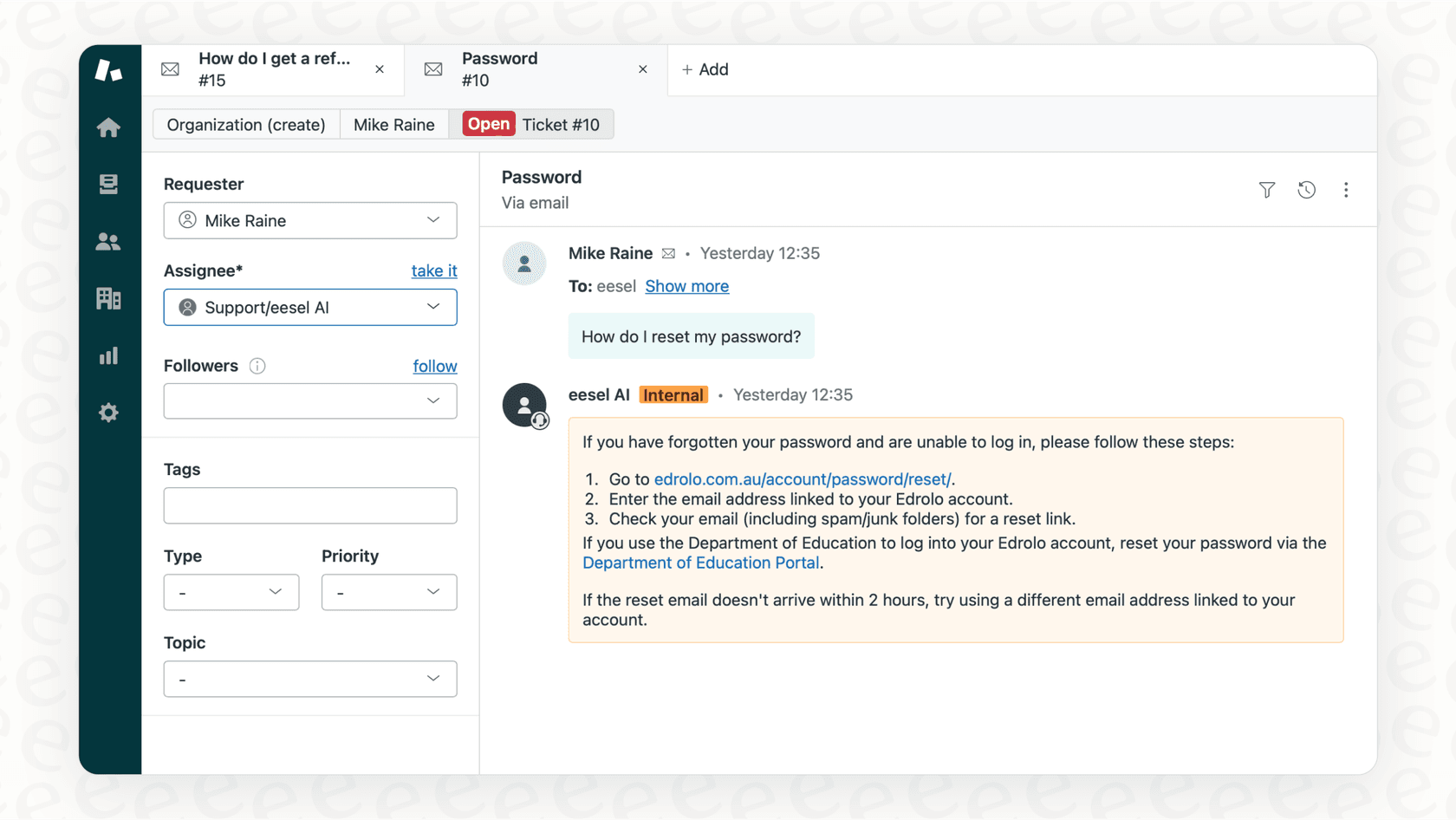
eesel is a complete application that plugs into the tools you already use, like Zendesk, Freshdesk, and Confluence. It learns from your past support tickets, help center articles, and internal docs in minutes. It handles the entire infrastructure, from integrations and learning loops to reporting and the ability to take real actions in your other systems. You get all the power of advanced AI models without any of the engineering overhead, and the pricing is usage-based (40¢ per ticket, $50 free to start, no per-seat fees), so you skip both the build cost and the token-math guesswork.
If you want to use agentic AI to autonomously resolve customer support tickets today, not months from now, try eesel free or book a demo.
Frequently Asked Questions
What is the official Kimi K2.5 pricing per million tokens?
How does the Kimi K2.5 pricing compare to models like Claude Opus 4.5?
Does the Agent Swarm feature affect the Kimi K2.5 pricing?
Is the lower Kimi K2.5 pricing always the most cost-effective option?
What makes the Kimi K2.5 pricing so competitive for a model released in 2026?


Article by
Rama Adi Nugraha
Rama is a software engineer at eesel AI with two years of experience writing about B2B SaaS, AI tools, and customer support technology. Based in Bali, Indonesia, he brings a developer's perspective to product comparisons — cutting through marketing copy to what the integrations and APIs actually do.