This guide provides a practical comparison of these two models from a business perspective. We'll look at what really matters: how they handle real-world coding, what you can actually do with their giant context windows, how much they cost, and how secure they are.
Picking the right AI model is just the start. The real challenge, and where the opportunity lies, is figuring out how to connect that raw power to your team's daily work and make it genuinely useful.
What is GPT 5.3 Codex?
Think of GPT 5.3 Codex as OpenAI's model specialized for programming tasks. This is the engine behind tools like the new Codex app, which can refactor code across multiple files or act on its own to build and debug software. For developers, it’s available through a solid API for building custom tools.
For a business, what's most important isn't just its coding ability, but also the enterprise-level security it’s built on. When you're handling company data, security and privacy are huge. OpenAI has tackled this directly, offering SOC 2 Type 2 compliance and a strict policy of not using API data to train their models. This means your private code and internal info stay private, which is critical for any company looking to use AI seriously.
What is Gemini 3 Pro?
Gemini 3 Pro is Google's versatile, multimodal model. This means it was built from the start to understand more than just words. You can give it text, images, video, audio, and even whole PDFs, and it processes everything natively. It’s not just a language model; it's a powerful information processor.
According to Google's official documentation, its key feature is a very large 1,048,576 token context window. We'll get into what that means in a minute, but for now, just know it can remember an incredible amount of information at once.
It’s also deeply integrated into the Google ecosystem. If your team lives and breathes Google Workspace, Gemini feels like a natural fit. And like OpenAI, Google guarantees its API does not use customer content to improve products, a critical privacy promise for any business.
Performance and capabilities: A head-to-head comparison
Let's get into what these models can actually do. Raw performance is what separates a tech demo from a tool your business can use effectively. Here’s how they compare where it counts.
Coding and development workflows
For any software team, a key question is: which model writes better code? To figure that out, we can look at SWE-bench, a rigorous benchmark that tests an AI's ability to solve real software engineering problems from GitHub.
The latest SWE-bench leaderboards show that Gemini 3 Pro Preview has a small lead, successfully fixing 74.2% of the issues thrown at it. That's a high score on a challenging test. But OpenAI isn't far behind. Their latest comparable models, like GPT-5.2, score consistently between 69.0% and 71.8%, proving they are more than capable for both general coding and complex problem-solving. <quote text="I am surprised how bad G3 Pro is at some tasks. However leave G3 Pro to find bugs and mistakes, and OMG, it's such a token-expensive yet valuable task. I use it a lot. It has that 'hacker' mind. I found some bugs/leaks in a code that I thought was solid as a rock. G3 casually put me to my place.
But give him a task in the project to implement end-to-end often it fails bc it either convolutes it, either gets blocked, either understands wrongly." sourceIcon="https://www.iconpacks.net/icons/2/free-reddit-logo-icon-2436-thumb.png" sourceName="Reddit" sourceLink="https://www.reddit.com/r/codex/comments/1qpqjof/comment/o2dogs1/">
The takeaway is that both models perform at a high level. However, based on this specific benchmark for autonomous coding, Gemini 3 Pro currently has a slight edge.
| Benchmark | GPT-5.2 (latest comparable OpenAI model) | Gemini 3 Pro Preview | Winner (on this benchmark) |
|---|---|---|---|
| SWE-bench Verified | 71.8% (high reasoning) | 74.2% | Gemini 3 Pro |
Long-context reasoning and knowledge processing
This is an area where Gemini 3 Pro excels. Its 1,048,576 token context window is a significant advantage. To put that in perspective, it's more than double the context of even the most advanced GPT-5.2 models.
A large context window means the AI can handle tasks that used to be impossible without complex workarounds. You can feed it your entire codebase and ask it to find a tricky bug. You can upload years of legal documents and ask for a summary of a specific case. For a support team, it could mean understanding a customer's entire ticket history in one go to give a truly personal answer. It's the difference between having a short-term memory and a photographic one.
Multimodality and enterprise security
Gemini's native multimodal design is a notable feature. It can "watch" a video or "listen" to an audio file and reason about the content directly through its API. This enables new applications, from analyzing user session recordings to transcribing and summarizing meetings.
However, businesses often weigh innovative features against practical security needs. This is an area where OpenAI offers strong features, including SOC 2 Type 2 compliance and the option for Business Associate Agreements (BAAs) for HIPAA, which are non-negotiable for companies in regulated fields like healthcare.
Developer and user experience
Beyond pure power, the day-to-day experience of using and integrating these models is what really determines their value. A brilliant model that's difficult to work with won't get you very far. Let's look at how they feel to both users and the developers building with them.
Web interface and ecosystem integration
When it comes to the user-facing tools, the two platforms have different approaches.
Gemini is woven into the Google ecosystem you already use. It’s in Gmail, helping you write emails. It’s in Docs, helping you draft reports. For teams that run on Google Workspace, this is a significant advantage. The AI is right there in your daily tools, making it a seamless part of your workflow.
ChatGPT, on the other hand, provides a more focused, standalone chat experience. It's excellent for deep-dive reasoning, creative brainstorming, and tackling complex problems in its own dedicated interface. It is a powerful, specialized tool you go to for specific tasks.
The right choice depends entirely on how your team works. Do you want an AI that's everywhere in your existing tools, or a dedicated specialist you can call on when needed?
API access and tool implementation
For developers, both models offer powerful APIs with advanced features like tool-calling, which lets the AI interact with other systems. But building reliable automations on top of a raw API is a significant engineering effort. You have to manage prompts, handle errors, build integrations, and fine-tune the model's behavior. This can require dedicated resources.
Pricing and access
For any business, cost is a critical factor. Here’s a clear breakdown of what it costs to use GPT 5.3 Codex and Gemini 3 Pro.
API pricing
When you use these models through their APIs, you usually pay per "token," which is a small piece of a word. Costs are split between input (the data you send) and output (the response you get).
Gemini 3 Pro uses a tiered model that gets more expensive for prompts over 200,000 tokens, while GPT-5.2 Codex has a flat rate. Google also has a useful feature called Context Caching, which can cut costs if you're repeatedly asking questions about the same large document by storing a tokenized version for a lower hourly rate.
Here’s how the numbers look:
| Model / Feature | Gemini 3 Pro (API, Standard) | GPT-5.2 Codex (API, Standard) |
|---|---|---|
| Input / 1M Tokens | $2.00 (≤ 200k tokens) $4.00 (> 200k tokens) | $1.75 |
| Output / 1M Tokens | $12.00 (≤ 200k tokens) $18.00 (> 200k tokens) | $14.00 |
| Context Caching | Available (e.g., $0.20 / 1M tokens) | Available (e.g., $0.175 / 1M tokens) |
Free vs. paid tiers
What if you just want your team to try these models for daily tasks without committing to an API?
With ChatGPT, the base models are usually available for free, though with some limits. To get unlimited access to the most powerful models like GPT-5.2, you'll need a subscription through ChatGPT business plans.
With Gemini, the free version uses lighter, less powerful models. To get consistent access to Gemini 3 Pro's full power, you'll need paid Google AI subscriptions.
This is an important difference for teams that want to let employees experiment before deciding on a bigger, API-driven project.
Choosing the right model for your team
So, after all that, which model should you pick? The answer, as it often is, is: it depends.
Choose GPT 5.3 Codex for: A mature developer ecosystem, strong all-around coding performance, and when enterprise security certifications like SOC 2 are a top priority.
Choose Gemini 3 Pro for: Tasks that need huge context windows (like analyzing an entire codebase), native analysis of video and audio, and for the highest performance on tough coding benchmarks like SWE-bench.
Ultimately, a powerful AI model is a foundational technology. The real value for your business comes from how you use it to solve specific problems in your daily workflows.
For a deeper dive into the latest AI developments, including updates on these models, this video offers a great overview of the current landscape.
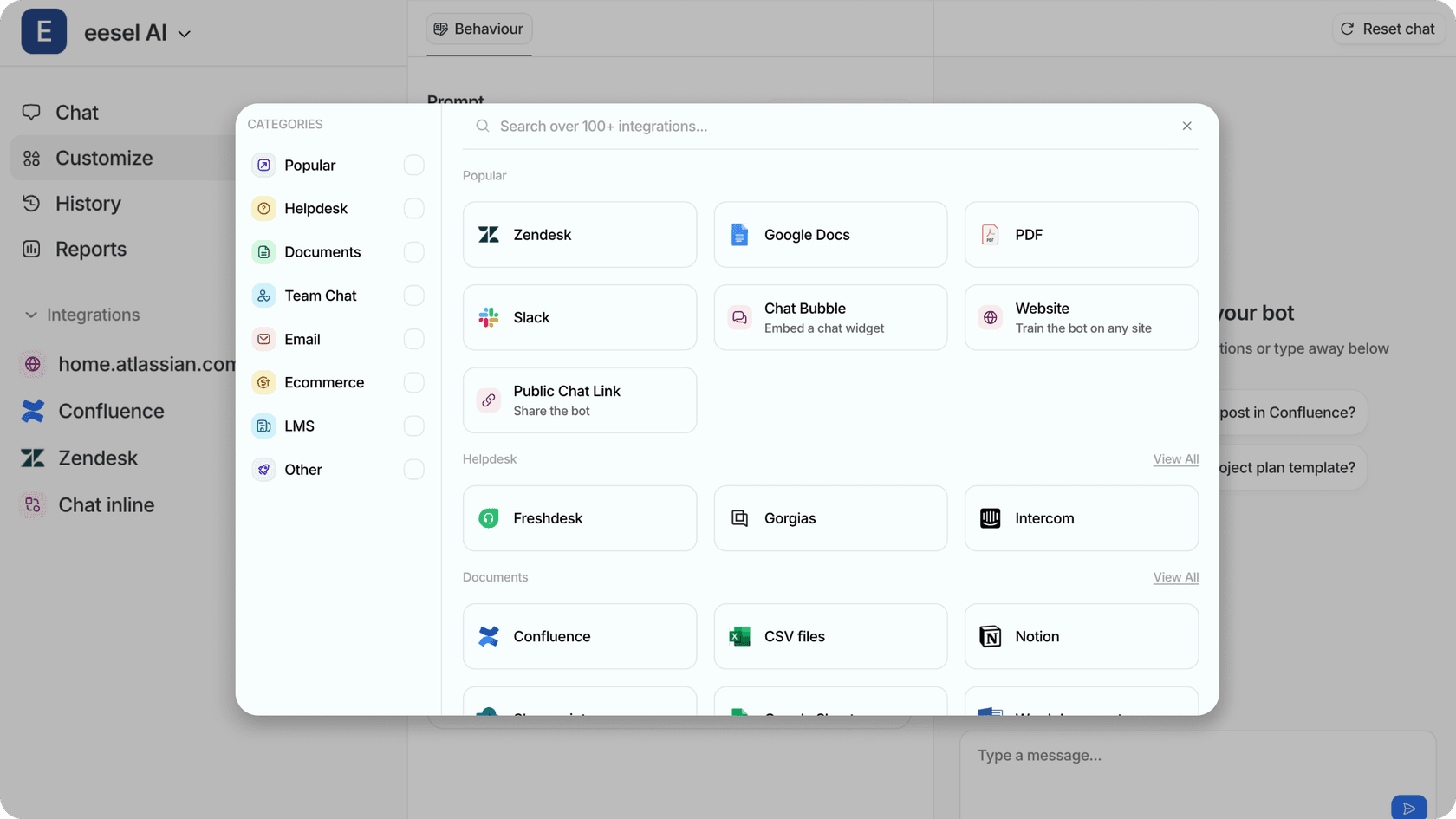
This is where platforms that integrate these models into existing workflows become valuable. Instead of just picking a raw model, you can use an AI platform like eesel. We provide the layer that puts the world's best AI to work for you, right inside the platforms you already use. Eesel handles the messy integrations, the complex prompts, and the tedious workflows, letting you go from a powerful technology to a productive new team member in minutes, not months.
Ready to see how an AI teammate can change your business? See eesel in action and find out what's possible when you have the right teammate on your side.
Frequently Asked Questions
For a startup focused on coding, what's the main difference in the GPT 5.3 Codex vs Gemini 3 Pro comparison?
When considering GPT 5.3 Codex vs Gemini 3 Pro, which is better for analyzing large documents?
How does pricing factor into the GPT 5.3 Codex vs Gemini 3 Pro decision for a business?
If my business operates in a regulated industry like healthcare, what should I consider regarding GPT 5.3 Codex vs Gemini 3 Pro?
In the GPT 5.3 Codex vs Gemini 3 Pro debate, which model is easier to integrate into existing workflows?


Article by
Rama Adi Nugraha
Rama is a software engineer at eesel AI with two years of experience writing about B2B SaaS, AI tools, and customer support technology. Based in Bali, Indonesia, he brings a developer's perspective to product comparisons — cutting through marketing copy to what the integrations and APIs actually do.