It feels like a new AI model drops every other week, and it's easy to get numb to the hype. But once in a while, something pops up that's worth paying attention to. Kimi K2.5, the new open-source model from Moonshot AI, seems to be one of those. It’s not just making waves with big benchmark scores; it’s got some genuinely new 'agentic' tricks up its sleeve.
But let's be real: high scores on a test don't mean much when you're trying to figure out if a tool can actually help your business. So, this review cuts through the noise. We're looking at Kimi K2.5's real-world performance, its limitations, and whether it’s something a business team can actually use day-to-day. We'll get into its core tech, its standout 'Agent Swarm' feature, the hefty hardware it needs, and what it'll cost you.
Understanding the Kimi K2.5 model
At its heart, Kimi K2.5 is a unified, open-weights multimodal model from Moonshot AI. You can think of it as a powerful open-source rival to big proprietary models like GPT-4, trained on a massive dataset of roughly 15 trillion mixed visual and text tokens.
The secret sauce is its Mixture-of-Experts (MoE) architecture. In plain English, while the model has a mind-boggling 1 trillion total parameters (the building blocks of an AI), it only activates about 32 billion for any given task. This makes it way more efficient than a traditional model that has to power up everything for every single request. It’s like having a huge team of specialists on call, but you only pay for the ones you need for the job at hand.
Here’s a quick rundown of its main features:
- Native Multimodality: It was designed from day one to understand text, images, and video together, not as separate add-ons.
- Agentic Capabilities: It can use tools and figure out complex, multi-step tasks on its own.
- Agent Swarm: This is its most talked-about feature, letting it deploy a team of sub-agents to tackle a problem from multiple angles at once.
- Four Operational Modes: It can run in Instant, Thinking, Agent, and Agent Swarm modes, so you can choose between speed, deep thought, and full autonomy.
Key features and performance
This is where we get into what Kimi K2.5 can actually do. The model packs some serious punch, especially in a few key areas.
Coding with vision and developer tools
Kimi K2.5 has raised the bar for open-source coding. It scored an impressive 76.8% on SWE-Bench Verified, a test that measures how well a model can solve real-world software engineering problems. This score puts it in the same league as the best open-source coding models out there.
A key capability is its ability to write code from visual inputs. The Kimi tech blog shows a fantastic example where it clones a website's entire design, including interactions and animations, just by watching a screen recording. It’s not just looking at a static image; it's understanding motion and user experience to write working code.
To make this even more useful for developers, Moonshot AI also released Kimi Code, a dedicated command-line interface (CLI). This lets developers hook the model right into their local setup and code editors like VSCode, making it a smooth part of their workflow, visual inputs and all.
Agent Swarm for parallel task execution
Agent Swarm is probably Kimi K2.5’s most groundbreaking feature. It’s a system where the model can spin up to 100 specialized sub-agents to work on different parts of a large task at the same time. This was trained using a method called Parallel-Agent Reinforcement Learning (PARL), which means it learned how to manage a team of AIs.
Here’s the breakdown: a main "orchestrator" agent gets a complex request, splits it into smaller jobs, and hands those jobs out to the sub-agents. By working on the problem in parallel, it can cut down the time it takes by up to 4.5x compared to a single agent plugging away step-by-step.
The example from the Kimi tech blog shows this perfectly. When asked to find the top three YouTube creators in 100 different niche categories, the Agent Swarm created 100 sub-agents. Each one researched a single category at the same time, and the orchestrator then gathered all 300 profiles into a final spreadsheet. This is the kind of work that would take a human researcher days, but Agent Swarm can get it done in a tiny fraction of the time.
Native multimodality for office productivity
Because K2.5 was trained on a mix of images and text from the start, it’s not just a text model that can also look at pictures. This built-in multimodality makes it effective for complex office tasks.
It can create entire documents, spreadsheets with working Pivot Tables, and presentation slides from simple conversational prompts. This elevates it from a simple chatbot to a genuine assistant for everyday knowledge work.
Practical limitations for businesses
For all its power, Kimi K2.5 isn't a silver bullet. Using it in a business setting comes with some big hurdles, especially for teams that aren't deeply technical. These challenges show the gap between a powerful, raw model and a polished, business-ready solution.
Extreme hardware requirements and self-hosting
Running this model yourself requires a significant commitment of resources. The full model is a huge 630GB and needs at least four H200 GPUs to run properly. Even if you use smaller, compressed versions, you're still looking at needing over 240GB of unified memory (a mix of RAM and VRAM) just to get it running at a decent clip.
For many businesses that are not dedicated AI research labs, these specifications can make self-hosting impractical. The cost and complexity of setting up and maintaining that kind of hardware is a significant barrier. This is why fully managed platforms are so valuable; a solution like eesel AI gives you a business-ready AI teammate without you having to buy any hardware or do any technical setup.
Inconsistent user experience
There have been a bunch of user reports of Kimi K2.5 identifying itself as "Claude," which suggests that it was trained heavily on outputs from Anthropic's models. While not a deal-breaker, this can lead to a confusing and inconsistent user experience.
On top of that, its performance can be hit-or-miss. While it's a beast at coding, some users find it can be a bit long-winded or less "sharp" than other models for general tasks. And when you use it through third-party services, performance can be slower or less reliable during busy times as providers struggle with its heavy demands. An AI that provides inconsistent responses can be challenging, especially in a customer-facing role. That’s why an AI agent from eesel AI learns your company’s voice and procedures from day one by reading your past tickets and help docs, making sure every interaction is consistent and on-brand.
Sonnet yes. If you think it matches opus you're smoking crack.

A powerful engine, not a ready-to-use car
The best way to think about Kimi K2.5 is as an incredibly powerful, general-purpose engine. But you still have to build the car around it. For specific business jobs like customer service or IT support, a purpose-built platform will always work better.
An AI for support needs to do more than just chat. It has to take action in other systems, connect deeply with help desks like Zendesk and Freshdesk, and follow specific rules about when to pass an issue to a human. These are all features that need to be built on top of a foundation model like Kimi. Instead of spending months building a support solution from scratch, eesel AI offers a complete AI teammate that's ready to go. You can test it on your past tickets, control what it handles, and roll it out across your support channels with just a few clicks.
How to access Kimi K2.5
Since self-hosting is out of reach for most businesses, you'll likely be using Kimi K2.5 through APIs and third-party platforms that do all the heavy lifting for you.
Access via APIs and platforms
The main way to get programmatic access is through the official Moonshot AI platform. This lets you build the model into your own applications.
A few third-party providers have also started offering access, taking on the hosting complexity for a fee. Users on Reddit have mentioned getting access through platforms like OpenCode and Chutes.
For the brave few with the right hardware, the model can be deployed using open-source inference engines like vLLM, SGLang, and KTransformers.
Official pricing and plans
Here’s a look at the official pricing and how you can pay to use Kimi K2.5.
| Plan / Service | Price | Key Features & Notes |
|---|---|---|
| Kimi App 'Moderato' Membership | $19 / month | Includes monthly quotas for tools like Kimi Code and Deep Research. API fees are not included. |
| Official API Access | $0.60 / 1M input tokens $3.00 / 1M output tokens | Pay-as-you-go access to the model via the Moonshot AI platform. |
| Web Search Tool | $0.005 / call | An additional fee charged per use of the $web_search tool, plus token costs for the results. |
Final thoughts: A developer's tool, a business's project
Kimi K2.5 is a massive achievement for open-source AI. Its performance in vision-based coding and its innovative Agent Swarm feature narrow the gap with some of the top proprietary models. For developers, AI researchers, and technical teams who are comfortable working with APIs and its complexities, it's an incredibly powerful and flexible foundation to build on.
I just got my LLM ‘workstation’ set up and tbh, getting vLLM to work on Qwen3 VL was more difficult than I had anticipated with a myriad of incompatibilities popping up until I finally sorted it out... Would it be at all feasible to run Kimi K2 Thinking on this with a reasonable (16-32k) context? If so, would someone be willing to share a vLLM template for this setup?
However, it is definitely not a plug-and-play business solution. The extreme hardware costs, technical setup, and inconsistent user experience mean it’s still a tool for builders. It’s not a ready-made AI teammate that can jump in and start solving problems like customer support or internal Q&A for most companies.
To see Kimi K2.5 in action and understand why it's generating so much excitement in the AI community, check out this overview which explores its state-of-the-art capabilities.
Considering a business-ready AI teammate?
While Kimi K2.5 shows the incredible raw potential of AI, most businesses need a solution that is ready to deploy. Instead of building an AI agent from scratch, an alternative is to adopt a pre-built solution.
That’s the whole idea behind eesel AI. Eesel is an AI teammate you can onboard in minutes, not months. You connect it to your existing tools like Zendesk, Intercom, and Confluence, and it instantly learns your business context, tone, and processes by reading your past conversations and help docs.
With eesel, you don't need a team of AI developers or a six-figure hardware budget. You get a fully functional AI agent for customer service that you can supervise, guide, and "level up" to handle more responsibility when you’re confident in its performance. It offers the capabilities of a custom AI solution, without the implementation complexities.
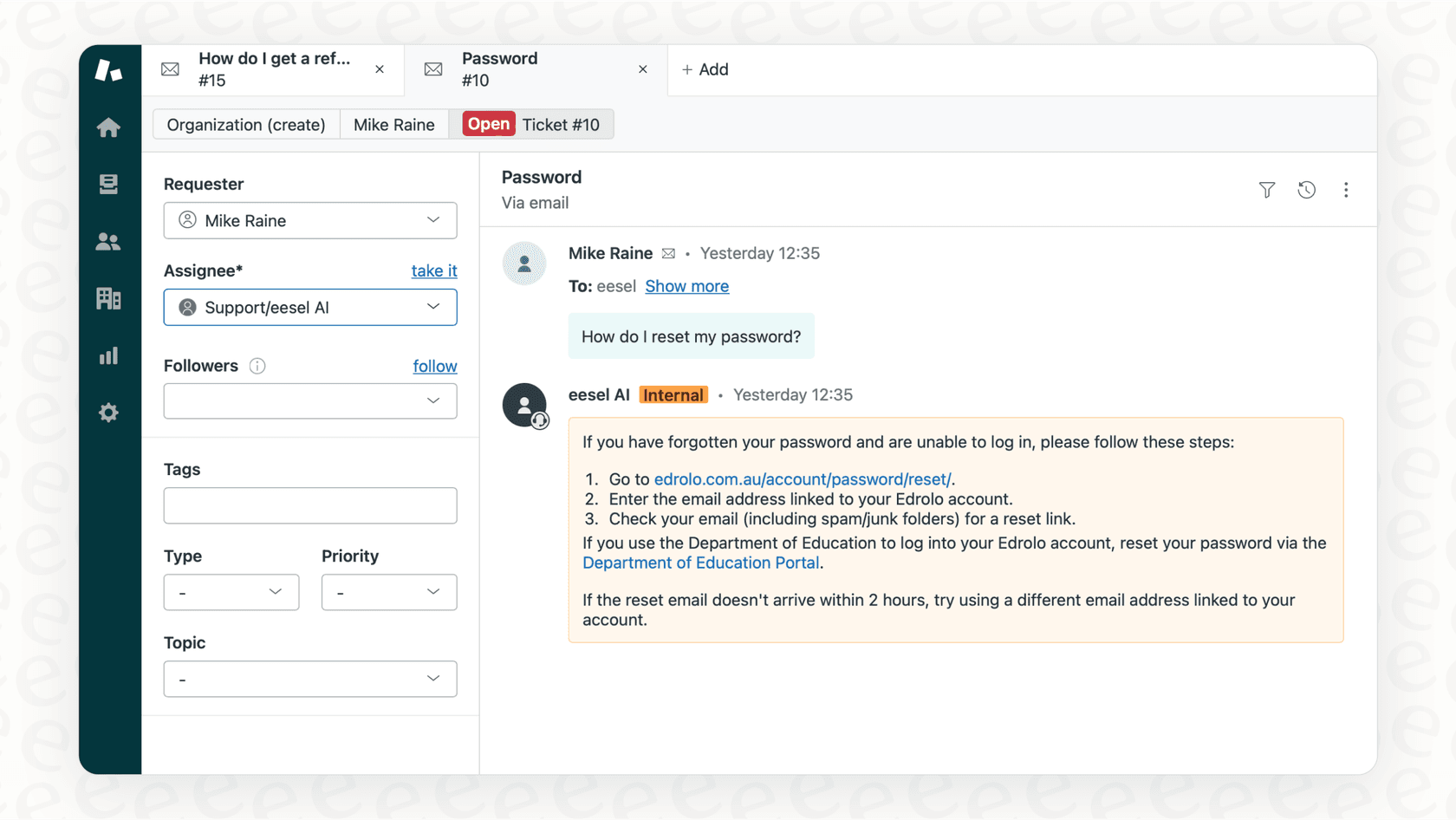
See how an AI teammate can transform your business. Try eesel AI for free.