

What Grok 4.5 actually is
Grok 4.5 is xAI's own description of "our flagship model for code and everything else: agentic tool calling, minimal hallucinations, configurable reasoning" and, in the company's words, "the most intelligent and fastest model we've built." It shipped publicly on July 8, 2026, after a private beta at SpaceX and Tesla that reportedly started around June 28.
The model itself, grok-4.5 in the API, is a single SKU with configurable reasoning rather than the fast/mini/heavy split some labs use. Set reasoning_effort to low, medium, or high (high is the default), and the model trades speed for depth accordingly. The headline spec bump from the prior Grok 4.3 is a 500,000-token context window (Artificial Analysis calls that roughly 750 pages of A4), plus built-in server-side tools for web search, X search, and code execution that you can call without wiring up your own retrieval layer.
Where you'll actually run into it: it's now the default model in Grok Build, xAI's coding agent CLI, it ships on all Cursor plans, and it's the default model behind the Word, PowerPoint, and Excel Microsoft Copilot-style add-ins. It's also live on OpenRouter, Vercel, Cloudflare, Snowflake, and Databricks Mosaic if you'd rather not touch xAI's console directly.
The benchmarks, independently checked
xAI's own launch page didn't render for scraping (a common problem with JS-heavy announcement pages), so the numbers below come from Artificial Analysis's independent measurement of Grok 4.5 on high reasoning, which is the stronger citation anyway since it's not graded by the company that built the model.
| Benchmark | Grok 4.5 result | Where it ranks |
|---|---|---|
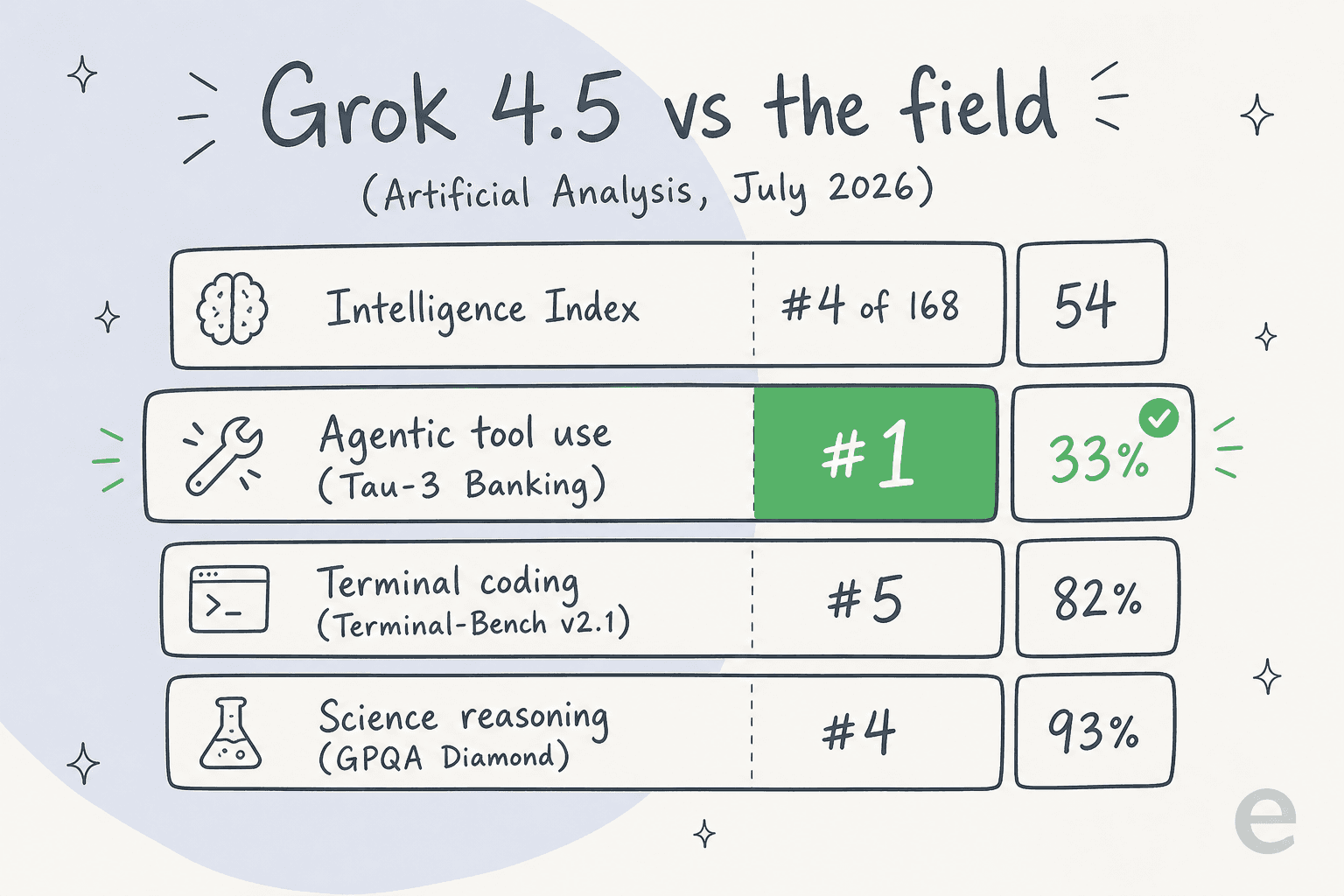
| Intelligence Index (v4.1, 9-eval composite) | 54 | #4 of 168, behind Claude Fable 5 (60), Claude Opus 4.8 (56), GPT-5.5 (55) |
| 𝜏³-Banking (agentic tool use) | 33% | #1 of 28 models charted, ahead of GPT-5.5 (31%) and Claude Sonnet 4.6 (31%) |
| GPQA Diamond (scientific reasoning) | 93% | #4, near-tied with Gemini 3.1 Pro / GPT-5.5 |
| Terminal-Bench v2.1 (agentic coding) | 82% | #5, behind Fable 5, Opus 4.8, GPT-5.5, Opus 4.7 |
| Speed | 85.6 output tokens/sec | Faster than the ~73 tokens/sec class average |
That agentic tool-use score is the one worth sitting with: it's not "top 4," it's the outright best score on the board. Artificial Analysis's own read is that Grok 4.5 is "amongst the leading models in intelligence and reasonably priced when comparing to other models of similar price," and it's also faster and more concise than the class average, generating 60M tokens on the full Intelligence Index run versus a 72M-token average.
One number to treat carefully: reporting during the private beta claimed Musk said Grok 4.5 "may match or exceed Anthropic's Opus model in performance". The independent numbers put it just below Opus 4.8 (56) and roughly level with Opus 4.7 (54). Read the launch marketing as marketing.
Grok 4.5 pricing
Full API pricing, confirmed on xAI's docs and the grok-4.5 model page:
| Model | Context | Input | Cached input | Output | Batch discount |
|---|---|---|---|---|---|
| grok-4.5 (current flagship) | 500K | $2.00 /1M | $0.50 /1M | $6.00 /1M | None at launch |
| grok-4.3 (prior flagship) | 1M | $1.25 /1M | $0.20 /1M | $2.50 /1M | 20% |
Server-side tools are billed on top of tokens: web search, X search, and code execution are each $5 per 1,000 calls; file attachment search is $10/1k calls; collections/RAG search is $2.50/1k calls. Storage runs $0.025/GiB/day for files and $0.10/GiB/day for collections. If you go over the 200K-token mark in a single request, xAI charges a different, higher rate, though the exact figure wasn't published on the docs page at the time of writing, so budget for it rather than assume it's flat.
On the consumer side, tier names are confirmed (Grok Free, SuperGrok, SuperGrok Heavy, bundled access via X Premium+), but xAI hasn't published SuperGrok's dollar price on a page that actually renders for scraping. The ~$30/month SuperGrok and ~$300/month SuperGrok Heavy figures you'll see quoted around the web are secondary and unconfirmed on a primary source, so treat them as directionally right, not gospel, until xAI puts a number on its own pricing page. Early Grok 4.5 access on the consumer app went to SuperGrok and X Premium+ subscribers first.
For how that stacks up against the rest of the field, see our full xAI pricing guide.
How the launch actually landed
Because Grok 4.5 is only hours old as of this review, community coverage is concentrated on Hacker News and X rather than Reddit, which was blocked to both search and direct fetch at the time of writing. What's there is a genuinely split reaction, not a one-sided win.
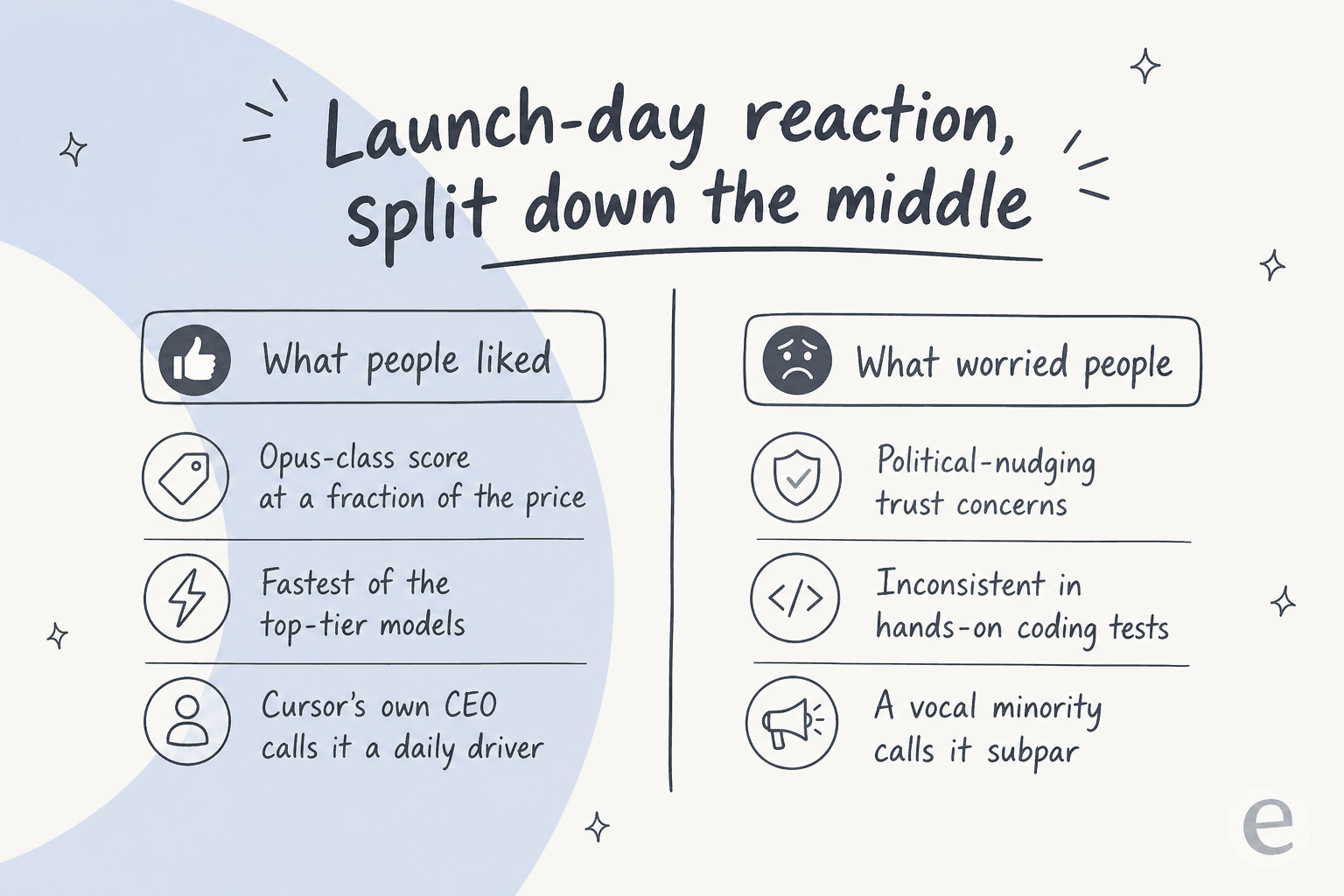
On the positive side, Cursor's CEO Michael Truell posted that Grok 4.5 is "an Opus-class model that's fast and low cost… a significant step up over any model we've developed so far" and has "become the daily driver for many on our team" (worth noting Cursor co-launched the model, so this is a vendor-adjacent endorsement, not a neutral third party). Artificial Analysis on X flagged that it hit its GDPval-AA v2 score "at a cost of $0.49 per task," putting it clearly on the cost-vs-performance frontier.
"Grok is not a serious AI, it's not suitable for professional work and has mediocre performance anyway."

"I just don't think that I can ever trust an xAI model knowing that they are actively trying to shape its replies to fit a political narrative. How can you trust their models to be reliable in a business setting with the foreknowledge that their models are being nudged around in the backend?"
That trust thread was the loudest single theme on the Hacker News launch post, ahead of any capability discussion. A counter-argument showed up in the same thread too: one commenter pushed back that "Grok has in most of my testing been MORE politically correct than GPT and Gemini… on grok.com or in the app Grok is very tame." Both readings are live in the same comment section, which tells you the debate is unresolved, not settled in either direction.
On raw coding ability, the picture is mixed in practice even though the benchmarks look strong on paper. In the most-discussed hands-on comparison thread, where someone had Grok 4.5, GPT-5.5, and Claude build the same apps, one commenter noted it was "so strange to write a whole post with Claude giving the best results and Grok consistently the worst, but awarding Grok the winner because at least it did the worst fastest." Another called it "pretty decent, comparable with some older Opus models, and fairly cheap per token". Cheap and fast is the consistent thread; best-in-class output quality is not.
Grok 4.5 pros and cons
What it's genuinely good at:
- Cheapest way to get near-frontier intelligence. At $2/$6 per 1M tokens, it undercuts what you'd pay for Claude or GPT-5.5-class output while landing within a few points of them on the Intelligence Index.
- The best agentic tool-use score on the board, full stop, not just "top tier." If your workload is calling tools and taking actions rather than writing essays, this is the number that matters most.
- Fast. 85.6 tokens/sec against a ~73 average, and noticeably more concise than the average model at the same task.
- A genuinely large context window at 500K tokens, useful for anything that needs to hold a lot of ticket history, docs, or code in view at once.
Where it falls short:
- Not the smartest model available. It sits at #4 on the Intelligence Index, behind Claude Fable 5, Claude Opus 4.8, and GPT-5.5. If raw reasoning quality is the only thing you're optimizing for, it isn't the pick.
- Trust is a live, unresolved concern, and it's the single loudest theme in the community reaction, not a footnote. That matters a lot more once the model is customer-facing than when it's writing code in an IDE.
- No batch discount at launch, unlike the older grok-4.3, which got a 20% break on async workloads.
- Consumer pricing isn't actually published anywhere you can verify. SuperGrok's ~$30/month figure is community-reported, not confirmed on a primary xAI page.
Is Grok 4.5 good for customer support?
Here's where the model and the use case start to diverge. xAI calls "minimal hallucinations" a headline property of Grok 4.5, and independently, that's plausible, fewer hallucinations is genuinely better than more. But minimal is not zero, and a support queue is the one place where "usually right" isn't good enough, because a wrong answer doesn't just look bad in a benchmark table, it goes to an actual customer.
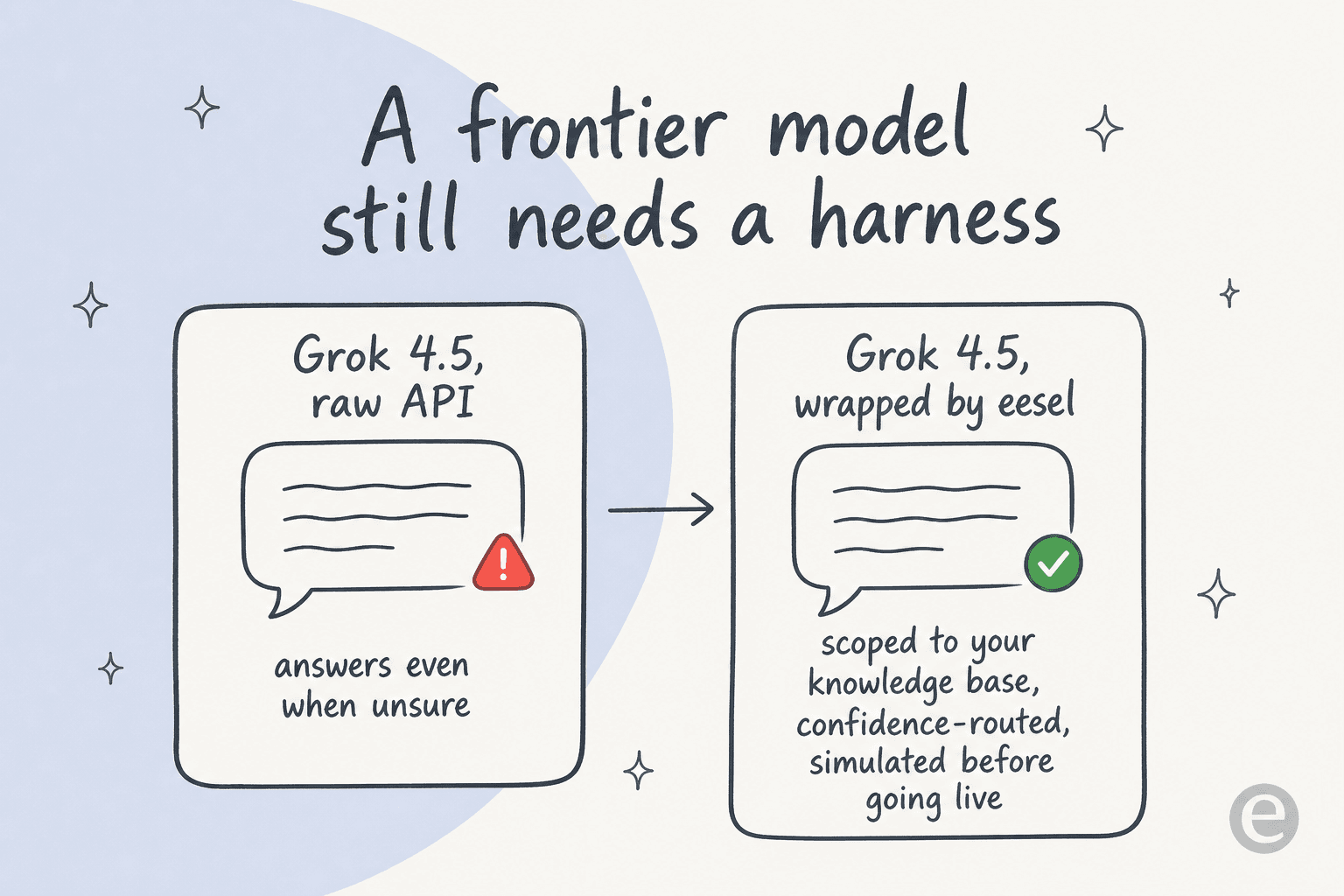
I've seen this exact failure mode up close. In eesel's own early rollouts, a bot with no hard fallback on a failed knowledge-base lookup would occasionally fabricate an answer from whatever it had seen in training rather than say it didn't know, in one memorable case answering a completely unrelated support question with "Oxygen," lifted straight from the periodic table, because the retrieval came back empty and the model filled the gap anyway. That's not a Grok-specific problem, it's what any capable model does by default when nothing stops it from guessing confidently. It's also exactly the kind of objection we hear on sales calls: buyers want an AI that only answers the tickets it's actually confident about, and silently leaves the rest for a human, rather than one that tries to answer everything and sometimes gets it wrong where a customer can see it.
That's the gap between "a strong model" and "a safe support setup." eesel scopes the model to your own help docs and past tickets, routes anything below a confidence threshold to a human instead of guessing, and runs a full simulation against your historical tickets before anything goes live, so you can see exactly what it would have said, on real past cases, before a single customer sees a reply. It works the same way regardless of which model is underneath, Grok 4.5, GPT, or Claude, because the wrapper is the actual safety layer, not the model choice.

The verdict
If you're picking a model for agentic, tool-heavy work and cost matters, Grok 4.5 is a genuinely strong pick, arguably the best price-to-performance option on the market right now for that specific job. If you need the single smartest model for open-ended reasoning, Claude Fable 5, Claude Opus 4.8, or GPT-5.5 still edge it out, at a higher price. And if you're weighing it for anything customer-facing, the model quality was never really the bottleneck, the trust concerns and the lack of a hard stop on confident wrong answers are, which is a setup problem more than a model problem.
Try eesel
Whatever frontier model wins this month, Grok 4.5, GPT-5.5, or whatever ships next, the hard part of AI support was never picking the smartest LLM. It's making sure the model only answers what it actually knows, and hands off the rest cleanly. eesel sits on top of your existing helpdesk, whether that's Zendesk, Freshdesk, Gorgias, HubSpot, or Front, learns from your real ticket history on day one, and runs a full simulation against your past tickets so you can see the exact coverage before it ever touches a live conversation. Pricing is one fixed monthly price, from $299/month for 500 credits (1 credit per ticket or chat), with no seat fees, so you're not paying for a model's benchmark score, you're paying for tickets it actually works on.
Frequently Asked Questions
Is Grok 4.5 actually good?
How much does Grok 4.5 cost?
Is Grok 4.5 better than Claude or GPT-5.5?
Can I use Grok 4.5 for customer support?
What's actually new in Grok 4.5 versus Grok 4.3?


Article by
Rama Adi
Rama is a software engineer at eesel AI with two years of experience writing about B2B SaaS, AI tools, and customer support technology. Based in Bali, Indonesia, he brings a developer's perspective to product comparisons — cutting through marketing copy to what the integrations and APIs actually do.