8 Kimi K2.7 Code alternatives worth trying in 2026

Kurnia Kharisma

Katelin Teen
Last edited July 9, 2026

Why people go looking for a Kimi K2.7 Code alternative
Give Moonshot its due first: Kimi K2.7 Code is a genuinely credible open-weight coding model. It's a 1-trillion-parameter Mixture-of-Experts model (32B activated per token), it beats its own predecessor Kimi K2.6 on all six of Moonshot's published benchmarks, and at $0.95 input / $4.00 output per 1M tokens it undercuts every closed frontier model on price. The weights ship under a Modified MIT license, so self-hosting is a real option, not a marketing footnote.
The reasons people leave anyway are specific, not vague dissatisfaction. My full Kimi K2.7 Code review goes deep on all three, but the short version:
- The headline efficiency claim doesn't match real bills. Moonshot's model card claims ~30% fewer reasoning tokens than K2.6. Real users report the opposite.
- Thinking mode is mandatory. You cannot disable it or override the fixed sampling parameters, so there's no lever to trade reasoning depth for speed or cost.
- It's not the smartest model available. GPT-5.5 leads on five of Moonshot's own six benchmarks, and Claude Opus 4.8 leads on four, including the two you'd weight heaviest for raw coding quality.
Here's the exact contradiction, straight from the community:
"Kimi 2.7 Code is good, but it thinks forever and consumes way too much limit."

That's the pattern to keep in mind through every item below: an AI lab's own model card and a real account's actual spend are two different documents, and only one of them is yours.
The alternatives at a glance
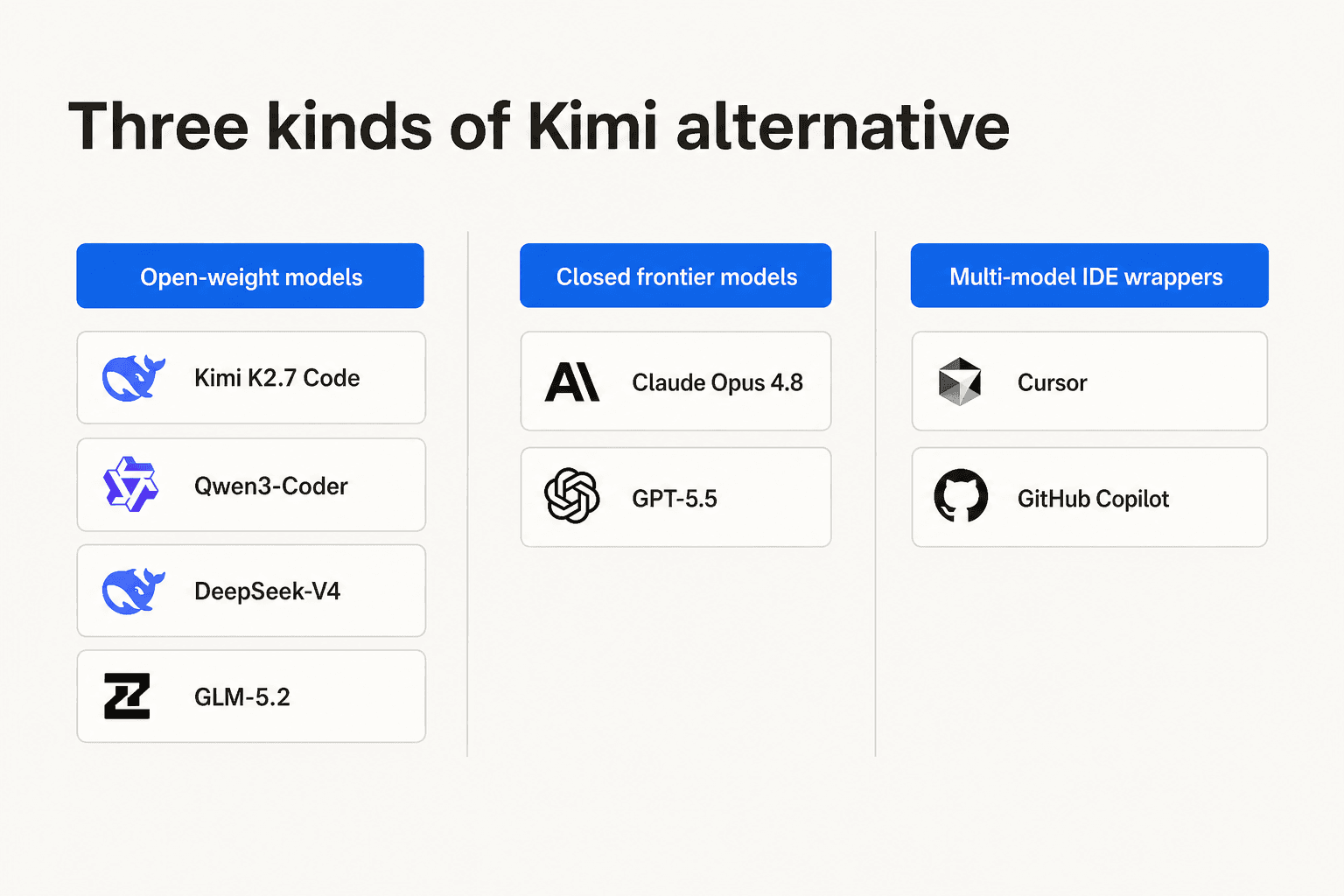
Before the deep dives, here's how all eight stack up on the dimensions that actually matter when you're switching: price, openness, and what kind of tool you're actually getting (a raw model vs. a full IDE).
| Tool | Best for | Input / output per 1M tokens | Open weight? | Self-host option | Context window | Standout benchmark |
|---|---|---|---|---|---|---|
| Claude Code | Highest coding quality, price no object | $5.00 / $25.00 (Opus 4.8) | No | No | 1M tokens (API) | Leads 4 of 6 vs. Kimi K2.7 Code |
| GPT-5.5 / OpenAI Codex | Outright benchmark leadership | $5.00 / $30.00 | No | No | Long-context tier available | Leads 5 of 6 vs. Kimi K2.7 Code |
| Qwen3-Coder-480B | Cheap, open-weight, huge repo context | $1.50 / $7.50 | Yes (Apache 2.0) | Yes | 262K tokens | 480B-A35B MoE for repo-scale refactors |
| DeepSeek-V4 | Lowest hosted API price | $0.44 / $0.87 (Pro tier) | Yes | Yes | 1M tokens | Cheapest frontier-ish model in this list |
| GLM-5.2 | Long-horizon agentic coding at a discount | $1.40 / $4.40 | Yes (MIT) | Yes | 1M tokens (stable) | 81.0 on Terminal-Bench 2.1 |
| ZCode | A first-party agent harness around GLM-5.2 | Bundled in $12.60-$112/mo plans | Model yes, harness no | Model only | Inherits GLM-5.2's 1M | Remote control via WeChat/Feishu/Telegram |
| Cursor | One IDE, any frontier model | $20-$200/mo subscription | No | No | Model-dependent | 64% of Fortune 500 usage claim |
| GitHub Copilot | Cheapest agentic entry + GitHub-native tooling | $10-$100/mo subscription | No | No | Model-dependent | 20M+ users, 60M+ code reviews shipped |
1. Claude Code - best for teams who want the smartest coding agent, price aside
Claude Code is Anthropic's agentic coding tool, and it's the model that Kimi K2.7 Code's own benchmark table can't beat on the metrics that matter most for hard coding work. It runs across a terminal CLI, VS Code, JetBrains, a desktop app, and even a mobile-to-PR workflow, all sharing the same engine so your CLAUDE.md instructions and MCP servers travel with you regardless of surface.
What it's good at: on Moonshot's own six-benchmark comparison table, Claude Opus 4.8 leads four of six, including the two coding-quality benchmarks I'd weight heaviest (Program Bench, MLS Bench Lite). Community sentiment backs this up hard: Reddit and X users comparing Claude Code against Gemini CLI, Copilot, and Cursor consistently describe it as behaving "like a senior engineer who already read your whole codebase twice." Anthropic's own metrics claim engineers now merge 5 PRs a day on average, a 67% jump since adopting Claude Code.
Where it falls short: rate limits are the single loudest recurring complaint. Users on the $17-20/month Pro plan report hitting caps within minutes of an intensive session, and the community consensus is that the $100/month Max plan is the realistic floor for sustained agentic coding, not the $20 entry tier.
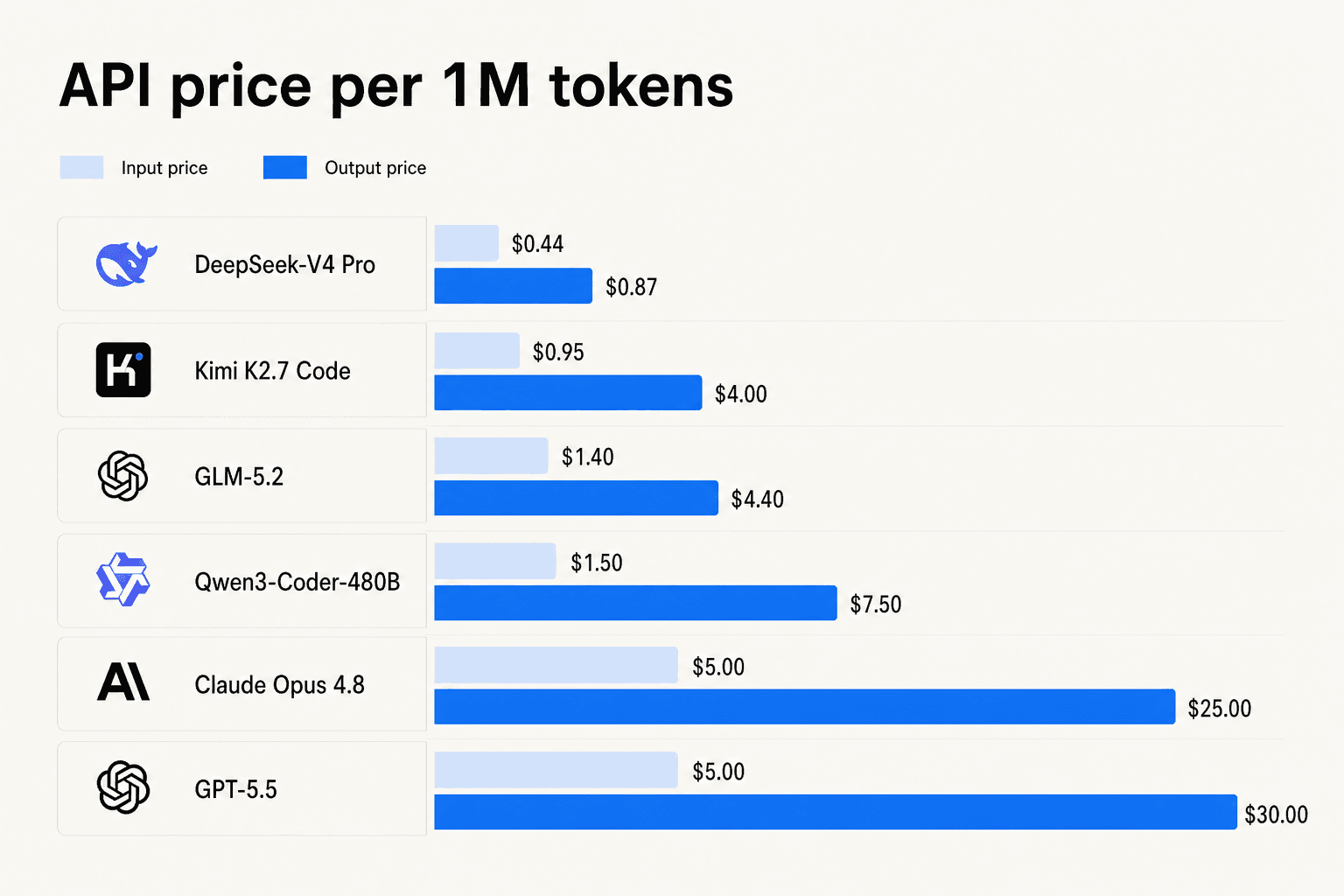
Pricing: Claude Code itself is bundled into Claude's subscription plans, not sold separately: Pro at $17-20/month, Max 5x at $100, Max 20x at roughly $200. API access to the underlying model runs $5.00 input / $25.00 output per 1M tokens for Opus 4.8, or $3.00/$15.00 for Sonnet 4.6 if you don't need the flagship.
Our take: if the reason you're leaving Kimi K2.7 Code is the hallucination and quality-regression complaints, Claude Code is the safest landing spot. It costs more than Kimi per token, but the community's read on reliability is the sharpest contrast in this whole list.
2. GPT-5.5 (via OpenAI Codex) - best for outright benchmark leadership
GPT-5.5 leads Kimi K2.7 Code on five of Moonshot's own six published benchmarks, more than any other model in this list. Accessed via OpenAI Codex, it's the model to reach for if raw problem-solving depth on hard coding tasks is the deciding factor, ahead of price or openness. OpenAI has also previewed a next-generation GPT-5.6 family (Sol, Terra, Luna) with a headline cybersecurity capability, though it's still gated to vetted partners and not yet in ChatGPT or the public API as of this writing, so GPT-5.5 remains the model you can actually buy today.
What it's good at: the benchmark spread against Kimi K2.7 Code isn't close. GPT-5.5 wins Kimi Code Bench v2 (69.0 vs. 62.0), Program Bench (69.1 vs. 53.6), MLS Bench Lite (35.5 vs. 35.1), Kimi Claw 24/7 Bench (52.8 vs. 46.9), and MCP Atlas (79.4 vs. 76.0). The one benchmark Kimi K2.7 Code wins outright against both GPT-5.5 and Claude Opus 4.8 is MCP Mark Verified, a tool-use metric, so if your workload is unusually tool-call-heavy relative to raw reasoning, that's a real asterisk worth knowing.
Where it falls short: GPT-5.5's short-context API rate is $5.00 input / $30.00 output per 1M tokens, the priciest output rate of any model in this list, and it jumps to $10/$45 on the long-context tier past roughly 272K tokens. There's also a $30/$180 Pro tier for the heaviest reasoning workloads. This is a "pay for the ceiling" model, not a budget pick.
Pricing: $5.00/$30.00 per 1M tokens (short context) via the API and Codex; ChatGPT consumer plans run Free ($0), Go ($8/month), Plus ($20/month), and Pro ($100-200/month) with Codex access bundled in at the Plus tier and above.
Our take: if GPT-5.5's benchmark lead alone doesn't sell you, remember Kimi K2.7 Code's own launch materials picked this exact model as the bar it couldn't clear on five of six tests. For OpenAI Codex alternatives beyond this single pick, that roundup covers the wider field by use case.
3. Qwen3-Coder - best for cheap, open-weight coding at repo scale
Alibaba's Qwen family runs a dedicated coding line, and Qwen3-Coder-480B-A35B is the closest thing to a like-for-like Kimi K2.7 Code swap: open-weight, MoE, and priced to compete on cost. It activates only 35B of its 480B total parameters per token, which keeps it fast despite the scale, and the Qwen Cloud API is fully OpenAI-compatible, so switching your harness over is close to a one-line config change.
What it's good at: at $1.50/$7.50 per 1M tokens for the full 480B model, or as low as $0.07/M on third-party hosts for the smaller Qwen3 Coder Next variant, this is real budget territory. One Redditor called the $0.07/M tier "cheating" for daily coding work, and praised its 262,144-token context for dropping in five or six entire Python files at once.
Where it falls short: Qwen's own token plans have drawn sharp criticism for opacity and speed of consumption. One documented head-to-head found Qwen's $30 plan burned 23% of its monthly quota on a single code review task, while Claude, OpenAI, and Kimi consumed under 1% of comparable plans on the identical task. The community's explanation is poor prompt caching relative to other providers, the same "cheap on paper, expensive in practice" story that's dogging Kimi K2.7 Code right now. Alibaba also killed its generous free coding tier (2,000 requests/day) in April 2026, which triggered a real churn wave to Claude and self-hosting.
Pricing: Qwen3-Coder-480B-A35B at $1.50 input / $7.50 output per 1M tokens on Qwen Cloud; Qwen3 Coder Next as low as $0.07-$0.22/M via OpenRouter and other third-party hosts. Full breakdown of the wider Qwen lineup is in our Qwen pricing guide.
Our take: treat the sticker price as a starting point, not the whole story, and budget for real usage before committing. If Kimi's "cheap per token, expensive per bill" problem is exactly what pushed you away, don't swap it for a twin with the same flaw. Our Qwen alternatives roundup covers where else to look if this one doesn't land.
4. DeepSeek-V4 - best for the lowest price on a hosted API
DeepSeek is the Chinese lab that made open-weight frontier-class reasoning models a mainstream option in the first place, and DeepSeek-V4, its current flagship, undercuts Kimi K2.7 Code on price while matching it on openness. The consumer chat app at chat.deepseek.com is free with no metered cap, and the API is both OpenAI- and Anthropic-compatible, so it's a genuine drop-in for Claude Code, GitHub Copilot, or any other harness without touching your existing code.
What it's good at: DeepSeek-V4 Pro runs $0.435 input / $0.87 output per 1M tokens, less than half of Kimi K2.7 Code's own $0.95/$4.00 rate, before automatic context caching drops cache-hit input to a fraction of a cent. It carries a 1M-token context window (up to 384K output tokens), well past Kimi K2.7 Code's 256K ceiling, and thinking mode is switchable rather than locked on.
Where it falls short: DeepSeek's real-time web search and current-events freshness lag Google-backed alternatives, and it's hosted in China under Chinese data law, a recurring concern in community discussion for teams with strict data-residency requirements. Exact V4 benchmark numbers also aren't independently confirmed the way Moonshot's and Z.ai's launch tables are cross-referenced against third parties, so treat any specific score claim with the same "verify before you commit budget" caution as any vendor number.
Pricing: deepseek-v4-flash at $0.14 input / $0.28 output per 1M tokens for lighter workloads; deepseek-v4-pro at $0.435/$0.87 for higher-capability tasks. Consumer chat and mobile apps are free.
Our take: if the whole reason you're shopping is that Kimi's "cheap" rate didn't feel cheap once real usage hit it, DeepSeek-V4 is the most direct fix, a genuinely lower price with the same open-weight safety net if the hosted rate ever changes on you.
5. GLM-5.2 - best for long-horizon agentic coding without the frontier price tag
GLM-5.2 is Z.ai's (formerly Zhipu AI) flagship open-weight model, released June 16, 2026, and it's purpose-built for exactly the kind of long-running, multi-hour agentic coding sessions Kimi K2.7 Code targets, at roughly a sixth of frontier pricing. It's the first GLM-5 generation model with a stable 1M-token context window, up from 200K in GLM-5.1, and Z.ai explicitly trained it to stay reliable across long, messy agent trajectories rather than just nominally accepting the token count.
What it's good at: GLM-5.2 is the highest-ranked open-weight model on three separate long-horizon coding benchmarks (FrontierSWE, PostTrainBench, SWE-Marathon) and the first open-weight model to cross 80% on Terminal-Bench 2.1, landing at 81.0 against Claude Opus 4.8's 85.0. Independent confirmation came from Artificial Analysis, which found GLM-5.2 leads all open-weight models on its own intelligence index. It ships under an unrestricted MIT license, "no regional limits" by Z.ai's own framing, which matters if data-sovereignty concerns are part of why you're moving off a China-hosted model in the first place, or part of why you're not.
Where it falls short: at $1.40 input / $4.40 output per 1M tokens on the API, it's still pricier than Kimi K2.7 Code's own rate on paper, and one Hacker News commenter flagged that GLM-5.2 sits in "an uncanny valley where it's too big to run at home, too expensive and slow compared to similarly capable models" once you account for how far a Claude or Codex subscription actually stretches. Z.ai itself was added to the US Commerce Department's Entity List in January 2025 over national-security concerns, which is worth knowing before an enterprise procurement conversation.
Pricing: API at $1.40 input / $4.40 output per 1M tokens; the GLM Coding Plan runs Lite at roughly $12.60/month, Pro at $50.40, and Max at $112 (annual billing), consuming quota at 3x during peak hours.
Our take: GLM-5.2 is the strongest "same idea as Kimi K2.7 Code, executed with a bigger context window and a cleaner efficiency story" pick on this list, but it earns its own caveat about subscription math the same way Kimi did.
6. ZCode - best for a first-party agent harness built specifically around GLM-5.2
Where GLM-5.2 is a model, ZCode is Z.ai's own desktop "agentic development environment" built around it, the equivalent relationship Moonshot has with its Kimi CLI. It launched July 2, 2026, and instead of a chat sidebar bolted onto an existing editor, it runs alongside your terminal with a "Goals" system for multi-step tasks, plus the option to trigger or steer work remotely from WeChat, Feishu, or Telegram.
What it's good at: deep, first-party tuning between the agent harness and GLM-5.2's execution model, plus genuinely novel remote control, you can nudge a long-running task from your phone via chat app, not just check on it. BYOK support means Anthropic, DeepSeek, Kimi, and OpenRouter models all plug in if you don't want GLM-5.2 as the default.
Where it falls short: the community reception has been mixed in ways worth knowing before you commit. The most substantive Hacker News thread includes a detailed first-hand comparison against Claude Opus 4.8:
"GLM 5.2 has never refused a task. So for anything security-related... I use GLM 5.2... On average, I think Opus 4.8 is still a better, more reliable, and faster model, but if it went away tomorrow and I only had GLM 5.2, I wouldn't be too sad about it."

Other commenters flagged the TUI as "quite heavy and crashing quite often as compared to Claude Code," called the interface "an exact copy of Codex" despite the "Claude Code from the makers of GLM" marketing framing, and raised a real trust question about "a piece of proprietary Chinese software that gets full system control." Exact usage caps per plan tier also aren't disclosed anywhere on Z.ai's own pricing page, which is the same pricing-transparency complaint aimed at Kimi's Token Plans and Qwen's credit system.
Pricing: bundled into the same GLM Coding Plan as GLM-5.2 itself, Lite at ~$12.60/month, Pro at ~$50.40, Max at ~$112 (annual billing, yearly-discounted rate).
Our take: ZCode is worth trying if you specifically want Z.ai's remote-control angle or already prefer GLM-5.2's "never refuses" behavior on sensitive tasks, but the trust and reliability concerns are real enough to pilot on a sandboxed project first, not your main repo.
7. Cursor - best for staying in one IDE and switching models as prices shift
Every model above is a single bet on a single lab. Cursor sidesteps that entirely: it's an AI-native code editor, built on a VS Code fork, that gives you Claude Opus 4.8, GPT-5.5, Gemini 3.1 Pro, Grok Build 0.1, and Cursor's own Composer 2.5 model inside a single subscription. As of mid-2026 it claims usage across 64% of Fortune 500 companies.
What it's good at: the Composer/Agent mode is the standout differentiator versus GitHub Copilot, genuinely autonomous multi-file editing at the same price point Copilot charges for autocomplete. The free Hobby tier is real, not a bait-and-switch trial: 2,000 Tab completions and 50 slow premium requests a month with no credit card. G2 reviewers rate it 4.7/5 across 205 reviews, and "friction-free VS Code migration" is the most repeated onboarding praise.
Where it falls short: usage limits feel tight for power users even on the $20 Pro plan, with heavy Agent sessions capable of exhausting monthly credits in a single day. The Electron-based app is also flagged as "RAM-hungry like Chrome" in reviews, and rapid release cadence means keyboard shortcuts and workflows shift under you more often than a slower-moving tool would.
Pricing: Hobby free; Pro at $20/month ($16 annual); Pro+ at $60; Ultra at $200; Teams from $40/user; Enterprise custom. Students get a full free year with a verified school email.
Our take: if switching models every time pricing or benchmarks shift sounds exhausting rather than exciting, Cursor removes that decision entirely, you're never locked into one lab's roadmap the way a raw API key locks you into Moonshot's. For the wider field, our Cursor alternatives roundup and direct Cursor vs. Windsurf comparison go deeper.
8. GitHub Copilot - best for the cheapest agentic entry point with GitHub-native reach
GitHub Copilot is the other major multi-model wrapper, and it wins on two things Cursor doesn't: it's cheaper to start, and it's woven directly into GitHub itself, issues, pull requests, Actions, and code review, rather than bolted on from outside. As of mid-2026 it's crossed 20 million users and shipped 60 million code reviews, with 71% of those reviews surfacing genuinely actionable feedback.
What it's good at: the Pro tier starts at $10/month, half of Cursor's entry price, with cloud agent access, code review, and third-party agent selection (Claude and Codex are both pickable from the same GitHub issue assignee dropdown) included. G2 rates it 4.5/5, and Gartner Peer Insights puts it at 4.4/5 across 463 ratings.
Where it falls short: the dominant 2026 community debate is Copilot vs. Claude Code, and the Reddit consensus is blunt:
"Github Copilot is worse than Claude Code or Codex. It's true to me. GC is best in term of value though."
A June 2026 shift to usage-based billing (code review now consumes GitHub Actions minutes) and an April 2026 change making Free/Pro/Pro+ interactions train GitHub's models by default (opt-out, not opt-in) have both drawn real pushback in the community.
Pricing: Free tier with 2,000 completions/month; Pro at $10/month ($15 in AI credits); Pro+ at $39 ($70 in credits, unlocks Opus-tier models); Max at $100 ($200 in credits). Full breakdown in our Copilot pricing guide.
Our take: if budget is the primary constraint and you're already living inside GitHub's ecosystem, Copilot is the cheapest credible entry into agentic coding, full stop, you're trading some ceiling on quality for a real floor on cost. For the wider shortlist, our Copilot alternatives roundup covers where else to look.
How I'd choose between these
Every alternative above solves a different version of "Kimi K2.7 Code isn't working for me," so the honest answer to "which one" starts with naming your actual complaint:
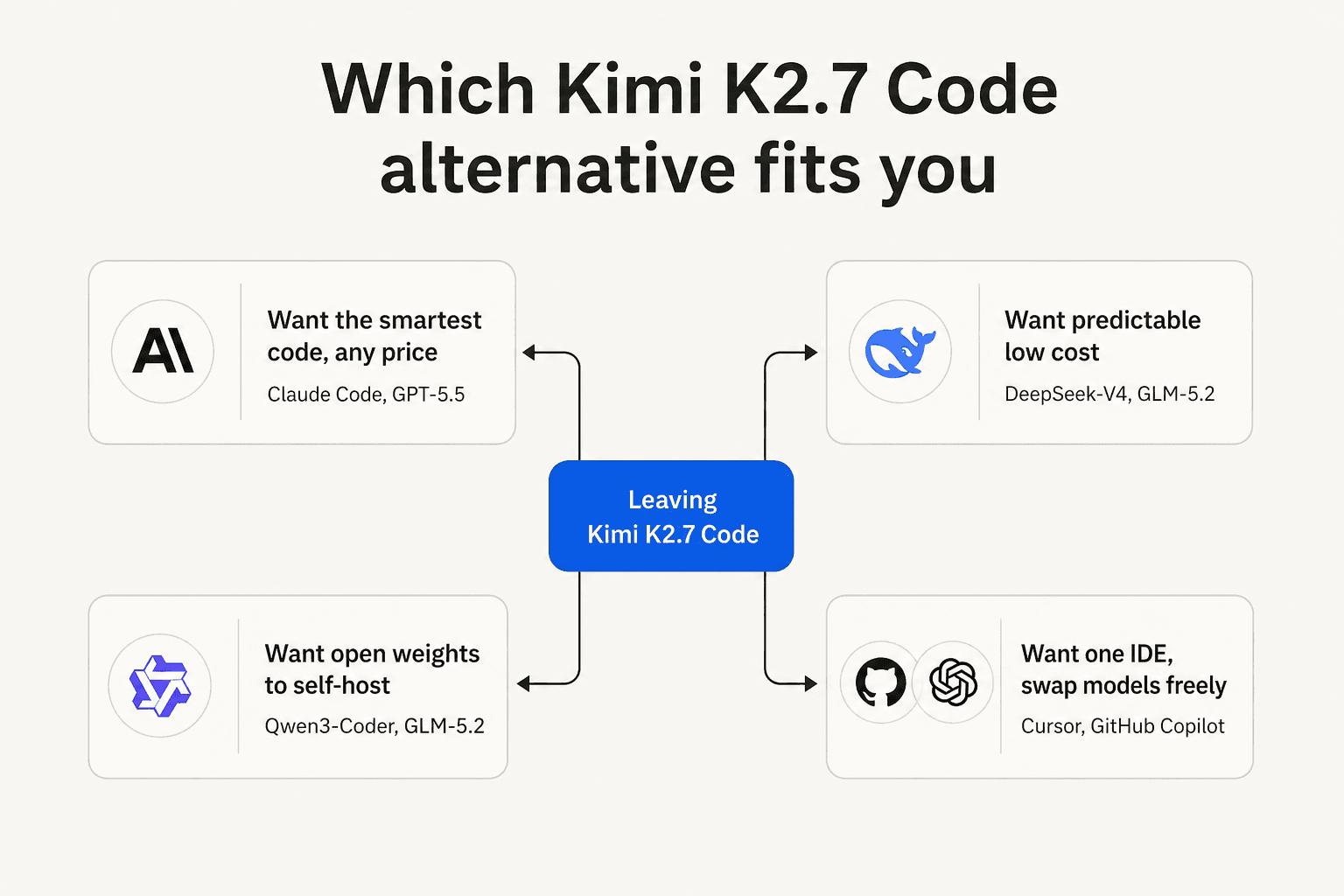
- The model isn't smart enough → Claude Code or GPT-5.5, and accept the higher price as the cost of the ceiling.
- The price didn't match the promise → DeepSeek-V4 or GLM-5.2, both genuinely cheaper than Kimi K2.7 Code's own rate, though budget for real usage, not the sticker.
- You want open weights without Kimi's specific quirks → Qwen3-Coder or GLM-5.2, same self-hosting safety net, different execution.
- You're tired of betting on one lab at all → Cursor or GitHub Copilot, where the model underneath is your choice, not your lock-in.
If none of those descriptions fit and you're just curious whether Kimi K2.7 Code's specific efficiency claim holds up on your own workload before you commit, that's worth testing directly rather than trusting either the launch post or this list. The same rule applies whichever model wins: verify the real cost on real work before the budget conversation, not after.
Try eesel
I work on eesel, and this exact problem, a vendor's efficiency number turning out to be a lab number rather than a real bill, is one I've watched play out in AI support tooling for years, not just in coding models. I've sat on calls where a buyer built a careful budget off a vendor's per-interaction rate, then panicked mid-onboarding once the real usage math landed differently than the pitch implied. It's the same gap Kimi K2.7 Code's own launch is having right now, just wearing a different vendor's logo.
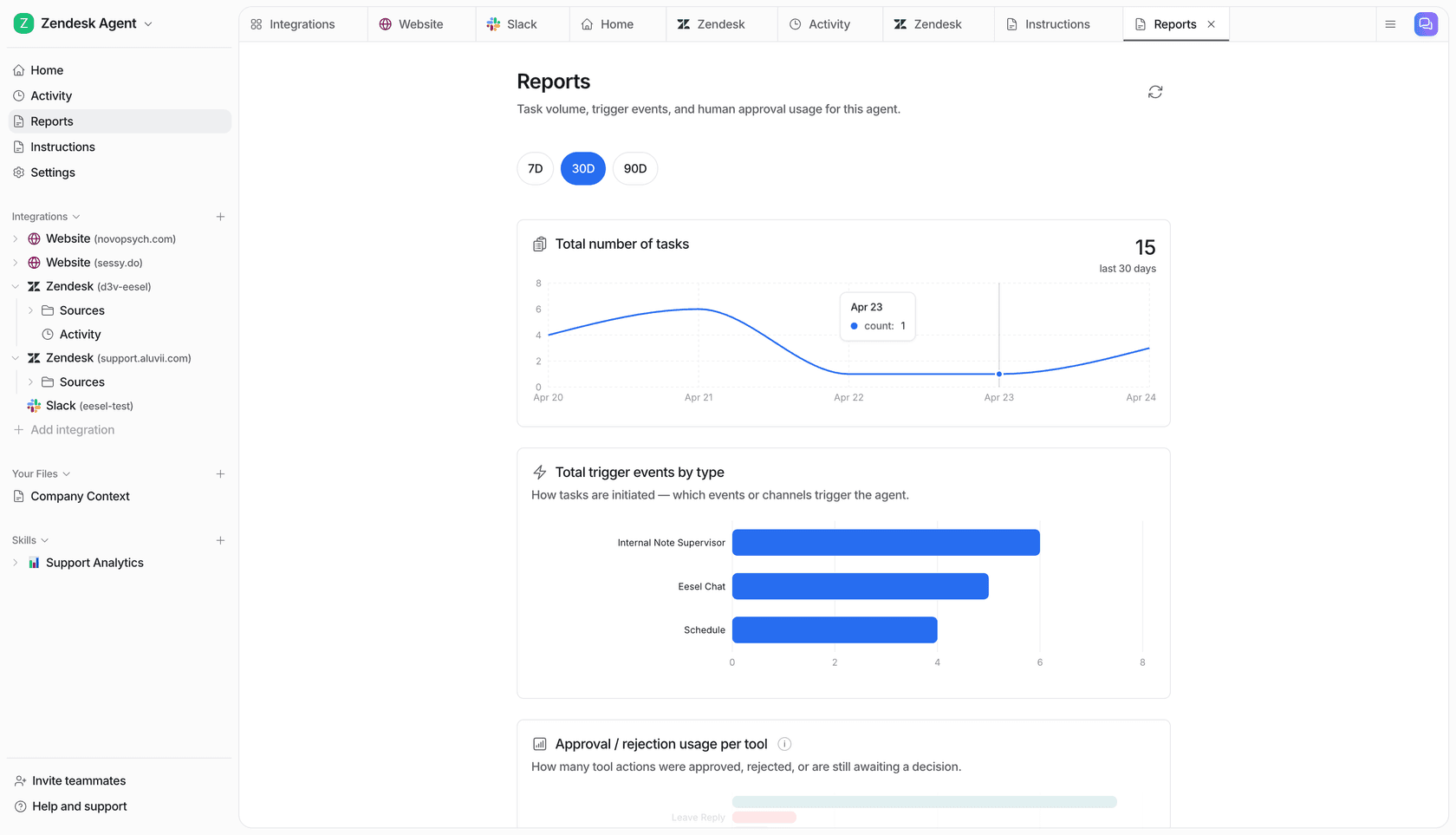
That's why eesel prices support automation as a fixed monthly plan on credits, from $299/month for 500 credits (1 credit per ticket or chat, however long), not per token or per seat, so the number in the sales deck is the number on your invoice, whatever your ticket volume does month to month. eesel plugs into your existing helpdesk, whether that's Zendesk, Freshdesk, or Front, learns from your real ticket history, and runs a full simulation against your own historical tickets before anything goes live, so you see the actual resolution rate and actual cost, not a benchmark number from someone else's data. Whichever coding model your engineering team ends up on, the support side of the business deserves the same "verify before you bet the budget" discipline.
You can try eesel free, no self-hosting, no credit card, and no lab-number-vs-real-bill gap to discover three weeks in.
Frequently Asked Questions
Why are people looking for a Kimi K2.7 Code alternative?
What is the best free alternative to Kimi K2.7 Code?
Is Claude Code better than Kimi K2.7 Code for coding?
Which Kimi K2.7 Code alternative is cheapest for high-volume coding?
Can I self-host a Kimi K2.7 Code alternative instead of using an API?
Should I use Cursor or GitHub Copilot instead of a single model like Kimi?
What's the difference between GLM-5.2 and ZCode?


Article by
Kurnia Kharisma
Kurnia is a software engineer and writer at eesel AI with two years of SEO experience, writing about AI tools, helpdesk software, and customer support. He pairs a developer's understanding of how these products are built with search-driven research into what actually ranks and resonates with the people searching for them.