
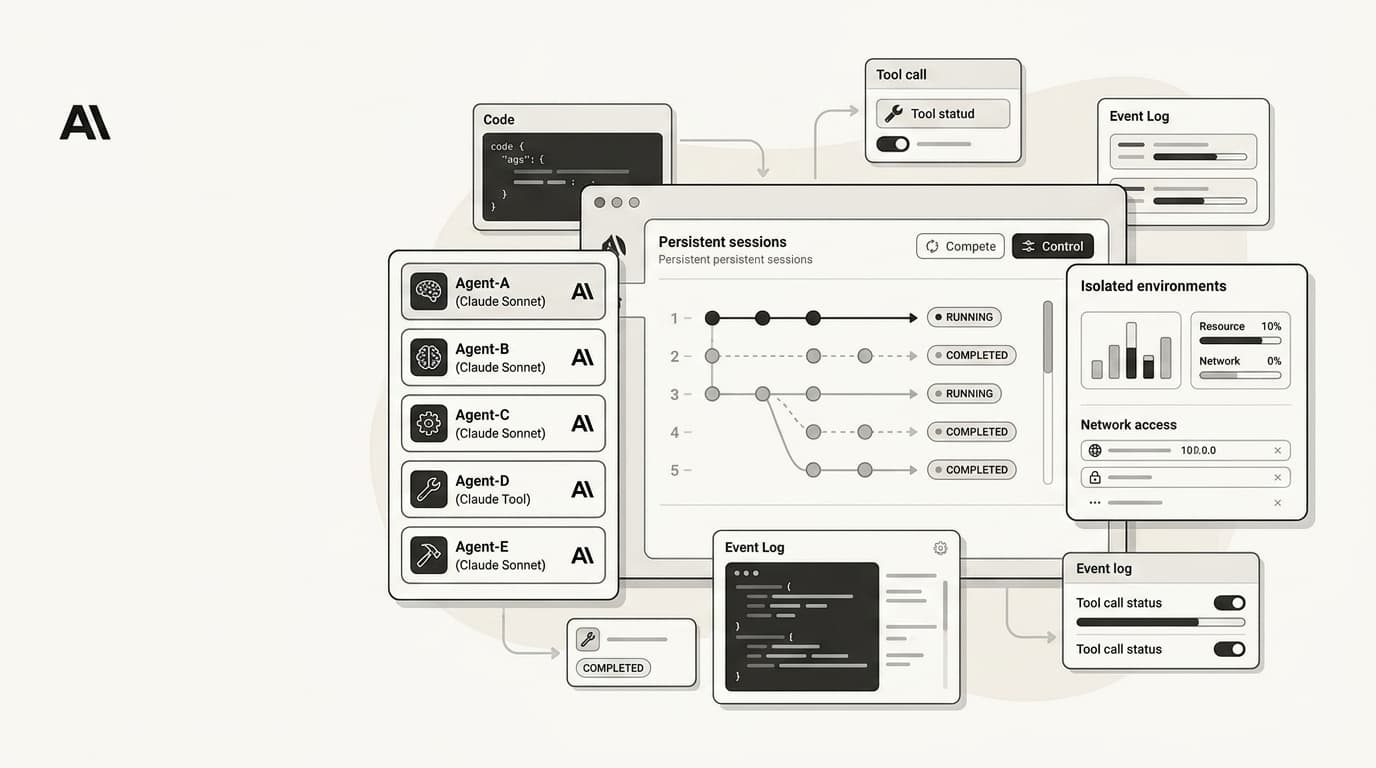
AI agents have moved quickly from experimental scripts running on a laptop to the backbone of production software. But if you've ever tried to ship an autonomous agent, you know that the "brain" (the AI model) is only half the battle. The other half is the plumbing: the secure sandboxes, the long-running session management, the tool execution loops, and the infrastructure that doesn't fall over when you scale from one user to a thousand.
That's exactly the problem Claude Managed Agents (launched in April 2026) aims to solve. Instead of spending weeks building a custom agent harness, developers can now offload the infrastructure layer to Anthropic.
What are Claude Managed Agents?
At its heart, Claude Managed Agents is a managed infrastructure service that handles the execution environment for AI agents. It's not a new model or a no-code builder. Think of it as an "agent harness" (the software layer that wraps around a model) provided as a hosted service.
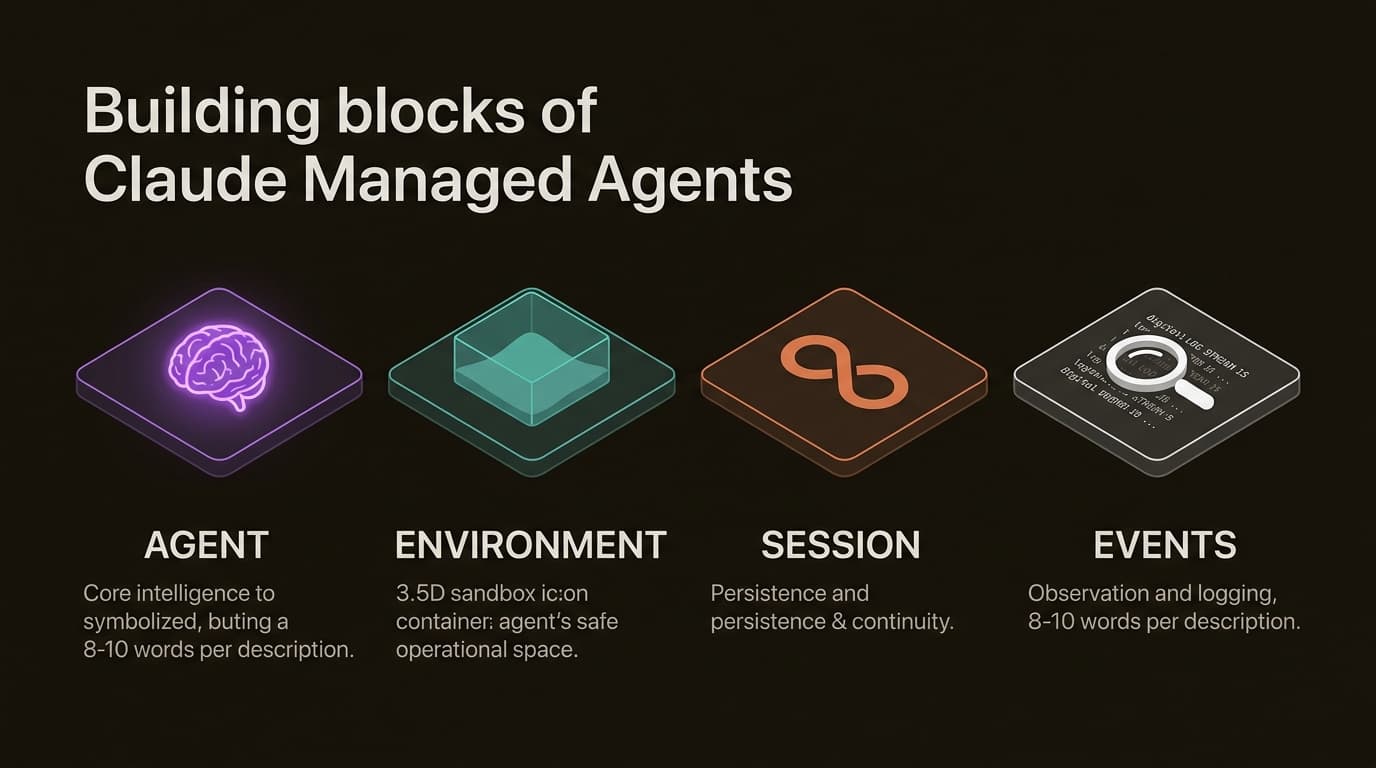
The platform is built around four core building blocks:
- Agent: This is the definition of your teammate. It includes the model choice (Sonnet, Opus, or Haiku), the system prompt, and the set of tools it's allowed to use.
- Environment: These are isolated cloud sandboxes where the work actually happens. You can configure these containers with pre-installed packages like Python, Node.js, or Go, and set specific network access rules.
- Session: A session is a single, persistent run of an agent. Unlike standard API calls that are stateless, sessions can run for minutes or hours, maintaining progress even if the network connection drops.
- Events: This is the "black box" recorder for your agent. Every decision, tool call, and output is logged as an event, providing full traceability for debugging and governance.
The key distinction is that while tools like Claude Code are built for individual users, Managed Agents is infrastructure for those who build platforms and products for others to use.
How Claude Managed Agents works: Decoupling brain from hands
Most early agent systems were built as "pets," named, hand-tended containers where the brain, the tools, and the session log all lived in one place. If the container failed, the session was lost. Anthropic's engineering team realized this was a scaling bottleneck and moved toward a decoupled architecture.
Cattle, not pets
In this new model, the "brain" (the harness and model) is separated from the "hands" (the sandboxes and tools). The container becomes "cattle," interchangeable and easily replaceable. If a container dies mid-task, the harness catches the error and simply provisions a new one. There's no need to nurse a failed process back to health.
The performance payoff
This decoupling isn't just about reliability. It also provides a massive performance boost. In a coupled system, inference cannot start until the container is fully provisioned (cloning repos, booting processes, etc.). With Claude Managed Agents, inference starts as soon as the brain pulls pending events from the session log.
Anthropic reports that this architecture dropped the p50 Time-to-First-Token (TTFT) by roughly 60 percent, while the p95 dropped by over 90 percent. For the user, this means the agent starts "thinking" and responding almost instantly, even if a complex sandbox is still spinning up in the background.
The session as a context object
Long-horizon tasks often exceed a model's context window. Managed Agents addresses this by treating the session log as a durable "context object" that lives outside the model. The harness can interrogation this log to fetch specific slices of history, allowing the agent to "remember" or "reread" relevant context without overwhelming its current window.
Key features and developer capabilities
Managed Agents provides a secure, governed environment that handles the operational complexity of autonomous work.
Secure sandboxing and governance
Security is a primary concern when giving an agent access to real systems. Anthropic solves this by running agents in secure, sandboxed environments where generated code is isolated from sensitive credentials. For example, when an agent needs to push code, the repository token is used during sandbox initialization but is never reachable by the agent's generated code.
Built-in tooling and MCP
Out of the box, agents have access to a comprehensive set of built-in tools:
- Bash: Run shell commands in the container.
- File operations: Read, write, edit, and search files.
- Web search: Search the web and retrieve content from URLs.
For everything else, the MCP Connector allows you to bridge your agent to external services using the Model Context Protocol.
Research preview features
Several high-impact features are currently in research preview and require separate access requests:
- Multi-agent coordination: The ability for one agent to spawn and direct other agents to parallelize work (used by teams like Notion).
- Self-evaluation (Outcomes): Agents can define success criteria and evaluate their own performance, iterating until the goal is achieved.
- Persistent memory: Allowing agents to maintain knowledge and context across multiple distinct sessions.
Pricing and performance metrics
Pricing for Managed Agents is split into two parts: standard token usage and a runtime infrastructure fee.
| Fee Type | Rate | Description |
|---|---|---|
| Inference | Standard API Rates | Based on model tokens (Sonnet, Opus, Haiku) |
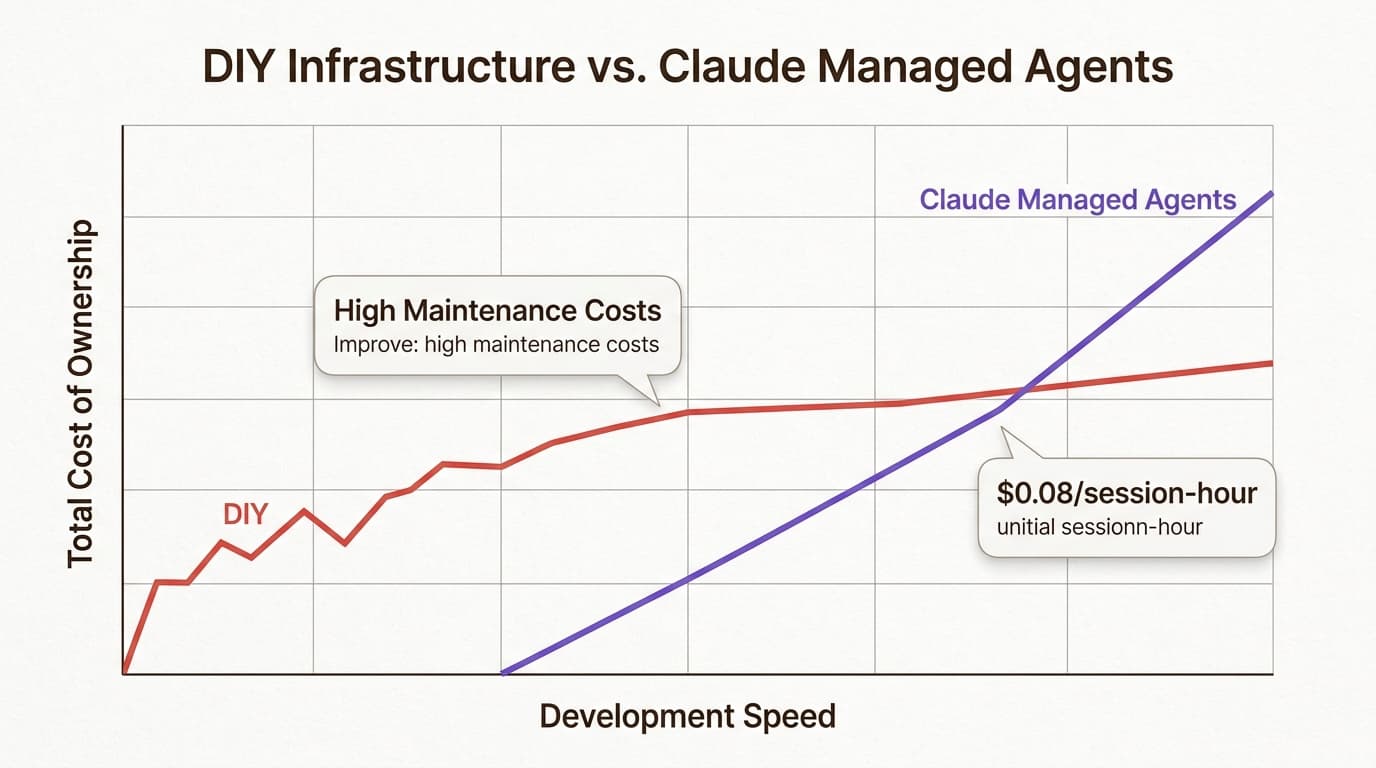
| Runtime | $0.08 per session-hour | Active agent execution time in the cloud |
Standard token rates for Sonnet 4.6 are $3 per million input tokens and $15 per million output tokens. The $0.08 per session-hour covers the cost of keeping the cloud container active while your agent works. Idle time is not billed.
In terms of performance, Anthropic's internal testing shows a 10-point improvement in task success for structured file generation compared to standard prompting loops. This gain comes from the harness being co-optimized with the model to handle context management and error recovery more effectively than a generic DIY loop.
Claude Managed Agents vs. DIY vs. eesel AI
Choosing between building your own agent stack or using a managed service depends on your scale and requirements.
The DIY path
If you need total model flexibility (e.g., mixing Claude with GPT-5 or Gemini) or have strict data residency requirements that forbid third-party clouds, you might build your own stack using frameworks like CrewAI or LangGraph. However, you will be responsible for the "security nightmare" of sandboxing and the engineering overhead of session persistence.
Managed Agents
This's the fastest path to a production-ready agent. It's ideal for teams that want to offload the infrastructure plumbing and focus entirely on the agent's logic and user experience. The trade-off is vendor lock-in to the Claude ecosystem.
The eesel AI difference
While Claude Managed Agents provides the "factory" and infrastructure to build custom agents, we take a different approach at eesel AI. We provide the finished "teammates" that are ready to work right away.
Our AI teammates focus on rapid onboarding. While building a custom managed agent might take a developer weeks to fine-tune, an eesel AI agent can be onboarded in minutes, learning from your existing documentation in Zendesk, Slack, or Notion instantly.
We also offer predictable pricing with a fixed number of AI interactions, which can be more stable for high-volume support teams than the combined token and session-hour model of the API.
Real-world use cases: Who is building with it?
Several early adopters have already integrated Managed Agents into their core products:
- Notion: Uses multi-agent coordination to run dozens of tasks in parallel, from building websites to creating presentations, directly from a task board.
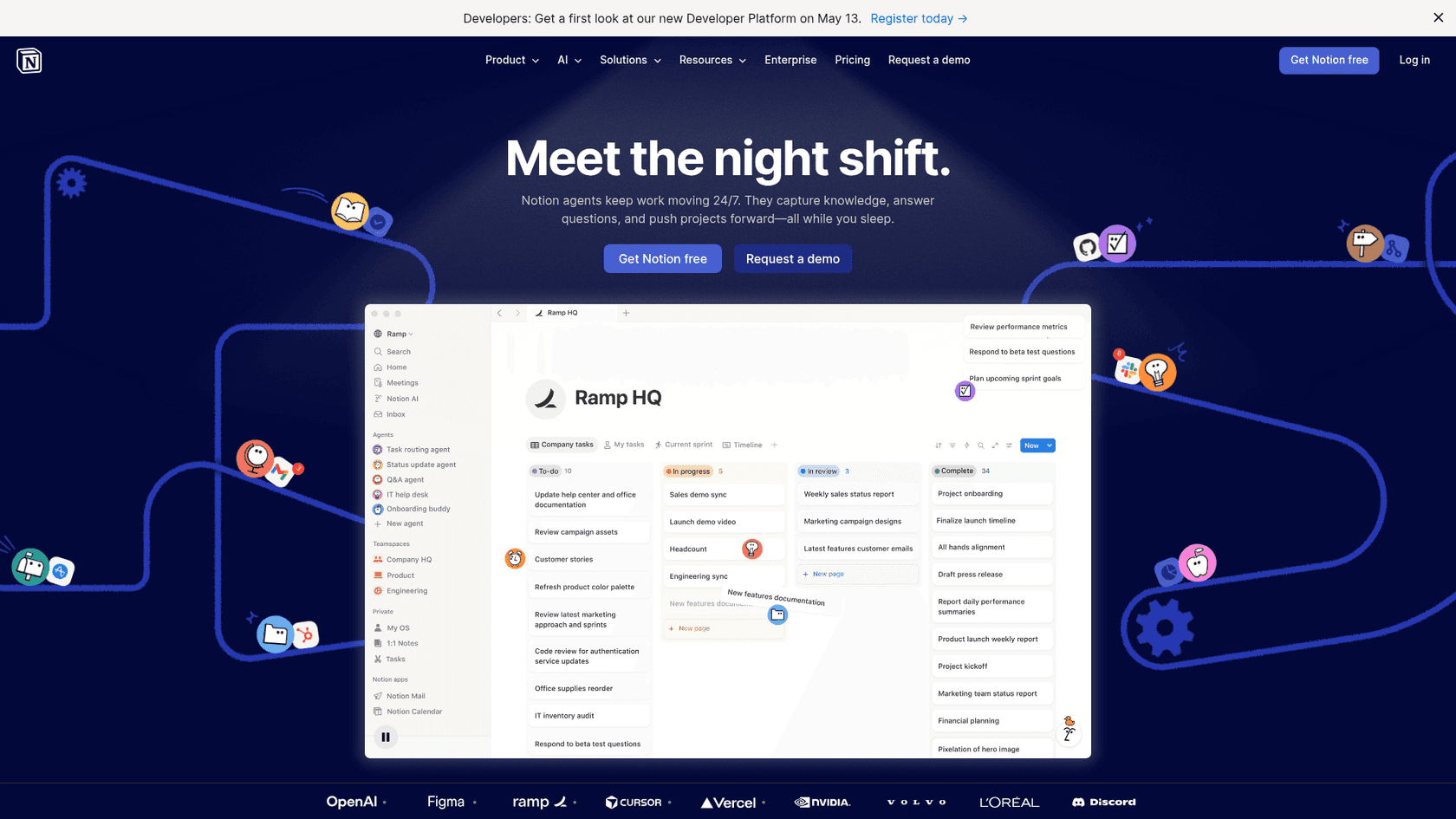
Notion's project management landing page - Asana: Created "AI Teammates" that act as Launch Planners and Compliance Reviewers, reducing task completion times from days to minutes.
- Sentry: Built an autonomous bug-fixing agent that analyzes errors, writes the fix, and opens a pull request automatically.
- Vibecode: Allows users to design and publish mobile apps just by talking to an agent, turning a $10,000 development project into a $100 conversational task.
Choosing the right path for your AI teammates
The shift toward managed agentic infrastructure is a sign that AI is moving past simple chat interfaces into truly autonomous work. Whether you build a custom solution on Claude Managed Agents or hire a ready-to-go teammate from eesel AI, the goal is the same: to offload the repetitive, manual work so your team can focus on higher-value strategy.
If you are a developer looking for full control over a custom agentic product, Managed Agents is a powerful starting point. But if you want to start seeing the benefits of AI automation in your support or operations teams today, our AI blog writer and helpdesk agents are ready to join your team.