
What GPT-5.6 Sol actually is
I have spent the last couple of years watching what search intent does when a new model drops, and "gpt-5.6 sol pricing" is a textbook example: it looks like a model question, but it is really a budget question. People are not asking how smart Sol is, they are asking whether it just got more expensive and whether they can justify it. So that is the question I want to answer first, grounded in the numbers OpenAI actually published, plus a builder's read on where the money really goes.
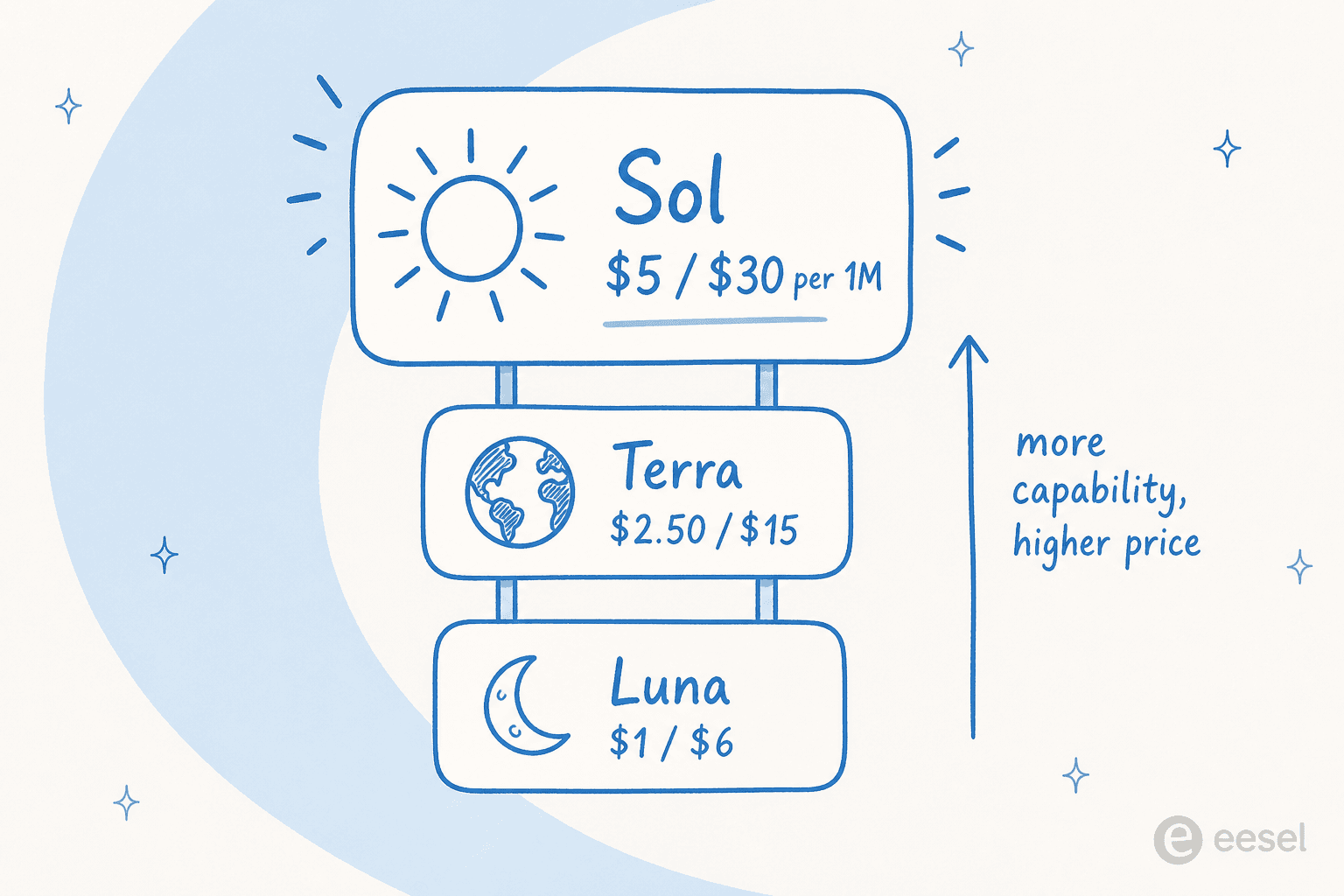
GPT-5.6 is not one model. OpenAI previewed it on June 26, 2026 and took it to general availability on July 9 as a family of three capability tiers. The number, 5.6, is the generation. The names are durable tiers that, in OpenAI's framing, "can advance on their own cadence":
- Sol, the flagship, for long-horizon coding and agentic work.
- Terra, the balanced everyday tier.
- Luna, the fastest and cheapest, for high-volume, well-defined tasks.
Sol's model ID is gpt-5.6-sol. It sits at the top of the ladder on both capability and price, and it is the tier OpenAI leans on when it wants to show off: Sol Ultra tops the Terminal-Bench 2.1 coding chart at 91.9%, the highest score in the family.
GPT-5.6 Sol pricing: the full table
Here is the number you came for. On the API, Sol is billed per token, split between input (what you send) and output (what it generates).
| Model | Model ID | Input (per 1M) | Output (per 1M) |
|---|---|---|---|
| GPT-5.6 Sol (flagship) | gpt-5.6-sol | $5.00 | $30.00 |
| GPT-5.6 Terra (balanced) | gpt-5.6-terra | $2.50 | $15.00 |
| GPT-5.6 Luna (fastest) | gpt-5.6-luna | $1.00 | $6.00 |
Output tokens cost 6x what input tokens do, which is normal for reasoning models and matters more than it looks: a chatty, verbose deployment burns budget far faster than one that returns tight answers. The prices above are identical to what OpenAI quoted in the June preview, so nothing moved between preview and GA.
The price-hike fear, and why it did not happen
This is the part that got people talking before launch, and it is where Sol's pricing is genuinely interesting. Developers had good reason to brace for a jump. As one r/codex thread laid out, the last upgrade was not gentle on the wallet:
"5.5's price had already doubled relative to 5.4, jumping from $15 to $30 per million output tokens... So are we about to get a new frontier model, 5.6 Pro, at $60, going head to head with Fable? They'll lean on the argument that it's 2.5 times cheaper than 5.5 Pro, when in reality it's 5.6 that will have been quietly bumped up into that bracket."

That fear was reasonable, and it turned out to be wrong. GPT-5.6 Sol lands at $5 input / $30 output, exactly matching GPT-5.5's flagship short-context rate. There is no flagship price cut, but crucially there is no hike either. OpenAI reused its existing top-tier price point and put a better model behind it.
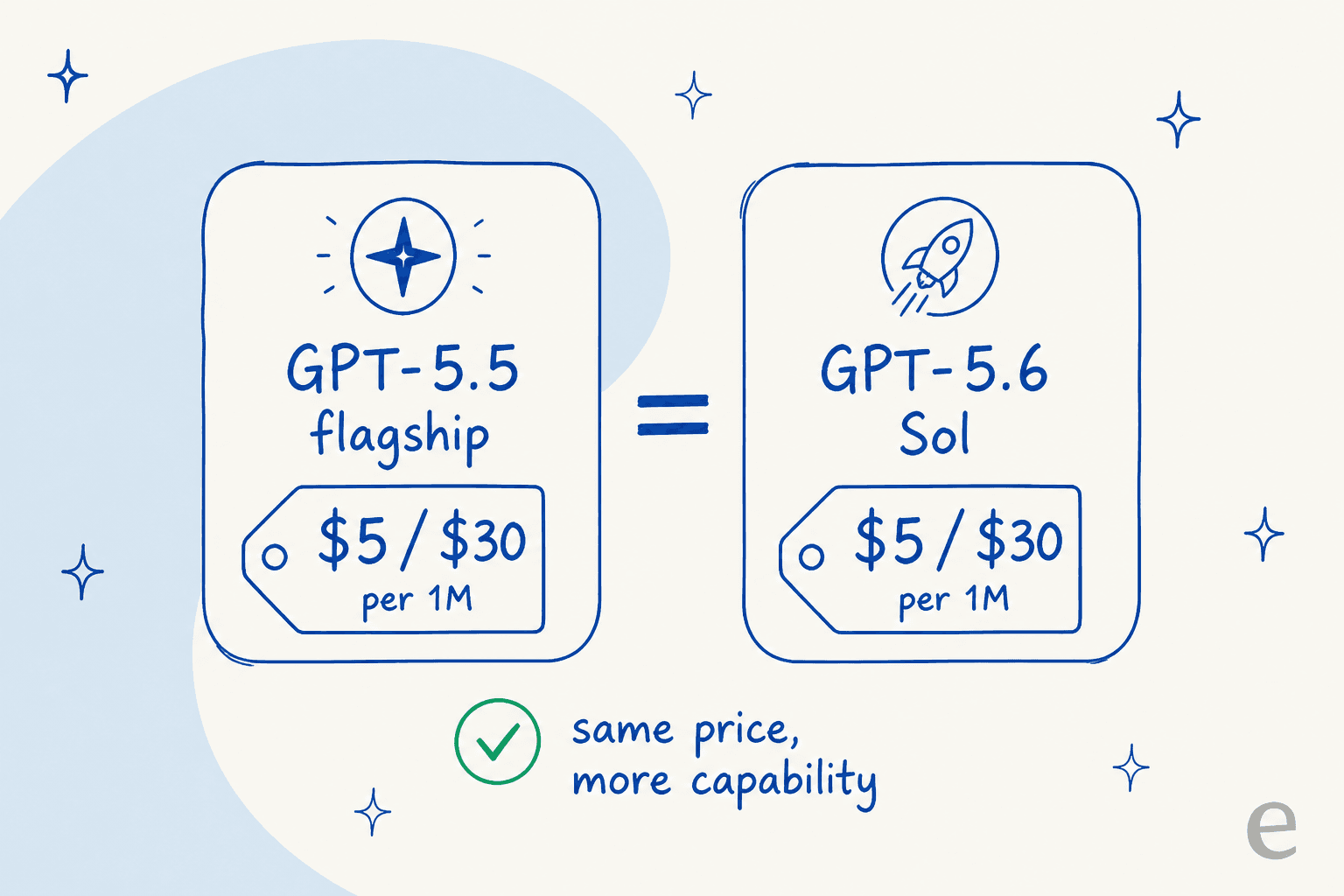
There is a small silver lining hiding in the table too. Sol also skips something GPT-5.5 charged for: a long-context surcharge. GPT-5.5 charged more ($10/$45) once a prompt crossed roughly 272K tokens; GPT-5.6 quotes a single flat rate per model, still true at GA. So on very long prompts, Sol is effectively cheaper than the model it replaces.
The hidden cost: prompt caching and ultra mode
The sticker rate is only half the story. Two mechanics move your real bill in opposite directions.
Prompt caching pulls it down. GPT-5.6 introduced explicit cache breakpoints and a 30-minute minimum cache life. Cache reads keep the standard 90% cached-input discount, so repeated context on Sol costs roughly $0.50 per 1M tokens instead of $5. Cache writes are billed at 1.25x the uncached input rate. If your workload reuses a big system prompt or knowledge base on every call, that discount is where the savings live.
Ultra mode pushes it up, hard. This is the gotcha unique to the flagship. GPT-5.6 added two new compute controls: a max reasoning effort setting, and an ultra multi-agent mode that spins up multiple subagents to work a problem in parallel. It is what powers Sol Ultra's chart-topping 91.9% score. But every subagent generates and consumes its own tokens, so an ultra run does not cost one Sol call, it costs several. If you turn it on without watching usage, the flat $5/$30 rate stops being a useful estimate of what a task actually costs. Treat ultra as a premium mode you reach for deliberately, not a default.
Where you can actually use Sol
Here is where Sol stands apart from its siblings, and it is the single most practical difference for most readers. GPT-5.6 is "in ChatGPT" now, but only partly, and Sol is the tier that made it in.
Per OpenAI's help center, Sol is the only GPT-5.6 tier selectable in standard ChatGPT conversations (via the Medium, High, and Extra High reasoning picks on Plus, Pro, Business, and Enterprise, with Sol Pro reasoning on Pro and Enterprise). GPT-5.5 Instant is still the everyday default. Terra and Luna are not selectable in normal chat at all. The full spread:
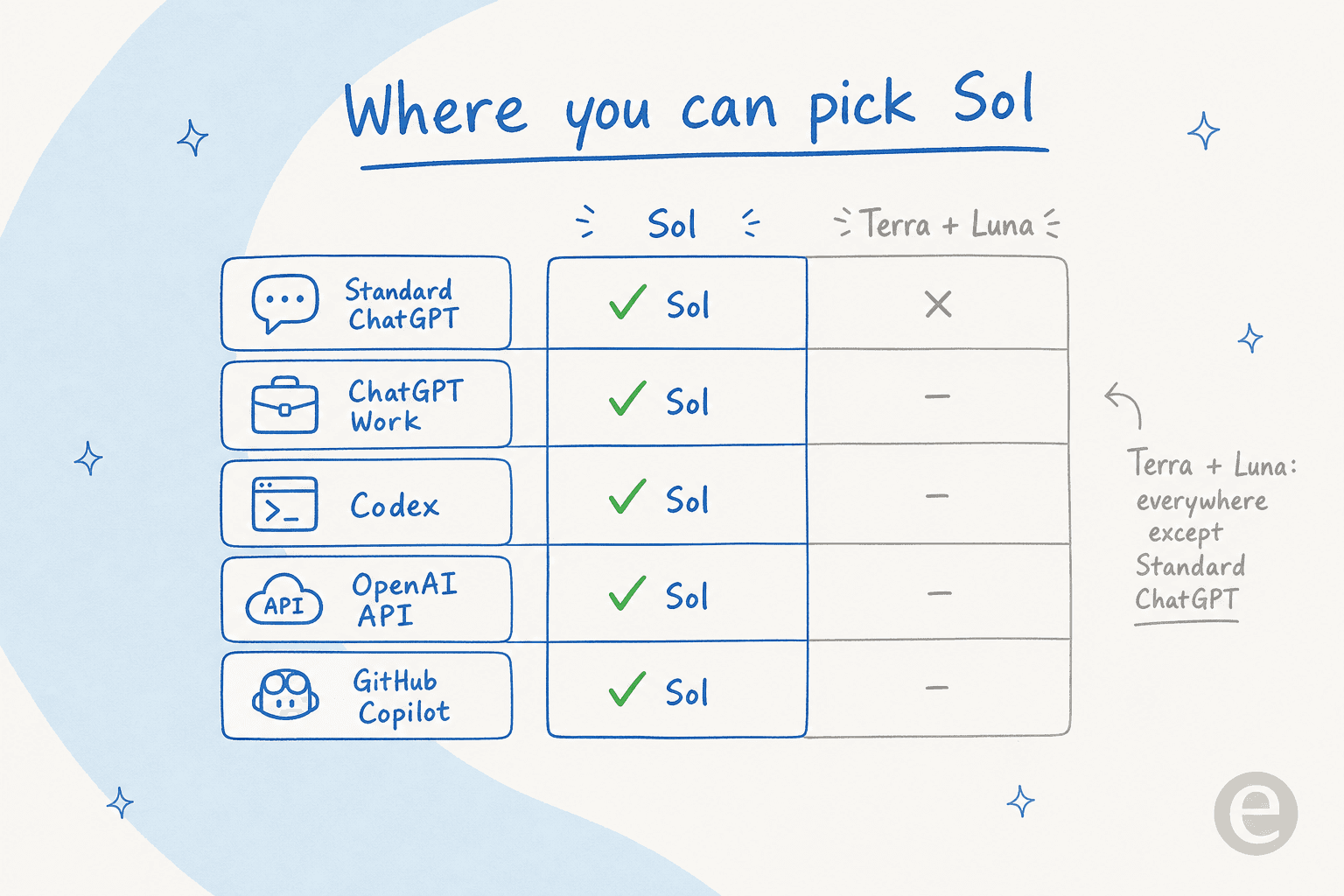
- Standard ChatGPT (Plus, Pro, Business, Enterprise): Sol, and only Sol.
- ChatGPT Work: all three tiers.
- Codex: all three for paid plans; Terra also reaches Free and Go there.
- The OpenAI API: Sol, Terra, and Luna directly.
- GitHub Copilot: per GitHub's changelog, Sol is on the Pro+, Max, Business, and Enterprise SKUs, billed at provider list pricing.
So if you open ChatGPT and pick a GPT-5.6 reasoning mode, you are using Sol whether you meant to or not. That is worth knowing, because it means the flagship's cost profile is the one most people are unknowingly exposed to.
What it costs in ChatGPT (the consumer angle)
If you are not calling the API, Sol's "price" is just your ChatGPT subscription. The token rate never shows up on your bill; the seat price does.
| Tier | Price | Sol access |
|---|---|---|
| Free | $0/mo | No GPT-5.6 in standard chat |
| Go | $8/mo | No GPT-5.6 in standard chat |
| Plus | $20/mo | Sol on Medium/High reasoning |
| Pro | $100-200/mo | Sol + Sol Pro reasoning; 5x-20x usage |
| Business | $20-25/user/mo | Sol, plus Terra/Luna in Work & Codex |
| Enterprise | Custom | Full spread, volume discounts |
The practical read: for an individual, Plus at $20/mo is the cheapest door to Sol. For a team that wants Sol across ChatGPT and Codex with data protection, Business at $20-25/user/mo is the entry point. Heavy Codex or deep-research users are the ones who justify the Pro tiers, where Pro $100 unlocks 5x Plus usage and Pro $200 unlocks 20x.
Estimate your own Sol bill
Sticker rates are abstract until you plug in your own volume. This calculator does the token math for Sol and shows what the same workload would cost on Terra and Luna, so you can see when the flagship is worth it and when it is overkill.
To put the default numbers in words: roughly 2M input and 500K output tokens a day runs about $750/mo on Sol, versus around $375 on Terra and $150 on Luna for the same volume. When the work is repetitive and well-defined, paying 5x for the flagship is hard to justify. When it is genuinely open-ended reasoning, it can be the cheapest thing in the room, because a cheaper model that fails the task costs you the retry plus the human who has to clean it up.
What developers are saying about Sol
The reaction to Sol split the way flagship launches usually do: real respect for the benchmark numbers, tempered by "I'll wait for real-world tests." On the capability side, one careful reader of the system card summed it up:
"Overall, the card gives a clear and consistent impression that GPT-5.6-Sol is a substantial improvement over GPT-5.5, but still short of Mythos."
The recurring caution is that a vendor's own benchmark rarely predicts day-to-day behavior:
"ill wait to see some real world tests before i commit to switching over fully..."
The other headline for Sol is speed, not just price. The most-repeated number in the community is that Sol will run on Cerebras at 750 tokens per second, versus roughly 70-100 for the current 5.5 XHigh setting. For a flagship, that combination (top-of-family capability, no price increase, and a big latency drop) is the actual pitch, more than the raw benchmark bar.
What a flagship's price means for customer support
Here is where I will be opinionated, because it is the part I actually work on. For AI customer service, Sol is usually the wrong default. Support is a high-volume, well-defined workload, exactly the shape Luna was built for, and cost per interaction is the number that decides whether automation pencils out. Running tier-1 tickets through a $5/$30 flagship when a $1/$6 tier handles them just as well is money set on fire.
But the deeper point cuts against the whole "which model" question. I have watched a confident-sounding bot quietly give wrong answers to real customers, which is why every rollout I trust gets simulated against historical tickets before it touches a live queue. That experience taught me an uncomfortable truth: swapping to Sol almost never fixes a support agent that is answering badly, and swapping to Luna rarely breaks one that is answering well. The model is one swappable part of a much larger system.

What actually decides whether an answer is right is the layer around the model: what knowledge it can retrieve, how well it is grounded in your help center and past tickets, and what guardrails stop it from hallucinating an answer when it should escalate. Get that layer right and the cheap tier is plenty; get it wrong and even Sol will confidently mislead your customers. It is the same reason a domain-specific setup usually beats a raw frontier model for support, and why deflection rate depends far more on retrieval quality than on which tier you picked.
Try eesel
If you are pricing out Sol because you want to automate support, the model is the easy part, and probably not the part you should be paying flagship rates for. eesel is the layer that turns any GPT-5.6 tier into an AI support agent that stays accurate: it trains on your past tickets and help center, lets you simulate the agent against thousands of historical conversations before it ever replies to a real customer, and plugs into your existing helpdesk software in minutes.

Because eesel stays model-flexible, you can run tier-1 tickets on a cheap tier and reserve the flagship for the few cases that need it, without re-architecting your stack every time OpenAI ships a new model. It is free to try, and you can see how it handles your real tickets before committing to anything.
Frequently Asked Questions
How much does GPT-5.6 Sol cost?
Is GPT-5.6 Sol more expensive than GPT-5.5?
Can I use GPT-5.6 Sol in ChatGPT?
What is GPT-5.6 Sol's price for small teams?
How does GPT-5.6 Sol pricing compare to Terra and Luna?
Is GPT-5.6 Sol worth it for customer service?


Article by
Kurnia Kharisma
Kurnia is a software engineer and writer at eesel AI with two years of SEO experience, writing about AI tools, helpdesk software, and customer support. He pairs a developer's understanding of how these products are built with search-driven research into what actually ranks and resonates with the people searching for them.