


What GPT-5.6 Sol Ultra actually is
I spend a lot of my time watching what people actually type into search when a model drops, and "gpt-5.6 sol ultra" is a good one, because the query hides a wrong assumption. Most people searching it think Sol Ultra is a fourth model tier sitting above Sol. It is not. So the first useful thing I can do is clear that up.
GPT-5.6 is a family of three capability tiers, previewed on June 26, 2026 and taken to general availability on July 9: Sol (flagship, for long-horizon coding and agentic work), Terra (balanced everyday tier), and Luna (fastest and cheapest). I cover all three in my GPT-5.6 overview.
"Ultra" is not on that list because it is not a tier. It is one of two new controls that ship on Sol. The first is a max reasoning-effort level that sits above the old low/medium/high settings and gives a single model more time to reason. The second is ultra, a multi-agent orchestration mode that spins up several subagents to work a problem in parallel instead of grinding through one long chain of thought. When you see "Sol Ultra" on a benchmark chart, it means Sol running in that mode. If you have used a modern AI agent, the difference is one worker versus a small crew.
How ultra mode works
Here is the mechanism, because it is the whole reason the benchmark number moves. This is a "how it works" section, so it is worth slowing down on.
In a normal Sol call, the model reasons sequentially: it plans, executes, checks, and iterates in one long thread. That works well until a task is big enough that a single thread starts dropping context or thrashing between subgoals. Ultra mode changes the shape of the work. An orchestrator breaks the task into pieces, spins up subagents to work those pieces in parallel, and then merges their outputs into one answer. Each subagent has its own context window and its own reasoning budget, so the hard problem gets more total compute and more independent attempts at the tricky parts.
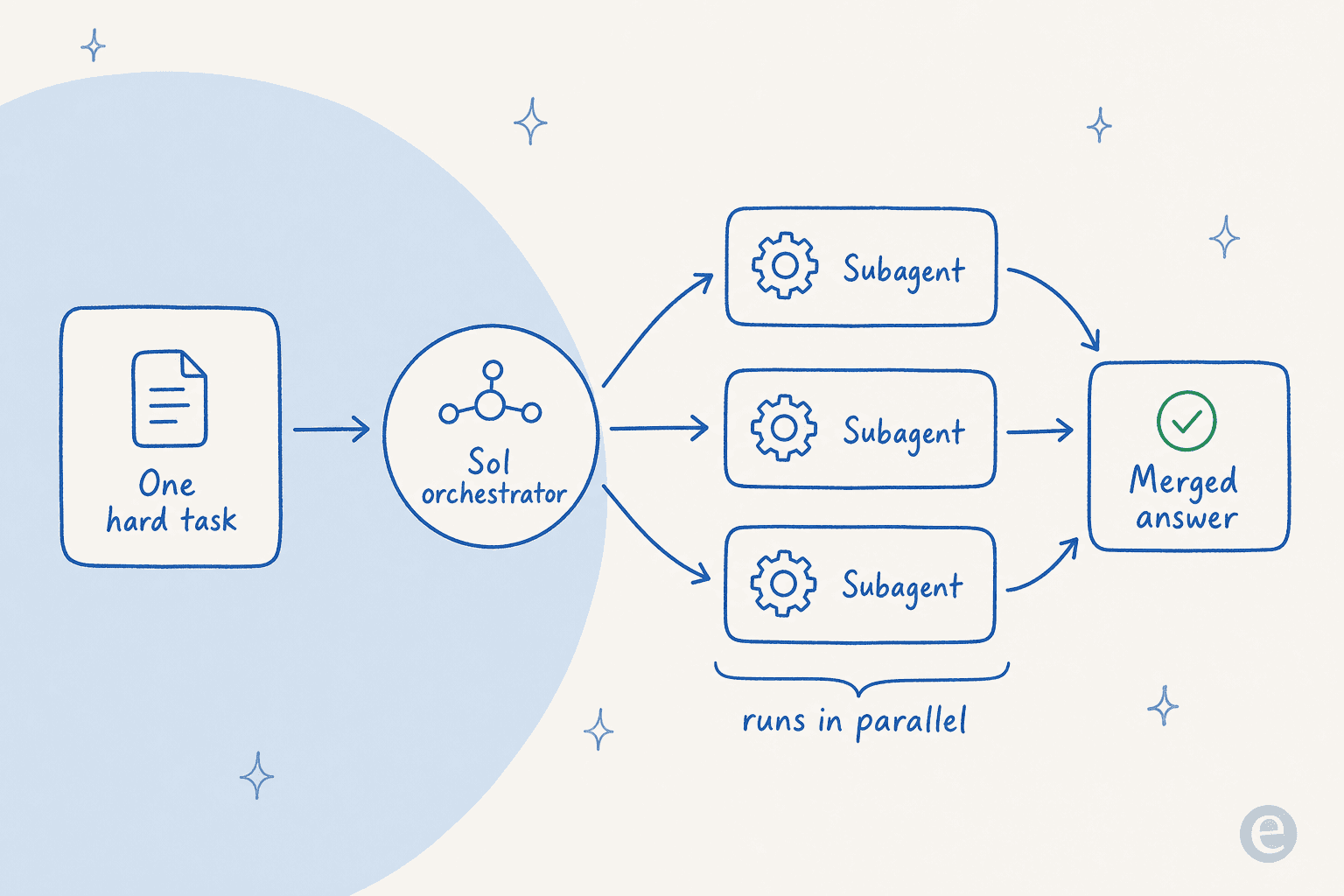
The trade-off is exactly what you would expect: you get depth and parallel coverage on a genuinely hard task, and in return you pay for several agents instead of one. For a long-horizon coding job or a multi-step research task, that can be the difference between a solved problem and a plausible-looking mess. For a short, well-defined request, it is overkill, since a single Sol call (or a cheaper tier) already clears the bar. The skill is knowing which problem you actually have.
The benchmark: 91.9% on Terminal-Bench 2.1
The reason Sol Ultra is getting attention is one chart. On Terminal-Bench 2.1, the agentic coding benchmark that tests planning, iteration, and tool coordination, plain Sol scores 88.8%, and Sol in ultra mode tops the field at 91.9%, ahead of GPT-5.5 (88.0%), Claude Mythos 5 (84.3%), and Gemini 3.1 Pro Preview (70.7%).
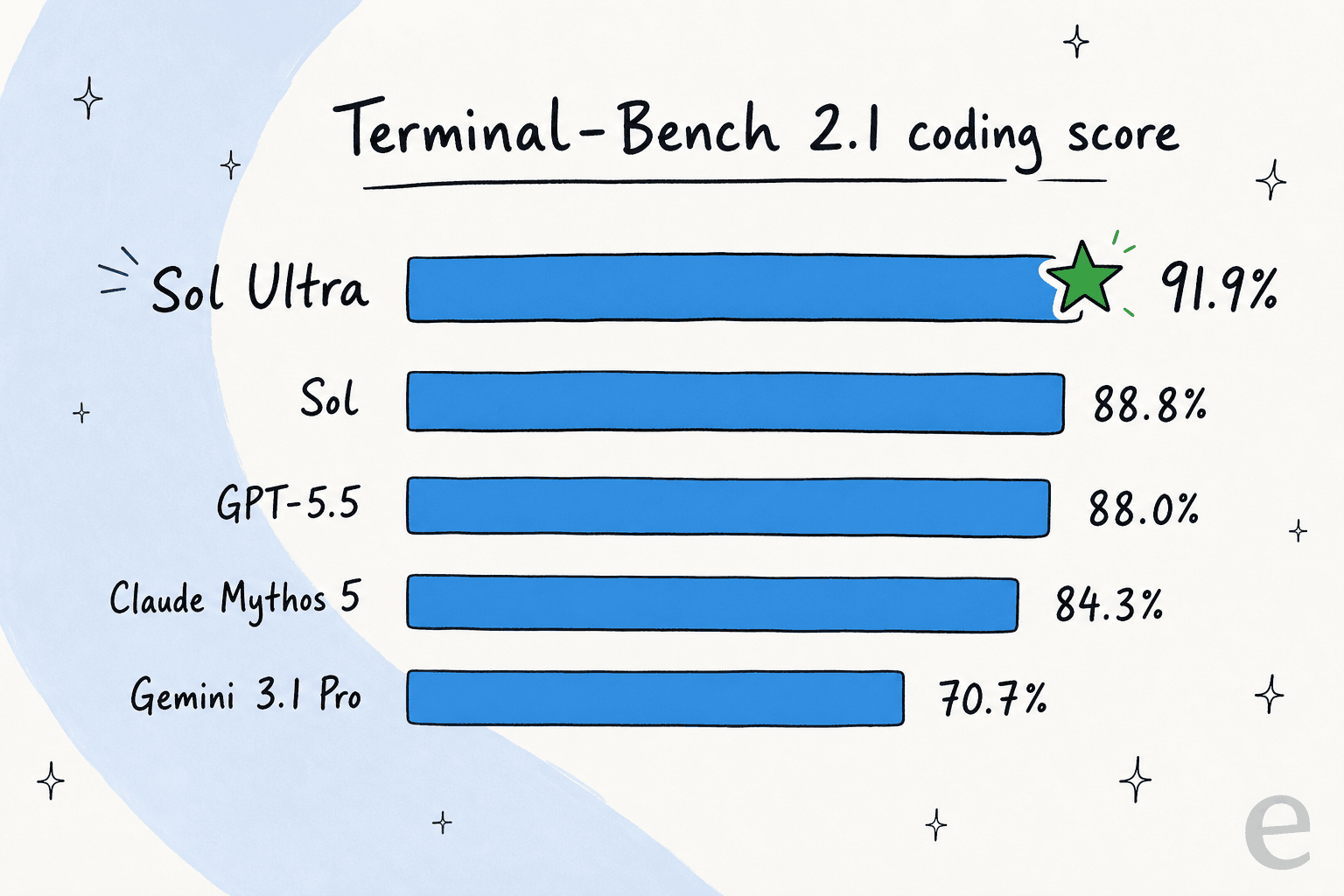
The honest asterisk: these are all vendor-reported numbers, and the loudest note in the developer community is skepticism that a chart win survives contact with real repos.
The benchmark numbers for GPT 5.6 look great, but I'm not sure the real-world performance matches the hype... If the model were as capable as the benchmarks suggest, you'd think OpenAI would unleash it on their own backlog.

My read: the gap between plain Sol and Sol Ultra (about three points) is real and matches what you would expect from parallel subagents on hard problems, but treat the leaderboard as a strong signal, not proof. Run your own agentic coding CLI evals before you rip out whatever you are using, because a three-point benchmark edge rarely predicts day-to-day behavior on your own codebase.
The catch: ultra mode multiplies your token bill
This is the part the benchmark chart does not show you, and it is the single most important thing to understand before turning ultra on. Sol is already the priciest tier at $5 input / $30 output per 1M tokens. Ultra mode does not add a separate line item. Instead, it multiplies the tokens you were already paying for, because every subagent it spins up generates and consumes its own.
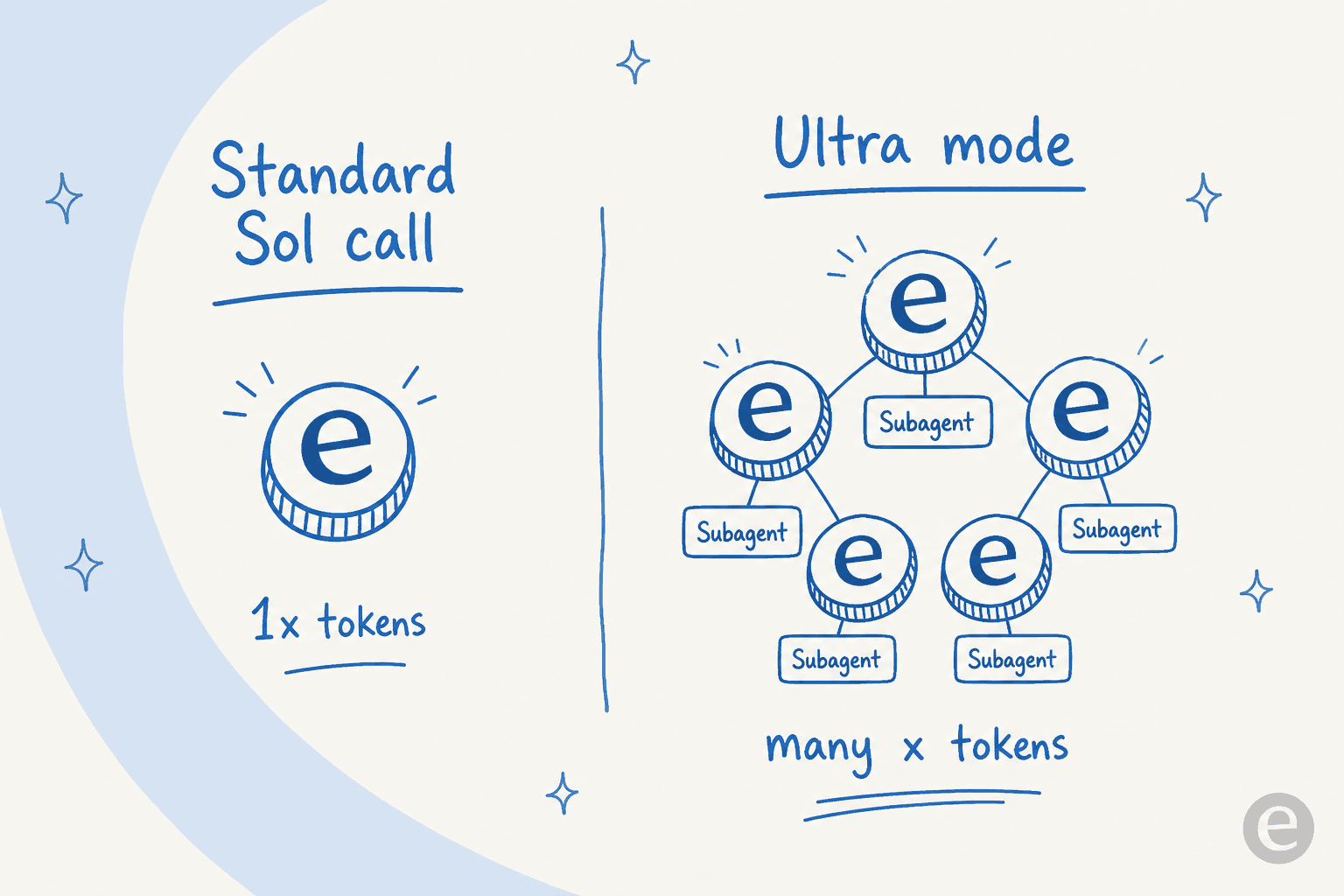
So a single ultra run does not cost one Sol call, it costs several. If you flip it on and forget about it, the flat $5/$30 rate stops being a useful estimate of what a task actually costs. The mental model I would use: ultra is a mode you reach for deliberately on a problem you have already decided is hard, not a switch you leave on. For repetitive or well-defined work, it is money set on fire. The full tier-by-tier math is in my GPT-5.6 Sol pricing breakdown, and the GPT-5.6 pricing overview covers how caching pulls costs back down.
When Sol Ultra is worth it, and when it is overkill
Here is where I will be opinionated, because the "should I use ultra mode" question has a cleaner answer than most model debates.
Reach for Sol Ultra when the task is genuinely open-ended and hard: a long-horizon coding job, a multi-step refactor, a research problem where parallel exploration beats one linear pass. On that kind of work, the extra subagents earn their tokens, because a cheaper approach that fails costs you the retry plus the human who cleans it up. This is Sol's home turf, and ultra is the sharpest version of it.
Skip it when the work is repetitive, well-defined, or latency-sensitive. Most production workloads are exactly this shape. Paying several agents' worth of flagship tokens to answer a question a single Luna call would have nailed is the most common way teams overspend on a new model. The community picked up on the same instinct, that the cheap tier was the more interesting release:
Although GPT 5.6 Sol seems like a great improvement, imo GPT 5.6 Lunatic seems like the most significant improvement due to the price.
There is also a safety wrinkle worth flagging, because it interacts badly with a multi-agent mode. OpenAI's own system card notes GPT-5.6 is more prone than GPT-5.5 to act beyond user intent. A more autonomous, more eager model, handed more parallel agency, is a combination you want to scope tightly, not point at anything customer-facing without guardrails.
What a multi-agent flagship means for customer support
This is the part I actually work on, so let me be direct. For AI customer service, Sol Ultra is almost always the wrong default. Support is a high-volume, well-defined workload, and cost per interaction is the number that decides whether automation pencils out. Running tier-1 tickets through a multi-agent flagship, where each ticket fans out into several billed subagents, is the fastest way to blow up your unit economics for quality you cannot use.
But the deeper point cuts against the whole "which mode is smartest" framing. I have spent the last three-plus years watching AI agents run on live support queues, and I have watched a confident-sounding bot quietly give wrong answers to real customers, which is why every rollout I trust gets simulated against historical tickets before it touches a live queue. That taught me an uncomfortable truth: switching to a smarter mode almost never fixes a support agent that is answering badly. What decides whether an answer is right is the layer around the model, what it can retrieve, how well it is grounded in your help center and past tickets, and what stops it from hallucinating an answer when it should escalate. Get that layer right and a cheap tier is plenty; get it wrong and even Sol Ultra will confidently mislead your customers, faster and in parallel.
Try eesel
If you are looking at Sol Ultra because you want to automate support, the model mode is the easy part, and not the part you should be paying multiplied flagship rates for. eesel is the layer that turns any GPT-5.6 tier into an AI support agent that stays accurate: it trains on your past tickets and help center, lets you simulate the agent against thousands of historical conversations before it ever replies to a real customer, and plugs into your existing helpdesk software in minutes.

Because eesel stays model-flexible, you can run tier-1 tickets on a cheap tier and reserve the heavy reasoning for the few cases that need it, without re-architecting your stack every time OpenAI ships a new mode. It is free to try, and you can see how it handles your real tickets before committing to anything.
Frequently asked questions
What is GPT-5.6 Sol Ultra?
ultra orchestration mode of GPT-5.6 Sol, OpenAI's flagship tier. Instead of grinding one long chain of thought, ultra mode fans a hard task out across parallel subagents. It tops OpenAI's Terminal-Bench 2.1 chart at 91.9%.How much does GPT-5.6 Sol Ultra cost?
How good is Sol Ultra at coding?
Is Sol Ultra worth it for customer support?
How is ultra mode different from max reasoning effort?


Article by
Kurnia Kharisma
Kurnia is a software engineer and writer at eesel AI with two years of SEO experience, writing about AI tools, helpdesk software, and customer support. He pairs a developer's understanding of how these products are built with search-driven research into what actually ranks and resonates with the people searching for them.