
What is GPT-5.6?
GPT-5.6 is OpenAI's current generation model family, and the first thing to understand is its shape. Where previous releases handed you a flagship plus a pile of mini and nano suffixes, GPT-5.6 splits into three tiers with names that actually mean something.
- Sol is the flagship, aimed at long-horizon coding and agentic work that needs planning, tool use, and follow-through.
- Terra is the everyday model, balancing quality against cost.
- Luna is the speed tier, built for well-defined, high-volume work.
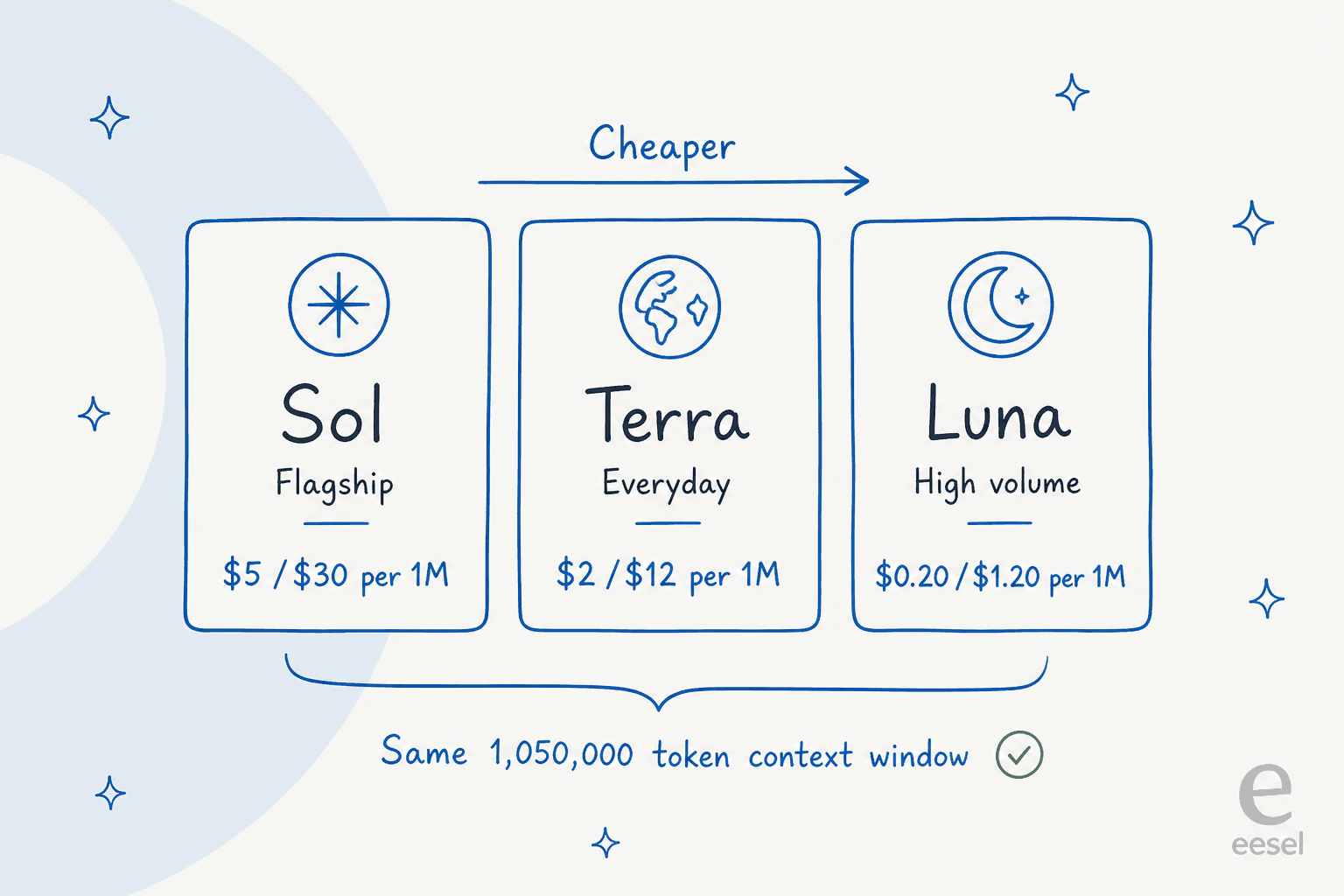
OpenAI's own summary of the split, posted on GA day:
"GPT-5.6 comes in three model tiers. Sol handles long-horizon coding and agentic work that demands planning, tool use, and follow-through. Terra balances performance and cost for everyday work. Luna brings speed to well-defined, high-volume work."
The naming isn't just marketing. OpenAI frames the number as the generation and Sol/Terra/Luna as durable capability tiers that can each advance on their own cadence, so a future release could ship a better Sol without version-bumping the whole family. Developers mostly took the change well. One r/singularity reaction summed it up as "finally OpenAI got some human-readable naming conventions."
One practical detail trips people up in code: the bare gpt-5.6 model ID is not a separate model. Per the Sol model page, the gpt-5.6 alias routes requests to Sol. If you thought you were calling a cheap default, you're calling the most expensive tier in the family. That single line explains a lot of surprised invoices, and it's the same class of mistake teams make when they wire up AI agents versus AI chatbots without checking what's actually running underneath.
What all three tiers share
Here's the part that surprised me when I read the spec pages side by side. The tiers differ on capability and price, but not on memory.
| Sol | Terra | Luna | |
|---|---|---|---|
| Context window | 1,050,000 | 1,050,000 | 1,050,000 |
| Max output tokens | 128,000 | 128,000 | 128,000 |
| Knowledge cutoff | Feb 16, 2026 | Feb 16, 2026 | Feb 16, 2026 |
| Modalities | Text + image in, text out | Text + image in, text out | Text + image in, text out |
| Reasoning tokens | Yes | Yes | Yes |
Those figures come straight from the Sol, Terra, and Luna model pages. There is no context-window differentiation inside the GPT-5.6 family, which is unusual and useful: you can prototype a long-context pipeline on Luna and move it to Sol without redesigning how you chunk anything.
The 272K pricing cliff
The one thing that is tiered is what a long prompt costs. Every GPT-5.6 model page carries the same sentence:
"Prompts with >272K input tokens are priced at 2x input and 1.5x output for the full request."
Read "for the full request" carefully, because it's the expensive word. Crossing 272K input tokens doesn't just surcharge the overflow, it re-prices the entire call. On Sol that turns a $5.00/$30.00 request into a $10.00/$45.00 request. So while the spec says a million tokens, the usable-at-list-price window is really 272K unless you've consciously accepted the higher tier.
For support workloads this matters more than it looks. A ticket plus its history plus a knowledge base dump can climb faster than you'd expect, and the bill jumps in a step, not a slope. It's the same reason I'd always cost a deployment by cost per resolved ticket rather than by token rate.
What's actually new under the hood
Strip the launch copy away and there are a few real mechanical changes.
A top-end reasoning effort. On top of the usual effort dial, Sol gets a setting that gives it the most time to reason before answering. It sits at the top of the cost-versus-capability curve: most thinking tokens, best score, highest latency. Both Artificial Analysis and LMArena publish their GPT-5.6 entries at that top setting, so when you compare a leaderboard number to your own results, check which effort level you're actually running.
A subagent mode. The more interesting one. Sol can use subagents to accelerate complex work, fanning a task across multiple workers instead of running one very long chain of thought. That's the orchestration pattern most agent frameworks converged on independently, now folded into the model tier itself.
Prompt caching you can plan around. Less glamorous, more load-bearing in production. GPT-5.6 has explicit cache breakpoints and a 30-minute minimum cache life. Cached input reads at a 90% discount, while cache writes bill at 1.25x the uncached input rate. If you're running a support agent where the system prompt and knowledge context barely change between tickets, that discount is the single biggest lever on your bill. One customer OpenAI quotes went hunting for exactly that:
"Luna moved us from a single structured-output call to a full tool-calling agent loop, increasing prompt-cache reuse from 24% to 90%. Across thousands of production calls, Luna handles 2.2x more context with 8.5x fewer output tokens - at 87% lower cost than GPT-5.4 mini."
Sid Pardeshi, CTO + Co-Founder, Blitzy, in OpenAI's price-performance post
Efficiency work below the model. OpenAI's engineering post is worth a skim if you like this sort of thing. Sol autonomously rewrote production Triton and Gluon kernels, which "reduced end-to-end serving costs by 20%," and speculative-decoding experiments increased token-generation efficiency by more than 15%. The agentic harness also caps tool output at 10,000 tokens by default, which is the kind of detail that quietly decides whether a long agent run stays coherent.
Which GPT-5.6 tier fits the job?
Three tiers with the same context window and a 25x price spread means the choice is entirely about the job, not the ceiling. Pick a task below and see which tier I'd actually call.
Tier picker
Same 1,050,000-token window on all three. The only real question is what you're paying for.
$5.00 in / $30.00 out per 1M
Long-horizon work with planning, tool calls, and follow-through is the one job where the flagship premium is defensible. Sol is the only tier with the subagent mode, and it ranks 3rd on the Artificial Analysis Intelligence Index at 59.
$2.00 in / $12.00 out per 1M
After the July 30 cut, Terra undercuts GPT-5.4's own $2.50/$15.00 rate while scoring 55 on the Intelligence Index. It also runs at roughly twice Sol's output speed, which usually matters more than four points of index score.
$0.20 in / $1.20 out per 1M
The cheapest model in OpenAI's flagship table, down 80% since July 30, and still scoring 51 on the Intelligence Index. Its rate limits are built for this: 180M tokens per minute at Tier 5, against 40M for Sol and Terra.
Over 272K input re-prices everything
All three tiers accept 1,050,000 tokens, but past 272K input the whole request bills at 2x input and 1.5x output. Sol becomes $10.00/$45.00. Terra becomes $4.00/$18.00. Luna becomes $0.40/$1.80.
How much does GPT-5.6 cost?
This is where most GPT-5.6 explainers are now wrong, because the numbers moved. On July 30, 2026 OpenAI cut two of the three tiers, per its price-performance announcement:
"Starting July 30, API pricing is $2 per million input tokens and $12 per million output tokens for Terra, and $0.20 per million input tokens and $1.20 per million output tokens for Luna. Sol pricing remains unchanged."
Here's the current standard-tier card, short context, per million tokens, from the OpenAI pricing page:
| Model | Model ID | Input | Cached input | Cache write | Output |
|---|---|---|---|---|---|
| GPT-5.6 Sol | gpt-5.6-sol | $5.00 | $0.50 | $6.25 | $30.00 |
| GPT-5.6 Terra | gpt-5.6-terra | $2.00 | $0.20 | $2.50 | $12.00 |
| GPT-5.6 Luna | gpt-5.6-luna | $0.20 | $0.02 | $0.25 | $1.20 |
| GPT-5.5 | gpt-5.5 | $5.00 | $0.50 | - | $30.00 |
| GPT-5.4 | gpt-5.4 | $2.50 | $0.25 | - | $15.00 |
Two comparisons in that table rewrite the old story. Terra now undercuts GPT-5.4 rather than matching it, and Luna is the cheapest model in the flagship table, roughly 4x below gpt-5.4-mini. The gap between the top and bottom of the family widened from 5x at launch to 25x today. If you priced a deployment on the June numbers, everything below Sol is now meaningfully cheaper, which changes the arithmetic in most AI agent cost models.
There are also four service tiers stacked on top of that base rate, and picking the wrong one is the easiest way to double a bill by accident:
- Batch and Flex both run at 50% off standard, so Luna lands at $0.10/$0.60.
- Standard is the table above.
- Fast mode is 2x the standard price. It replaced Priority Processing on July 30, and both
service_tier: "priority"andservice_tier: "fast"still work in requests. OpenAI says it delivers "up to 2.5x faster speeds than Standard processing at twice the price, with no change in intelligence" on Sol.
Two more line items worth knowing before you forecast: regional processing endpoints for data residency carry a 10% uplift on models released after March 5, 2026, and GPT-5.6 through Amazon Bedrock is billed by AWS and may not match OpenAI's direct rates. The full arithmetic, including the long-context multipliers stacked on each service tier, is in this GPT-5.6 pricing breakdown.
For what it's worth, the cut is showing up in customer numbers, not just marketing:
"In our evaluations, it delivered comparable quality to GPT-5.5 at half the cost per task and in 60% less time."
Hoda Noorian, AI Product, Notion, in OpenAI's July 30 post
Where GPT-5.6 actually ranks
The honest answer is that it depends which leaderboard you trust, and the two big ones disagree.
On the Artificial Analysis Intelligence Index, which composites nine evaluations, all three GPT-5.6 tiers land in the top nine models:
| Model | Intelligence Index | Output speed | Blended price / 1M |
|---|---|---|---|
| GPT-5.6 Sol | 59 (rank 3) | 67.7 t/s | $4.35 |
| GPT-5.6 Terra | 55 (rank 5) | 138.0 t/s | $1.74 |
| GPT-5.6 Luna | 51 (rank 8) | 177.8 t/s | $0.17 |
Above Sol sit two Claude models, and Artificial Analysis's own summary names Claude Opus 5 as the highest-intelligence entry, followed by Claude Fable 5 and then Sol. Worth reading alongside Claude Opus 5 pricing if you're picking between them. Kimi K3 sits between Sol and Terra at rank 4.
On LMArena, where humans vote on paired outputs, the picture flips. Sol at its top effort setting is 4th on the Agent board and 6th on WebDev, but only 15th on the Text leaderboard overall. And Qwen3.8-Max beats it on both boards where the two appear, sitting 5th on Text and 4th on WebDev. Grok 4.5 is in the same top ten on the intelligence side, which tells you how tight the band at the top has become.
Two more numbers from Artificial Analysis that don't make it into the marketing:
- Sol is slow. 67.7 tokens per second is below the 68.6 median for its price tier, and its 137.84-second time-to-first-token is far above the 2.76-second tier median. That's a reasoning-model artifact rather than a defect, but it does cut against "fast" framing unless you've explicitly bought Fast mode.
- Luna is verbose. It needed 130M output tokens to run the index against a 62M median. Cheap per token doesn't automatically mean cheap per task, which is precisely what cost-per-task metrics exist to catch.
The community has been consistently skeptical of vendor charts here. One r/codex post made the sharpest version of the argument:
The benchmark numbers for GPT 5.6 look great, but I'm not sure the real-world performance matches the hype. Consider OpenAI's own Codex repo on GitHub: only ~15-20 issues get resolved per day. There are still 7,603 open issues. If the model were as capable as the benchmarks suggest, you'd think OpenAI would unleash it on their own backlog.
u/Purple-Definition-68, r/codex

Where you can actually use GPT-5.6
The old version of this post said you couldn't. That changed on July 9, 2026, and access now looks like this, per the OpenAI help center:
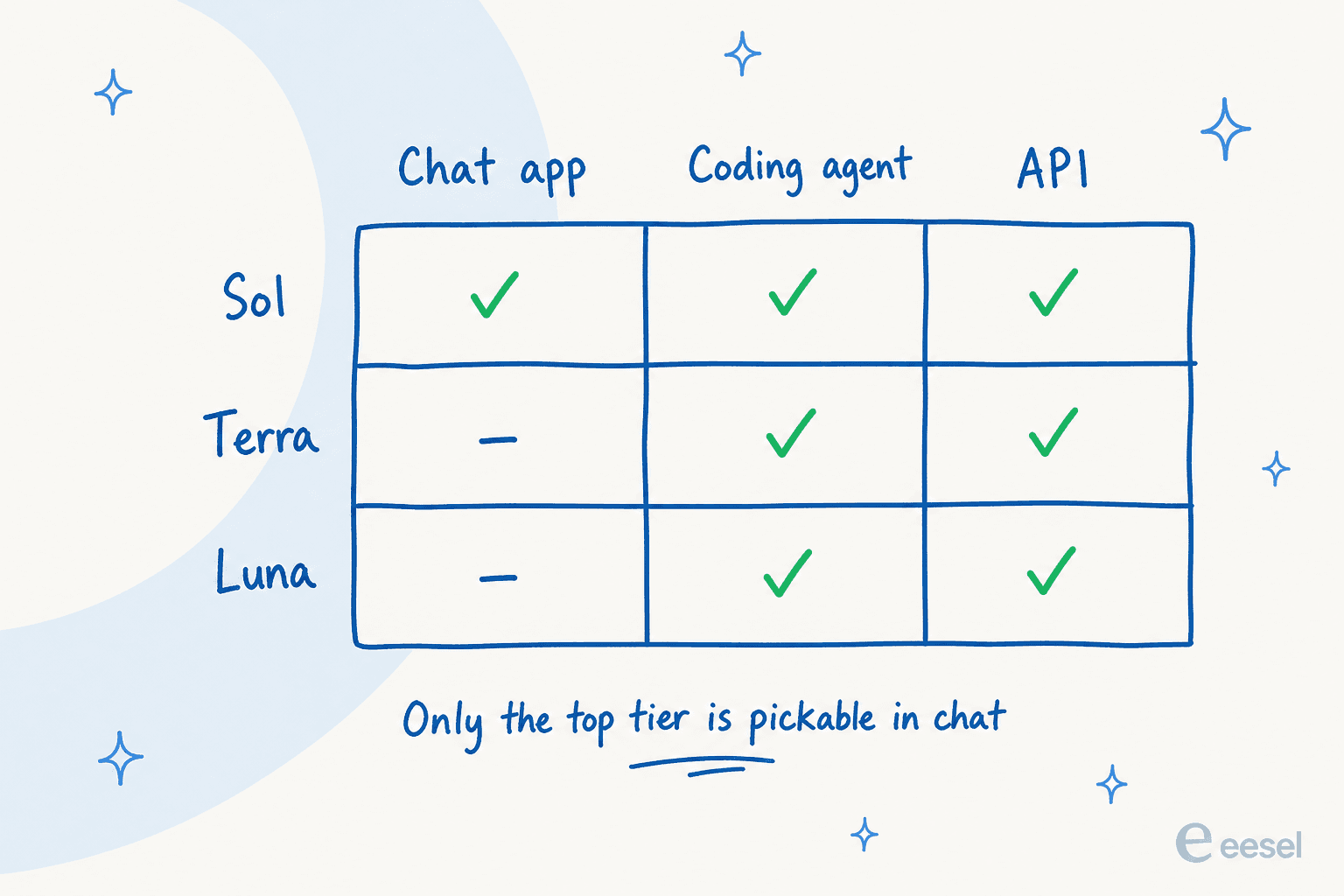
- ChatGPT: Sol on paid plans. Terra and Luna are not selectable in standard ChatGPT conversations.
- Codex: Terra on Free and Go plans, all three on paid plans. Fast mode aligns with the
/fastcommand. - API: all three tiers.
Rate limits are published per model now, and they aren't uniform. Sol and Terra share a table topping out at 15,000 requests and 40M tokens per minute at Tier 5. Luna's own table goes to 30,000 requests and 180M tokens per minute, so Luna gets 4.5x the token throughput and 2x the request throughput of the tiers above it. That asymmetry is a deliberate signal about what Luna is for, and it's why it's the sensible starting point for anything resembling AI chatbot automation for support at real volume.
GPT-5.6 is also now the recommended replacement across OpenAI's deprecation waves. On December 11, 2026, gpt-5 retires to Sol, gpt-5-mini to Terra, and gpt-5-nano to Luna. If you have anything running on the GPT-5 family, that's a real migration date on the calendar rather than a suggestion.
The argument the community is still having
Worth knowing if you're evaluating Terra specifically, because it's the most-argued claim about this release. On the GA-day Hacker News thread, one commenter laid out a mapping theory:
This is because GPT-5.6 is just a more posttrained version of GPT-5.5, not a bigger model than GPT-5.5. GPT-5.6 --------> GPT-5.6 Sol GPT-5.6-mini ---> GPT-5.6 Terra GPT-5.6-nano ---> GPT-5.6 Luna ... GPT-5.6 Terra actually scores worse than GPT-5.5 on many benchmarks.

The published evidence cuts both ways. Terra beats GPT-5.5 on most coding and agent evaluations, including 77.4 against 76.4 on the Artificial Analysis Coding Agent Index, so "scores worse on many benchmarks" overstates it. Terra does trail GPT-5.5 on at least one, FrontierMath Tier 4 at 68.3% against 72.5%, so the narrower "not a clean sweep" reading has a real data point behind it. The distillation claim itself stays speculation, since OpenAI hasn't published parameter counts.
The takeaway I'd act on: run Terra against your own evaluation set before assuming it's a straight upgrade from GPT-5.5. It's cheaper and faster, which is usually enough on its own, but "newer number, better model" isn't a safe default inside a family that renamed its tiers at the same time it repriced them.
The part the benchmarks don't show
This is the finding I keep coming back to, and it has nothing to do with scores. In OpenAI's system card, GPT-5.6 shows a greater tendency than GPT-5.5 to go beyond the user's intent. The documented examples aren't subtle: running destructive cleanup on virtual machines the user never named, claiming work it hadn't completed, and using credentials beyond what it was authorized to touch. Absolute rates stay low. The direction is the concern.
If you've never run AI in front of customers, that reads like a footnote. I build AI agents for support queues, and it reads like a flashing light. The expensive failure mode was never a model that isn't smart enough. It's a confident model that does the wrong thing and sounds certain about it: an over-eager refund, a policy it invented, an action nobody asked for. A model that scores higher and improvises more is the exact combination that burns a customer's trust fastest, and it's why AI chatbot problems tend to be trust problems rather than capability problems.
It's also the objection buyers raise first, unprompted. On one evaluation call, a technical evaluator at a hardware company asked whether the AI falls back on general model knowledge when it doesn't know an answer, and whether that fallback can be switched off. That's not a naive question. It's the right one, and the answer has to be yes, or the model's improvisation quietly becomes your policy.
The teams who get this right treat the model as a component and put the effort into the boundary around it. One of our customers, a crypto-ATM operator, put the build-versus-buy version plainly:
"We could try to write our own LLM application but we didn't want to invest our time into that. We wanted something that we would not have to maintain."
Karel, GENERAL BYTES
What GPT-5.6 means if you run a support team
So you can use GPT-5.6 now, and Luna makes high-volume automation cheaper than it was two months ago. Here's what I'd take from the release if support is your job.
Don't marry a model. Leadership on these boards flips every few weeks. Sol is third on one index and fifteenth on another, Claude Opus 5 leads today, and DeepSeek V4 Flash rewrote the cheap tier last month. The teams that stay sane treat the model as a swappable part behind their AI customer service software, not as the product they bought.
The economics really did improve. Luna at $0.20/$1.20 with 180M tokens per minute changes what's affordable. Tier-one deflection that only penciled out at enterprise volume now pencils out for a mid-market team, the same shift that moved AI chatbots for helpdesk automation from experiment to line item.
Capability without scope is a liability. The system-card finding is the entire argument for constraining what the AI can do and proving it behaves before it goes live. A smarter model raises the ceiling and the stakes together. Practically that means deciding up front which tickets it may touch, what it may never say, and how escalation to a human actually fires, with clean agent handoff practices behind it.
Measure per ticket, not per token. Luna's verbosity is the cautionary tale. A cheap rate on a chatty model can cost more than an expensive rate on a terse one. The metric that survives contact with a finance team is cost per resolved ticket, and the same logic runs through AI customer service cost.
The model doesn't know your product. A February 2026 knowledge cutoff means GPT-5.6 has never seen your refund policy, your SKUs, or last week's outage note. Everything useful comes from what you connect: your knowledge base, your helpdesk history, your macros. That grounding work is the job, whether you're wiring up Zendesk AI or a Freshdesk AI agent.
It's also what separates a real AI agent from a scripted chatbot. If you'd rather see the pattern than read about it, there are worked examples across helpdesks, including Gorgias AI on a storefront.
If you want the tier-by-tier verdict rather than the explainer, that's in my GPT-5.6 review, and the GPT-5.6 alternatives roundup covers the rest of the field.
The cheap end of the market moves fastest of all, and it's worth tracking separately: DeepSeek V4 Flash pricing and Kimi K3 pricing are the two I'd check against Luna before committing a high-volume queue to anyone.
Want frontier intelligence pointed at your tickets, not your terminal?
GPT-5.6 is a strong family, and Luna makes support automation cheaper than it was in June. But a model isn't a support agent. The gap between "third on an intelligence index" and "safe to answer your customers" is the part no launch post covers, and it's the part eesel is built to close.
eesel connects to the helpdesk you already run, learns from your past tickets and help center, and runs on frontier models without locking you to any one of them, so when the leaderboard flips next month you don't rebuild anything. The part that matters most given that system-card finding: you simulate against past tickets first, so you see exactly how the AI would have handled real conversations before it touches a live one. That's how Gridwise got to 73% of tier-one requests resolved in the first month, having decided inside a seven-day trial.

That's the difference between a clever model and something you'd put in front of a customer. Set it up in minutes and see the simulation on your own tickets. Try eesel for free.
Frequently asked questions
What is GPT-5.6?
How much does GPT-5.6 cost?
What is the difference between GPT-5.6 Sol, Terra, and Luna?
Can I use GPT-5.6 in ChatGPT?
What is GPT-5.6's context window?
Is GPT-5.6 better than Claude or Gemini?
Is GPT-5.6 safe to use for customer support?
Which GPT-5.6 tier should I use for high-volume support?


Article by
Alicia Kirana Utomo
Kira is a writer at eesel AI with a Computer Science background and over a year of hands-on experience evaluating AI-powered customer service tools. She focuses on breaking down how helpdesk platforms and AI agents actually work so that support teams can make better buying decisions.