


What Qwen3.8-Max actually is
Qwen (Tongyi Qianwen) is Alibaba Cloud's family of models, spanning text, vision, audio, code and agents. The "Max" tier is the proprietary flagship line, sitting above the cheaper Plus and Turbo tiers and above the open-weight Qwen3 checkpoints. Qwen3.8-Max is the newest one, and Alibaba previewed it as "Qwen3.8-Max-Preview" on July 19, 2026.
Here's the honest version, because the launch itself was unusually thin. There was no formal blog post, no model card and no benchmark table at preview, just two posts on X from the Qwen team and a working, paid preview endpoint. So most of what follows is Alibaba's own framing, which nobody outside the lab had independently checked yet.
The specs Alibaba states:
- 2.4 trillion total parameters, a sparse Mixture-of-Experts design (Qwen on X).
- First multimodal Qwen above 1T parameters, handling text, images, video and documents, per lead researcher Shuai Bai.
- A 1-million-token context window, carried over from its predecessor Qwen3.7-Max.
- Aimed at coding, agentic workflows and long-horizon "professional cowork" tasks, which is where Alibaba says it beats Qwen3.7-Max.
The active-parameter count per token, the full benchmark suite and the license were all missing at preview. Alibaba said they're coming. Until they land, treat the internals as marketing, not measurement.
Under the hood: how Qwen3.8-Max works
This is where a giant parameter count stops being the headline. A 2.4T dense model would be far too expensive to run, so Qwen3.8-Max is a Mixture-of-Experts model: most of those parameters sit idle on any given token, and only a small slice fire. That's the same trick that lets Qwen's cheaper tiers undercut rivals, scaled up.
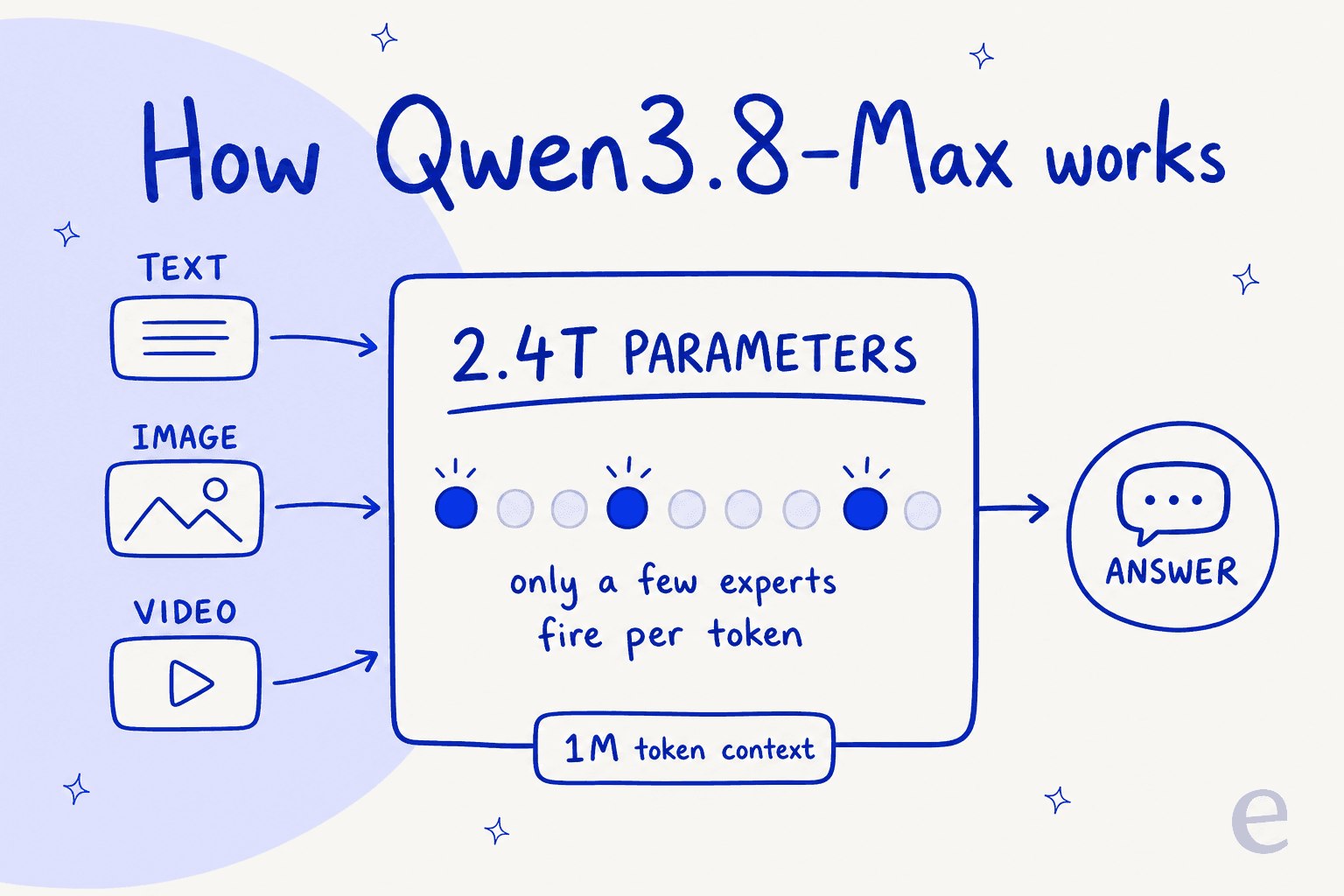
The multimodal part is the real jump for the Max line. Earlier Max models were text-first; here Alibaba says the model natively ingests images, video and documents alongside text, which is what Shuai Bai flagged as the first-of-its-kind detail:
"Qwen3.8-Max Preview is now available for early access! This is our first trillion-parameter multimodal model."
The catch worth repeating: the sparsity ratio, the expert count and the training recipe weren't published. So we know the shape Alibaba is describing (huge, sparse, multimodal) but not the numbers that would let anyone reproduce or rank it. That's a real gap for a model claiming a top-two spot.
What Alibaba claims about performance
Here's the sentence everyone quoted. The Qwen team's own launch post frames it against the top of the field:
"Qwen3.8 is launching and going open-weight soon! With a massive 2.4T parameters, this model is continuously evolving. We believe it's one of the most powerful models available today... second only to Fable 5."
"Second only to Fable 5" is a big swing, Fable 5 being the current top-tier Claude model. The problem is there's nothing behind it yet: no benchmark chart, no independent index score, no model card. For context, the previous flagship Qwen3.7-Max launched in May 2026 with real numbers, 80.4% on SWE-bench Verified and the highest-placed Chinese model on the Artificial Analysis intelligence index at the time. Qwen3.8-Max arrived with the confidence but not the receipts.
There's also a pattern worth naming, gently. Qwen has a long track record of topping open-model download charts and posting strong benchmark results, and a recurring critique is that it can look stronger on evals than in messy real-world use. So a self-reported "top two" before any independent test is exactly the claim to hold loosely.
What Qwen3.8-Max costs
This is the part that made developers actually click. During preview, Qwen3.8-Max is sold at 10% of standard pricing through three surfaces: Alibaba's Token Plan subscription, and its Qoder and QoderWork agentic coding products. There is no standalone per-token API rate published yet, which is unusual for a Max model.
The Token Plan Personal tiers look like this:
| Tier | Monthly | 7-day credit quota | 5-hour credit quota |
|---|---|---|---|
| Lite | ~$6 (39 CNY) | 2,500 credits | 700 credits |
| Standard | ~$20 (139 CNY) | 10,000 credits | 3,000 credits |
| Pro | ~$70 (499 CNY) | 40,000 credits | 12,000 credits |
Source: Alibaba Cloud Token Plan (Personal Edition). On top of the 10% preview rate, Alibaba stacks a night discount, an extra 80% off credit consumption between 22:00 and 08:00 (UTC+8), which works out to about 0.2% of the standard rate for off-hours runs. That's aggressive, and it's clearly designed to get people testing the preview cheaply.
The subscription-credit model is also the exact thing Qwen users have complained about before. On the previous generation, Reddit users reported credits burning far faster than expected, and Qwen models tend to generate more output tokens per task than peers, which quietly inflates the real cost even when the sticker rate looks low. The preview discount papers over that for now. When it ends, budget for it.
One useful detail: the Token Plan endpoint speaks both the OpenAI and Anthropic API protocols, so third-party clients like Claude Code, Cursor, Cline and Codex work out of the box once you issue a key. If you already live in one of those tools, trying the preview is a five-minute job.
Should you jump on Qwen3.8-Max right now?
The preview is cheap and easy to try, which makes "should I switch to it" the wrong question and "what am I actually testing" the right one. Walk the decision below before you rewire anything important around a preview.
The bigger picture: an open-weight race between Chinese labs
Strip away the specifics and this is why Qwen3.8-Max trended: it dropped days after Moonshot AI's 2.8-trillion-parameter Kimi K3, and Alibaba happens to hold roughly a 36% stake in Moonshot. So two labs in the same orbit are now racing to set the size ceiling for near-frontier models, and both are promising open weights. On Hacker News, the top comment read the timing exactly that way:
"I assume that this announcement has been prompted by that of Moonshot AI... I wonder if Alibaba has always planned to make this big LLM open weights, or they have chosen to do this now, to better compete with Moonshot AI."

The read a lot of people landed on is that commoditizing frontier-level intelligence is itself the strategy, and that it's good for everyone downstream regardless of the motive:
"The Chinese firms seem to be working hard to commoditize intelligence which may be the most effective way to debase American frontier labs. And yeah: it also happens to be really good for humanity."
For a buyer, the takeaway isn't which lab wins. It's that the model layer is getting cheaper and better every few weeks, and the smart move is to build so you can swap the engine without re-plumbing everything around it.
Where a frontier model stops, and support work begins
Now the part I care about most, because I build AI agents for a living. It's tempting to read a launch like this and think "great, plug the best model in and my support queue solves itself." It doesn't work like that, and the gap is exactly where most AI support projects quietly fail.
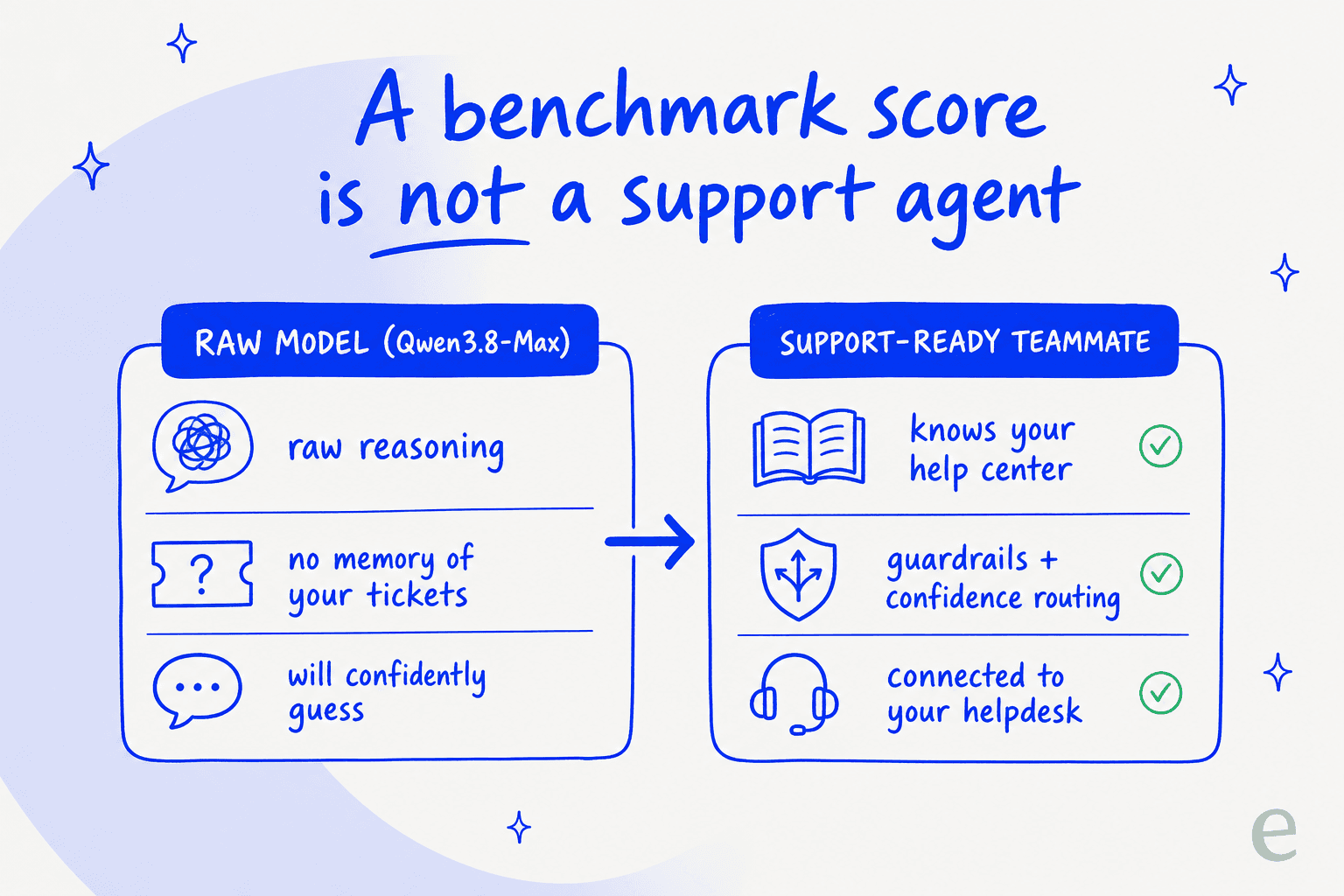
A model like Qwen3.8-Max gives you raw reasoning. What it doesn't give you is any idea of your refund policy, your product edge cases, or the fact that ticket #4021 is a VIP who's already emailed twice. It has no memory of your past tickets, no guardrail to stop it confidently inventing an answer, and no connection to the helpdesk where the work actually happens. A bigger parameter count doesn't fix any of that.
We've spent years putting AI on live support queues, and the lesson that stuck is that a confident-sounding model giving a wrong answer is worse than no answer at all. One paying customer's bot cheerfully confirmed it supported product models that weren't in their database, because the help center said "we support all models." That's the failure mode a raw preview model makes more likely, not less, because it sounds so sure of itself. As one support lead put it to me:
"The AI will never be able to answer 100% of the questions, but if it tries and just answers wrong, I cannot go check all my 7,000 tickets to see if it made a good answer. I need an AI that only handles the tickets it's confident about, and leaves the rest alone."
a DTC brand CX lead handling 7,000 tickets a month
That's why eesel AI runs a simulation over your historical tickets before anything goes live, so you see the resolution rate and the exact replies on real past conversations first, not after a customer gets burned. It's also why answers route by confidence: if the agent isn't sure, it drafts for a human or escalates instead of guessing. Doing it that way, Gridwise hit 73% tier-1 ticket resolution in its first month.
And you could wire a model like Qwen3.8-Max into your stack yourself. Most teams find the maintenance is the real cost, which is the build-versus-buy call one customer summed up neatly: "We could try to write our own LLM application, but we didn't want to invest our time into that. We wanted something we wouldn't have to maintain." The model underneath matters far less than that wrapper, which is the quietly good news about Qwen3.8-Max, Kimi K3, or whatever wins next month: a well-built AI for customer service inherits every frontier gain without you re-plumbing anything.
Try eesel AI
If you got here because you want an AI model to actually resolve tickets and not just chat, that's the whole point of eesel AI. It plugs into Zendesk, Freshdesk, Slack and 100+ other tools, learns from your help center and past tickets, and starts drafting or resolving in minutes, not weeks.

The differentiator is the trust ramp: simulate on your real ticket history, see the numbers, start in draft mode, and go fully autonomous only when you're happy. You get the frontier model's smarts with guardrails built for support. Try eesel free, no credit card needed.