

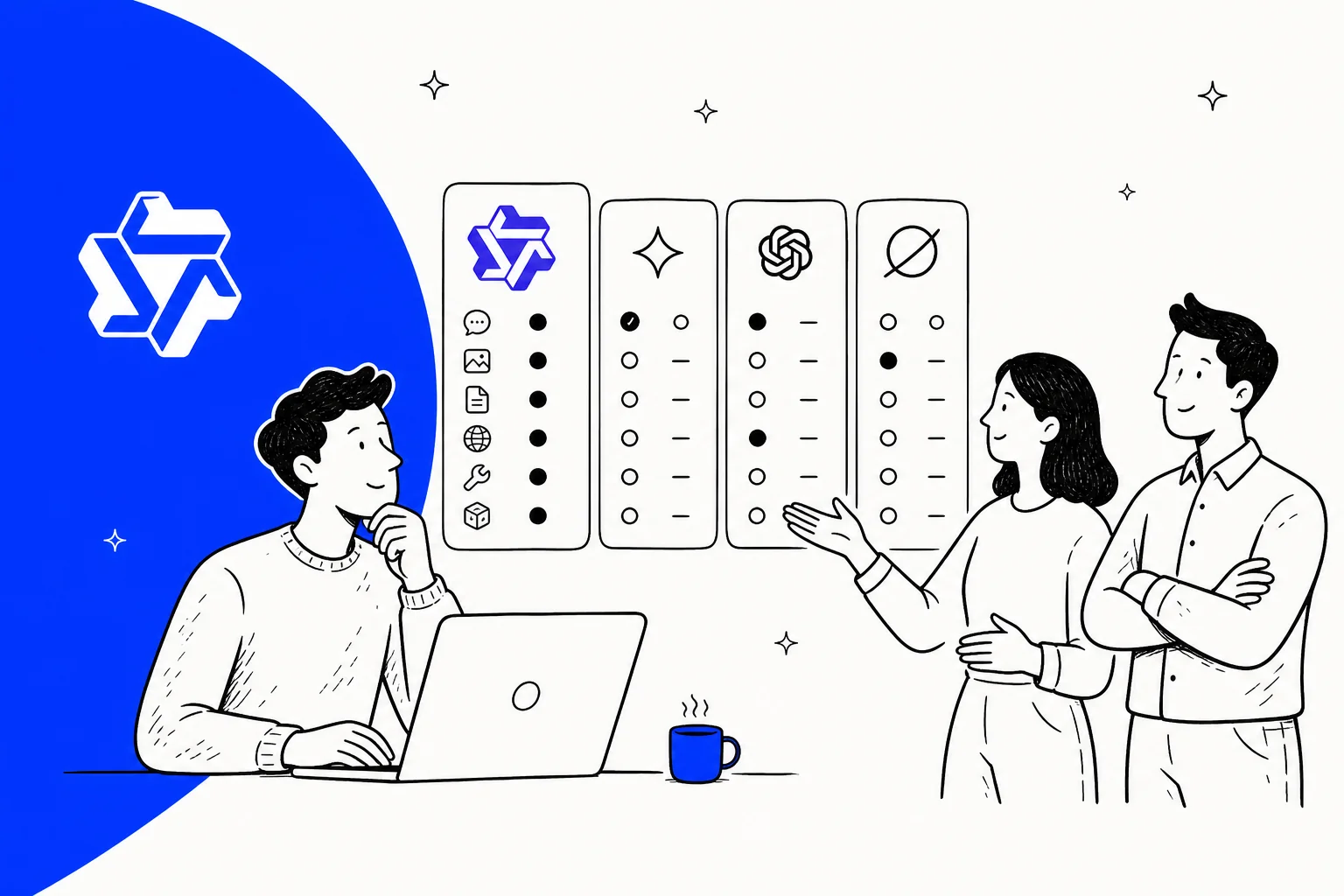
How I picked these alternatives
I write about search intent for a living, so I started from what people actually type when they search "Qwen3.8-Max alternatives." It splits into two camps: people who want a better or more finished frontier model, and people who assumed a big model would solve a real job (usually coding or customer support) and are realising it won't on its own.
So this list covers both. Five are direct model-for-model rivals, ranked by how real they are today (published benchmarks, pricing, and weights beat a marketing post). The sixth is the honest answer for anyone whose actual goal is a working AI support agent, not a chat window.
Every model here is judged on the same five things: what it is, where it's strong, what to watch out for, what it costs, and my verdict. Here's the whole field at a glance first.
Qwen3.8-Max alternatives at a glance
| Model | Maker | Params (total) | Open weights | Context | Multimodal | Published pricing | Best for |
|---|---|---|---|---|---|---|---|
| Kimi K3 | Moonshot AI | 2.8T (MoE) | Committed (Jul 27) | 1M tokens | Text-first | ~$3 / $15 per M | The direct rival, coding + agents |
| Claude | Anthropic | Not disclosed | No | 200K–1M | Text + vision | Yes, per-token | Reliability, agentic coding, safety |
| GPT-5.6 | OpenAI | Not disclosed | No | Large | Text + vision + audio | Yes, per-token | Broad ecosystem, tooling |
| Gemini 3.5 Pro | Not disclosed | No | 1M+ | Fully multimodal | Yes, per-token | Long context, Google stack | |
| Grok 4.5 | xAI | Not disclosed | No | Large | Text + vision | Yes, per-token | Real-time data, X integration |
| eesel AI | eesel | Model-agnostic | n/a | Uses frontier model | Inherits model's | From $299/mo (500 credits) | Actually resolving support tickets |
A note on the blanks: the proprietary labs don't publish parameter counts, and that's normal now. The bigger tell is the "published pricing" and "open weights" columns, where Qwen3.8-Max at preview scored a no on both. Now the detail on each.
1. Kimi K3 — the direct rival
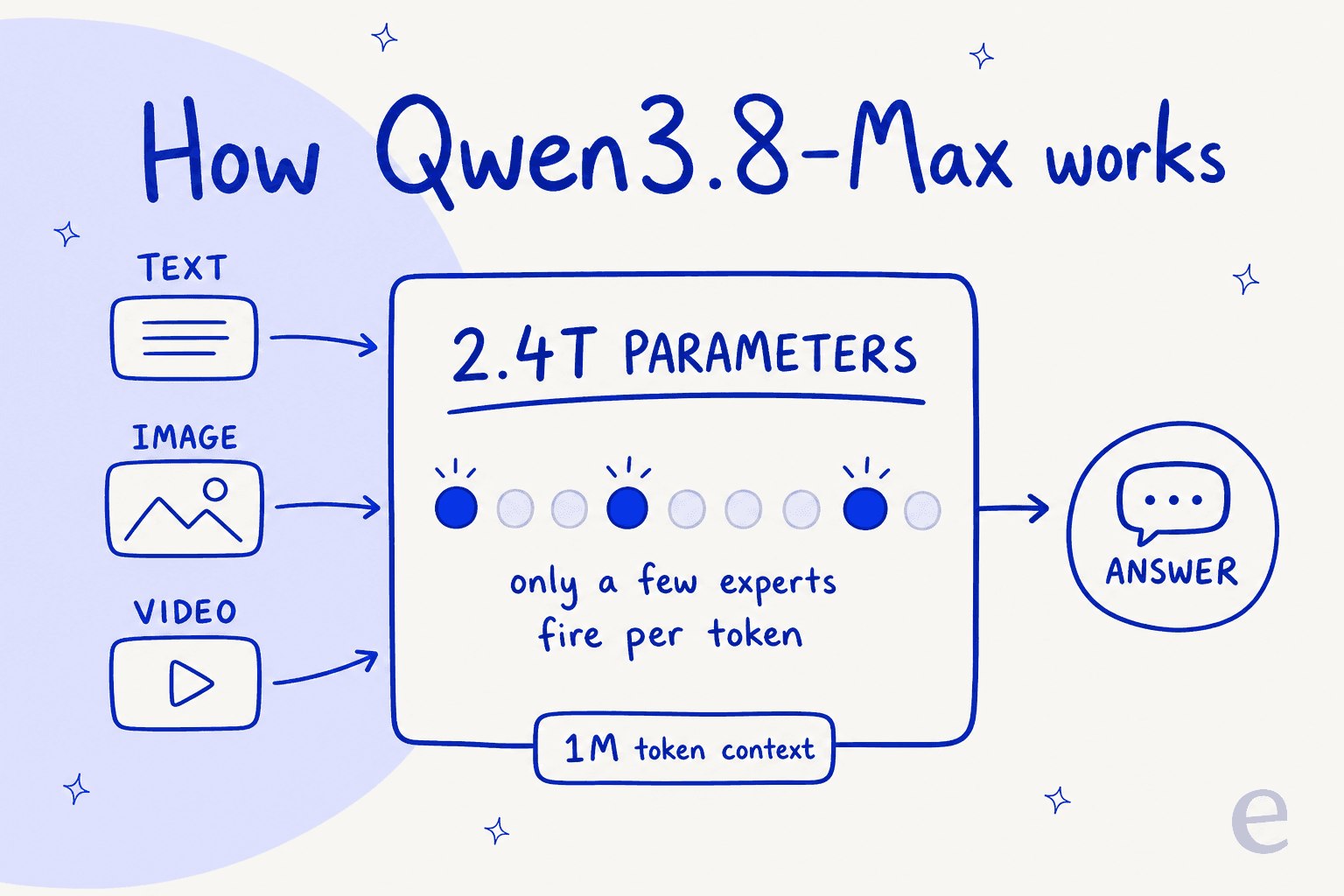
If Qwen3.8-Max has a true head-to-head competitor, it's Kimi K3. Moonshot AI shipped it on July 16, 2026, just three days before Qwen's preview, and the timing wasn't a coincidence (Alibaba holds roughly a 36% stake in Moonshot). Both are enormous sparse Mixture-of-Experts models with a 1-million-token context window aimed at coding and agentic work.
What it is. A 2.8-trillion-parameter MoE model, slightly larger on paper than Qwen3.8-Max. It's positioned as a near-frontier general model with strong agentic-coding chops.
Where it's strong. Unlike the Qwen preview, Kimi K3 came with the receipts: a committed open-weight release date (July 27) and published API pricing. That makes it far easier to plan around.
Watch out for. The weights were delayed once already, and the pricing surprised people. At roughly $3 in and $15 out per million tokens, Kimi K3 is Claude-Sonnet-tier, not the bargain many expect from a Chinese open-weight model. Big-context runs add up fast.
Pricing. About $3 per million input tokens and $15 per million output, with weights promised for self-hosting.
Verdict. This is the alternative to reach for if you specifically want the Qwen3.8-Max profile (huge, sparse, long-context, coding-focused) but with real numbers you can budget against. See the full Kimi K3 alternatives breakdown if you're torn between the two.
2. Claude — the reliability pick
Here's the irony: Qwen's own launch line benchmarked itself against Fable 5, the top-tier Claude model. So if you take Alibaba at its word that Fable 5 is the one to beat, then Claude is quite literally the model Qwen3.8-Max is chasing.
What it is. Anthropic's family spans Claude Sonnet 5 for everyday work, Opus 4.8 for the hardest reasoning, and Fable 5 for long-horizon, days-long tasks. All proprietary, all closed-weight.
Where it's strong. Consistency under real workloads and agentic coding. Claude is the model most teams trust when a wrong answer is expensive, and it's the default engine in tools like Claude Code and Cursor.
Watch out for. No open weights, ever, and per-token pricing at the top tier is premium. If cost-per-token is your only axis, the Chinese models undercut it.
Pricing. Published per-token rates that vary by tier; the full breakdown is in our Claude pricing guide.
Verdict. The safest choice when you need a model you can depend on today, with a track record instead of a preview promise. If Qwen's real pitch is "almost as good as Fable 5," the obvious move is to just use the thing it's measuring against.
3. GPT-5.6 — the ecosystem pick
GPT-5.6 is OpenAI's current flagship, and it's the alternative to pick when what you actually need is the surrounding ecosystem, not just the raw model.
What it is. A proprietary multimodal flagship handling text, vision, and audio, with a large context window and deep tool-use support.
Where it's strong. Breadth. GPT-5.6 has the widest integration surface, the most third-party tooling, and the most documentation of any model here, which matters more than a benchmark point when you're shipping. The GPT-5.6 review digs into where it lands versus Claude.
Watch out for. Closed weights, and the model lineup has gotten confusing (there are several GPT-5.6 variants). Pick the tier deliberately or you'll overpay.
Pricing. Per-token, published, tiered by variant. See our GPT-5.6 pricing guide.
Verdict. The pragmatic default if you already live in OpenAI's tooling. It won't win a size contest against Qwen3.8-Max, but the ecosystem around it is worth more than the extra parameters. The GPT-5.6 alternatives post covers the trade-offs.
4. Gemini 3.5 Pro — the long-context pick
Google's Gemini 3.5 Pro matches Qwen3.8-Max on the two specs Alibaba leaned hardest on: a huge context window and native multimodality.
What it is. A fully multimodal proprietary model (text, images, audio, video) with a 1-million-token-plus context window, tightly integrated with Google Workspace and Cloud.
Where it's strong. Genuinely long-context tasks, like reasoning over an entire codebase or a stack of documents at once, and anything that lives inside the Google stack.
Watch out for. Closed weights, and you're most rewarded for it if you're already on Google Cloud. Outside that, the lock-in cuts both ways.
Pricing. Published per-token rates with generous free-tier access for testing.
Verdict. If the whole reason Qwen3.8-Max caught your eye was the 1M context window and multimodal input, Gemini 3.5 Pro delivers that today, from a lab with a full model card.
5. Grok 4.5 — the real-time pick
Grok 4.5 from xAI is the alternative for one specific need: answers grounded in what's happening right now.
What it is. A proprietary multimodal model with direct, live access to the X firehose, so it reasons over current events without a separate retrieval step.
Where it's strong. Real-time data and a personality that some users prefer for open-ended chat. The Grok 4.5 review covers where it's genuinely competitive versus where it's hype.
Watch out for. Closed weights, tight coupling to X, and benchmark claims that (like Qwen's) deserve a skeptical read until third parties confirm them.
Pricing. Per-token and subscription options; details in the Grok 4.5 pricing guide.
Verdict. A niche but real pick if live data is core to your use case. For most people it's not the first alternative to Qwen3.8-Max, but for news, trading, or social monitoring, it's the one with a structural edge. Weigh it against the field in Grok 4.5 alternatives.
6. eesel AI — the alternative if you want resolved tickets, not a raw model
Now the part I care about most, because I build content for a company that puts AI on live support queues. A big share of people searching for Qwen3.8-Max alternatives don't actually want another model. They want a job done, usually "answer my support tickets," and they've correctly sensed that a raw model won't do it alone.
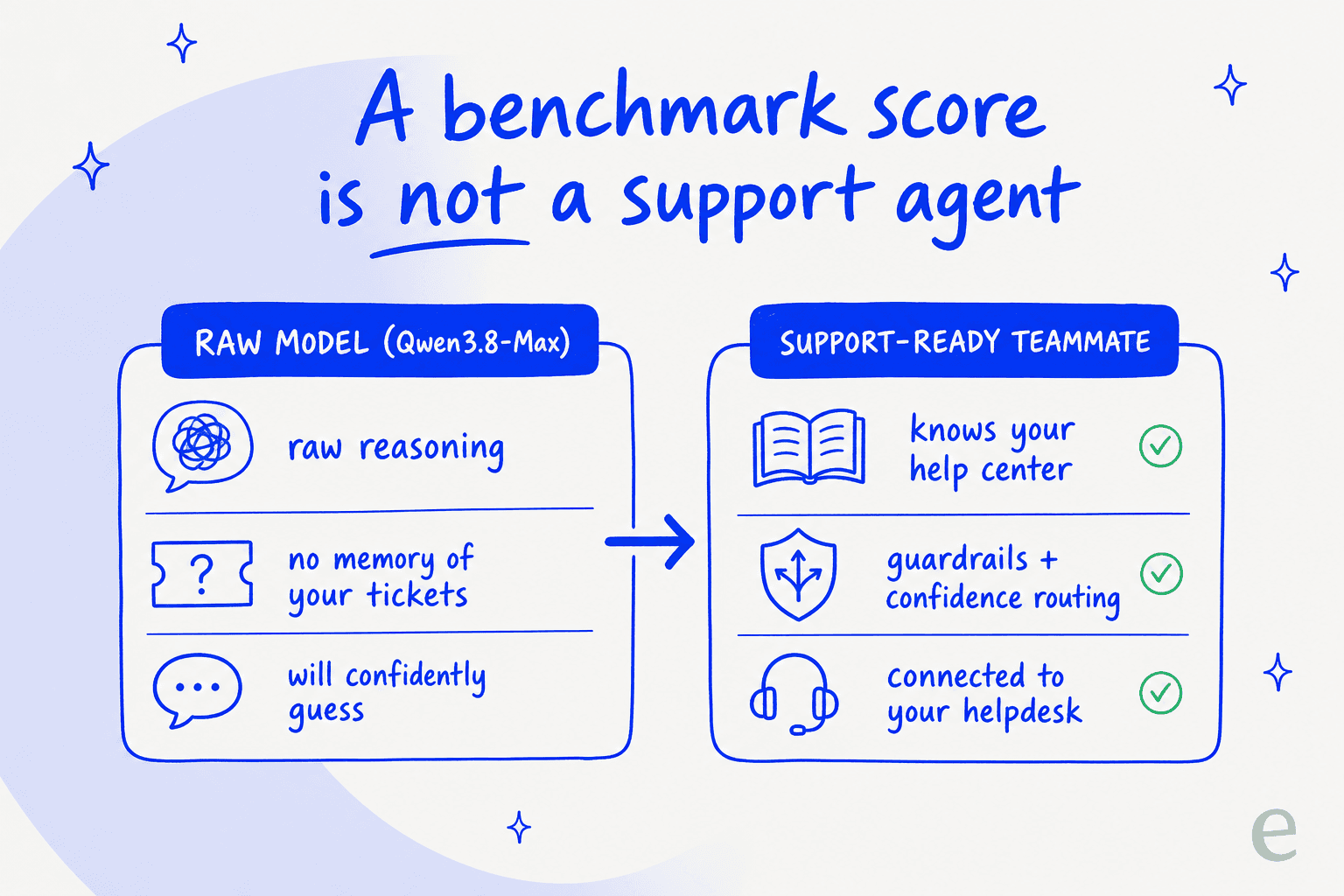
They're right. A model like Qwen3.8-Max or Kimi K3 gives you raw reasoning. What it doesn't give you is any idea of your refund policy, your product edge cases, or the fact that ticket #4021 is a VIP who's already emailed twice. It has no memory of past tickets, no guardrail to stop it confidently inventing an answer, and no connection to the helpdesk where the work happens.
We've spent years on this, and the lesson that stuck is that a confident-sounding model giving a wrong answer is worse than no answer at all. One paying customer's bot cheerfully confirmed it supported product models that weren't in their database, because the help center said "we support all models." A bigger parameter count makes that failure more likely, not less, because the model sounds so sure. As one support lead put it to me:
"The AI will never be able to answer 100% of the questions, but if it tries and just answers wrong, I cannot go check all my 7,000 tickets to see if it made a good answer. I need an AI that only handles the tickets it's confident about, and leaves the rest alone."
a DTC brand CX lead handling 7,000 tickets a month
That's the gap eesel fills. It's model-agnostic by design, so it rides on top of a frontier model and inherits every gain from Qwen, Kimi, Claude, or whatever wins next month, while adding the three things the model can't: your knowledge, confidence-based routing, and a real helpdesk connection.
Where it's strong. eesel simulates over your historical tickets before anything goes live, so you see the resolution rate and the exact replies on real past conversations first, not after a customer gets burned. Answers route by confidence: unsure ones draft for a human or escalate instead of guessing. Gridwise hit 73% tier-1 resolution in its first month doing it this way.
Watch out for. It's not a raw model you self-host, and it's not the tool if you literally just want an API to call. It's the layer for teams whose goal is resolved tickets.
Pricing. One fixed monthly price from $299/month for 500 credits (1 credit per ticket or chat), with no per-seat fees, so cost tracks ticket volume rather than headcount. A free plan includes 100 credits.
Verdict. If you came here to make support better, this is the actual alternative. The model underneath is a commodity that gets cheaper every few weeks; the wrapper is what turns it into an AI for customer service.
Which alternative should you pick?
The honest decision comes down to what you're actually trying to do. Walk it below.
The pattern behind all of this
Step back and the real story isn't which model wins. It's that the model layer is getting cheaper and better every few weeks, with Chinese labs racing to commoditize frontier-level intelligence. On Hacker News, the read a lot of people landed on was that this race is good for everyone downstream:
"The Chinese firms seem to be working hard to commoditize intelligence which may be the most effective way to debase American frontier labs. And yeah: it also happens to be really good for humanity."

For a buyer, the takeaway is simple: build so you can swap the engine without re-plumbing everything around it. That's the quietly good news about picking any of these alternatives. If your AI support setup is model-agnostic, you inherit every frontier gain for free, and "which model is best this week" stops being a decision you have to keep re-making.
Try eesel AI
If you got here because you want an AI to actually resolve tickets and not just chat, that's the whole point of eesel AI. It's model-agnostic, so it rides on whichever frontier model is winning, then adds the parts a raw model can't: your help center, past tickets, guardrails, and a real connection to Zendesk, Freshdesk, Slack, and 100+ other tools.

The differentiator is the trust ramp: simulate on your real ticket history, see the numbers, start in draft mode, and go fully autonomous only when you're happy. You get a frontier model's smarts with guardrails built for support. Try eesel free, no credit card needed.