
What you are actually getting access to
I build integrations at eesel, which means most of my week goes on pointing the eesel stack at whatever model just shipped and then finding out where the paperwork lies. Qwen 3.8 Max carries more paperwork than most of them, because there are two different products wearing almost the same name.
Alibaba announced the model twice. On July 19, 2026, qwen3.8-max-preview turned up at the World AI Conference in Shanghai with no blog post, no model card, no benchmark table either. Then on August 2 the real launch landed: a 5,068-word technical post, two full benchmark tables, per-token pricing, plus an open-weights promise. The GA ID is qwen3.8-max.
Those two IDs are not two versions of one purchase. The preview was sold only through the Token Plan subscription and has no model card at all, while https://www.qwencloud.com/models/qwen3.8-max-preview returns a 404. The GA model is sold pay-as-you-go, and is also included in Token Plan. So when somebody tells you they are "on the preview pricing," what they are describing is a credits bucket, not a rate.
The specs you are buying access to, from the QwenCloud model card: 2.4 trillion total parameters with 95 billion active in a sparse MoE, a 1,000,000-token context window, 131,072 max output, and up to 262,144 tokens of reasoning. reasoning_effort ships with three levels and defaults to xhigh, with preserve_thinking on out of the box. If what you want is the capability read instead of the access read, the eesel Qwen 3.8 Max review digs into what those numbers actually buy, and the head-to-head against Kimi K3 is where the token-efficiency question gets ugly.
One small heads-up which cost me ten minutes. The launch post lives at ?id=qwen3.8, not ?id=qwen3.8-max. The wrong id renders an empty page instead of a 404, so it looks like the announcement got pulled.
Pick your route
Five surfaces, and five different bills. Work out which one you are before you create the account, because switching later means re-plumbing.
Route finder
Which Qwen 3.8 Max door is yours?
Pick the sentence that sounds most like your week.
Route 1
Qwen Studio chat
CostFree. Web, iOS, Android, macOS, Windows.
SetupSign in. No key, no billing account.
The catch: model choice sits behind login, so you cannot confirm from outside that 3.8-Max is the one answering you.
Route 2
QwenCloud API, per token
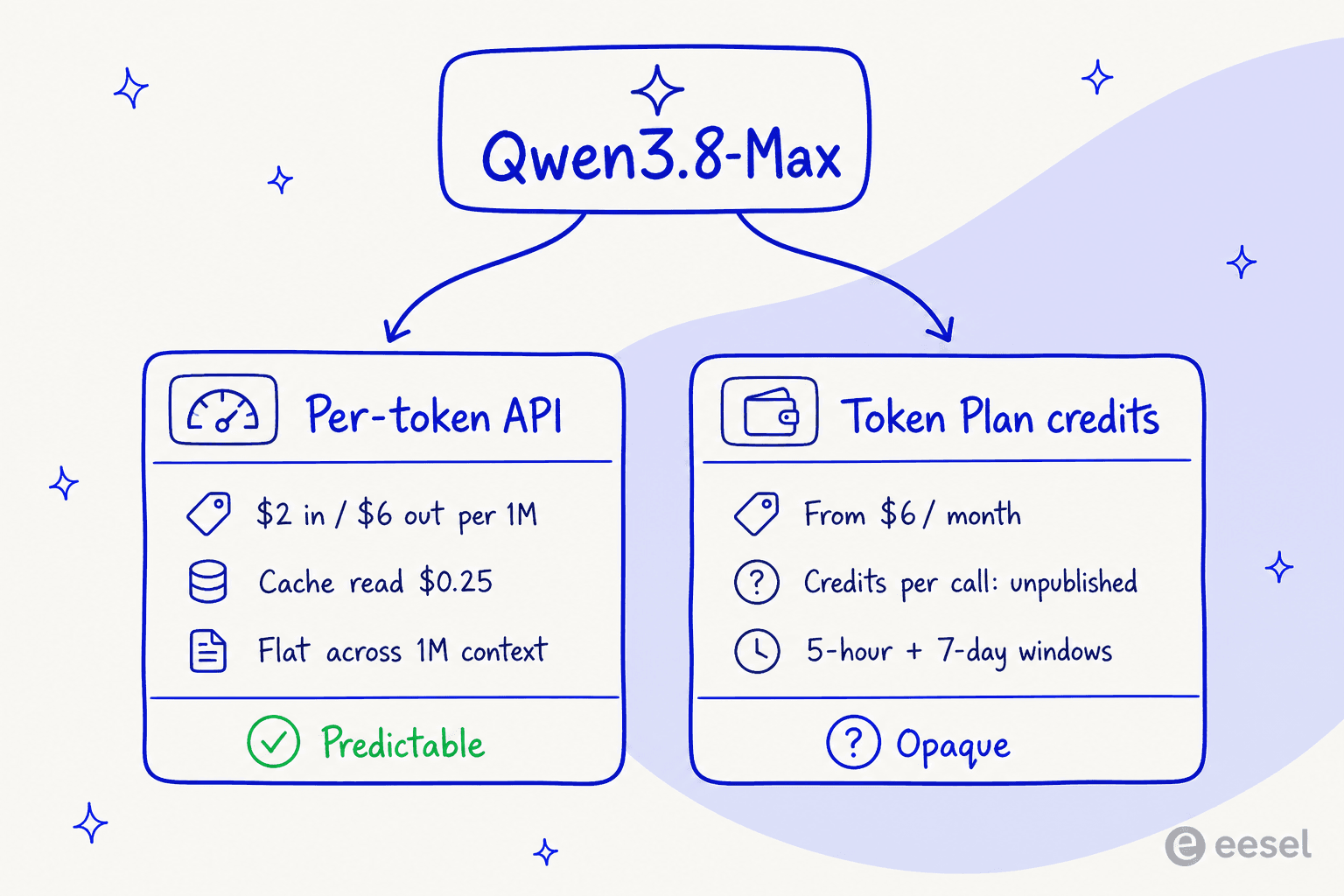
Cost$2 per 1M in, $6 per 1M out, $0.25 cached read.
SetupCreate a key, set a base URL, model qwen3.8-max.
The catch: nothing hidden here, which is exactly why this is the route to pick if you need to forecast a bill.
Route 3
Token Plan credits
CostPersonal $6 / $18 / $68 a month. Team seats $20 to $200.
SetupSubscribe, then call from the same API surface.
The catch: the credits-per-call coefficient is unpublished, and personal quotas reset on fixed 5-hour and 7-day windows rather than accruing.
Route 4
Qoder and third-party harnesses
CostWhatever the underlying key bills. Qoder is its own product.
SetupPoint Claude Code, Codex, Qwen Code or OpenClaw at a swapped base URL.
The catch: the OpenClaw config Alibaba publishes caps output at 65,536 tokens, half the model's real ceiling.
Route 5
Open weights, self-hosted
CostNot purchasable. Not published.
SetupNone available as of August 3, 2026.
The catch: promised "next week" from August 2 with no license, date or repo. And 2.4T parameters clears 500GB even at 1.5 bits per weight.
Here is the same thing as a table, since one of you is going to want to screenshot it.
| Route | What you get | Price | Best for | Main catch |
|---|---|---|---|---|
| Qwen Studio | Consumer chat, all platforms | Free | Kicking the tyres | Model picker is behind login |
| QwenCloud API | Per-token pay-as-you-go | $2 / $6 per 1M | Production apps | None on price, plenty on verbosity |
| Token Plan | Credit subscription | From $6/mo | Heavy agent loops | Credit coefficient unpublished |
| Qoder and harnesses | Agentic coding IDE and CLIs | Key-dependent | Coding work | Conflicting output ceilings |
| Open weights | Self-hosting | Unavailable | Nobody, yet | Not shipped |
Route 1: the free chat
Qwen Studio is the fastest door and it costs nothing. Per qwen.ai there are clients for web, iOS, Android, macOS and Windows.
One honest caveat, because I did check. The logged-out page is an image-generation onboarding flow, and it does not name Qwen 3.8 Max anywhere in its public HTML. Model selection lives behind the authentication. So the chat is real and it is free, only you have to sign in first before you can verify which model is answering you.
Worth to know what this route is good for and what it is not. As a way to sanity-check whether the model handles your domain, it is fine. As a way to evaluate latency or cost, or how the model behaves under a system prompt that you control, it is bad. For that you want route 2.
Route 2: the API, per token
This is the one I would pick for anything real. You create a key in the QwenCloud console, and after that the rate card is the whole story.
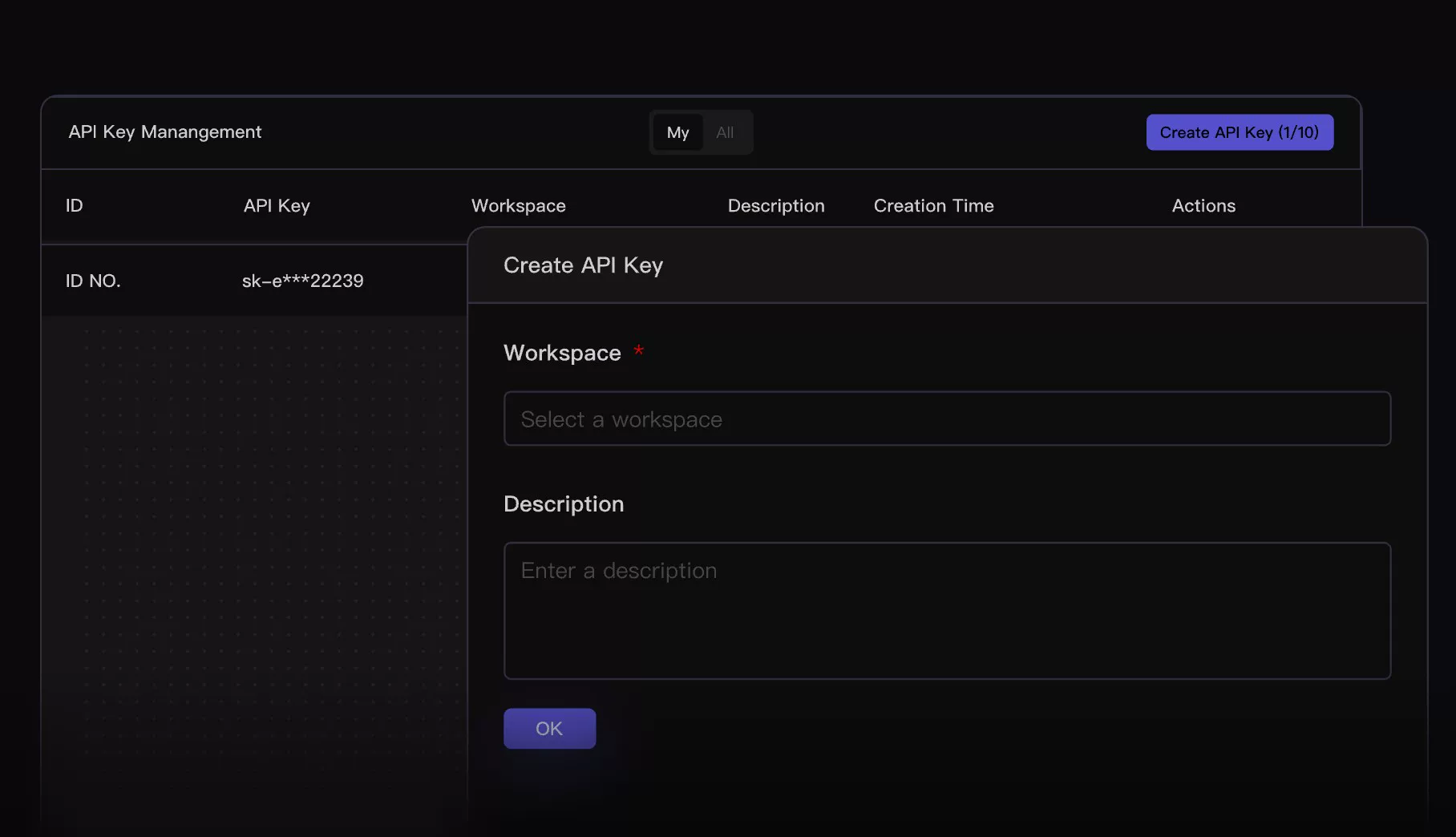
Note the counter sitting on that button: ten keys per account, and every key is scoped to one workspace. If your plan is key-per-environment or key-per-customer, budget for that ceiling now and not at rollout.
The published meters, from the model card:
| Meter | Price per 1M tokens |
|---|---|
| Input | $2 |
| Output | $6 |
| Input, implicit cache | $0.25 |
| Explicit cache creation | $2.50 |
| Explicit cache read | $0.17 |
Two details in that table matter more than the headline does. First, there is no context-length bracket: one flat $2/$6 pair across the whole 1M window, no tiered pricing selector at all. Which is unusual, and it is good news, because tiered context pricing is exactly where long agent sessions get quietly expensive. Second, that implicit cache at $0.25 does real work if your prompts share a stable prefix, and most support and coding workloads do.
Rate limits sit at 15,000 RPM and 2M TPM on the same card. For a reference against the rest of the field, the eesel Qwen 3.8 Max pricing post runs this same math next to GPT-5.6 pricing and Kimi K3 pricing. The DeepSeek V4 Flash comparison is the one to read if cheap-per-token is your whole criterion.
The part that saves you a rewrite
You almost certainly do not need a new client library for this. Alibaba exposes the same model over three protocols in each of six regions, per the Model Studio list: OpenAI-compatible at /compatible-mode/v1, Anthropic-compatible at /apps/anthropic, and native DashScope at /api/v1. The regions are Beijing, Hong Kong, Singapore, Tokyo, Frankfurt and US (Virginia).
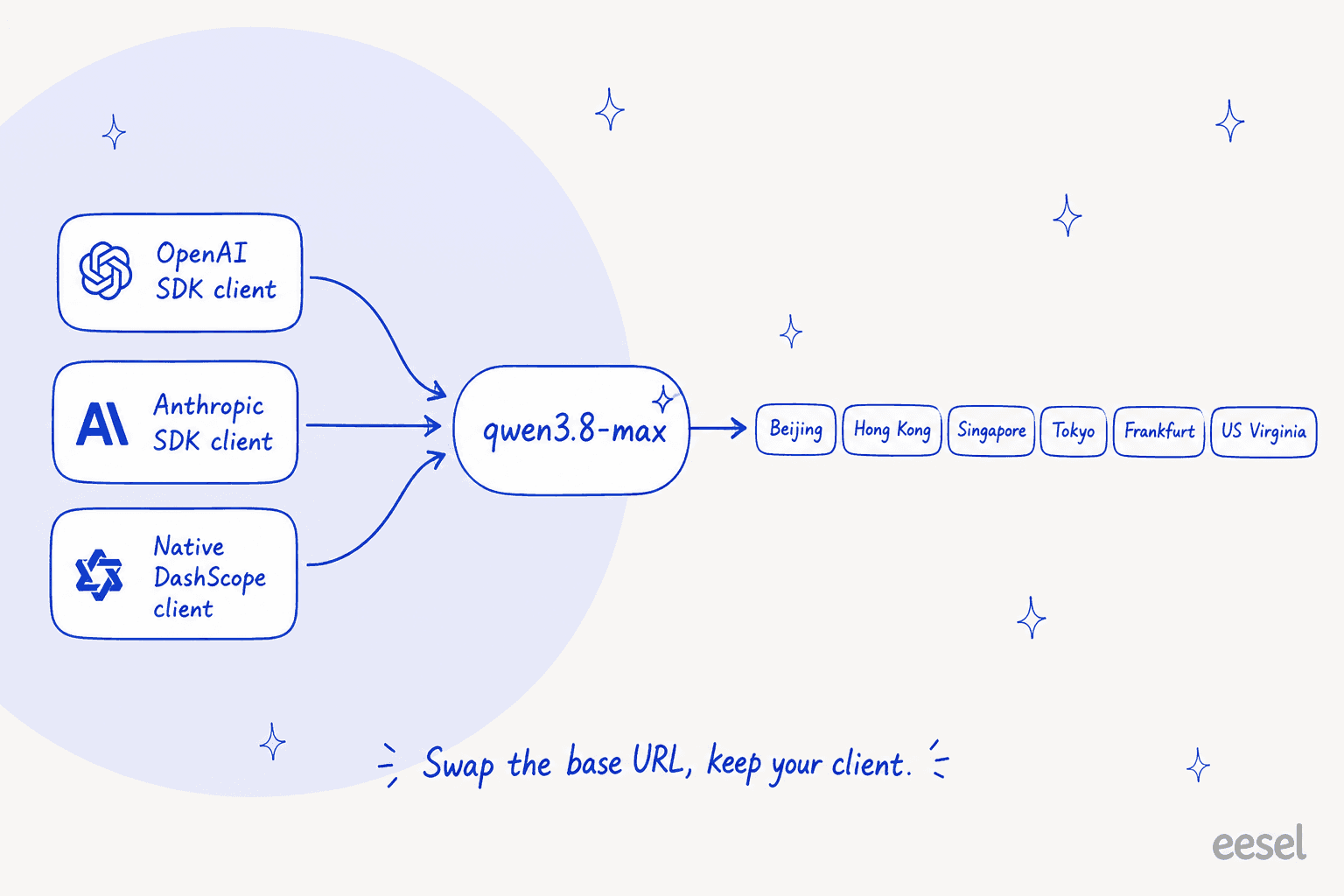
In practice that means an existing OpenAI SDK integration reaches this model by changing a base URL plus a model string. Nothing else. QwenCloud supports chat-completions and the Responses API, and the feature list on the model card confirms function calling, structured JSON outputs, prefix completion, context caching, batches, web search and fine-tuning. The server-side built-in tools (code_interpreter, web_extractor, web_search, t2i_search, i2i_search) sit on the Responses API specifically.
Route 3: Token Plan credits
The subscription route is where I would slow down. It is the only way to reach the older preview model, and as an economic product it is a completely different animal from the API.
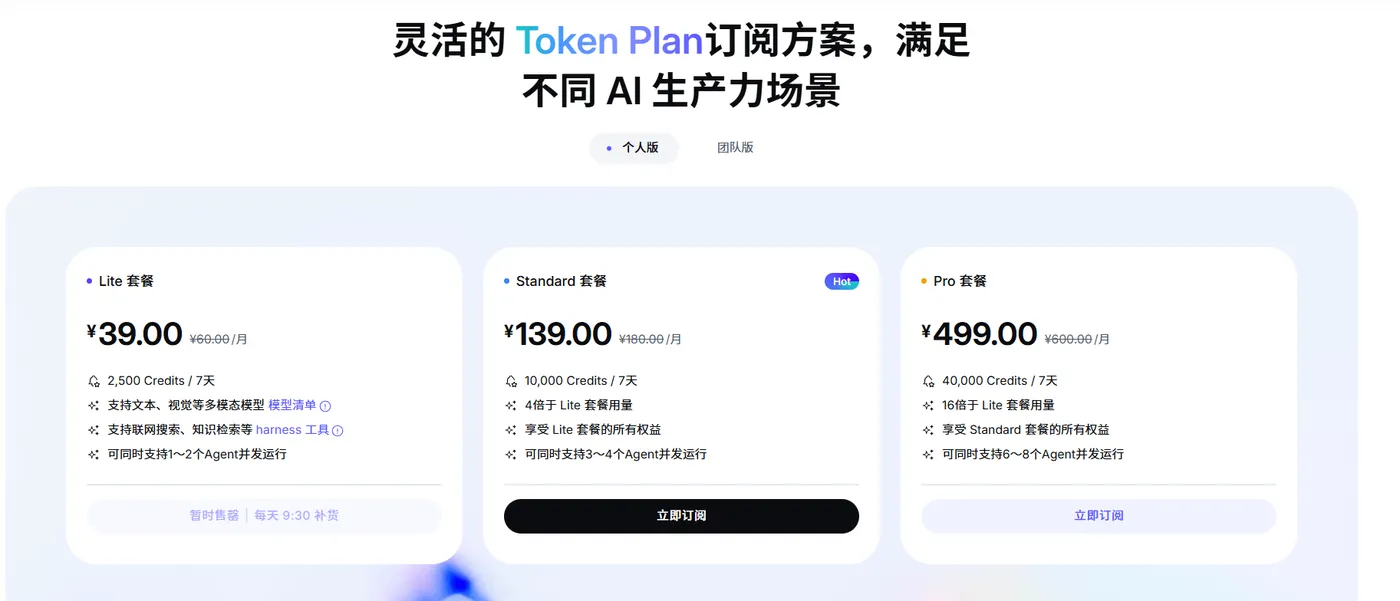
Internationally the Token Plan doc prices Personal at $6, $18 and $68 a month (list $8, $25, $80). That grants 2,500, 10,000 and 40,000 credits per rolling 7-day window, and on top of that 700, 3,000 and 12,000 per 5-hour window. Team seats run $20 Standard, $75 Pro and $200 Max per seat per month, for 25,000, 100,000 and 250,000 credits monthly. China mainland runs the same quotas but in yuan: ¥39, ¥139 and ¥499 Personal, then ¥150 to ¥1,398 per team seat.
Now the part which nobody puts in the marketing copy. Alibaba does not publish what a credit buys. The Personal Edition doc says a call's credit cost gets set dynamically by model type, token volume, thinking mode and tool calls, then deducted at tiered coefficients which are not listed anywhere public. The one worked example on the site is for a different model, qwen3.6-plus, at roughly 3.18 credits for a 8,349-token input and 573-token output.
Three more mechanics that bite:
- Quotas are windows, not balances. Hitting either the 5-hour or the 7-day cap pauses service until that window resets, and unused credits do not carry over. Renewing extends the term, only it does not top up the current cycle.
- Team seats are one member to one key, non-shareable, with no window limits but a hard monthly block when the seat pool empties.
- Long sessions cost more per request. The Team doc states plainly that some models bill in tiers by context length, and it warns that accumulating context inside agent loops pushes requests up into higher brackets.
There is a real discount here worth to name. During the preview, credit consumption ran at 10% of normal, and between 22:00 and 08:00 a further 80% off stacked on top of that, landing on 2% of standard burn. Two qualifiers though. The night discount is Personal Edition only, and GA qwen3.8-max gets a flat 50% night rate instead of the stacked 2%. Both are explicitly revocable, also Alibaba never names the timezone.
I have watched this exact shape of pricing catch people out on my own side of the fence. One buyer I worked with, a European email-security company on Freshdesk, burned through 200 interactions in a single test day and started worrying straight away about what that meant at their expected volume. The number itself was fine. Not being able to predict the number is the thing that makes a finance team say no. An unpublished coefficient does that to you at a much bigger scale, which is the whole argument for taking route 2 instead.
Route 4: Qoder and the coding harnesses
If your access question is really "can it drive my repo," then Alibaba has already done the work for you. Qoder is its agentic coding IDE and CLI, installed with curl -fsSL https://qoder.com/install | bash, and the launch post describes it as co-evolving with the model.
The more useful bit is that the same post also ships copy-paste configs for four harnesses which you may already run: Claude Code (via an ANTHROPIC_BASE_URL pointed at https://dashscope-intl.aliyuncs.com/apps/anthropic), Codex on the Responses protocol, Qwen Code (@qwen-code/qwen-code), and OpenClaw. If you have a coding assistant workflow already, then this is a base-URL change and not a migration.
Watch one inconsistency here. The model card says 131,072 max output. The OpenClaw config which Alibaba publishes in that same launch post sets "maxTokens": 65536, exactly half of it, and the gap never gets explained. So Alibaba's own shipped tooling never asks for the ceiling it advertises. If you hit truncation on a long generation, that config value is the first thing for checking.
For flavour on what long-horizon access looks like in practice, Alibaba points at a 16-day autonomous coding run which produced 265 commits, 127 PRs and 151 issues in the public oh-my-cli repo as of July 30, 2026. Take it as a demo and not a benchmark. It does tell you which path Alibaba is investing in, though.
Route 5: the weights, which you cannot have yet
This is the route that most people asking about access are really asking about. It is also the one which does not exist.
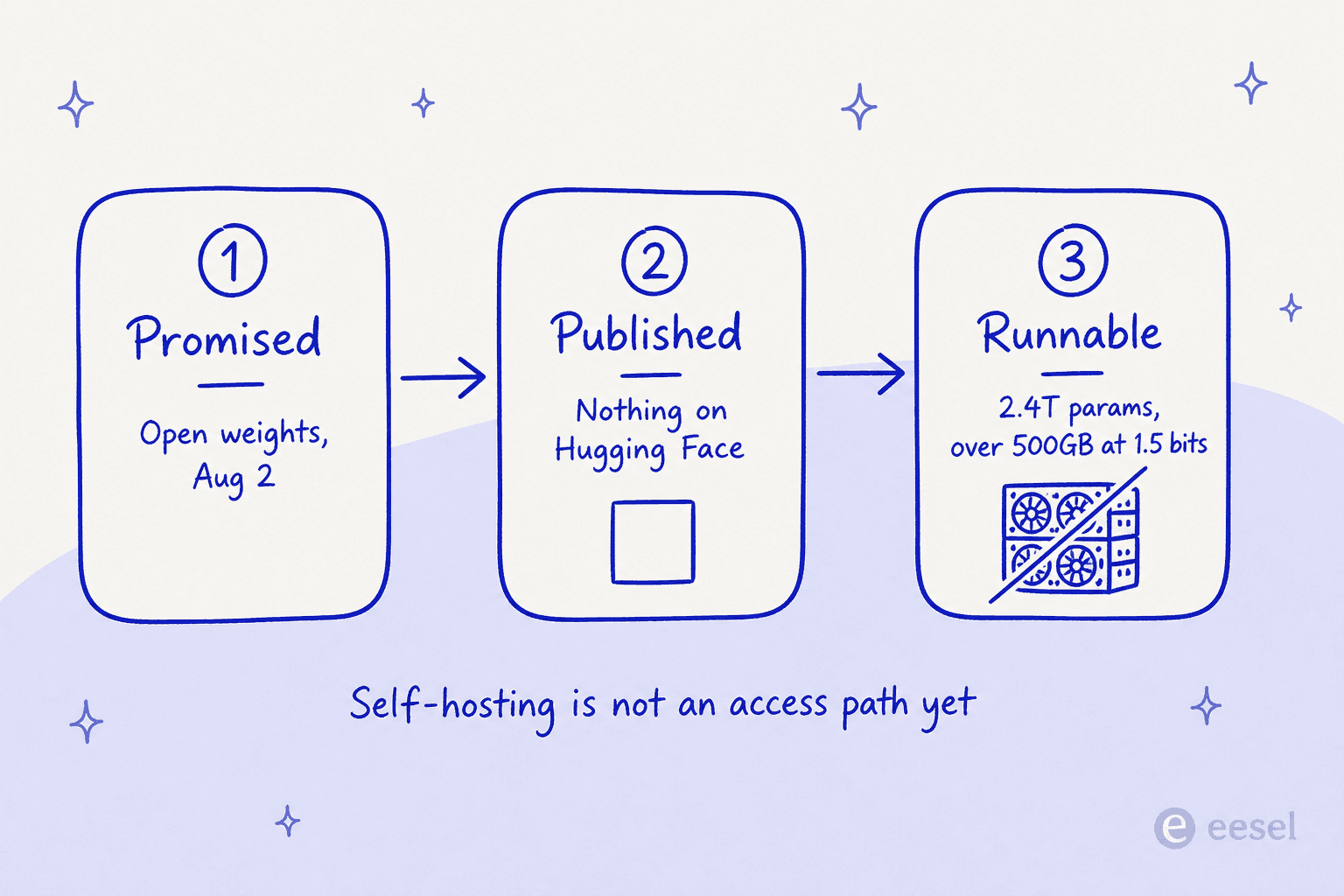
The launch post commits to it three separate times, calling it the first open-weight model at Max scale, with the weights going to Hugging Face and ModelScope "next week." As of August 3, 2026 there is no repo, no license, no firm date either. And the qwen.ai homepage tags the entry "Open-Source" for a release whose weights are not out.
The community reaction was less about the promise and more about the arithmetic:
At 1.5 bits per weight it'll still be over 500gb - that's still not running on consumer hardware.
Best case they release smaller models. 120b class of qwen 3.8 would be incredible - it fits on device for those serious about AI, but without millions of dollars in hardware for terabytes of VRAM

That is the honest read of it. Even a shipped 2.4T checkpoint is a datacentre artefact and not a laptop one. The sibling release which people are really waiting on is Qwen3.8-27B, announced open-weight alongside the flagship:
They've also announced Qwen3.8-27B being released open-weight next week. Qwen3.6-27B is widely regarded as one of the best local models, especially since nothing else comes close to it, that isn't benchmaxxed, without being significantly larger. If 3.8 truly improves upon it that would be awesome.
If local inference is a hard requirement for you, that is the release to track, and the eesel piece on small language models covers why the small end is usually the right end for production anyway. For comparable open-weight options today, see Qwen 3.8 Max alternatives and the Kimi K3 explainer, which did ship its weights on the date it promised.
Five mistakes I would save you
Access problems with this model are almost never capability problems. Mostly they are paperwork.
- Calling
qwen3.8-max-previewand expecting a rate. It has no model card and no per-token price. If you want a number, you want the GA ID. - Reading a preview-era article as GA pricing. There is a widely-circulated set of CNY per-1K brackets which claims a 256K context, and that contradicts the GA card's 1M. Any bracket table you find off Alibaba's own properties, treat it as unverified.
- Assuming the 2% night rate applies to you. It was preview-only and Personal-only. GA gets a flat 50% night discount, and Team gets no night discount at all.
- Budgeting the Lite tier without checking stock. The Lite plan was showing "temporarily sold out, restocked daily at 9:30" when I looked on August 3, 2026. Which is a sentence I did not expect to be writing about an API subscription.
- Trusting a single-number verdict on quality. The model is not on the Artificial Analysis board at all, so any "independent intelligence score" you see quoted for it belongs to some different Qwen. Compare on the Fable 5 and GPT-5.6 head-to-heads instead.
What access does not give you
Every route above arrives on the same place: a model which answers prompts. If you came here to put AI onto a support queue, that is maybe a fifth of the job.
The other four fifths are the parts which nobody sells you with a key. Retrieval over your own help centre and your past tickets, so that answers come out grounded instead of merely plausible. Actions, so the agent can tag and route and close instead of only talking. Escalation rules, with a clean handoff to a human. And then a way to test the whole thing on historical tickets before it ever touches a customer, which is the step separating a working rollout from an incident.
I say that from scars and not from theory. I have watched a confident-sounding bot cheerfully confirm support for products which were not in the customer's database at all, purely because the knowledge base said "we support all models." One B2B technical support team I worked with flagged exactly that fear before going live, and they were right to. Which is why every eesel rollout simulates against real past tickets first, and that is not a feature you get out of a base URL. The eesel guides on hallucination prevention and on resolution rate go deeper on both halves of it.
The model choice matters far less than people expect it to, as well. Whether you route through Qwen, GLM 5.2, Gemini 3.5 Pro or Fable 5, the thing which moves your deflection rate is the retrieval and testing layer wrapped around it. I make that case at length in AI agents versus chatbots and in RAG versus fine-tuning.
Try eesel for support work instead of wiring it yourself
If your reason for reading a model-access guide was "I want AI answering tickets," then you can skip every route above. eesel is the layer that turns a model into a support teammate, and it takes minutes instead of a procurement cycle.
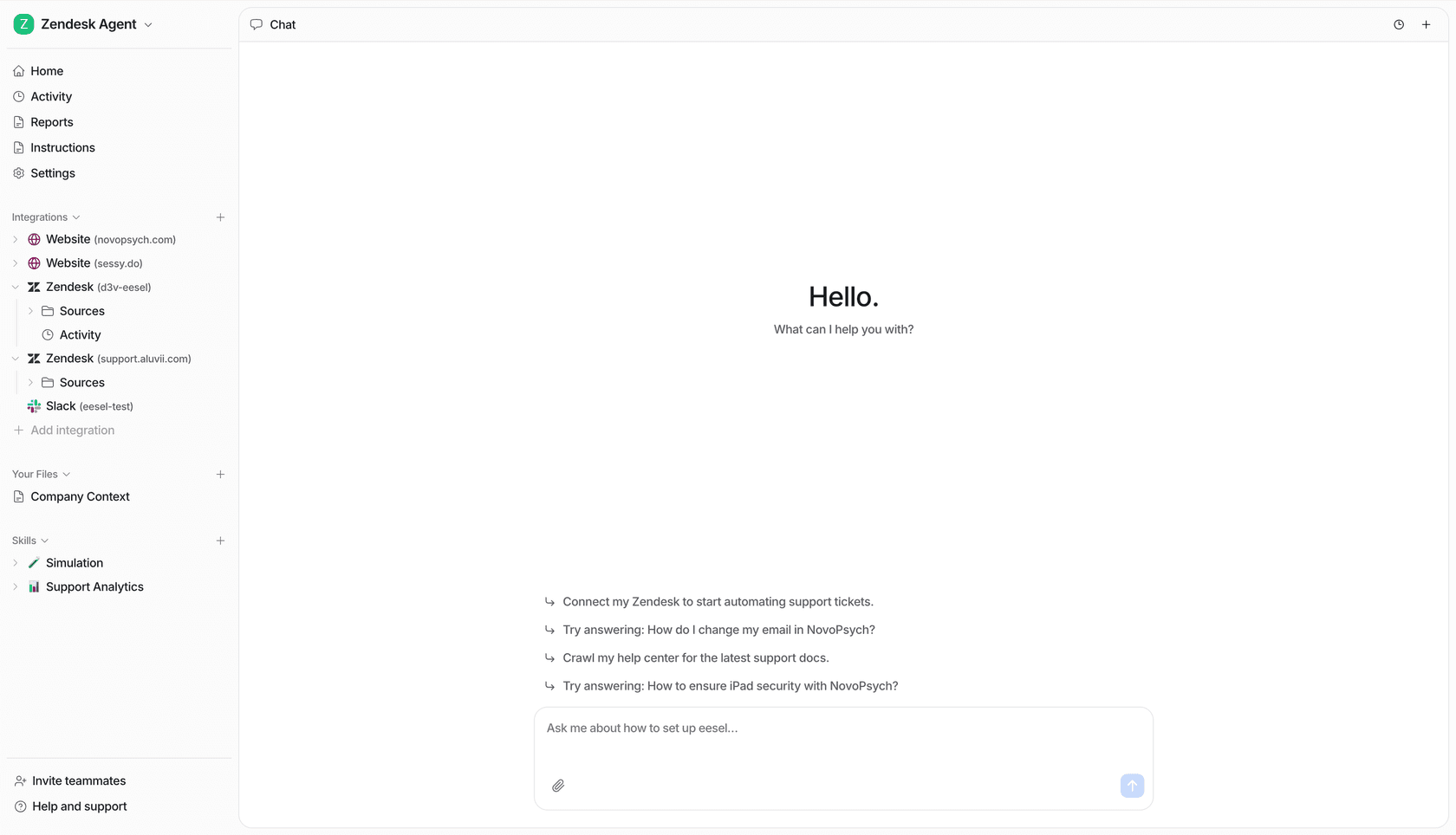
Connect Zendesk, Freshdesk, Gorgias, Front or HubSpot, then point it at your help centre, and it learns from your past tickets instead of from a prompt you wrote at midnight. After that you simulate the whole thing on historical conversations, see the resolution rate before you commit anything, and switch it on when the number is one you can defend. No API keys for rotating, no credit coefficients to reverse-engineer, and no region to pick. If you want the wider field first, the eesel best AI helpdesk software roundup and the support ticket automation guide are the places to start, and ticket classification covers the triage half.
Try eesel free, or book a demo if you would rather I drive.
Frequently Asked Questions
How do I access Qwen 3.8 Max for free?
What is the Qwen 3.8 Max API price per token?
What is the Qwen 3.8 Max model ID?
qwen3.8-max, printed on the QwenCloud model card. The earlier preview was qwen3.8-max-preview, which is a different commercial product sold only through Token Plan. Mixing the two up is the most common reason a first API call 404s.Can I download the Qwen 3.8 Max weights and self-host it?
Is the Token Plan subscription cheaper than the Qwen 3.8 Max API?
Can I use Qwen 3.8 Max inside Claude Code or Codex?
Which regions can I call Qwen 3.8 Max from?
Is Qwen 3.8 Max access good enough to answer customer tickets?


Article by
Rama Adi Nugraha
Rama is a software engineer at eesel AI with two years of experience writing about B2B SaaS, AI tools, and customer support technology. Based in Bali, Indonesia, he brings a developer's perspective to product comparisons — cutting through marketing copy to what the integrations and APIs actually do.