

The 60-second scoreboard
| Qwen 3.8 Max | DeepSeek V4 Flash | |
|---|---|---|
| Model ID | qwen3.8-max | deepseek-v4-flash |
| Pinned build | Qwen3.8-Max | DeepSeek-V4-Flash-0731 |
| Released | Aug 2, 2026 | Jul 31, 2026 |
| Input / 1M | $2.00 | $0.14 |
| Cached input / 1M | $0.25 | $0.0028 |
| Output / 1M | $6.00 | $0.28 |
| Context window | 1,000,000 | 1,000,000 |
| Max output | 131,072 | 384,000 |
| Architecture | 2.4T total / 95B active MoE | 284B total / 13B active MoE |
| Weights | Promised, unpublished | Open, MIT |
| Inputs | Text, image, video, docs | Text |
| Reasoning default | xhigh, preserve_thinking on | Thinking on, effort high |
| Max reasoning tokens | 262,144 | Not published |
| Throughput cap | 2M TPM, 15K RPM | 2,500 concurrent requests |
| LMArena Text rank | #5, 1496 | #79, 1436 |
| AA Intelligence Index | Not scored yet | 50 |
| Pending price change | None published | 2x during peak hours |
Two rows are doing most of the work here. The output ceiling is the quiet one: Flash will write 384K tokens in a single response against Qwen's 131,072, which matters for anything that has to generate a long artefact instead of a chat reply. The other one is the pending peak-hour change, which I would put in a spreadsheet, because it is the only announced future price move on either side.
Work out what you would actually pay
The ratios above are per token. What you actually care about is the invoice, and that depends on the shape of your traffic more than on the rate card itself. Drag the dials.
What DeepSeek V4 Flash actually is
Flash is the small sibling in DeepSeek's V4 family, and the word "small" is doing real work in that sentence. It is a Mixture-of-Experts model with 284B total parameters and only 13B active, against V4 Pro's 1.6T total and 49B active, per DeepSeek's model downloads table. For scale, DeepSeek's own previous generation, V3.2-Base, was 671B total and 37B active, so Flash is under half the total size of the model it replaces. Thirteen billion active parameters puts its per-token compute closer to a small language model than to anything with "frontier" in the marketing.
The build behind the API alias is DeepSeek-V4-Flash-0731, and DeepSeek is unusually upfront that this was not a new architecture. The changelog says it kept the preview's architecture and size and "was only re-post-trained." That admission matters, because the benchmark jump between the preview and 0731 is enormous. DeepSeek's published table has DeepSWE going from 7.3 to 54.4 on identical weights, differing only in post-training.
Three architectural pieces are named on the V4 model card: a hybrid of Compressed Sparse Attention and Heavily Compressed Attention, Manifold-Constrained Hyper-Connections for signal stability across layers, and the Muon optimizer. The efficiency claim everyone quotes, 27% of the single-token inference FLOPs and 10% of the KV cache versus V3.2, is measured on Pro, not on Flash, so be careful about repeating it for this model.
Two details I care about, as someone who ships this stuff for a living. Speculative decoding ships inside the checkpoint rather than as a separate draft model, so in vLLM it comes down to one flag, and DeepSeek explicitly warns you not to point it at a draft path. And the weights are MIT-licensed, about 167GB in mixed FP4 and FP8, with 57 quantizations already on Hugging Face. If your plan is to run a frontier-adjacent model on your own hardware, that is the whole ballgame.
What Qwen 3.8 Max actually is
Qwen went the other way on nearly every axis. Alibaba's flagship is a 2.4-trillion-parameter sparse MoE with 95B active, and its first multimodal model above a trillion parameters, taking text, images, video and documents in. The Qwen team's preview claim was that it is "second only to Fable 5," which at the time came with no benchmark table and no model card, and no license either.
General availability on August 2 fixed the numbers problem. Not the openness one. The GA post shipped a full benchmark chart and a 1,000,000-token window, and QwenCloud now carries a real rate card at $2 and $6, with implicit cache reads at $0.25.
Weights were promised on Hugging Face and ModelScope, restated at GA as coming "next week," and have not appeared. So the honest framing, on licensing, is that one of these two is open source today and the other is a promise. My Qwen 3.8 Max alternatives roundup goes deeper on what that means if you need weights, and the Qwen 3.8 Max pricing guide tracks how the preview rate became this one.
The other thing to know is about defaults, not about capability. Qwen ships with xhigh reasoning on and preserve_thinking enabled, and it will spend up to 262,144 reasoning tokens. Every one of those bills at the output rate, so cost per task and rate per token start to pull apart. It is the same trap I wrote about in the Opus 5 vs Sonnet 5 comparison, where the pricier model won on cost per task by finishing in fewer tokens. Worth adding one fairness note here: Qwen's own coding-harness config declares maxTokens: 65536, so the 131K output ceiling is not what its shipped tooling actually asks for.
The price gap, and the two things it hides
Here is that gap drawn to scale, since the ratio does not really land as a sentence.
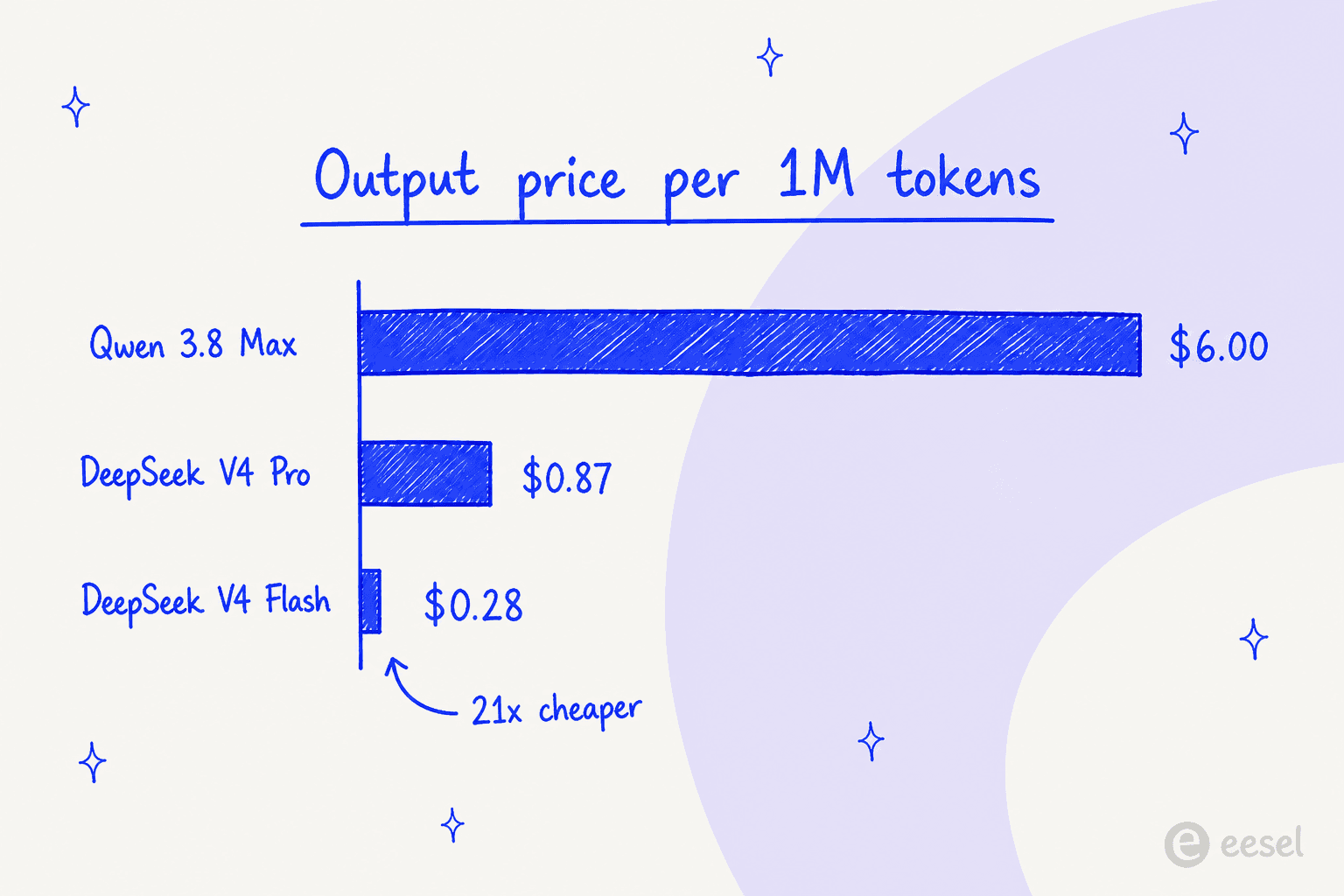
So, the first thing it hides. DeepSeek splits input pricing into cache-hit and cache-miss rates, and on Flash the gap is $0.0028 against $0.14, a 50x spread. Caching is on by default with no code change, which sounds like free money right up until you read how a hit gets decided.
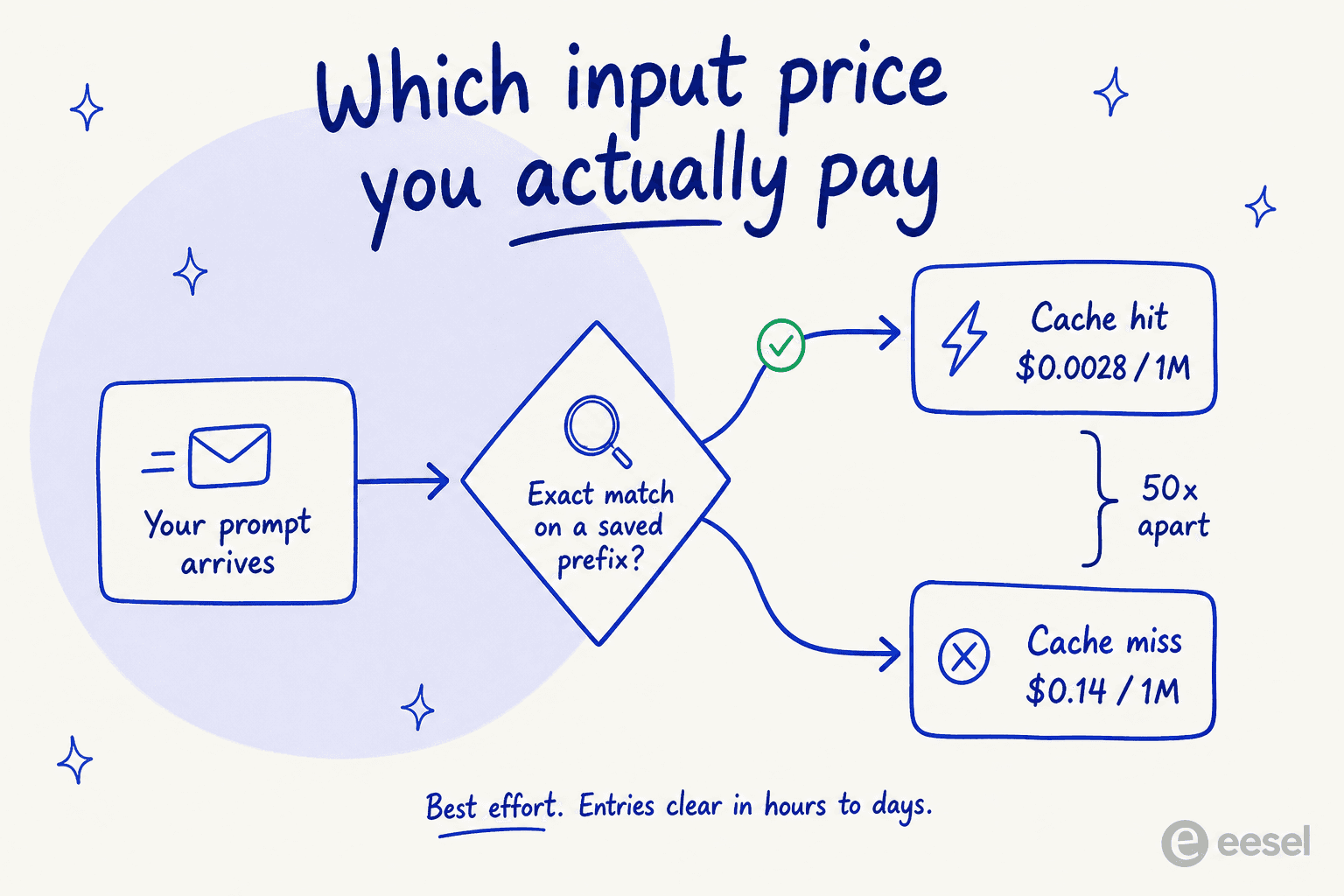
A request only bills at the hit rate if it fully matches a persisted cache prefix unit. Partial overlap does not count at all, which DeepSeek puts down to its sliding-window attention. DeepSeek calls the caching best-effort with no guaranteed hit rate, and unused entries clear "usually within a few hours to a few days." You can audit the split per call through prompt_cache_hit_tokens in the response, and you should do that, because the $0.0028 rate is not a steady state you can budget against.
The second thing it hides is which direction DeepSeek's next price move goes. There is no off-peak discount live today. Instead the price card announces that peak-hour prices "will be 2x the regular prices," applicable to all billing items, during 9:00 to 12:00 and 14:00 to 18:00 Beijing time. In UTC that is 01:00 to 04:00 and 06:00 to 10:00, daily. The effective date is unannounced, and there is no peak-rate table published either.
I have watched this exact anxiety play out on sales calls before. One buyer we spoke with had seen a prior vendor's price more than double and came in asking about contractual price locks before they would discuss anything else. A pending 2x with no start date is exactly the kind of line that makes a finance team refuse to standardise on a vendor, however good today's rate looks.
Benchmarks: whose table, run on whose harness
Both labs published numbers. Neither one ran the other's harness, so stacking the two tables on top of each other gives you a comparison that is not real.
DeepSeek's headline table for 0731 is nine agentic benchmarks, and Flash beats V4 Pro Preview on all nine while trailing Claude Opus 4.8 on all nine. Worth knowing that Opus has moved a generation further on since, which my Claude Opus 5 review covers:
| Benchmark | V4-Flash-0731 | V4-Flash Preview | V4-Pro Preview | Opus-4.8 |
|---|---|---|---|---|
| Terminal Bench 2.1 | 82.7 | 61.8 | 72.1 | 85.0 |
| NL2Repo | 54.2 | 39.4 | 38.5 | 69.7 |
| Cybergym | 76.7 | 38.7 | 52.7 | 83.1 |
| DeepSWE | 54.4 | 7.3 | 12.8 | 58.0 |
| Toolathlon-Verified | 70.3 | 49.7 | 55.9 | 76.2 |
| Agents' Last Exam | 25.2 | 15.8 | 16.5 | 25.7 |
| AutomationBench Public | 25.1 | 10.8 | 12.8 | 27.2 |
| DSBench-FullStack | 68.7 | 37.0 | 41.8 | 71.6 |
| DSBench-Hard | 59.6 | 25.8 | 31.1 | 71.7 |
Read the footnotes, they change how much weight those rows carry. DeepSeek's 0731 model card says the code-agent tasks ran in "the minimal mode of DeepSeek Harness (to be released)" at max reasoning effort, so the harness that produced these scores is not public and the numbers cannot be reproduced independently today. And two of the nine rows, DSBench-FullStack and DSBench-Hard, are DeepSeek's own internal test sets.
Alibaba's chart has the same shape of problem, only from the other side. Six of its coding benchmarks are in-house Qwen evals, and competitor scores came from mixed harnesses rather than identical conditions. Several rows are graded by rival models too. I walked through that chart properly in the Qwen 3.8 Max versus GPT-5.6 comparison.
The one place where a like-for-like number exists is inside DeepSeek's own cross-mode table, and honestly it is the most useful thing in this entire post:
| Benchmark | Flash non-think | Flash high | Flash max |
|---|---|---|---|
| HLE (Pass@1) | 8.1 | 29.4 | 34.8 |
| Apex (Pass@1) | 1.0 | 19.1 | 33.0 |
| LiveCodeBench (Pass@1) | 55.2 | 88.4 | 91.6 |
| GPQA Diamond (Pass@1) | 71.2 | 87.4 | 88.1 |
| MRCR 1M (MMR) | 37.5 | 76.9 | 78.7 |
Same weights, same price card. Three configurations. Non-thinking Flash scores 8.1 on HLE and 1.0 on Apex; at max effort it scores 34.8 and 33.0. Turning thinking off on this model is not a small trade, and turning it on means you pay for reasoning tokens at the output rate, with a 384K ceiling to fill. That is the sentence I would want anyone quoting the $0.28 figure to read first.
DeepSeek is also honest about where Flash loses to Pro, and I respect that. The model card states that Flash-Max reaches comparable reasoning performance given a bigger thinking budget but sits "slightly behind on pure knowledge tasks and the most complex agentic workflows." The numbers back it: SimpleQA-Verified is 34.1 for Flash Max against 57.9 for Pro Max. Thirteen billion active parameters is where world knowledge gets expensive, and that gap was measured on the preview, so nobody should be claiming 0731 closed it.
What the independent boards say, and where they disagree
This is where the easy version of this comparison falls over. There are two independent referees. They measure different things, and right now they are pointing in opposite directions.
Artificial Analysis scores DeepSeek V4 Flash at max effort with an Intelligence Index of 50, third among open-weights models, at a cost per task of $0.03. The same board scores the non-reasoning variant of the same weights at 29. So my earlier point is not only DeepSeek's internal table talking: an outside lab measured a 21-point intelligence swing between the cheap configuration and the good one.
Artificial Analysis also flags one thing that cuts against the price story. Flash burned 210M output tokens to complete the Intelligence Index against a class median of 100M, which the board describes in its own words as "very verbose in comparison". The whole run still only cost $72.02, so cheap tokens absorbed the verbosity here. But the mechanism here is the one I flagged on Qwen's defaults, and it turns out the model with the measured verbosity problem is the cheap one. This is the number I wish more AI coding tool comparisons published, because verbosity is the thing that turns a rate card into a bill.
As for Qwen on that board: it is not on it. Qwen 3.8 Max has no Artificial Analysis score as of August 3, 2026, one day after GA. The highest Alibaba row is Qwen3.7 Max at 46. Anyone who quotes an independent intelligence number for Qwen 3.8 Max this week is quoting the wrong model.
LMArena, which is human preference voting rather than automated evals, tells you the reverse story:
| Board | Qwen 3.8 Max | DeepSeek V4 Flash |
|---|---|---|
| Text, overall rank | #5 | #79 |
| Text Elo | 1496 ± 10 | 1436 ± 4 (48,667 votes) |
| WebDev | #4, 1668 | #8, 1577 (as -high) |
| Vision | #2, 1305 | Not eligible |
Sixty Elo points and seventy-four rank places, in favour of the model costing 21x more. Two caveats first, before anyone screenshots that table. Qwen's WebDev and Text rows are tagged Preliminary with the widest confidence intervals on the board, ±18 on only 1,563 votes, against Flash's ±4 on 48,667. And plain deepseek-v4-flash is missing from WebDev entirely, so that row is comparing Qwen against Flash's -high variant.
So the scoreboard reads like this: the automated composite likes Flash and has not measured Qwen, while humans prefer Qwen by a wide margin on thin data. That same automated-versus-human split showed up in my GPT-5.6 versus Claude comparison, and it is why I do not trust a single-number verdict on any of these launches.
Where these two are not really competing
Strip the price out and a different picture shows up. These two sit in different quadrants, and the search query that brought you here flattens that difference.
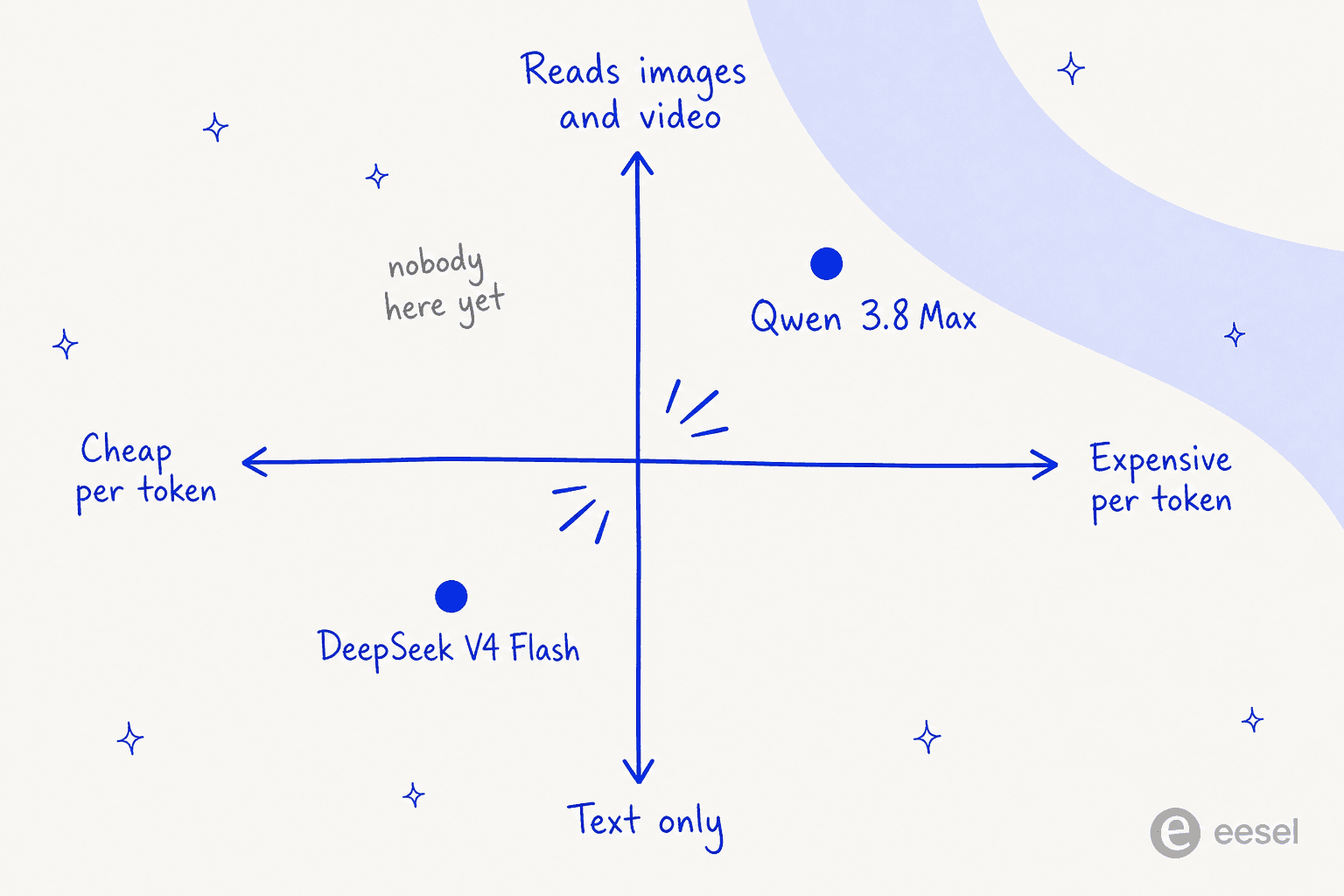
DeepSeek publishes no image, video, audio or document input for V4 Flash. Its config declares a causal language model with no vision encoder block, and the Hugging Face pipeline tag is text generation. The feature row on the price card lists JSON output, tool calls and FIM, with no file-input row anywhere. DeepSeek's multimodal work lives in separate model lines on the same org. To be precise about it, no image input is documented, and that is not the same thing as a statement that it cannot.
So if your inputs include screenshots, that decides it for you. A support queue where customers attach photos of a broken product, an AI agent reading Confluence pages with embedded diagrams, a workflow parsing scanned invoices. On Alibaba's own chart, every vision row is a clean Qwen win, and that capability is not on the board for Flash at any price. It is the same split I keep hitting when teams evaluate a best LLM for customer support: the cheapest token rarely reads the attachment.
If your inputs are text and you want the weights, Flash decides it just as quickly. MIT license, 167GB, 57 community quantizations, and DeepSeek's own vLLM and SGLang recipes published. Qwen 3.8 Max cannot be self-hosted at all right now, which is the whole argument in my open-source AI agents roundup, and the reason I would not treat these two as interchangeable backends for the same no-code AI support agent.
What the reaction actually says
Nobody has published a same-prompt, side-by-side hands-on of these two yet, which is no surprise when one of them is only hours old. What does exist is arithmetic, and the sharpest version came from a Japanese AI account on GA day, laying the DeepSWE scores next to each other in one X post: Qwen 3.8 Max at 56.6, DeepSeek V4 Flash at 54.4, Kimi K3 at 69, GLM 5.2 at 44. Two points of DeepSWE, at 14x the input price and 21x the output price.
The receipts that people posted unprompted in the DeepSeek launch thread are the most concrete cost data anywhere in the reaction:
"I use deepseek for a lot of my personal day-to-day agent needs, and I will simply put this here and let this speak for itself, last 30 days:

A reply topped it with 2.1 billion tokens across 12 days for $19.27, crediting what they called the "120x cheaper input cache" and admitting that most of that traffic was experimental loops producing rubbish.
On the Qwen side, the strongest hands-on report is not about quality at all. It is about getting the thing to finish:
"Claude finished in around 16 min, but I spent close to 2 hours shepherding the Qwen build. For the implementation, there were signs it had good vision, but the timeouts make this very hard to use in a production setting."
Simon Willison's pelican test landed in the same place, with a price attached: per his HN comment, it took 11 minutes, forgot the wheels, and cost 17 cents. Note also the reply pushing back that the timeouts were the harness and not the model, a fair correction that has not been settled either way.
The scepticism cuts both ways, and the same account that did the DeepSWE arithmetic was blunt about Flash's jump twelve days earlier: DeepSWE going from 7.3 to 54.4 on unchanged weights invited a benchmaxxing suspicion, given how poorly the model had scored when that benchmark was new. Worth holding onto that, because a re-post-train producing a 47-point swing is either a real training result or a fitted one, and there is no public harness to tell you which.
Two Flash complaints repeat often enough to count as findings. The first one is reliability under compression:
"DeepSeek V4 hallucinates like crazy and often forgets explicitly mentioned parts of the context. I guess compressing tokens and cherry-picking attention comes at a cost."
Artificial Analysis puts a number next to that: Flash's AA-Omniscience hallucination rate is 84%, which is a 12-point improvement on its predecessor and still a high number in absolute terms.
The second one is about where the tokens go, and for anyone in support this is the one that actually decides it:
"The model is fantastic. And costs almost nothing. The only problem I see is that they will train on your data. There are zero-data-retention providers of DeepSeek models [...] But these are 3x to 5x more expensive than directly using DeepSeek."
If you are routing customer tickets, then the first-party rate is not the rate you get to use. Paying 3x to 5x for zero data retention moves Flash from $0.28 output to somewhere around $0.84 to $1.40, which is a different conversation from the one the price card starts.
Which one I would build on
For high-volume text work where you can measure output quality yourself, DeepSeek V4 Flash. The price is real, the weights are MIT, the 2,500 concurrency ceiling is five times Pro's, and the 384K output limit is the most under-discussed spec on either card. Run it at high effort rather than low, and budget for the reasoning tokens rather than the sticker rate. Treat the cache-hit rate as a hope instead of a line item.
For anything where the input is not plain text, Qwen 3.8 Max, and not reluctantly. Multimodal at frontier scale is a category Flash is not in, and $6 per million output tokens is a normal price for that. Its human-preference lead is the strongest argument for paying 21x, and the honest caveat is that this lead currently rests on 1,563 votes, with no independent intelligence score behind it yet.
What would move me between them is one number neither lab publishes: how many attempts each model needs on your work. Flash at $0.28 that retries three times costs more than Qwen at $6.00 that lands first. Before I picked, I would push a few hundred of my own real inputs through both, at matched reasoning effort, and then count the retries. That is a weekend of work, and it beats every leaderboard in this post.
For a support queue specifically, my honest answer is that this comparison is the wrong axis. Both models can produce a fluent reply to a ticket. Neither knows your refund window, and neither will escalate when it is unsure. Neither one has read the 4,000 tickets your team already answered either. That last part is a retrieval problem, not a model-choice problem, and it is why AI hallucination prevention is a product feature rather than a model spec.
I hear the downstream version of this constantly: one buyer burned through 200 interactions in a single test day and immediately started worrying about per-interaction costs at 9,000 a month. Their problem was never really the token rate. It was that nothing in the setup told them whether the answers were right, which is the real variable in any AI customer service cost model, and the reason I track AI ticket resolution rate instead.
Try eesel for support work
eesel AI is deliberately model-agnostic, because the winning model changes every three weeks and the layer around it is what you actually own. It trains on your past tickets and your help center rather than a generic crawl, and it holds a confidence threshold so an unsure answer becomes a helpdesk handoff instead of a guess. And it simulates against your historical tickets before it answers a live customer.
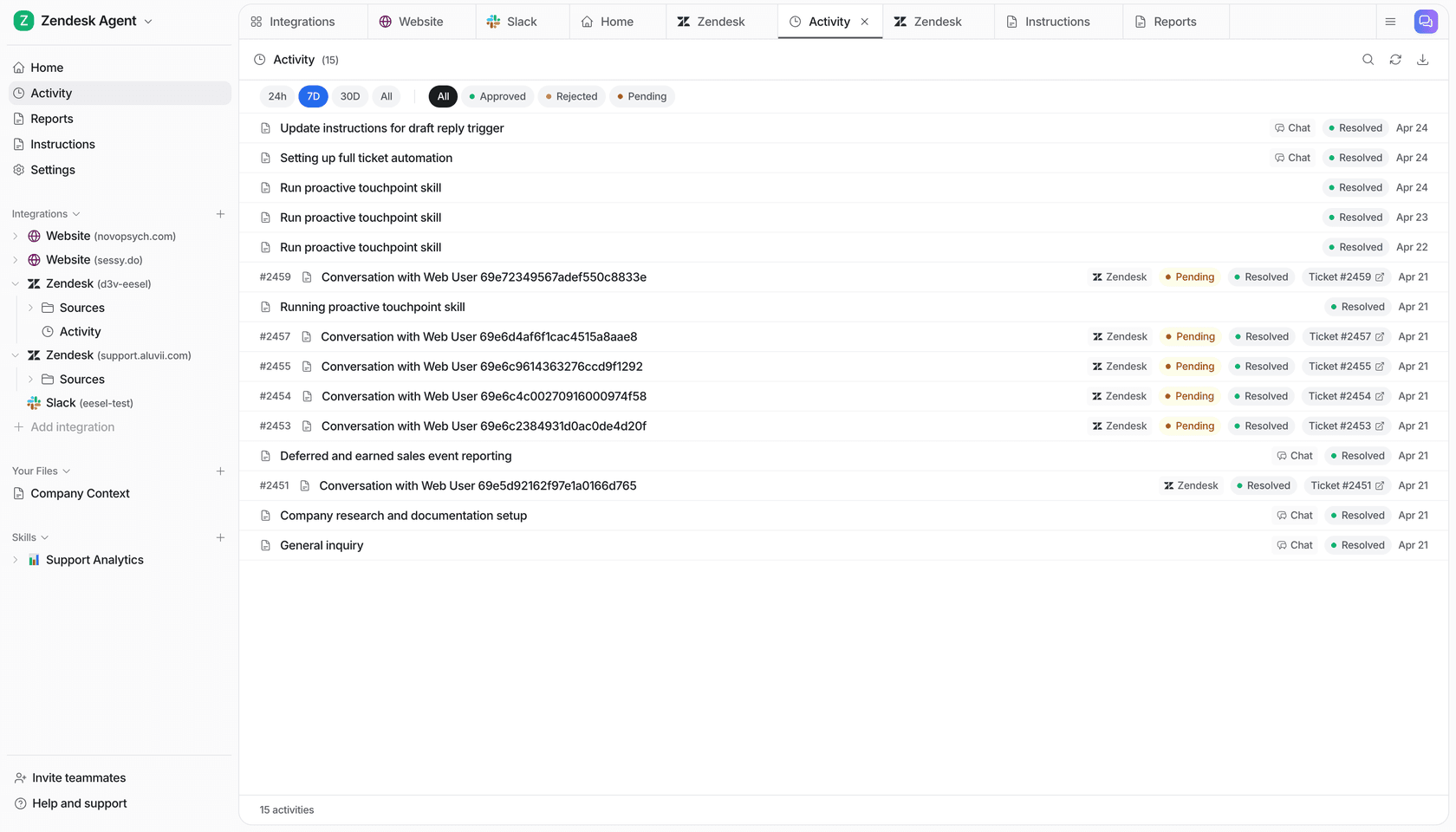
That simulation step exists because of the vehicle-brand story at the top of this post. If you are evaluating Qwen or DeepSeek for an actual support ticket automation job, the first question worth answering is not which token is cheaper. It is what your resolution rate looks like on your own tickets, before a customer sees any of it.
It plugs straight into the helpdesk you already run, Zendesk included, and it is free to try on your own queue.
Frequently Asked Questions
Is DeepSeek V4 Flash cheaper than Qwen 3.8 Max?
Which is better, Qwen 3.8 Max or DeepSeek V4 Flash?
Does DeepSeek V4 Flash have open weights?
What is the context window on Qwen 3.8 Max vs DeepSeek V4 Flash?
Can DeepSeek V4 Flash read images like Qwen 3.8 Max?
How much does DeepSeek V4 Flash cost to run at scale?
Can I use Qwen 3.8 Max or DeepSeek V4 Flash for customer support?


Article by
Alicia Kirana Utomo
Kira is a writer at eesel AI with a Computer Science background and over a year of hands-on experience evaluating AI-powered customer service tools. She focuses on breaking down how helpdesk platforms and AI agents actually work so that support teams can make better buying decisions.