

The price card, side by side
Both models live on one page, which makes for an unusually clean comparison. Same vendor, same card, same day.
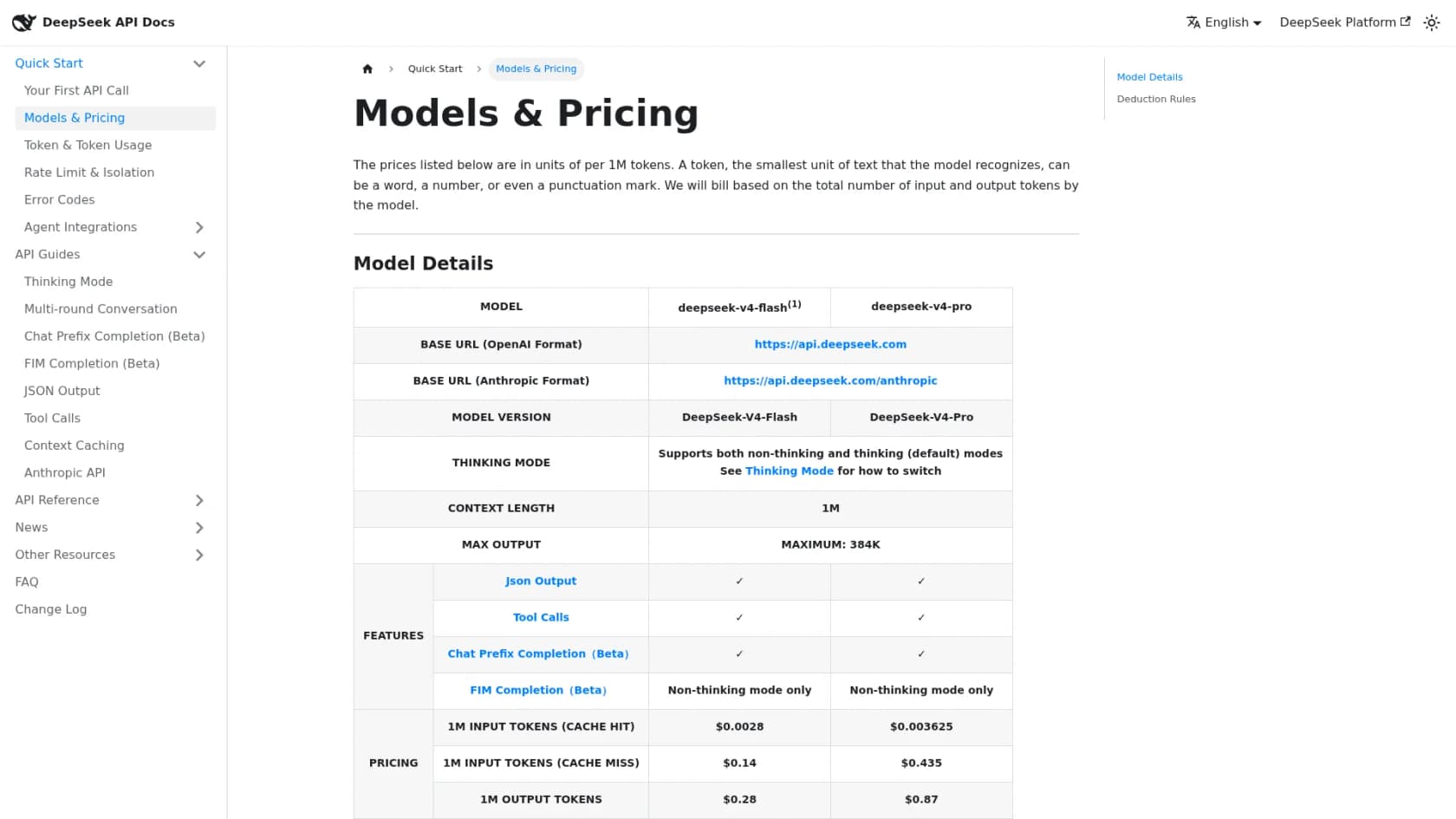
| Billing item (per 1M tokens) | deepseek-v4-flash | deepseek-v4-pro | Pro / Flash |
|---|---|---|---|
| Input, cache hit | $0.0028 | $0.003625 | 1.29x |
| Input, cache miss | $0.14 | $0.435 | 3.11x |
| Output | $0.28 | $0.87 | 3.11x |
Two things are worth to notice before the benchmarks arrive. The ratio is not uniform, for one: Pro is 3.11x Flash on the rates you pay most of the time, but only 1.29x on cache hits. Then there is the cache rate itself. Flash's cache-hit price is a 50x discount against its own cache-miss price, and caching is on by default with no code change needed. Artificial Analysis called that ~98% cache-hit discount more aggressive than the 90% most of the industry offers.
The catch is that a request only bills at the hit rate when it fully matches a persisted cache prefix unit. Partial overlap does not count, which DeepSeek attributes to its sliding-window attention. Caching is documented as best-effort too, and unused entries clear within hours to days, so treat the cheap rate as a discount you sometimes get and not a rate you can plan around.
One more line on the card changes the arithmetic. DeepSeek says the API will soon adopt peak-hour pricing at 2x regular rates, during 9:00–12:00 and 14:00–18:00 Beijing Time, daily. No effective date is published anywhere. Today's numbers are the regular rates, not a discount window.
Same window, different brain
The specs that usually separate a cheap tier from an expensive one are identical here.
| Spec | V4 Flash | V4 Pro |
|---|---|---|
| Total parameters | 284B | 1.6T |
| Active parameters | 13B | 49B |
| Context length | 1M | 1M |
| Max output | 384K | 384K |
| Thinking mode | On by default | On by default |
| Concurrency limit | 2,500 | 500 |
| Responses API | Yes | Not yet |
Both are Mixture-of-Experts models pre-trained on more than 32T tokens. They share the same hybrid attention design (Compressed Sparse Attention plus Heavily Compressed Attention), and also the same Manifold-Constrained Hyper-Connections and Muon optimizer. The 1M window is real in the config rather than in the marketing: max_position_embeddings reads 1048576, which is reached by YaRN-extending a 64K-trained window 16x.
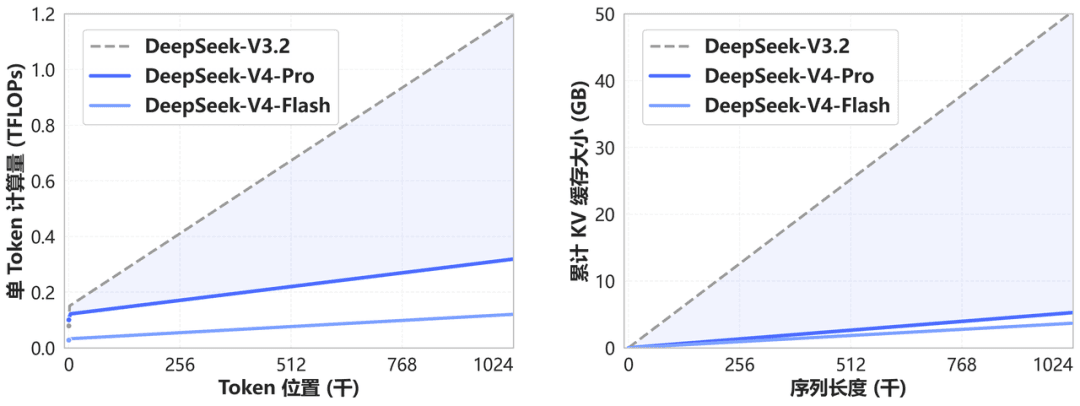
So buying Pro does not buy you a bigger window, it buys 3.8x the active parameters. The distinction matters here, because active parameters mostly buy recall, and recall is exactly the place where these two diverge. If the idea of a smaller model holding its own is new to you, our small language models explainer covers the general case.
Image input is documented on neither model. The pipeline tag on both Hugging Face repos says text generation, the config declares DeepseekV4ForCausalLM with no vision encoder anywhere in it, and the feature row on the price card lists JSON output, tool calls and FIM without any vision row. DeepSeek's multimodal work sits in a separate model line. One developer building an agent wired a second model in specifically to cover vision and web search.
Work out what each tier actually costs you
That 3.11x price ratio only holds if both models emit the same number of tokens, which they do not. Artificial Analysis flags Flash as verbose: it generated 210M output tokens to complete the Intelligence Index, against a class median of 100M. Reasoning tokens bill at the output rate, so verbosity turns into a real line item.
Which raises the useful question. How much more talkative would Flash have to get before Pro becomes the cheaper choice? Plug your own numbers in.
The number to take away is this. On output tokens alone, Flash has to be more than 3.11x as verbose as Pro before Pro comes out cheaper. AA's measured gap against the class median is about 2.1x. Input tokens make it harder still, since most workloads are input-heavy and Flash's input rate is a third of Pro's. In practice Flash wins on cost by a distance verbosity does not close.
Worth to calibrate what any of this means in business terms, though. Even Pro's rate is a rounding error next to a salary, and the interesting comparison for a support team is AI versus a human agent, not Flash versus Pro.
The benchmark inversion
Here is the part that surprised people. On 2026-07-31 DeepSeek shipped DeepSeek-V4-Flash-0731, which it says kept the same architecture and size and was only re-post-trained. So, same 284B/13B, new post-training. The published agentic table:
| Benchmark | Flash 0731 | Flash Preview | Pro Preview | GLM-5.2 | Opus 4.8 |
|---|---|---|---|---|---|
| Terminal Bench 2.1 | 82.7 | 61.8 | 72.1 | 81.0 | 85.0 |
| NL2Repo | 54.2 | 39.4 | 38.5 | 48.9 | 69.7 |
| Cybergym | 76.7 | 38.7 | 52.7 | – | 83.1 |
| DeepSWE | 54.4 | 7.3 | 12.8 | 46.2 | 58.0 |
| Toolathlon-Verified | 70.3 | 49.7 | 55.9 | 59.9 | 76.2 |
| Agents' Last Exam | 25.2 | 15.8 | 16.5 | 23.8 | 25.7 |
| AutomationBench Public | 25.1 | 10.8 | 12.8 | 12.9 | 27.2 |
| DSBench-FullStack † | 68.7 | 37.0 | 41.8 | 61.8 | 71.6 |
| DSBench-Hard † | 59.6 | 25.8 | 31.1 | 54.5 | 71.7 |
Flash 0731 beats the Pro build on all nine rows, and trails Claude Opus 4.8 on all nine. The same small-tier-beats-big-tier question is live at other labs too, worth to flag, and it usually resolves the other way: our Opus 5 against Sonnet 5 comparison found the expensive tier winning on cost per task, not only on quality.
Two caveats DeepSeek prints itself, and I will repeat them. The † rows are internal test sets. And the code-agent runs used DeepSeek's own harness, which is not released, so nobody can reproduce these independently yet. One X analyst put the fair reading plainly:
"DeepSeek is launching a very cheap, very capable coding-agent Flash model that looks surprisingly close to Claude Opus 4.8, especially considering it's the lightweight model. That said, this is DeepSeek's own benchmark selection, so it's naturally designed to highlight its strengths."
The independent board agrees on the direction. Artificial Analysis scored Flash 0731 at 50 on its Intelligence Index, which is six points ahead of DeepSeek V4 Pro at 44. Cost per task: $0.03 for Flash, $0.05 for Pro.
A DeepSWE jump from 7.3 to 54.4 on an unchanged weights shape does invite suspicion, and at least one prominent Japanese AI account said so directly. The previous score was so weak that the rebound reads to them like benchmark-targeting. Fair thing to hold in mind, which is also why the independent index number matters more here than the vendor table does.
Where Pro still wins
DeepSeek's preview-era cross-mode table is the only place either model is measured at matched reasoning effort, and it is where the Pro case lives.
| Benchmark (max effort) | Flash | Pro | Gap |
|---|---|---|---|
| SimpleQA-Verified | 34.1 | 57.9 | +23.8 |
| Chinese-SimpleQA | 78.9 | 84.4 | +5.5 |
| BrowseComp | 73.2 | 83.4 | +10.2 |
| MRCR 1M | 78.7 | 83.5 | +4.8 |
| GDPval-AA (Elo) | 1395 | 1554 | +159 |
| MMLU-Pro | 86.2 | 87.5 | +1.3 |
| LiveCodeBench | 91.6 | 93.5 | +1.9 |
The recall gap is the one that should decide anything. A 23.8-point spread on SimpleQA-Verified is no rounding difference, and it is exactly what 13B active parameters costs you. DeepSeek says as much in its own words, describing Flash as slightly behind on pure knowledge tasks and the most complex agentic workflows, then scoping its parity claim to simple agent tasks.
Long-context retrieval leans the same way. Both models advertise 1M, but MRCR 1M runs 83.5 on Pro against 78.7 on Flash, so the window is the same size while the needle-finding is not. If your workload is "stuff a huge corpus in and ask precise questions about it", that is Pro's territory. It is also the workload where RAG rather than raw context usually wins outright, and fine-tuning is the third option people reach for, which our custom AI models piece covers.
Two asterisks matter on that table. These numbers are preview-build Flash, from before the 0731 rebuild, and DeepSeek has not republished any knowledge benchmark table for 0731, so I cannot tell you whether the SimpleQA gap survived it. Then on human preference, LMArena still ranks deepseek-v4-pro at 1458±4 above deepseek-v4-flash at 1436±4, on roughly 49,000 votes each. The automated index and the human votes point in opposite directions here, which is a good reason to not ship a single-number verdict.
The reasoning-effort trap
If I were about to move spend between the two, this is the section I would read first. It is not intuitive, and it is not on the price card either. DeepSeek publishes a requested-to-actual effort mapping:
| You request | Flash serves | Pro serves |
|---|---|---|
low | low | high |
high | high | high |
xhigh | high | max |
max | max | max |
Read the Pro column one more time. There is no cheap setting on Pro, since a low request gets served at high, so you pay 3.11x the token rate and you cannot dial the reasoning budget down to compensate for it. Flash has the opposite quirk, where xhigh silently downgrades to high, so touching that parameter buys nothing above high. DeepSeek says the Pro mapping is due for an update in early August 2026.
Thinking is on by default on both of them, at effort high, and reasoning tokens bill at the output rate. There is no separate -thinking model string, it is a parameter on the same alias. Turning it off is not a small trade, either. Non-thinking Flash scores 8.1 on HLE and 1.0 on Apex, against 34.8 and 33.0 at max. So if you want the cheap configuration you are choosing a materially different model, which is the lesson our LLM optimization guide keeps landing on.
Two sampling gotchas while you are in there. In thinking mode temperature, top_p, presence_penalty and frequency_penalty are all unsupported, and setting them raises no error, it just does nothing at all. Also, if the model performed a tool call, you must pass reasoning_content back on every subsequent turn.
Operational differences that decide it
Price and benchmarks get the headlines. These are the things that actually decide the choice on a real deployment.
- Concurrency. Flash allows 2,500 concurrent requests and Pro allows 500. DeepSeek publishes no RPM or TPM limit at all, so concurrency is the whole rate-limit model, counted per account regardless of the key, returning HTTP 429 above the cap. For anything fan-out shaped that 5x is decisive.
- Responses API. Supported on Flash only, and DeepSeek says Pro support arrives in early August 2026. The 0731 build is also adapted specifically for Codex.
- Open weights. Flash ships MIT-licensed at ~167GB mixed FP4/FP8, with 8 finetunes and 57 quantizations already published, plus a DSpark speculative-decoding module baked into the same checkpoint. Pro has no public checkpoint of its own. If licensing is what brought you here, open-source chatbot platforms gives the wider view.
- Versioning. The Flash alias auto-tracks the newest build, which means a benchmark quoting "DeepSeek V4 Flash" may not be the model you get. One developer's complaint about the suffix is worth to heed here: pin
-0731whenever you cite anything.

What developers actually report
The most useful explanation of why the small model wins on agentic work came from a team that tested both, then went looking for the reason:
"DeepSeek V4 Flash is the most cost effective model we've tested. We had to really understand why it outperformed DeepSeek V4 Pro (although even on unreliable model cards, Flash was very close to Pro). Pro is slower and smarter in one-shot reasoning problems, but less effective with tools and therefore less performant in long horizon agentic tasks (especially with custom tools it was not trained on)."

Smarter one-shot, worse with tools. It matches the benchmark split almost exactly, and it is the cleanest mental model I have found for choosing between these two.
On what people actually spend, here are two unprompted receipts from the launch thread:
"I use deepseek for a lot of my personal day-to-day agent needs, and I will simply put this here and let this speak for itself, last 30 days:
Someone running both tiers for a fortnight reported paying about $1.50 a day for Pro, and put the gap at "~50% more expensive than Flash". That is noticeably narrower than the card's 3.11x, which is what heavy cache hits plus a lower Pro token count will do to a real bill. Their other note is the one I would underline, though: both tiers need babysitting, small tasks, fresh sessions and manual sanity checks.
The negatives are specific, and they repeat. Hallucination and dropped context come up often:
"DeepSeek V4 hallucinates like crazy and often forgets explicitly mentioned parts of the context. I guess compressing tokens and cherry-picking attention comes at a cost."
Artificial Analysis measures the same thing from the other side. Flash 0731's AA-Omniscience hallucination rate is 84%, a 12-point improvement on its predecessor, driven by fewer hallucinations rather than by higher accuracy. And the objection dominating every DeepSeek thread is not about quality at all:
"The model is fantastic. And costs almost nothing. The only problem I see is that they will train on your data. There are zero-data-retention providers of DeepSeek models, of which I have used openrouter (with zdr guardrails), and fireworks. But these are 3x to 5x more expensive than directly using DeepSeek, possibly due to poor caching."
That last point quietly rewrites the whole comparison for anybody handling customer data. At a zero-data-retention provider, Flash's $0.28 output becomes roughly $0.84–1.40, which lands on top of Pro's first-party rate. The Flash-vs-Pro price gap only exists on the first-party API, and the first-party API is the one you cannot point at a support inbox. That is the point where most teams stop shopping for tokens and start shopping for customer service automation that handles the retention question for them.
What this changes if you point it at a support queue
I ship integrations and model plumbing at eesel, so this is the question I get asked the most. Which model should sit behind the AI agent? After three-plus years of running AI on live support queues, my honest answer is that the tier choice sits somewhere around fifth on the list of things deciding whether it works.
Here is evidence from our own data instead of a benchmark. In a cross-validated trial on real Zendesk traffic, 284 chats plus a 100-ticket manual check at a European e-commerce team, the AI hit 93% triage accuracy and 100% spam detection with zero false positives on the 22% of the inbox that was spam. Draft quality came out directionally right 88% of the time. But only 12% of drafts went out as-is, with a 7% factual error rate. When we dug into why agents rewrote the rest: about 65% was length and tone, about 20% needed data the AI was not connected to, and only around 5% was the model being wrong.
That 65/20/5 split is the whole argument. Four-fifths of the quality gap was fixable by connecting more systems and by training on the team's own sent replies, and a bigger model does neither of those for you. The worst failures we have seen were not intelligence failures at all, either. We have had paying customers whose bot fabricated answers when knowledge-base retrieval returned nothing, one of them inventing subscription details for a live customer. The fix there was a hard fallback on retrieval failure, which is a pipeline decision and not a parameter count.
So if the choice between these two is for support ticket automation: pick Flash, spend the money you saved on connecting your real data sources, then put a proper escalation path behind it.
A few things move the resolution number further than any tier upgrade will, in roughly this order. Getting ticket classification right first, so that the AI is only answering what it should be. Then building a real agent handoff path for everything else. And training on your own data, specifically your team's sent replies, which our trial data said would take as-is draft adoption from 12% toward 30–40% on its own.
Then there is the constraint sitting above all of that. DeepSeek's first-party API is where the cheap rates live, and it is also where your tickets become training data, so for customer conversations you are realistically pricing a zero-data-retention provider instead. Which changes the shortlist, and our AI customer service solutions overview makes a better starting point than a token rate card does. Whichever way you go, improving resolution rate stays a data problem long before it becomes a model problem.
Try eesel
Want the cheap-model economics without betting your inbox on somebody's benchmark? eesel plugs into the helpdesk you already run and learns from your past tickets and help centre. The part that matters for this post: it lets you simulate the agent against your own historical tickets before a single customer sees it. You get back a real resolution rate, plus a real list of what it would have got wrong, on your data and in your tone, whichever model happens to be winning this month. Free to try, and priced per resolved ticket rather than per seat.
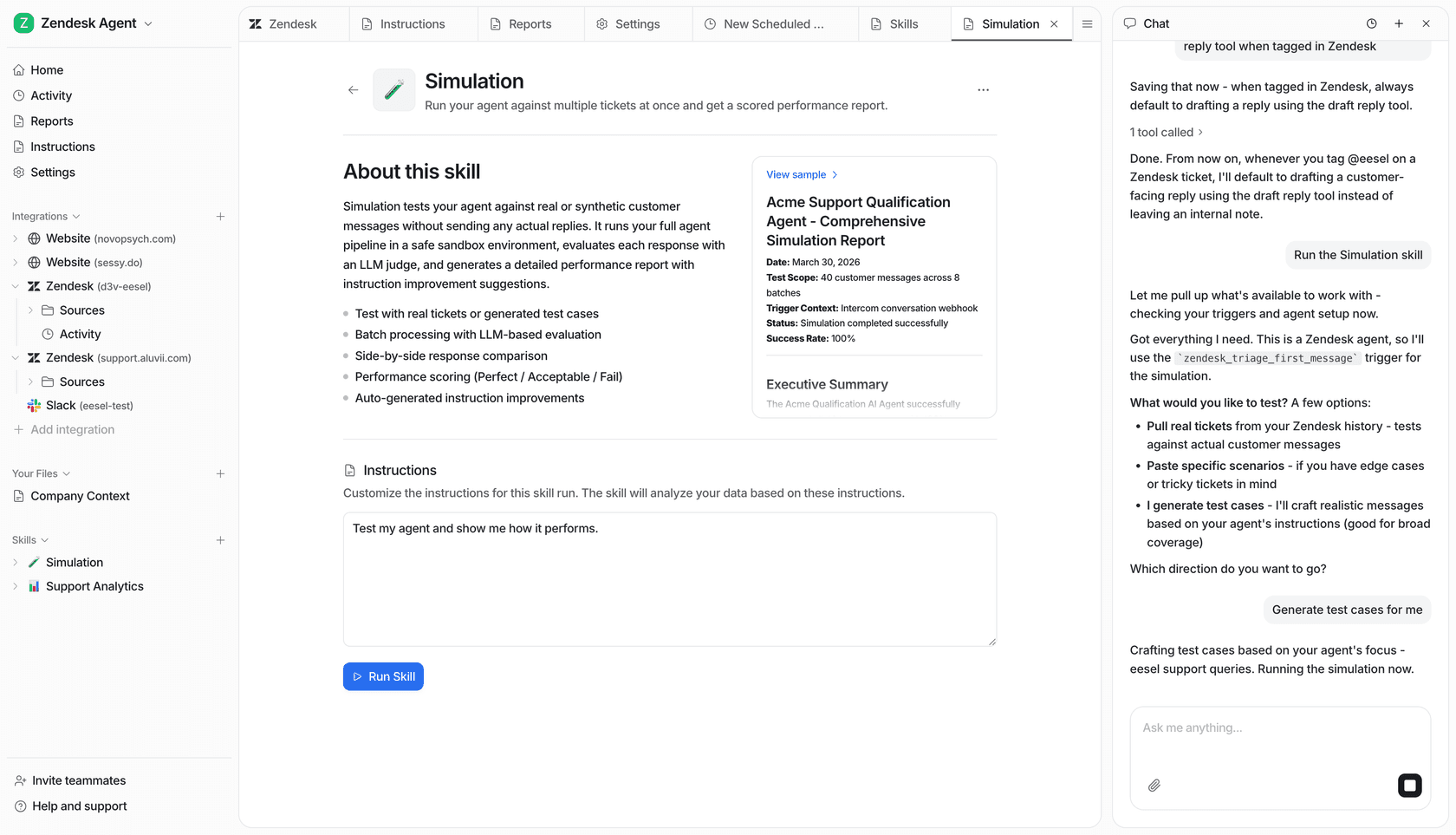
That simulation habit exists because of scars, not because of marketing. We have watched confident-sounding bots give wrong answers, and running the rollout against historical tickets first is the only thing catching it before a customer does. If you want the wider field before deciding, our best AI agents roundup and the best AI helpdesk software list are two places to start.
Which one I would pick
For agentic and coding work in August 2026: Flash, without hesitating. It is 3.11x cheaper on the rates you actually pay. It beats Pro on every agentic row DeepSeek publishes, scores six points higher on the independent index, carries 5x the concurrency, and it is the only one of the two with open weights plus Responses API support. There is no version of this comparison where Pro wins on agentic work today.
For factual recall, precise retrieval over a very large context, or anything where being confidently wrong gets expensive: Pro, and check whether you should be on Claude Opus 5 or GPT-5.6 instead. That SimpleQA gap is large enough that "just use the cheap one" is bad advice on knowledge work, and Pro's own edge over the Western frontier models on that axis is not obvious.
Timing is the wildcard. DeepSeek says the V4-Pro refresh is coming, and the same re-post-training that took Flash's DeepSWE score from 7.3 to 54.4 has not been applied to Pro yet. One commenter asked the obvious question out loud. If this is a twelve-month commitment rather than a this-sprint call, that is the event to watch for.
Worth to price this against the rest of the field while you are here. Qwen 3.8 Max lands at $2/$6 and Kimi K3 at $3/$15, so both of them sit well above DeepSeek on every meter.
If you want the head-to-heads rather than the rate cards, I have run Qwen against Flash directly, plus Qwen against Kimi and Qwen against GPT-5.6.
Coming from the previous generation, our DeepSeek V3.2 write-up carries the upgrade context, and Qwen 3.7 Flash is the closest cheap-tier rival to it. For the harness layer sitting on top of whichever model you pick, see best AI coding assistants.
Frequently Asked Questions
What is the difference between DeepSeek V4 Flash and V4 Pro?
Is DeepSeek V4 Flash better than V4 Pro?
How much does DeepSeek V4 Pro cost compared to Flash?
Does DeepSeek V4 Flash have open weights?
Which DeepSeek model is best for a customer support agent?
Can I run DeepSeek V4 Pro at low reasoning effort to save money?
low request on Pro is served at high, so the cheap setting does not exist on that tier. On Flash, low really is low and xhigh is served as high. DeepSeek says the Pro mapping is due to change in early August 2026.Is DeepSeek V4 Flash pricing about to change?


Article by
Rama Adi Nugraha
Rama is a software engineer at eesel AI with two years of experience writing about B2B SaaS, AI tools, and customer support technology. Based in Bali, Indonesia, he brings a developer's perspective to product comparisons — cutting through marketing copy to what the integrations and APIs actually do.