


I read both system cards before writing any of this, and the thing I keep coming back to is that the second dollar buys very little for most people. Claude Fable 5 costs exactly double Claude Opus 5, on every line of the price sheet. Anthropic's own docs tell you to start with Opus 5, stepping up to Fable 5 only for the workloads that need the highest available capability. Unusual advice, that, from a vendor talking about its own flagship. The numbers back it up though.
There is a handful of coding benchmarks where Fable 5 still comes out on top, though the margins there sit under one point. On the agentic ones Opus 5 wins by double digits: 43.3 against 33.8 on FrontierBench. Then 70.6 against 66.1 on OSWorld 2.0, and also 26.0 against 17.4 on Zapier's AutomationBench. Sharpest number of the lot: Opus 5 at high effort scored 1606 on AA-Briefcase at $10.41 per task, which beats Fable 5's 1574 at $22.30.
Which model, it turns out, is the smaller question. The effort level is the real one. Opus 5 at max costs more per task than Opus 4.8 does, while the same model at high effort undercuts the flagship by half. And for anyone pointing either of these at a support queue, forget the benchmark rank for a second: the 50% hallucination rate Artificial Analysis measured on Opus 5 is the figure that should worry you.
The two models, side by side
My job at eesel is building integrations and APIs, so with any new model release the first thing I open is the spec table. The launch video comes later, if at all. Want the plain-English version first? Start with what Fable 5 is, then the rundown of Fable 5 capabilities. Below is what the models overview actually publishes for these two.
| Spec | Claude Fable 5 | Claude Opus 5 |
|---|---|---|
| Claude API model ID | claude-fable-5 | claude-opus-5 |
| AWS Bedrock ID | anthropic.claude-fable-5 | anthropic.claude-opus-5 |
| Context window | 1M tokens | 1M tokens |
| Max output | 128k tokens | 128k tokens |
| Input price / MTok | $10 | $5 |
| Output price / MTok | $50 | $25 |
| Batch input / output | $5 / $25 | $2.50 / $12.50 |
| Adaptive thinking | Yes, always on | Yes |
| Comparative latency | Slower | Moderate |
| Reliable knowledge cutoff | Jan 2026 | May 2026 |
| Batch API extended output | Not supported | Up to 300k tokens |
| Generally available | June 9, 2026 | July 24, 2026 |
Two rows in there deserve a second look.
First one is the knowledge cutoff. Fable 5's reliable cutoff sits at January 2026, four months older than the May 2026 on Opus 5. So the flagship is the model walking around with the staler head. Ask either of them about something that happened this year and the cheaper one has simply read more of it.
Second, the batch row. On the Message Batches API Opus 5 supports up to 300k output tokens, sitting behind the output-300k-2026-03-24 beta header, and Fable 5 is just absent from that list entirely. Strange gap, for a model marketed at long-form generation jobs.
Price: double on every line
No clever structure to unpick here. Across input and output, and across cache writes and cache reads too, Anthropic set Fable 5 at exactly 2x Opus 5.
| Model | Base input | 5m cache write | Cache read | Output |
|---|---|---|---|---|
| Claude Fable 5 | $10 | $12.50 | $1 | $50 |
| Claude Opus 5 | $5 | $6.25 | $0.50 | $25 |
| Claude Opus 4.8 | $5 | $6.25 | $0.50 | $25 |
| Claude Sonnet 5 (to Aug 31, 2026) | $2 | $2.50 | $0.20 | $10 |
| Claude Haiku 4.5 | $1 | $1.25 | $0.10 | $5 |
All of those figures come from Anthropic's pricing page. A few things get buried on that page, and they will change your bill:
- Neither model charges a long-context premium. A 900k-token request bills at the same per-token rate as a 9k one. A generation ago that was not the case.
- Opus 5's minimum cacheable prefix is 512 tokens, joint-lowest in the lineup along with Fable 5. Which means short system prompts that could never get cached on Opus 4.5 now can.
- Fast mode on Opus 5 is $10/$50, the exact per-token price of standard Fable 5, and what it buys is around 2.5x the default speed. Worth a second look, that fork. Same money either way, and the choice in front of you is speed against the flagship.
- On subscriptions, Pro gets Fable 5 through usage credits, while Max 5x and 20x get it at 50% of weekly limits. In practice you burn the Fable allowance twice as fast, and that matters when you are budgeting off Claude Pro pricing instead of the API sheet.
Both Claude flagships live at the expensive end of the frontier tier. From OpenAI the closest comparable is GPT-5.3 Codex pricing. Google's equivalent sits over at Gemini 3 pricing. Down at the cheap end the open-weight challenger is Kimi K2.5.
Plug your own volumes into this. The ratio stays 2:1 whatever you type in, though the absolute gap only starts to sting once you are past a certain scale.
Where Fable 5 still wins
Let me be fair to Fable for a moment. The launch coverage flipped from "state of the art" to "why would you" in roughly six weeks, and neither of those framings is right.
Per the table in Anthropic's own Opus 5 system card, Fable 5 holds the lead on four things:
- SWE-bench Pro: 80, against 79.2 on Opus 5
- DeepSWE v1.1: 69.7 against Opus 5's 68.8
- FrontierCode 1.1 main set: 53.5, with Opus 5 on 53.4
- Humanity's Last Exam, no tools: 56.5, and 56.3 for Opus 5
Two more advantages exist that no benchmark table will show you. On AA-Omniscience, Artificial Analysis found Opus 5 carrying lower factual knowledge than Fable 5, and puts that down to size class. Then there is the LMArena text leaderboard, where claude-fable-5 sits at rank 1 on an Elo of 1507 across 14,646 votes. Opus 5 does not show up there at all, since the snapshot predates its release. Blind human preference and benchmark intelligence are two different things, and the human one belongs to Fable right now.
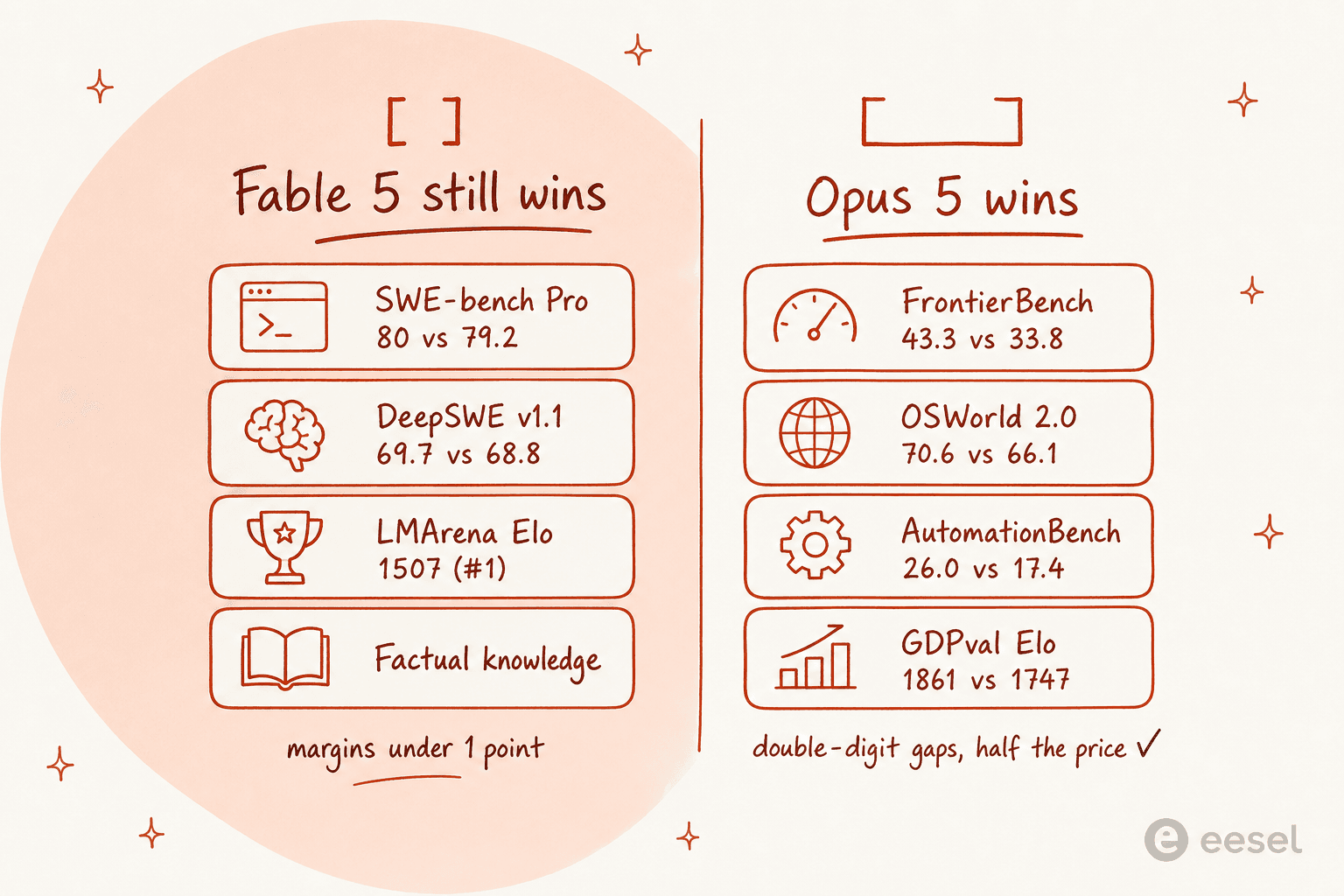
Put the left column and the right column next to each other, though. Decimal places, that is what Fable's leads are made of. Opus 5's are whole numbers.
One more thing Fable owns outright, and it happens to be the pitch Anthropic actually makes for it: multi-day autonomous work. An agent harness is how the product page describes running it, with the model working for days at a time, planning across stages and handing work down to sub-agents. Cursor's line on this is that Fable 5 opened up "a class of long-horizon problems that were out of reach for earlier models." A week-long migration that you hand off and then review at the end is a real category of work, and Fable is built for exactly that.
In practice that shape of work happens in an agent harness rather than a single chat window. Most of the time the delegation is being done by Claude Code subagents. Running it on Anthropic's own infrastructure instead? Then your surface is managed agents. And a longer walkthrough of multi-agent systems is sitting there too, if that is the road you are on.
Where Opus 5 wins, and it isn't close
Anything with an agent loop in it goes the other way entirely. It is the category that matters most if you live inside an agentic coding CLI, or inside any of the current AI coding assistants.
| Evaluation | Claude Opus 5 | Claude Fable 5 | Gap |
|---|---|---|---|
| FrontierBench v0.1 | 43.3 | 33.8 | +9.5 |
| OSWorld 2.0 (computer use) | 70.6 | 66.1 | +4.5 |
| AutomationBench | 26.0 | 17.4 | +8.6 |
| GDPval-AA v2 (Elo) | 1861 | 1747 | +114 |
| AA-Briefcase (Elo) | 1720 | 1574 | +146 |
| SWE-bench Multimodal | 59.4 | 54.1 | +5.3 |
| SWE-bench Multilingual | 89.5 | 86.6 | +2.9 |
| BrowseComp | 90.8 | 87.4 | +3.4 |
All of those figures come from the system card. Of the charts, FrontierBench is the one worth sitting with for a minute, since it plots the whole effort ladder instead of one single point.
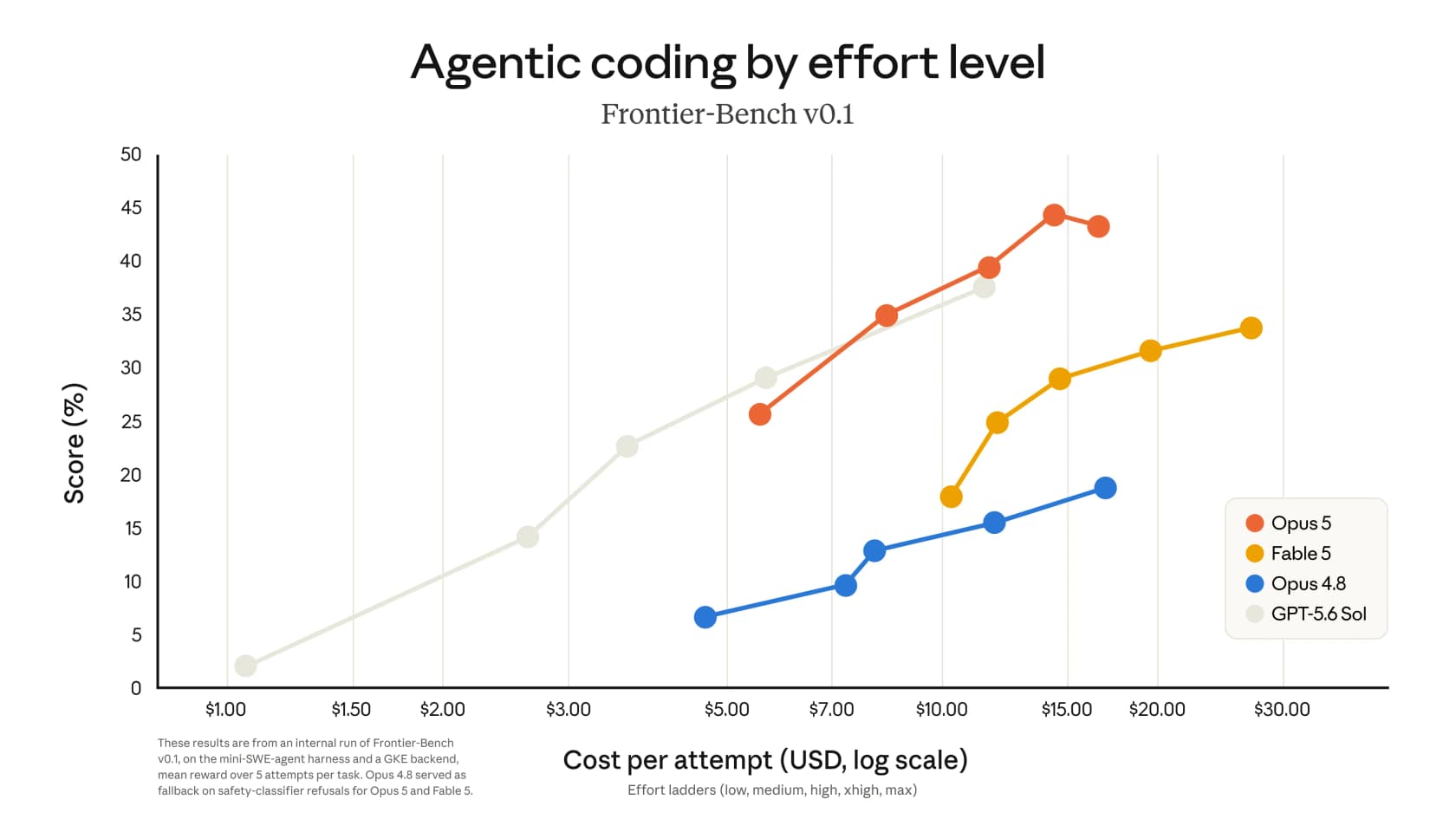
The entire Opus 5 curve sits above and to the left of Fable's. Its cheapest point on that chart scores about the same as Fable's most expensive one, which is quite a thing to sit and look at. Anthropic's own phrasing on OSWorld is blunter: Opus 5 surpasses Fable 5's best result at just over a third of the cost.
I have run this same head-to-head against the other labs too. Google's flagship gets covered in Gemini 3 Pro against Opus. For OpenAI's coding model, the same treatment lives over in GPT-5.3 Codex against Opus.
A small irony hides in the partner quotes. Cognition, at Fable's June launch, called it the highest-scoring model on FrontierBench. Six weeks on and the same company's line in the Opus 5 post is that it "approaches Fable-level performance at half the cost." Both statements were true on the day they were written. That is the speed this tier is moving at.
The Zapier comment is the one I would put in front of a finance team. Opus 5 topped AutomationBench without spending more tokens than the prior Claude models, and it hit 100% on the churn-prevention workflow that previous models had failed outright.
The effort dial is the actual decision
Almost every comparison misses this part. It is also where I would spend your attention.
Artificial Analysis benchmarks each of Opus 5's five effort settings as its own separate model, for the simple reason that they behave like separate models. Across GDPval-AA v2 those effort levels span 407 Elo points, and output token usage ranges around 8x going from low up to max. So "Claude Opus 5" is really five performance profiles wearing one name.
| Model / setting | AA-Briefcase Elo | Cost per task | Minutes per task |
|---|---|---|---|
| Claude Opus 5 (max) | 1720 | $17.79 | 36.2 |
| Claude Opus 5 (xhigh) | 1693 | $14.26 | 34.3 |
| Claude Opus 5 (high) | 1606 | $10.41 | 25.7 |
| Claude Fable 5 | 1574 | $22.30 | – |
| Claude Opus 5 (medium) | 1470 | – | – |
| Claude Opus 5 (low) | 1223 | – | – |
Every figure there comes from Artificial Analysis's AA-Briefcase run. That high row is the whole argument: 32 Elo better than the flagship, and at 47% of the price.
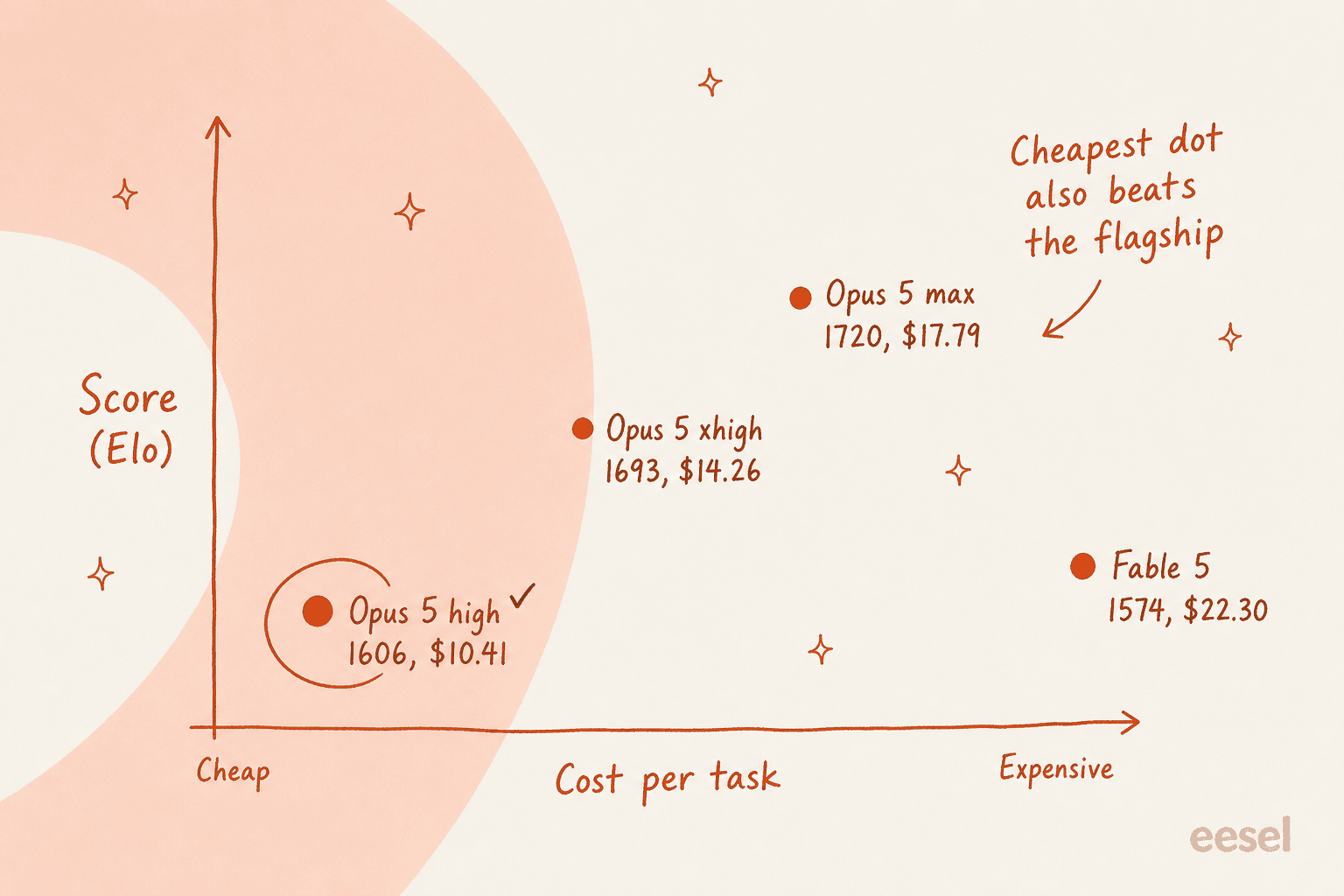
The trap runs the other way as well. At max effort, one Intelligence Index task on Opus 5 costs $2.03, against $1.80 for Opus 4.8 and $1.53 for Sonnet 5. So it lands 26% cheaper per task than Fable while being more expensive per task than its own predecessor. Set the effort to max and then forget about it, and what you have upgraded is mostly your bill. There is more on choosing per task in my guide to model selection.
Developers worked this out within days of launch. One of them ran a controlled A/B and published the raw numbers:
"Findings: At matched effort, Opus 5 spends roughly 2x the output tokens of 4.8."

Same sticker price, and a different bill at the end of the month. That gap is the most useful thing to internalise about this generation, and it applies to Fable as well.
Three things the benchmark tables don't show
The scores are the easy part of any model comparison. Everything below turned up while I was reading the docs instead of the leaderboards, and each one of them would move my answer further than a two-point benchmark gap ever would.
Fable's safeguards route your requests to other models
Of the differences between these two, this one gets discussed the least, and it carries a real operational cost.
Fable 5 ships with safeguards covering cybersecurity and biology, and any query that trips one gets routed off to a weaker model automatically. On the Fable 5 page Anthropic is specific about where they go: cybersecurity flags route to Opus 4.8, biology flags route to Opus 5. To handle that, API customers have to configure a Fallback API.
How often does it fire, though? On the FrontierBench run the system card recorded Fable's classifiers flagging 42% of API calls across 26% of trials. For Opus 5 the same figures were 5% of calls in 4% of trials.
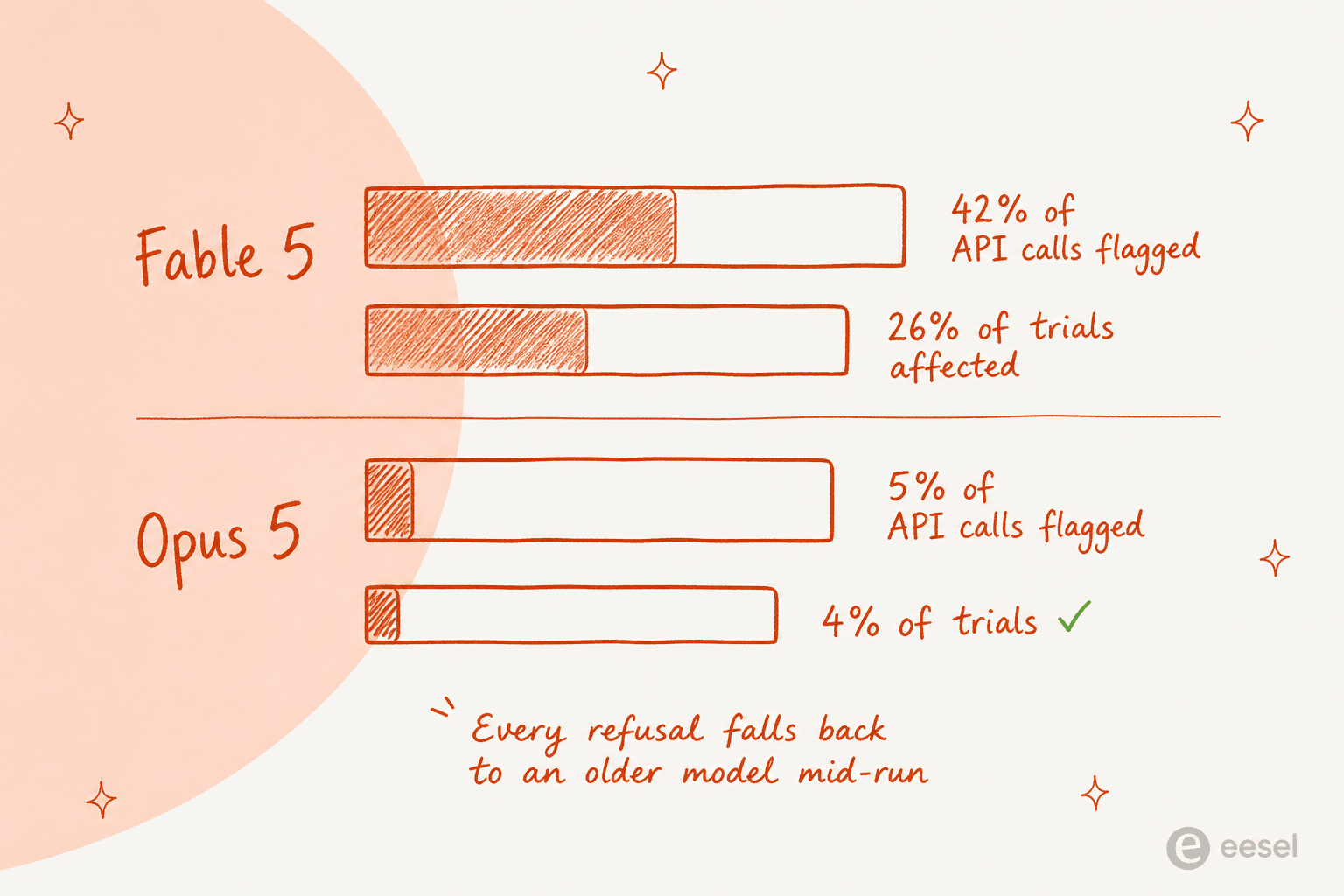
A fair caveat sits under that. Those figures come from a single benchmark inside the safety-sensitive domains the classifiers were built to target, so it is not general traffic. Anthropic also confirms you are not charged Fable prices on rerouted requests. Still, if your work touches security or biology at all, a meaningful slice of your flagship run is quietly getting served by something else. One of those somethings being the exact model you were choosing between.
Fable 5 went dark for nineteen days
Anthropic's own announcements block tells it plainly enough. Fable 5 launched June 9, 2026, then access got pulled on June 12, and it was restored on July 1.
At the time I wrote up the return in Fable 5 is back.
None of that says anything permanent about Fable's reliability, in my view. It does belong in the decision though, if you are about to make a top-tier model a hard dependency inside a production pipeline. Using Fable requires 30-day data retention for safety monitoring too, which is a compliance conversation that Opus 5 never forces on you.
Both are slow, and Opus 5 is slower than the marketing suggests
Artificial Analysis is not gentle on Opus 5 here. Its model page measured 52.6 output tokens per second where the class median is 76, plus 68.04 seconds to first token against a median of 2.81. Anthropic's own table puts Fable 5's latency at "Slower" and Opus 5's at "Moderate," so between the two Fable is the slower one.
That sixty-eight seconds to first token does include reasoning at max effort, and dropping the effort buys back very little: 52.8 t/s for xhigh, 56.8 t/s for high. Chat-latency models, neither of these. They are batch-and-background models, and pretending otherwise is how a feature ships that nobody is willing to wait for.
What developers actually say
On this pairing the community read is sharper than the launch coverage was, and the argument they are having is barely about the sticker price at all.
"Another way to ask the question, why is Opus half as expensive?"
The answer people keep landing on is a boring one. Probably right, too:
"I don't understand where this thought of pricing and performance must follow. Opus used to be triple the price. Doesn't mean Opus 4 is better than Opus 5. The cost to serve Fable is higher than the cost to serve Opus. It's that simple."
On subscriptions that gap widens well past 2:1, since Fable eats through a Max allowance at a completely different rate:
"working for about 3-5 hours drains 50% of my weekly 20x subscription using Fable 5 only. I have now been using Opus 5 only (since I'm out of Fable) for about 7 hours and it drained about 6% of my weekly usage. Meaning that you can do insane amounts of work with Opus 5 on 20x and I consider it unlimited. While Fable 5 is a sneeze."
Not everyone has been sold on Opus 5, and the complaints repeat consistently enough that I take them seriously. Scope creep in Claude Code is the recurring one:
"Opus versions since 4.6 have all had a fair amount of awkward, canned prose. But as Anthropic has increased the model's intelligence, it also seems to have made it more panicky, pedantic, and prone to scope creep. Opus 5 is the worst offender thus far for me [...] To me, its judgment feels strangely anxiety-shaped."
Which produced the most popular workaround I have come across, and it does not involve picking one model at all:
"/model switching mid-session. Fable in plan mode first — it reads the repo and writes out the plan, no code. Switch to Opus to implement, you can then optionally switch back to Fable to review the diff. Context carries over so nothing gets re-explained."
Fable plans, Opus grinds. Put Fable's orchestration strength next to Opus 5's price on the execution loop and that split defends itself better than either model does alone. Same logic sits behind running Opus in Claude Code for implementation and keeping the cheaper tiers on the mechanical passes.
The number that should worry you more than the rank
Capability is what every table above measures. This next number governs anything customer-facing.
On AA-Omniscience, Artificial Analysis found Opus 5's accuracy improved 7 points over Opus 4.8. It also answers more often when it is uncertain, and its hallucination rate rose 14 points, to 50%. So half its answers on that set are hallucinated. The accuracy gain got bought with more confident guessing.
For a coding agent with tests to run against it, confident guessing stays recoverable. For a bot talking to your customers it is the whole failure mode. From the support side I have watched this play out more than once. One team I worked with, a Danish B2B vehicle-telematics support group on Zendesk running about 200 tickets a month and scaling toward 2,000, hit it in the most ordinary way imaginable. Their knowledge base said they supported all vehicle models, so the bot went and cheerfully told customers it supported car brands that were nowhere in their database. Nothing was wrong with the model itself. The grounding was wrong, and the model was too confident to catch that.
Which is why a benchmark rank would never decide a support deployment for me. The deciding factors are what the model is allowed to see, and then what happens the moment it is unsure. That whole argument gets laid out properly in RAG vs LLM, while the failure modes live in my guide to AI hallucinations.
An Elo is not the metric worth watching. AI resolution rate set against cost per resolution is.
And for the high-volume, short-turn jobs that a support queue is actually made of, neither flagship is the right tool at all. Take ticket triage: a few hundred tokens go in, a label comes out, thousands of times a day.
Sonnet 5 comes out faster and cheaper at the same quality, with Haiku cheaper again.
So which should you run?
| If you are | Run | Why |
|---|---|---|
| Doing agentic coding day to day | Opus 5 at high or xhigh | Beats Fable on every agent benchmark, at 47% of the cost per task |
| Handing off a multi-day migration | Fable 5 | Built for long-horizon autonomous runs, and Cursor backs that up |
| Chasing the last point on SWE-bench Pro | Fable 5 | 80 against 79.2, and that is the whole prize |
| Running high-volume short tasks | Sonnet 5 or Haiku | Both flagships are overkill and too slow |
| Touching security or biology work | Opus 5 | Fable reroutes a large share of those calls anyway |
| Building anything customer-facing | Neither, on its own | Grounding and guardrails decide quality, not model tier |
| On a Max plan and out of Fable credits | Opus 5 | Fable drains a weekly allowance at a completely different rate |
My actual recommendation, short version: default to Opus 5 at high effort. Keep Fable 5 for the plan-and-review pass on work that really does run for days, and stop paying max-effort prices for tasks that never needed them.
More or less, that is also what Anthropic tells you to do. Their docs say to start with Claude Opus 5 and move up only when the highest available capability is what you need. It is not often a vendor talks you down from the expensive thing.
If your answer here turns out to be "neither," the options worth a look get rounded up in Claude alternatives. And for a non-developer team the surface matters more than the model does, which turns it into a Claude Cowork pricing question instead of this one.
Where eesel fits
Choosing between two models is what most of this post has been about. After years of watching eesel run AI on live support queues, the position I have landed on is that a support team should not have to make this choice in the first place.
An eesel AI teammate plugs into your helpdesk, trains on your own past tickets and your help center, and handles the model routing underneath all of it. Six weeks from now when the frontier moves again, and it will move, nothing in your setup has to change. The part you actually tune is the part that matters: what the AI is allowed to answer, and when it escalates to a human, plus how confident it has to be before it replies at all. Every rollout gets simulated against your historical tickets first, so what it would have said on real tickets is visible to you before a single customer sees it. That simulation step exists because of the "we support all models" problem above.

Reading a model comparison because you are trying to work out what to put on your support queue? Then that is the real question sitting underneath. My roundup of AI helpdesk software takes the wider view, while best LLM for support goes model by model.
You can try eesel free, or watch how it handles your tickets in a demo. Pricing is a fixed monthly credit plan (1 credit per ticket or chat, from $299 a month), so the effort-level trap in this post never applies.
Frequently Asked Questions
What is the difference between Claude Opus 5 and Claude Fable 5?
Is Claude Fable 5 worth twice the price of Opus 5?
How much does Claude Opus 5 cost compared to Fable 5?
Which Claude model is best for customer support?
Does Claude Opus 5 hallucinate more than Fable 5?
What effort level should I run Claude Opus 5 at?
Can I switch from Fable 5 to Opus 5 without changing my code?
xhigh or max effort while thinking is disabled. Test the swap on a real workload first, the same way you would with Claude Code subagents.