


Claude Duet costs $0 on top of a Claude Pro or Max plan, and you can't buy it any other way. Pro is $20 a month (or $200 a year), Max 5x is $100 and Max 20x is $200, per Claude's pricing page. It's US only, waitlist only, and not on Team or Enterprise yet.
The real price is your usage limit. Duet shares the same five-hour and weekly limits as your chats and Claude Code, and its background check-ins count even when you aren't using it. Light users will be fine on Pro. If you already hit Pro's cap, Max 5x is the realistic floor, and Max 20x is the cheapest per unit of usage at $10 per Pro-sized block.
If what you actually want is an agent for your support queue, a personal agent billed against one person's limit is the wrong meter. eesel prices its AI helpdesk teammate by the ticket, $299/month for 500 credits, and Cape Coffee Beans uses it for about 160 scheduled queue checks a month.
What does Claude Duet cost?
Anthropic opened the Claude Duet research preview on October 21, 2026. The pricing line in the help center is short: "During the research preview, Claude Duet is included with the Pro and Max plans at no extra cost."
I'm an engineer at eesel, and I spend my days building agents that run on a meter. The thing I've learned watching buyers is that the sticker is rarely what bites. One budget-conscious buyer I remember from a sales call had seen a previous vendor's price more than double, and the first thing they asked us for was a price lock. Duet doesn't have that risk on the sticker, because there isn't one. The risk sits one layer down, in how fast an always-on agent drains a shared allowance. If you want the product tour first, my Claude Duet overview covers what it does.
Here is every individual Claude plan and whether it gets you Duet.
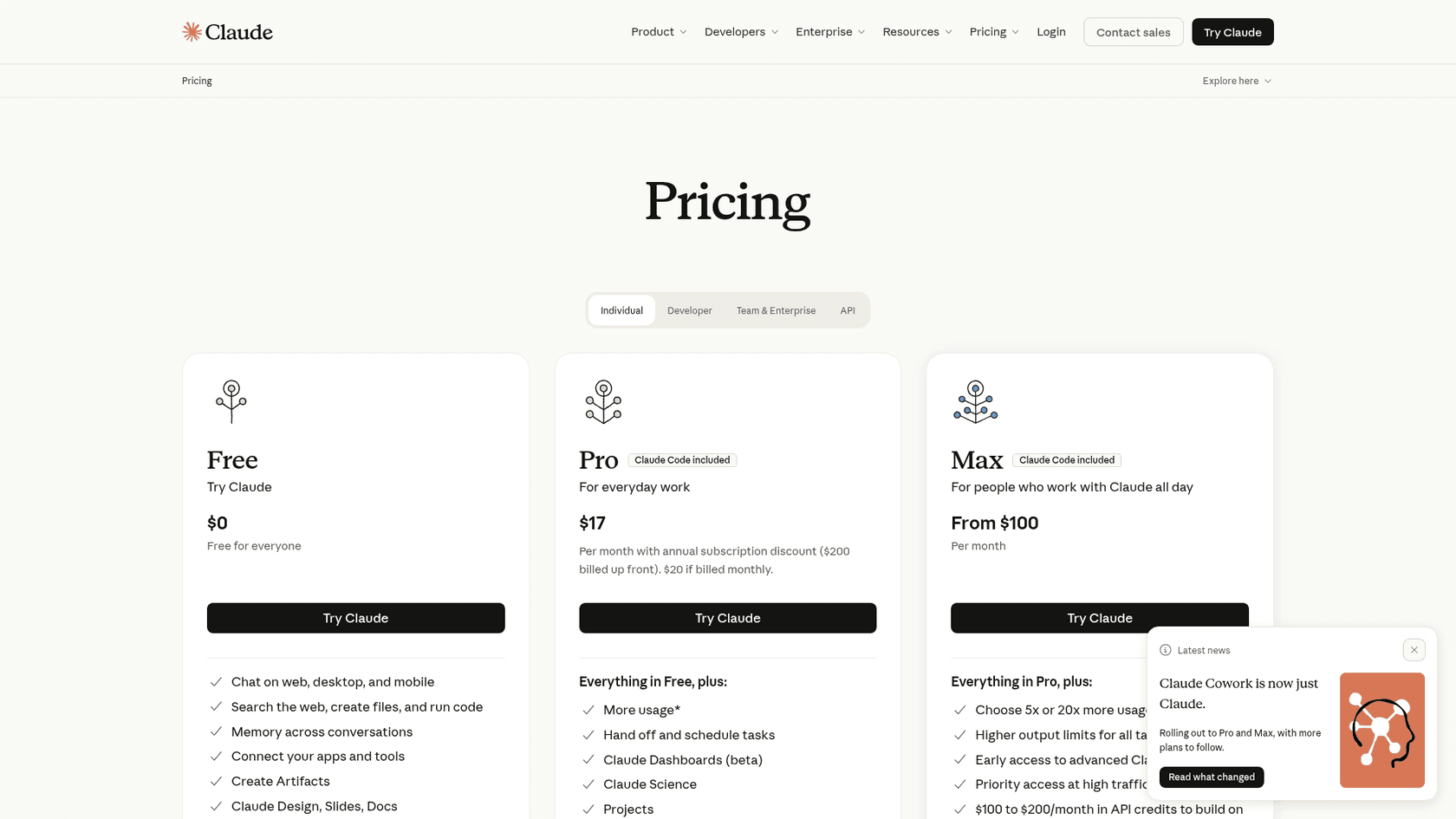
| Plan | Price | Billing | Usage vs Pro | Claude Duet |
|---|---|---|---|---|
| Free | $0 | n/a | Less than Pro | Not included |
| Pro | $20/month, or $17/month on annual ($200 up front) | Monthly or annual | 1x | Included, US only, waitlist |
| Max 5x | $100/month | Monthly only | 5x per session | Included, US only, waitlist |
| Max 20x | $200/month | Monthly only | 20x per session | Included, US only, waitlist |
| Team standard | $20/seat/month annual, $25 monthly | Monthly or annual | More than Pro | Not yet |
| Team premium | $100/seat/month annual, $125 monthly | Monthly or annual | 5x a standard seat | Not yet |
| Enterprise | $20/seat/month annual + usage at API rates, 20-seat minimum | Annual | Usage-based | Not yet |
Prices come from Claude's pricing page, the Max plan article and the Pro plan article. Max also now includes $100 or $200 a month in API credits for the Claude Platform, but those are for building apps, not for Duet.
A few details on that table are worth slowing down for:
- Max is monthly only. There's no annual discount on Max, so the only discounted way into Duet is annual Pro.
- App store prices can differ. The Max article notes the prices "are for web subscriptions only. Mobile pricing may vary depending on your app platform." Duet is a phone app, so subscribe on the web.
- There are no standing discounts. Anthropic says its support team "cannot issue one-off discounts or coupons" for Pro or Max.
Why is "no extra cost" only half the price?
Because Duet doesn't get its own budget. The help center says it "uses your plan's usage limits, including the five-hour session and weekly limits, at the same rate as chats in Claude." Every Claude surface draws from the same pool, per Anthropic's usage limits article: claude.ai, Claude Code and Claude Desktop all count.
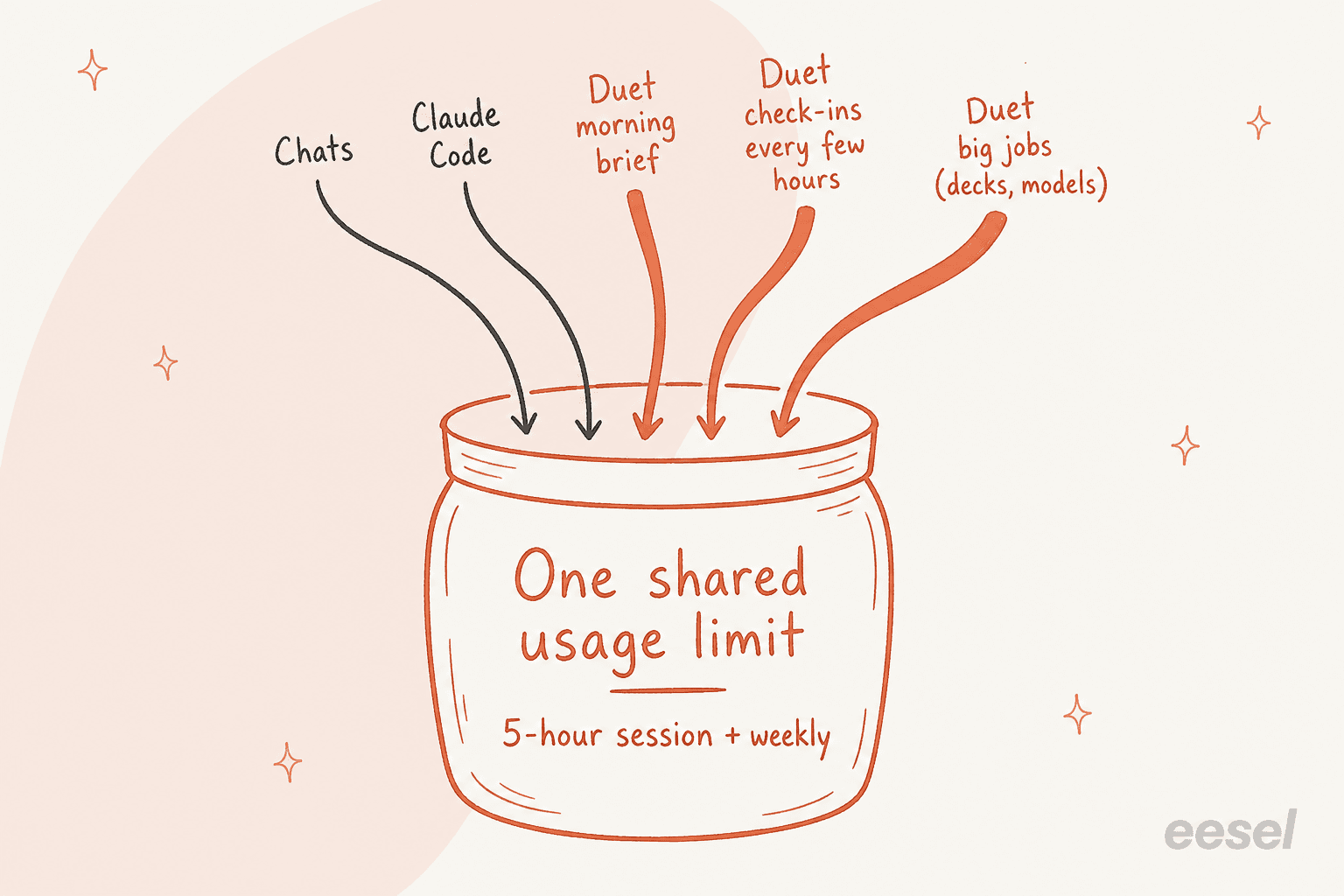
What makes Duet different from a chat is that three of those streams run without you typing anything:
- The morning brief. Each day it reads across your email and calendar and starts drafting.
- Check-ins every few hours. Anthropic is open about the trade: it "checks your connected accounts every few hours, because checking nonstop would use up your plan's limits much faster."
- Big jobs. Per the announcement, "larger tasks, like building a financial model or a deck, require more model turns and background work."
Two more things push usage up that you don't control. You can't pick the model: Duet runs on Claude Opus 5.5, the larger model, and "decides how much effort a job needs." And connectors are heavy. Anthropic's own limits article warns that "tools and connectors are token-intensive." Duet's whole value is connectors, with access to over 6,000 connectors and plugins in the Claude Marketplace.
What Anthropic hasn't published is how much of your limit one brief or one check-in uses. Nobody outside Anthropic can give you that number yet, so I'd be wary of anyone who does. The practical way to find out is to watch Settings > Usage for your first week.
That's exactly the worry on Hacker News under the launch:
"I'd not want precious tokens to be wasted by some random polling Duet may be doing, all while using Opus as its underlying agent."

And from a reader who had used a rival agent:
"I really have no interest in this if it's going to use my plan's regular limits. I have less control over the context window, if its going off task."
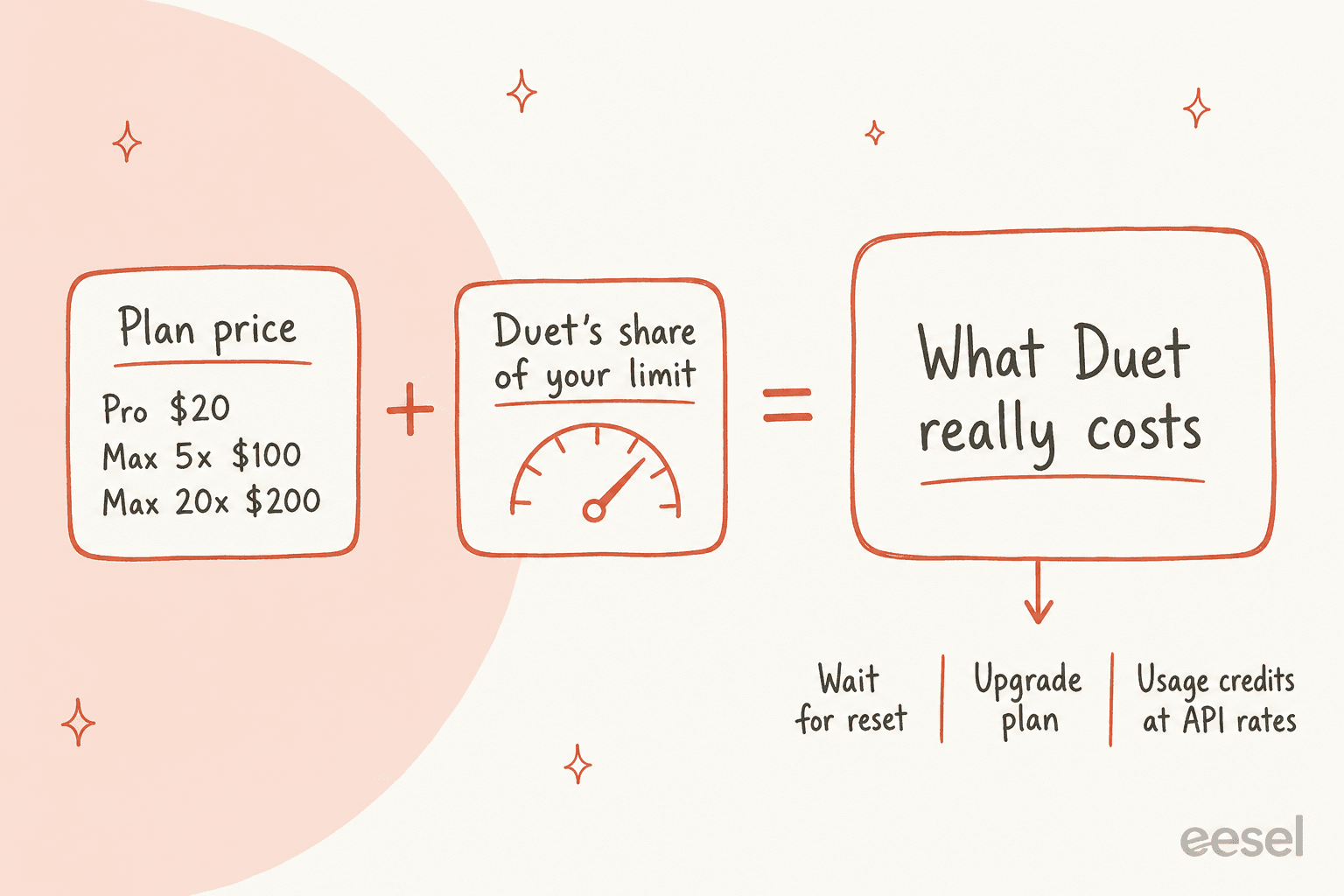
So the honest equation looks like this.
What happens when you run out?
You have three options once Duet and everything else have emptied the limit:
- Wait. The session limit resets every five hours. The weekly limit resets at a fixed day and time assigned to your account, which you can see in Settings > Usage.
- Upgrade. Moving from Pro to Max applies the new limits right away. On an annual Pro plan, leftover value becomes account credit toward Max, per the Max plan article.
- Turn on usage credits. This is Claude's pay-as-you-go overflow, billed "at standard API rates" on top of your subscription, per the usage credits article.
The third one is where a "free" agent can become a real line item. Opus 5.5 lists at $4 per million input tokens and $20 per million output tokens on the API price card. As a simple illustration of the rate, not a measurement of Duet: a job that reads 100,000 tokens of email and writes 5,000 tokens back would cost about $0.40 plus $0.10, so $0.50, at list price. My Anthropic API pricing and Opus 5.5 pricing posts go deeper on token math.
One caveat I'd flag before you rely on it: the usage credits article names Claude, Claude Code and Claude Cowork, and the Duet help center doesn't say whether Duet keeps working on credits. If you turn them on, set a monthly spend cap. You also have to enable credits on the web, since mobile subscribers "can only enable usage credits on the web version of Claude."
The free limit reset
Anthropic does soften the start. When you're admitted, you get "one full limit reset, which resets both your five-hour session and weekly limits," usable until November 30, 2026.
Two gotchas from the limit reset article: the "Reset for free" button "isn't currently available on Claude Mobile," so you redeem it on the web or in Claude Desktop, and "once you use it, you can't undo it." I'd hold it for your first heavy week, when you're testing Duet on a real deck or model, rather than burning it on day one.
Should you pick Pro or Max for Claude Duet?
Max is the same price per unit of usage as Pro until you reach Max 20x. That's the part most comparisons skip.
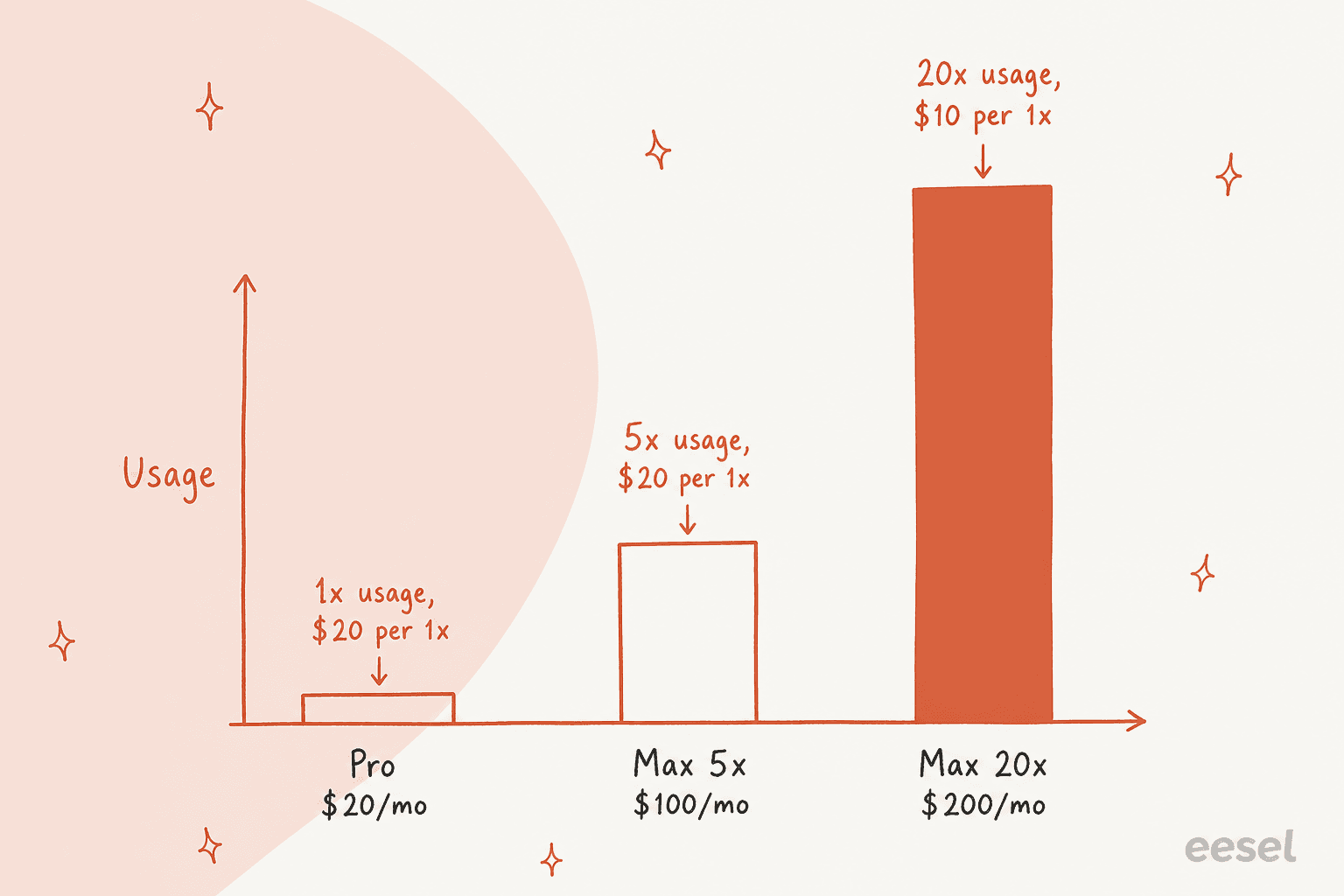
- Pro to Max 5x is five times the price for five times the per-session usage,
$20per Pro-sized block either way. You're not getting a bulk deal, you're buying headroom, plus priority access at busy times. - Max 20x is the only plan that halves the rate, at
$10per block. It only pays off if you'd really use 10x Pro or more.
Here's how I'd decide, based on how you use Claude today and what you'd hand to Duet.
Which Claude plan should you run Duet on?
Pick one answer in each row. Prices from claude.com/pricing, October 23, 2026.
1. How often do you hit Claude's limits today?
2. What would you hand to Duet?
One pattern I'd avoid: upgrading to Max on day one "for Duet" before you've seen what it costs you. You get a free full reset when you're admitted. Use that first week on Pro as your measurement window.
How does Claude Duet pricing compare to OpenAI Dots and Meta Muse?
On sticker price, Duet is the cheapest way into a frontier-model personal agent right now. OpenAI Dots starts on ChatGPT Pro from $100 a month, and Meta Muse is free to start with paid tiers that weren't priced at launch.
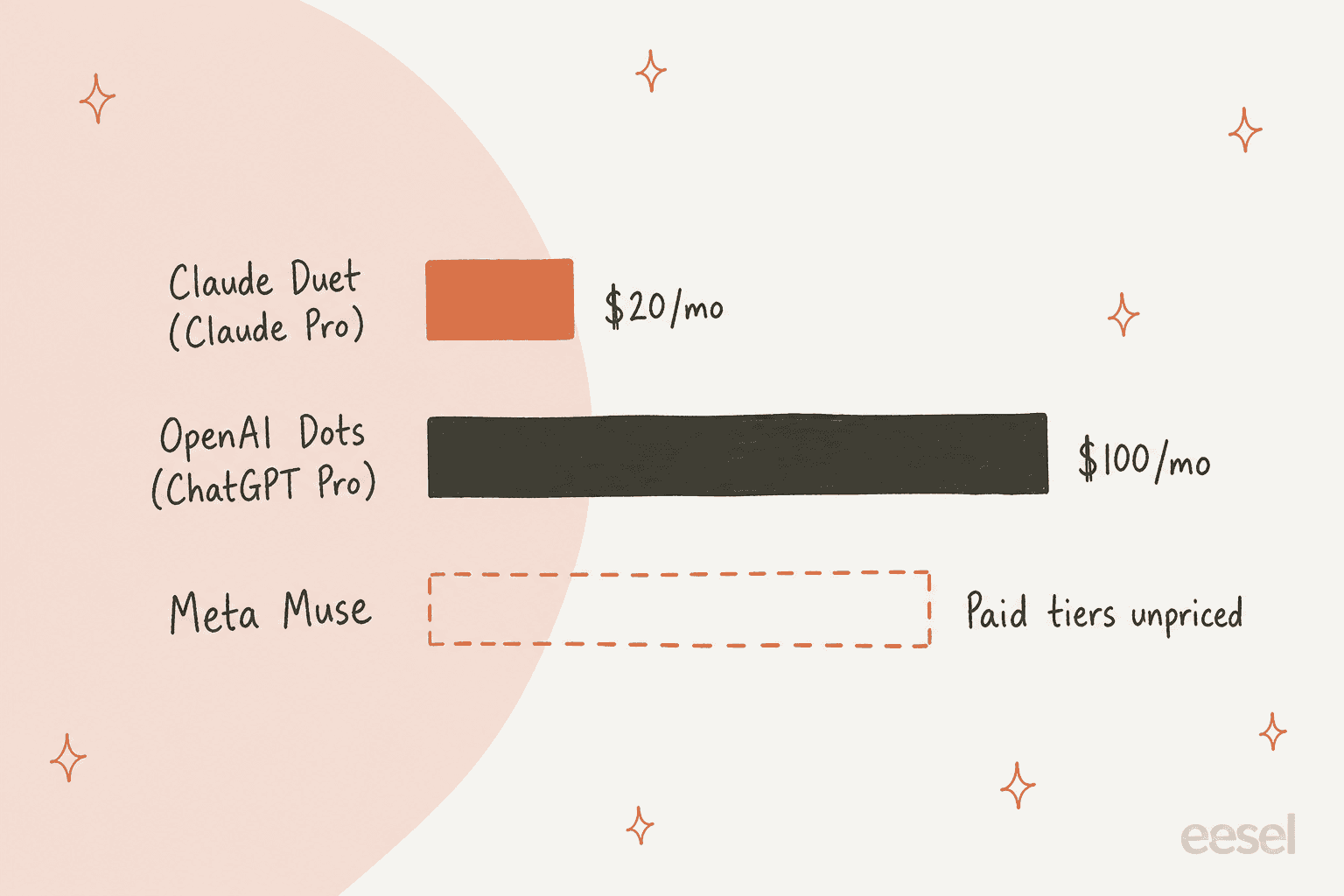
| Claude Duet | OpenAI Dots | Meta Muse | |
|---|---|---|---|
| Cheapest plan that includes it | Claude Pro, $20/month | ChatGPT Pro, from $100/month | Free to start |
| How usage is metered | Shared Claude five-hour and weekly limits | Covered in my Dots pricing post | Covered in my Muse pricing post |
| Model | Claude Opus 5.5, no choice | GPT-6 Astra | Muse Spark 1.3 |
| Team plans | Not yet | Business Premium | Consumer only |
Dots and Muse details are from my earlier write-ups. One Hacker News reader summed up the price gap:
"Functionally, Anthropic will have a frontier model driving a personal agent available a 1/5 the cost of OpenAI."
That's fair on the sticker. The comparison that matters more is cost per useful hour, and that depends on how much of a shared Pro limit Duet eats, which nobody can measure from the outside yet. If you're a heavy Claude Code user, a $20 Duet may cost you more in lost coding time than a $100 Dots costs in cash. For a wider view of the category, see my AI personal assistant guide, the Grok Bot pricing breakdown and the self-hosted route in OpenClaw pricing.
Some readers think even the expensive tiers are a bargain against hiring help:
"I have three things per month that would need a personal assistant. Now that the cost of a PA is $2/mo instead of $2000/mo, I can just hand those things off. Why wouldn't I?"
Is Claude Duet worth the money?
For a US founder or consultant already paying for Claude, yes. You aren't paying anything new, and the morning brief alone is worth testing. It works the way AI email assistants and an AI scheduling assistant do, but on top of the Claude skills and connectors you've already set up.
It's a weaker deal if:
- You already live at Pro's limit. Duet competes with your own Claude Code automation for the same pool.
- You're outside the US or on Team. You can't buy it at any price yet. Claude Cowork is the closest option today, and my Cowork pricing post covers its cost.
- You run on Microsoft 365. Pro advertises "Claude in Chrome and Microsoft 365," but the Duet help center says "Microsoft 365 isn't available yet" inside Duet.
- You want a predictable bill. A subscription with a shared limit and a pay-as-you-go overflow is cheap to start and hard to forecast.
When is a personal agent the wrong meter?
Look at what Anthropic's testers did with it. Anthropic says one restaurant owner with about 110 employees has used Duet "for accounting, customer support, and marketing." That's a fine use for an owner keeping track of everything. It also shows the pricing mismatch: customer support for a business is billed here against one person's chat allowance, checked every few hours.
A support queue needs a different meter. It belongs to a team, it needs answers in minutes, and its cost should scale with tickets, not with how much one person chats with Claude that week. That's the gap an AI helpdesk agent fills, and the same reason I'd be careful about Dots for customer support too.
eesel gives you AI teammates hired for one job each. Today that's the AI helpdesk teammate and the AI blog writer. The pricing is built for that job: a free trial with 100 credits and no card, then teammate plans from $299/month for 500 credits up to $1,749/month for 5,000, where "a ticket or chat is 1 credit, however long." Scheduled agents and reports use credits too, so the same honesty applies: background work isn't free on eesel either. The difference is that you can see it per ticket and per check, and overage is opt-in at $0.80 a credit with a cap you set, per the eesel pricing page.
Here's what scheduled work looks like for real eesel customers:
- Cape Coffee Beans runs eesel on Zendesk, Shopify and Google Drive. Every morning it sweeps the Zendesk queue for unassigned tickets, pending tickets with no follow-up date, and leads on the wrong form, then emails the founder a short list. That's about 160 scheduled checks a month, read-only on those sweeps.
- Cactus Club Cafe, a Vancouver restaurant group, runs a tier 1 agent on its internal Zendesk tech desk. In one month it handled 750 tickets and wrote 790 draft replies for the team, against 51 sent directly.
That's Duet's morning brief, pointed at a shared queue and priced per ticket. For the cost side in more depth, see my posts on AI customer service cost, agent vs human cost and AI employee pricing.
If you already work in Claude Code, the eesel CLI lets you connect a helpdesk, edit the teammate's instructions and approve pending actions from your terminal, which my AI agent CLI post walks through.
Try eesel for your support queue
If Duet has you pricing out an always-on agent, price the queue your customers wait in too. eesel's helpdesk teammate plugs into Zendesk, Freshdesk, Gorgias and more, learns from your help center and past tickets, and runs scheduled checks like the one below on a timetable you set.
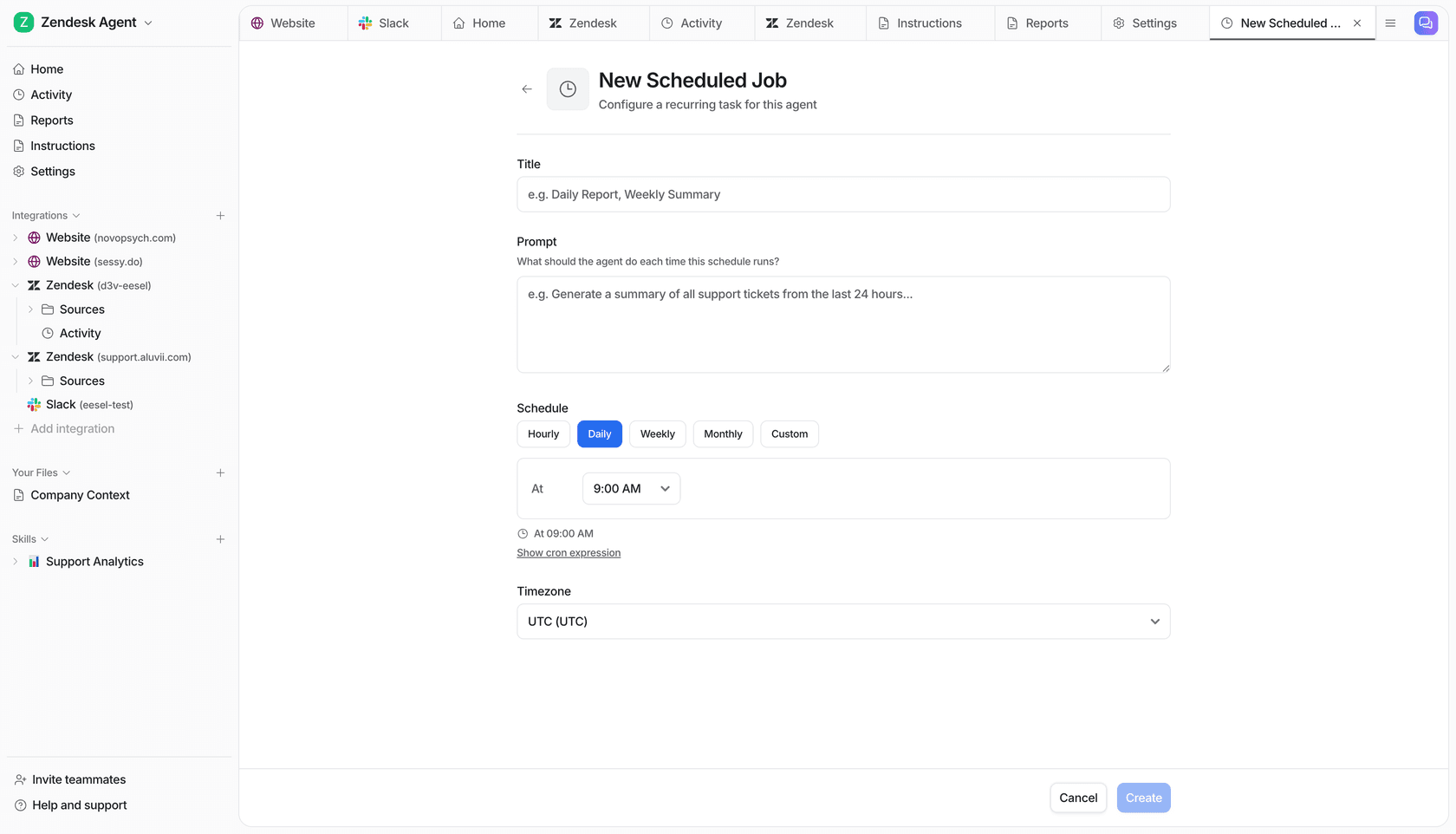
You pay one fixed monthly price, a ticket counts as one credit however long it runs, and you can see real drafts on your own tickets before paying anything. Try eesel free with 100 credits.
Frequently Asked Questions
How much does Claude Duet cost?
Claude Duet has no separate price. During the research preview it's included with Claude Pro ($20 a month, or $17 a month on the $200 annual plan) and Max ($100 for Max 5x, $200 for Max 20x), per Anthropic's help center. The real Claude Duet cost is the share of your usage limit it uses. My Claude pricing guide covers every plan.
Is Claude Duet free?
No. It isn't on the Free plan. You need Pro or Max, a US Claude account and a waitlist invite. Once you're in, Duet adds nothing to your bill, but its morning brief and check-ins count toward the same limits as your chats and Claude Code.
Should I get Claude Pro or Max for Claude Duet?
Pro is enough if you rarely hit limits today and want Duet mainly for the morning brief. If you already hit Pro's five-hour cap, or plan to hand Duet decks and financial models, Max 5x is the safer floor. Max 20x is the cheapest per unit of usage at $10 per Pro-sized block. The Claude Pro pricing post has more on the base plan.
What happens when Claude Duet hits my usage limit?
You wait for the five-hour or weekly reset, upgrade, or turn on usage credits, which bill at standard API rates. Duet runs on Claude Opus 5.5, listed at $4 per million input tokens and $20 per million output tokens. Anthropic's Duet docs don't yet say whether Duet itself keeps running on usage credits, so set a monthly spend cap if you enable them.
Does Claude Duet pricing include Team or Enterprise plans?
Not yet. Anthropic says it plans to bring Duet to Team and Enterprise later, with no date. Team seats run $20 to $125 per seat a month. If you need an agent for a shared queue today, an AI helpdesk agent like eesel works across the whole team.
What is the Claude Duet limit reset?
When you're admitted to the preview you get one full limit reset, which refills both your five-hour session and weekly limits. It's usable until November 30, 2026. You redeem it on the web or in Claude Desktop, not the mobile app, under Settings, Usage.
Is Claude Duet cheaper than OpenAI Dots?
On sticker price, yes. Duet starts on the $20 Claude Pro plan, while OpenAI Dots pricing starts on ChatGPT Pro from $100 a month. The catch is that Duet shares one usage limit with the rest of Claude. My Claude Duet overview compares the two in full.