


My Claude Duet review in one line: 3.5 out of 5, a careful, sharp-judging personal agent that most people can't get yet. Duet runs on Claude Opus 5.5, sends a morning brief, checks your apps every few hours, and asks before it sends, pays, signs or deletes anything. The approval line is drawn in the right place, and at no extra cost on a $20 Pro plan it's the cheapest way into a frontier-model personal agent.
The catch is reach, not brains. It's a US-only waitlist for Pro and Max, it isn't on Team plans, it shares your chat usage limits, Slack works with limits and Microsoft 365 isn't there yet. You can't watch its browser or pick its model, and the first hands-on reports on Hacker News are mixed.
Get it if you're a US founder or consultant living in Gmail and Google Calendar. Skip it for a support inbox. A shared queue needs a teammate built for that job: at Adverscale, eesel's helpdesk teammate worked about 2,400 Zendesk tickets in a month, and it never decides a refund on its own.
How I reviewed Claude Duet
I'm on eesel's customer support team and I work the eesel support queue every day, so I read agent launches with one question in mind: what happens when it's wrong in front of a customer? I've spent the last few years watching AI agents work live support queues for eesel customers, and every rollout gets simulated against past tickets before it touches a real one, because a confident bot that's quietly wrong is the failure that costs you.
Here's my method, so you can weigh the verdict:
- Every primary source. Anthropic's launch announcement, the get started guide in the help center, the Duet product page and the Claude pricing page, all re-checked on October 23, 2026.
- The whole launch thread. The Hacker News thread sat at
544points and510comments when I pulled it. - Hands-on reports. Duet opened on October 21 and invites go out in waves, so first-person reports are still thin. I quote the detailed ones.
I don't have an invite yet, so I'm not going to pretend I lived with it. Where a claim comes from someone else's time with Duet, I say so. If you want the feature tour first, my colleague's Claude Duet explainer covers it. This post is the verdict.
Claude Duet review scorecard
Here's how I'd score it on the six things that decide whether an always-on agent earns a spot in your week.
| Area | Score | Why |
|---|---|---|
| Judgment | 4.5/5 | Opus 5.5 decides what needs you and what can wait; Anthropic's testers describe catches they never asked for |
| Safety design | 4.5/5 | Approval before send, pay, sign or delete; hard blocks on trading and transfers; passwords kept out of the chat |
| Value for money | 4/5 | No extra charge on Pro ($20/month) or Max, but background checks draw on your shared limits |
| Apps it can reach | 3/5 | 6,000+ connectors and plugins, but Slack works with limits, Microsoft 365 isn't available and it can't text or call |
| Transparency | 2.5/5 | You can't watch its browser, choose the model or see its own setup |
| Availability | 1.5/5 | US only, Pro and Max only, waitlist in waves, no Team or Enterprise |
| Overall | 3.5/5 | The best-judged personal agent on paper, open to a small slice of people |
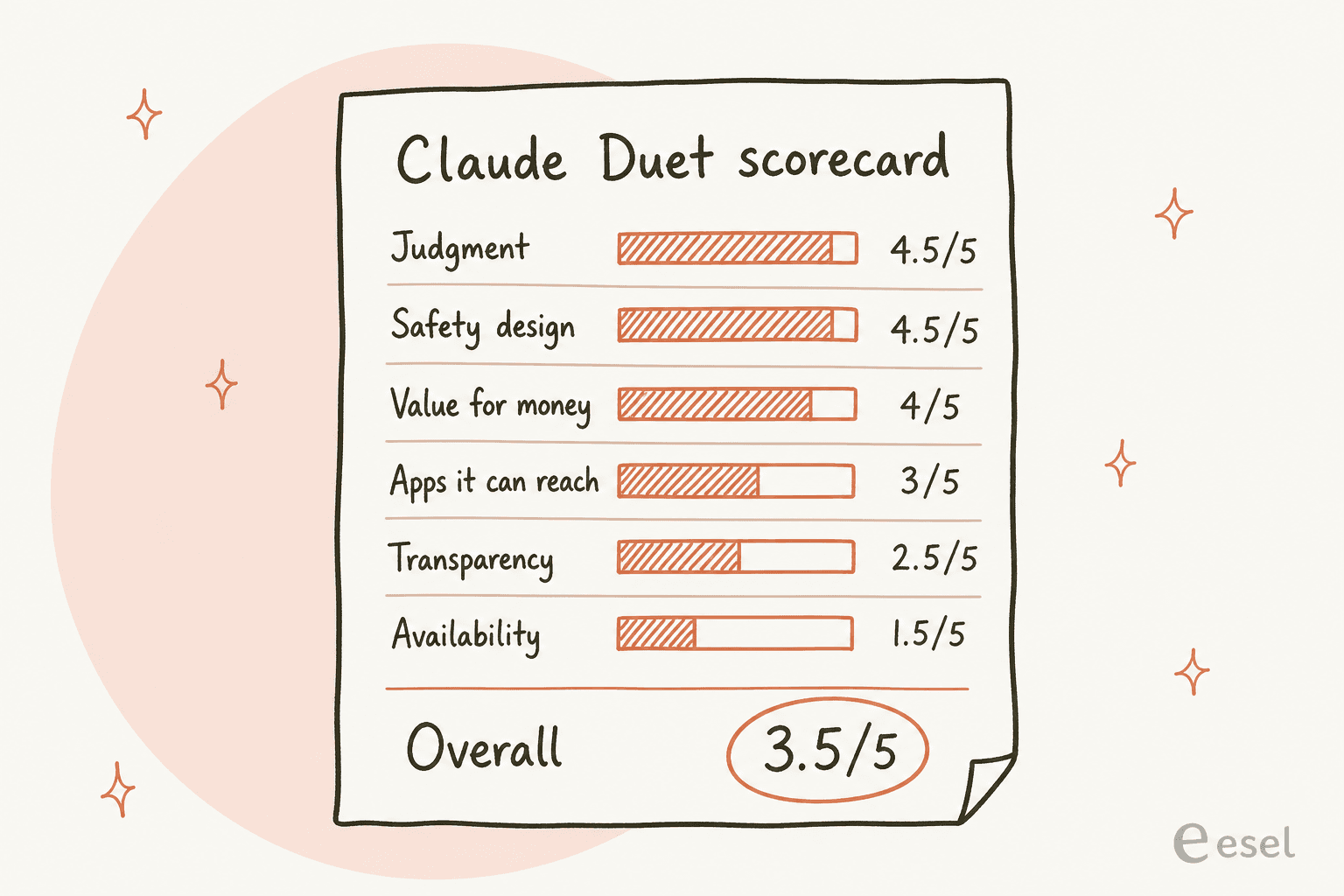
For context, I'd put it half a point above OpenAI's agent in my colleague's Dots review, mostly on price and access to a $20 plan. Scores are a blunt tool, though. If you're outside the US, the 1.5 on availability is the only number that matters.
What Claude Duet gets right
The short version: Anthropic built Duet around judgment and restraint, and both show in the design.
The judgment is the product
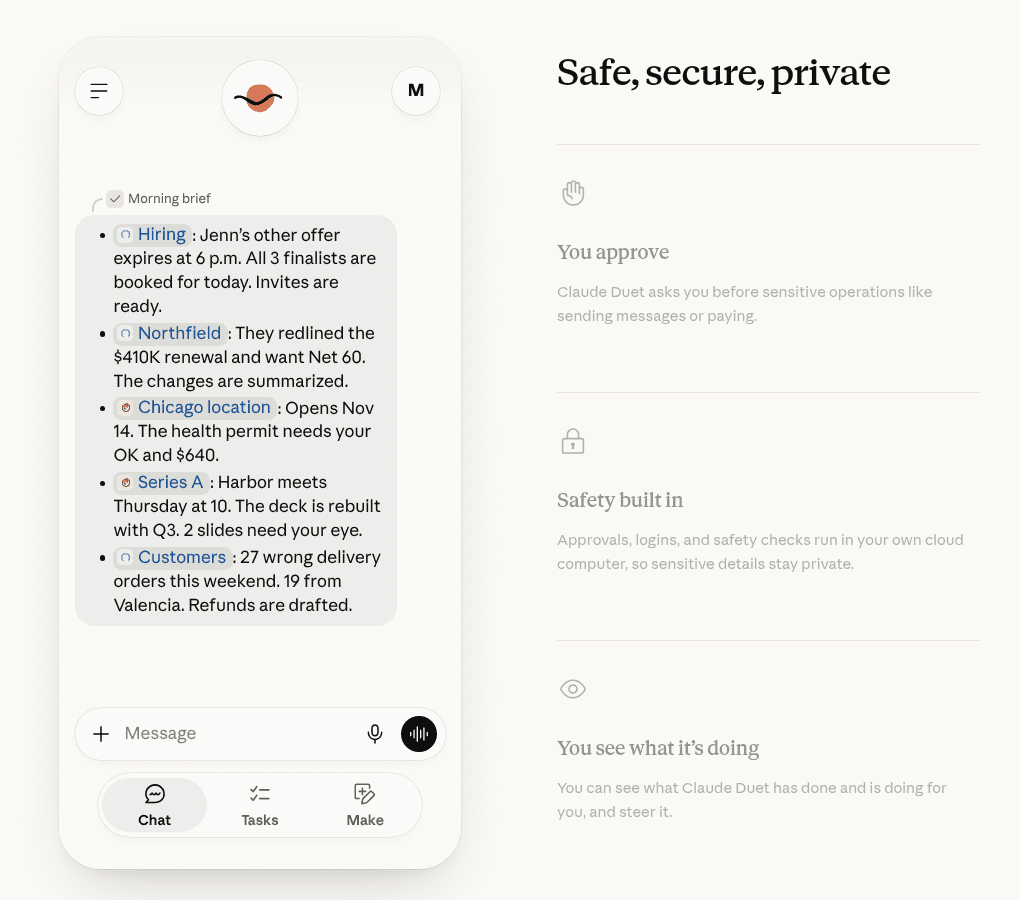
Anthropic says it plainly: "What makes Claude Duet so helpful is its judgment." Each morning it reads across your email and calendar, picks what most needs you, and can start the first steps, like drafting replies for you to review. Then it goes quiet until something needs you.
The tester stories in the announcement are the strongest evidence that this works. A real estate broker had Duet flag a property showing that sat on her calendar for the wrong day, "without having to ask." A brand strategist had it notice a client call right before her flight and offer to move it. Neither is a task anyone gave it. That's the difference between a personal agent and an AI scheduling assistant that only does what you tell it.
The model is a big part of why people are excited, and my colleague's Opus 5.5 review covers it in depth. One Hacker News reader who loves Meta's agent plans to try Duet anyway:
"I think I'll be giving duet a shot despite how much I've enjoyed Muse just because Opus 5.5 is so insanely good."

The approval line is drawn in the right place
This is the part I'd hold up as the model for other agent launches. Duet "reads, drafts, and prepares work on its own." Before it sends a message, makes a payment, signs a document or deletes anything, it shows you exactly what it's about to do and waits. If you can't approve right away, it finishes the rest of the task and brings the approval back later.
Some actions stay off the table even with your OK: trading securities, moving money between accounts, or accessing someone else's account. Purchases go through Link or Shop Pay with a one-time card for that purchase only. A new classifier also refuses to share the strictest tier of information, "including credit card numbers and government identification."
One detail I liked more than the headline features: when Duet gives you a number or a summary, it tells you which email, file or spreadsheet it came from. In support, that's the habit that separates an agent you can trust from one you have to double-check. It's the same reason I care so much about agent handoffs on the queue I work.
Anthropic is also honest about the soft spot. On prompt injection, the help center says "no defense is perfect, which is one reason consequential actions need your approval." That's a sentence more vendors should write.
It starts with what you already have
Duet "runs on your Claude account, so the memory, skills, and connectors you've set up in Claude are there from your first message." If you've connected Gmail, HubSpot or QuickBooks in Claude, or built Claude skills, Duet picks them up. It can also search your past Claude chats for context, using the same memory setting as the main app.
Credentials follow the design Anthropic uses for Claude Managed Agents, so Duet "never directly sees your passwords or sign-in tokens." When a site asks for a password, you type it into a separate form on your phone.
The price of entry is low
During the research preview, Duet is "included with the Pro and Max plans at no extra cost." Pro is $20 a month, or $17 a month billed annually, per Claude's pricing page. For comparison, OpenAI's personal agent starts on ChatGPT Pro at $100 a month, per OpenAI's pricing page. My colleague's Claude Duet pricing breakdown does the Pro versus Max math in full.
Where Claude Duet falls short
None of these are hidden. Anthropic lists most of them itself, which I respect. They still shape who should use it.
It checks in, it doesn't watch
Duet "checks your connected accounts every few hours, because checking nonstop would use up your plan's limits much faster." That's a fair trade for a personal inbox. But the help center is clear about the cost: "something urgent can arrive between checks."
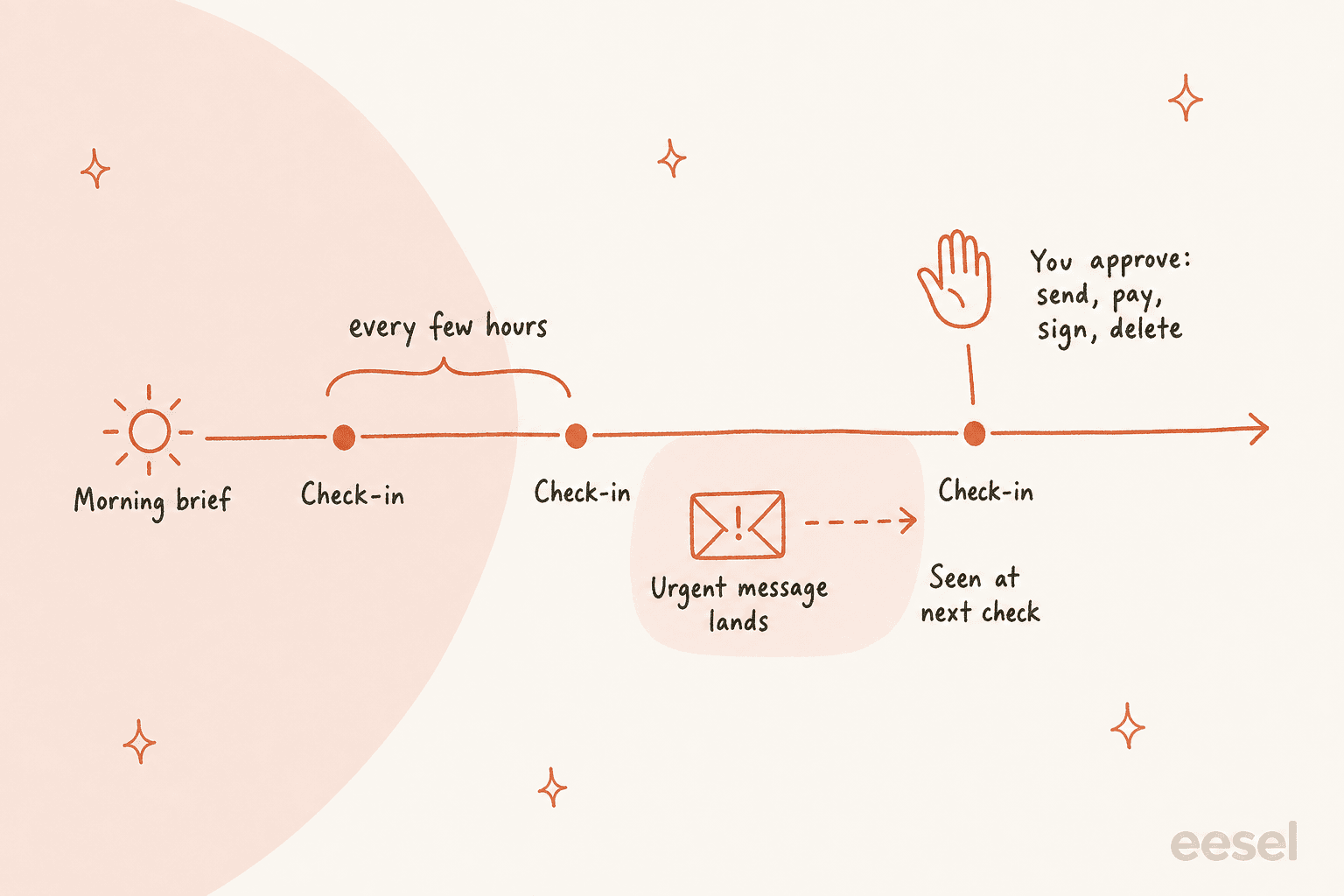
For one founder, a few hours is fine. For a customer waiting on a refund, it isn't. A buyer once told eesel's sales team, in effect, that customers don't wait for the monthly report, they need an answer now. The same logic applies to a check-in schedule. You can tell Duet what you want to hear about and how often, but more often means more of your limit.
You can't see inside it
You can't watch Duet work in its browser or take over. You can't choose a model either: it runs on Opus 5.5 "and decides how much effort a job needs." The product page promises that "you see what it's doing," which in practice means what it has done and is working on in the Tasks tab, not a live view of the browser.
The most detailed hands-on report in the launch thread came from someone who'd used both Dots and Duet, and the visibility it did show annoyed him:
"I let it go to see what it would do and I hated the UI/UX within seconds. It started "working" and dumping "Cards" in the chat of the tickets it was looking up in my ticketing system."
He also said that when Duet didn't have access to the data it needed for a task, it pushed ahead instead of asking. That's one person on day two of a research preview, so I wouldn't read too much into it. But it's the right thing to watch for in your first week: an agent that asks too often is annoying, and one that doesn't ask when it's missing context is worse.
The app list has gaps
Anthropic says Duet can use "the over 6,000 connectors and plugins" in the Claude Marketplace, and its examples are very small-business shaped: Stripe invoices, Gusto payroll, Docusign agreements, a Shopify store. The limits sit in the fine print.
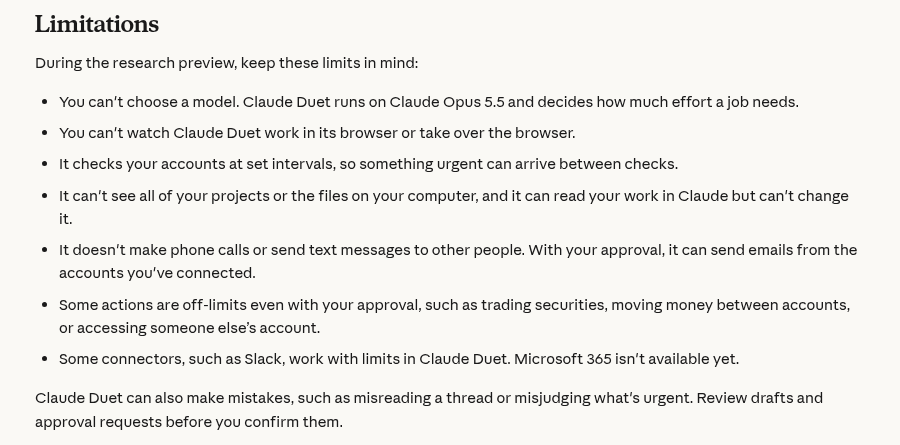
- Slack "works with limits." If Slack is where your work happens, the Cowork Slack integration goes further today.
- Microsoft 365 "isn't available yet." The product page shows a Microsoft / Office 365 logo in its connector strip, so the two pages disagree. I'd trust the help center until Anthropic updates one of them.
- No calls or texts to other people. It can send email from your connected accounts, with your approval.
- No local files. It can't see files on your computer, and it can read your Claude work but not change it.
Anthropic also says personal errands "such as booking tickets, aren't quite as strong" as work tasks.
It shares your limits, and it isn't fast
Duet uses your plan's five-hour session and weekly limits "at the same rate as chats in Claude," and its morning brief and check-ins count too. When you're admitted you get one full limit reset, usable until November 30, 2026. After that, a Pro user who already hits the cap in Claude Code will feel it.
Speed came up as well. One commenter relayed a video preview's verdict and agreed with it:
"The Duet agent is so slow that it's not actually particularly pleasant to use, even if it is smart."
Who can actually get Claude Duet?
Fewer people than the launch buzz suggests. Here's the list, straight from the help center.
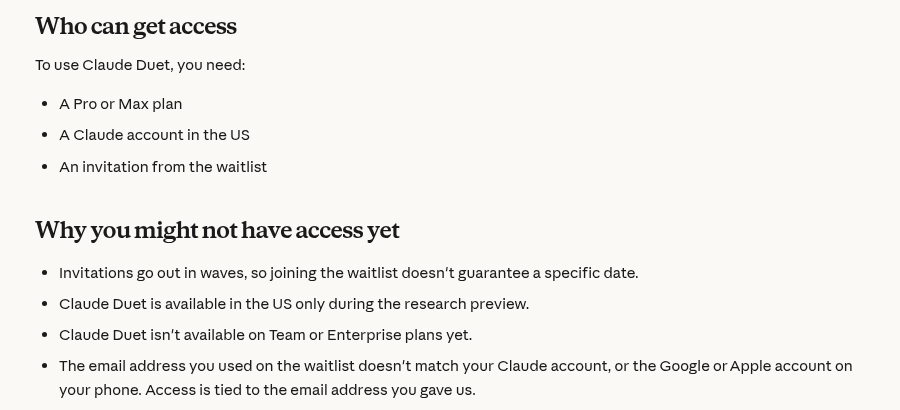
You need a Pro or Max plan, a Claude account in the US, and an invitation from the waitlist. It "isn't available on Team or Enterprise plans yet," and Anthropic says it plans to bring it "to those plans later," with no date. Access is tied to the email you gave the waitlist, so it has to match your Claude account and the Apple or Google account on your phone. That's the gotcha I'd expect to fill Anthropic's support inbox this week.
One correction to some early coverage: Duet isn't iPhone-only. The announcement says it's "a standalone app on iOS and Android, and on claude.ai," and the waitlist form asks for either phone type.
What are early users saying?
Anthropic's launch post on X drew over 52,000 likes, and Anthropic's own thread set expectations in a way I appreciated:
"Claude Duet is an early research preview, available through a waitlist on Pro and Max plans in the US. It can still misjudge what's urgent, and we'll keep tuning it based on what early users tell us."
On Hacker News, the reactions split three ways. Model fans are excited about Opus 5.5 behind a personal agent. Early users, like the two quoted above, found the UI busy and the pace slow. And a vocal group doesn't see what Duet adds over what they already run:
"This is cool, but I still don't understand how this is different from just a Claude session, with a browser."
That last point is fair for developers. If you already script your own agent with cron jobs or a self-hosted setup like OpenClaw, Duet's value is the packaging: the brief, the approvals and the payments flow, ready on your phone. For a non-technical owner, that packaging is the whole product.
How does Claude Duet compare?
Three big labs shipped this idea in about six weeks: Meta Muse on September 8, OpenAI Dots on September 29 and Duet on October 21. Here's how I'd separate them as a reviewer, using my colleagues' earlier verdicts.
| Claude Duet | OpenAI Dots | Meta Muse | |
|---|---|---|---|
| Best at | Prioritizing your day, careful approvals | Watching Slack, Teams and email | Personal errands and shopping |
| Model | Claude Opus 5.5 | GPT-6 Astra | Muse Spark 1.3 |
| Cheapest way in | Claude Pro, $20/month | ChatGPT Pro, $100/month | Free to start |
| Where it lives | iOS, Android, claude.ai | ChatGPT, Slack, Teams | iOS, Android, web, WhatsApp |
| Team plans | Not yet | Business Premium | Consumer only |
| Verdict | 3.5/5 (this review) | Dots review, 3/5 | Muse review |
Prices come from Claude's pricing page and ChatGPT's pricing page. xAI's Grok Bot is the other option in the category, built around teams sharing one computer.
My ranking for a US knowledge worker already on Claude: Duet first, because it costs nothing extra and the judgment is the best on offer. For someone who lives in Slack or Teams, Dots. For errands, Muse. For anyone outside the US, Cowork today and Duet later.
Is Claude Duet worth it?
For the right person, yes, and it's an easy yes because it costs nothing extra. Before you join the waitlist, run this quick check.
Claude Duet deal-breaker check
Tick anything that's true for you. Based on Anthropic's help center as of October 23, 2026.
Duet is US-only in the research preview. Claude Cowork is the nearest Claude option you can use now.
Duet needs Pro or Max. Team and Enterprise come "later," with no date.
Duet works for one person. A helpdesk teammate like eesel works the queue inside Zendesk or Gorgias for the whole team.
Background checks count toward your limits. Max gives you more room, and you get one free reset until November 30, 2026.
Microsoft 365 isn't available in Duet yet, per the help center.
Duet checks every few hours, so urgent items can wait until the next check.
You can't watch or take over Duet's browser. You see results in the Tasks and Make tabs.
Tick the statements that fit you to see whether Claude Duet works for you today, and what to use if it doesn't.
My verdict, in three parts:
- Get it if you're in the US on Pro or Max, your day runs through Gmail and Google Calendar, and you have more threads than you can track. That's the exact person Anthropic built it for, and the price is right. It's a strong pick in the AI personal assistant category and a better fit than most AI email assistants for someone who wants proactive help.
- Wait if you're on Pro and already short on limits, you run on Microsoft 365, or you want to see inside the agent before you trust it. The research preview will change, and Anthropic says the features "can change."
- Look elsewhere if the job belongs to a team. Duet answers to one person. That's a different kind of tool, and it's where most of my week goes.
Where Claude Duet stops for a support team
Anthropic's own tester list makes the point. Amin Ebrahimi, who owns Shahs of Kabob with about 110 employees, uses Duet "for accounting, customer support, and marketing." For an owner keeping track of everything, that's a great fit. It's not the same as running a support queue.
A support queue belongs to a team. It needs answers in minutes, not at the next check-in, and it needs every ticket owned, not summarized in a brief the owner skims at 7am. I've watched personal agents like Dots try customer support, and the gap is always the same: they're generalists working one inbox.
eesel takes the other approach. You hire AI teammates for a specific job, and today that's the AI helpdesk teammate and the AI blog writer. Each arrives with the skills, integrations and company context for its role, and works your team's tools instead of your personal inbox. Here's what that looks like in two published customer stories:
- Called in like a colleague, with a hard line on refunds. At Adverscale, which runs several US passport application services from one Zendesk, a support agent types @eesel in an internal note and the teammate, Emily, takes the ticket. In a month she worked about 2,400 tickets, sent about 1,600 replies and left about 2,700 internal notes. Refunds and cancellations always go to a person.
- Drafts in the brand's voice, and a person always sends. SaunaSpace, which handcrafts infrared saunas in Columbia, Missouri, uses eesel beside every Gorgias ticket. In a month it drafted about 110 customer conversations and wrote about 180 draft replies, answering from about 1,550 pages, articles and past tickets. Email tickets are never answered directly.
Notice the pattern: the same "read, draft, ask" ladder Duet uses, applied to a shared queue with the helpdesk as the source of truth. If you want the wider category, my posts on the best AI teammates, the AI employee idea and AI agents for small business go deeper.
And if you're one of the Hacker News readers who'd rather script this than use an app, the eesel CLI lets you connect a helpdesk, edit a teammate's standing instructions and approve or deny pending actions from the terminal, and Claude Code can drive it. My AI agent CLI post and the CLI for customer support guide walk through it.
Try eesel for your support queue
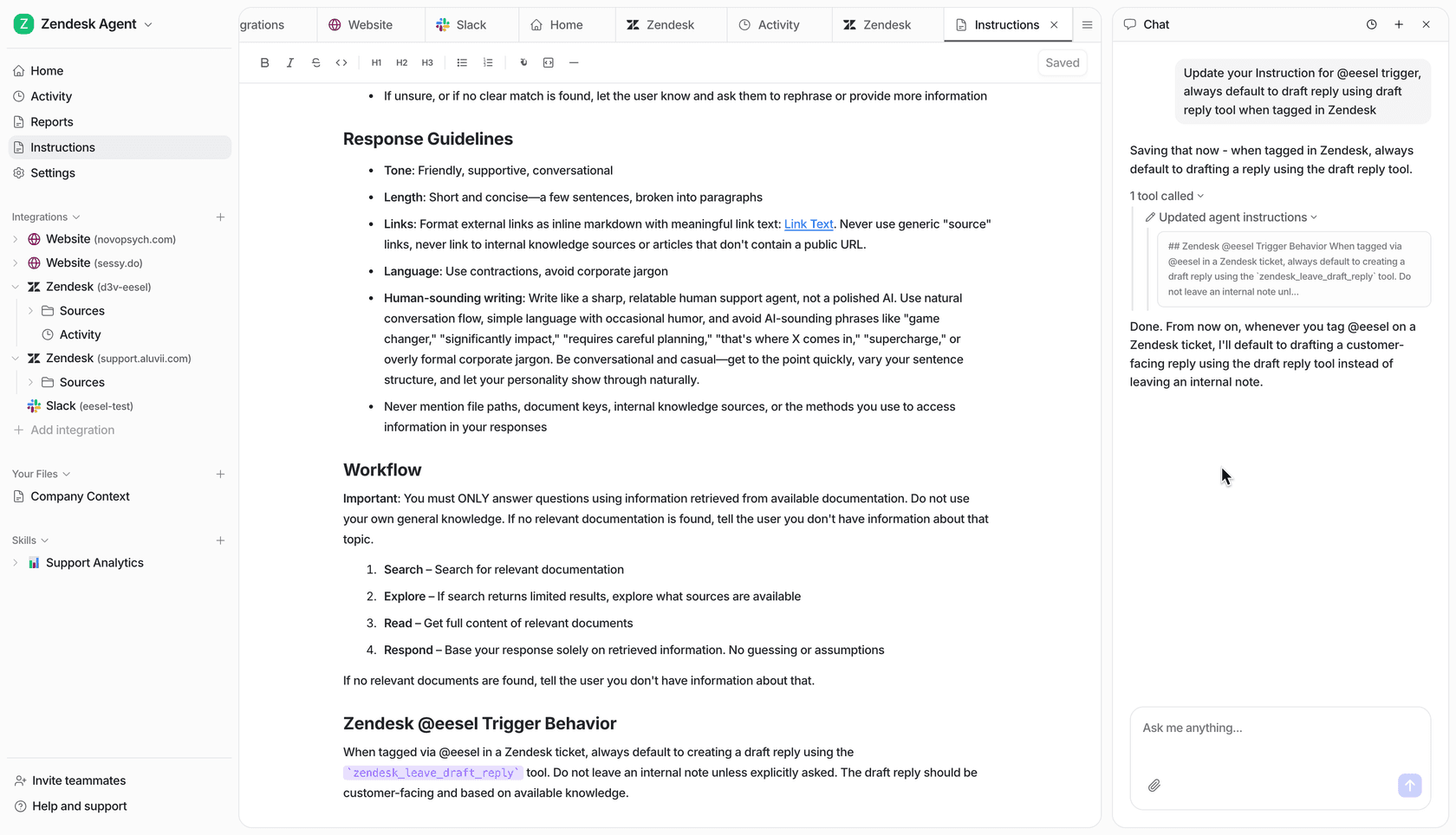
If Duet has you wondering what an always-on agent could do for your business, point it at the queue your customers actually wait in. eesel's helpdesk teammate joins Zendesk, Gorgias, Freshdesk and more, learns from your help center and past tickets, and drafts or answers with approval steps you set. You can even change its instructions by just telling it, the way you'd message Duet.
Pricing is public and flat: a free plan with 100 credits and no card, then teammate plans from $299/month for 500 credits, where one ticket or chat is one credit however long it runs. Scheduled jobs and reports use credits too, so, like Duet's check-ins, background work isn't free. Details are on the pricing page. Try eesel and have a helpdesk teammate drafting on your real tickets the same afternoon.
Frequently Asked Questions
Is Claude Duet worth it?
In my Claude Duet review I score it 3.5 out of 5. If you're a US Pro or Max subscriber who runs on Gmail and Google Calendar, yes: it costs nothing extra and the morning brief earns its place. If you're tight on limits, on Microsoft 365, or need it for a team, wait. My Claude Duet explainer covers every feature.
How much does Claude Duet cost?
Nothing on top of your plan during the research preview. It's included with Claude Pro ($20/month, or $17/month billed annually) and Max ($100 or $200/month), and it draws on the same usage limits as your chats. The full math is in my Claude Duet pricing post and the wider Claude pricing guide.
Is Claude Duet only on iPhone?
No. Anthropic's announcement says Claude Duet is a standalone app on iOS and Android, and it also works on claude.ai. The waitlist form asks for your phone type, iPhone or Android. If you want an agent inside a desktop browser instead, look at Claude for Chrome.
What are the biggest limits in this Claude Duet review?
It's US-only and waitlisted, it isn't on Team or Enterprise, it checks your apps at set intervals so urgent things can wait, you can't watch its browser or choose a model, Slack works with limits and Microsoft 365 isn't available yet. For a team inbox, an AI helpdesk agent fits better.
Is Claude Duet better than OpenAI Dots?
Duet is cheaper to get into (Claude Pro at $20/month versus ChatGPT Pro at $100/month) and its safety design is just as careful. Dots reaches Slack and Teams, which Duet doesn't fully cover yet. One early user who tried both preferred Dots for now. My OpenAI Dots review scores it 3 out of 5.
Is Claude Duet safe to connect to email and payments?
It asks before it sends, pays, signs or deletes, it never trades securities or moves money between accounts, and purchases use one-time cards through Link or Shop Pay. Anthropic also says no prompt injection defense is perfect. My notes on agent handoffs cover how to stage that trust.
How do I get Claude Duet?
Join the waitlist on Anthropic's Claude Duet product page with the email on your Claude account, pick your phone type, and wait for an invitation, which goes out in waves. You need a Pro or Max plan and a US Claude account. While you wait, Claude Cowork is the closest thing in the Claude family.