


What Claude Opus 5.5 actually is
Anthropic shipped Claude Opus 5.5 on September 22, 2026, and it's best understood as an efficiency pass on Opus 5 rather than a ground-up new model. The headline is the reversal: every previous Opus launched at a premium, and this is the first one to launch cheaper than the model it replaces.
The price moved from Opus 5's $5/$25 to $4/$20 per million tokens, a flat 20% cut. That sounds small until you remember what Opus is usually for: long, token-heavy, autonomous work where the output side of the bill dominates. A 20% haircut on the $20 output rate is where most teams feel it.
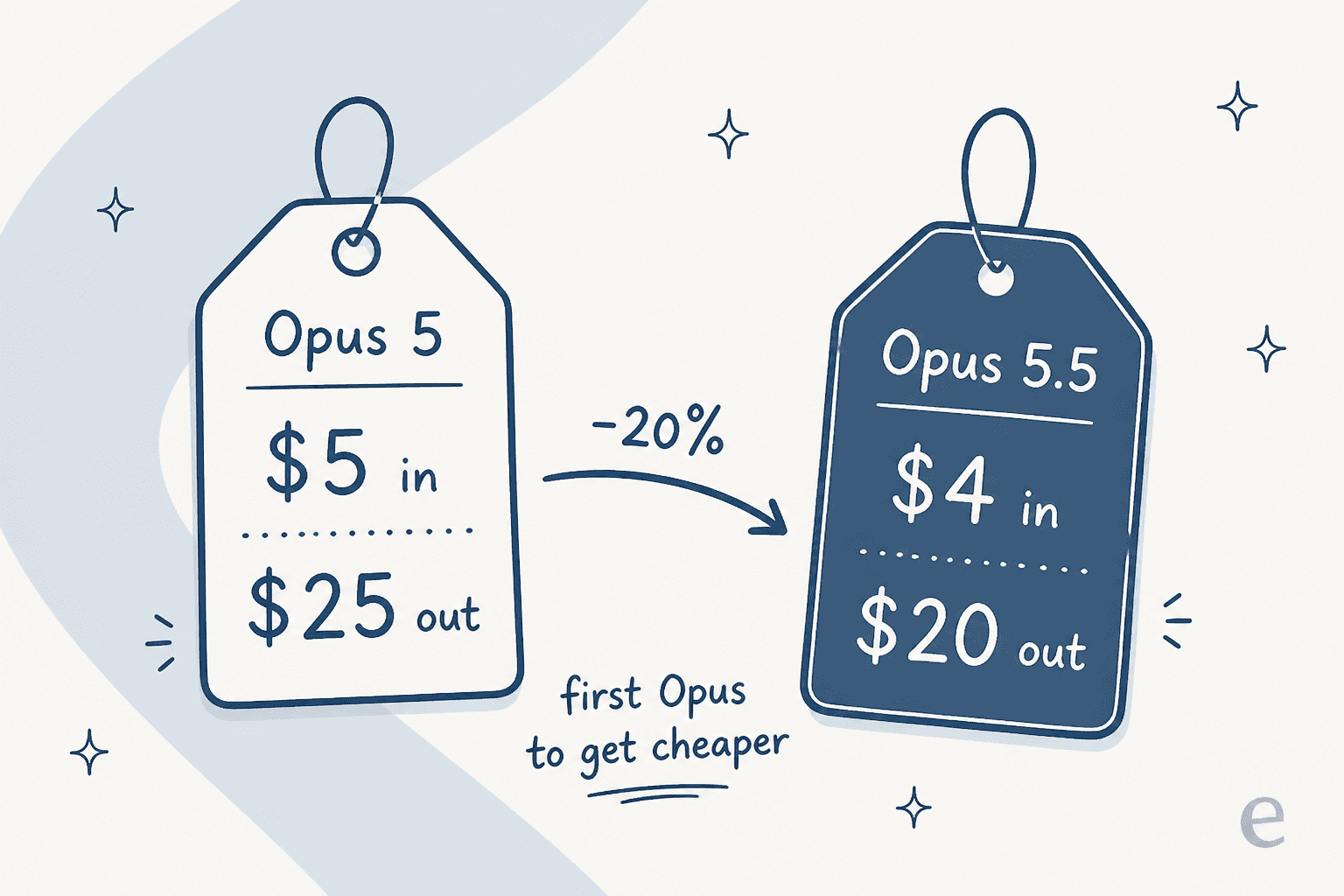
A few things changed under the hood alongside the price. The default effort dropped from high to medium, thinking is always on, and Anthropic now tells you to start with Opus 5.5 for most work instead of treating Opus as the last-resort premium tier. It carries a 1M-token context window, up to 128K output tokens (300K on Batch), native vision, and a June 2026 knowledge cutoff. It's the default on Claude Max, the strongest model on Claude Pro, and it's what powers Claude Code for agentic coding.
The effort dial is the whole review
I build AI agents at eesel, so every frontier launch means the same drill: rerun my evals, look at cost per finished job, decide what moves. The thing that surprised me most about Opus 5.5 wasn't the quality, it was how much the effort setting dominates everything else about using it.
Here's the mechanism. Opus 5.5 exposes an effort control with five levels: low, medium (the new default), high, very high, and max. Higher effort doesn't just make it "try harder" in a vague way; it makes the model reason for longer and emit far more tokens before it answers. At max effort on a hard task, it spent roughly 119k output tokens versus a much leaner run at low effort. Since output is billed at $20 a million, the effort dial is really a cost dial wearing a quality label.
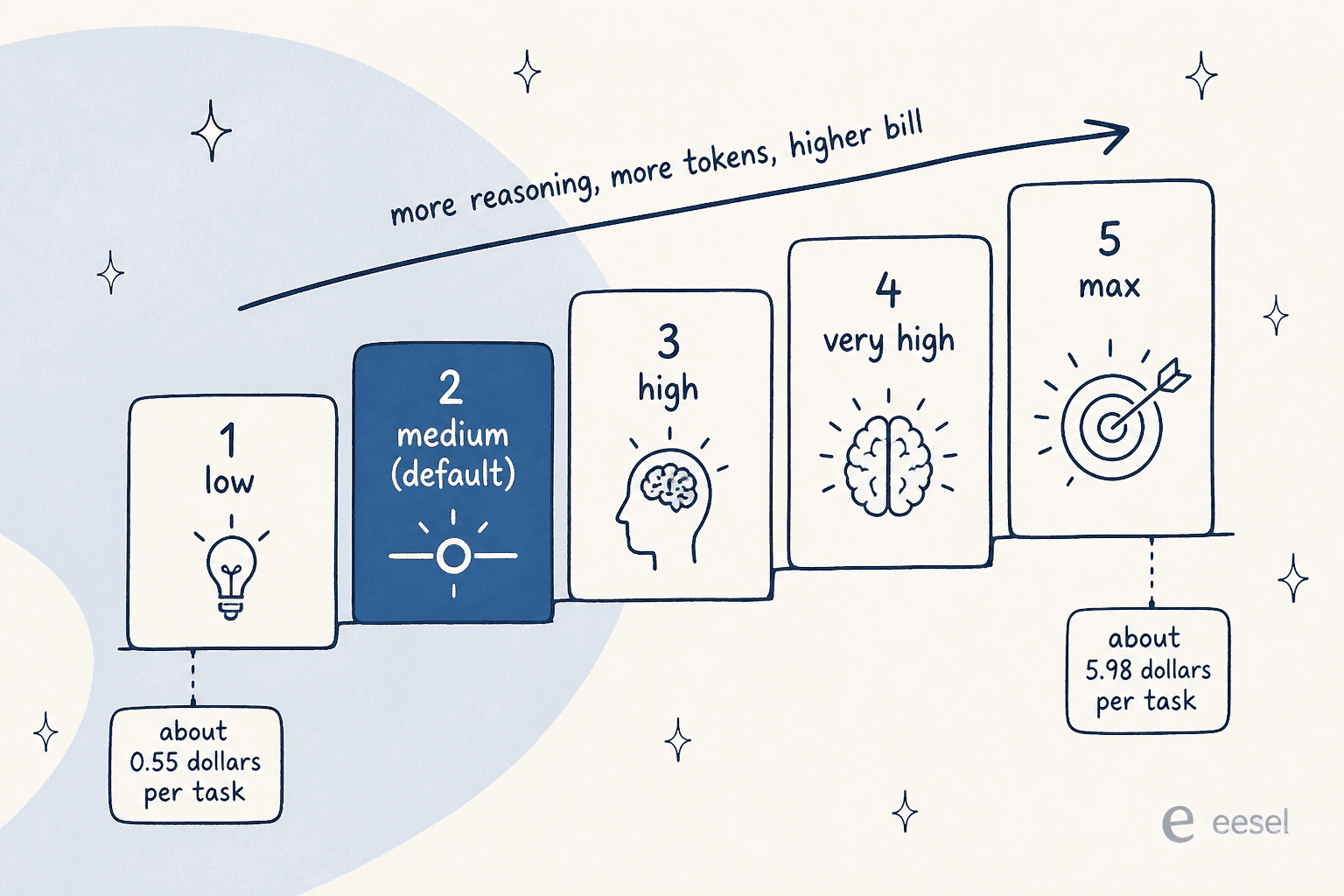
That's why the per-token rate is almost a distraction. On Artificial Analysis's own measurement, the same hard task costs about $0.55 at low effort, about $1.34 at medium, and about $5.98 at max. The intelligence you're paying for climbs with it: the low-effort run scores 42 on the Intelligence Index, medium hits 51, and only at max does it reach the headline 58. So the real question when you deploy Opus 5.5 isn't "can I afford it," it's "what's the lowest effort level that still clears the bar for this task." Most of the time, that's medium.
This is also the single biggest gotcha for anyone moving up from Opus 5, where the default effort was high. Drop the same workload onto Opus 5.5 without touching the setting and your per-task bill can actually fall, because the default now sits a notch lower. It's a genuinely thoughtful default, but it means you can't reason about cost from the sticker alone.
The benchmarks: it wins almost every row
Strip away the price for a second, because on raw capability Opus 5.5 is the clear leader. On the Artificial Analysis Intelligence Index it sits at number one with a 58, ahead of the frontier field. It's not a single-benchmark fluke either: it leads on GDPval-AA (1846), on AutomationBench, and on the long-horizon coding evals that matter most for agents.
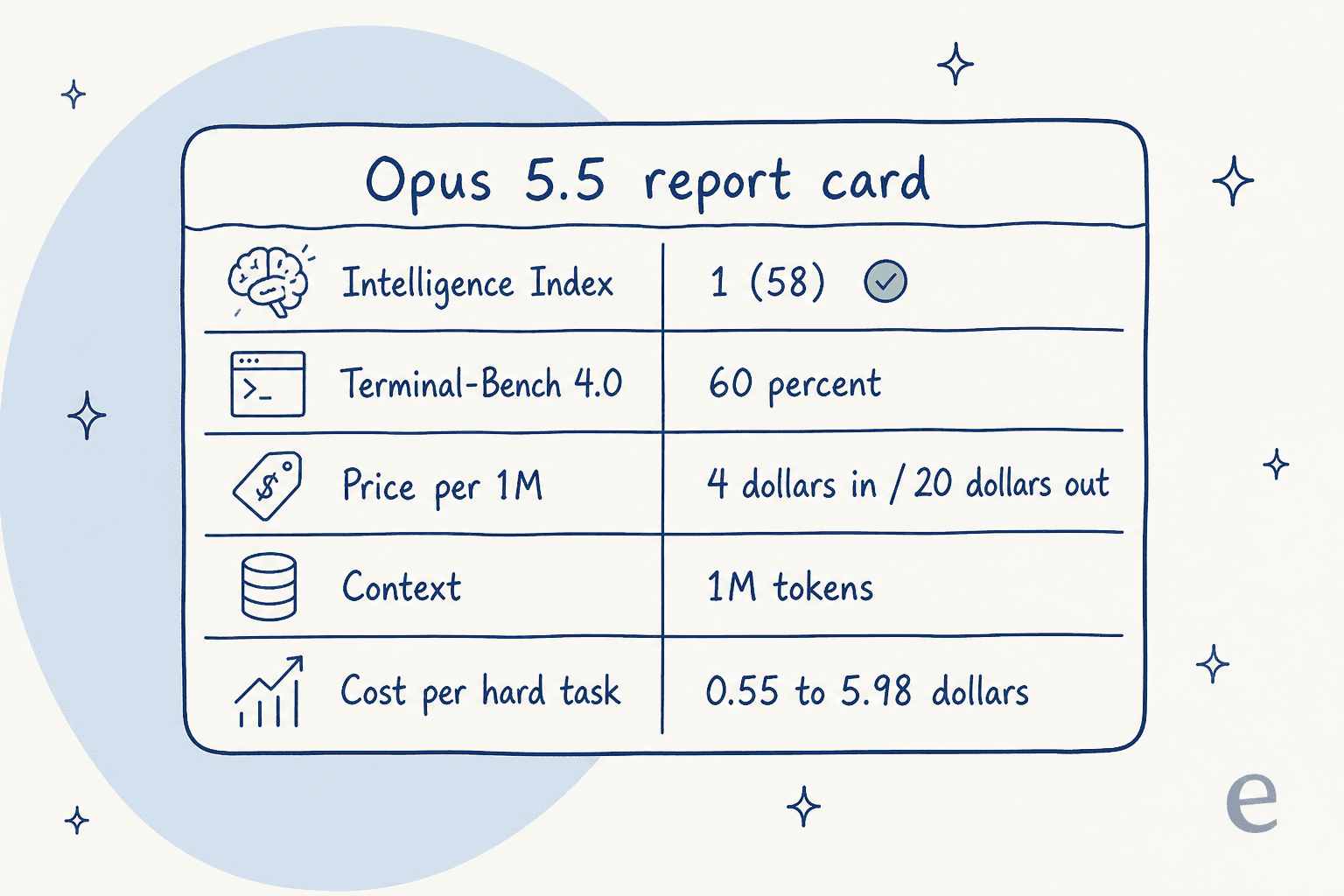
The coding story is where it pulls ahead most visibly. On Terminal-Bench 4.0, run through Artificial Analysis's harness at max effort, Opus 5.5 scored 60% against 44% for its closest priced rival. That's the kind of gap that shows up as fewer dead-ends in a long agentic coding run, which is exactly the workload Anthropic tuned it for. If you're doing hard, autonomous, multi-step engineering work, this is the model that finishes tasks other models stall on.
Where I'd add a caveat: the top score is a max-effort number, and max effort is the $5.98-a-task setting. The benchmarks that crown Opus 5.5 are measuring it at its most expensive. That's fair, every model is measured at its ceiling, but it means the leaderboard win and the everyday experience aren't the same thing unless you're always paying for max.
What Claude Opus 5.5 really costs
Here's the full rate card, because "starts at" pricing hides exactly the parts that bite on token-heavy work.
| Item | Rate |
|---|---|
| Input (per 1M tokens) | $4 |
| Output (per 1M tokens) | $20 |
| Cache read (per 1M tokens) | $0.20 |
| Long-context surcharge | None |
| Context window | 1M tokens |
| Max output | 128K tokens (300K on Batch) |
| Cost per hard task (AA) | $0.55 (low) to $5.98 (max) |
Two rows deserve a second look. First, there's no long-context surcharge, which sets Opus 5.5 apart from rivals that double their input rate past a threshold; on huge-context jobs, that flat pricing quietly closes the per-token gap. Second, cache reads at $0.20 a million mean that if your workload is a big stable system prompt plus short questions, a large slice of your input bill is cheap.
A quick worked example. Say you run 1,000 hard agent tasks a month. At medium effort ($1.34 each) that's about $1,340. Push the same 1,000 tasks to max effort for the last few points of intelligence and you're at roughly $5,980. That 4x swing is a config choice, not a plan change, and it's the cost per task I'd put on a whiteboard before rolling Opus 5.5 into anything high-volume. For the full breakdown with Batch and regional rates, see my Opus 5.5 pricing guide, and the wider OpenAI API vs Anthropic API comparison covers how it stacks against the other frontier platform.
Where Opus 5.5 earns its price, and where it doesn't
Let me be concrete about the fit, because "it's the best model" is true and unhelpful.
It earns its price when the task is hard, long, and expensive to get wrong. A multi-hour coding agent refactoring a real codebase, a research task that has to hold a huge context and reason across it, an ambiguous problem where a cheaper model spins in circles. In those cases the extra tokens buy you a finished result instead of a plausible-looking dead end, and the bill is cheap next to the engineer-hours it saves.
It's the wrong tool when the task is well-defined and high-volume: classification, short replies, translation, simple lookups, the boring 80% of most production workloads. Paying Opus rates and Opus latency for work that a mid-tier model nails is money and speed you don't get back. Opus is deliberate by design, so for anything a human is waiting on live, like a chat reply, the responsiveness matters more than the last few Intelligence Index points. That's the case for a two-model setup: route the genuinely hard tasks to Opus 5.5 and everything else to Sonnet 5, or reach for one of the cheaper picks in my Opus 5.5 alternatives roundup.
The honest one-line take: Opus 5.5 is the best model, and "best model" is rarely the same question as "right model for this task."
What people are actually saying
The launch thread reaction lined up with my own testing: real respect for the capability, and a recurring reminder that the label on the effort dial matters more than the leaderboard. One experienced tester, comparing it against the frontier competition that shipped the next day, landed here:
My initial takeaway is that GPT-6 is mostly a lower cost win, for Luna. GPT-6 Max is an upgrade on intelligence too, but its mostly a cost play (which is great, not complaining). I personally am preferring Opus 5.5 at medium over GPT-6 Sol Max, in very very early tests. Similar price range, more capability.

That "at medium" is doing a lot of work, and it's the whole point of this review. The other theme worth surfacing is how little any single benchmark should decide your choice in 2026:
Only hands-on experience matters in the end, and these days it's very easy to switch models.
That last clause, "very easy to switch models," is the real story of the year, and it leads straight to the question most model reviews skip.
Try eesel: the teammate that runs on any model
Every model review quietly assumes the reader's job is to pick a model, wire up its API, handle the prompt engineering, connect it to your tools, and keep it from hallucinating on live customers. For most teams, that's not the job. The job is a higher resolution rate, or published posts. A frontier model like Opus 5.5 is infrastructure; it's the engine, not the employee.
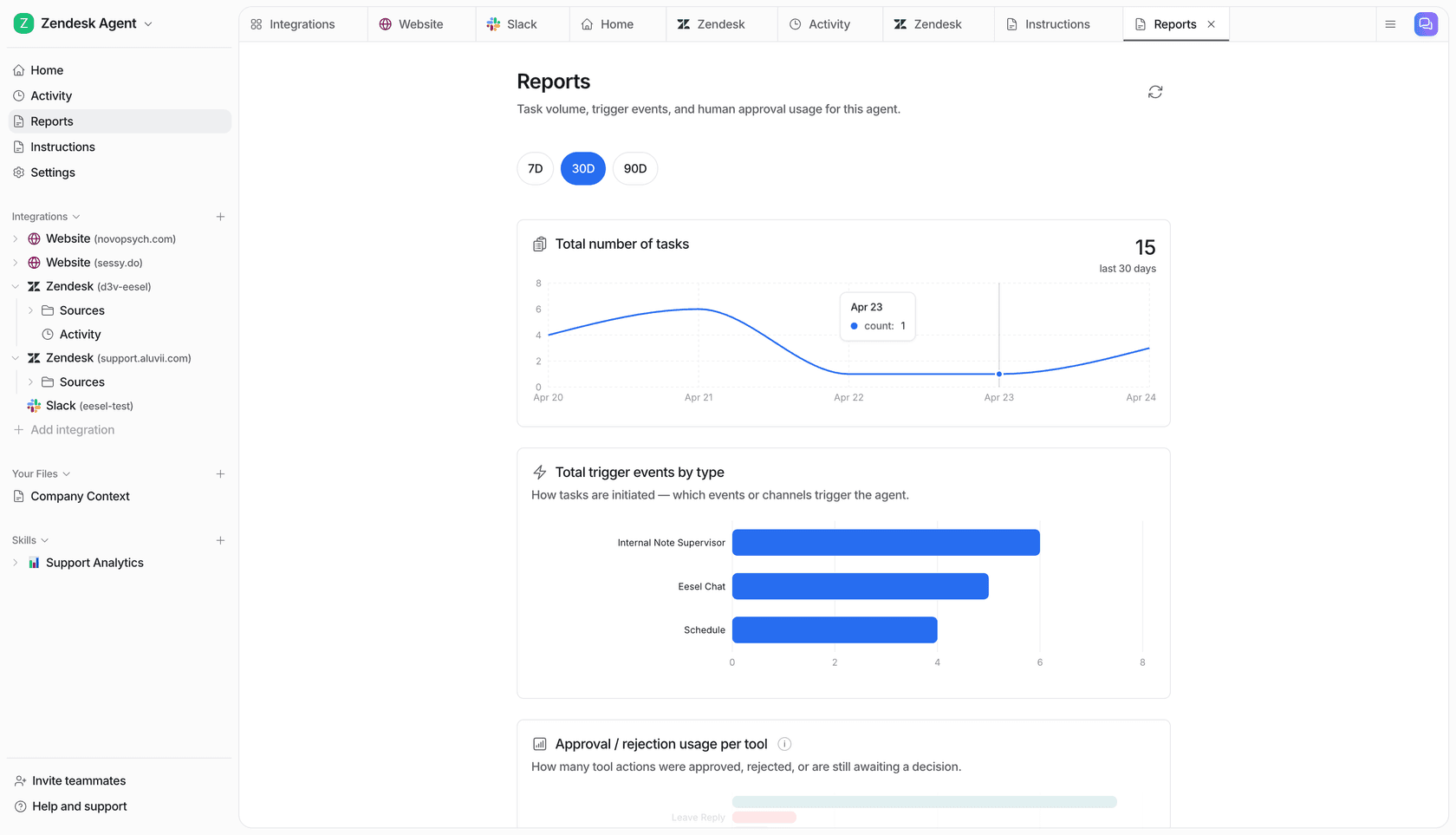
That's how I'd frame eesel. It's an AI teammate platform, and you hire ready-to-work teammates for specific jobs. The current roster is an AI helpdesk teammate that joins your existing support queue and an AI blog writer that drafts researched posts. Each one arrives already knowing its job, plugged into your tools, and grounded in your company's context, so you're not the one choosing between effort levels and babysitting a prompt. Because the model sits underneath the teammate, a cheaper or smarter model shipping next month is a free upgrade, not a rebuild, and the AI helpdesk teammate is billed per resolved ticket rather than per token, so the effort-dial math above stops being your problem.
If you're the kind of person who reads a model review to the end, you'll like this part: the whole thing is drivable from the terminal. The eesel CLI (npx @eesel/cli) connects integrations, edits the agent's standing instructions, simulates a rollout against your historical tickets, approves actions, and reads the activity log of every run, all as JSON, with a --dry-run flag that prints the exact call a write would make before it sends. Every workspace is also an MCP server, so coding agents like Claude Code, Codex, and Cursor can operate the same teammate. It's the same product as the dashboard, exposed for people and agents who live in a terminal. You can try eesel free.
Frequently Asked Questions
Is Claude Opus 5.5 worth it in 2026?
How much does Claude Opus 5.5 cost?
What is the effort dial in Claude Opus 5.5?
Is Claude Opus 5.5 good for coding?
Do I need Claude Opus 5.5 to build an AI support agent?


Article by
Alicia Kirana Utomo
Kira is a writer at eesel AI with a Computer Science background and over a year of hands-on experience evaluating AI-powered customer service tools. She focuses on breaking down how helpdesk platforms and AI agents actually work so that support teams can make better buying decisions.