8 best Claude Opus 5.5 alternatives in 2026 (cheaper, faster, open)

Kurnia Kharisma Agung Samiadjie

Katelin Teen
Last edited September 23, 2026

Why people look past Claude Opus 5.5
First, the fair part. Opus 5.5 earns its reputation. It's built for long-running agentic coding and knowledge work, it handles ambiguity without much hand-holding, and it sits at number one on the Artificial Analysis Intelligence Index with a score of 58. Anthropic even dropped the price from Opus 5's $5/$25 to $4/$20, which is a genuine, unforced concession to buyers. If you're already deep in Claude Code and the work is genuinely hard, staying put is a defensible call.
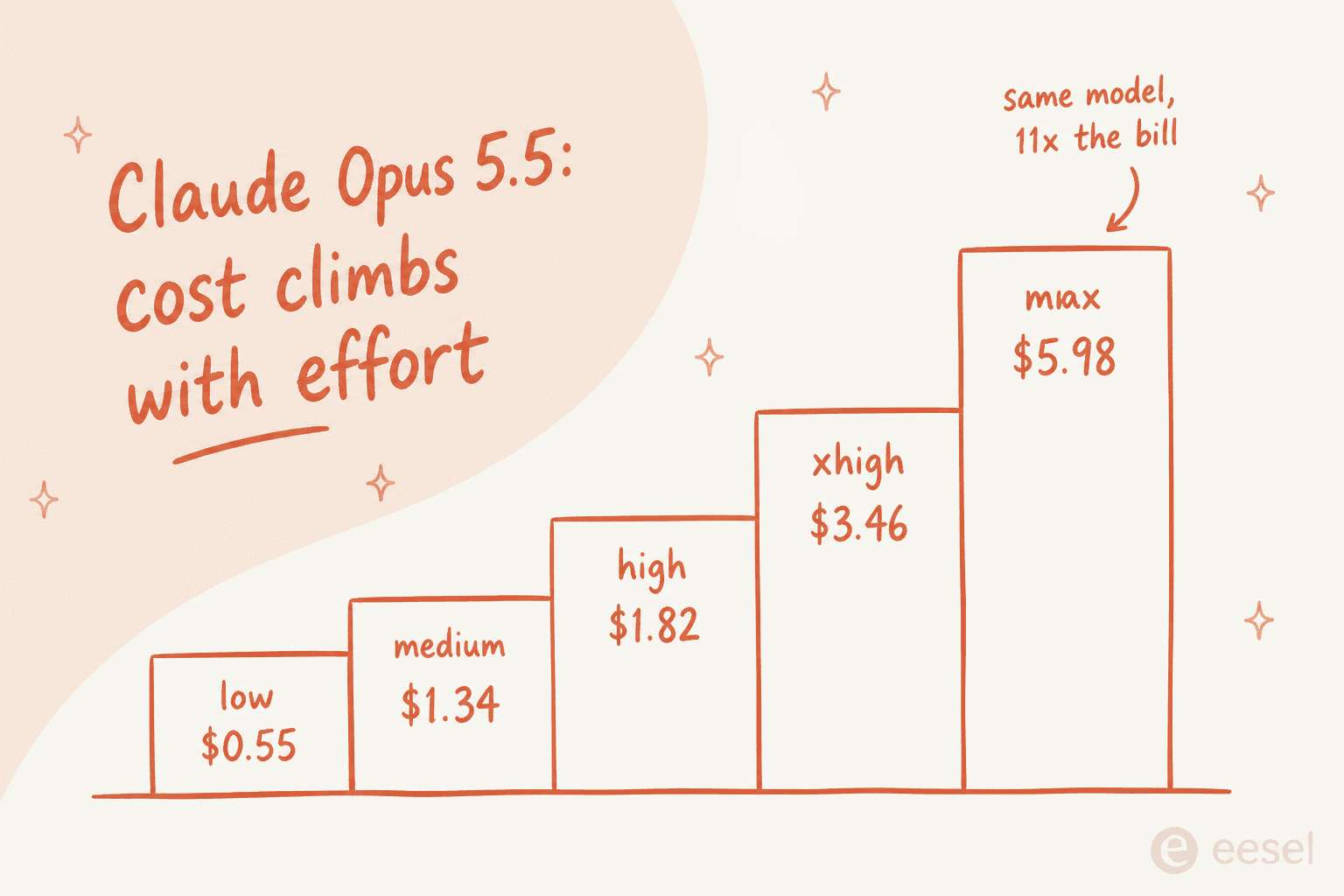
I've spent the last few years putting AI on live customer support queues, and the thing that surprised me most about frontier models wasn't the quality, it was that the bill tracks the effort dial far more than the sticker price. Opus 5.5 is a perfect example. The per-token rate is mid-pack, but its per-task cost swings from about $0.55 at low effort to $5.98 at max, because at high effort it reasons for longer and emits more tokens.
So the reasons people go shopping are usually one of four:
- Cost per finished task. A model that scores a few points lower but costs a fifth as much per task is the better buy for most workloads.
- Speed. Opus is deliberate. For anything a human waits on, like a chat reply, latency matters more than a benchmark.
- Open weights. Some teams need to self-host for privacy, sovereignty, or cost control.
- Multimodal breadth or context. Audio, video, or a genuinely huge context window can be the deciding feature.
Here's how the eight alternatives I'd actually consider stack up before we get into each one.
The Claude Opus 5.5 alternatives at a glance
| Model | Best for | Price /1M (in / out) | Context | Open weights | Native vision |
|---|---|---|---|---|---|
| Claude Opus 5.5 (incumbent) | Hardest agentic coding | $4 / $20 | ~1M | No | Yes |
| GPT-6 Sol | Frontier quality, cheaper per task | $2 / $10 | 1.05M | No | Yes |
| Gemini 3.8 Flash | Cheap multimodal at scale | $0.75 / $3.75 | 1M | No | Yes (+ audio/video/PDF) |
| Grok 4.7 | High-volume agent loops | $2 / $6 | 500K | No | Yes |
| Qwen 3.8 Max | Multimodal value, open base | $2 / $6 | 1M | Base only | Yes |
| Kimi K3 | Open weights with vision | $3 / $15 | 1M | Yes | Yes |
| DeepSeek V4 Flash | The cost floor | ~$0.22 / $0.66 | 1M | Yes (MIT) | No |
| GPT-6 Luna | Cheapest at scale | $0.10 / $0.50 | 1.05M | No | Yes |
| Claude Sonnet 5 | Staying in the Claude family | $2 / $10 | ~1M | No | Yes |
Prices are standard short-context list rates per million tokens, checked September 2026. DeepSeek's figure is the off-peak cache-miss input and standard output rate. Gemini 3.8 Flash's rate is promotional through December 31, 2026, then doubles.
A quick note on how I picked. This is a shortlist, not a catalogue, so I weighted three things: a real, checkable price (per token and, where Artificial Analysis has measured it, per task), how the model actually behaves versus its marketing, and whether it fills a gap Opus 5.5 leaves open. Anything that was just "Opus but slightly worse at the same price" didn't make it.
1. GPT-6 Sol: the closest frontier rival, at a fifth of the cost
Best for: teams that want near-frontier quality but can't stomach Opus 5.5's per-task bill.
GPT-6 Sol launched on September 23, 2026, one day after Opus 5.5, and it's the most direct comparison on this list. It carries a 1,050,000-token context window, native image input, and the full OpenAI Responses tool set including web search, code interpreter, hosted shell, computer use, and MCP.
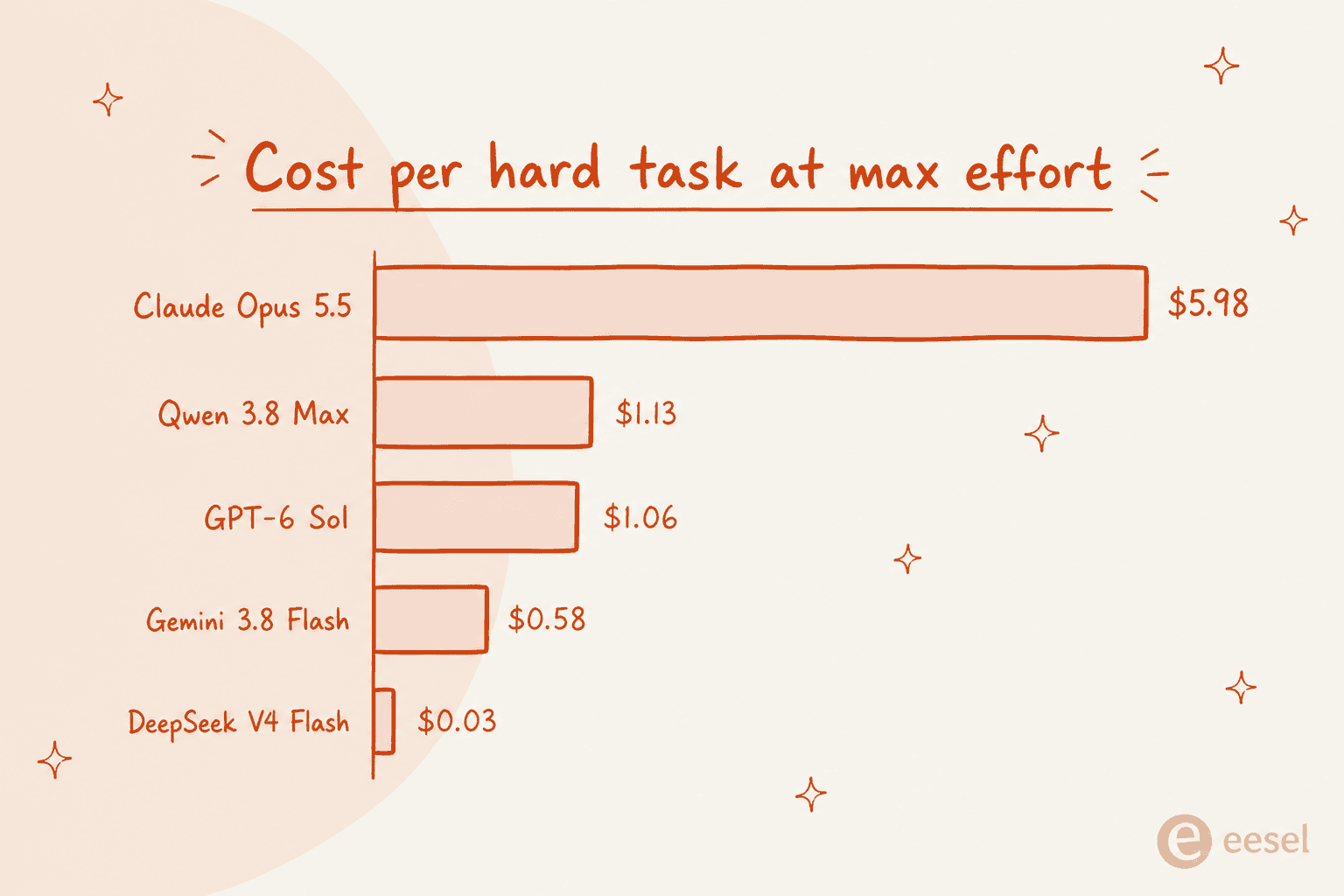
On raw intelligence, Opus wins: Artificial Analysis scores Sol at 48 on its Intelligence Index against Opus 5.5's 58. But look at what each point costs. Sol is $2/$10 per million tokens, half of Opus, and at max effort it finishes a hard task for about $1.06 versus Opus's $5.98, partly because it emits far fewer output tokens. That's the sharpest number in this whole post.
There's a real debate about whether that gap is worth it, and the community is split down the middle. Here's one experienced tester on the launch thread:
My initial takeaway is that GPT-6 is mostly a lower cost win, for Luna. GPT-6 Max is an upgrade on intelligence too, but its mostly a cost play (which is great, not complaining). I personally am preferring Opus 5.5 at medium over GPT-6 Sol Max, in very very early tests. Similar price range, more capability.

Pros: roughly 5x cheaper per task at max effort, cleaner default prose, a huge context window, and a genuine factuality improvement (OpenAI reports around half the mistakes of the prior Sol; max-effort hallucination dropped from 92% to 60% on Artificial Analysis).
Cons: a lower reasoning ceiling than Opus 5.5, and it's not on ChatGPT's free tier, so casual access means a paid plan.
Verdict: for most build-an-agent workloads, Sol is the smarter buy. You give up a slice of peak reasoning and get most of it back in speed and budget. If you're running many tasks and watching the invoice, start here.
2. Gemini 3.8 Flash: the cheap, genuinely multimodal option
Best for: high-throughput jobs that need audio, video, or PDF input on a tight budget.
Gemini 3.8 Flash is Google's third Flash release in six weeks, and it does something odd: it outscores Opus 5.5 on the Artificial Analysis Intelligence Index (59 to 58) while costing a fraction as much, at $0.75/$3.75 per million tokens through the end of 2026. It's also the only model here that natively ingests image, audio, video, and PDF, with a 1M-token input window.
The honest caveats matter, though. Time to first token is 13.30s against a class median near 3s, so it's disqualifying for anything a human waits on live and perfect for an overnight batch. It's also verbose, and Google itself tells you in the launch post that efficiency-first workloads should stay on 3.7 Flash. On price and multimodal reach it's excellent; on responsiveness it isn't.
Pros: frontier-level Intelligence Index score, the broadest input types on the list, very cheap, and a free tier for testing.
Cons: slow first token, verbose output that eats into the price advantage, and a January 1, 2027 price doubling to $1.50/$7.50 already on the calendar.
Verdict: if your workload is asynchronous and multimodal, this is arguably the best value on the page. Just don't put it behind a live chat widget where the 13s first-token delay will show. For the difference between an async agent and a real-time one, our piece on AI agents versus rule-based chatbots is a useful frame.
3. Grok 4.7: priced to live inside agent loops
Best for: high-volume, multi-hour agentic coding where per-token cost compounds.
Grok 4.7 shipped on September 21, 2026, built on a larger base model than 4.6 with a longer reinforcement-learning run weighted toward multi-hour tasks. It's $2/$6 per million tokens below a 200K prompt, which is the cheapest output rate of any frontier-tier model here, and it has a 500K context window plus a new Context Compaction API for long sessions.
The benchmark story is "frontier-adjacent at last year's prices." On xAI's own table, Grok 4.7 posts Terminal-Bench 4.0 of 37.6 (nearly double 4.6's 20.3), EEBench 64.0, and a Harvey Legal Agent score of 19.6 that actually beats both Sol and Opus-class models. It doesn't win everywhere, though. On HealthBench Professional it scores 56.7, behind both GPT-6 Sol and Anthropic's top tier.
Pros: the low output rate makes it well-suited to loops that burn tokens, a real jump in coding and terminal benchmarks, and the strongest xAI safety stack yet.
Cons: a 500K context window that's half of the 1M-token rivals, the long-context surcharge ($4/$12) applies to every token in the request once you cross 200K, and it loses to the frontier on health and some reasoning evals.
Verdict: if you're wiring a coding agent that runs for hours and you care about the per-token meter more than the last few points of reasoning, Grok 4.7 is a strong, honest pick. There's also an xAI CLI if you want to drive it from the terminal.
4. Qwen 3.8 Max: frontier-tier Intelligence Index, half the price
Best for: teams that want an Opus-class Intelligence score with a downloadable base to fall back on.
Qwen 3.8 Max went generally available on August 2, 2026, and it's quietly one of the better-value frontier models. It's a 2.4T-total / 95B-active mixture-of-experts model with a 1M-token context, priced at $2/$6 per million tokens on Alibaba's cloud. On the Artificial Analysis board it now ranks sixth with an Intelligence Index of 58.08, effectively level with Opus 5.5's headline number, for a fraction of the cost.
The nuance is that automated indexes and human preference disagree here. On LMArena, Qwen 3.8 Max is strong on blind preference: Text #5, WebDev #4, and Vision #2. But the composite index and the human votes point in slightly different directions, so I'd never ship a single-number verdict on it. Note too that the open base weights exist but aren't feature-equivalent to the hosted Max, which adds vision, non-thinking mode, and built-in tools.
Pros: frontier-level Intelligence Index at $2/$6, excellent multimodal LMArena rankings, and an open base for teams that want a self-host option.
Cons: the open weights carry a non-Apache license and lack the hosted model's features, and the automated-versus-human score gap means you should test on your own tasks.
Verdict: an underrated pick. If you want something that benchmarks near Opus 5.5 for less and you're comfortable running your evals rather than trusting one score, Qwen 3.8 Max deserves a slot on your shortlist.
5. Kimi K3: open weights that actually see
Best for: teams that want a genuinely open, vision-capable frontier model.
Kimi K3 is Moonshot AI's flagship, a 2.8T-total / 104B-active mixture-of-experts model with a 1M-token context and native vision (image and video). Crucially, the open weights shipped on time, on July 27, 2026, and the safetensors index confirms the 2.8T parameter count from outside the press release. On the Artificial Analysis Intelligence Index it lands at 57, in the same neighbourhood as Opus 5.5.
Pricing is $3/$15 per million tokens, which is the Claude Sonnet band rather than the bargain-basement tier. One quirk worth knowing: reasoning can't be turned off. The reasoning_effort control now has low and high levels, but they're a latency control, not a cost tier, since every level bills the same. A public image URL isn't accepted either; you pass base64 or a file ID.
Pros: truly open weights with vision, a frontier-adjacent Intelligence score, and strong agentic and BrowseComp results.
Cons: priced like Sonnet rather than like the cheap open models, reasoning that can't be disabled, and image handling that needs base64 rather than URLs.
Verdict: the pick when "open weights" and "handles images" both have to be true. If you only need one of those, DeepSeek is cheaper and Qwen benchmarks higher, so Kimi K3 is a specific choice rather than a default.
6. DeepSeek V4: the cost floor, with an asterisk
Best for: the absolute lowest cost per token, and teams that want MIT-licensed weights.
DeepSeek V4 Flash is the cheapest way to run a capable model on this list, full stop. It's a 284B-total / 13B-active mixture-of-experts model with a 1M-token context and MIT open weights, and on Artificial Analysis it scores an Intelligence Index of 50 at roughly $0.03 per task at max effort, which is not a typo.
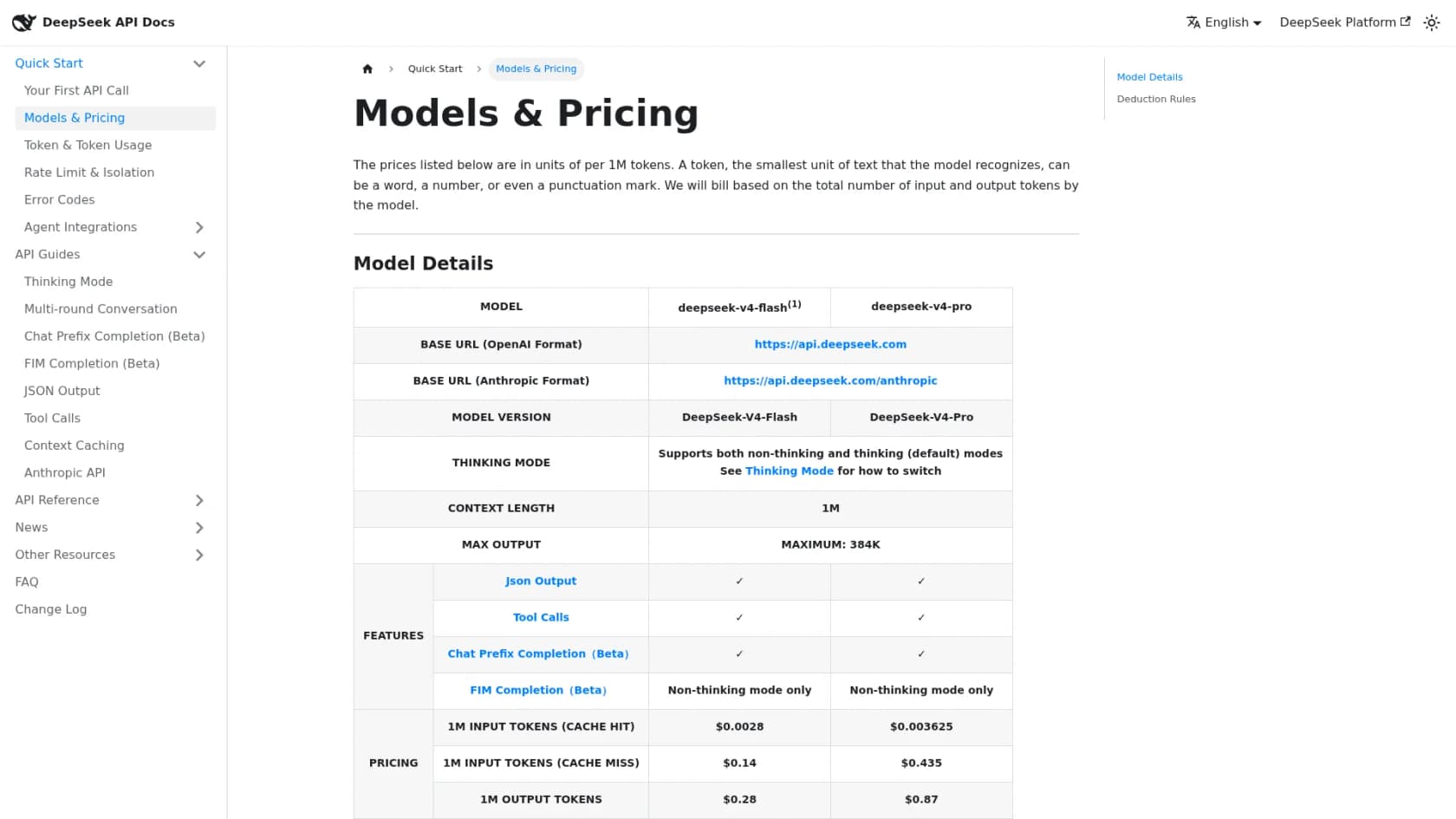
The asterisks are real and worth stating plainly. Pricing carries a peak/off-peak surcharge: cache-miss input is $0.22/$0.44 and output $0.66/$1.32 per million (off-peak / peak), where peak is Chinese business hours, so a US or EU queue mostly bills off-peak. The model is text-only, with no documented image input. And its data sits in the PRC under PRC law, while the paid-API terms are silent, not permissive, on training use. That combination makes it a poor drop-in for regulated customer data, even though it's a fantastic engine for code and internal tooling. One developer put the practical case bluntly:
I have been using DeepSeek since forever and it's so good I was able to write a compiler and native desktop applications with it. I use it as a coding assistant in my IDE so the results end up at the same quality I would write by hand.
Pros: the lowest per-task cost anywhere, MIT-licensed open weights, and a 1M-token context.
Cons: text-only, verbose with a high hallucination rate, a fragile peak-pricing quirk, and PRC data residency that rules it out for sensitive customer data.
Verdict: the value champion for code and internal work where the data isn't sensitive. Pair it with our guide to AI hallucinations before you point it at anything customer-facing.
7. GPT-6 Luna: the cheapest way to scale
Best for: high-volume, lower-stakes work where a few points of intelligence don't change the outcome.
GPT-6 Luna is OpenAI's budget tier, and it's aggressively cheap at $0.10/$0.50 per million tokens, a flat 50% cut from GPT-5.6 Luna. It shares Sol's 1,050,000-token context and native image input, and it's the only GPT-6 model available on ChatGPT's Free and Go ($8) plans. OpenAI's own framing is "build with Sol, scale with Luna," and the market seems to agree; the prior Luna was already the most-used model on OpenRouter.
6-luna is at the pareto for most of the tasks! I dont know how they make money here but its insane value from a closed source model.
The honest counterpoint is that "cheapest per token" and "cheapest per task" aren't the same thing. On heavily-cached coding workflows, some developers find open models like DeepSeek work out cheaper still because of the cache-read differential, so run your own numbers if caching dominates your usage.
Pros: the cheapest closed-frontier-family option, a big context window, and free-tier access for testing.
Cons: the lowest reasoning ceiling of the GPT-6 line, and per-task math that can lose to open models on cache-heavy jobs.
Verdict: the right tool for volume, classification, translation, and simple agent steps. It's not the model you hand your hardest reasoning task, but it's a superb workhorse and a great default for the boring 80%.
8. Claude Sonnet 5: stay in the family, pay half
Best for: teams that like Claude's tooling and ecosystem but don't need Opus on every call.
If the reason you're on Opus 5.5 is the Claude ecosystem, Claude Sonnet 5 is the obvious in-house alternative. It's $2/$10 per million tokens, exactly half of Opus, and Anthropic positions it as the best balance of speed and intelligence. You keep the same API, the same Claude Code integration, and the same tool ecosystem; you just stop paying Opus rates for tasks that don't need Opus reasoning.
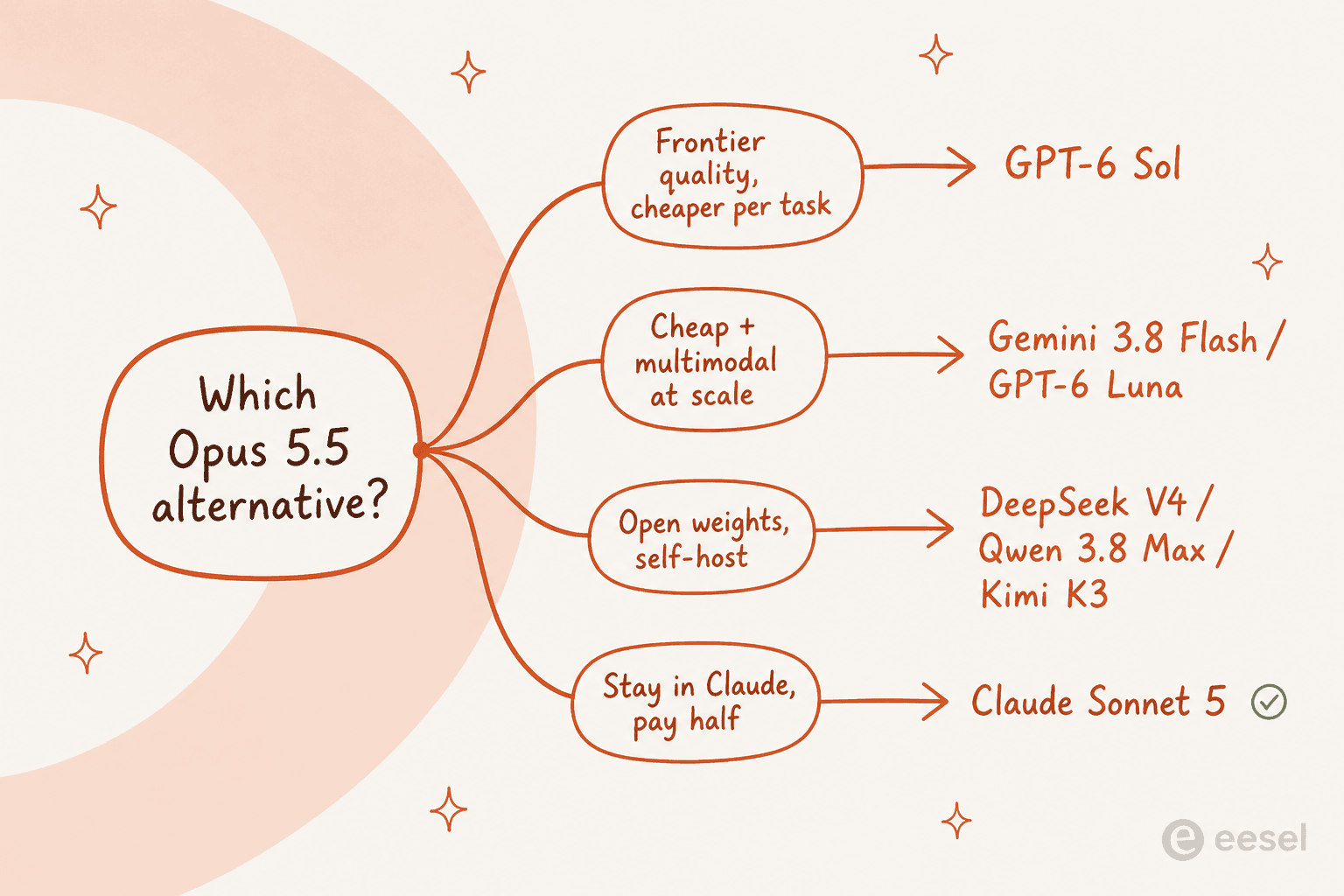
The most sensible pattern I've seen is a two-model setup: route the hard, ambiguous tasks to Opus 5.5 and everything else to Sonnet 5. It captures most of Opus's ceiling on the tasks that need it while cutting the bill on the ones that don't.
Pros: half the price of Opus, no ecosystem switch, and Anthropic's speed-tuned tier.
Cons: a lower reasoning ceiling than Opus 5.5, and you're still inside one vendor's pricing.
Verdict: the lowest-friction alternative on this list. If you're happy with Claude and just want to spend less, this is the change to make before you go looking anywhere else.
How I'd actually choose
Strip away the leaderboard and the decision comes down to a few honest questions. There's no single winner, because "best" depends on the shape of your workload.
- Want the closest thing to Opus for far less? GPT-6 Sol. Near-frontier quality, about a fifth of the per-task cost.
- Running async, multimodal jobs at scale? Gemini 3.8 Flash for reach and price, or GPT-6 Luna for the cheapest per-token rate.
- Need open weights? DeepSeek V4 for the cost floor, Qwen 3.8 Max for the highest benchmark, Kimi K3 if you also need vision.
- Happy with Claude? Sonnet 5 at half the price, ideally routed alongside Opus for the hard tasks.
And there's a quieter point under all of this, one that experienced developers keep landing on. The benchmarks are a starting gun, not a verdict:
Only hands-on experience matters in the end, and these days it's very easy to switch models.
That last clause, "very easy to switch models," is the real story of 2026. Which leads to the question most of these comparisons skip.
Try eesel: the teammate that runs on any of these models
Here's the thing every model-versus-model post quietly assumes: that your job is to pick a model, wire up its API, handle the prompt engineering, connect it to your tools, and keep the whole thing from hallucinating on live customers. For most teams, that's not the job. The job is a higher resolution rate, or published posts. The model is just the engine.
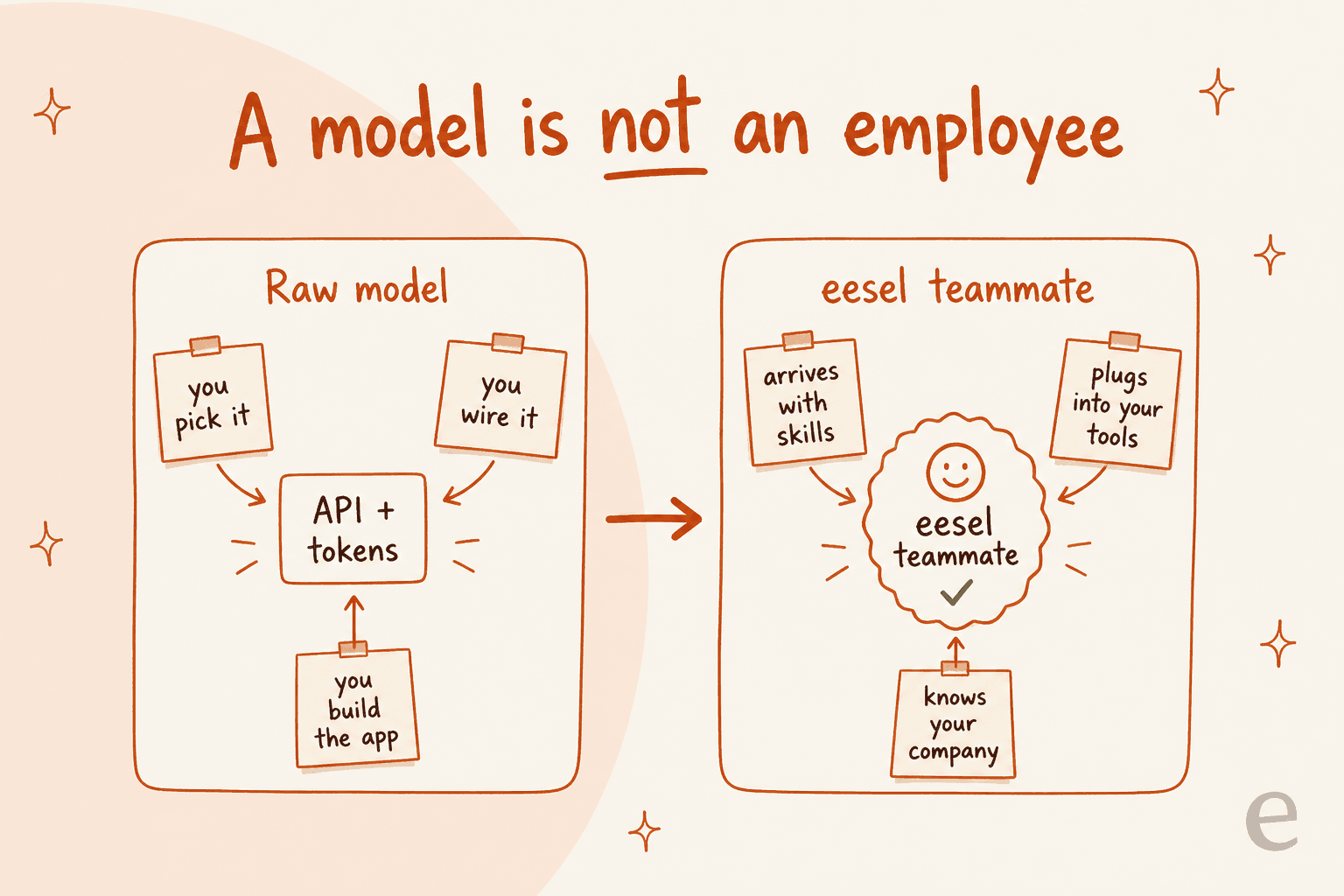
That's how I'd frame eesel. It's an AI teammate platform, and you hire ready-to-work teammates for specific jobs. The current roster is an AI helpdesk teammate that joins your existing support queue and an AI blog writer that drafts researched posts. Each one arrives already knowing how to do its job, plugged into your tools, and grounded in your company's context, so you're not the one choosing between Opus 5.5 and Sol and babysitting a prompt. Because the model sits underneath the teammate, a cheaper or better model shipping next month is a free upgrade, not a rebuild.
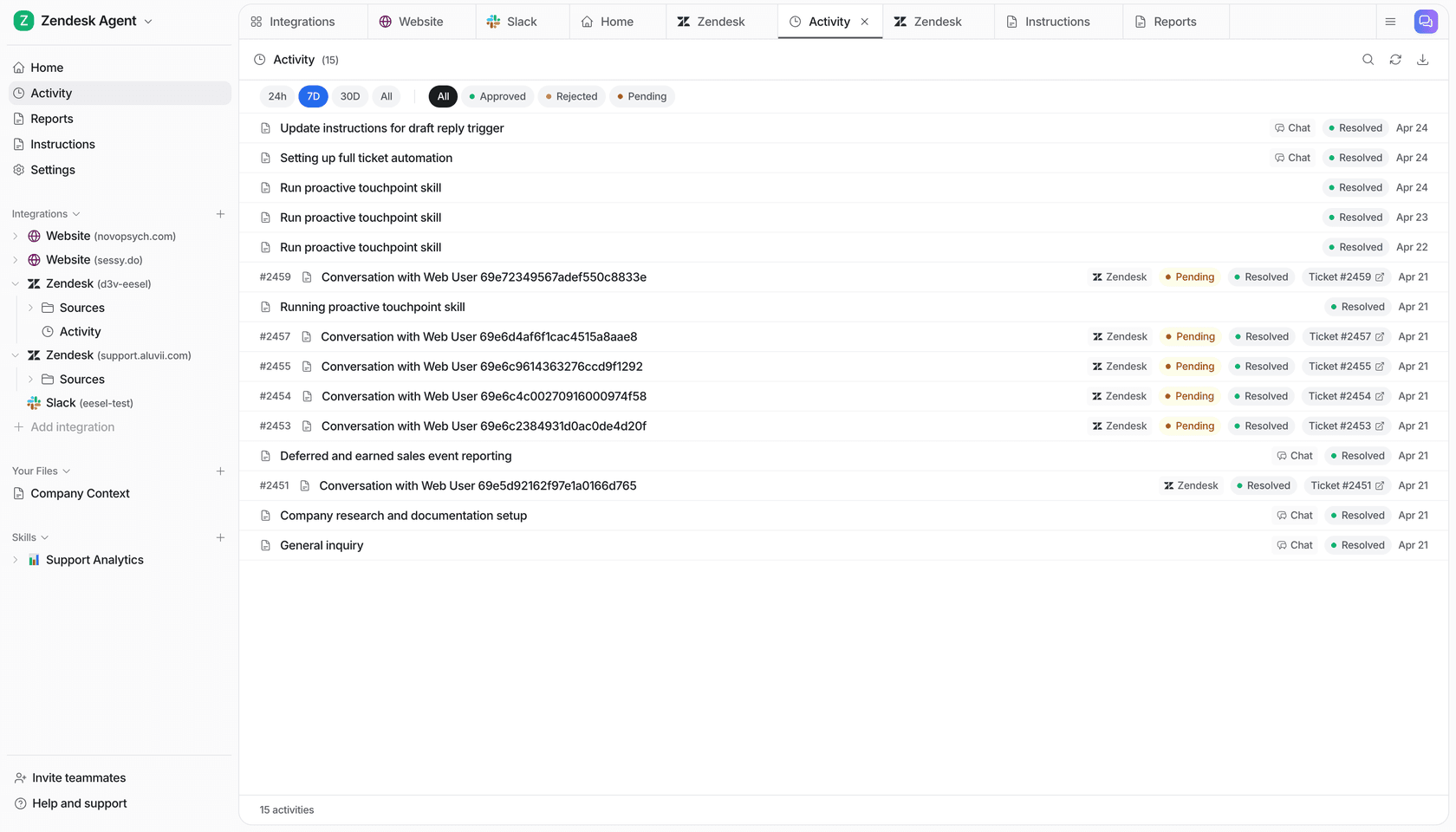
If you're the kind of person who reads a model-alternatives post, you'll like this part: the whole thing is drivable from the terminal. The eesel CLI (npx @eesel/cli) lets you connect integrations, edit the agent's standing instructions, simulate a rollout against your historical tickets, approve actions, and read the activity log of every run, all as JSON, with a --dry-run flag that prints the exact call a write would make before it sends. Every workspace is also an MCP server, so coding agents like Claude Code, Codex, and Cursor can operate the same teammate. It's the same product as the dashboard, exposed for people and agents who live in a terminal. You can try eesel free.
Frequently Asked Questions
What is the best Claude Opus 5.5 alternative?
How much does Claude Opus 5.5 cost, and are the alternatives cheaper?
Are there open-source alternatives to Claude Opus 5.5?
Which Claude Opus 5.5 alternative is best for coding agents?
Do I have to pick one model to build an AI support agent?


Article by
Kurnia Kharisma Agung Samiadjie
Kurnia is a software engineer and writer at eesel AI with two years of SEO experience, writing about AI tools, helpdesk software, and customer support. He pairs a developer's understanding of how these products are built with search-driven research into what actually ranks and resonates with the people searching for them.