8 best Claude Sonnet 5.5 alternatives in 2026 (by why you're leaving)

Kurnia Kharisma

Katelin Teen
Last edited September 29, 2026

Why people look past Claude Sonnet 5.5
The fair part goes first. Sonnet 5.5 is a big step over Claude Sonnet 5. Anthropic's launch table puts it at 70.6% on Terminal-Bench 4.0, ahead of Opus 5.5's 66.4%, and Zendesk told Anthropic tickets were processed 20% faster with it. The Sonnet 5.5 review goes through all of that, and my colleague's verdict there still holds, which is great at Medium effort.
I've spent two years on SEO, so the search behaviour around this model told me something even before any benchmark did. "Sonnet 5.5 alternatives" started showing up the day after launch, which is too early for anybody to have outgrown the model. People were searching because something broke, or because a bill surprised them. These are the four reasons I organise the rest of the post around.
Reason 1: five breaking changes, and one hits bots hardest
Anthropic lists five breaking changes for code that ran on Sonnet 5. thinking: disabled now returns a 400 and points you to between_tools. The old computer_20251124 tool is rejected on the Claude API and Google Cloud. Some advisor tool pairings are also refused.
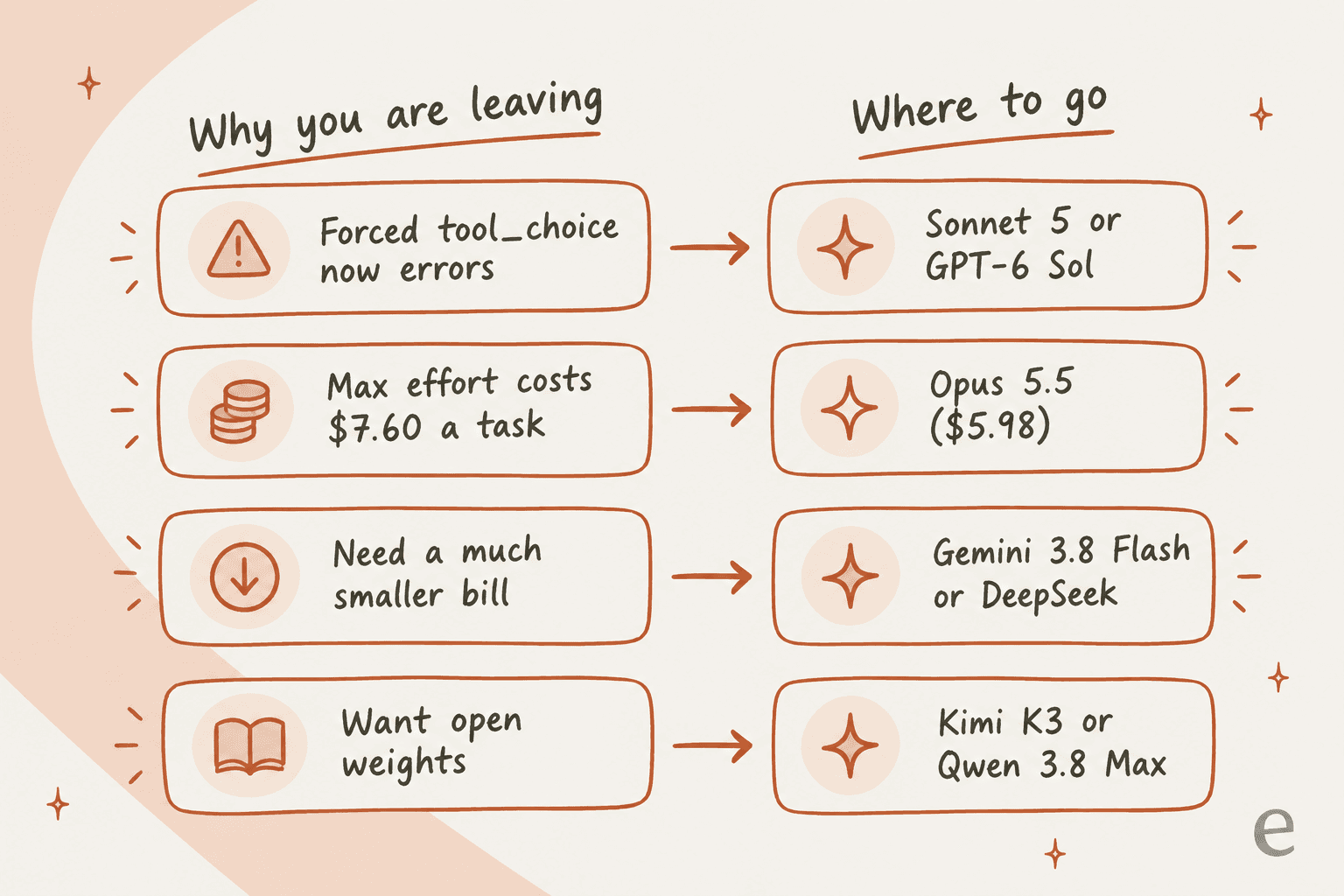
The one that breaks production bots is forced tool use. tool_choice set to any or to a named tool returns a 400 invalid_request_error on Sonnet 5.5. Anthropic's suggested fix is to keep auto, set strict: true, or move to structured outputs, and to "say in the prompt when the tool applies." That works, but in the end it swaps a guarantee for a request. If your ticket triage or extraction step relied on the model always calling classify_ticket, you now have a behaviour to re-test and not a line to change. And moving up to Opus 5.5 doesn't help here: its migration notes list the same 400.
Reason 2: max effort costs more than Opus
Sonnet 5.5's API default effort is high. At the top of the ladder it becomes expensive. On Artificial Analysis's Intelligence Index, Sonnet 5.5 at max scored 56 for $7.60 per task, while Opus 5.5 at max scored 58 for $5.98. Sonnet just used more tokens to get to that score.
"I'm a bit confused myself. On artificial analysis, sonnet 5.5 max has a cost per task of $7.60 while opus 5.5 max has $5.98. Sonnet 5.5 max was using 193k tokens per task while opus 5.5 max was using 119k."

Simon Willison saw the same shape, only on one single prompt. His effort table ran from 1.6 cents at low to $1.28 at max, where the model "burned through 128,000 thinking tokens" in about 15 minutes and failed to finish (simonw on Hacker News).
Reason 3: cache reads cost the same as Opus
Sonnet 5.5 is half the price of Opus 5.5 on input, output and cache writes. Cache reads are the exception, $0.20 per million on both, because Opus 5.5 bills cache reads at 0.05x. On a long agent loop most of the tokens go to cache reads, so the gap closes. The Anthropic API pricing page has the multipliers.
"Cache read is the same as Opus as well where most agentic workflow cost comes from. Not quite sure where this fits well."

Reason 4: the same sticker buys very different work
This is the chart that surprised me most while I was researching. Three models share the exact same $2 in / $10 out price. At max effort they still produce very different bills for each finished task.
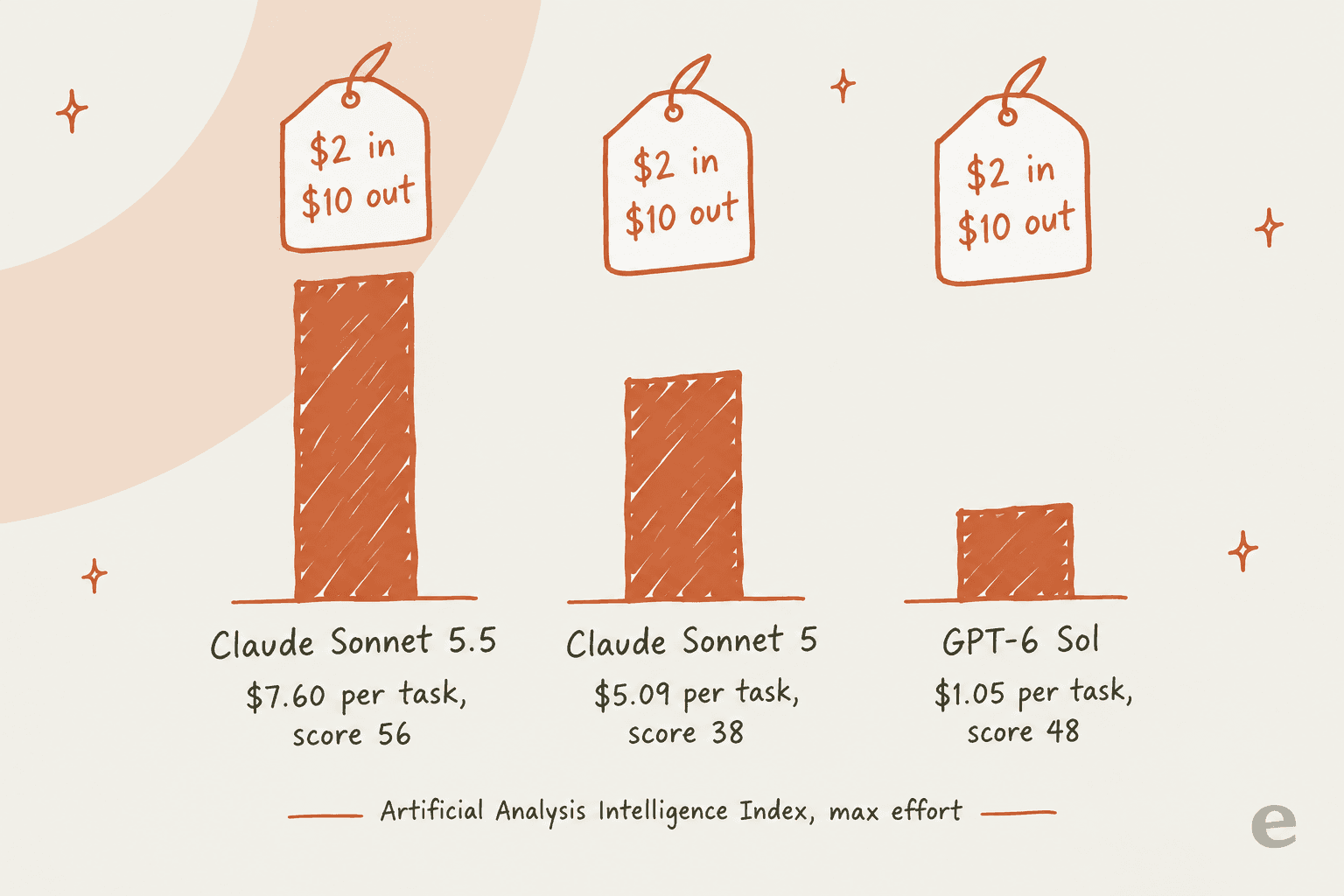
Sonnet 5.5 is the smartest of the three. It's also the most expensive one per task, by a wide margin. The per-token sticker tells you almost nothing about the bill. What matters is tokens per task, which is a property of the model that you only learn by running it.
Claude Sonnet 5.5 alternatives at a glance
Prices are per million tokens on each vendor's own pricing page, checked on 2026-09-29. The Artificial Analysis column uses the current Intelligence Index scale, with the effort setting AA tested in brackets. I left a cell blank instead of mixing in a score from the older scale.
| Model | Input / output | Cache read | Context | AA score, cost per task | Forced tool choice | Open weights | Best for |
|---|---|---|---|---|---|---|---|
| Claude Sonnet 5.5 (baseline) | $2 / $10 | $0.20 | 1M | 56, $7.60 (max) | No, returns 400 | No | Fast coding at Low/Medium |
| Claude Opus 5.5 | $4 / $20 | $0.20 | 1M | 58, $5.98 (max) | No, returns 400 | No | Hard tasks at high effort |
| Claude Sonnet 5 | $2 / $10 | $0.20 | 1M | 38, $5.09 (max) | Yes | No | Zero-rewrite fallback |
| GPT-6 Sol | $2 / $10 | $0.20 | 1.05M | 48, $1.05 (max) | Yes (Responses API) | No | Same price, lower bill |
| Gemini 3.8 Flash | $0.75 / $3.75 | $0.075 | 1M | 41, $1.24 (high) | Yes (any mode) | No | Cheap multimodal batch work |
| Grok 4.7 | $2 / $6 | $0.50 | 500K | 46, $3.74 (xhigh) | Yes (required or named) | No | Long agent loops |
| Qwen 3.8 Max | $2 / $6 | $0.25 | 1M | - | Named tool, non-thinking only | Base model, custom licence | Cheaper output, open base |
| Kimi K3 | $3 / $15 | $0.30 | 1M | - | required only | Yes, custom licence | Open weights with vision |
| DeepSeek V4.1 Flash | $0.15 / $0.60 off-peak | $0.003 | 1M | 39, $0.27 (max) | Non-thinking mode only | Yes, MIT | The cost floor |
The forced tool choice column comes from each vendor's own function-calling docs. Read it carefully, because this is the column most people get wrong. Anthropic's tool definition docs list Opus 5.5, Sonnet 5.5 and Fable 5.1 together as models where any and tool return a 400. DeepSeek and Qwen only allow forced tools with thinking turned off, and Kimi K3, which always thinks, accepts required but not a named tool. Only Sonnet 5, GPT-6 Sol, Gemini 3.8 Flash and Grok 4.7 force a tool call with reasoning on.
How I picked these
I started from the four reasons above, then I asked one question for every candidate: does this model fix a specific reason someone leaves Sonnet 5.5, without creating a worse one? Every price comes from the vendor's own pricing page. Every cost-per-task figure comes from Artificial Analysis, which runs the same Intelligence Index on each model and publishes what it spent. Community quotes come from Hacker News and Reddit threads where people ran the models themselves.
I left out Claude Haiku 4.5 as a main pick. It's a real option at $1/$5, but Anthropic lists its earliest retirement as October 15, 2026, about two weeks from now, and I wouldn't start a migration onto a model with that date on it.
Find your alternative in ten seconds
Tap the reason that brought you here.
Why are you leaving Claude Sonnet 5.5?
Pick one to see where I'd go.
1. Claude Opus 5.5
Best for: teams that run Sonnet 5.5 at xhigh or max effort and are paying for it.
I put the counterintuitive pick first. Claude Opus 5.5 costs twice as much per token, and it can still be the cheaper model. At max effort on Artificial Analysis, Opus 5.5 scored 58 for $5.98 a task, Sonnet 5.5 scored 56 for $7.60. Opus shipped as Anthropic's first Opus to get cheaper, $4/$20 down from $5/$25, and its cache reads bill at 0.05x, which is why they match Sonnet's $0.20.
It also rewards going lower. The Sonnet 5.5 pricing breakdown found Opus 5.5 at Medium scoring 51 for $1.34 a task, against Sonnet 5.5 at Xhigh scoring 52 for $2.74. Nearly the same score, for about half the money.
Pros
- Higher ceiling than Sonnet 5.5 on the Intelligence Index, 58 to 56 at max.
- Cheaper per task than Sonnet 5.5 at max effort.
- Same Claude API, same tooling, same Claude Code workflows.
Cons
- Twice Sonnet's per-token price on input, output and cache writes, so at Low and Medium Sonnet 5.5 wins.
- Slower, which people on the launch thread noticed straight away.
- Rejects forced
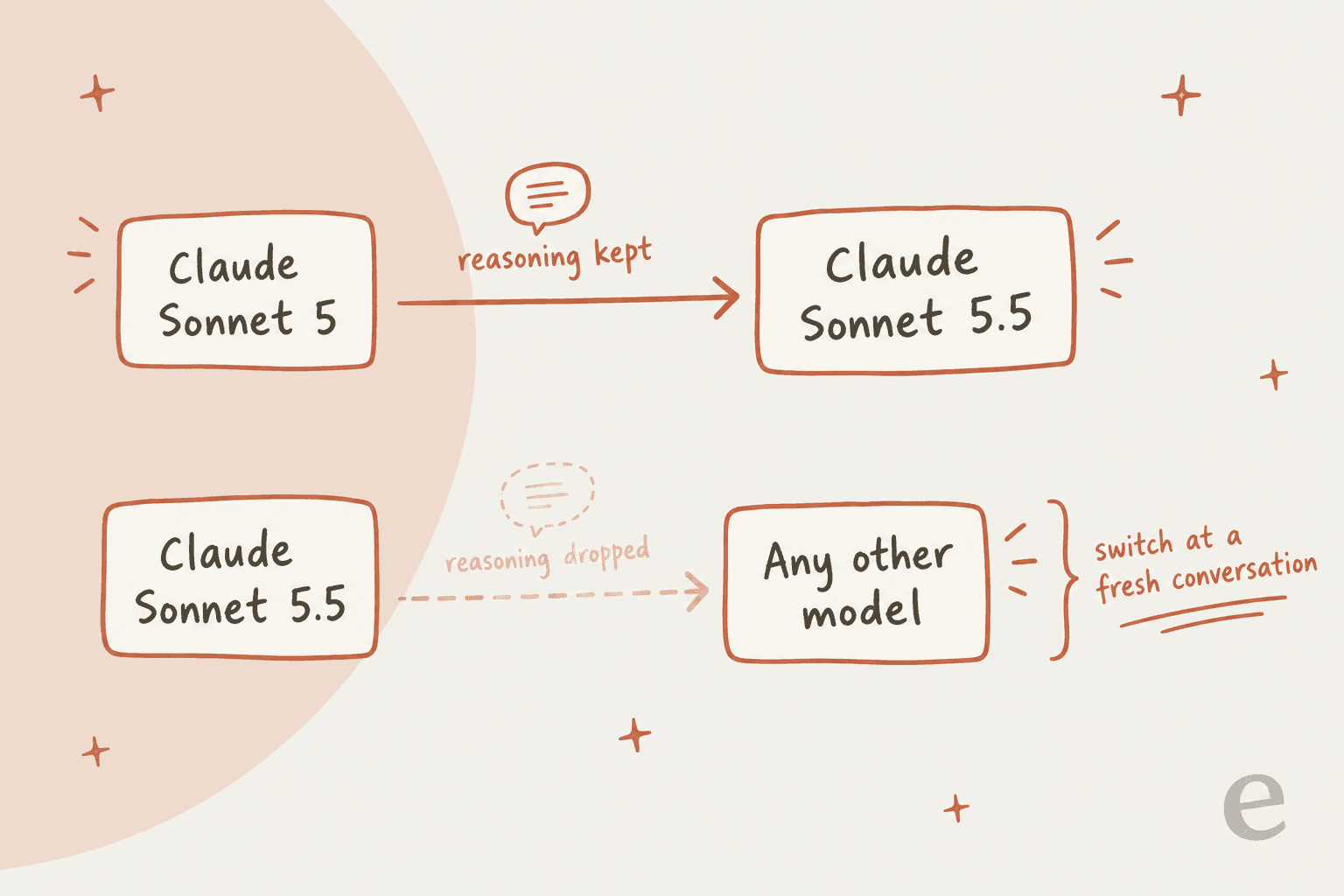
tool_choiceexactly like Sonnet 5.5, so it's no fix for that breaking change. - Sonnet 5.5 can't read Opus 5.5's thinking blocks and vice versa, so mixing them in one conversation drops reasoning.
Pricing
$4 input, $20 output, $0.20 cache read per million tokens, with Batch at half price. See the Claude Opus 5.5 pricing post for every line.
My take: If your workload lives at xhigh or max, move up to Opus 5.5 and drop an effort level. You'll likely pay less and get a better answer. If you run at Low or Medium, stay on Sonnet 5.5; this pick doesn't apply to you.
2. Claude Sonnet 5
Best for: anyone whose production code broke on Sonnet 5.5's forced tool use or thinking: disabled change.
This is the boring answer, but on the day when your pipeline starts throwing 400s it is the right one. Claude Sonnet 5 is the model all five breaking changes are measured against, so by definition none of them apply. It's the same $2/$10 price. Anthropic's deprecations page lists it as active, with no retirement before June 30, 2027.
There is a nice detail in the docs for anyone planning a staged move. Sonnet 5.5 can read Sonnet 5's thinking blocks, so a conversation that starts on Sonnet 5 and moves up keeps its reasoning. The reverse doesn't work.
Pros
- A one-line rollback: change the model ID, nothing else.
- Keeps forced
tool_choice, manual thinking budgets and the older computer-use tool. - Retirement floor more than 20 months out.
Cons
- Clearly less capable. Terminal-Bench 4.0 is 10.3% against Sonnet 5.5's 70.6% on Anthropic's launch table.
- Not cheaper per task either. At max it measured
$5.09for a score of 38. - No longer in Anthropic's current-models table, so new features will land on 5.5 first.
Pricing
$2 input, $10 output, $0.20 cache read per million tokens. The Claude Sonnet 5 pricing post has plan and Batch details.
My take: Use Sonnet 5 as a parking spot, not a destination. Roll back today, fix your tool calls on a branch against Sonnet 5.5 or GPT-6 Sol, then move forward. The Claude Sonnet 5 alternatives list is worth a look if you're parking longer.
3. GPT-6 Sol
Best for: teams that want Sonnet-class pricing with forced tool calls and a smaller bill per task.
GPT-6 Sol has the identical sticker to Sonnet 5.5: $2 input, $0.20 cached, $2.50 cache writes, $10 output (OpenAI pricing). The difference is how many tokens it spends. At max effort on Artificial Analysis, GPT-6 Sol scored 48 for $1.05 a task, about a seventh of Sonnet 5.5's max-effort bill. It's less capable at the top: 48 against 56.
For the forced-tool-use crowd, OpenAI's function calling guide documents required and named-function tool choice. One catch on the model page: through Chat Completions, GPT-6 Sol only supports function calling with reasoning_effort set to none. Use the Responses API if you want tools and reasoning together.
Pros
- Same per-token price as Sonnet 5.5, much lower cost per task at max.
- Documented forced tool choice.
- 1,050,000-token context and a full Responses API tool set.
Cons
- Lower ceiling: 48 on the Intelligence Index against Sonnet 5.5's 56.
- Prompts over 272K input tokens bill at 2x input and 1.5x output for the whole request.
- A vendor switch means new SDK code, new prompt tuning and new evals.
"Sonnet 5.5 is way better than GPT 6 Sol. Does that even make sense?"
That comment is an honest counterweight to the numbers. On hard coding work plenty of people prefer Sonnet 5.5, and the benchmarks back them.
Pricing
$2 input, $0.20 cached, $10 output, with Batch and Flex at half. The GPT-6 Sol pricing post and the GPT-6 Sol alternatives list go deeper.
My take: The best straight swap for high-volume, tool-heavy work where "good and cheap per task" beats "best." For peak coding quality, stay with Anthropic.
4. Gemini 3.8 Flash
Best for: high-volume batch and multimodal work where nobody is waiting on the first token.
Gemini 3.8 Flash is $0.75 in and $3.75 out per million tokens, thinking tokens included, through December 31, 2026 (Gemini API pricing). That's under 40% of Sonnet 5.5's rates. It takes text, image, audio, video and PDF input, which Sonnet doesn't match on audio and video. On Artificial Analysis at high effort it scored 41 for $1.24 a task.
There are two things to plan around. The price doubles to $1.50/$7.50 on January 1, 2027. And Artificial Analysis measured its time to first token at 13.3 seconds, far above the class median, even though its output speed ranks near the top. Good for an overnight job, poor for a live chat reply.
Pros
- Much cheaper per token, with Batch and Flex at half again.
- Broadest input types on this list.
- A free tier to prototype on.
Cons
- Price doubles in three months.
- Slow first token rules it out for anything a person waits on.
- Google says 3.8 "works harder" and uses more tokens, and still recommends 3.7 Flash for efficiency-first work.
Pricing
$0.75 input, $3.75 output, $0.075 cache read until year end. See Gemini 3.8 Flash pricing and the Gemini 3.8 Flash review.
My take: A strong pick for document processing, for transcripts, and also anything with video. Budget for the January price change now, not in December.
5. Grok 4.7
Best for: long-running agent loops where cheaper output tokens add up.
Grok 4.7 is $2 in and $6 out per million below 200K prompt tokens (xAI pricing). That's 40% cheaper output than Sonnet 5.5, and output is where reasoning models spend. xAI built it on a larger base model with a longer RL run aimed at multi-hour tasks, and it nearly doubled Grok 4.6 on Terminal-Bench 4.0, 37.6 against 20.3 on xAI's own table. On Artificial Analysis at xhigh it scored 46 for $3.74 a task.
Pros
- Output at
$6, 40% under Sonnet 5.5. - 500K context and a Context Compaction API for long sessions.
- Strong agentic scores on xAI's EEBench and Briefcase numbers.
Cons
- Cross 200K prompt tokens and the whole request bills at
$4/$12, not just the overflow. - Terminal-Bench 4.0 at 37.6 is well below Sonnet 5.5's 70.6.
- Cached reads at
$0.50cost more than Anthropic's$0.20.
Pricing
$2 input, $0.50 cached, $6 output under 200K. The Grok 4.7 pricing post covers the tool-call meters.
My take: Worth testing if your agents generate a lot of output and they stay under 200K context. Keep prompts trimmed, because the long-context cliff is steep.
6. Qwen 3.8 Max
Best for: teams that want Sonnet-level input pricing, cheaper output, and a downloadable base model.
Qwen 3.8 Max is $2 in and $6 out per million on Qwen Cloud, with a 1M context, 131K max output and up to 262K reasoning tokens. It's a 2.4T-parameter mixture-of-experts model with 95B active. The base weights are on Hugging Face as Qwen3.8-2.4T-A95B, under a custom Qwen licence rather than Apache.
The licence and the feature list should be read together. The hosted Max adds vision input, a non-thinking mode and built-in tools that the open base doesn't carry. "Open" here means you can run the base model, not that you get the hosted product.
Pros
- Same input price as Sonnet 5.5, 40% cheaper output.
- Strong human-preference rankings, including Text #5 on LMArena in August.
- A self-hosting path if you ever need it.
Cons
- The open base is not feature-equivalent to the hosted model.
- Custom licence, so check it with legal before shipping on it.
- Data goes to Alibaba's cloud unless you self-host.
Pricing
$2 input, $6 output, $0.25 implicit cache read. See Qwen 3.8 Max pricing and the Qwen 3.8 Max review.
My take: A good middle option if the output price of Sonnet is the thing that hurts and you want an exit from any single vendor later.
7. Kimi K3
Best for: teams that need open weights with native vision and are ready to run serious hardware.
Kimi K3 is Moonshot AI's flagship: 2.8T parameters with 104B active, a 1M context and native image and video understanding. The weights are on Hugging Face, which none of the Western models here offer. On the API it's $3 in, $0.30 cached and $15 out per million (Moonshot pricing), with cache writes billed separately at $3 or $6 depending on TTL.
That makes it pricier than Sonnet 5.5 on the API. The reason for picking it is the control, not the cost.
Pros
- Open weights at frontier scale, with vision built in.
- 1M context and output settable up to 1M tokens.
- A self-host path for data that can't leave your network.
Cons
- More expensive than Sonnet 5.5 per token on the hosted API.
- Reasoning can't be turned off at any effort level.
- The weights repo is about 1.5 TB, so self-hosting is a cluster job.
Pricing
$3 input, $0.30 cached, $15 output. See Kimi K3 pricing and Kimi K3 alternatives.
My take: Only pick Kimi K3 if you'll actually self-host. If you're calling the API anyway, Sonnet 5.5 at Medium is cheaper and easier.
8. DeepSeek V4.1 Flash
Best for: the lowest possible bill, and the only permissive open licence on this list.
DeepSeek V4.1 Flash is $0.15 in and $0.60 out per million off-peak, and $0.30/$1.20 at peak hours (DeepSeek pricing). The API name is now deepseek-flash. On Artificial Analysis at max effort, it scored 39 for $0.27 a task, priced at peak rates, so off-peak runs roughly half that. The weights are MIT-licensed.
It's also the model DeepSeek moved its V4 Pro traffic onto, which tells you how confident they are in it. It supports tool calls, the Anthropic API format and the Responses API, so an Anthropic-SDK codebase can often point at it with a base URL change.
Pros
- About 28x cheaper per task than Sonnet 5.5 at max, by AA's numbers.
- MIT weights and an Anthropic-compatible endpoint.
- Vision built into the mainline model.
Cons
- A much lower ceiling: 39 on the Intelligence Index.
- The paid API terms don't publish a data processing agreement or zero-retention option, and data is processed in China.
- Peak pricing doubles the rate from 01:00-04:00 and 06:00-10:00 UTC on weekdays.
"I have been using DeepSeek since forever and it's so good I was able to write a compiler and native desktop applications with it."
Pricing
Off-peak $0.15 input, $0.60 output, $0.003 cache hit; peak is double. See DeepSeek V4.1 Flash pricing.
My take: Excellent for internal tooling, code generation and batch jobs. For anything that carries customer data, think twice about the data terms before the price.
What developers are saying about Sonnet 5.5 versus the field
The launch thread on Hacker News ran to 556 comments, and the split was clear. People like the speed and the benchmark jump. They're unsure where it fits next to Opus 5.5.
"Per the charts, there is largely no point to using Sonnet 5.5 at high+ as opus low generally will give similar performance at similar or lower cost. But Sonnet 5.5 at medium and below gives you a cheaper option at a performance worse than the lowest thinking Opus (low), which may be viable for "low intelligence" use cases."
The pattern several people settled on isn't "leave Sonnet 5.5" at all. It's splitting the work: Opus plans, Sonnet builds at Low or Medium, Opus cleans up. One commenter put it as "80% Sonnet 5.5, Opus 5.5 to finish the last 20%" (vektormemory on Hacker News). If that fits your setup, the Claude Code subagents guide shows how to wire it.
There's a quality regression worth knowing too. One developer running an adversarial benchmark saw Sonnet 5.5 score 7.4% against Sonnet 5's 17.8%, because it "returns to ask the user questions whether to keep going" (dom96 on Hacker News). For an unattended agent this is a behaviour change you should test for.
Switching is a support problem, not only a model problem
Every model on this list will ship a new version within months, and some of those versions will break something. Sonnet 5.5 shipped five breaking changes. Gemini 3.8 Flash's price doubles in January. Haiku 4.5 has a retirement date two weeks out. Whatever you pick today, someone on your team owns re-testing it next quarter.
This is the part buyers underestimate. On one eesel sales call I reviewed, a budget-conscious buyer at a small hardware company said they'd been burned when a prior vendor's price "more than doubled," and they wanted a contractual price lock before signing anything. The model layer has the same risk, only on a faster clock.
For a support queue specifically, this is where I'd stop picking models at all. eesel runs AI teammates on live helpdesk queues, and every rollout is simulated against the team's historical tickets before it answers a real customer. When the model underneath changes, that simulation is how you find the forced-tool-call style regression before a customer does. The best support-ticket model roundup compares the models on that job, and the AI support agent cost guide covers the budget side.
Try eesel if the model is going into your helpdesk
A raw model is infrastructure. You pick it, you wire its tool calls, and then write the evals and re-run them when a breaking change lands. eesel is the employee on top: an AI helpdesk teammate that joins your Zendesk or other helpdesk, learns from your past tickets and help center, and is tested against your historical tickets before it replies to anyone. You never set tool_choice, and a model's breaking change is something eesel absorbs instead of your support queue.
If you came here from a terminal, the eesel CLI drives the same teammate. Install it with npm i -g @eesel/cli, connect a helpdesk with eesel integrations connect, edit its standing rules with eesel instructions, and read every run as JSON with eesel activity. Writes accept --dry-run, and every workspace is also an MCP server, so Claude Code, Codex or Cursor can operate it for you. It's the programmable control you'd want from a model API, pointed at a teammate that already does the job.
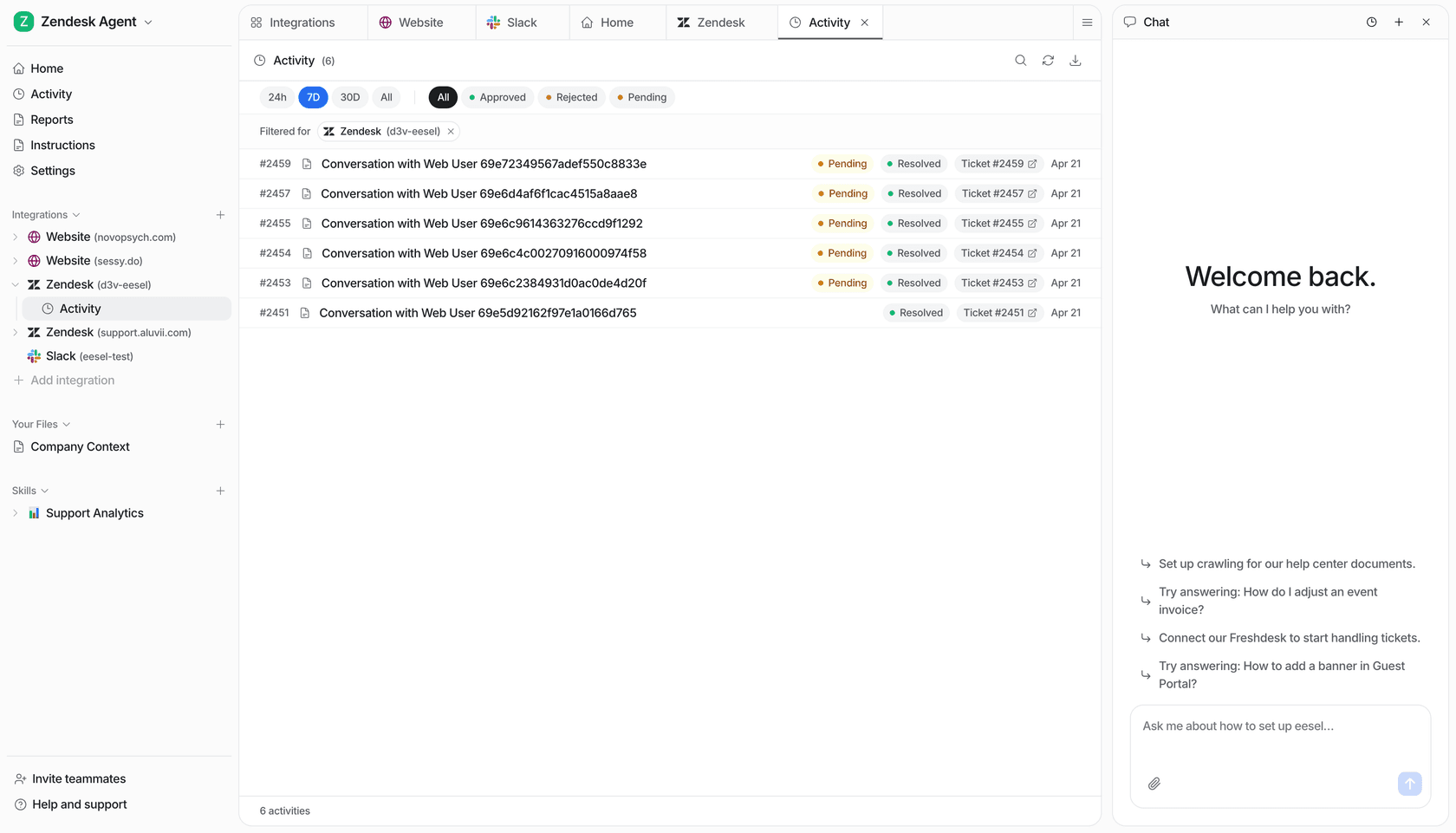
eesel pricing is a fixed monthly credit plan, with a free tier to test it on your own tickets. Try eesel and see your queue answered without choosing a model first.
Frequently Asked Questions
What is the best Claude Sonnet 5.5 alternative?
Is there a Claude Sonnet 5.5 alternative that supports forced tool use?
tool_choice set to any or a named tool, and it has no retirement before June 30, 2027. GPT-6 Sol, Gemini 3.8 Flash and Grok 4.7 also force tool calls. Note that Claude Opus 5.5 rejects it too, so moving up the Claude lineup is not a fix. The guide to the AI helpdesk API covers where forced tool calls matter in support.Is Claude Opus 5.5 cheaper than Claude Sonnet 5.5?
What is the cheapest Claude Sonnet 5.5 alternative?
Are there open-source Claude Sonnet 5.5 alternatives?
Can I switch from Claude Sonnet 5.5 to another model mid-conversation?
Which Claude Sonnet 5.5 alternative is best for a customer support bot?


Article by
Kurnia Kharisma
Kurnia is a software engineer and writer at eesel AI with two years of SEO experience, writing about AI tools, helpdesk software, and customer support. He pairs a developer's understanding of how these products are built with search-driven research into what actually ranks and resonates with the people searching for them.