


Why look past GPT-6 Sol at all
Let me be fair to Sol first, because it earns it. It launched on 23 September 2026 as the mid-tier of the GPT-6 family, sitting between GPT-6 Luna and the GPT-6 Astra flagship. OpenAI's pitch is simple and honest: the same general intelligence as GPT-5.6 Sol, about half the factual mistakes, at half the API price. It has a 1,050,000-token context window, web search, code interpreter, a hosted shell, computer use, and MCP support baked in. For most everyday chat, extraction, and drafting, it gives you a very good answer for a reasonable price.
So why does anyone shop around? A few concrete reasons keep coming up.
First, price at volume. Sol's $2 input and $10 output per million tokens is mid-pack, not cheap. When you are running a model inside an agent loop that calls it thousands of times a day, the output price is the number that decides your bill, and several models below charge a fraction of Sol's $10.
Second, it is locked to OpenAI. Sol is closed-weight and, on the API, not on the free tier at all, so Tier 1 is your floor. If your compliance story needs self-hosting, or you just want to avoid single-vendor risk, Sol cannot help you there.
Third, it is a value release, not a capability leap. On general intelligence it is roughly level with the model it replaces. If you actually need a smarter model for hard coding or long-horizon agent work, you are looking up the stack, not sideways.
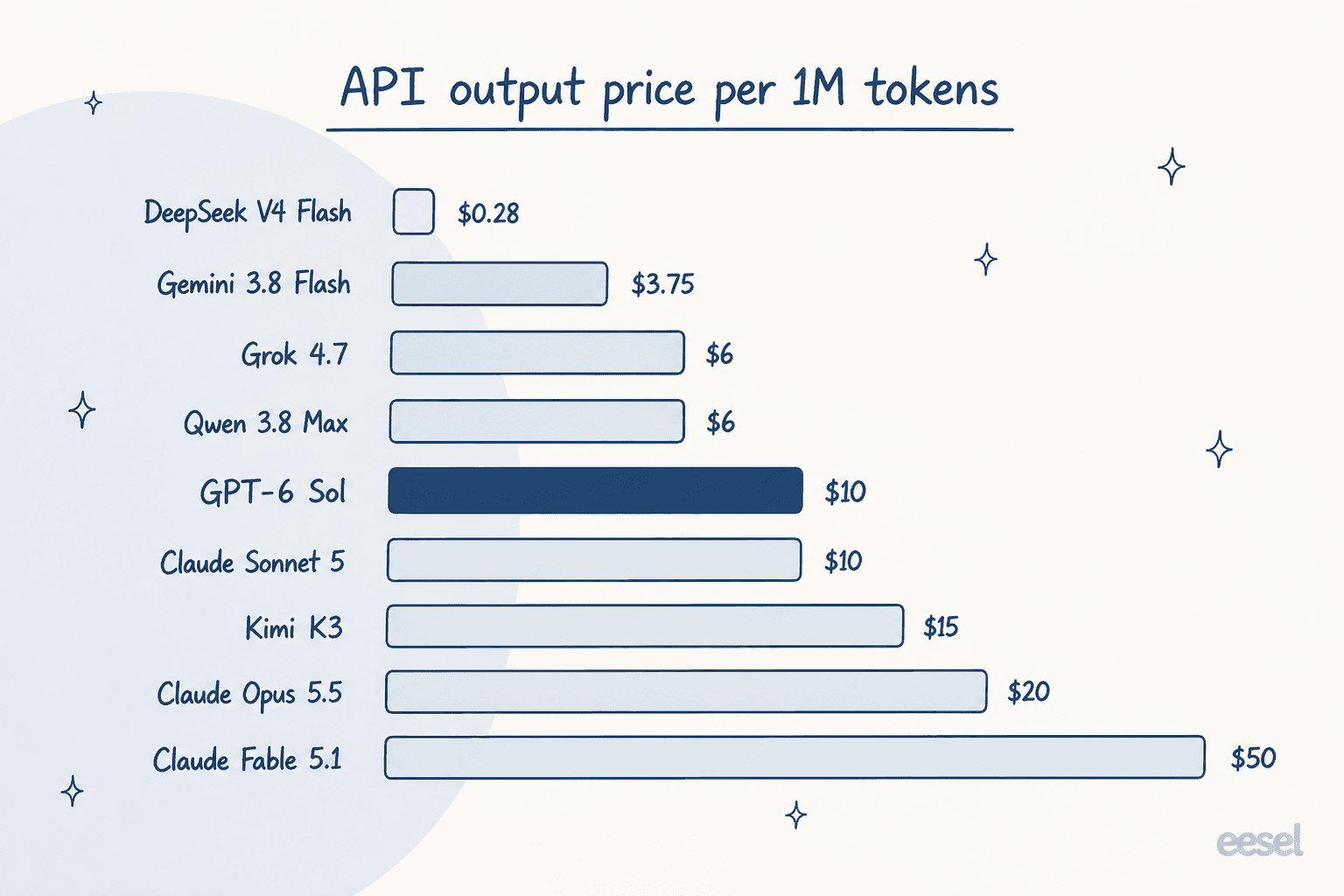
That output-price spread is the whole story in one picture. Sol's $10 sits right in the middle, with budget models an order of magnitude cheaper on one side and frontier models five times pricier on the other. Which direction you move depends entirely on the job.
How I picked these alternatives
I kept the list to models that are real, generally available, and that a team could actually put into production today. I weighed four things:
- Price, honestly. Real input and output rates per million tokens, plus the gotchas (long-context surcharges, cache pricing, promo rates that expire).
- Capability for the money. Where the model lands on public benchmarks and independent measures like Artificial Analysis, not just the vendor's own chart.
- Openness. Closed API only, or open weights you can download and host.
- Fit for a job. Balanced workhorse, frontier ceiling, budget-and-speed, or self-host. Nobody needs eight models; they need the right one for their situation.
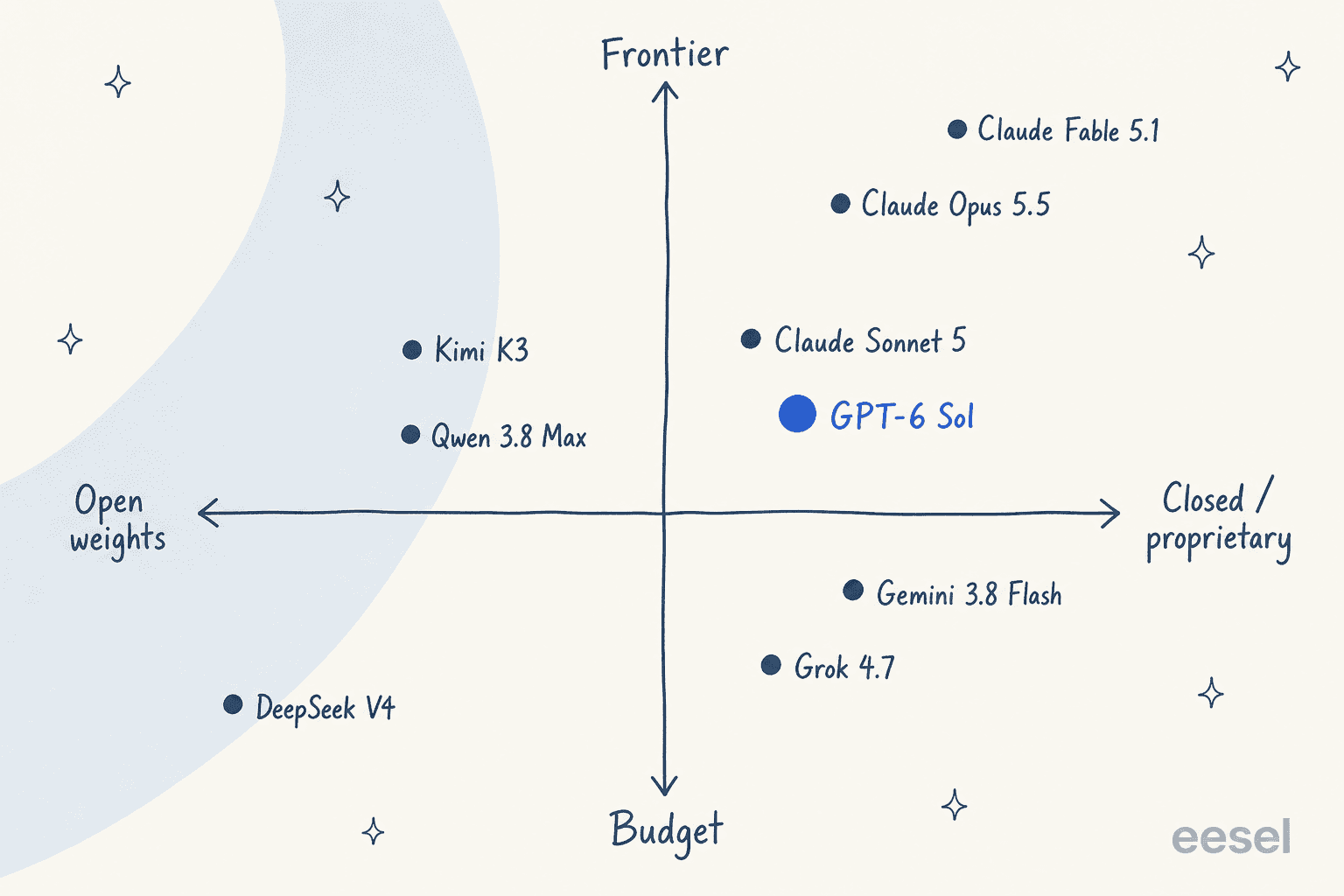
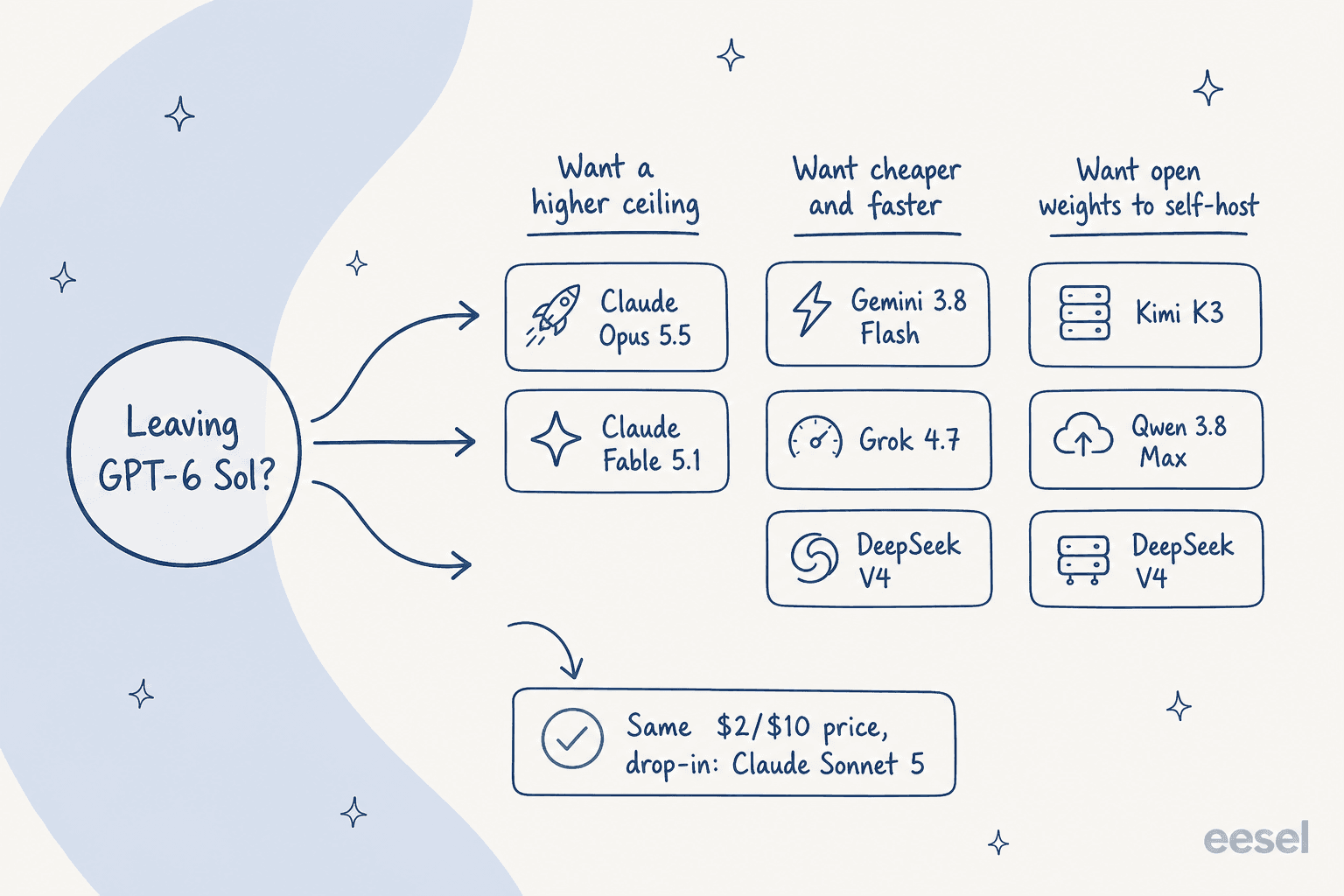
Here is the whole field at a glance before we go one by one.
| Model | Best for | API price (in / out per 1M) | Context | Weights |
|---|---|---|---|---|
| Claude Sonnet 5 | Same-price drop-in swap | $2 / $10 | 1M | Closed |
| Claude Opus 5.5 | A higher ceiling, tuned by effort | $4 / $20 | 1M | Closed |
| Google Gemini 3.8 Flash | Cheapest fast option at scale | $0.75 / $3.75 | 1M | Closed |
| Grok 4.7 | Cheaper output in agent loops | $2 / $6 | 500K | Closed |
| Kimi K3 | Open-weight flagship | $3 / $15 | 1M | Open |
| DeepSeek V4 | Rock-bottom budget + self-host | $0.14 / $0.28 (Flash) | ~1M | Open |
| Qwen 3.8 Max | Open ecosystem, multilingual | $2 / $6 | 1M | Open (base) |
| Claude Fable 5.1 | Frontier ceiling for hard work | $10 / $50 | 1M | Closed |
A quick note on that "smartest" question, since it comes up immediately. On the Artificial Analysis Intelligence Index snapshot taken the day Sol and Opus 5.5 both launched, Opus 5.5 sat at 58 (ranked first of 212 models) versus Sol's 48. That is a real gap. But AA rescales its index periodically, so I have avoided pasting a single index number next to every model here; comparing a score from one week's snapshot against another's is how people accidentally publish nonsense. Where I quote a benchmark below, it is on a basis I trust.
1. Claude Sonnet 5 - the same-price drop-in
Best for: teams that want a balanced workhorse at Sol's exact price, without OpenAI lock-in.
If Sol is the balanced everyday model, Claude Sonnet 5 is the same slot from the other big lab. And the pricing is not just close, it is identical: $2 input and $10 output per million tokens, with cache reads at $0.20. That $2/$10 was briefly an intro rate that was scheduled to rise to $3/$15, but Anthropic cancelled the increase in August 2026, so it is now the permanent standard price, not a lapsing promo.
What you get for the same money is a different set of strengths. Sonnet 5 has a 1M-token context window and a reputation for cleaner long-form prose and steadier long coding sessions. Where it trails is knowledge freshness: its training cutoff is January 2026, older than Sol's, and Anthropic has published fewer head-to-head benchmark numbers in plain text than OpenAI has.
Pros: identical $2/$10 pricing; strong writing and coding; 1M context; a second-vendor hedge against OpenAI-only risk.
Cons: older knowledge cutoff; fewer published benchmarks to check; no built-in free tier on the API.
My take: if the only reason you are on Sol is "it was the sensible default," Sonnet 5 is the first alternative to try, because switching costs you nothing on price and buys you optionality. Pick it if you value prose quality or want to avoid single-vendor lock-in; stay on Sol if you lean hard on OpenAI's tool ecosystem.
2. Claude Opus 5.5 - a real step up in ceiling
Best for: teams that need more raw capability than Sol and are willing to tune effort to control cost.
Opus 5.5 is the interesting one, because the naive read gets it wrong. On paper it costs more than Sol: $4 input, $20 output per million, twice Sol's per-token rate. It also topped that launch-day Artificial Analysis index at 58 against Sol's 48. So it is smarter and pricier, and you would assume the per-task math follows the sticker.
It does not, and this is the non-obvious bit worth internalising. Because you dial Opus 5.5 by reasoning effort, the effort-matched cost can flip the comparison. In the head-to-head, Opus 5.5 at medium effort scored 51 for about $1.34 per task, beating Sol at max effort's 48 for $1.06 by a wide quality margin for a small cost premium. At the very top, Sol is far cheaper per task ($1.06 vs Opus's $5.98 at max), because Opus burns many more output tokens. Task length and effort are the hinge, not the model name.
Opus 5.5 is also Anthropic's first Opus to get cheaper than its predecessor, a 20% cut, and Anthropic now recommends starting with it for most work. The community read is more mixed on verbosity:
writes like gemini, a drastic improvement over the opus 5.1 claudeisms

Pros: clear capability jump over Sol; effort dial lets you buy quality cheaply on shorter tasks; 20% price cut over Opus 5; June 2026 cutoff.
Cons: expensive per task at max effort; can still be verbose; overkill for simple extraction or chat.
My take: pick Opus 5.5 when Sol's answers are not quite good enough and you will actually tune the effort setting. If you would just run everything at max and never touch the dial, you will pay for capability you are not using.
3. Google Gemini 3.8 Flash - the cheap, fast one
Best for: high-volume workloads where cost and throughput beat everything else.
If your bottleneck is budget, Gemini 3.8 Flash is the obvious move. It is $0.75 input and $3.75 output per million through 31 December 2026, then exactly double from 1 January 2027 ($1.50/$7.50). Even at the 2027 rate it undercuts Sol's output price. It has a 1M-token input window, a free tier, and on Artificial Analysis it ranks third of 196 models for raw output speed.
Two honest caveats. First, it is not a new base model; Google's own model card says four times over that it is "based on Gemini 3.7 Flash," and Google literally tells efficiency-focused developers to stay on 3.7. Second, throughput is not the same as responsiveness: AA measured its time to first token at 13.3 seconds against a 3-second class median. That is fine for an overnight batch job and a real problem for anything a human is waiting on, like a live chat reply.
Pros: cheapest fast option here; huge context; free tier; excellent throughput.
Cons: slow first-token latency; not a genuinely new model; can be verbose and burn extra tokens.
My take: reach for Gemini 3.8 Flash for large batch and background jobs where per-token cost dominates. For anything latency-sensitive, its slow first token disqualifies it, and I would look at Grok or Sonnet instead.
4. Grok 4.7 - cheaper output for agent loops
Best for: agentic workloads that call the model constantly and care about output price.
Grok 4.7 from xAI landed on 21 September 2026 and matches Sol on input ($2) while undercutting it on output: $6 per million versus Sol's $10, below a 200K-token prompt. It is built on a larger new base model than Grok 4.6 with a longer reinforcement-learning run weighted toward multi-hour agentic tasks, and it posts a real jump on agent benchmarks, nearly doubling its Terminal-Bench 4.0 score over 4.6.
Watch two things. The long-context pricing is a trap worth reading twice: above 200K prompt tokens the rate jumps to $4/$12 and applies to all tokens in the request, not just the overflow. And on some evals Grok 4.7 genuinely loses to Sol; on HealthBench Professional it scores 56.7 against Sol's 60.5, so it is not a clean win everywhere.
Pros: cheaper output than Sol; big agentic improvement over 4.6; strong safety stack; 500K context.
Cons: punishing long-context pricing cliff; loses to Sol on some domains; the "Fast" variant is Cursor and Grok Build only, not the public API.
My take: Grok 4.7 is priced to run at volume in agent loops, and that is exactly where I would use it. Just keep requests under the 200K token line, or the long-context rate erases the savings.
5. Kimi K3 - the open-weight flagship
Best for: teams that want a frontier-class model they can actually download.
Kimi K3 from Moonshot AI is the standout if openness matters. It is a 2.8-trillion-parameter mixture-of-experts model (104B active), with a 1M-token context, and crucially the weights shipped on time to Hugging Face, where the safetensors index confirms the full 2.8T count from outside the press release. You can run it yourself.
On the hosted API it is $3 input and $15 output per million, the same band as Claude Sonnet, so this is not the bargain-basement play K2 was; the value is the open weights, not the API rate. On benchmarks it beats the previous generation of frontier models and trails the current top tier like Fable 5.1 and GPT-5.6 Sol. One quirk to know: reasoning cannot be turned off at any level, so its cheapest setting is a latency control, not a true cost tier.
Pros: genuinely open weights, verified on Hugging Face; frontier-adjacent quality; 1M context; native vision.
Cons: API price is mid-tier, not cheap; reasoning always on; public image URLs are not accepted (base64 only).
My take: if your reason for leaving Sol is that it is closed, Kimi K3 is the strongest open-weight flagship to self-host. If you just want a cheaper hosted API, its $3/$15 is not it, and I would look at DeepSeek instead.
6. DeepSeek V4 - the budget king you can host
Best for: the absolute cheapest per-token option, with the bonus of open weights.
DeepSeek V4 is where the price chart falls off a cliff. The Flash tier is $0.14 input and $0.28 output per million, roughly one thirty-fifth of Sol's output price, with open weights on top. There is a genuinely odd twist here worth knowing: after a late-July re-training, the cheap Flash tier currently outscores the pricier Pro tier on all nine agentic benchmarks DeepSeek publishes, and Artificial Analysis has Flash ahead of Pro on its own index. The expensive tier is simply the older build right now.
Where Pro still earns its keep is recall and long-context needle-finding, on things like SimpleQA-Verified and 1M-token retrieval. And a fair caveat: on the LMArena human-preference leaderboard, Pro still ranks above Flash, so the automated index and human voters disagree. Read both before you commit.
Pros: dramatically the cheapest here; open weights; Flash punches well above its price.
Cons: the tier naming is genuinely confusing right now; Pro's reasoning cannot be dialled down cheaply; smaller ecosystem than the big labs.
My take: for cost-sensitive, high-volume work, DeepSeek V4 Flash is unbeatable on price and surprisingly capable. Start on Flash, not Pro, despite the names, and benchmark on your own task before you assume the cheap tier is worse.
7. Qwen 3.8 Max - the open ecosystem play
Best for: teams that want an open base, strong multilingual performance, and a big cloud behind it.
Qwen 3.8 Max from Alibaba went generally available on 2 August 2026. It is a 2.4-trillion-parameter mixture-of-experts model (95B active) with a 1M context, priced at $2 input and $6 output per million, matching Sol on input and beating it on output. On LMArena it is strong: fifth on the Text board and second on Vision at the time of checking.
The openness story has an asterisk. The base weights did ship as Qwen3.8-2.4T-A95B, but under a custom qwen3.8-max licence, not Apache 2.0, and the open base is not feature-equivalent to the hosted Max (which adds vision, non-thinking mode, and built-in tools). If you want a permissively licensed Qwen, the smaller Qwen3.8-27B is the Apache-2.0 one. So read the licence before you build on it.
Pros: cheaper output than Sol; strong on LMArena, especially vision and multilingual; open base weights available.
Cons: Max licence is custom, not Apache; open base lacks the hosted features; automated and human rankings point different ways.
My take: Qwen 3.8 Max is a good pick if you want to live in an open ecosystem and value multilingual and vision work. Just do not assume "open" means "Apache-licensed drop-in for the hosted Max," because it is not.
8. Claude Fable 5.1 - the frontier ceiling
Best for: the hardest coding and long-horizon agent work, where quality beats cost outright.
When Sol is not smart enough and the effort dial on Opus 5.5 still is not enough, Fable 5.1 is the top of Anthropic's Claude 5 family. It is expensive, $10 input and $50 output per million, five times Sol's output price, and it does not pretend otherwise. What you buy is the ceiling: it leads the pack on Terminal-Bench-Science (52.6%), CursorBench (73.4%), and HLE-with-tools (65%), and it topped the Grok team's own GDPval Elo table above every rival they listed.
The real-world runs are the part that stick: Anthropic cites a 38-hour unattended agent session at Ramp, and a research team cracking a years-old problem. The one change that softens the price is the cache read cut to $0.25 per million, cheaper per cached token than Opus 5.5. Worth knowing before you build: Fable 5.1 removed forced tool use (tool_choice any/tool now 400s) and adds a statistical text watermark to all output for EU AI Act compliance.
Pros: genuinely frontier quality; huge real-world agentic runs; cheap cache reads; 1M context.
Cons: the most expensive model here by far; watermark and refusal false-positives frustrate some developers; overkill for everyday tasks.
My take: Fable 5.1 is not a Sol replacement for most workloads, it is the model you escalate to for the 5% of jobs that are genuinely hard. Route your easy traffic to something cheap and reserve Fable for the work that actually needs it.
The thing nobody switching models actually asks
Here is what I keep running into, and it is the reason I wrote the ending before the list. Most people comparing GPT-6 Sol alternatives for a real product, especially customer support, are asking the wrong question. They are optimising the engine when the thing that decides whether it works is everything wrapped around the engine.
I have spent the last few years putting AI agents on live support queues across thousands of businesses, and the pattern never changes. The model is rarely the bottleneck. The bottleneck is: does it have your actual company context, can it take real actions in your helpdesk, and can you trust it before it touches a live customer? We learned that the hard way, which is why every eesel rollout now simulates against your historical tickets first, so you see the resolution rate and the exact answers on real past tickets before anything goes live. A raw model API gives you none of that. It gives you a very smart text-completion endpoint and a bill.
Swapping Sol for Sonnet 5 or Gemini Flash changes your token cost. It does not, by itself, get you a support agent. That is a different layer, and it is the one I would actually spend the decision on.
Try eesel
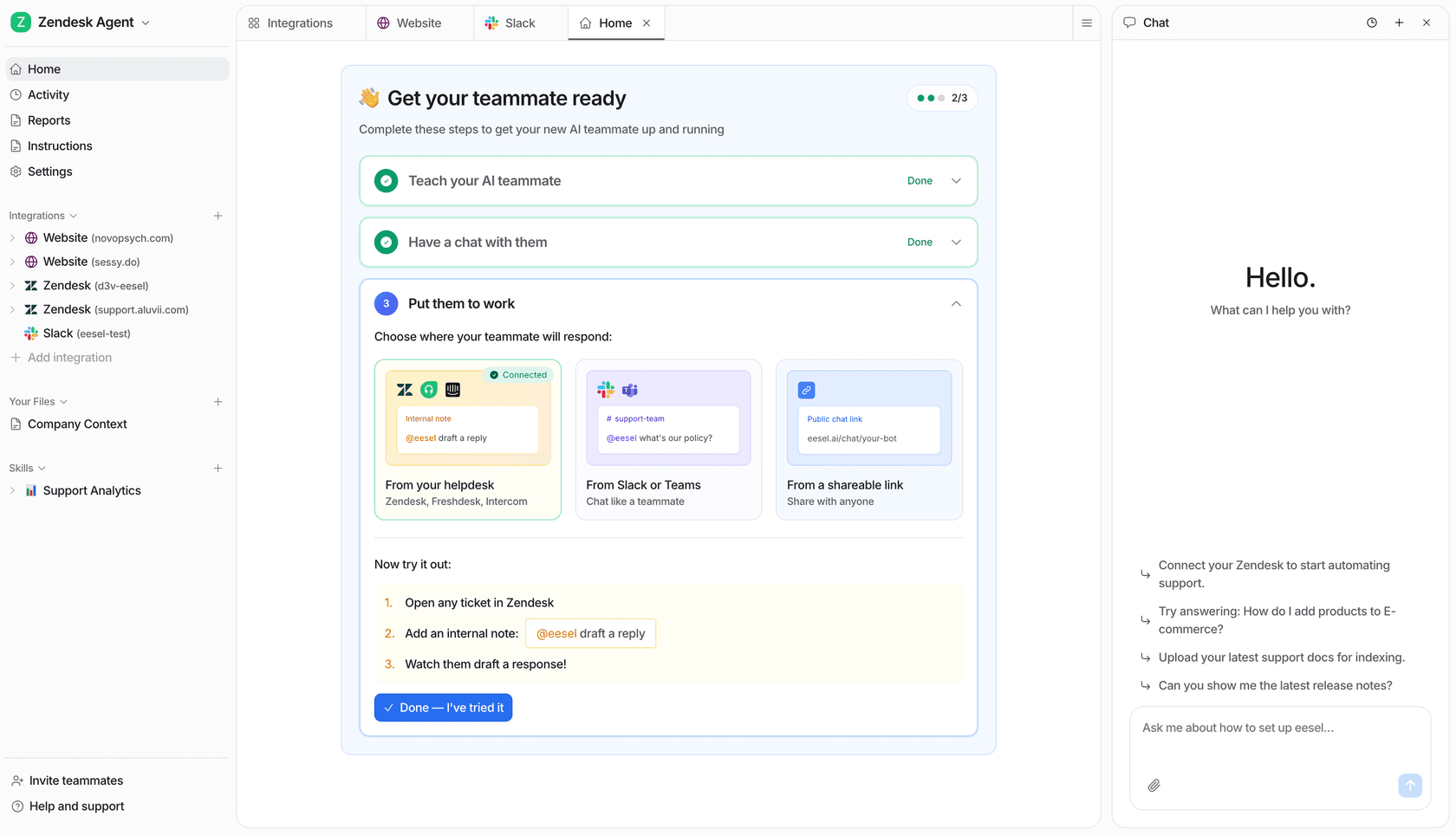
The way I think about it: a model is infrastructure, and eesel is the employee you hire to run on top of it. You do not pick eesel instead of GPT-6 Sol or Claude or Gemini; you pick the teammate, and it uses whichever model is right for the job under the hood. Today that roster is a ready-to-work AI helpdesk teammate that joins your existing support queue already knowing your help center and past tickets, and an AI blog writer for content. Each arrives with the skills, integrations, and company context for its role, and it is billed per resolution, not per token, so a chatty model does not blow up your bill.
If you are the kind of person comparing model APIs in the first place, the eesel CLI is probably the fastest way to see this. It is an agent-friendly surface over the same teammate and workspace: you can drive it from a terminal, automate it in scripts, and let coding agents like Claude Code, Codex, and Cursor operate it directly, alongside the MCP server, webhooks, and network access controls. Same agent as the dashboard, just headless. You can try eesel free and simulate it on your own tickets before committing to anything.
Frequently Asked Questions
What is the best GPT-6 Sol alternative in 2026?
Is there a cheaper alternative to GPT-6 Sol?
What is a good open-weight alternative to GPT-6 Sol?
Is GPT-6 Sol better than Claude Sonnet 5?
Do GPT-6 Sol alternatives work for customer support automation?


Article by
Kurnia Kharisma Agung Samiadjie
Kurnia is a software engineer and writer at eesel AI with two years of SEO experience, writing about AI tools, helpdesk software, and customer support. He pairs a developer's understanding of how these products are built with search-driven research into what actually ranks and resonates with the people searching for them.