

What Grok 4.7 actually is
Grok 4.7 is xAI's frontier model for coding, agentic tasks, and knowledge work. On the API it is served as grok-4.7, with a 500k context window, text and image inputs, and text-only output with no output limit, per the xAI release notes. Reasoning effort is configurable across low, medium, high (the default), and xhigh, so you can dial how hard the model thinks per request.
Under the hood, xAI says Grok 4.7 uses a new, larger base model than Grok 4.6. I want to be precise here, because a lot of the coverage put an exact parameter count on it: xAI's own materials describe it as a larger base model without publishing a figure, so the specific number floating around is not something the company stated. What xAI does claim is the shape of the change, and that shape is the interesting part.
The training was weighted toward hard problems that take many hours to finish, then reinforced over a longer run. xAI also trained the model to natively understand its Grok Bot harness, which is the scaffolding that lets the model chat, call tools, and work through a task. In plain terms, they optimised less for answering a single question well and more for grinding through a long, multi-step job without losing the plot.
What changed from Grok 4.6
The clean way to see the jump is to line the two models up on the benchmarks xAI published. The gains are not uniform, and where they cluster tells you what this release is really about.
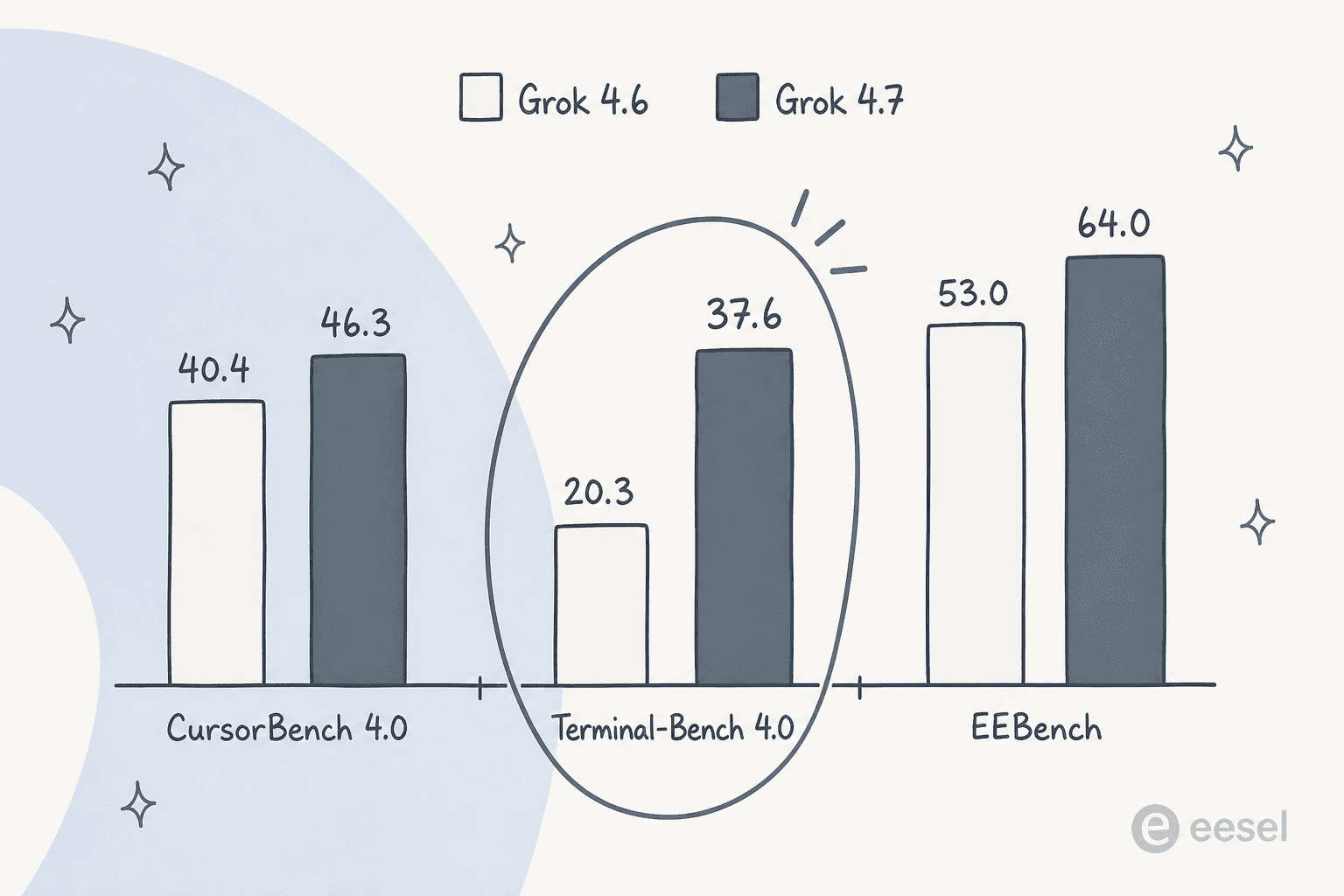
The single biggest move is on Terminal-Bench 4.0, which measures multi-hour work at a real terminal: Grok 4.6 scored 20.3% and Grok 4.7 nearly doubles it to 37.6%. That is exactly the kind of long-horizon task the longer RL run was built for, and it is where the release earns its keep. Coding and engineering follow the same story: CursorBench 4.0 climbs from 40.4% to 46.3%, and EEBench (electrical engineering) jumps from 53.0% to 64.0%.
Here is the fuller table, with GPT-5.6 Sol and Fable 5.1 alongside so the numbers have context. All Grok 4.7 figures are at xHigh effort, Grok 4.6 at High.
| Benchmark | Grok 4.7 | Grok 4.6 | GPT-5.6 Sol | Fable 5.1 |
|---|---|---|---|---|
| Input price / 1M | $2 | $2 | $4 | $10 |
| Output price / 1M | $6 | $6 | $20 | $50 |
| CursorBench 4.0 (coding) | 46.3% | 40.4% | 41.7% | 51.8% |
| DeepSWE v1.1 | 71.0%* | 65.2% | 72.7% | 70.0% |
| Terminal-Bench 4.0 | 37.6% | 20.3% | 37.3% | 57.9% |
| EEBench (electrical eng) | 64.0% | 53.0% | 39.4% | 56.4% |
| AA Briefcase v1.1 (Elo) | 1,657 | 1,546 | 1,487 | 1,678 |
| Harvey Legal Agent | 19.6% | 15.8% | 2.5% | 6.7% |
| HealthBench Professional | 56.7% | 48.5% | 60.5% | 62.1% |
*Grok 4.7's DeepSWE score is measured at high effort. Figures from xAI's Grok 4.7 announcement.
Two honest caveats before anyone reads that as a clean sweep. Fable 5.1 still tops the board on CursorBench, Terminal-Bench, and clinical reasoning, so if you only care about the peak score and cost is no object, it is ahead. And on HealthBench Professional, both GPT-5.6 Sol (60.5%) and Fable 5.1 (62.1%) edge out Grok 4.7's 56.7%. Grok 4.7's story is not "best at everything." It is "very close to the best, at a fraction of the price."
Grok 4.7 pricing, and the Fast tax
Pricing is where this model gets interesting, so it is worth spelling out rather than waving at a "starts at" number.
| Tier | Input / 1M | Cached input / 1M | Output / 1M |
|---|---|---|---|
grok-4.7, prompt under 200k tokens | $2.00 | $0.50 | $6.00 |
grok-4.7, prompt 200k and over | $4.00 | $1.00 | $12.00 |
| Grok 4.7 Fast (Cursor and Grok Build only) | 2x the rates above | 2x | 2x |
The first gotcha is the long-context tier. Once a request crosses 200k prompt tokens, the higher rates apply to every token in the request, not just the overflow past 200k. So a 210k-token prompt is billed entirely at $4 / $12, not mostly at $2 / $6. For long agent loops that slowly accumulate context, that cliff is real, and it is why xAI shipped a Context Compaction API to shrink conversations before they tip over.
The second is the Fast variant. Grok 4.7 Fast is the same model served at twice the output speed for twice the token price, and it is only available inside Cursor and Grok Build, not on the public API. It is a latency-for-money trade, useful when you are watching code stream back and every second counts, and skippable for batch or background work where speed does not matter.
Then there are the meters that most write-ups miss. On the API, xAI's pricing page lists tool calls separately: web search, X search, and code execution run $5 per 1,000 calls, file-attachment search is $10 per 1,000, and the RAG-style collections search is $2.50 per 1,000. Priority Processing doubles all token rates. None of these break the bank, but if you are modelling the cost of an agent that searches and executes constantly, the token price is not the whole bill.
The takeaway: Grok 4.7 is priced to be run at volume. That is a deliberate position, and it is the clearest reason to pick it over a pricier frontier model for anything that loops.
Where Grok 4.7 sits against GPT-5.6 Sol and Fable 5.1
If you plot capability against cost, Grok 4.7 lands in a corner that is getting crowded but still valuable: strong scores, low price.
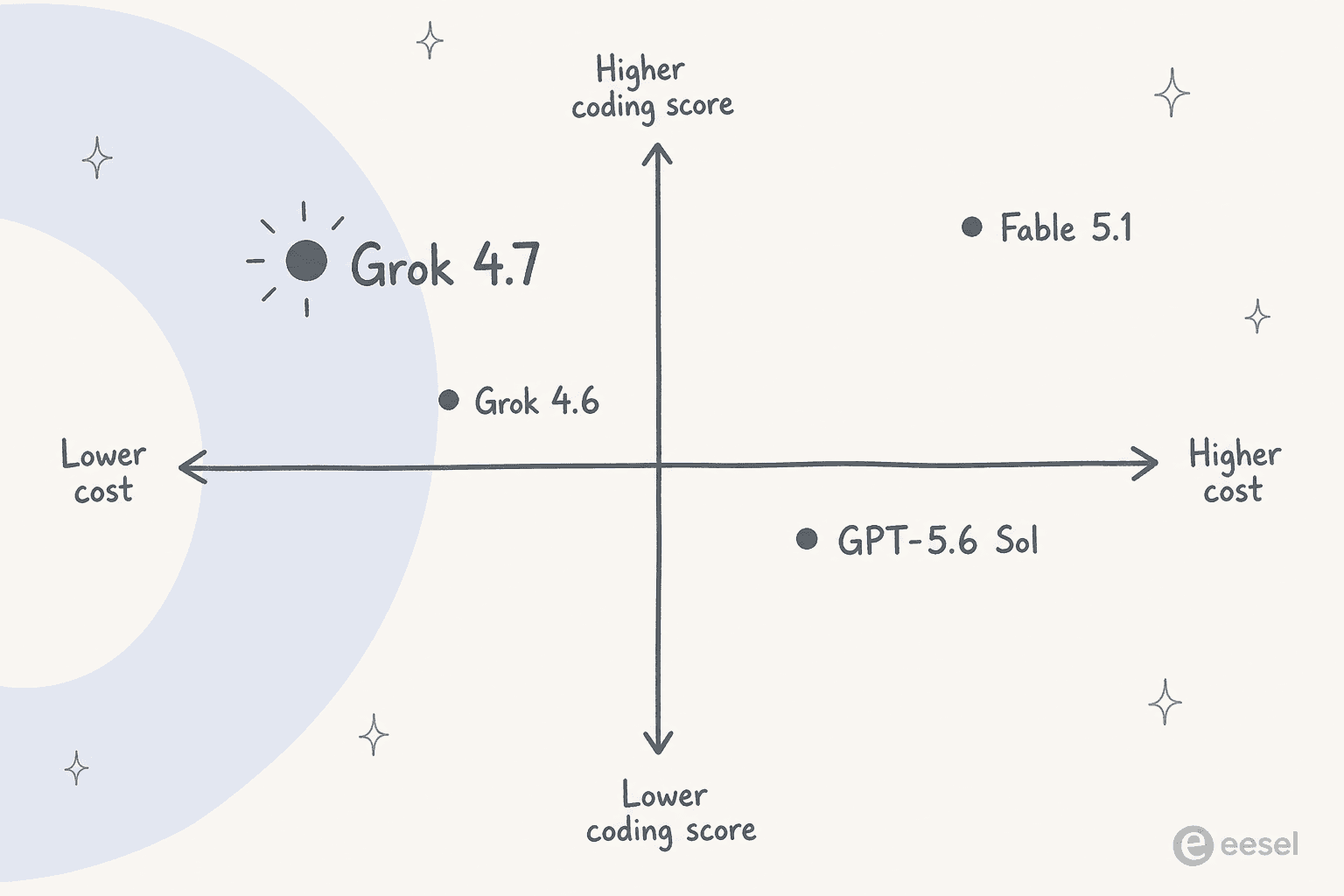
Against GPT-5.6 Sol, Grok 4.7 is the better deal on most agentic and engineering work: it beats Sol on CursorBench, EEBench, Terminal-Bench, Harvey's legal benchmark, and AA Briefcase, at half the input price and less than a third of the output price. Sol keeps a real edge on clinical reasoning and a narrow one on DeepSWE, so it is not a blowout, but the price gap makes Grok 4.7 the default for cost-sensitive agent work.
Against Fable 5.1, the honest read is that Fable is still the stronger model on raw coding and long-horizon terminal work, and its GDPval professional-knowledge Elo of 1,735 leads Grok 4.7's 1,695. But Fable charges $10 / $50 per million tokens, five to eight times Grok's rates. So the question is not "which is smarter" (often Fable) but "how much are you willing to pay per marginal point." For a lot of production workloads, Grok 4.7 is the answer that keeps the invoice sane.
Safety and cybersecurity
xAI put real weight on safety this cycle, and it is one of the more concrete parts of the release. Grok 4.7 was built with an entirely new safeguard stack, and xAI calls it the strongest model it has tested on refusals and jailbreak resistance.
The specifics are what make that claim checkable. On HackerBench v0.3, xAI's benchmark for risky cyber tasks, Grok 4.7 lets through only 3.3% of risky dual-use prompts while, xAI says, rarely blocking legitimate security work. It also tops LatchBio's biosafety benchmark at 62.4%. The pitch is a model that stays useful for real security and research work without being an easy tool for the dangerous version of the same task, and xAI has started giving select cybersecurity partners invite-only access to the model's red-team capabilities for defense research. Benchmarks are the vendor's own, so treat them as a starting point, but the direction is clear.
Who Grok 4.7 is actually for
After sitting with the numbers, here is where I land. Grok 4.7 is a strong pick if you are writing code, building agents, or shipping anything on the API where token cost compounds. The combination of frontier-adjacent scores and Grok 4.6 pricing is the whole reason to care, and the long-horizon gains mean it holds up better than 4.6 on jobs that run for a while.
Real users echo the "run it constantly" angle. One heavy Grok subscriber described wiring it into everyday jobs and still not hitting limits:
"I have a Grok bot monitor my email every 15 minutes and file things away for me. I have another bot that monitors for blood test results... and I never even get close to using my quota."

Where I would set expectations is deep, gnarly code. Frontier models are all getting better at one-shotting a script, and that is real, but it is not the same as carrying a large codebase. As one developer put it in the same thread:
"The models keep getting better at one shotting. That's useful in a lot of situations, like for small one-off scripts... For the code itself, it doesn't help me much though."
That is a fair read of any model in this class, Grok 4.7 included. Use it for the volume of medium-hard work where its price wins, and reach for the priciest model only on the tasks that actually need the last few points.
A frontier model is the engine, not the employee
Here is the reframe I promised in the TL;DR, because it is the thing most "which model should I use" posts skip.
Grok 4.7 is infrastructure. It is a brilliant engine you rent by the token, and it arrives knowing nothing about your company, your tickets, your tone, or your tools. To turn it into something that does a real job, someone has to build the harness: connect the knowledge, wire the integrations, write the guardrails, handle escalation, and keep it all running. That is a real project, not a config toggle.
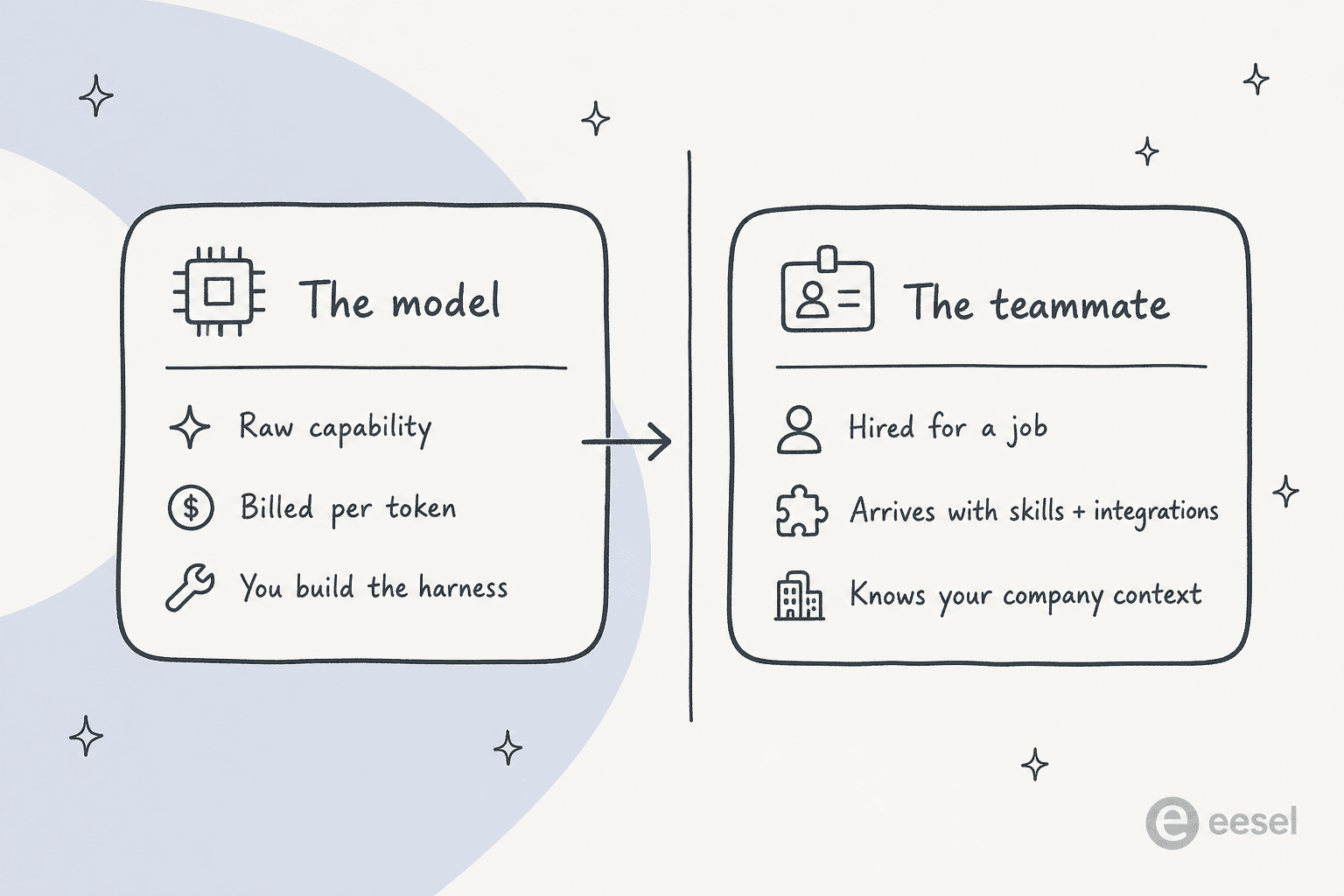
That gap is the whole idea behind eesel. Instead of handing you a model and a blank harness, eesel is an AI teammate platform where you hire ready-to-work teammates for a specific job. The current roster is an AI helpdesk teammate that joins your support queue and an AI blog writer that researches and drafts long-form posts. Each one shows up already carrying the skills, integrations, and company context its role needs, running on frontier models underneath so you get the capability without owning the plumbing.

And if you liked Grok 4.7 because you live in a terminal, eesel meets you there too. The eesel CLI operates the same teammate and workspace as the dashboard, but from the command line: a person can run it, scripts can automate it, and coding agents like Claude Code, Codex, and Cursor can drive it. You can inspect a teammate's instructions, send a test message, read back the JSON result and activity, and propose a bounded change for an owner to approve, all without leaving your shell. It is the same "operate the agent programmatically" pattern that makes a raw model API appealing, pointed at an employee that already knows the job. You can try eesel free.
Frequently Asked Questions
What is Grok 4.7?
Grok 4.7 is xAI's frontier model for coding, agentic tasks, and knowledge work, released on September 21, 2026. It runs on a new, larger base model than Grok 4.6, keeps the 500k context window, and is served on the xAI API as grok-4.7. It is the same kind of raw model engine that a product like an AI teammate is built on top of.
How much does Grok 4.7 cost?
Grok 4.7 pricing is $2 per million input tokens, $0.50 cached input, and $6 output below 200k prompt tokens, doubling to $4 / $1 / $12 once a request crosses 200k, per the xAI pricing page. That matches Grok 4.6 exactly, so the upgrade adds capability without a price rise.
What is the difference between Grok 4.7 and Grok 4.6?
Grok 4.7 uses a larger base model and a longer reinforcement-learning run weighted toward multi-hour tasks, and it posts the biggest gains on long-running agentic benchmarks like Terminal-Bench 4.0. Both share the 500k context window and the same token pricing.
Is Grok 4.7 good for coding?
Yes, coding is its headline strength. It scores 46.3% on CursorBench 4.0 and leads Grok 4.6 across every software benchmark xAI published, and it is served inside Cursor and Grok Build. For deeper code work, teams often still pair it with a more expensive model on the hardest tasks.
How do I access Grok 4.7?
You can call Grok 4.7 through the xAI API as grok-4.7, use it free in Grok Build, or reach it inside Cursor. If you want that intelligence doing a defined job rather than raw tokens, an AI teammate platform like eesel packages a frontier model with the skills, integrations, and company context for a real role.
Is Grok 4.7 better than GPT-5.6 Sol or Fable 5.1?
It depends on what you weigh. Grok 4.7 beats GPT-5.6 Sol on most coding and agentic benchmarks at a fraction of the price, while Fable 5.1 still leads on peak coding and terminal work but costs five to eight times as much per token. For cost-sensitive, high-volume work, Grok 4.7 is usually the better value.
What is Grok 4.7 Fast?
Grok 4.7 Fast is the same model served at twice the output speed for twice the token price, available only inside Cursor and Grok Build rather than the public API. It is worth it when low latency matters, like watching code stream back, and skippable for batch or background jobs.


Article by
Alicia Kirana Utomo
Kira is a writer at eesel AI with a Computer Science background and over a year of hands-on experience evaluating AI-powered customer service tools. She focuses on breaking down how helpdesk platforms and AI agents actually work so that support teams can make better buying decisions.