

What Grok 4.7 is
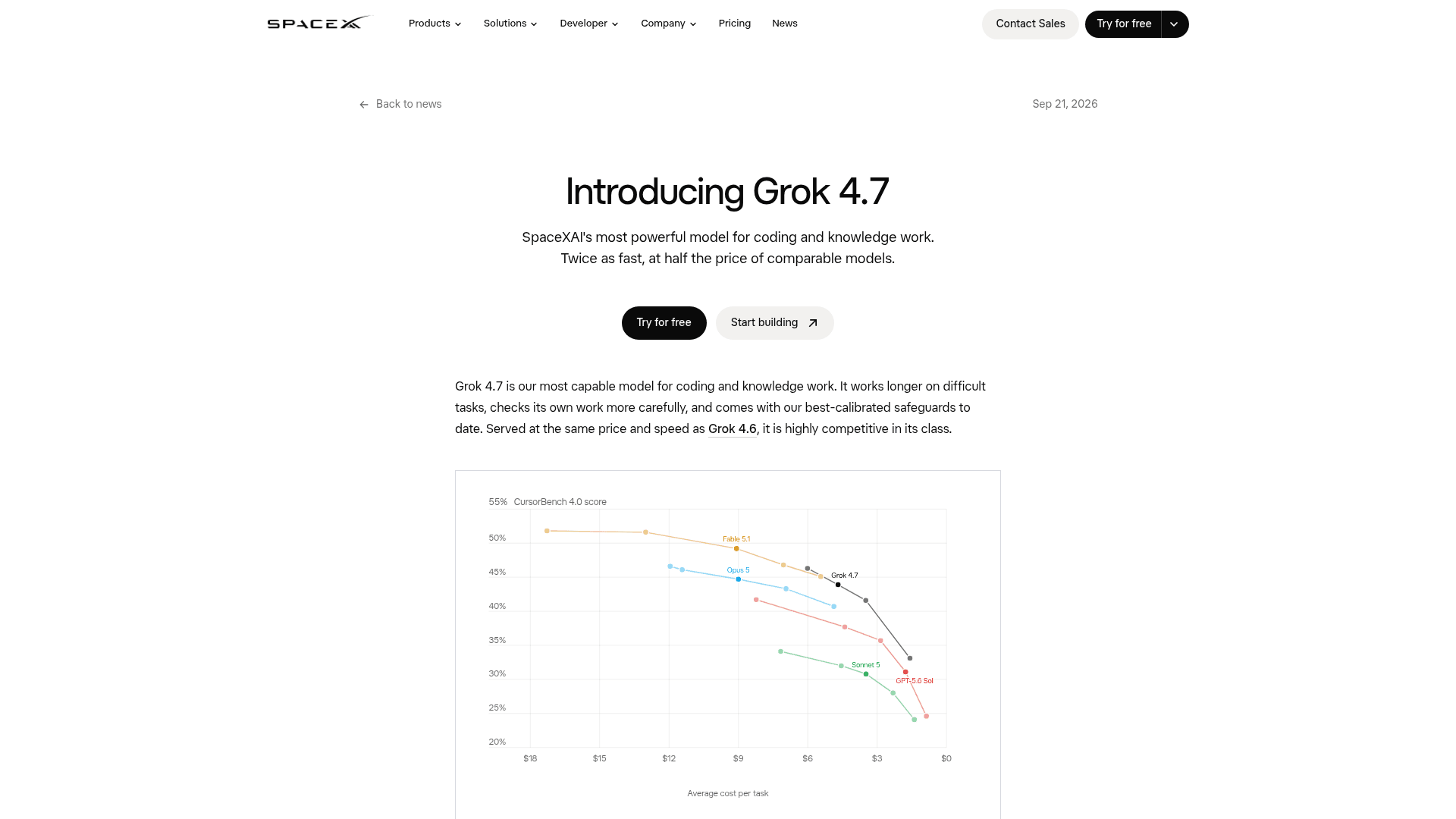
Grok 4.7 is xAI's flagship model for code, agents, and knowledge work, released as grok-4.7 on the xAI API. It keeps the 500k-token context window from Grok 4.6, takes text and image in and returns text out, and exposes configurable reasoning effort at low, medium, high, and xHigh. Its knowledge cutoff is May 2026, and like every Grok model it has no live-event awareness unless you turn on the server-side web and X search tools.
The build itself is the interesting part. xAI trained 4.7 on a new, larger base model than 4.6, then ran a longer reinforcement-learning pass on a harder task mix weighted toward problems that take many hours. It was also trained to natively understand the Grok Bot harness, which is why it feels more fluent at multi-step, tool-calling work than a raw chat model usually does. One brand-new API feature ships alongside it: a Context Compaction API for squeezing long histories back under the pricing cliff.
Grok 4.7 is the text-and-code brain of a wider lineup, and this review is only about that model. If you came looking for the other pieces, xAI splits them out: Grok Imagine handles image and video, the Grok Voice API handles speech, and the agent-builder side lives in Grok Bot. Everything below is grok-4.7 on its own.
What actually changed from Grok 4.6
The upgrade from Grok 4.5 to 4.6 was incremental, as the Grok 4.5 review noted. The jump to 4.7 is not, at least in one place. The clearest way to see it is the benchmark deltas xAI published.
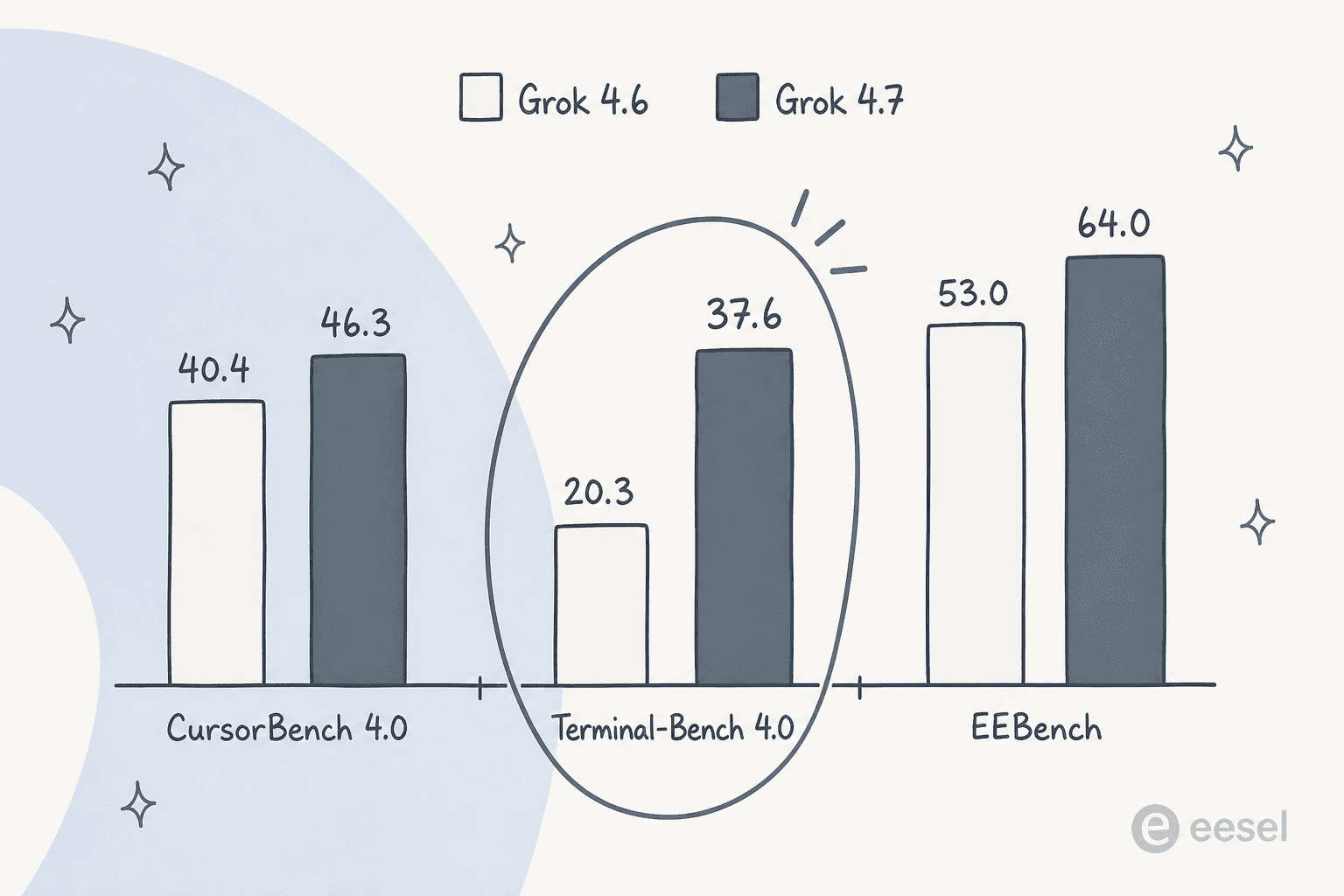
CursorBench 4.0 moved from 40.4 to 46.3, and EEBench (electrical engineering) from 53.0 to 64.0. Those are solid. The standout is Terminal-Bench 4.0, which nearly doubled from 20.3 to 37.6, the single biggest 4.6-to-4.7 gain and a direct read on how well the model runs long, multi-step terminal work without losing the plot. If your use case is an agent grinding through a real task list rather than answering one prompt, this is the number that matters, and it is the one the Grok 4.6 review could not have shown you.
The rest of the improvements are quieter: better self-verification, steadier long-context handling, and stronger document and presentation output, which shows up as gains on the GDPval and AA Briefcase professional-work benchmarks. None of that is free elsewhere, and here it arrives at the same price.
The benchmarks, read honestly
xAI benchmarked Grok 4.7 xHigh against Grok 4.6 High, GPT-5.6 Sol Max, and Fable 5.1 Max. Here is the primary table, straight from the launch page, so you can see both where 4.7 wins and where it does not.
| Benchmark | Grok 4.7 | Grok 4.6 | GPT-5.6 Sol | Fable 5.1 |
|---|---|---|---|---|
| Input $/1M | $2 | $2 | $4 | $10 |
| Output $/1M | $6 | $6 | $20 | $50 |
| CursorBench 4.0 | 46.3 | 40.4 | 41.7 | 51.8 |
| DeepSWE v1.1 | 71.0* | 65.2 | 72.7 | 70.0 |
| Terminal-Bench 4.0 | 37.6 | 20.3 | 37.3 | 57.9 |
| EEBench | 64.0 | 53.0 | 39.4 | 56.4 |
| AA Briefcase v1.1 (Elo) | 1657 | 1546 | 1487 | 1678 |
| Harvey Legal Agent | 19.6 | 15.8 | 2.5 | 6.7 |
| HealthBench Professional | 56.7 | 48.5 | 60.5 | 62.1 |
*high-effort score. Source: xAI, Grok 4.7 launch.
Read it fairly and the picture is clear. Grok 4.7 wins outright on EEBench and the Harvey Legal Agent benchmark, where it more than doubles Fable's score, and it is competitive everywhere. But Fable 5.1 tops CursorBench, Terminal-Bench, and AA Briefcase, GPT-5.6 Sol edges it on DeepSWE, and on HealthBench Professional Grok 4.7 loses to both. So if your job is peak coding accuracy or clinical reasoning and budget is no object, Grok 4.7 is not the pick. If your job is running that capability at volume, the next chart is the one that decides it.
The pricing is the whole argument
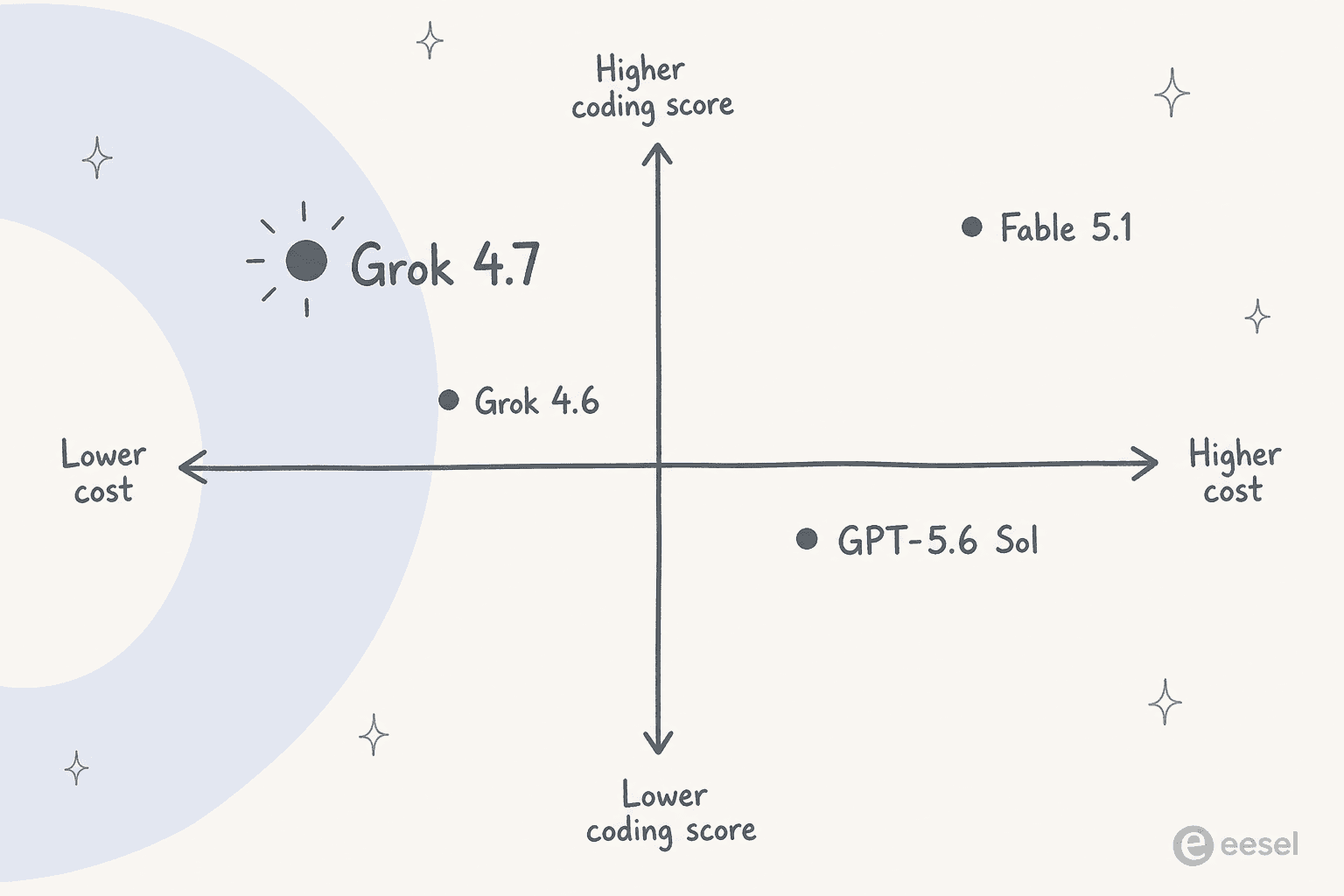
Grok 4.7 delivers roughly Fable-adjacent capability at Grok 4.6 pricing. Concretely, a task that reads 50k tokens and writes 10k costs about $0.16 on Grok 4.7 versus $0.40 on GPT-5.6 Sol and $1.00 on Fable 5.1. Multiply that by an agent doing thousands of runs a day and the model choice stops being about a benchmark decimal and becomes about your bill.
Two caveats keep this honest. First, the 200k cliff: cross 200k prompt tokens and the rate doubles to $4 / $1 / $12, applied to every token in the request, not just the overflow, which is exactly what the Context Compaction API exists to dodge. Second, the launch chart compared against the old GPT-5.6 Sol at $4 / $20, but OpenAI shipped GPT-6 Sol at $2 / $10 the day after, so the live output-price gap is 40%, not the 70% the chart implies. The xAI pricing picture is still the strongest in its tier, just not by as wide a margin as the slide. The full meter-by-meter breakdown lives in the Grok 4.7 pricing guide.
There is also the Fast-variant tax to know about. Grok 4.7 Fast is the same model at 2x output speed for 2x the token price, and it exists only inside Cursor and Grok Build, not the public API. It is worth paying when you are watching code stream back and latency stings; it is money burned on batch or overnight jobs where nobody is waiting.
I run agents at high volume (tool-calling, terminal work)
Yes, switch. This is the sweet spot. The Terminal-Bench jump plus $2 / $6 pricing is exactly what an agent loop wants. Watch the 200k cliff and use Context Compaction.
I need the single best coding accuracy, cost aside
Stay on Fable 5.1 for the hardest tasks. Many teams route most work to Grok 4.7 and escalate only the peak cases to a pricier model.
I do clinical or health-sensitive reasoning
Not the pick. Grok 4.7 trails GPT-5.6 Sol and Fable 5.1 on HealthBench Professional. Choose on that benchmark, not price.
I want AI to answer support tickets or write my blog
A raw model is the wrong layer. You want a teammate that already knows your product and plugs into your tools. Jump to the last section.
Safety, which xAI took seriously this time
Worth a paragraph because it is a real shift. Grok 4.7 shipped with an entirely new safeguard stack and is, by xAI's own testing, its strongest model on refusals and jailbreak resistance. On HackerBench v0.3 it lets only 3.3% of risky dual-use prompts through while rarely blocking legitimate security work, and it tops LatchBio's biosafety benchmark at 62.4%. xAI has also started giving select cybersecurity partners invite-only access to the model's red-team capabilities. For a company whose earlier models drew criticism on exactly this axis, that is a meaningful, checkable improvement rather than a press-release line.
What people actually building on it say
Benchmarks are xAI's story. Here is what independent developers report. The most useful signal I found was about scope: the model one-shots small things beautifully, and the enthusiasm cools on large existing codebases.
"I agree, the models keep getting better at one shotting. That's useful in a lot of situations, like for small one-off scripts that filter/transform some tool call, or make a clever bash call. For the code itself, it doesn't help me much though."

That tracks with the benchmark shape: strong on bounded, well-specified tasks, less magical when the job is "understand this 200k-line repo." The other recurring theme is that heavy daily users rarely hit the usage ceiling, which matters if you were burned by credit caps on other tools.
"I use the crap out of Grok in my daily life, including to build a couple self-hosted apps as an amateur. I have a Grok bot monitor my email every 15 minutes and file things away for me... and I never even get close to using my quota."
Both align with the through-line of this review: as a cheap, high-throughput engine you can lean on all day, Grok 4.7 delivers. What neither commenter is describing is a system that shows up already knowing their company, which is the exact gap I want to close in the last section.
Who should use Grok 4.7
Reach for it if you write code, run agents, or build on the API and you care about cost per task, which is most people building AI products in 2026. It is the natural default for high-volume agent loops, and a smart base layer even if you escalate the hardest 5% of jobs to Claude Opus 5 or Fable. Compared against the rest of the cheap-frontier field, it is a stronger all-rounder than Kimi K3 or DeepSeek V4 Flash on agentic work.
It also beats Qwen on terminal tasks and undercuts GPT-5.6 Sol on price while matching it on most coding. Inside an editor it ships in Cursor, so day-to-day it competes with the same tools that crowd already argues about.
Skip it, or at least don't lead with it, if you need peak coding accuracy regardless of budget, if your work is clinical, or if what you actually want is not a model at all but a finished job getting done. That last case is more common than the model-review framing admits, and it is where I want to be direct.
The part a model review usually skips: an engine is not an employee
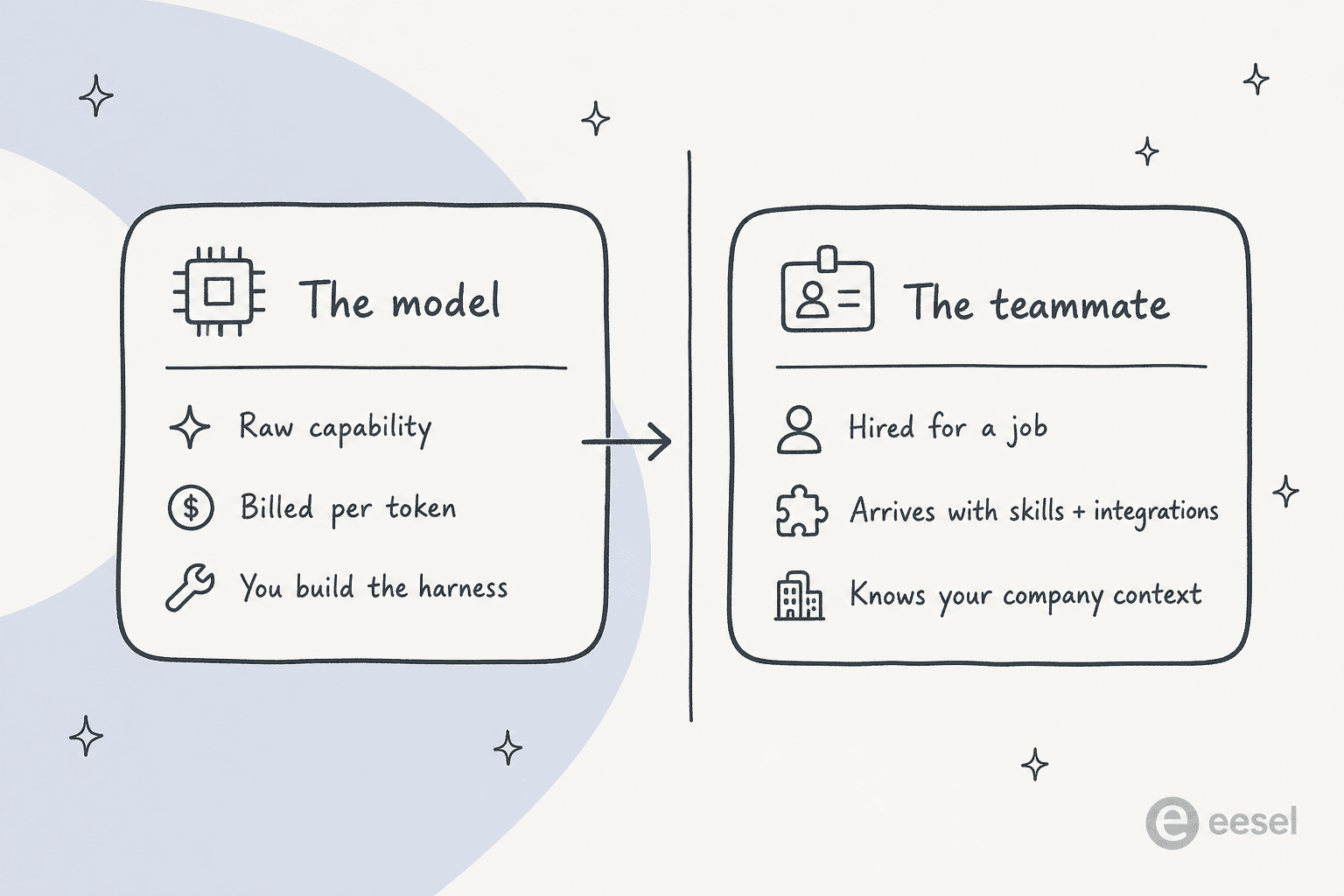
Here is the thing three years of putting AI on live support queues taught me. A frontier model is an incredibly capable engine, and an engine is not the same thing as an employee. Grok 4.7 gives you raw intelligence by the token. It does not know your refund policy, it is not connected to your helpdesk, it has never seen your past tickets, and it will not, on its own, decide which questions it is confident enough to answer and which to leave for a human. Wiring all of that up is a real project, and it is the part the benchmark score is silent about.
This is a build-versus-buy call that lands on every team eventually. One customer, an infrastructure company, put it plainly to us:
"We could try to write our own LLM application but we didn't want to invest our time into that. We wanted something that we would not have to maintain."
That is the gap eesel is built to close. eesel is an AI teammate platform, and you hire ready-to-work teammates for specific jobs rather than renting raw tokens. The current roster is an AI helpdesk teammate that joins your existing support queue, and an AI blog writer that stands next to the best AI writing tools for research-grade content. Each one arrives already built on frontier models, and already carrying the skills, integrations, and company context for its role.
The support teammate trains on your historical tickets, drafts or fully answers in your tone, and only handles what it is confident about, which is the exact control the model-by-the-token approach makes you engineer yourself. That difference is the whole argument in AI agent versus rule-based chatbot, and it is why AI for customer service is a product category, not just a prompt.
The proof is in the queue, not the benchmark. One customer, a mobility platform, saw eesel resolve 73% of tier-1 requests in the first month, and another reported up to 80% time savings on support. Those are numbers you get from a teammate that knows the job, not from a model that scored well on Terminal-Bench. If you are still weighing the cost side, the AI agent versus human cost breakdown and the wider AI customer service software landscape are the pieces I would read next.
If you actually want to drive the model yourself
For the developers Grok 4.7 is aimed at, there is a middle path worth knowing about. eesel ships a command-line interface and MCP server that expose the same teammate and workspace an agent-friendly way. A person can drive it from a terminal, scripts can automate it, and coding agents like Claude Code, Codex, and Cursor can operate it directly. So you get the programmable, headless control that made you interested in a raw API in the first place, but pointed at a teammate that already knows your company rather than a blank model you have to teach from scratch every run. It is the same instinct behind automating ticket triage from code instead of clicking through a dashboard.
Want to see it on your own tickets? eesel plugs into your helpdesk in minutes, trains on your history, and lets you simulate against thousands of past tickets before it answers a single live one. Free to try.

My verdict
Grok 4.7 is an easy model to recommend for what it is: the best value at the frontier, especially for agents and high-volume coding. It is not the smartest model on every axis, and the launch chart oversells the price gap now that GPT-6 Sol exists, but for cost-sensitive work it is the one I would reach for first. Just remember what you are buying. A model gives you capability by the token. If what you need is a job reliably done, that takes a teammate, and that is a different purchase entirely.
Frequently Asked Questions
Is Grok 4.7 good?
For coding and agentic work at low cost, yes. In my Grok 4.7 review it posts the biggest jump of any recent xAI release on long-running terminal tasks and holds a frontier position on price-performance. It is not the single smartest model on every board, since Claude's Fable 5.1 still leads peak coding and terminal work, but it is the best value in its class.
How much does Grok 4.7 cost?
Grok 4.7 is $2 per million input tokens, $0.50 cached, and $6 output below 200k prompt tokens, then $4 / $1 / $12 once a request crosses 200k, per the xAI pricing page. That is identical to Grok 4.6. The full breakdown, including the search and code-execution meters, is in the Grok 4.7 pricing guide.
Is Grok 4.7 better than GPT-5.6 Sol?
On xAI's own benchmark set, Grok 4.7 beats GPT-5.6 Sol on most coding and agentic tasks at a fraction of the price, though Sol edges ahead on clinical reasoning. Note that OpenAI has since shipped GPT-6 Sol at $2 / $10, so the live price gap is narrower than the launch chart suggests.
What is the difference between Grok 4.7 and Grok 4.6?
Grok 4.7 runs on a larger base model and a longer reinforcement-learning run weighted toward multi-hour tasks. It posts the biggest gains on Terminal-Bench 4.0, nearly doubling the 4.6 score. Both keep the 500k context window and the same pricing, so this is a free capability bump. The Grok 4.6 review covers the prior release.
Is Grok 4.7 good for coding?
Coding is its headline strength. It scores 46.3% on CursorBench 4.0 and beats Grok 4.6 across every software benchmark xAI published. It ships inside Cursor and Grok Build, and community coders report it is strong at one-shotting scripts, if less transformative on large existing codebases.
What is Grok 4.7 Fast?
Grok 4.7 Fast is the same model at twice the output speed for twice the token price, available only in Cursor and Grok Build rather than the public API. It is worth the tax when latency matters, like watching code stream, and skippable for batch or background jobs. See the xAI pricing overview.
How do I access Grok 4.7?
You can call it on the xAI API as grok-4.7, use it free in Grok Build, or reach it inside Cursor. If you want that intelligence doing a defined job rather than raw tokens, an AI teammate packages a frontier model with the skills, integrations, and company context for a real role like support automation.


Article by
Rama Adi Nugraha
Rama is a software engineer at eesel AI with two years of experience writing about B2B SaaS, AI tools, and customer support technology. Based in Bali, Indonesia, he brings a developer's perspective to product comparisons — cutting through marketing copy to what the integrations and APIs actually do.