
What I actually mean by "voice model"
I've spent the last couple of years wiring eesel into helpdesks, which means I've read a lot of vendor pages about AI that answers customers. Voice is the one category where the architecture claim is real and checkable, so it's worth being precise about it.
Most voice stacks are three products in a trench coat: speech to text, a language model, then text to speech, often from three different vendors. Every hop adds latency, cost, and one more thing that can fail at 2am. xAI's own framing on the Voice Agent Builder launch was that this is what they set out to collapse, and Think Fast 2.0 is the model doing the collapsing.
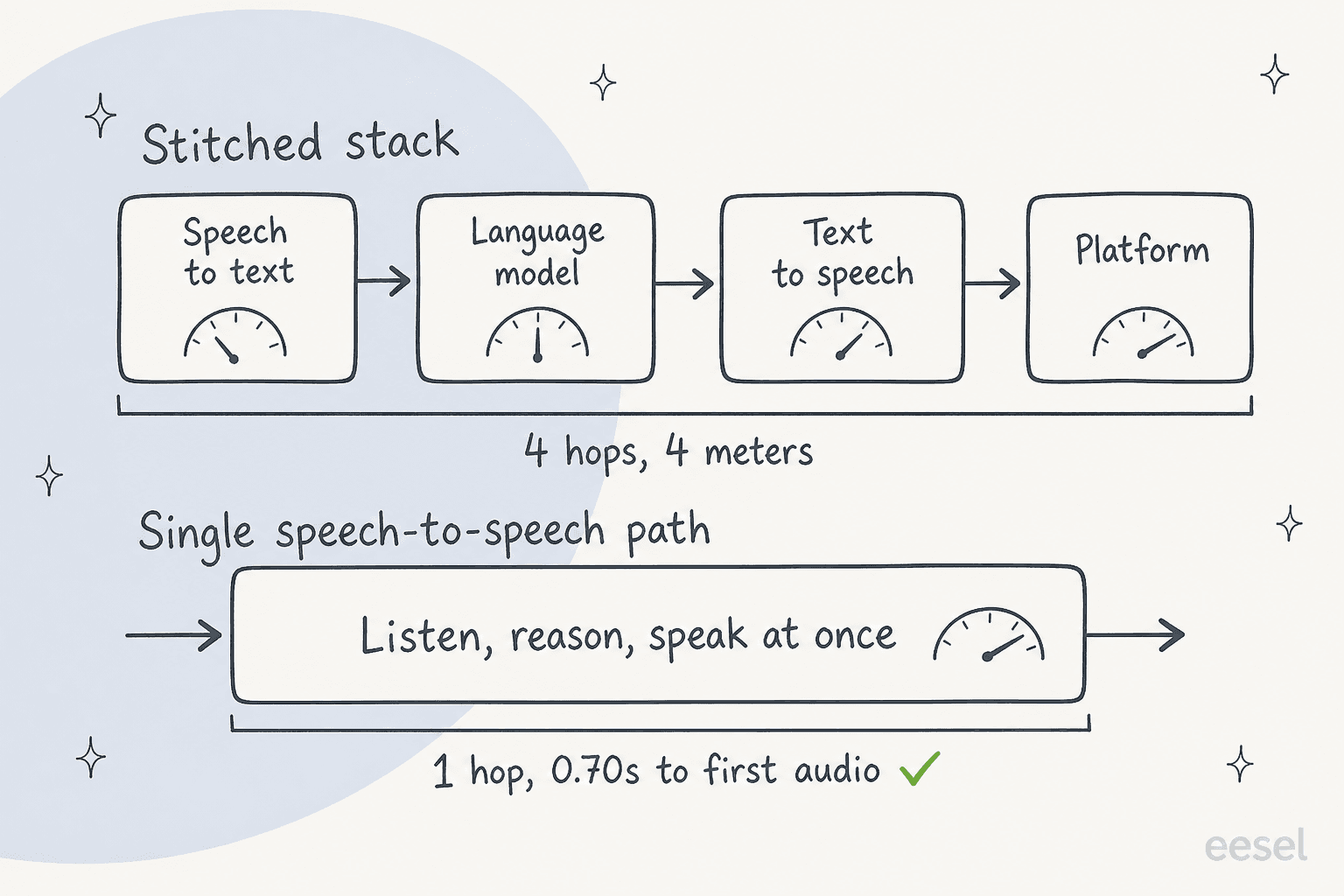
Think Fast models do something specific that I hadn't seen productised before: they reason while they're already speaking. xAI describes it as reasoning in parallel with speech, so the thinking doesn't sit in front of the first syllable. In practice, a tool call usually fires before the agent finishes its first sentence. That's the whole trick behind 0.70 seconds, and it explains why the model can be both fast and unusually good at multi-step work, which normally trade against each other.
Think Fast 2.0 also cut reasoning tokens hard. xAI reports the median response uses 0.4x the reasoning tokens of Think Fast 1.0, which is the kind of change you feel on a long call rather than in a demo.
The benchmark table, and the two rows people skip
Here's what xAI published on launch day, sourced to Artificial Analysis.
| Benchmark | Think Fast 2.0 | Think Fast 1.0 | GPT-Realtime-2.1 (High) | Gemini 3.1 Flash (High) |
|---|---|---|---|---|
| AA Speech-to-Speech Quality Index | 82.9% | 75.7% | 79.1% | 69.5% |
| Speech reasoning (Big Bench Audio) | 97.2% | 97.1% | 96.0% | 96.6% |
| Conversational dynamics (Full Duplex Bench) | 95.1% | 77.8% | 95.7% | 74.3% |
| Agentic performance (τ-voice Bench) | 56.5% | 52.1% | 45.7% | 37.7% |
| Time to first audio | 0.70s | 1.25s | 1.21s | 2.98s |
A few things I'd flag if you were reading this over my shoulder.
First, the row that matters most for support is τ-voice Bench at 56.5%, and Grok wins it by almost 11 points over OpenAI's best. τ-voice measures agents under realistic call conditions: noise, accents, interruptions, callers changing their mind mid-sentence. It's the closest published proxy for "can this thing run a real workflow on a real phone line." A 56.5% ceiling also means roughly two in five of those hard scenarios still fail, which is the number I'd put in front of anyone promising full automation.
Second, the conversational dynamics row is the one xAI does not win. GPT-Realtime-2.1 High edges it 95.7% to 95.1%, and the jump for Grok is from 77.8%, so this was clearly the fix of the release. Fair play to them, it's a 17-point move.
Now the context xAI's own table leaves out. Pull up the full Artificial Analysis leaderboard and Think Fast 2.0 is second overall, not first. Alibaba's Qwen Audio 3.0 Realtime Plus sits at 84.1%. It also takes 4.02 seconds to start talking, versus 0.70, which for a phone line is the difference between a conversation and dead air. Same story on latency: Deepslate Opal answers in 0.44s and Gemini 2.5 Flash Native Audio Dialog in 0.63s, both faster than Grok, and both well behind it on the index. Grok's claim is the combination, and on the combination it's the best thing on that page.
The August 5 alias flip, in dollars
This is the part I'd actually put in a calendar reminder.
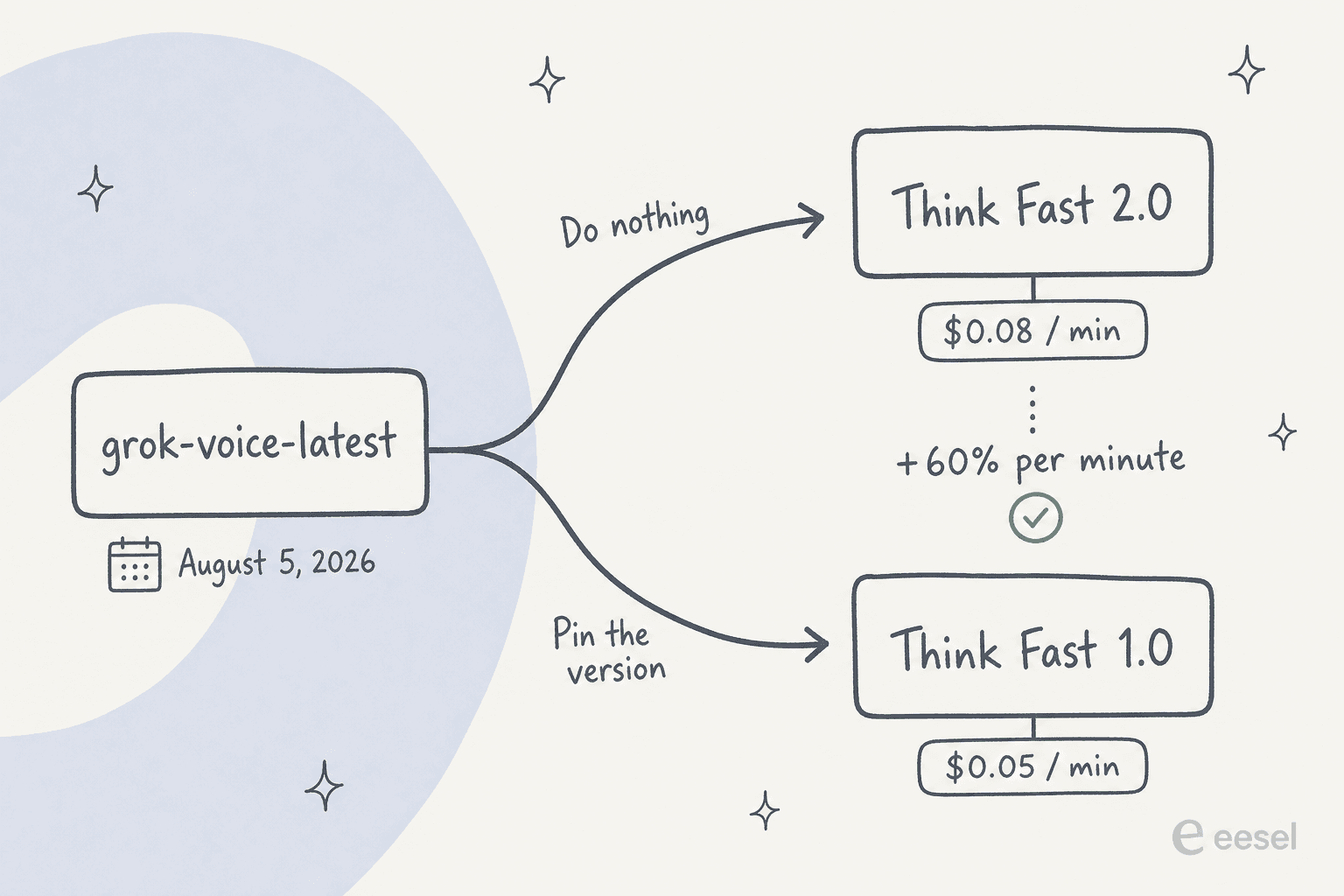
From the xAI pricing page, the voice rate card reads:
| Model or mode | Rate |
|---|---|
Speech to speech, grok-voice-think-fast-1.0 | $0.05 / min ($3.00 / hr) audio, $0.004 / text input |
Speech to speech, grok-voice-think-fast-2.0 | $0.08 / min ($4.80 / hr) audio, $0.004 / text input |
| Speech to text | $0.10 / hr (REST), $0.20 / hr (streaming) |
| Text to speech | $15.00 / 1M chars |
xAI's line on the migration is that no action is needed to upgrade, and to stay on 1.0 you pin grok-voice-think-fast-1.0 before August 5. Both halves of that are true. The half that doesn't get said out loud is that the default path is the expensive one, and a 60% per-minute increase arrives without a deploy on your side. If you run any volume, work out what that costs you before it lands rather than after.
Two other meters ride along with it. A provisioned phone number in the Voice Agent Builder is $0.01 per minute on top. Server-side tools bill per invocation: web search and X search at $5 per 1,000 calls, document collections search at $2.50 per 1,000, file attachment search at $10 per 1,000. A support agent that looks something up on nearly every call is buying those by the thousand, so put them in the model.
What August 5 costs you
Pick your monthly talk time. Rates are xAI's published voice rates plus $0.01/min for a provisioned number.
One caveat on comparing that to anyone else: xAI publishes a flat per-minute price, while OpenAI and Google bill per audio token. Artificial Analysis normalises it as cost per hour of input audio, and on that basis Think Fast 2.0 measures $4.80, GPT-Realtime-2.1 High measures $10.75, and Gemini 3.1 Flash High measures $1.75. The Grok figure is exactly 60 times its published minute rate, so it's a real rate card. The other two are measurements of one benchmark run, and they'll move with how chatty your agent is. If you're picking between them, read the OpenAI Realtime API pricing properly rather than trusting a single normalised column.
Transcription is the quiet upgrade
The benchmark table gets the attention, but I think the transcription work is the more useful change if you're putting this on a phone line.
xAI evaluated across thousands of short phrases in 24 languages and reports Think Fast 2.0 beating dedicated transcription models: 1.5x to 2.0x better word error rate than Deepgram Nova 3 and ElevenLabs Scribe v2, and 1.4x better than Think Fast 1.0. The claim I care about more is the noisy one, where they say the gap to dedicated speech-to-text widens to roughly 10x under background noise and telephony compression.
That's the actual condition of support calls. Nobody phones support from a recording booth. They phone from a car, a warehouse, a kitchen with a kid in it. If you've ever watched a transcript turn "cancel my order" into "can I sell my order," you know that one bad word is a whole wrong workflow. Anyone running multilingual support should look at the per-language chart on the announcement rather than the average, because the spread across those 24 languages is wide.
Two session parameters are there specifically to patch the remaining gaps, and they're worth knowing about on day one. audio.input.transcription.keyterms biases transcription toward up to 100 terms of 50 characters each, which is where your SKU names and plan names go. replace maps a phrase to a spoken substitution before text to speech, so the audio says your brand correctly while the transcript keeps the original spelling. The docs' example maps "Acme Mobile" to "Acme Mobull," which tells you exactly how unglamorous and necessary that feature is.
What building on it actually involves
I read the speech-to-speech docs the way I read any API I might have to support, which is looking for the parts that will bite later. A few notes from that pass.
The API is wire-compatible with OpenAI's Realtime API. You point the WebSocket at wss://api.x.ai/v1/realtime, swap the key, and most existing client code runs. That is a deliberately low switching cost, and it's the strongest commercial argument xAI has here. It's not perfectly compatible: conversation.item.done, rate_limits.updated and a handful of output_audio_buffer.* events aren't emitted, and conversation.item.input_audio_transcription.delta is renamed to .updated with cumulative rather than incremental payloads. If you built anything on those events, that's your porting work. The tool-calling differences are worth a read too.
Tools come in five types: function for your own APIs, file_search over uploaded document collections, web_search, x_search, and remote mcp servers. The MCP support is the one I'd use, because it means your existing internal tooling is reachable without writing a voice-specific shim.
Reasoning defaults to high effort. You can set reasoning.effort to "none" to switch it off. Worth noting because a real HN complaint about the previous generation was the opposite ask:
"Grok voice model is also a thinking model. I agree that it's far better than the other voice models Just give me a option to have a slower response but better model…"

Three xAI-specific extensions are the ones I'd flag to anyone building a support line:
force_messagespeaks a hard-coded, TTS-synthesised line without involving the model, with aninterruptibleflag. This is how you deliver "this call is being recorded" verbatim, every time, which is a compliance requirement, not a nice-to-have.resumptioncaches turns against aconversation_idand replays them on reconnect. Off by default. Without it, a dropped WebSocket loses the conversation, and mobile callers drop connections constantly.idle_timeout_msmakes the server re-engage a silent caller on a timer that re-arms after every response. That's the difference between a patient agent and an awkward silence.
Migration advice from the docs is the opposite of what you'd expect: make your system prompt shorter, not longer. xAI's guidance is to ask Grok to generalise your existing prompt rather than port it verbatim, and to strip out prompt hacks written to patch the previous model's edge cases. I've done that exercise on our own prompts across model upgrades. It's uncomfortable and it's usually right; carried-over workarounds are how a prompt slowly becomes unmaintainable.
Does it work in production? Starlink is the only real evidence
Benchmarks are one thing. The only deployment either announcement puts numbers on is Starlink's sales and support line, which runs on Grok Voice, and the figures xAI published with Think Fast 1.0 are worth quoting exactly:
- 20% conversion rate. One in five sales inquiries buys Starlink service while on the phone with Grok.
- 70% resolution rate. The majority of support inquiries resolve autonomously with no human in the loop.
- 28 tools. One agent, dozens of distinct tools, across hundreds of support and sales workflows.
- Hardware troubleshooting, hardware replacements, and service credits are all granted autonomously.
Those are strong numbers, and they're first-party, which cuts both ways. Starlink and xAI share an owner, so this is the best-case deployment with the most engineering attention available. A 70% autonomous resolution rate is real, and it's also what you get with a dedicated team building 28 tools for one line of business.
For Think Fast 2.0 specifically, xAI says A/B testing on that same Starlink line showed "a significant increase in sales conversion rate and support containment rate" and publishes no number for either. I'd like the number. Until there is one, the honest read is that 2.0 is better on benchmarks and probably better in production, on a vendor's word.
The community read is thin so far, which itself says something about who's paying attention. The launch thread on Hacker News drew five points and two comments:
"Don't know why this post isn't more popular, this is a SOTA voice model, beating dedicated labs like ElevenLabs"
The more useful signal is from people who've been living with the previous generation:
"Grok voice is the best voice AI voice assistant and it's not even close. The speed + intelligence tradeoff is just right. While GPT voice is smug and unhumanlike despite trying hard to be human."
And the calibrated version of the same view, which I'd trust most:
"Grok voice is surprisingly good, actually. It's still a dumber model than the thinking modes of frontier models, but it's less dumb than the voice modes of other providers."
Who should actually pick this up
Clear yes if you're running a phone line at volume and latency is the thing killing you. Sub-second first audio plus the best published agentic score is not a close call against the alternatives, and OpenAI Realtime compatibility means your spike costs a day, not a sprint. Anyone standing up call center automation from scratch should shortlist it.
Clear yes if you're a developer who wants to skip the stack. The Voice Agent Builder bundles telephony, retrieval, guardrails and call review, with SIP for numbers you already own. That's real time saved versus assembling four vendors, and the alternatives mostly charge a platform fee on top. Worth noting the voice model is versioned separately from the text line, so Grok 4.5 releases don't move it.
Not yet if your support volume is email and chat. This is the mistake I watch teams make: they see a great voice number and start planning a phone deflection project, when most of their queue never dials anybody. Voice is a channel, not a strategy. Start from where the tickets are, and if your phone line is already wired into a helpdesk, check what your Gorgias phone integration or equivalent already does before adding a second stack.
Not yet if you need to prove safety before go-live. There's no published way to dry-run Think Fast 2.0 against your own historical calls before pointing traffic at it. Call recording, transcripts and guardrails all exist after the fact, in the Builder. That's review, not rehearsal, and the distinction matters when the agent can issue refunds. The same gap shows up across the category, which is why preventing wrong AI answers is mostly a process problem rather than a model problem.
Careful if you're on grok-voice-latest right now. See the calculator above. Tomorrow.
Want the same thing for your ticket queue?
Grok Voice is good at the phone. The problem is that for most support teams the phone is the small channel, and the ticket queue is where the volume actually lives.
That's the half eesel does. It plugs into Zendesk, Freshdesk, Gorgias, Front, HubSpot and the rest, trains on your past tickets, macros and help center rather than a prompt you have to write from scratch, and drafts or sends replies inside the helpdesk your agents already have open. No new tool for anyone to learn.
The bit I'd point at, given everything above about the gap between a benchmark and a live queue: before you turn it on, eesel simulates the agent against your own ticket history and tells you what it would have answered and how often. That's the rehearsal step the voice stacks don't have. It exists because I've watched a confident-sounding bot answer wrong, and I'd rather find that out on last month's tickets than on this morning's.
One customer's read on why that step matters, an anonymised quote from a DTC supplements CX lead we spoke to:
"The AI will never be able to answer 100% of the questions... I need an AI who is only handling the tickets that it's confident to handle and all the other ones, leave them alone."
That's the setting, not a caveat. Confidence routing, ticket-type exclusion, and a simulation before go-live.

Free to try, and you can have it answering on your own tickets in a few minutes. Try eesel.
Frequently asked questions
What is Grok Voice Think Fast 2.0?
xAI's flagship speech-to-speech model, announced July 29, 2026, that listens, reasons and speaks on one model path instead of chaining three services. That single path is where the 0.70 second time-to-first-audio comes from. It becomes the model behind grok-voice-latest on August 5, 2026. If your goal is email and chat rather than calls, an AI helpdesk agent is the closer fit.
How much does Grok Voice Think Fast 2.0 cost per minute?
$0.08 per minute of audio, or $4.80 an hour, plus $0.004 per text input. Think Fast 1.0 remains listed at $0.05 per minute, so Grok Voice Think Fast 2.0 pricing is a 60% step up per minute. A provisioned number adds $0.01 per minute, and tool calls bill separately. Weigh it against your broader AI customer service cost picture, and against what a human agent costs.
Is Grok Voice Think Fast 2.0 faster than GPT-Realtime?
Yes, on the published measurement: 0.70 seconds to first audio against 1.21 seconds for GPT-Realtime-2.1 High. It isn't the fastest model on the board, though. Deepslate Opal answers in 0.44s and Gemini 2.5 Flash Native Audio Dialog in 0.63s, both further down the quality index. The OpenAI Realtime API comparison covers the trade the other way, including WebRTC versus WebSocket transport.
Do I have to upgrade from Think Fast 1.0?
Only if you do nothing. On August 5, 2026 grok-voice-latest repoints from grok-voice-think-fast-1.0 to grok-voice-think-fast-2.0, so pinning the old version before then is what keeps you on it. Pinning versions in production is good hygiene regardless, the same instinct behind testing AI answers before customers see them.
Can Grok Voice Think Fast 2.0 handle customer support calls?
It's designed for exactly that. Starlink's line runs on Grok Voice with 28 tools, 70% autonomous resolution and 20% sales conversion, and the model does function calling, document search, MCP and human transfer. The realistic framing is in can AI answer support calls, and the operational side in how to automate phone support and AI escalation management.
What is the transcription accuracy of Grok Voice Think Fast 2.0?
xAI reports 1.4x better word error rate than Think Fast 1.0 and 1.5x to 2.0x better than Deepgram Nova 3 and ElevenLabs Scribe v2 across 24 languages, widening to roughly 10x in noisy audio. Check the per-language chart rather than the average if you run multilingual support, because accuracy varies by language and it's the tail that hurts your CSAT.
Does Grok Voice work with Zendesk or Gorgias?
Not natively. Grok Voice is a model and a builder, so any helpdesk write-back is a function tool or MCP server you wire up yourself. If you want AI inside the helpdesk instead, start with Zendesk AI or Freshdesk's Freddy. On the telephony side, the Zendesk Talk setup is the closest native equivalent. Either way, treat voice as one more channel feeding the same queue.
Is Grok Voice Think Fast 2.0 worth it over Think Fast 1.0?
For a hard agentic workload, probably: 82.9% against 75.7% overall, plus almost half the latency and a 17-point jump in conversational dynamics. For a simple FAQ line where 1.0 already resolves what you need, the 60% rate increase buys you accuracy you may not use. Model that against your own resolution rate and call center ROI before you let the alias decide for you. If you're comparing across the whole lineup, xAI pricing is the next stop.
Sources
- Grok Voice Think Fast 2.0, xAI, July 29, 2026
- Grok Voice Think Fast 1.0, xAI, April 23, 2026
- Introducing the Voice Agent Builder, xAI, July 1, 2026
- 21 New Flagship Grok Voices, xAI, July 6, 2026
- xAI pricing, voice API rates, last updated July 3, 2026
- Speech to Speech API docs, xAI, last updated August 2, 2026
- Speech to Speech models leaderboard, Artificial Analysis
Frequently Asked Questions
What is Grok Voice Think Fast 2.0?
grok-voice-latest on August 5, 2026. If your goal is answering email and chat rather than phone calls, an AI helpdesk agent is the closer fit.How much does Grok Voice Think Fast 2.0 cost per minute?
Is Grok Voice Think Fast 2.0 faster than GPT-Realtime?
Do I have to upgrade from Grok Voice Think Fast 1.0?
grok-voice-latest stops pointing at grok-voice-think-fast-1.0 and starts pointing at grok-voice-think-fast-2.0. To stay on the older, cheaper model, pin grok-voice-think-fast-1.0 explicitly before that date. Pinning is what xAI recommends for production anyway, the same discipline that preventing bad AI answers depends on.Can Grok Voice Think Fast 2.0 handle customer support calls?
What is the Grok Voice Think Fast 2.0 transcription accuracy?
How does Grok Voice Think Fast 2.0 pricing compare to other voice APIs?
Where does Grok Voice Think Fast 2.0 not help?


Article by
Rama Adi Nugraha
Rama is a software engineer at eesel AI with two years of experience writing about B2B SaaS, AI tools, and customer support technology. Based in Bali, Indonesia, he brings a developer's perspective to product comparisons — cutting through marketing copy to what the integrations and APIs actually do.