

What Grok Voice Agent Builder actually is
xAI announced Voice Agent Builder on July 1, 2026, pitched as a way to "create a personalized voice agent in under 2 minutes without a single line of code." It's a no-code layer on top of Grok Voice, and it targets, in xAI's own words, "operators and developers who want high-volume production voice agents without building the surrounding stack from scratch."
That's a real problem it's solving. Most voice AI today is three separate APIs bolted together: speech-to-text, a language model, then text-to-speech, often from three different vendors. xAI's line on that: "every hop adds cost, latency, and new failure modes." Voice Agent Builder replaces the stack with one interface on a speech-to-speech path that's tightly coupled to the model rather than assembled from three.
It's also flexible about infrastructure. You can bring your own phone numbers over SIP, wire your own tools and MCP servers to it, or connect a custom client over WebSocket instead of using xAI's console. Under the hood, the Grok Voice Agent API that powers this launched back in December 2025, and it's built on an in-house voice stack, the voice activity detection, tokenizer, and audio models are all built from scratch rather than stitched from third-party pieces, which is part of why xAI can iterate on speed and intelligence together.
How it's different: one model instead of three
This is the part worth actually understanding, because it explains almost every other claim in this review.
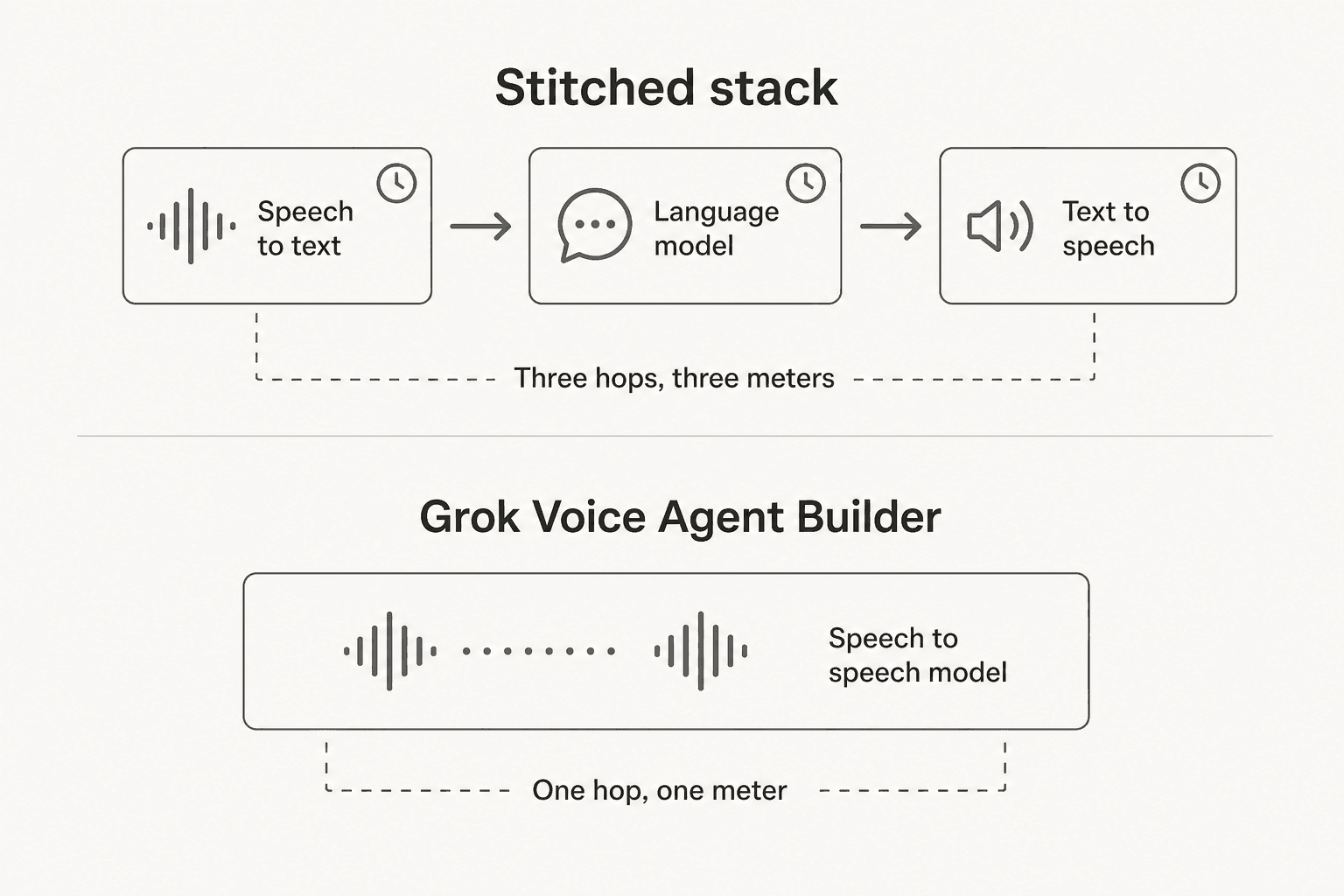
A typical voice stack passes audio through three hops: a speech-to-text model transcribes it, a language model reasons over the text, and a text-to-speech model turns the reply back into audio. Each hop is usually a different vendor, billed separately, and each one adds latency and a place things can go wrong, an accent the transcriber mishears, a reasoning step that loses the caller's tone, a synthesis step that sounds robotic.
Grok Voice Agent Builder collapses that into one model that processes speech in and generates speech out directly. The LiveKit partnership announcement frames it well: because Grok "processes speech input and output within one model," it can reliably respond in under 700 milliseconds, and it can carry paralinguistic detail, laughing, whispering, sighing, that gets lost when text is the intermediate format. A community summary from a Reddit thread on the launch put it plainly:
"It works with a direct speech to speech setup connected to the Grok model. This differs from the common approach of linking separate speech to text, language model, and text to speech services from different providers."

xAI trained the underlying model on what it calls the hardest calls it could find, real calls with low-quality telephony audio, background noise, strong accents, interruptions, and callers who change their minds mid-sentence, across ambiguous workflows spanning dozens of tools in 25+ languages. It benchmarks that on τ-voice Bench against Gemini 3.1 Flash Live and GPT Realtime 1.5 across Overall, Retail, Airline, and Telecom categories, and separately claims the #1 spot on Big Bench Audio, independently verified by Artificial Analysis. One Reddit reaction to that ranking, only half-joking:
"So ...in other words, it is the Best voice agent so far in all of history?"
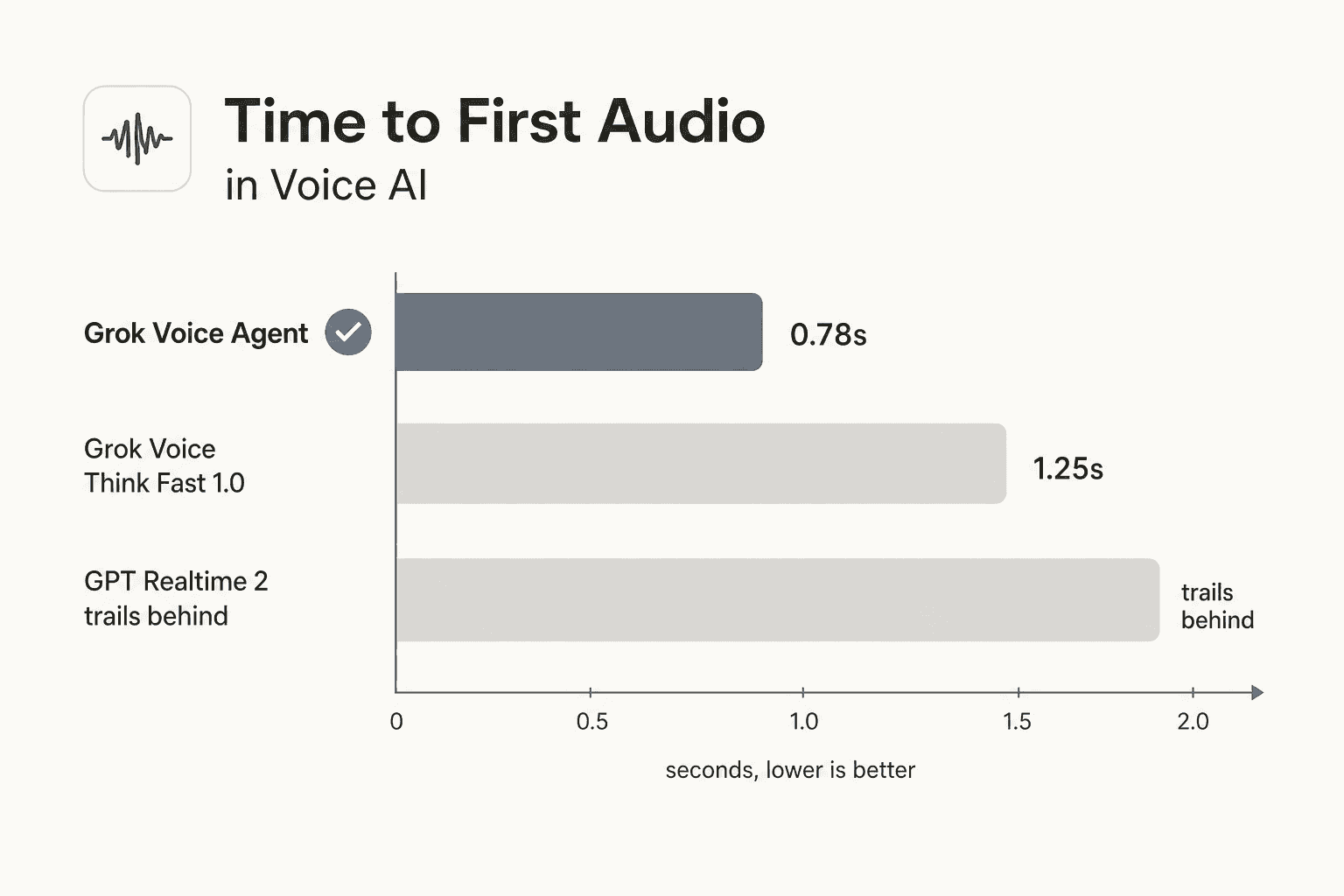
A third-party latency test from Impekable (directional, not a primary source, but worth noting) clocked Grok Voice Agent at 0.78 seconds time-to-first-audio, ahead of GPT Realtime 2 in the same comparison.
Setting up an agent: what "two minutes, no code" actually means
The setup flow, per xAI's own walkthrough, is genuinely simple on paper:
- Describe the call flow in plain language. You write a prompt describing how calls should go, and the model reasons in real time to follow long instructions and work through ambiguous requests.
- Attach a knowledge base. Upload documents (plain text, Markdown, Word, PowerPoint, Excel, HTML, JSON) into shareable collections that multiple agents can pull from, so policies and product specs live in one place instead of pasted into every prompt.
- Wire up tools. Named integrations include Google Calendar or Outlook Calendar for scheduling, email confirmations, custom API calls to check order status or issue a refund, web or X search for current info, Linear or Notion for ticketing, and Google Drive or OneDrive for file access. If the caller needs a human, the agent can transfer the call and notify your team in real time.
- Pick a voice and a number. Choose from 80+ built-in voices, or clone your brand's voice from about two minutes of audio. Every account gets a free phone number, and you can bring an existing number over SIP or test entirely in the browser first.
- Review what happened. Every call is recorded and transcribed, with visibility into which tools the agent used, and guardrails restrict off-script behavior like reading back card numbers.
xAI names two concrete use cases in the launch: a booking line that schedules appointments and sends confirmations, and support/sales flows that check order status or process refunds, which is exactly the kind of work most AI agents are built for today, just on the phone instead of in a chat window.
The developer who's put this to the most public test is Brendan Jowett, who built a full ecommerce voice assistant and posted about it on LinkedIn:
"I built a full ecom voice assistant that switches languages mid-conversation, controls websites, and sounds more human than any model I've tested."

Commenters on that post zeroed in on the same two things: mid-conversation language switching, and the fact that the agent can actually navigate a website and take actions, not just answer questions.
"The website-control part is the jump most voice demos skip, answering questions is easy, actually navigating and adding to cart is where it gets real. Mid-conversation language switching is a nice touch for ecom."
Where the review gets less flattering
Two things in that same comment thread are the parts xAI's launch post doesn't dwell on, and a fair review has to.
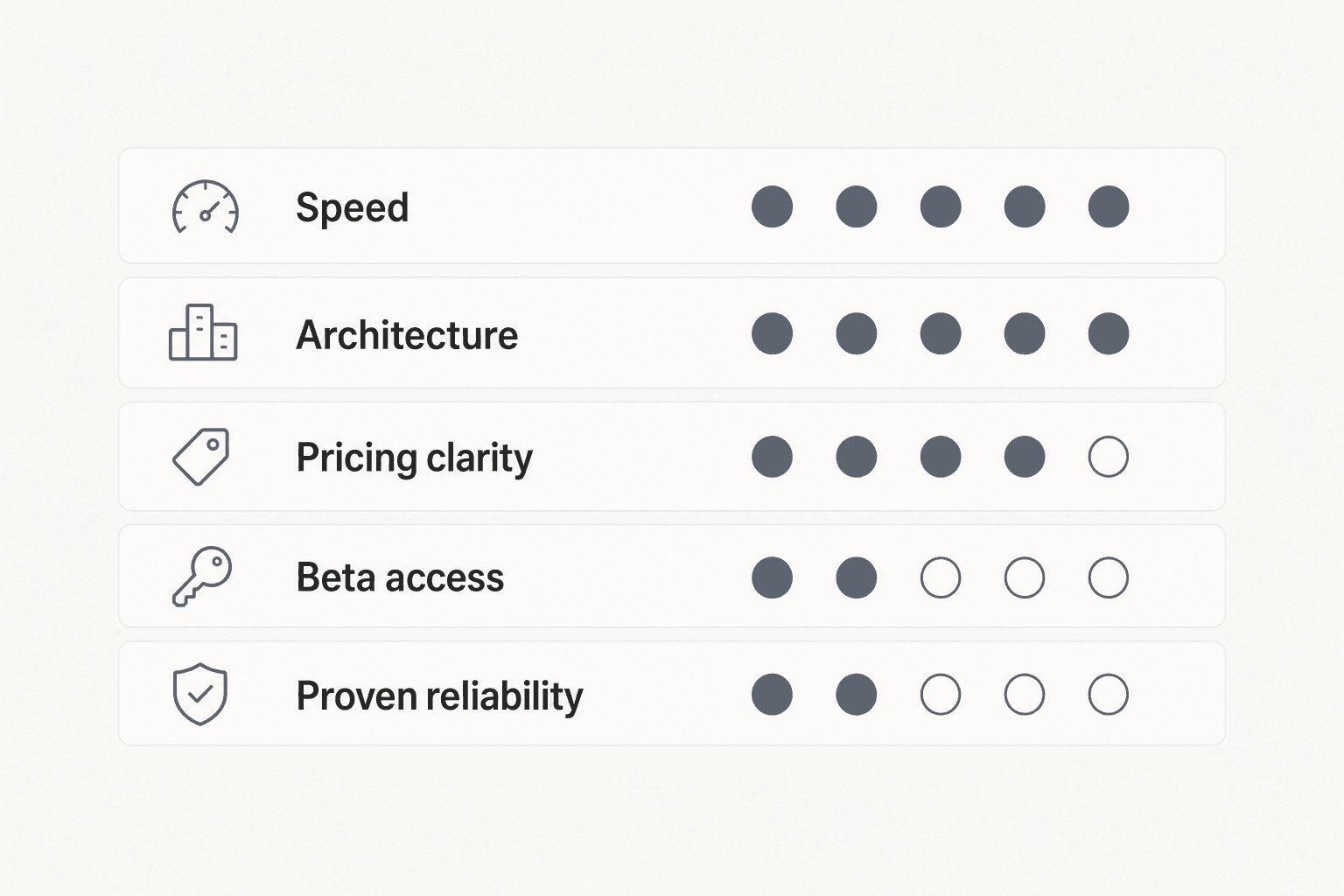
The first is beta access. The single sharpest complaint I found is a developer who simply couldn't get in:
"I wanted to try 'Grok Voice Agent API' instead of OpenAI's but I can't obtain ephemeral key: Failed to get ephemeral token: 403 The caller does not have permission to execute the specified operation. Team is not authorized to perform this action. My key have no restrictions. Is this API limited to enterprise only?"
That's not a one-off. A top commenter on the Voice Agent Builder launch thread didn't even know where to start:
"How do I try it? Available in Grok app?"
And even fans of the benchmark win aren't calling it finished:
"Good job on getting it to #1 in the benchmark but cost and speed needs work. Though I expect xAI to deliver on cost and speed soon enough."
The second, more serious gap is the confirm-step question. The same LinkedIn thread that praised the ecommerce demo also surfaced the sharpest, most experienced-sounding critique in all of my research for this post:
"The quick build is never the part that bites you, it's the moment the agent actually acts on the site. A voice assistant that adds to cart is one misheard word away from ordering the wrong thing, so the real work is making it confirm the action before it commits, not just fire it. I learned that the hard way letting agents act unsupervised. Did you build a confirm step in, or does it just execute what it hears?"
Nobody in the thread, including the original poster, answered that with a concrete "yes, here's the confirm step." That's the exact failure mode I'd want closed before I put an agent like this in front of a real customer with a real credit card. It's the same lesson we've learned running eesel on live support queues: we've watched a confident-sounding bot quietly give the wrong answer, which is why we now simulate every rollout against a team's own historical tickets before it ever talks to a real customer. A voice agent taking an unconfirmed action on a misheard word is the phone-call version of the exact same risk.
There's also no local or self-hosted option yet, which matters if your compliance posture requires that, and the τ-voice Bench percentage scores against Gemini and GPT Realtime weren't published as readable numbers in the announcement, so you're taking the "#1" framing partly on trust.
Grok Voice Agent Builder pricing: what you'll actually pay
xAI's own framing is "simple and transparent," and on paper it is: fewer meters than a stitched stack, one clear headline rate. Here's the full breakdown from xAI's pricing page:
| Item | Cost |
|---|---|
| Voice Agent (Realtime, speech-to-speech) | $0.05/min ($3.00/hr) |
| Realtime text input | $0.004/message |
| Text to Speech | $15.00/1M characters |
| Speech to Text (batch) | $0.10/hr |
| Speech to Text (streaming) | $0.20/hr |
| Free provisioned phone number | Included |
| SIP-connected own number | +$0.01/min |
| Web Search / X Search tool calls | $5/1,000 calls |
| Collections Search (RAG) tool calls | $2.50/1,000 calls |
| Files & Collections storage | $0.025/GiB/day (files), $0.10/GiB/day (collections) |
There's no published free tier, no trial credit, and no self-serve discount for annual commitment on the voice product specifically. The flat $0.05/min rate with no separate platform fee is genuinely a good deal against the old stitched-stack norm, where you'd pay separately for transcription, LLM tokens, and synthesis, and community reaction backs that up:
"The Grok Voice Agent API leads the industry in cost-efficiency. Developers are billed at a simple flat rate of $0.05 per minute."
Do the math on volume, though, before you assume it's cheap for your use case. A support line running 5,000 calls a month at an average of 4 minutes each is 20,000 minutes, or $1,000/month before you touch a single tool call, on top of whichever tool-calling fees your agent's actions trigger. That's a real number worth comparing against whatever you're paying today, and against the alternative of not building a phone channel at all.
Where I'd use this, and where I wouldn't
If you're already building or maintaining a voice product, phone banking, telehealth intake, a booking line, a Salesforce voice agent, Voice Agent Builder is a genuinely strong starting point. The architecture is right, the price is right, and the fact that developers keep saying they wanted to try it "instead of OpenAI's" tells you where the real competitive pressure in AI voice agent platforms is right now. If you're evaluating the wider field, my breakdowns of the best AI voice assistant tools and Zendesk's own voice AI assistants are worth reading before you commit to building from scratch.
If you're weighing this against a free option first, I'd also point you at what I found testing free voice assistant AI tools, most don't come close to this architecture, but they're a reasonable way to learn the space before you spend real API budget.
Where I'd think twice: if your support problem is mostly chat, email, and helpdesk tickets rather phone calls, which is true for most support teams I talk to, building a voice stack from scratch to solve a text problem is solving the wrong channel. And if you do need voice specifically, wait for the beta access gating to clear and for someone to publish a real answer on the confirm-step question before you put it in front of paying customers.
Try eesel
I work on eesel, and the reason Grok Voice Agent Builder's core idea, one model handling the whole interaction instead of a stitched, multi-vendor pipeline, resonates with me is that it's the same problem we solve for support teams on chat and email. eesel is an AI teammate that plugs directly into the helpdesk you already run, Zendesk, Freshdesk, Intercom, HubSpot, Gorgias, Front, and learns from your actual past tickets and help docs on day one instead of asking you to build a knowledge base and call flow from a blank page.
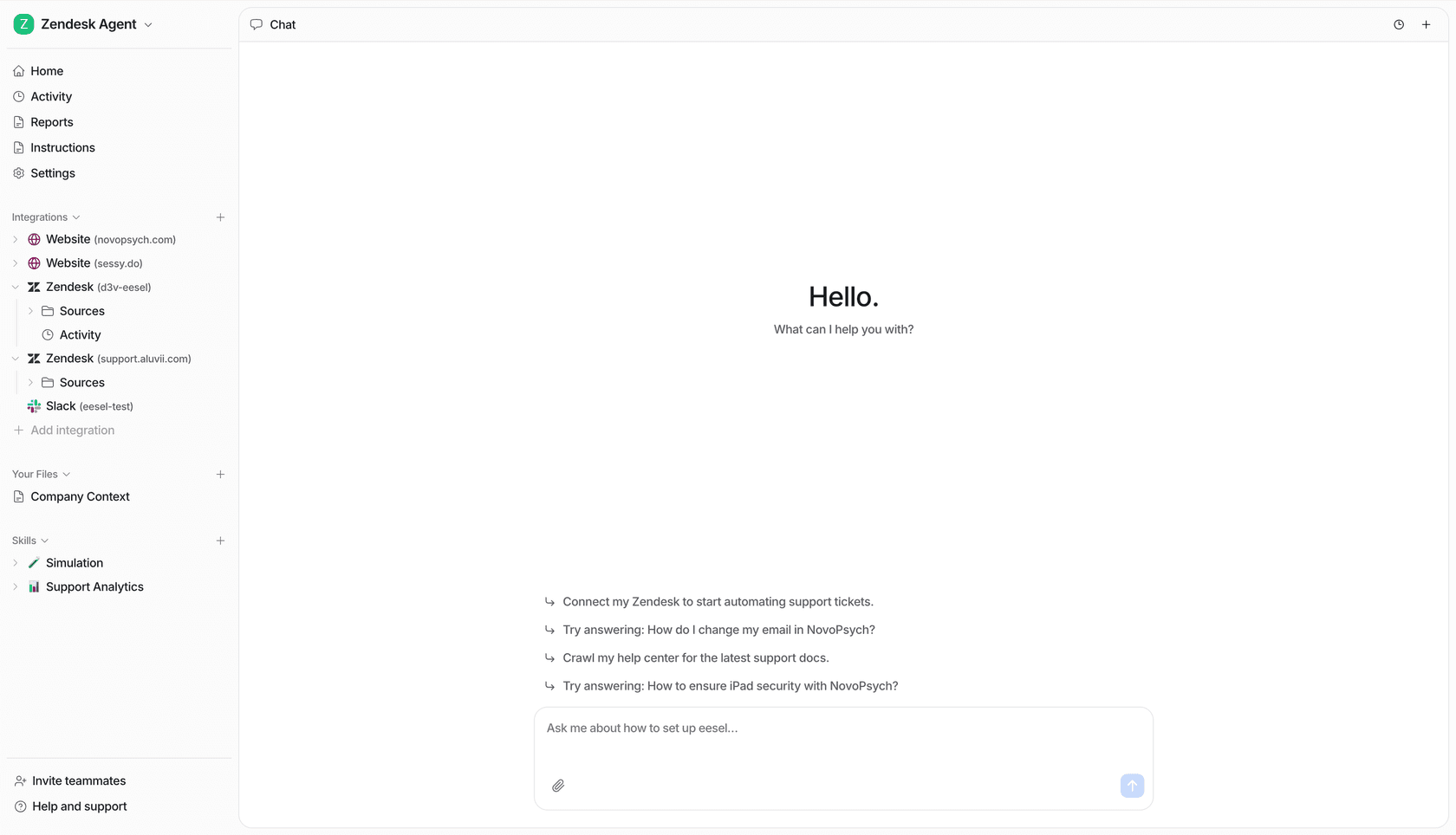
The confirm-step gap developers are raising for Grok's voice agents is one we've already had to solve for text: eesel uses confidence-based routing so a low-confidence answer gets drafted for a human to check rather than sent live, and you can simulate the agent against your own historical tickets before it ever talks to a real customer, so you see your actual resolution rate instead of trusting someone else's benchmark. Pricing is usage-based at $0.40 per resolved ticket with no per-seat fees and no platform minimum, so you pay for outcomes, not for a voice stack sitting idle between calls. You can try eesel free.
Frequently Asked Questions
Is Grok Voice Agent Builder worth it?
How much does Grok Voice Agent Builder cost?
What is Grok Voice Agent Builder's architecture, and why does it matter?
Does a no-code voice agent builder replace an AI agent for customer support?
What happens if the voice agent mishears a customer?


Article by
Kira
Kira is a writer at eesel AI with a Computer Science background and over a year of hands-on experience evaluating AI-powered customer service tools. She focuses on breaking down how helpdesk platforms and AI agents actually work so that support teams can make better buying decisions.