

Why look past Grok Voice Agent Builder at all
To be fair to Grok first: the architecture is the real story. A single speech-to-speech model instead of three stitched-together APIs is why xAI can claim time-to-first-audio under a second, and developers who've actually built with it back that up, particularly on mid-conversation language switching.
The reasons to look elsewhere are less about the tech and more about maturity. It's a beta launched July 1, 2026, several developers hit 403 "not authorized" errors trying to get access, there's no self-hosted or on-prem option for teams that need one, and nobody has years of compliance audits or enterprise deployments behind it the way Bland AI or Deepgram do. If you need a production voice agent live this quarter, not whenever xAI opens broader access, the platforms below have already done that work.
How I picked these
I looked at platforms that developers and teams actually compare Grok against in the wild, on Reddit and in vendor pricing FAQs that name each other directly. Every item below has public pricing, a real product I could look at, and independent user reviews on G2 or Reddit, not just a marketing page. I weighed four things: how the platform bills you (flat rate vs. composable stack), what the architecture actually is (unified model vs. cascaded pipeline, since that's what drives the latency story), what compliance and self-hosting options exist, and what real users say once they've built something on it.
| Platform | Pricing model | Starting cost | Architecture | Latency claim | Compliance | Self-hosted | Free tier | Best for |
|---|---|---|---|---|---|---|---|---|
| Grok Voice Agent Builder | Flat per-minute | $0.05/min | Unified speech-to-speech | Under 1s (#1 Big Bench Audio) | SOC 2, HIPAA-eligible, GDPR | No | Free number only | Fastest response, if you can get access |
| ElevenLabs Agents | Per-minute plan tiers | $0/mo (15 min free) | Multi-provider, BYO LLM | Not independently benchmarked | SOC 2, HIPAA, GDPR | No | Yes | Teams already using ElevenLabs voices |
| Retell AI | Composable per-minute | $0.115/min (example) | Multi-provider orchestration | ~600ms (unverified) | SOC 2 Type II, GDPR, self-serve BAA | No | $10 free credit | Developers who want granular flow control |
| Vapi | Usage + pass-through | $0.05/min hosting | Multi-provider orchestration | <500ms claimed, inconsistent per G2 | SOC 2, HIPAA, PCI (Scale) | No | 60+ free min | Maximum provider flexibility |
| Bland AI | Flat all-in per-minute | $0.14/min (Start) | Self-hosted, bundled stack | "Lowest latency" (unverified) | SOC 2 I&II, HIPAA, PCI, GDPR | Yes, Enterprise | Yes, Start tier | Regulated industries, compliance-first |
| Synthflow | Enterprise contract | From $30,000/yr | In-house telephony + orchestration | Not published | SOC 2, HIPAA, ISO 27001, PCI DSS, GDPR | No | No | Enterprise receptionist/booking at scale |
| Deepgram Voice Agent API | Per-minute tiers | $0 ($200 credit) | Unified stack, BYO option | Sub-200ms (TTS component) | SOC 2 Type 2, HIPAA, EU residency | Yes | Yes | The infra layer other tools already resell |
The architecture column is worth pausing on, because it explains most of the latency debate below.
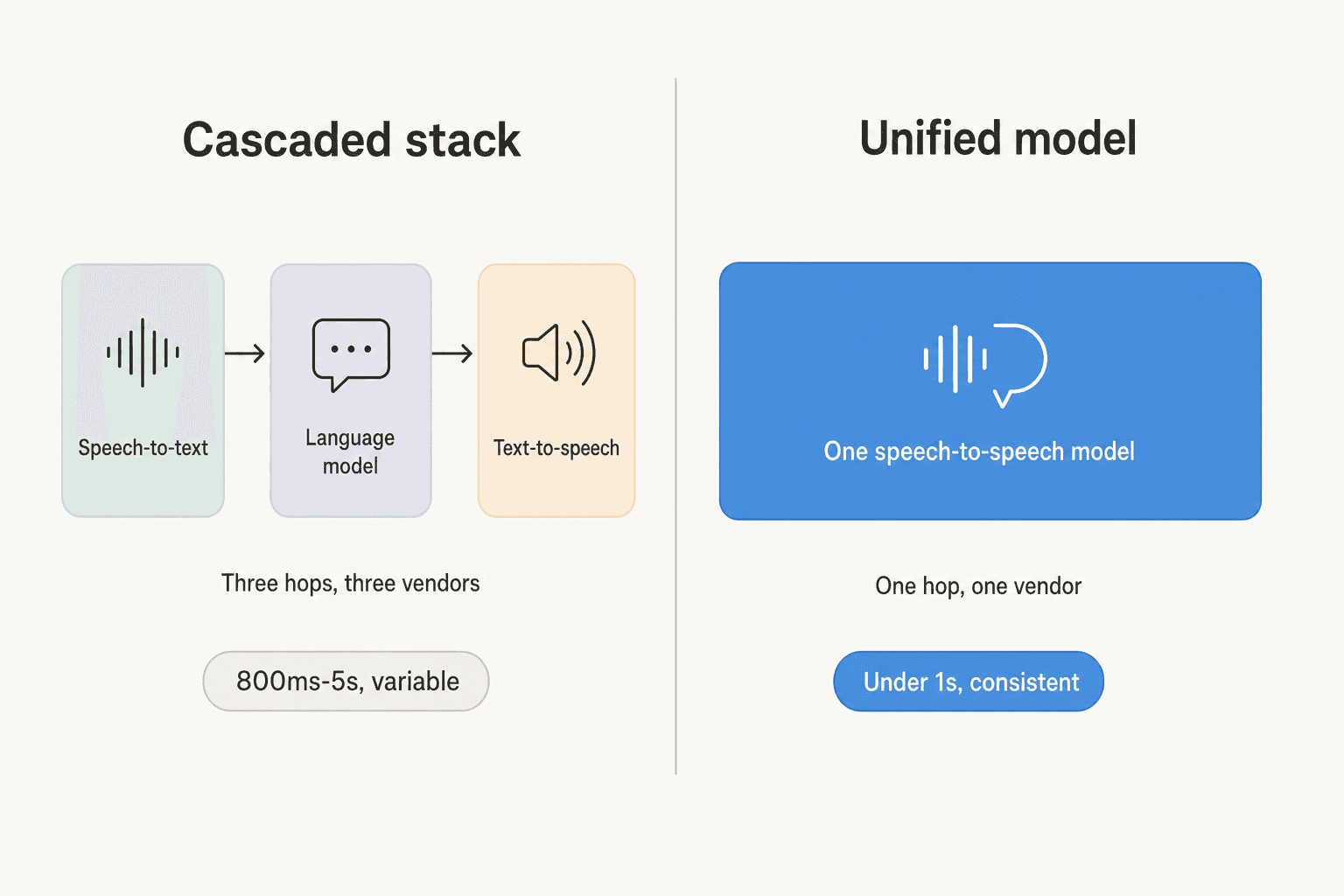
Platforms like Vapi, Retell AI, and Synthflow are orchestration layers: they chain a speech-to-text service, a language model, and a text-to-speech service together, three separate hops and often three separate vendors. That's where their flexibility comes from, you can swap in any Deepgram or ElevenLabs voice you like, but it's also where latency variance comes from. Grok and Deepgram's Voice Agent API instead run one model end to end, which is why their latency numbers are both faster and more consistent.
1. ElevenLabs Conversational AI (ElevenAgents)
Best for teams that already use ElevenLabs voices and want agents in the same platform.
ElevenLabs built its name on voice realism, 4.5/5 on G2 across 1,140+ reviews, and its Conversational AI product (branded ElevenAgents) extends that into full voice-agent territory: a visual multi-agent workflow builder, a built-in RAG knowledge base that auto-reindexes, and bring-your-own-LLM support for Claude, Gemini, GPT, or Qwen. Out-of-the-box integrations cover Salesforce, Stripe, Zendesk, Twilio, HubSpot, and Cal.com, plus hundreds more via MCPs.
Pricing:
| Plan | Price | Call minutes/mo | Concurrent calls |
|---|---|---|---|
| Free | $0 | 15 min | 4 |
| Starter | $6 | 75 min | 6 |
| Creator | $22 (first month $11) | 275 min | 10 |
| Pro | $99 | 1,238 min | 20 |
| Scale | $299 | 3,738 min | 30 |
| Business | $990 | 12,375 min | 40 |
| Enterprise | Custom | Custom | Custom |
Overage runs $0.08/min beyond your plan allowance, with burst pricing at $0.16/min if you exceed your concurrency cap during a spike. Text messages are $0.003 each. The language model and telephony costs are billed separately on top, the model usage draws from your shared credit pool, telephony is at cost.
Pros: the most natural-sounding voices on the market by a wide margin, a genuinely deep voice cloning library, and 32+ languages with automatic detection. Cons: the credit-based pricing model is the single most common complaint on Trustpilot, where the score sits at just 3.2/5 against G2's 4.5, users report effective cost running well above the advertised rate once failed generations and regenerations are counted.
Our take: pick ElevenLabs if voice quality is the deciding factor and you're fine paying a premium for it. Skip it if you're optimizing purely for latency or cost, since Retell AI's or Grok's per-minute math will usually come in lower for pure phone-agent use cases.
2. Retell AI
Best for developers who want granular control over the call flow itself.
Retell AI positions itself as "3rd Gen Voice AI," an explicit contrast to older touch-tone IVR and intent-mapping IVA systems. It ships two distinct agent builders: a Conversation Flow builder for fine-grained structured control, and a Single/Multi-Prompt builder for flexible, prompt-driven agents, plus a Playground for interactive testing and automated Simulation Testing at scale before you go live.
Pricing: true pay-as-you-go, starting at $0 with $10 in free credits and no annual contract. AI Voice Agents run $0.07–$0.31/min, composable from Retell's own voice infrastructure at a flat $0.055/min plus whatever text-to-speech, language model, and telephony you pick. The pricing calculator's default example lands at $0.115/min. AI Chat Agents run $0.001–$0.052 per message depending on the model. Twenty concurrent calls are free, then $8 per concurrent call per month.
Retell connects to a wide multi-provider voice and LLM matrix, ElevenLabs, Cartesia, OpenAI, MiniMax, and Fish for voices, GPT, Claude, and Gemini for the language model, and integrates natively with HubSpot, Twilio, Salesforce, Genesys, and Amazon Connect.
Pros: a real G2 pattern around handling interruptions and off-script conversation well, one Reddit head-to-head test found Retell's conversion rate meaningfully ahead of Bland's on the same outbound script. Security is solid too: SOC 2 Type II, GDPR, and a self-serve BAA on every plan, not gated behind Enterprise. Cons: the ~600ms latency claim on Retell's homepage isn't backed by a linked independent benchmark, and per-minute cost stacks up fast once you add a capable LLM.
Our take: if you want to build the call flow yourself rather than describe it in a prompt, Retell's Conversation Flow builder is the most developer-friendly option here.
3. Vapi
Best for maximum flexibility across speech-to-text, language model, and voice providers.
Vapi is explicitly an orchestration platform rather than a proprietary voice model: every assistant is assembled from swappable speech-to-text, language model, and text-to-speech providers, "dozens of providers and models to choose from," per its own docs. It ships two build primitives: single-prompt Assistants for fast iteration, and Squads, multiple specialized assistants with context-preserving transfers for flows like medical triage or e-commerce order routing.
Pricing: the Build tier is self-serve and usage-based, 60+ free minutes, then $0.05/min for Vapi's own hosting on calls (or $0.005/msg for chat), with underlying model provider costs passed through at cost, or $0 if you bring your own API key. Ten call-concurrency lines are included, extra lines run $10/month. HIPAA compliance is a $2,000/month add-on, Zero Data Retention is $1,000/month. The Scale tier is an annual contract with committed, volume-discounted rates plus SOC 2, HIPAA, PCI, SSO, and RBAC.
Vapi claims 1 billion calls supported and 2.5M+ agents launched, backed by a $50M Series B. Enterprise customer Amazon Ring reports going "zero to production in two weeks," with 100% of inbound volume now running through Vapi.
That headline latency number, though, is where the architecture from the diagram above bites:
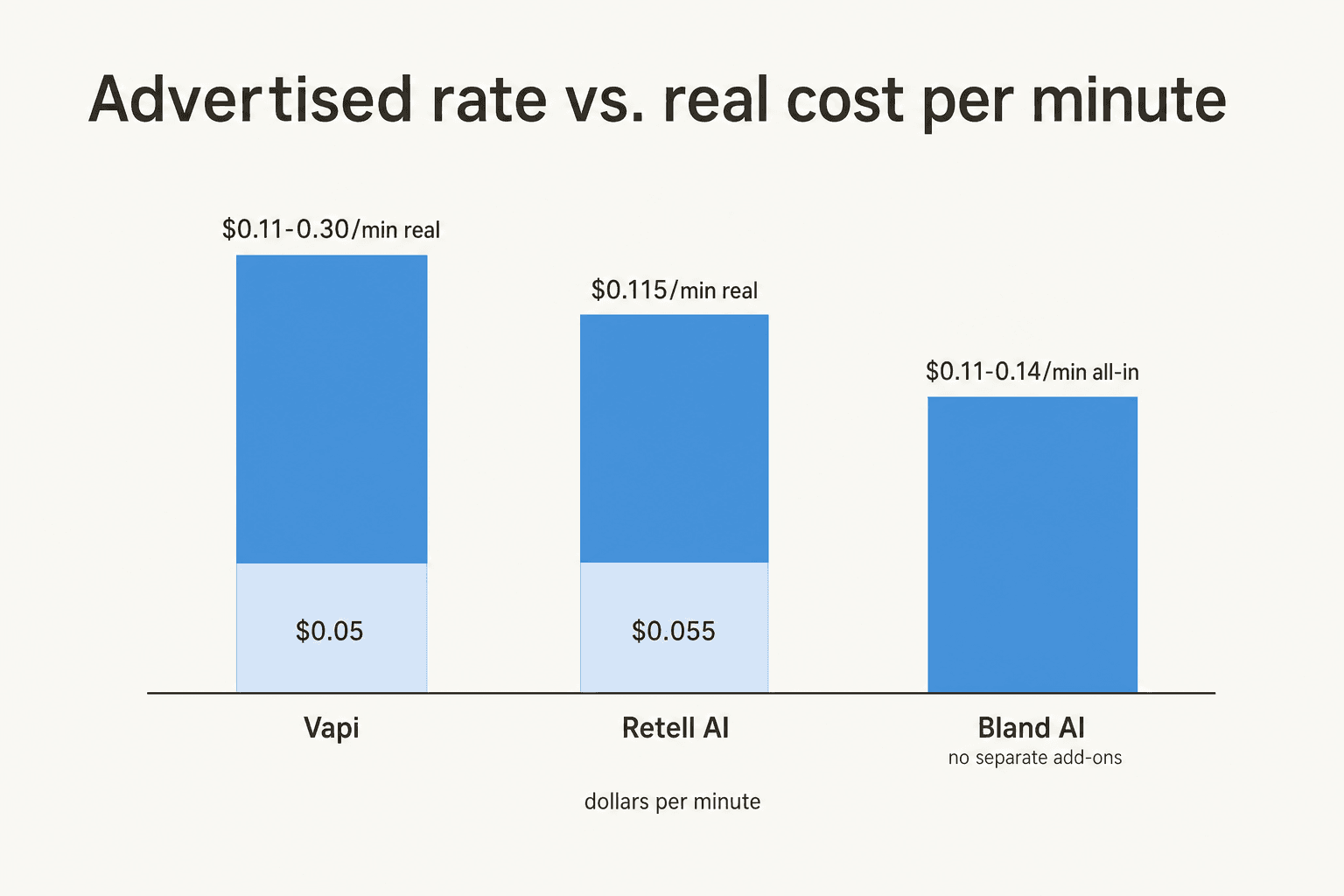
Pros: the widest provider selection of anything on this list, an easy on-ramp with a live usage calculator on the pricing page, and active production users who push back on the "falls apart at scale" narrative, one Reddit builder wrote, "I have many production AI voice systems running on Vapi right now with no issues." Cons: a G2 reviewer put it bluntly, "the single worst thing about VAPI is the latency! It's not predictable. Sometimes the latency is within 800-1000ms and sometimes it goes upto 4-5s," and traced it directly to the cascaded pipeline, "each hop adds latency and you're managing 3 WebSocket connections."
Our take: Vapi is the right call if you need to mix and match providers or already have preferred STT/LLM/TTS vendors. If consistent sub-second response matters more than provider choice, look at Grok or Deepgram instead. For a closer read on Vapi's own developer experience, see this Vapi AI review.
4. Bland AI
Best for regulated industries that need compliance and self-hosted infrastructure baked in, not bolted on.
Bland AI markets itself directly as "Voice AI for regulated industries," built for "high-stakes phone calls where security and trust actually matter," running on its own self-hosted infrastructure rather than routing calls through third-party model providers. It's raised a Series C of over $100M and counts Mutual of Omaha, TravelPerk, and Samsara among its customers.
Pricing: four tiers, all a flat per-minute rate that bundles the LLM, speech-to-text, text-to-speech, and telephony into one number, no separate token charges.
| Plan | Talk-time rate | Platform fee | Concurrency | Daily cap |
|---|---|---|---|---|
| Start (developers) | $0.14/min | $0 | 10 calls | 100 calls |
| Build (teams) | $0.12/min | $299/mo | 50 calls | 2,000 calls |
| Scale (high volume) | $0.11/min | $499/mo | 100 calls | 5,000 calls |
| Enterprise | Custom | Contracted | Custom | Unlimited |
Bland's own pricing FAQ makes the comparison explicit: "Vapi lists $0.05/min and Retell lists about $0.07/min for their voice infrastructure. You then pay separately for the LLM, speech-to-text, text-to-speech, and telephony... Adding typical provider rates brings most production stacks to roughly $0.13 to $0.30 per minute on Vapi." That's Bland's own framing of a competitor, worth reading as a sales pitch rather than an independent audit, but the underlying math (composable rates stack up) checks out against what Vapi and Retell publish themselves.
Pros: SOC 2 Type I & II, HIPAA with a signed BAA, PCI DSS, and GDPR from day one, on-prem/VPC deployment on Enterprise, and "Norm," an AI assistant that builds your first agent from plain-language instructions. G2 reviewers on Enterprise agreements rate it 5.0/5, specifically praising native Slack and Calendly integration. Cons: Reddit sentiment is more mixed at the self-serve tier, one 200-call head-to-head test found Bland's calls mostly ending in 20-30 seconds "with almost no traction," versus roughly 17% conversion for Retell on the same script.
Our take: if your buyer is a compliance officer as much as an engineer, Bland's self-hosted, all-in-one pitch is the strongest on this list. If you're a solo developer prototyping, the self-serve experience isn't as polished as Vapi's or Retell's.
5. Synthflow
Best for enterprise receptionist and appointment-booking deployments at real scale.
Synthflow bills itself as "the only end-to-end Voice AI platform with in-house telephony," and it's the one entry on this list that's repositioned hardest toward the enterprise since it launched. Agents are built with a visual Flow Designer and shipped through Synthflow's own BELL framework, Build, Evaluate, Launch, Learn, simulating real calls to check for accuracy and compliance before anything goes live. The platform claims 65M+ voice calls a month across 30+ countries and 99.99% uptime.
Pricing: as of this writing, the only publicly listed plan is Enterprise, starting from $30,000/year, scoped to call volume, concurrency, telephony setup, integrations, and security needs. The self-serve monthly tiers Synthflow used to run for SMBs and agencies are no longer on the live pricing page, this is now a contract-first product.
Pros: in-house telephony with multi-cloud redundancy and instant failover, a knowledge base that Synthflow claims delivers "zero off-script or hallucinated responses," and a strong 4.5/5 rating across 1,000+ G2 reviews. Backers include Accel, Singular, and Atlantic Labs. Cons: G2 reviewers specifically call out pricing getting steep as usage scales, and it's hard to fully test voice interactions without upgrading past the limited free access.
Our take: if you're deploying an AI receptionist or booking line across dozens of locations and need a vendor with a proven enterprise deployment process, Synthflow fits. If you're testing an idea with a small budget, the enterprise-only pricing rules it out immediately.
6. Deepgram Voice Agent API
Best for teams that want the same unified-stack speed as Grok, without betting on a beta.
Here's the twist worth knowing before you pick a "flexible" orchestration platform: Deepgram is already the default speech-to-text and text-to-speech provider quietly running underneath Vapi and Retell AI's own stacks. Its Voice Agent API packages that same infrastructure into a single, unified conversational pipeline, combining speech-to-text, LLM orchestration, and text-to-speech in one real-time flow, the same "one model instead of three" pitch Grok makes, but from a company that's been in production since 2015 with 200,000+ developers.
Pricing:
| Tier | Pay As You Go | Growth (~20% off) |
|---|---|---|
| Standard | $0.075/min | $0.068/min |
| Standard, BYO TTS | $0.065/min | $0.051/min |
| Custom, BYO LLM+TTS | $0.050/min | $0.041/min |
| Advanced | $0.163/min | $0.146/min |
| Advanced, BYO TTS | $0.122/min | $0.110/min |
The free tier gives a $200 credit with no card required; the Growth plan starts at $4,000/year. The Standard tier is also marketed as a flat $4.50/hour, the same number reframed for buyers who think in hours rather than minutes.
Pros: full deployment flexibility, fully managed, dedicated single-tenant, in-VPC, or fully self-hosted on NVIDIA GPU containers for air-gapped or regulated environments, plus SOC 2 Type 2, HIPAA, and EU data residency. Bring-your-own-LLM and TTS options mean you keep Deepgram's orchestration and streaming pipeline even if you want a different model underneath. Cons: the underlying Aura-2 voice model covers 7 languages against ElevenLabs' 70+, and no static independent millisecond benchmark is published for the Voice Agent API specifically, only for the TTS component (sub-200ms).
Our take: if the appeal of Grok's unified model is really the latency and simplicity, not the xAI branding, Deepgram is the closest thing to that architecture with an actual multi-year track record and named enterprise customers like Aircall and Jack in the Box already running on it.
Which one should you actually pick
Line these seven up on two axes, how self-serve versus enterprise-gated the pricing is, and how much of the stack is a single vendor versus a flexible multi-provider mix, and a clear map falls out.
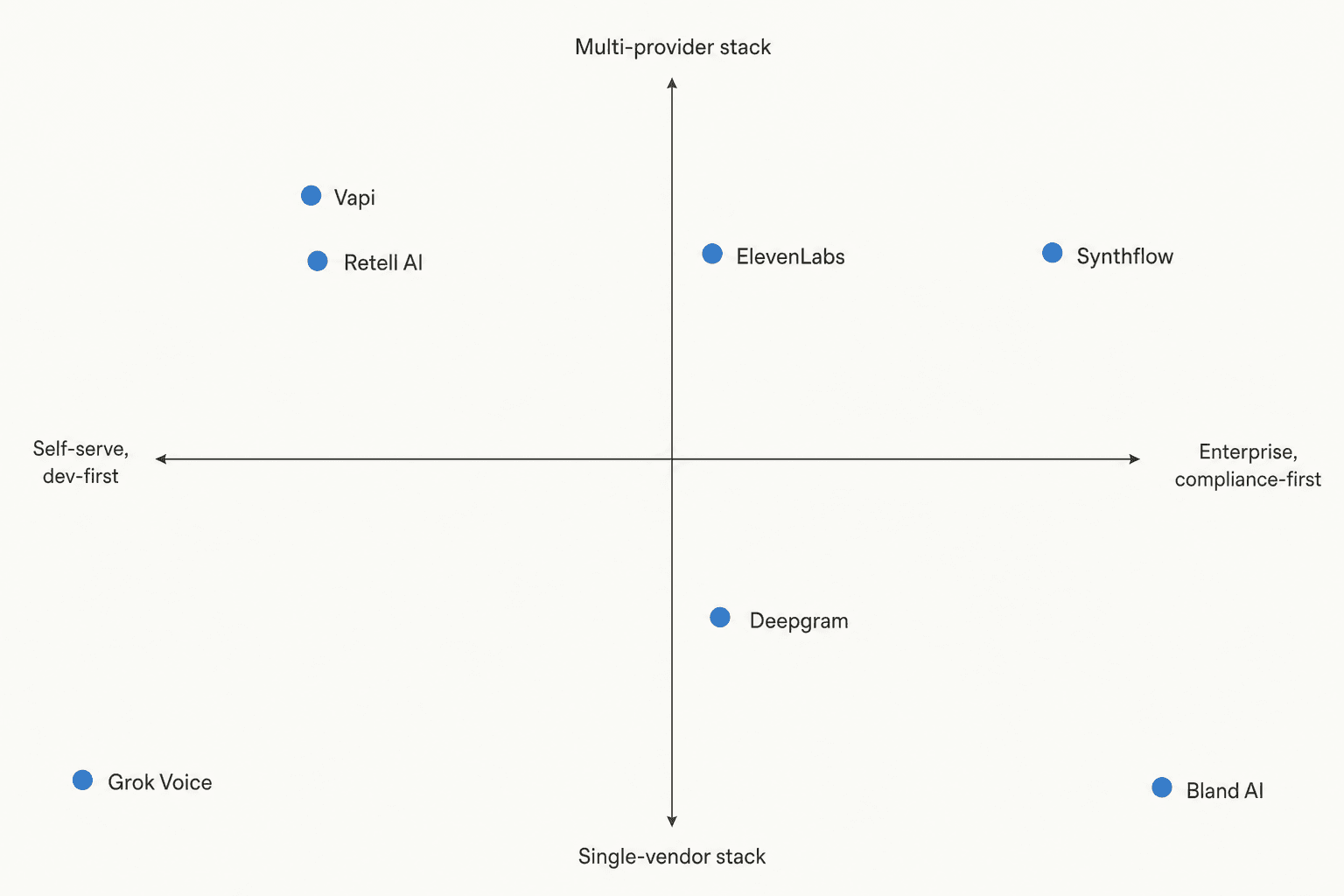
If you're prototyping solo and want to swap providers freely, start with Vapi or Retell AI. If you need voice realism above everything else, ElevenLabs. If a compliance officer is in the room, Bland AI or Deepgram's self-hosted option. If you're rolling out a receptionist line across a large enterprise footprint, Synthflow. And if you specifically want Grok's speed but can't wait for broader beta access, Deepgram's Voice Agent API is the nearest thing running in production today.
Try eesel
None of the seven platforms above are the right tool if your actual support backlog is chat and email tickets, not phone calls. That's a different problem, and it's the one eesel is built for: an AI helpdesk agent that plugs directly into Zendesk, Freshdesk, Intercom, or Front, learns from your own past tickets and help docs from day one, and drafts or resolves replies with full oversight before you ever flip on autonomous mode. Gridwise resolved 73% of tier-1 requests in its first month using eesel, and Smava runs a fully automated Zendesk agent processing over 100,000 German-language tickets a month.
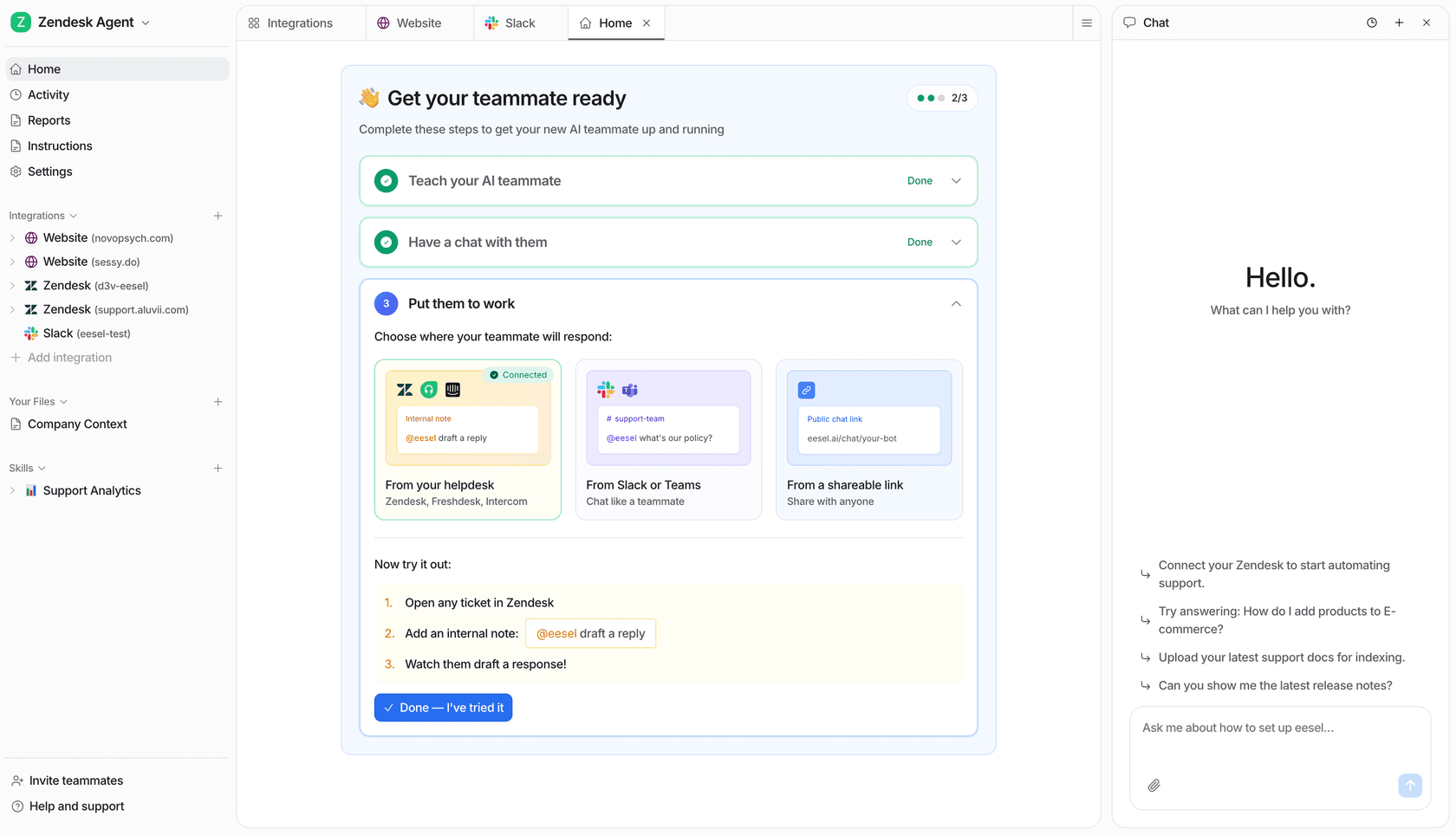
The differentiator that matters most against a voice-first build like the ones above: eesel simulates every rollout against your own historical tickets before it goes live, so you catch an AI hallucination in a test run instead of in front of a real customer. If your queue is text, not talk, that's the tool to reach for.
Frequently searched alongside this
Teams comparing Grok Voice Agent Builder against this list are usually also weighing broader AI voice agent platforms, voice options for specific ecosystems like the best AI voice assistant for Android, or the underlying model layer itself through pieces like Realtime API vs. Whisper vs. TTS API and Realtime API vs. WebRTC. If you're specifically comparing the text-to-speech layer rather than the full agent-building platform, ElevenLabs alternatives, Retell AI alternatives, Hume AI and its alternatives, Inworld AI, and Cartesia Sonic 3 alternatives cover that ground in more depth. And if the calculation ends up being build-vs-buy for support automation more broadly, AI agent vs. human agent cost is the place to start.
Frequently Asked Questions
What is the best alternative to Grok Voice Agent Builder?
Is there a free alternative to Grok Voice Agent Builder?
Which voice AI platform has the lowest latency?
What's the cheapest voice AI agent platform?
Which voice AI platform is best for HIPAA or regulated industries?
Can I use these voice AI platforms for customer support?
What's the difference between a cascaded and unified voice AI stack?


Article by
Kira
Kira is a writer at eesel AI with a Computer Science background and over a year of hands-on experience evaluating AI-powered customer service tools. She focuses on breaking down how helpdesk platforms and AI agents actually work so that support teams can make better buying decisions.