The 10 best Grok Voice Think Fast 2 alternatives in 2026

Riellvriany Indriawan

Katelin Teen
Last edited August 4, 2026
Why anyone is looking for a Grok Voice Think Fast 2 alternative
Fair to xAI first: the model is good. Measured independently, the numbers xAI published hold up. 97.2% on speech reasoning and 95.1% on Full Duplex Bench, with first audio landing at 0.70 seconds. Building a phone agent in 2025, you had nothing like it. I pulled the model apart in my Think Fast 2.0 review, and the mechanism sits in the launch breakdown.
Quality, then, is not why anyone leaves. The three reasons that do come up are all structural, and the money one I covered end to end in my Think Fast 2.0 pricing post.
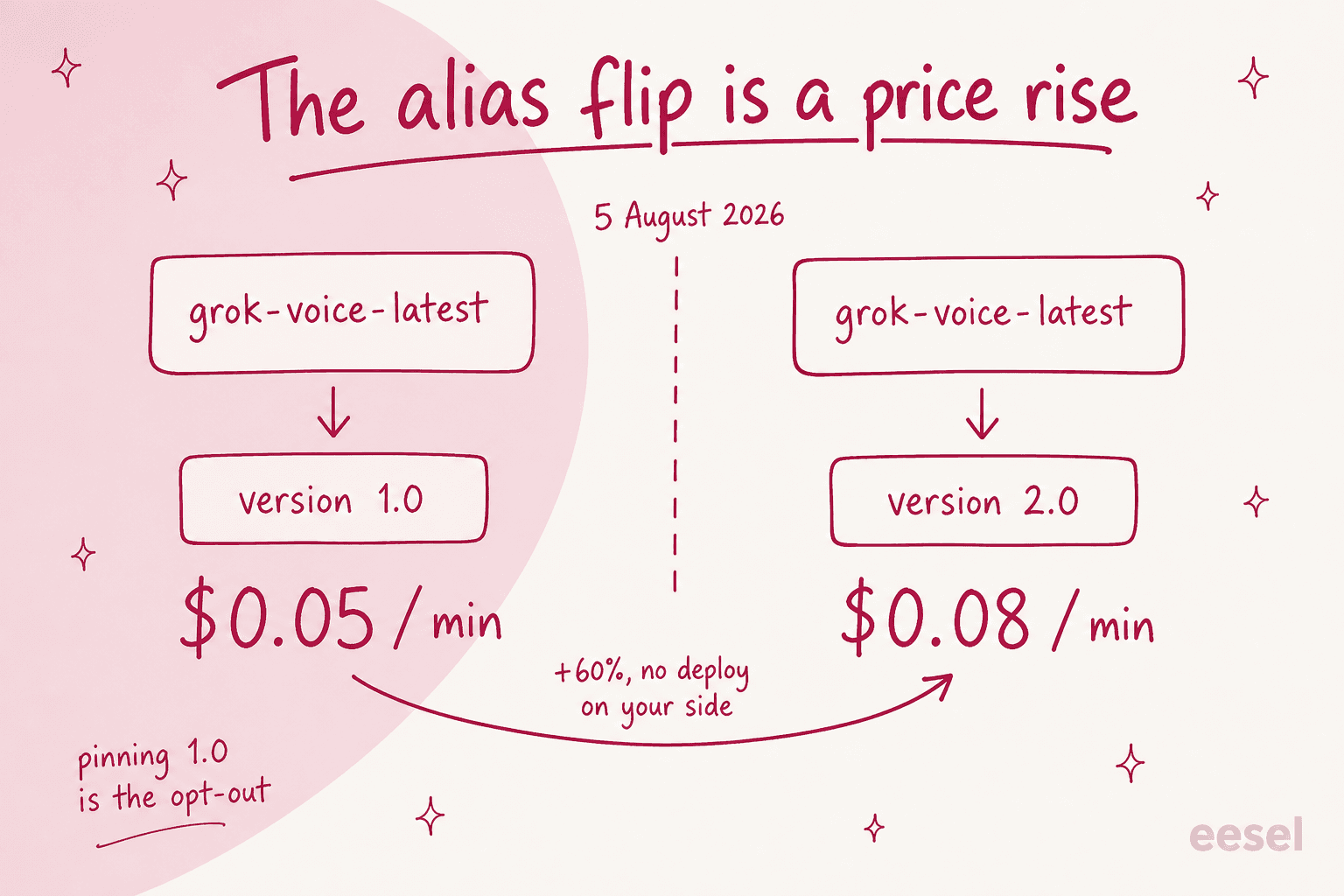
The price of the default path went up 60%. Speech to Speech sits on the xAI pricing page at $0.05/min for grok-voice-think-fast-1.0 and $0.08/min for 2.0, both plus $0.004 per text input event. No secret in the 2.0 rate. What caught people out is that grok-voice-latest used to resolve to 1.0, and the speech-to-speech guide puts the move to 2.0 on 5 August 2026. So if your production string is that alias, the per-minute cost rose 60% overnight while nothing in your repo changed.
Ten concurrent sessions is a real ceiling. The model card publishes 10 concurrent sessions per team, plus a 120 minute maximum session. xAI will raise it on request. Normal enough, except the default is the number you actually plan a launch around. Ten calls at once is a busy Tuesday afternoon for a ten-agent team. Not a stress test.
One region, no fast lane, no discount. Voice runs in us-east-1, and only there. It sits outside both of xAI's cost levers as well. The 20% batch discount is for text models; the 2x priority tier covers Chat Completions and Responses. Voice gets neither, which leaves you no way to buy the cost down or the throughput up.
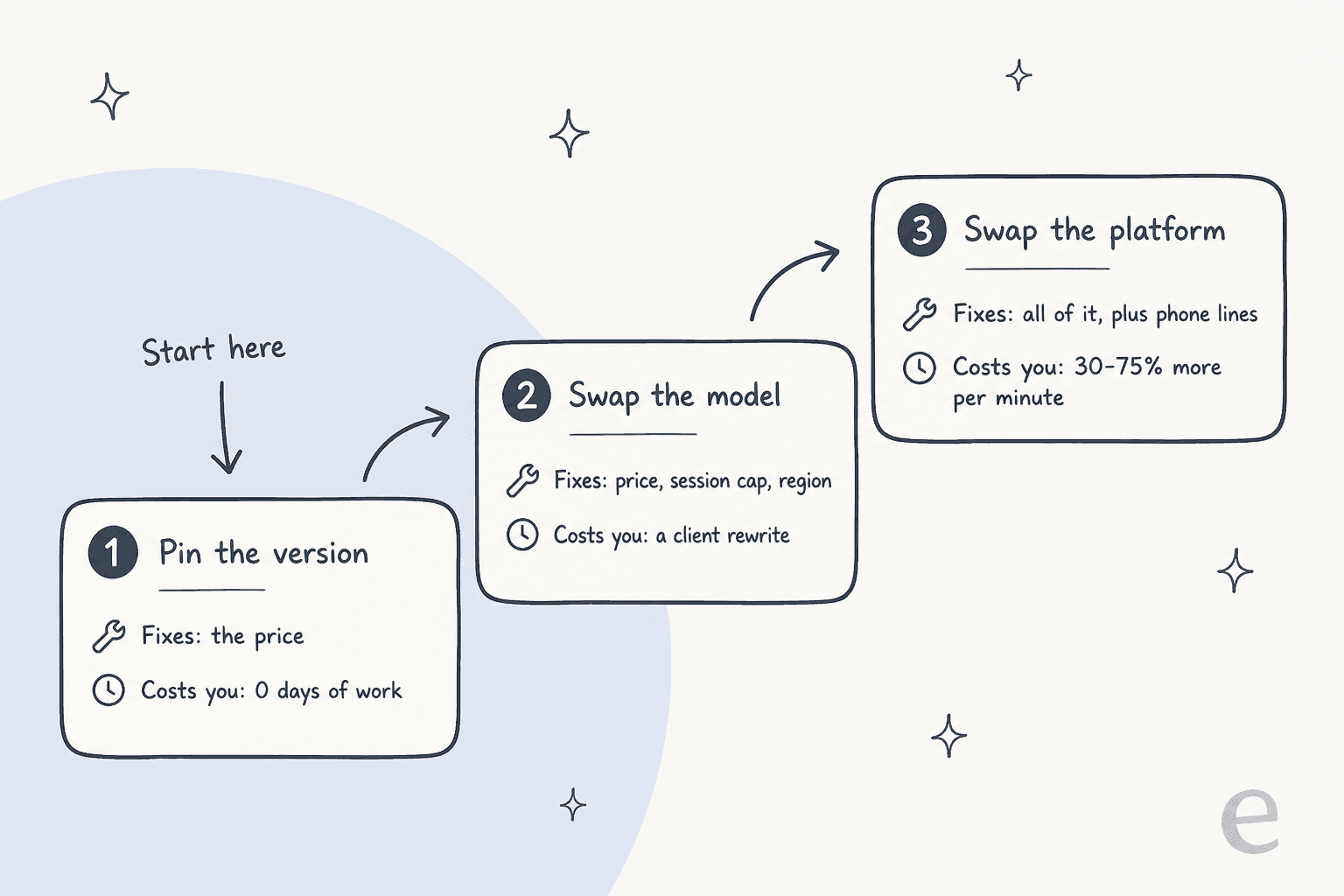
Each of those problems has a different fix. Most alternatives lists flatten that distinction, so here it is drawn out.
How I picked these ten
Three rules. Plus a caveat I would rather say out loud than hide.
Rule one: numbers come from the vendor's own pages, or from Artificial Analysis. AA runs the same three benchmarks against every model. Big Bench Audio for speech reasoning, Full Duplex Bench for turn-taking, then tau-Voice, which asks whether a support task actually got finished. That last one gets quoted least and matters most. It is why I built my voice support roundup around it rather than around vendor containment claims.
Rule two: model swaps and platform swaps stay separated, because they are not competing purchases. A model API hands you a WebSocket and nothing else. A platform hands you phone numbers and call logs and testing tools, on a bill 30% to 75% higher per minute. Mix the two into one ranked list and you end up comparing $0.08 against $0.14 as though they buy the same thing.
And then the caveat: the four model-layer options have no product UI to show you, because they are API endpoints. xAI's docs and launch posts carry no screenshots at all. Which is why the model sections lean on benchmark rows and documented behaviour, while the platform sections open with real captures of the product. Better to tell you that than pad four sections with stock art.
Grok Voice Think Fast 2 alternatives compared
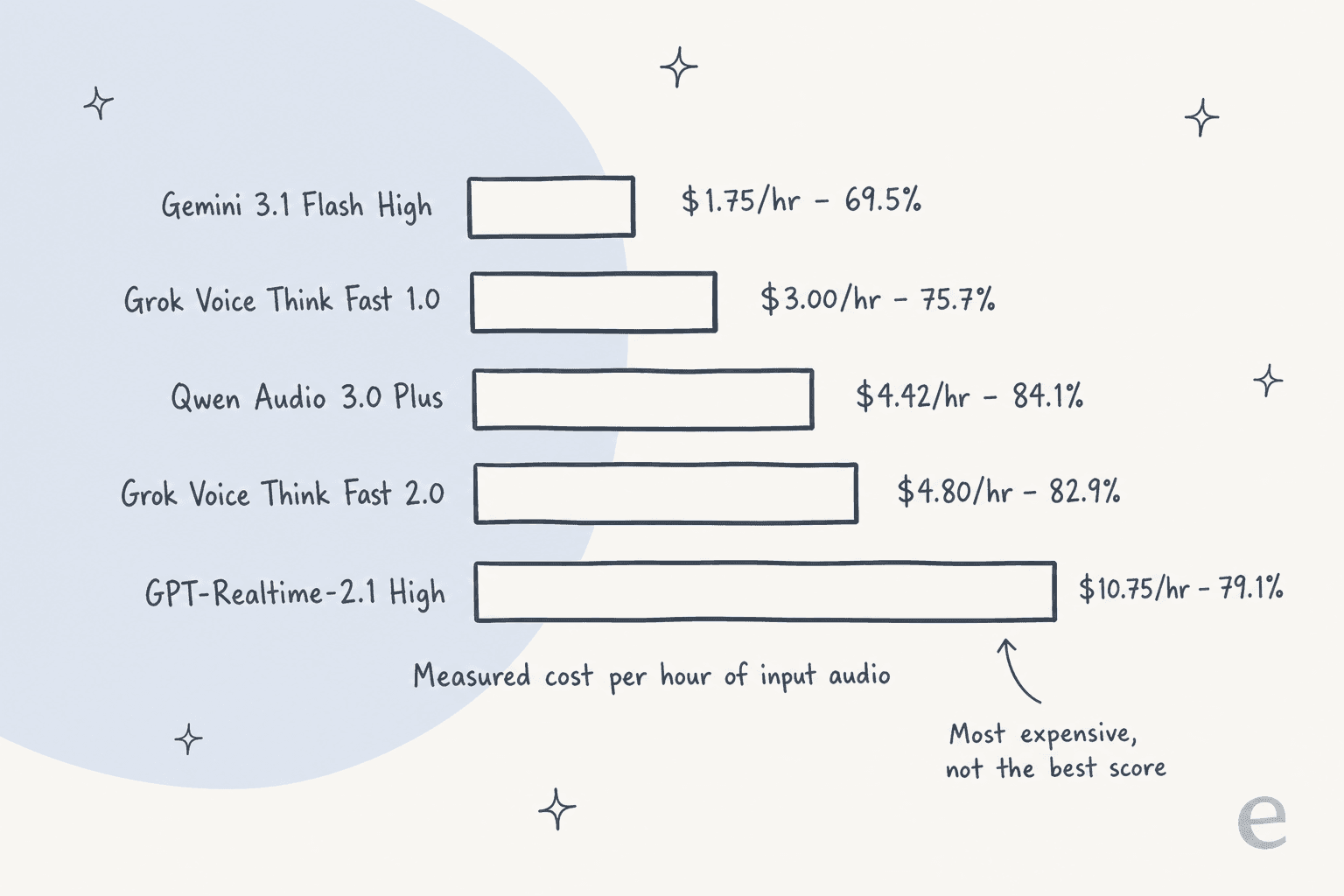
Read the measured cost column twice. That figure is Artificial Analysis running a fixed workload and reporting what the hour actually cost, which is a different thing from the list price on a pricing page. Grok bills a flat per-minute meter, so its $4.80 measured lands on its $4.80 list. Token-billed models drift a long way from theirs.
| Option | Layer | AA index | Speech reasoning | Turn-taking | tau-Voice | Time to first audio | Measured $/hr | Billing shape | Published concurrency | Phone numbers | Testing tools |
|---|---|---|---|---|---|---|---|---|---|---|---|
| Grok Voice Think Fast 2.0 | Model API | 82.9% | 97% | 95.1% | 56.5% | 0.70s | $4.80 | Flat per minute | 10 sessions | Add-on, +$0.01/min | Playground only |
| Grok Voice Think Fast 1.0 | Model API | 75.7% | 97% | 77.8% | 52.1% | 1.25s | $3.00 | Flat per minute | 10 sessions | Add-on, +$0.01/min | Playground only |
| GPT-Realtime-2.1 High | Model API | 79.1% | 96% | 95.7% | 45.7% | 1.21s | $10.75 | Token-based | Not published | No | No |
| Qwen Audio 3.0 Realtime Plus | Model API | 84.1% | 99% | 98.4% | 54.6% | 4.02s | $4.42 | Token-based | Not published | No | No |
| Gemini 3.1 Flash High | Model API | 69.5% | 97% | 74.3% | 37.7% | 2.99s | $1.75 | Token-based | Not published | No | No |
| ElevenLabs Agents | Platform | Not scored | Not scored | Not scored | Not scored | Not published | ~$4.80 | Prepaid minutes | 40 calls (Business) | Yes, included | Yes |
| Vapi | Platform | Not scored | Not scored | Not scored | Not scored | Not published | ~$6.30 | Assembled per minute | $10 per line | Yes | Yes, billed live |
| Retell AI | Platform | Not scored | Not scored | Not scored | Not scored | Not published | ~$8.10 | Assembled per minute | Not published | Yes | Yes, +$0.10/min |
| Bland AI | Platform | Not scored | Not scored | Not scored | Not scored | Not published | ~$8.40 | Bundled per minute | Not published | Yes | Yes |
| PolyAI | Platform | Not scored | Not scored | Not scored | Not scored | Not published | Quote only | Per minute, quoted | Not published | Yes, 99.9% SLA | Yes |
| Parloa | Platform | Not scored | Not scored | Not scored | Not scored | Not published | Quote only | By task complexity | Not published | Yes | Yes, on real calls |
Benchmark and measured-cost columns come from the Artificial Analysis speech-to-speech table. The platform hourly figures are mine, arithmetic on each vendor's published per-minute rate, so read them as a like-for-like conversion and not a measured result.
Pick the reason you are leaving
Pin the version. Do not migrate.
Change one string from grok-voice-latest to grok-voice-think-fast-1.0 and you are back on $0.05/min. You keep the same 97% speech reasoning score and give up turn-taking quality (77.8% versus 95.1%) and half a second of response time.
At 5,000 minutes a month that is $250 instead of $400. Same client, same WebSocket, one line of config.
Swap the model, or buy concurrency.
Session caps are an account limit, not a model limit, so any other provider escapes it. GPT-Realtime-2.1 is wire-compatible, so the client barely changes. If you would rather buy the number outright, ElevenLabs Business publishes 40 concurrent calls and Vapi sells lines at $10 each.
Ask xAI to raise the cap first. It is free, and 10 is a default, not a hard limit.
You need a platform, not a model.
No model API sells you a phone number with an uptime guarantee attached. PolyAI quotes a 99.9% phone SLA plus a 24/7 emergency line, and Bland publishes 99.9% on every tier including free. Parloa is the only one that tests against your own historical calls.
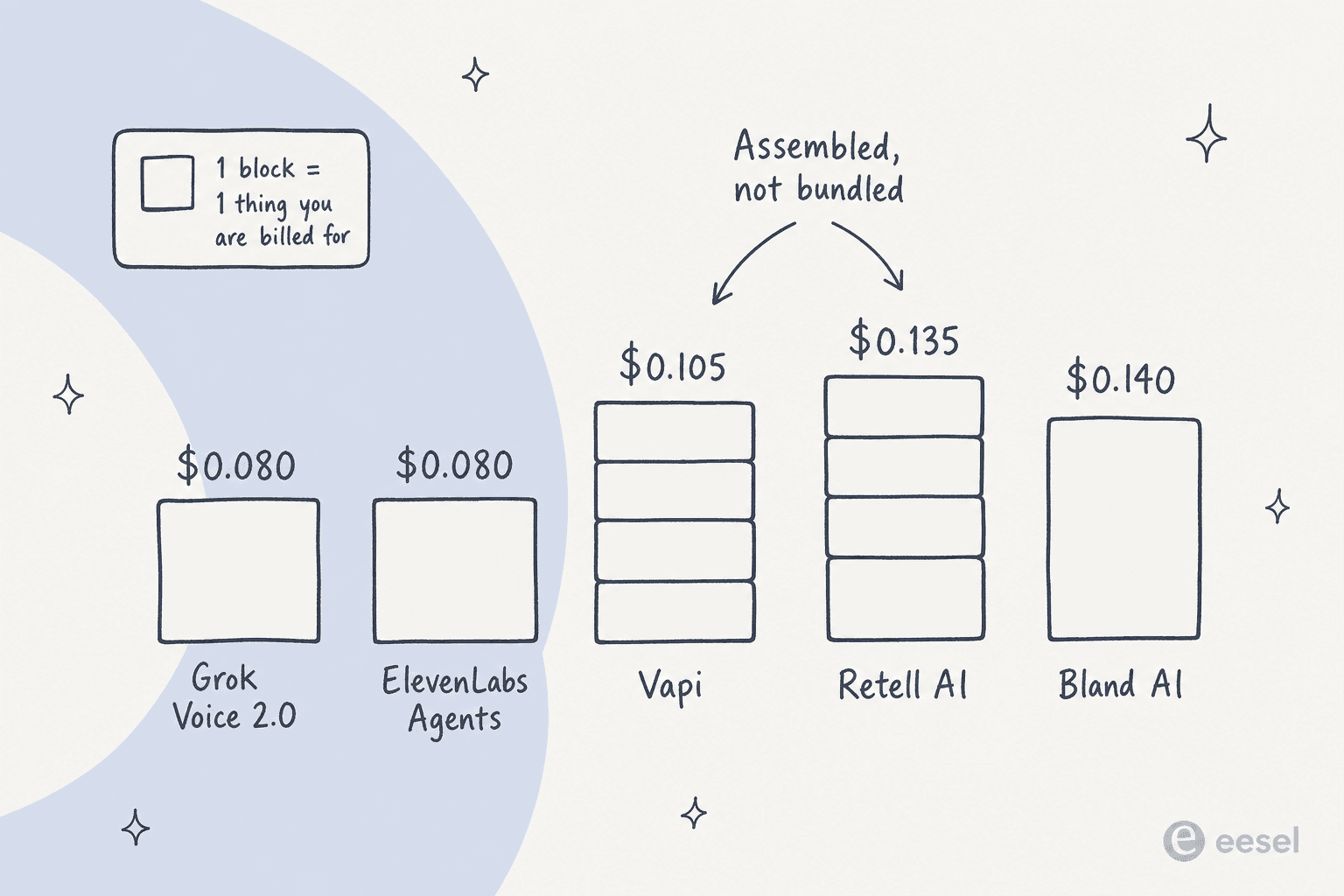
Budget $0.105 to $0.14 per minute all-in, versus $0.08 for the raw model.
Four drop-in model swaps
All four are the same shape of purchase as Grok Voice. A WebSocket, a model string, a bill by the minute. Migration effort runs from one config line up to a client rewrite.
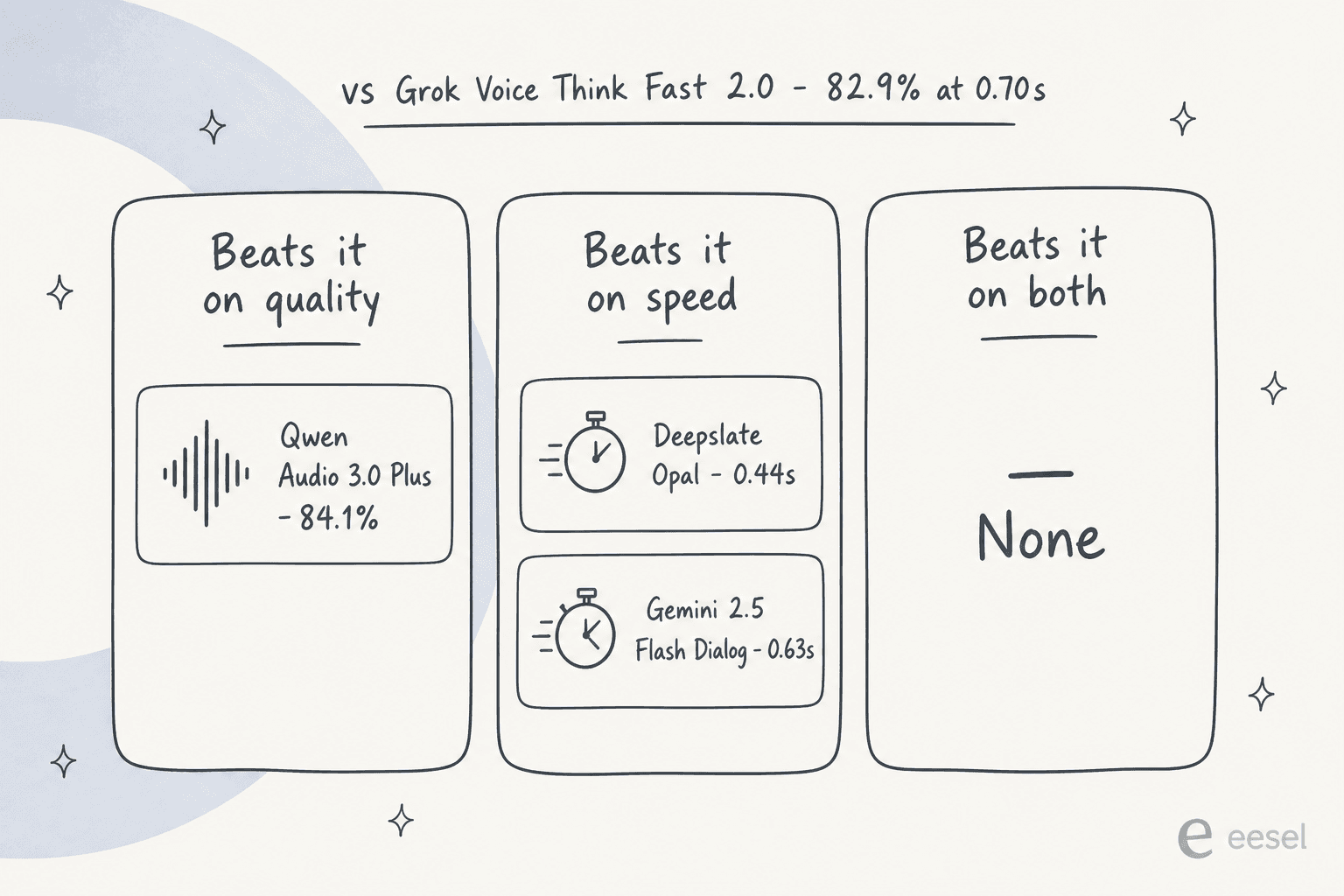
One chart before the individual takes, and it is the most useful thing I made for this post. I went looking for a model both better and faster than Think Fast 2.0. There isn't one.
1. Grok Voice Think Fast 1.0
Best for: cutting 37.5% off the voice bill this afternoon, with no migration at all.
Nobody lists this one, I think because it feels like cheating. grok-voice-think-fast-1.0 is still sitting on the pricing page at $0.05/min, and pinning it is a one-string change. Artificial Analysis measures it at $3.00 per hour of input audio, against 2.0's $4.80.
You do give something up. Worth knowing exactly what. Speech reasoning is effectively identical at 97%, and tau-Voice slips from 56.5% to 52.1%, so about four points of task completion. Conversational dynamics is where the real gap opens. Full Duplex Bench falls from 95.1% to 77.8%, the difference between a model that handles interruptions and backchannels cleanly and one that talks over people. Time to first audio nearly doubles too, 0.70s to 1.25s.
Pricing: $0.05/min ($3.00/hr) plus $0.004 per text input event. Same 10-session cap, same us-east-1.
Verdict: a scripted, low-interruption flow (order status, appointment confirmation, opening hours) makes the 1.0 tradeoff close to free money. Interrupting callers, or open-ended troubleshooting, is a different story. That 17 point turn-taking gap is exactly where a call goes bad, and there I would pay the extra three cents. One footnote: the older Voice Agent Builder posts all quote the 1.0 rate, so its pricing page reads low now.
2. GPT-Realtime-2.1
Best for: teams who want out of xAI entirely with the smallest possible client rewrite.
xAI built its realtime endpoint to be wire-compatible with OpenAI's Realtime API, deliberately. That cuts both ways. Adopting Grok was easy; leaving is easy for the same reason. OpenAI's best-scoring configuration is GPT-Realtime-2.1 High, 79.1% on the index, carrying the highest turn-taking score in the whole table at 95.7%.
Two things to know before committing. tau-Voice comes in at 45.7% against Grok's 56.5%, so on the benchmark that measures finished support tasks you hand back nearly 11 points. Then the cost turns on you. Artificial Analysis measures GPT-Realtime-2.1 High at $10.75 per hour, more than double Grok Voice 2.0.
The effort dial hides a trap as well. GPT-Realtime-2.1 Minimal measures $11.31/hr, more than High's $10.75, while scoring 6.6 points lower. Turning reasoning down is not a cost lever on token-billed voice. A weaker model just spends more tokens getting to the same place.
Pricing: token-based, so the bill follows the shape of the conversation. The older GPT-Realtime-2 lists $1.15/hr audio input and $4.61/hr audio output, then measures $4.14 all-in. Tells you how little the quotable input rate means here.
Verdict: right pick when compatibility is the constraint and budget is not. Moving off Grok specifically to save money? Wrong direction, and GPT-Realtime-2 High at a measured $4.14/hr is the better-value sibling anyway. The companion piece for the vendor layer is my phone support roundup.
3. Qwen Audio 3.0 Realtime Plus
Best for: the highest-quality speech model available, on channels where nobody is waiting on the line.
One model in the table beats Grok Voice Think Fast 2.0 on the headline index, and this is it, 84.1% against 82.9%. It tops both component benchmarks on the way, 99% on speech reasoning and 98.4% on turn-taking. Alibaba Cloud lists it at $0.03 per hour of audio input, the cheapest published input rate in the category.
Then comes the number that rules it out for a phone line. Time to first audio is 4.02 seconds. Four seconds of silence after a caller stops talking reads as a dropped connection. They say "hello?" and hang up. And the measured all-in cost lands at $4.42/hr despite that tiny input rate, so the cheap sticker does not survive contact with a real workload.
If you were hoping the Flash variant fixed the latency, it does not. Qwen Audio 3.0 Realtime Flash is 4.16 seconds, slightly slower, and 76.3% on the index.
Pricing: as listed, $0.03/hr audio input and $0.18/hr audio output. Measured on a fixed workload, $4.42/hr.
Verdict: for asynchronous voice work this is the best model here. Voicemail triage, call summarisation, recorded-message handling, call quality review. Live inbound support, no: four seconds of dead air is not something an index advantage fixes.
4. Gemini 3.1 Flash
Best for: the cheapest credible per-hour cost when you can accept a real quality drop.
Google's entry is the value play, and it does not pretend otherwise. Gemini 3.1 Flash High measures $1.75/hr, 64% below Grok Voice 2.0, and 97% speech reasoning holds up nicely at that price. Minimal runs $1.50/hr and answers in 0.96 seconds.
Turn-taking is the soft spot. Full Duplex Bench comes in at 74.3% for High and 72.3% for Minimal, both a long way behind Grok's 95.1%, with tau-Voice at 37.7%. Plainly: it understands the question, it is slower to work out whose turn it is to speak, and it finishes roughly two thirds as many support tasks. Google's fastest native audio option is a different model, Gemini 2.5 Flash Native Audio Dialog, answering in 0.63 seconds at a measured $1.42/hr. No index score on that one, since it has not been run on all three benchmarks.
Pricing: listed at $0.35/hr audio input and $1.38/hr audio output. Measured, $1.75/hr on High and $1.50/hr on Minimal.
Verdict: the honest budget pick. High-volume, low-stakes calls where a clumsy interruption costs nothing are a good fit for it. I would keep it off a billing or cancellation line, though. Google's wider lineup is in Gemini alternatives.
One migration detail bites regardless of which direction you go. xAI renamed OpenAI's ...input_audio_transcription.delta event to .updated, and the payload is cumulative rather than incremental. So a client written for OpenAI, appending each event to a buffer, quietly produces a transcript with every word repeated. Silent failure. The worst kind.
Six full platform swaps
Different purchase entirely. What these vendors sell is the orchestration around the model. Telephony, call logs, knowledge bases, testing tools, warm transfers, and someone to ring when the line goes down. You pay per minute for all of it, and the premium over the raw model runs bigger than most pricing pages let on.
I looked at Sierra as well, then left it out of the numbered list. It prices per resolved conversation instead of per minute and publishes no rate card, so a like-for-like comparison is not possible. The tau-voice research it published is worth reading, though, and I cite it below.
5. ElevenLabs Agents
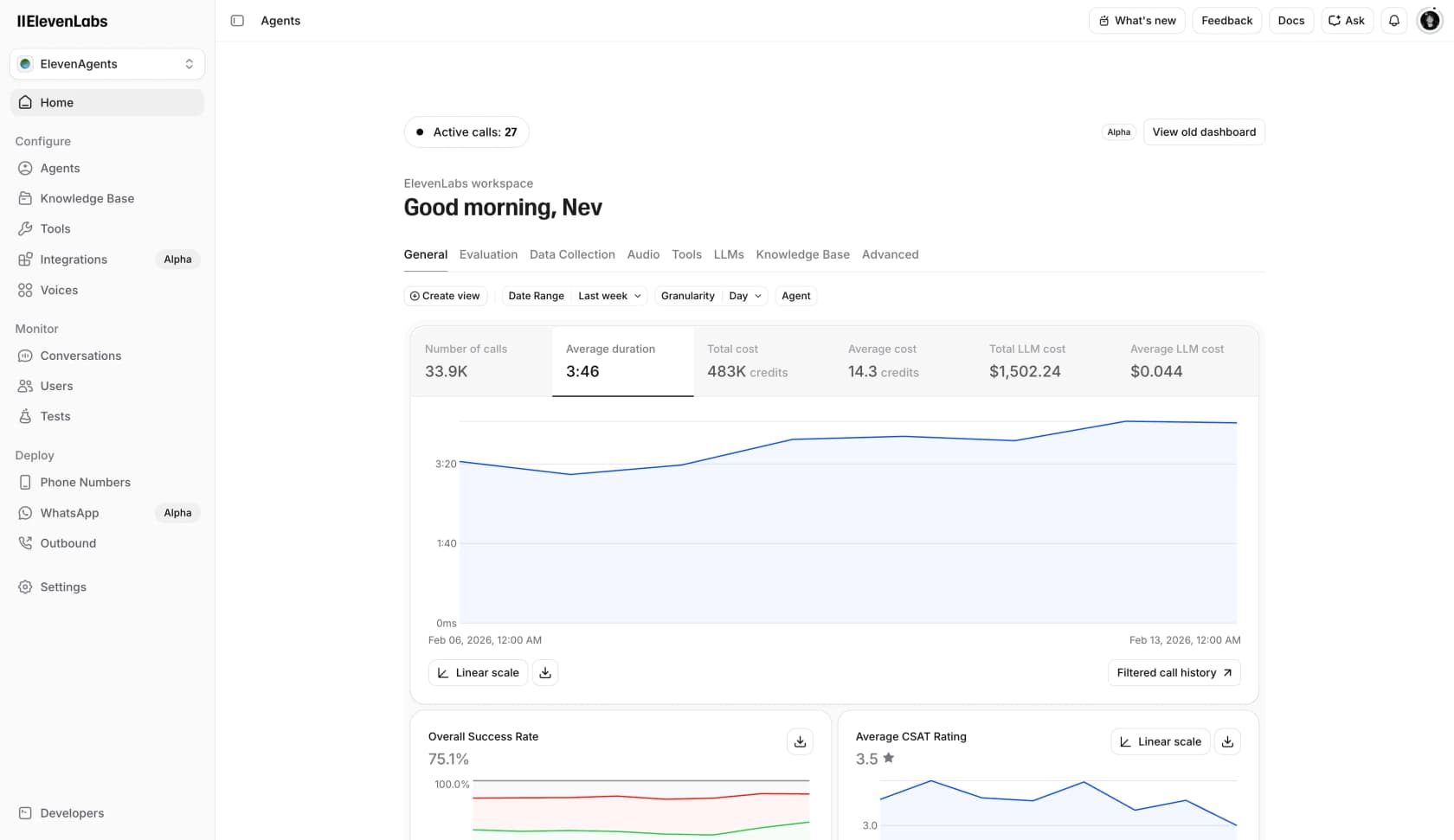
Best for: teams who want the best voices in the business plus a full agent platform, at exactly Grok's new price.
This is the coincidence that made the post interesting to write. Every paid tier of ElevenLabs Agents divides out to almost exactly $0.08 per included minute: $6 for 75 minutes, $22 for 275, $99 for 1,238, $299 for 3,738, $990 for 12,375. On the top tier the arithmetic is exact, 12,375 times $0.08 equals $990.00. Until 5 August, Grok undercut ElevenLabs by 37.5%. Now they are the same number to the cent.
So the choice stopped being about price. It is about billing shape now. ElevenLabs minutes are prepaid and they expire; Grok is pay as you go. At 500 minutes a month Grok costs $40, while the ElevenLabs tier that covers you is the $99 Pro plan, which is why spiky or low volume still favours pay as you go. Steady high volume, coin flip. And above 12,375 minutes a month ElevenLabs goes quote-only.
What the same money buys is substantial. Telephony sits on every tier including Free, and so do knowledge bases and RAG, and the console reports its own success rate (75.1% in the capture above) instead of making you build that dashboard yourself. Business allows 40 concurrent calls against Grok's default 10. One contradiction on their own site is worth flagging: the text-to-speech catalogue advertises 70+ languages while the agent configuration lists 31.
Pricing: Free $0 for 15 minutes, Starter $6 for 75, Creator $22 for 275 (half price first month), Pro $99 for 1,238, Scale $299 for 3,738, Business $990 for 12,375, Enterprise quoted. Text messages $0.003 each. There is no volume discount at any tier, because the allowances were derived from the price in the first place.
Verdict: strongest all-round platform swap here, and the first one I would shortlist if I wanted voice quality with a console attached. Spiky traffic, skip it: prepaid minutes that expire punish exactly that pattern. The wider field is in ElevenLabs alternatives.
6. Vapi
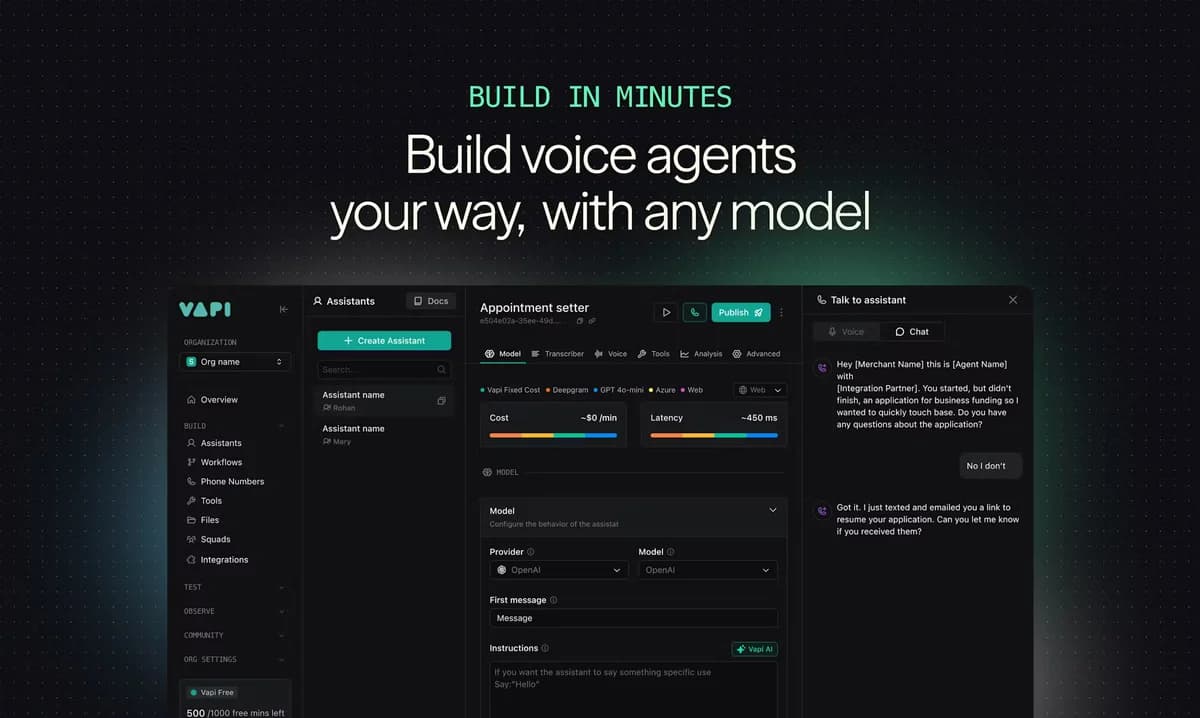
Best for: engineers who want to choose every layer of the stack themselves and see each line item.
Vapi charges $0.05/min for its own hosting, then passes through whatever you pick for speech-to-text, text-to-speech, the model and telephony. Assemble a realistic support build and you land near $0.105/min, meaning Vapi's own fee is roughly 48% of a realistic minute. On telephony the cheap options are Telnyx at $0.0055/min and Twilio inbound at $0.008/min. Concurrency is a flat $10 per line, which I like. It is the only vendor here putting a price on the exact thing Grok's 10-session cap limits.
Two things to plan around. The Visual Workflows builder retires on 19 August 2026, so anything built there needs a migration path. Test calls also bill at production rates, which means a heavy evaluation week turns up on the invoice. Separately: the knowledge base is file-upload only with Gemini-only retrieval, and there are no ticketing integrations at all, so anything touching your helpdesk becomes custom work.
Pricing: $0.05/min Vapi hosting, $0.005/message on SMS and chat, plus per-provider pass-through. $10/month per concurrent line. Compliance add-ons priced separately.
Verdict: right call when you have an engineer who wants control and a spreadsheet. Wrong call when you want the vendor making stack decisions for you, and a real risk if your workflow logic lives in the builder retiring this month. For the category map, AI voice companies has the full field.
7. Retell AI
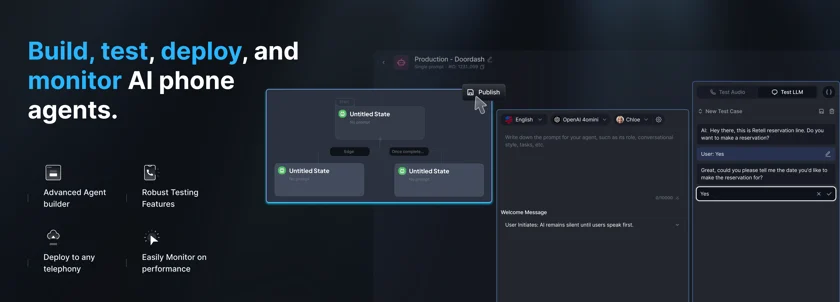
Best for: teams who want QA and compliance controls sold as switches rather than built in-house.
Retell advertises $0.07 to $0.31/min. The composition matters more than the range does. Voice infrastructure is $0.055/min and unavoidable, over half the cost of a cheap build before you have chosen a single component. Add platform text-to-speech at $0.015/min, add a model, and a realistic support agent sits around $0.135/min. At 5,000 minutes that is about $675 a month.
Add-ons are where it gets interesting, in both directions. PII removal at $0.01/min and safety guardrails at $0.005/min are unusually granular, and useful if you sit in a regulated vertical. AI-powered QA is $0.10/min, adding about 74% to the minute, so that one is a real budget decision and not a checkbox. Retell states SOC 2 Type II, HIPAA and GDPR compliance at the platform level; the contractual BAA and MSA are gated to Enterprise.
Two honest limits. The Zendesk integration is listed as coming soon rather than shipped, and there is no Freshdesk or Gorgias connector at all, so helpdesk work comes down to API glue. The meter also stops at transfer, which is generous, and it tells you where the product's responsibility ends. I did appreciate that their own FAQ answers "can AI replace call center agents?" with a flat no.
Pricing: $0.055/min voice infrastructure, $0.015/min platform voices ($0.040 for ElevenLabs voices), plus model and telephony. PII removal $0.01/min, guardrails $0.005/min, AI QA $0.10/min. Chat agents from $0.002/message.
Verdict: pick it when compliance controls and call QA are the requirement, and you would rather buy those than build them. Skip it when your integration list starts with a helpdesk, since that is the gap. Retell AI alternatives covers the rest of that shortlist.
8. Bland AI
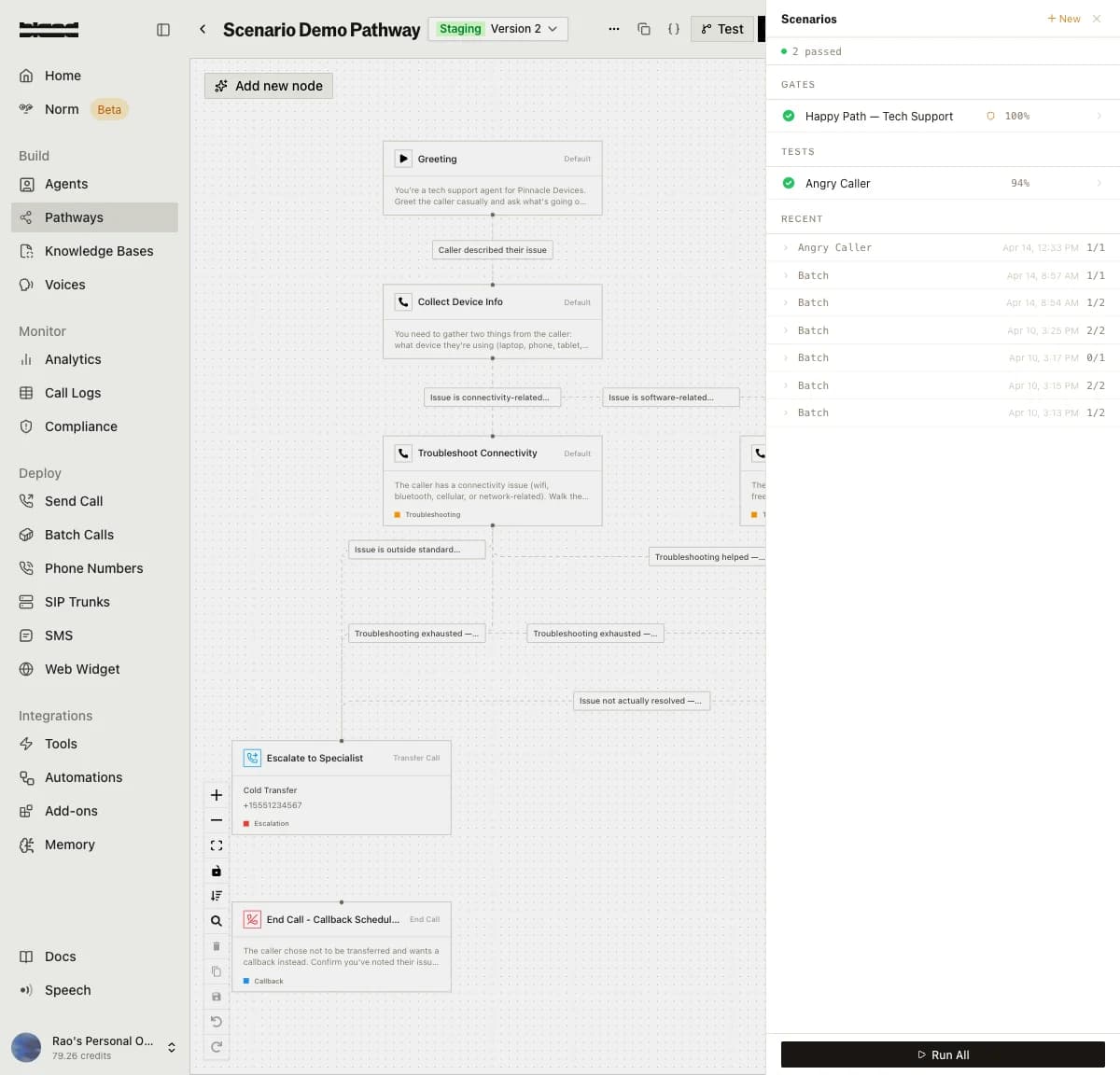
Best for: high-volume outbound calling and inbound on one bundled rate, with an SLA on every plan.
Bland bundles rather than assembles: $0.14/min on Start with no platform fee, $0.12/min on Build at $299/month, $0.11/min on Scale at $499/month. One rate, no stack to price out. What I would want a buyer to check is where those plans actually start paying off. Build only beats Start above 14,950 minutes a month, and Scale only above 16,633. Under those volumes the no-fee tier comes out cheaper, higher per-minute rate and all. At 12,000 minutes the effective rates run $0.148, $0.151 and $0.156, so both paid plans are worse.
The real differentiator: 99.9% uptime on every tier including free, which nobody else here does. Testing holds up too. The Pathways builder above runs named scenarios as deploy gates, a happy path and an angry caller, each with a score.
Bland publishes something most vendors would bury. It is the most useful screenshot in this whole post.
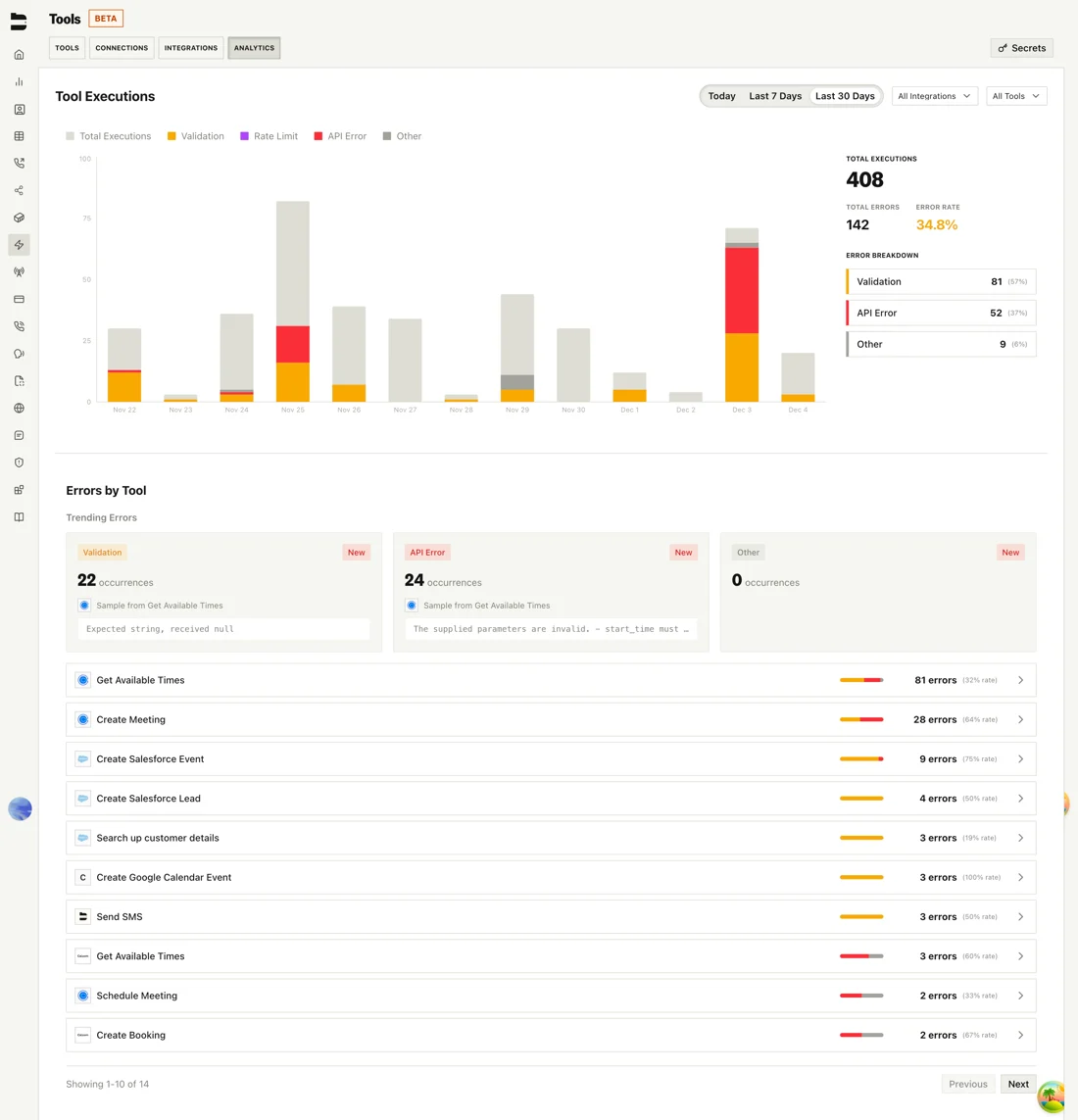
408 tool executions, 142 errors, a 34.8% error rate, broken out by tool. This is where voice agents actually leak. The model understood the caller fine; the calendar lookup returned null. Every vendor's numbers look like this. Only Bland ships you the dashboard to see it.
Two limits. Warm transfer is Enterprise-only, and the connector directory carries 19 entries with no helpdesk among them.
Pricing: Start $0.14/min, $0 fee. Build $0.12/min, $299/month. Scale $0.11/min, $499/month. Enterprise contracted. 99.9% SLA on all tiers.
Verdict: best pick for volume, and the plan maths says most teams should sit on Start far longer than the pricing page implies. Run the 14,950 minute calculation, plus the call centre ROI maths, before upgrading.
9. PolyAI
Best for: enterprise phone lines where the uptime guarantee is the product.
PolyAI prices per minute and quotes only, so no rate from me. What I can tell you is what the quote includes, which is the thing model APIs structurally cannot sell: a 99.9% phone SLA, and a 24/7 emergency line. Grok Voice publishes no uptime commitment, and no support channel for a voice outage either. When your phone line going quiet counts as a revenue event, that difference is the whole decision.
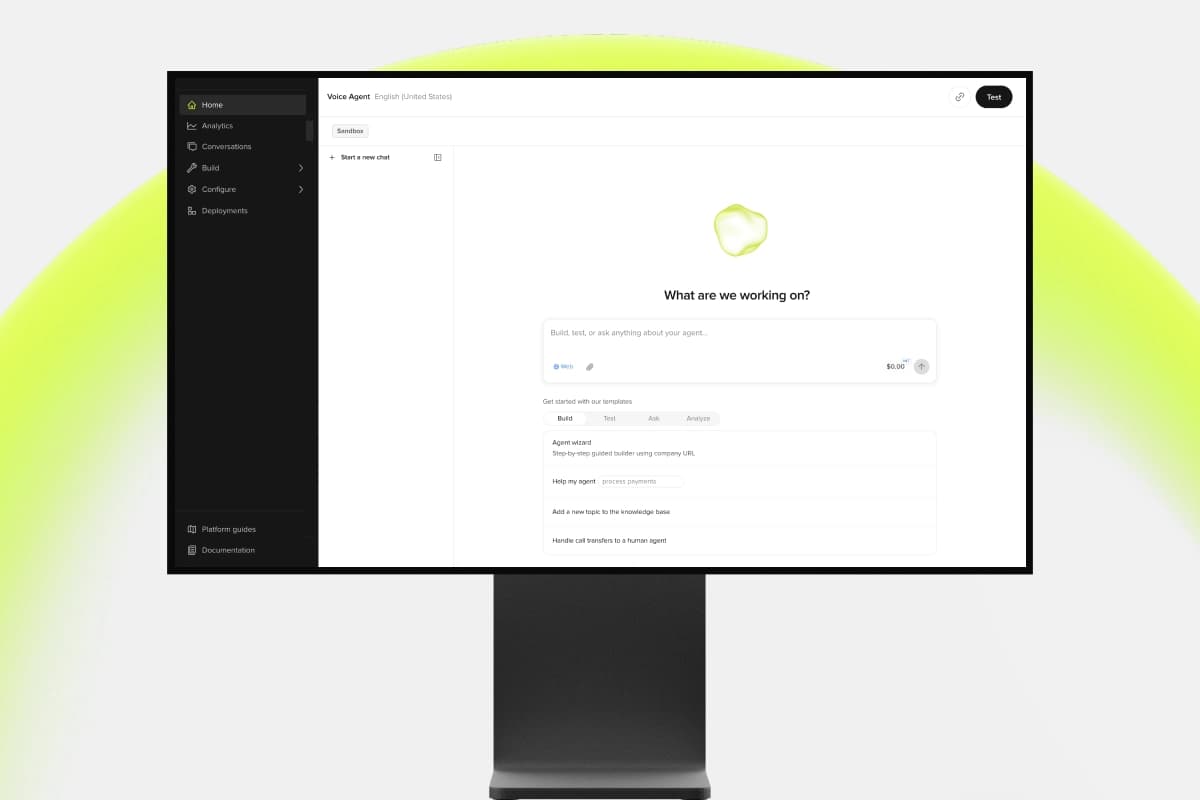
Certifications are not tier-gated here, which is unusual in this category. A mid-size buyer ends up with the same compliance posture as a large one. Agent Studio, in the capture above, is a conversational builder: you describe the change, then test it in a sandbox with a running cost counter, instead of dragging nodes around.
Pricing: quote only, per minute, SLA and emergency support included. Certifications not gated by tier.
Verdict: the shortlist entry for a regulated or high-revenue phone line. Not worth the sales cycle for a small team hoping to ship this month, and the missing published rate makes budgeting awkward. Call centre technology covers where this layer sits.
10. Parloa
Best for: teams who will not launch a phone agent without testing it against their own past calls first.
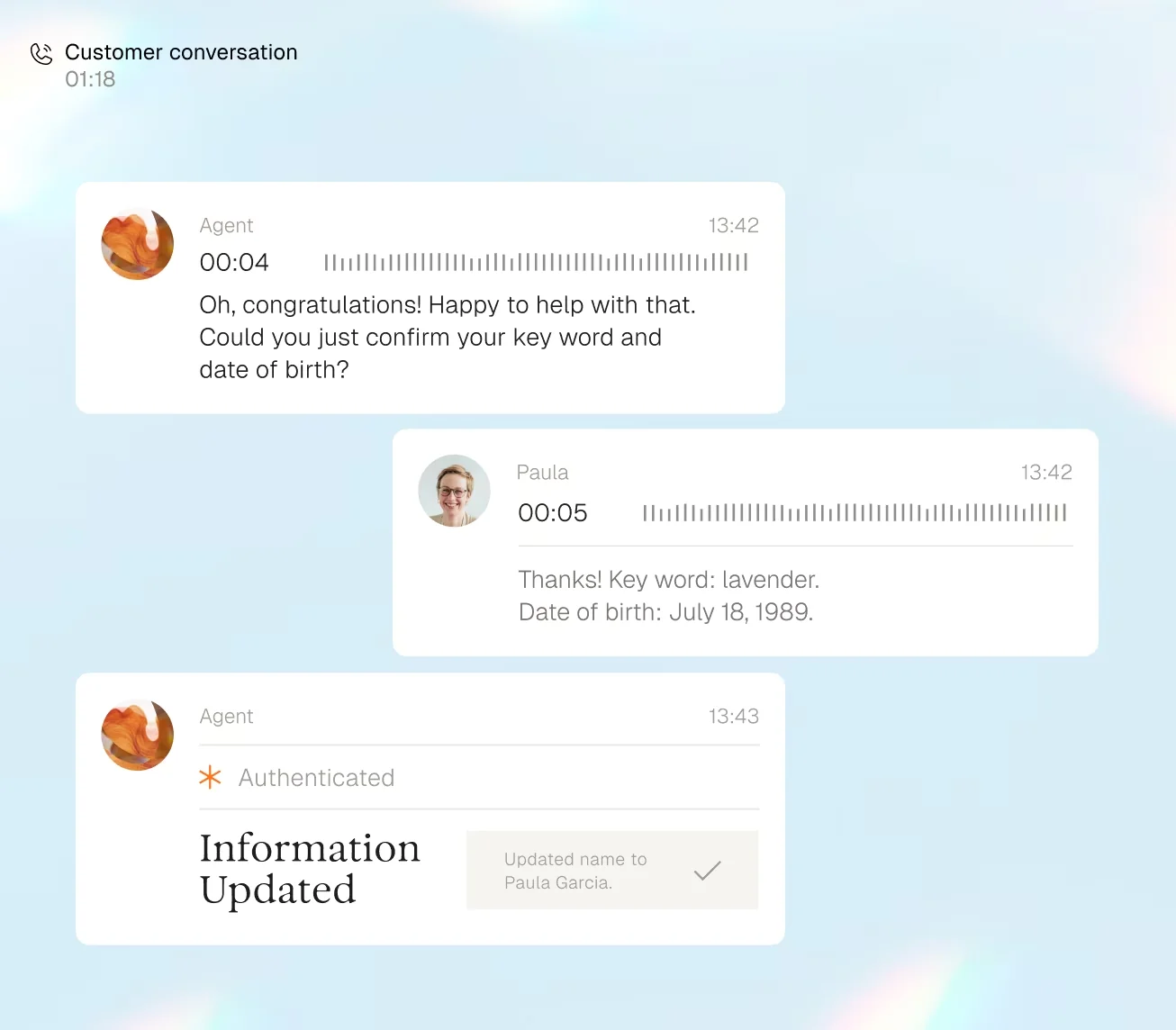
Fair warning on that image. Parloa publishes no screenshots of its actual application, so what sits above is the company's own illustration of the conversation view, not a capture. For a buyer that is a real finding, and I would want it disclosed if I were the one evaluating.
Parloa is on the list anyway because of one column nobody else can fill. It is the only vendor here whose simulation replays your real historical transcripts, blended with synthetic scenarios, and with root-cause tracing plus line-level fixes applied in the platform. Everyone else's "simulation" runs scenarios you wrote yourself, so it tests your imagination and not your call volume. Ever launched an agent that passed every test you invented and then fell over on the first real caller? Then you already know what that distinction is worth.
On the numbers the company is credible too. A Series D of $350M at a $3B valuation in January 2026, over $50M ARR, 150% net revenue retention.
Pricing: consumption-based by task complexity, quote only. The pricing page is not live.
Verdict: on a large migration this is the one I would push hardest for, because pre-launch testing against real history is the difference between a controlled rollout and a public incident. For a small team moving fast it fits badly, between the sales cycle and the absent rate card. Whatever you pick, pair it with deliberate handoff design.
What none of these ten actually fix
This is the part I care about most. It comes from working a support queue, not from reading benchmark tables.
tau-Voice is a support benchmark, not a generic audio test. A simulated caller phones the model with a real problem, and the score is whether the database ended up in the correct final state. Literally "did the customer's problem get fixed". Best score in the entire table: Grok Voice Think Fast 2.0, 56.5%. Every vendor page in this post markets 70% to 95% containment.
Two directions corroborate that gap. Sierra's tau-voice research finds every provider dropping 5 to 14 percentage points on the move from clean text to realistic phone audio, and puts 79% of first critical errors on the agent rather than the caller. Contact centre operators on Reddit put real full automation at 15% to 30%. Which lines up with what I see in automated ticket resolution work on the text side.
On Grok specifically, community sentiment runs warmer than my numbers suggest. Both of these are worth reading:
"Grok voice is surprisingly good, actually. It's still a dumber model than the thinking modes of frontier models, but it's less dumb than the voice modes of other providers."

"Don't know why this post isn't more popular, this is a SOTA voice model, beating dedicated labs like ElevenLabs"
Both true. Neither changes the 56.5%. The model is the best available, and it still finishes just over half of support tasks.
So, before spending a quarter on this decision, the question I would ask is how many of those calls exist because something upstream never got answered. In eesel's own customer research the pattern I keep hitting is the reverse of what vendors sell. One team put it plainly:
"The lack of voice recording support requires agents to summarize voice interactions for Eesel. Implementing this feature would significantly increase our usage."
A property-management support outsourcer using the AI as a Zendesk copilot
Read that again. The bottleneck was not the voice bot. Call content never reached the text AI, so a human retyped every phone conversation before automation could touch it. That is the real shape of voice in support work. Calls and tickets are one queue wearing two costumes, and the expensive channel is the one everyone tries to automate first.
Cheaper order of operations, usually: automating the text channels comes before the phone line. Then first response, and voice last. Still sizing the category? AI agents versus chatbots is the clearest starting point.
The budget question deserves the same care. A voice minute at $0.08 to $0.14 does not compare to a resolved ticket, so run the agent versus human cost numbers against your own volume instead of a vendor calculator. A modern AI helpdesk closes far more volume per dollar than any phone agent on this list. And AI customer service software is where most of that spend belongs first.
Try eesel for the tickets behind the calls
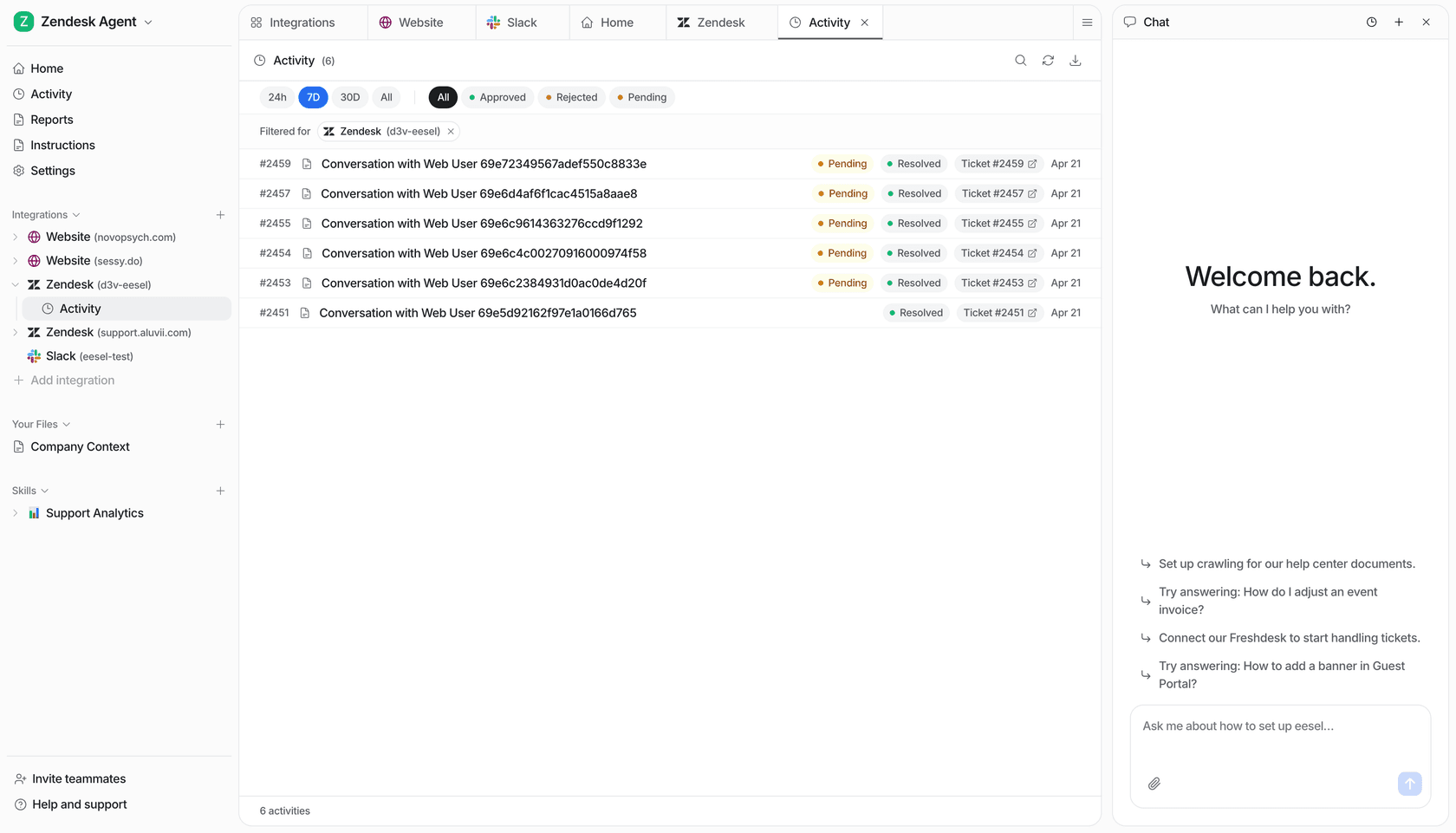
Straight with you: eesel is not on this list, because eesel does not sell a voice model or a phone line. What it does is the channel feeding your phone line.
It plugs into the helpdesk you already run, Zendesk and Freshdesk included. It learns from the help centre and the ticket history already sitting there, then resolves email and chat volume before any of it turns into a call at 4pm.
A Front connector exists too, plus Slack and the rest of the stack. It sits as a conversational AI layer over whatever helpdesk you run, not a replacement for it.
The bit relevant to everything above: we simulate every rollout against your own historical tickets before it answers a single live customer. That exists because we have watched a confident-sounding bot give a wrong answer. On a phone call there is no draft to review, nothing to retract. Same discipline Parloa charges enterprise money for, and the reason I would not launch any channel without it.
Billing is per resolution instead of per seat, so a quiet month costs less rather than the same. Try eesel free, or book a demo if you would rather see it run against your own ticket history first.
Frequently Asked Questions
What are the best Grok Voice Think Fast 2 alternatives?
Why did Grok Voice Think Fast 2 pricing go up?
grok-voice-latest alias repointed from 1.0 to 2.0, so anyone on the alias moved from $0.05/min to $0.08/min without shipping any code. The full breakdown is in my Grok Voice Think Fast 2 pricing post.Is there a cheaper Grok Voice Think Fast 2 alternative?
grok-voice-think-fast-1.0 holds you at $3.00/hr instead of $4.80/hr, which is 37.5% less for a model that still scores 97% on speech reasoning. Gemini 3.1 Flash measures cheaper still at $1.75/hr, but 13 points lower on the index.How much does a voice AI agent cost per minute in 2026?
What is the concurrent session limit on Grok Voice Think Fast 2?
Which voice model resolves the most support calls?
Do I need a voice model if my support is mostly email and chat?


Article by
Riellvriany Indriawan
Riell is a designer and writer at eesel AI with about two years of experience researching CX platforms, AI chatbots, and helpdesk software. She combines her design background with a sharp eye for how these tools actually look and feel in practice — making her comparisons unusually visual and user-focused.