The 8 best GPT-Live-1 alternatives for voice AI in 2026

Kurnia Kharisma Agung Samiadjie

Katelin Teen
Last edited September 11, 2026
Why look past GPT-Live-1 at all
GPT-Live-1 is very good. Launched in the API on September 10, 2026 after shipping first in ChatGPT, it collapses the old speech-to-text, reasoning, and text-to-speech chain into a single full-duplex model that listens and speaks at once. OpenAI measured a 30-point jump on Full Duplex Bench over GPT-Realtime-2.1, and paired with GPT-6 Astra it ranks first on Tau3. In one early rollout, the language app Speak cut interruptions by almost 80% versus its old turn-based system.

So why shop around? Three reasons keep coming up. First, GPT-Live-1 is deliberately not a reasoning model, and it says so: it delegates hard thinking to a backend like Astra or a third-party model, and that second bill is on you. One Hacker News commenter put it plainly:
"GPT-Live isn't a particularly intelligent model. It needs to handoff for reasoning and more complex tasks. You shouldn't expect its responses to be as reliable as a frontier model."

Second, you may want a different price shape, a self-hosted option, or a specific language mix. Third, you may not want to build the agent yourself at all, in which case a voice agent platform does more of the work. Here is how the eight break down.
The best GPT-Live-1 alternatives at a glance
| Tool | Type | Architecture | Billing unit | Headline price | Languages | Free tier |
|---|---|---|---|---|---|---|
| GPT-Live-1 | Voice model | Single speech-to-speech | Per minute + tokens | $0.05/min voice layer | Multiple | Via ChatGPT |
| Gemini Live | Voice model | Single native audio | Per token | ~$0.005/min audio in | 70+ | Yes (AI Studio) |
| Amazon Nova Sonic | Voice model | Single speech-to-speech | Per token | Not published as $/min | 7 (Nova 2) | AWS free tier |
| Grok Voice | Voice model | Single speech-to-speech | Per minute | $0.08/min flat | Multiple | No |
| Cartesia Sonic | Voice model + platform | TTS model + Line runtime | Per credit | Free to $299/mo | 44 | Yes (20k credits) |
| Deepgram | Platform | STT + LLM + TTS pipeline | Per minute | $0.056/min all-in | Multilingual | $200 credit |
| ElevenLabs | Platform | Pipeline + agents | Per included minute | ~$0.08/included min | 31+ (agents) | 15 free min |
| Vapi | Platform | Orchestrator | Per minute | ~$0.105/min assembled | Multiple | Trial credit |
| Retell AI | Platform | Orchestrator | Per minute | ~$0.135/min built | Multiple | Trial credit |
A word on how I judged these. The five model-layer tools are API-first, so most have no product dashboard to screenshot, and I have not pretended otherwise: those entries lead with architecture and pricing instead of a UI shot. The three builder platforms do have real consoles, so those open with a genuine capture. Prices are the vendor's own published rates as of September 2026.

Drop-in voice models (closest to GPT-Live-1's architecture)
These are the direct swaps. Like GPT-Live-1, they are models you call from your own code, and most run the whole conversation through one model rather than a chain.
1. Google Gemini Live API
What it is. Google's native-audio realtime API, the most direct big-lab rival to GPT-Live-1. It streams over a WebSocket, handles barge-in, and on the Gemini 2.5 Flash native-audio model it also supports affective dialog and proactive audio.
Strengths. Breadth is the story. Gemini Live supports 70+ languages, function calling with Google Search built in, and it plugs straight into Vertex AI and AI Studio, so if your stack is already on Google Cloud the integration is short. There is a real free tier for building.
Limits. Sessions are capped: audio-only runs about 15 minutes and audio-plus-video about 2 minutes before you need context-window compression to extend them. Google publishes no time-to-first-audio figure, so latency is something you benchmark yourself rather than read off the page.
Pricing. Token-based. On Gemini 2.5 Flash native audio it is $3.00 per 1M audio input tokens and $12.00 per 1M audio output tokens. The newer Gemini 3.1 Flash Live variant works out to roughly $0.005/min in and $0.018/min out, which is cheap for a frontier lab.
Best for. Teams already on Google Cloud who want a low per-minute floor and the widest language coverage.
2. Amazon Nova Sonic
What it is. AWS's unified speech-to-speech model on Amazon Bedrock. Like GPT-Live-1, it merges speech understanding and generation into a single model rather than a pipeline, with bidirectional streaming, function calling, and RAG knowledge grounding.
Strengths. It is the enterprise-procurement pick. It lives inside Bedrock, so it inherits AWS IAM, VPC, and billing, and it handles interruptions and background noise well. The current Nova 2 Sonic advertises 7 languages and up to a 1M-token context window.
Limits. Two things to check. The original Nova Sonic v1 reaches end of life on September 14, 2026, so target Nova 2 Sonic for anything new. And AWS does not publish a simple dollar-per-minute rate: you are billed by speech and text tokens on the Bedrock pricing page, which makes forecasting a spreadsheet exercise. Regions are limited too.
Pricing. Metered by speech tokens plus separate text tokens on Bedrock. No headline $/min is published, so model your own volume before committing.
Best for. AWS-native teams that want a single S2S model under their existing security and billing controls.
3. Grok Voice (Think Fast 2)
What it is. xAI's realtime speech-to-speech model. Of the whole list, it has the pricing shape closest to what buyers actually want: flat and predictable.
Strengths. Grok Voice is billed at a flat $0.08/min, and independent measurement from Artificial Analysis puts the real cost per hour at $4.80, which is exactly the list rate. That matters because token-billed rivals quote an input rate that can be a fraction of the real all-in cost. It is also fast, at about 0.70s to first audio, and near the top of the quality-and-speed frontier.
Limits. There are hard operational caps: 10 concurrent sessions per team by default, a 120-minute maximum session, and a single us-east-1 region. Telephony adds $0.01/min on a provisioned number. And on the support-specific tau-Voice benchmark, even the best configuration tops out around 56.5% of tasks resolved, a useful reality check against vendor containment claims.
Pricing. Flat $0.08/min, with the measured hourly cost matching the sticker. No volume discount and no priority fast lane on voice.
Best for. Teams that value a predictable, checkable per-minute bill over the absolute lowest token rate.
4. Cartesia Sonic
What it is. Cartesia makes the Sonic family of low-latency voice models, and in 2026 it also ships Line, a code-first platform for building voice agents on top of them. So it is both a model provider and, increasingly, a builder.
Strengths. Latency and control. Sonic-3.6 advertises sub-90ms first-byte audio, 44 languages, and voice cloning from a 10-second clip. Line is a developer-friendly runtime with a CLI and GitHub-based deploys, which fits teams that want to keep their voice agent in version control.
Limits. Billing is by credits, not minutes, which is a different mental model: TTS is one credit per character, so you convert to your own workload to compare. A self-hosted option is not published, so assume cloud unless you are on an Enterprise contract.
Pricing. Free at 20,000 credits/month, Pro $5/mo for 100k credits, Startup $49/mo for 1.25M, and Scale $299/mo for 8M. That works out to roughly $37 to $50 per 1M characters depending on tier.
Best for. Latency-sensitive builds and developers who want a code-first workflow. If you are weighing the voice quality specifically, our Cartesia versus ElevenLabs comparison goes deeper.
5. Deepgram Voice Agent API
What it is. Deepgram is the pipeline pick. Its Voice Agent API bundles Deepgram's own Nova speech-to-text and Aura text-to-speech, and lets you bring your own LLM in the middle. It is explicitly a configurable STT-LLM-TTS pipeline, not a single model.
Strengths. You get component-level control: swap the LLM, tune the STT, self-host if you need to. Barge-in and function calling are built in, new accounts get $200 in credit, and the all-in per-minute rate is actually published, which is rarer than it should be.
Limits. The pipeline shape is the tradeoff. Every handoff between stages adds a little latency and a little brittleness compared to a single model, and the LLM in the middle is a separate bill Deepgram does not charge for. Also note the rate change: Deepgram's published prices step up after September 12, 2026.
Pricing. Standard tier is $0.056/min pay-as-you-go and Advanced is $0.122/min, both rising after September 12. Underneath, Nova-3 STT is $0.0048/min and Aura-2 TTS is $0.030 per 1,000 characters.
Best for. Teams that want to own each stage of the stack and bring their own reasoning model.

Voice-agent platforms (assemble the whole agent)
If you would rather not wire models together yourself, these three give you a builder, telephony, and orchestration out of the box. The tradeoff is that you pay for that convenience in the per-minute rate.
6. ElevenLabs
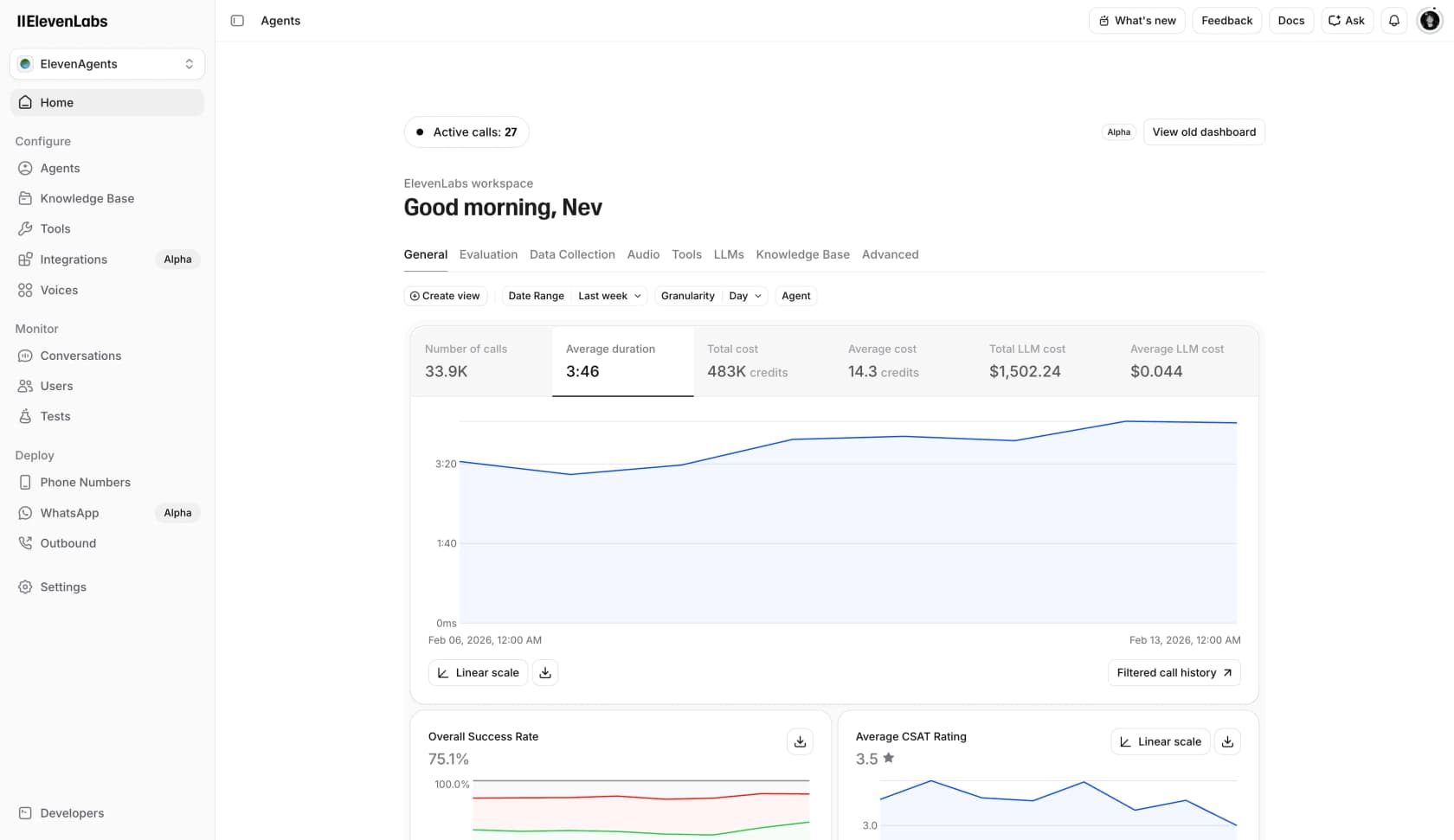
What it is. The best-known name in AI voice. Beyond its TTS catalogue, ElevenLabs ships a full Agents platform with a console, analytics, and telephony.
Strengths. Voice quality and polish are excellent, and the Agents console surfaces real operating metrics like success rate and CSAT rather than hiding them. It is the easiest of the three to demo to a stakeholder.
Limits. Billing is prepaid minutes that expire, which punishes spiky or low-volume usage: you buy an allowance, and unused minutes do not roll over. Above the Business tier's 12,375 minutes a month it is quote-only, and RAG storage is billed separately.
Pricing. Every paid tier divides to almost exactly $0.08 per included minute: Starter $6/75 min, Creator $22/275, Pro $99/1,238, Scale $299/3,738, Business $990/12,375. The free tier includes 15 agent minutes. Our full ElevenLabs pricing breakdown has the tier math, and the ElevenLabs reviews roundup covers the user reception.
Best for. Teams that put voice quality first and have steady, predictable minute volume. If you are cross-shopping, the ElevenLabs alternatives list is a good next stop.
7. Vapi
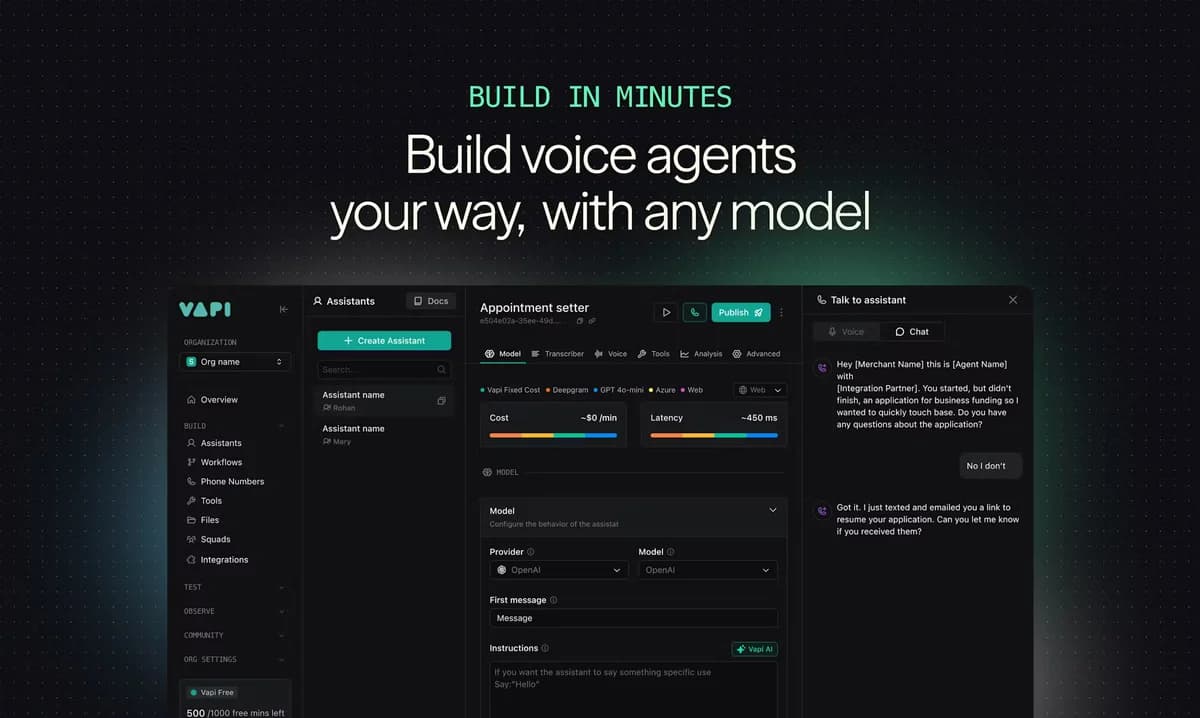
What it is. Vapi is a pure orchestrator. You bring the models, and Vapi handles the telephony, turn-taking, and glue so you can stand up a voice agent quickly.
Strengths. Speed to a working prototype. The assistant builder is clean, the model choices are open, and for a lot of teams Vapi is the fastest path from idea to a phone number that answers.
Limits. Two things to weigh. Vapi's own orchestration fee is a large slice of a realistic per-minute cost, so the assembled rate climbs once you add a good STT, LLM, and TTS underneath. The knowledge base is file-upload only with Gemini-only retrieval, there are no ticketing integrations, and testing is billed at production rates.
Pricing. About $0.105/min once assembled, with Vapi's own fee making up roughly 48% of a realistic minute.
Best for. Developers who want maximum model flexibility and are comfortable owning the integration work.
8. Retell AI
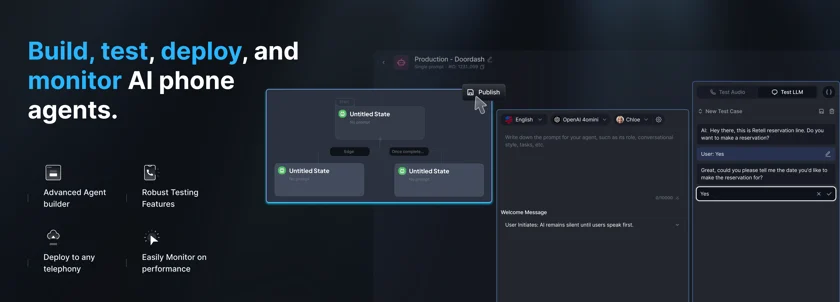
What it is. Retell is an orchestration platform aimed squarely at phone-based agents, with a conversation-flow builder and built-in QA.
Strengths. It is production-minded, with call analytics, a testing suite, and warm-transfer handling. For a straightforward outbound or inbound phone use case, it is a capable, opinionated choice.
Limits. The additive stack adds up. Retell's own voice infra is an unavoidable $0.055/min, and turning on AI QA at $0.10/min adds roughly 74% on top. Helpdesk connectivity is thin: Zendesk is listed as "coming soon" and there is no native Freshdesk, Gorgias, or Front. The meter also stops at transfer, so anything a human picks up is out of Retell's scope, and its own FAQ answers "can AI replace call center agents?" with a flat "No."
Pricing. Around $0.135/min for a realistic support build, roughly $675/month at 5,000 minutes. See the Retell AI pricing page for the component stack, and Retell AI reviews for how it lands in practice.
Best for. Phone-first teams that want a purpose-built voice-agent platform and can live with limited helpdesk integrations. The Retell alternatives list covers the near neighbors.
The honest gap: none of these resolve your tickets
Here is the thing I keep coming back to after years of running AI on support queues. Every tool on this list is voice infrastructure. It is a model, or a builder that assembles a model into a phone line. It is the mouth, not the employee. You still have to give it knowledge, wire it to your systems, decide what it is allowed to do, and figure out what happens when a caller has a problem it cannot solve.

And for most support teams, the bulk of the work is not on the phone at all. It is email, live chat, Slack, and the help center, where a customer describes a problem and expects the right, policy-correct answer back. That is the job eesel does. I should be straight about this: eesel is not a voice tool, so I am not going to pretend it competes with GPT-Live-1 on the phone. If you need voice, pair one of the eight above.
What eesel is, is a ready-to-work AI helpdesk teammate. It plugs into your helpdesk, learns from your past tickets and docs, and starts resolving conversations on the channels you already run. Two differences from the voice stack matter here:
- You are billed per resolved ticket, not per minute. A voice model charges for time on the line whether or not the issue is solved; eesel's usage-based pricing is around $0.40 per resolution, so the meter tracks outcomes. The cost math on support automation lands differently when you pay for answers instead of airtime.
- It simulates on your real historical tickets before it ever replies to a customer. The scar tissue behind that feature is real: I have watched confident-sounding bots quietly give wrong answers, so every eesel rollout is dry-run against thousands of your own past tickets first, and you see the projected behavior before go-live.
There is also a piece for the developers reading this. Because so much of this post is about APIs and building, it is worth knowing eesel is not dashboard-only. The eesel CLI drives the exact same teammate and workspace from a terminal: a person can run it by hand, a script can automate it, and a coding agent like Claude Code, Codex, or Cursor can operate it directly, alongside MCP and webhooks. So the same way you would script a voice model, you can script the support teammate: connect a knowledge source, propose an instruction change, run a simulation, and review the JSON result, all from the command line. It is the agentic path into a support agent, not just a chat box.
If your real question was "how do I answer more support conversations correctly," rather than "how do I add a voice," that is the tool worth trying.
How to choose
Match the tool to the actual job, not the demo:
- You want the closest GPT-Live-1 swap. Start with Gemini Live or Nova Sonic. Both are single S2S models with big-lab backing.
- You want a predictable bill. Grok Voice's flat $0.08/min or Deepgram's published $0.056/min all-in are the easiest to forecast.
- You want to ship without building. ElevenLabs, Vapi, or Retell give you a console and telephony today.
- You care about latency or code-first control. Cartesia's Sonic and Line fit that build.
- Your real job is resolving tickets, not answering calls. A text-first AI helpdesk agent will move your numbers more than any voice model, and you can weigh the AI agent cost against human agents before you commit.
One last note from the field, echoing that HN thread. Voice quality is basically solved now, and everyone on this list sounds good. The hard part, still, is being right. Another tester summed up the current model's habit well:
"The new gpt-live feature tends to interrupt with 'human' sounding injections like 'hmm', 'huh' a bit too much for my liking. Also its crutch is to start by paraphrasing what I just said."
Pick the voice that fits your stack and your budget. Then spend your real energy on the part that actually decides whether customers trust it: the answer underneath.
Frequently Asked Questions
What is the best GPT-Live-1 alternative?
It depends on the job. For a drop-in single-model swap, Google Gemini Live and Amazon Nova Sonic are the closest architectural matches. If you would rather assemble an agent in a visual builder, ElevenLabs, Vapi and Retell get you there faster. Grok Voice and Deepgram sit in between with flat per-minute pricing.
How much does GPT-Live-1 cost compared to the alternatives?
GPT-Live-1 in the API is $0.05 per minute for the voice layer only, and the backend reasoning model is billed separately. That headline is one of the lowest, but it is not the whole bill. See the GPT-Live-1 pricing breakdown for the full stack. Deepgram starts at $0.056/min all-in, Grok Voice is a flat $0.08/min, and ElevenLabs works out to about $0.08 per included minute.
Is there a free GPT-Live-1 alternative?
Several have free entry points. Deepgram gives new accounts $200 in credit, Cartesia has a free tier of 20,000 credits a month, Gemini Live has a free tier in Google AI Studio, and ElevenLabs includes 15 free agent minutes. None of these replace a production voice deployment, but they are enough to build and test.
What is the difference between a single-model voice AI and a cascaded pipeline?
A single speech-to-speech model like GPT-Live-1, Nova Sonic or Gemini Live listens and speaks with one model, so interruptions and timing feel natural. A cascaded pipeline stitches speech-to-text, an LLM and text-to-speech together, which is more configurable but adds a handoff at each stage. Deepgram, Vapi and Retell run the pipeline approach.
Which GPT-Live-1 alternative is best for customer support?
For a phone line specifically, a builder platform like Retell or Vapi wires voice into your stack fastest, though most still lack deep helpdesk connectors. If the real job is resolving tickets across email, chat and Slack rather than the phone, a text-first AI helpdesk agent is the better fit. See our roundup of AI voice companies for the phone-first options.
Can I use GPT-Live-1 for a phone-based call center?
Yes. GPT-Live-1 added telephony support at its API launch, so you can deploy a full-duplex agent to phone calls. If you want a purpose-built stack instead, compare the AI call center agent options and read our take on the real agent vs human cost before you switch a queue over.
Do any of these voice models replace human support agents?
Not on their own. Even Retell's own FAQ answers "can AI replace call center agents?" with a flat "No." Voice models are strongest at fluent conversation and weakest at reliably reaching the right final answer, which is why most teams pair them with a reasoning model and a human handoff. Our piece on AI vs human customer support covers where the line sits.


Article by
Kurnia Kharisma Agung Samiadjie
Kurnia is a software engineer and writer at eesel AI with two years of SEO experience, writing about AI tools, helpdesk software, and customer support. He pairs a developer's understanding of how these products are built with search-driven research into what actually ranks and resonates with the people searching for them.