

Block Dessa is a voice AI model that was trained only on recordings of people talking, with no text at all, and it is not something you can use yet. Block announced it on 23 October 2026 as a research preview: it listens and talks at the same time, laughs and sighs on its own, was trained on one NVIDIA GB200 NVL72 rack, and runs on a MacBook Pro M4 Max. There is a waitlist and early access for safety researchers, but no API, no price, no weights and no benchmark scores.
My read after going through Block's page, its 21 demo listings, and a 199-comment Hacker News thread: Dessa is the most natural-sounding voice model I've heard described, and also the furthest from being a product. The commenters who build voice agents kept landing on the same gap. It talks beautifully, but nothing Block has shown so far lets it look up an order, follow a script, or call a tool.
For support teams, that gap is the whole job. On the queues I build agents for at eesel, the hard part has never been sounding human, it's acting on real account data. Swiftreg answers number-plate tickets from live order data under rules it wrote itself, across about 2,100 Zendesk tickets a month. Watch Dessa as a research milestone; if your queue needs help this quarter, an AI helpdesk teammate on email and chat is the thing that ships.
Why I dug into Dessa
I'm a software engineer at eesel, and I spend my days building the AI agents that sit inside customers' helpdesks. Every few months a new voice model drops with a demo that makes a support lead message me asking "should we be doing phone AI now?". After GPT-Live-1, Grok Voice Think Fast 2.0 and Decagon Voice 3, Dessa is the next one.
So I did what I do with every launch: read everything the vendor actually published, listened to the clips, and separated what Block said from what other people assumed. That second part matters more than usual here, because Block has published remarkably little, and a lot of the coverage fills the gaps with guesses.
What is Block Dessa?
Dessa is a full-duplex speech-to-speech model built by a small AI research lab inside Block, the company behind Square, Cash App and Afterpay. In Block's words, it is "audio in, audio out", and "everything it knows came from human speech."
Three things make it different from most voice AI you've used:
- It skips text completely. Block says the team trained it "from scratch on nothing but human conversation", with "no text, no pretrained models." Most voice assistants are built on top of a text model.
- It's full-duplex. It "listens and talks at the same time, like you do," and learned from data when to cut in and when to backchannel with a "yeah!" or "got it!".
- It hears and makes emotion. Block says it "natively hears and speaks emotion, sarcasm, laughter, a frustrated sigh, a voice cracking with sadness."
The lab is very small. Block's page lists a lead, Ragavan Thurairatnam, six researchers, three interns and two former interns, and says the lab reports directly to Jack Dorsey. The team was founded by former members of Dessa, the Toronto deep learning startup that Square acquired, hence the name. That original startup was known for deepfake detection, which is an interesting history for a team now building the most human-sounding voice model around.
"We made the first AI model you can have a realistic conversation with that was trained entirely on speech! Dessa is a full-duplex speech-to-speech model that you can run on consumer GPUs. This is a GPT3 moment for speech."
That launch post pulled 16,807 likes, and Jack Dorsey's own post calling it "the most authentic full-duplex speech model ever built" crossed 68,000. The hype is real. The question is what sits under it.
How does Dessa work differently from other voice AI?
Most voice agents today are a relay of three models: speech-to-text turns your voice into words, a text model writes a reply, and text-to-speech reads it back. I've written about that setup in my Realtime vs Whisper vs TTS comparison. It works, and it's how most AI phone calls and AI call center agents are handled today.
The speaking end is often a voice vendor such as ElevenLabs. Cartesia's Sonic 3 is another common pick.
Block's argument is that the first step throws away the most human part of the conversation. Its page puts it bluntly: current voice AI "turns your voice into text and throws away an incredible amount of information text alone can't carry. The most powerful AIs in the world can't hear how you feel."
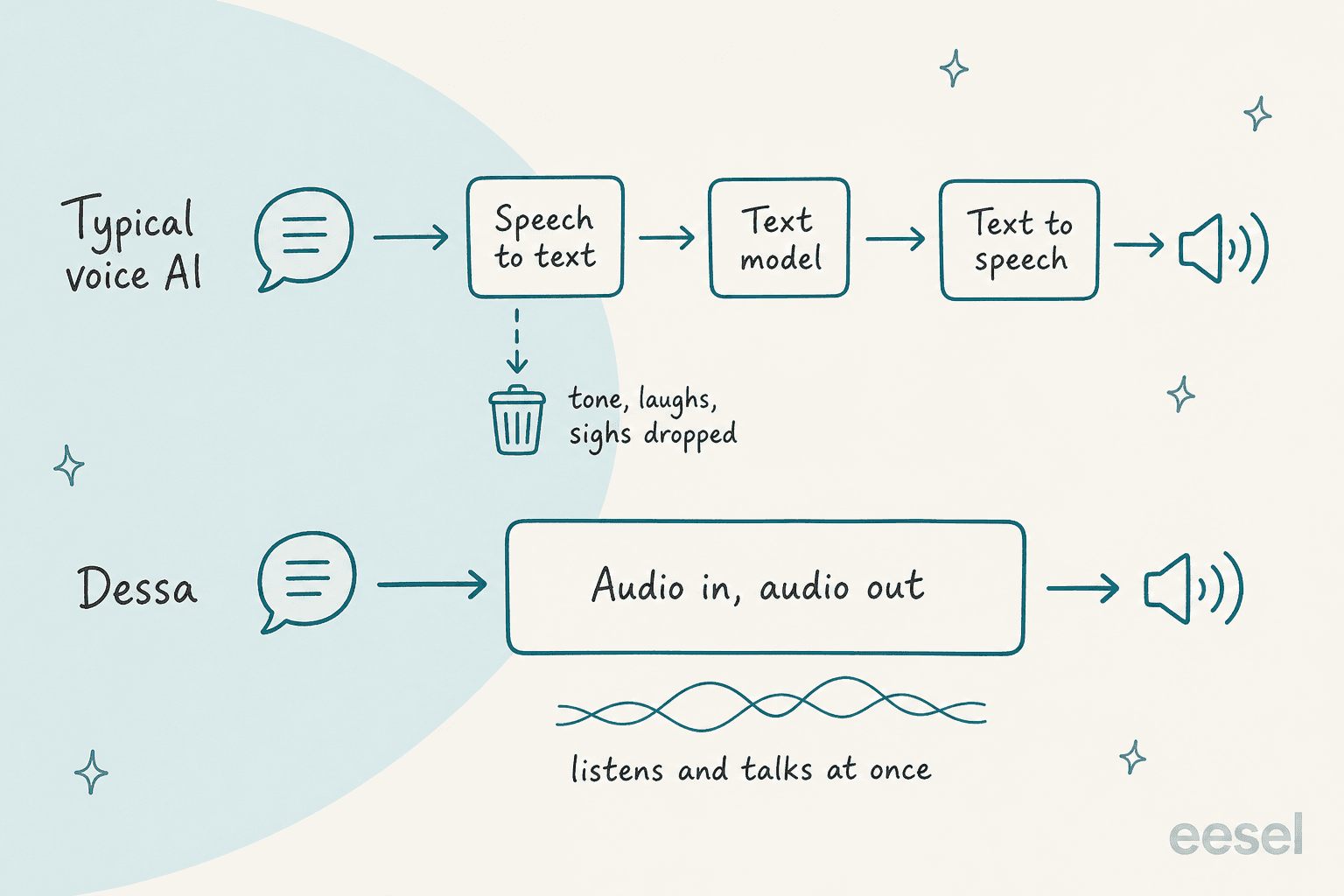
Dessa replaces the whole relay with one model that hears audio and produces audio. Because it never converts to text, the laugh, the pause and the sigh are part of what it learns from and what it produces. Models like OpenAI's gpt-realtime also process speech directly, and GPT-Live-1 hands the hard thinking to a separate backend model like GPT-5.5. Dessa's claim to fame, per Block, is that it never saw text at all.
The surprising part, if Block's claims hold, is the efficiency. Block says:
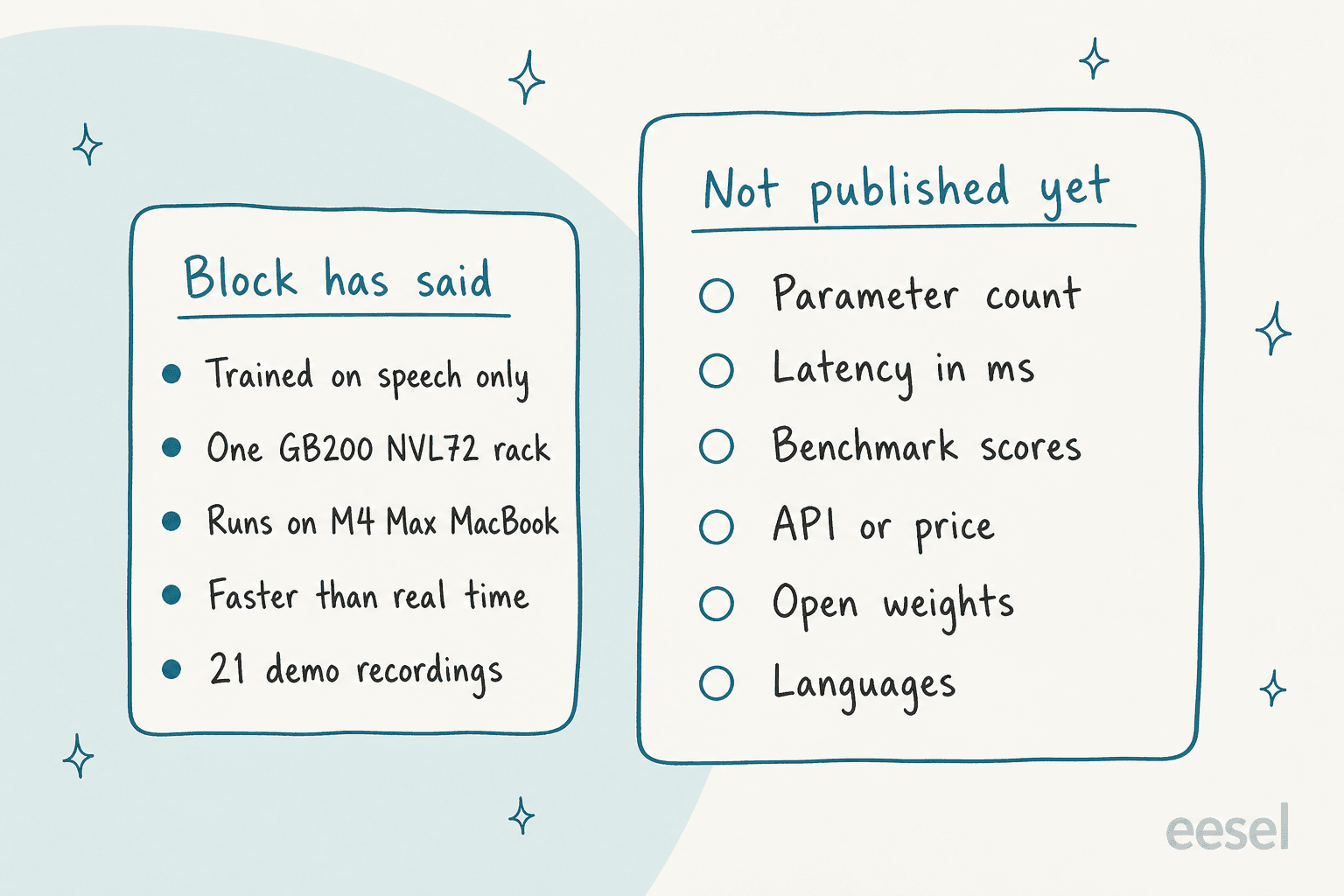
- Dessa "learned language from hundreds of times fewer words" than large text models.
- It was trained on "only one NVIDIA GB200 NVL72", a single rack rather than a data centre.
- Inference "runs faster than real time" and it "runs locally on a MacBook Pro M4 Max or better."
Block also lists open research questions it wants to explore: "How efficiently do they learn language and facts compared to text? How efficiently can they learn new languages? What sorts of In-context learning can they perform?" I like that the page says this out loud. It's a research lab telling you it doesn't know yet.
What do the Dessa demos actually show?
Block's page carries 21 recordings: six featured clips with captions and 15 more samples, running from 1:42 to 5:01. Block says "Nobody steers it" and that subtitles were added afterward. Each clip plays as two synced tracks, one human and one Dessa.

Here are the featured clips and what Block says each one shows:
| Demo clip | Length | What Block highlights |
|---|---|---|
| Talking about the release | 2:52 | Laughs mid-sentence, gets louder when asked to speak up |
| Remembering a movie | 2:39 | Finishes a movie title the person blanked on |
| An anniversary surprise | 1:52 | Gasps "oh my god" under its breath, then sounds grateful |
| Expressive conversation | 3:03 | "Huge range in intonation and speed" |
| Life advice | 4:57 | Sounds "genuinely empathetic" |
| Dessa in conversation with GPT-Live-1 | 2:25 | Interruption, patience, fast backchanneling |
That last clip is the closest thing to a comparison Block offers. It's two AI voices talking to each other, with a note that "the developer of GPT-Live-1 is not affiliated with Block and has not reviewed or endorsed Dessa." It's a fun listen, but it's a vibe check, not a benchmark.
There's also a guessing game on X, where an intern plays with the model and, in Block's words, "the model guesses the first one right straight away, and the second doesn't take long either." Ragavan framed it as proof that Dessa "developed world knowledge" purely from audio.
What has Block not told us yet?
This is the part most launch coverage skips, and it's the part that decides whether Dessa matters to you. As of 27 October 2026, Block's Dessa page is the only official write-up. There's no technical report, paper, model card or GitHub.
What's missing:
- Model size. No parameter count, so "runs on an M4 Max" can't be checked against memory needs.
- Latency. "Faster than real time" is a throughput claim. There's no time-to-first-audio figure in milliseconds, which is the number that decides whether a call feels natural.
- Benchmarks. No scores against GPT-Live-1, Grok Voice, Gemini or open models. Only qualitative lines like "Other models wait for you to finish, then laugh on cue."
- Languages. The demos are English. One sample is titled "Singing nonsense Spanish", which isn't the same as Spanish support.
- Access. No API, no price, no license, no open weights. The page footer says "Launch links are coming soon."
None of this is a knock on the research. A small lab sharing early work is normal. It just means any article telling you Dessa "beats" another model is guessing, and any plan you make around it today is built on demo clips.
What are people saying about Dessa?
The Hacker News thread has 532 points and 199 comments, and X lit up with the demo clips. Reactions split three ways.
The realism impressed a lot of people. The most-replied comment in the thread was about the hardware, not the voice:
"The conversation examples are impressive but this made me say holy shit out loud: 'it runs locally on a MacBook Pro M4 Max or better. And we figured out how to train Dessa on only one NVIDIA GB200 NVL72.'"

Not everyone heard the same thing, though. One commenter found the homepage sample "absolutely awful", and another said their non-technical wife picked out the AI voice correctly on the first try.
The voice is ahead of the brain. This was the most common critique from people who've built voice agents:
"The speech realism is very good, but the intelligence is pretty clearly 2024-level."
Another commenter caught a made-up fact in the movie demo, linking Bryan Singer to Superman IV. That's a good reminder that a confident voice makes AI hallucinations more convincing, not less.
Scams and impersonation. Several people worried about what a convincing, local voice model does to phone fraud:
"Block says it runs locally on a high-end MacBook. Once something like that is out, there's no server in the middle to watch it or switch it off. Research preview for now. Soon the only way to know you're talking to a human will be to hang up and call back."
Block seems aware of this. Its stated reasons for building Dessa are "curiosity (aka fun), better understanding between humans and AI, and safety," and the first outside access is going to safety researchers, not developers. What Block hasn't published yet is a model card, red-team results or any audio watermarking. OpenAI, by contrast, watermarks GPT-Live audio with SynthID and limits it to preset voices, so that's the bar I'd expect Dessa to meet before a public release.
Could Dessa handle customer support calls?
Not in its current form, and the reasons are specific. A phone support agent needs to do four things besides sounding good: call tools (look up the order, issue the refund), follow a script or policy, answer from your own help center, and connect to your phone system through an API. Block hasn't announced any of those.
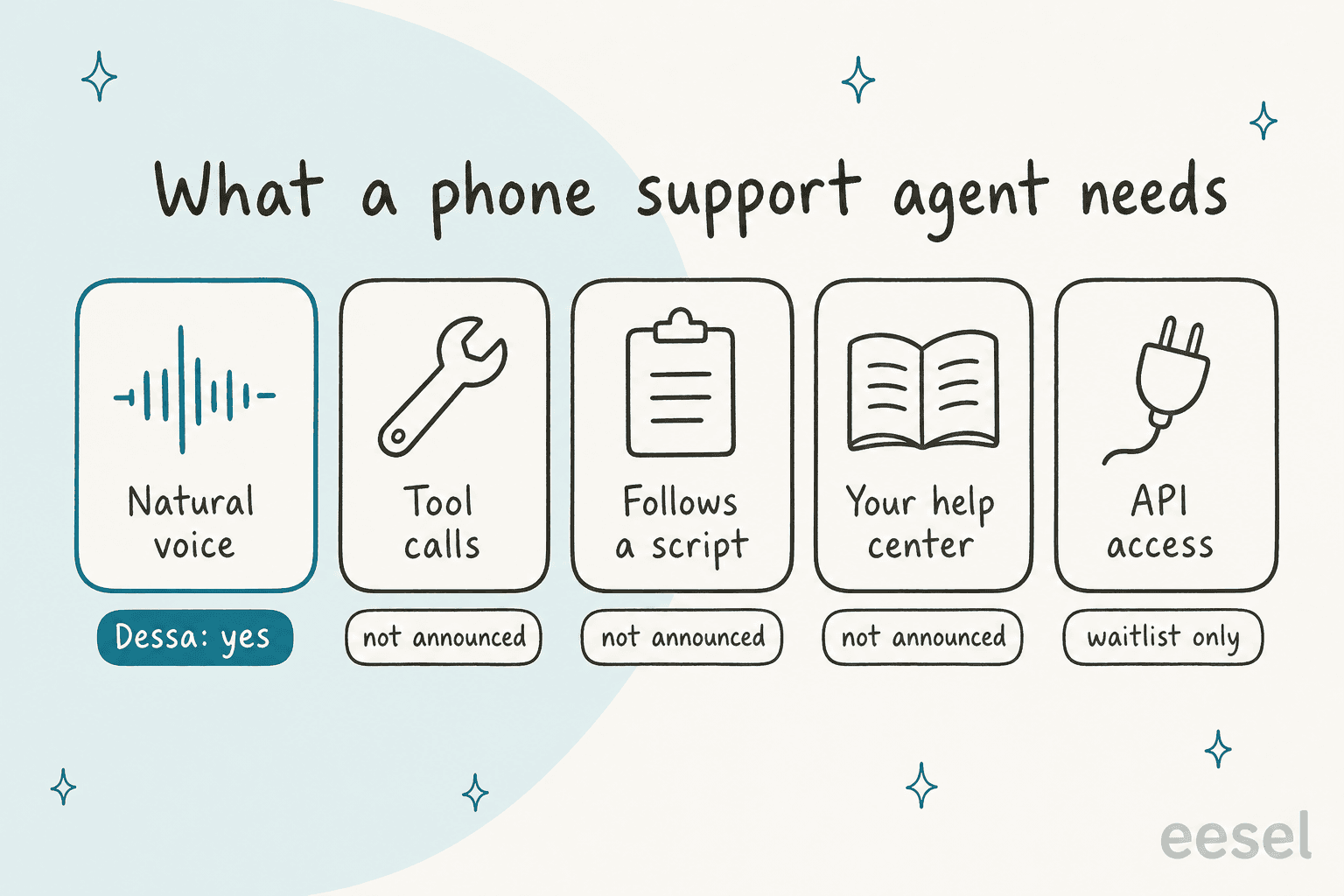
The HN crowd put it more sharply than I would:
"Given that it lacks both broad world knowledge and tool calling integration in any way, that seems kind of like a dead-end."
I don't think it's a dead end. Another commenter suggested splitting the listening and speaking parts from a model in the middle that handles the knowledge-base lookups and tool calls, which sounds like a sensible path. But that's future work, and Block hasn't said it's doing it.
There's also a customer-experience question nobody has an answer to yet. Dessa's signature move is interrupting and backchanneling like a person. Several commenters said that's exactly what they'd hate from a support line:
"I get irrationally angry when actual people interrupt me while I'm talking, I'll start throwing chairs when AI tech support agents start doing it."
From what I've seen on real support queues, customers forgive a slightly robotic voice that fixes the problem. They don't forgive a charming one that can't. When I roll out an agent at eesel, I simulate it against a team's historical tickets first, precisely because the failure that hurts is a confident wrong answer, not an awkward pause. If phone AI is on your roadmap, start with what your helpdesk already offers. Zendesk has voice AI agents, and Freshdesk has Freshcaller agents.
For standalone tools you can deploy now, my guides to AI voice agents for support and the best AI for phone support are the place to start.
How does Dessa compare with voice models you can use today?
Since Block hasn't published scores, the honest comparison is about what each one lets you do, not which sounds best.
| Block Dessa | GPT-Live-1 | Grok Voice Think Fast 2.0 | |
|---|---|---|---|
| How it's built | One speech-only model, no text training | Voice layer that hands reasoning to a backend model like GPT-5.5 | Voice model with reasoning built in |
| Can you use it today? | Waitlist and safety researchers only | Yes, via API | Yes, via API |
| Published price | None | $0.05 per minute for the voice layer | $0.08 per minute |
| Tool calling | Not announced | Yes | Yes |
| Runs locally | Yes, M4 Max MacBook or better (per Block) | No | No |
| Published benchmarks | None | Yes | Yes |
| Audio watermarking | Not announced | SynthID | Not covered here |
Interestingly, the GPT-Live-1 setup is close to what that Hacker News commenter proposed for Dessa: a voice layer for the conversation, and a separate model for the thinking and tool calls. My GPT-Live-1 review and pricing breakdown go deeper on it.
The local angle is the one new thing on Dessa's side of that table. A voice model that runs on a laptop opens up offline assistants, games and language practice in a way cloud APIs don't. If local AI is what interests you, it's worth reading alongside other on-device releases like Nemotron 3.5 Bolt, or my list of open-source AI agents.
For anything customer-facing this year, though, the models with APIs and tool calling win by default, and the voice model is only one part of a working AI agent. My roundup of AI voice agents and the Grok Voice Agent Builder review are better places to start than a waitlist.
Who should pay attention to Dessa?
- AI safety researchers: yes, directly. Block is asking for you by name, with an early-access form that takes an institutional email.
- Voice AI builders: watch it closely. If Block publishes weights or an API, a speech-only model that runs locally would be a real new option.
- Support and CX leaders: treat it as a signal, not a plan. The quicker wins on calls today are things like summarizing calls into tickets and broader call center automation. Voice AI is clearly going to sound more human. Whether it can act on your data is a separate question Dessa doesn't answer yet.
- Anyone worried about phone scams: fair worry. A family code word for unexpected calls is a cheap habit to start now.
Try eesel
Dessa shows where voice AI is going: more human, more emotional, eventually local. The part it hasn't reached yet, acting on real account data under your own rules, is what eesel's AI helpdesk teammate already does on email and chat tickets. It learns from your help center and past tickets, can look up orders before it replies, and hands off to a person when it should.
SamCart runs one agent on its Freshdesk tickets and another on its website chat, answering from 280 help center articles. Swiftreg handled about 2,100 Zendesk tickets in a month from live order data, with about 1,500 public replies sent. Both run on the queues they already had, no waitlist needed.
If your ticket queue needs help before voice AI matures, try eesel free and run it against your own past tickets first.