
The model underneath changes every few weeks
I build integrations at eesel, and for the last couple of years a big part of my job has been watching AI agents go live on real support queues. One lesson carries over to voice almost directly, which is that the agent that demos well is rarely the same one that holds up once your actual customers start calling. It's the reason every eesel rollout gets simulated against historical tickets before it goes live. Also worth saying up front: eesel doesn't sell a voice agent, so this list is an easier one for me to write straight.
The shift that should change how you shop is in the numbers. Back in August, the best score on Artificial Analysis' tau-Voice benchmark was 56.5%, and Grok Voice Think Fast 2.0 was the one holding it. tau-Voice is the one voice benchmark that is built around support, where a simulated caller phones the agent with a real problem and the score only counts if the database ends up in the correct state. By 29 September, Gemini 3.8 Live Extended Thinking was sitting at 68.6%, and two OpenAI GPT-Live-1 variants had also moved above the old ceiling.
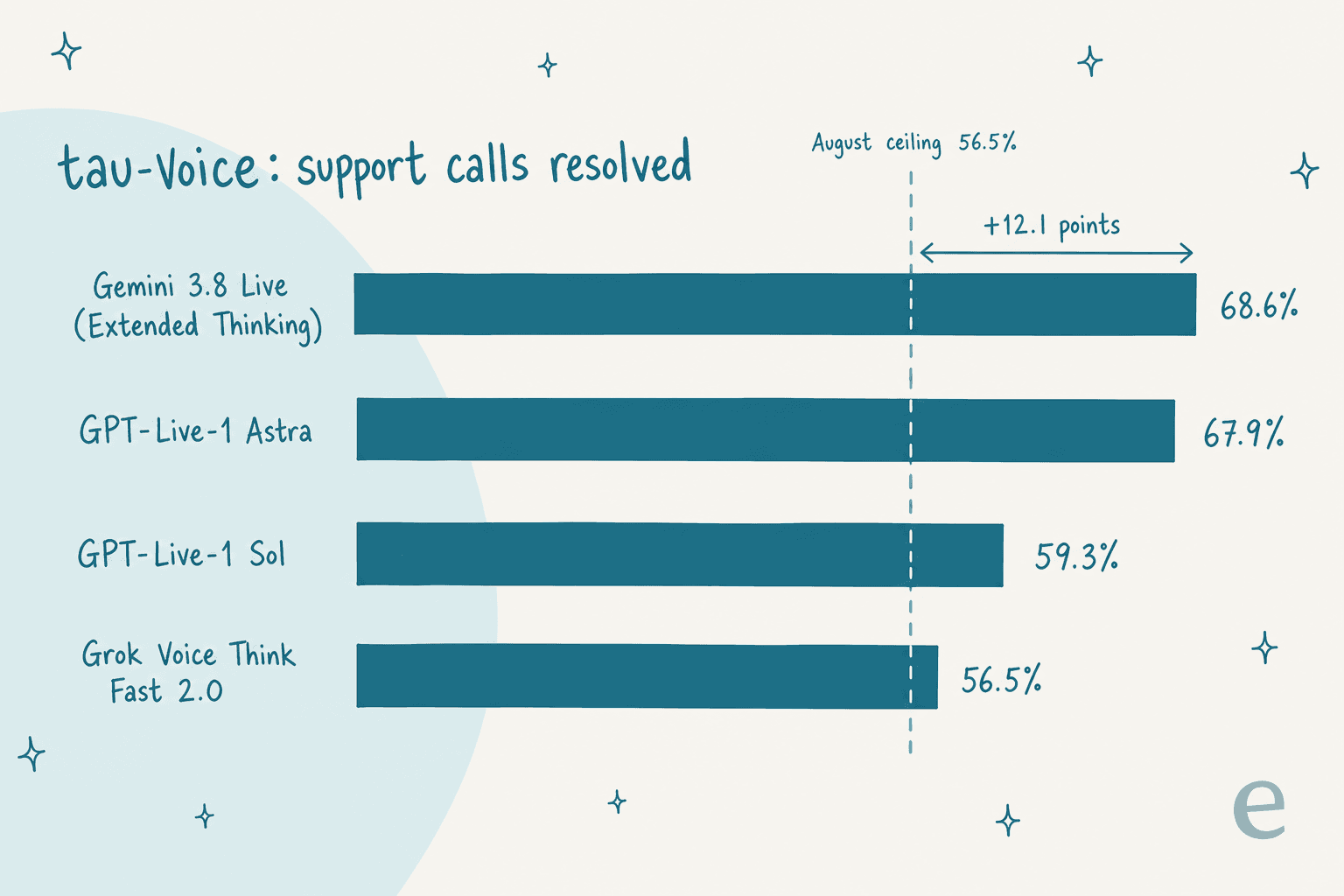
Two things follow from this. The first one is that even the best model still fails about 31% of realistic support calls, so a clean human handoff is not something you can treat as optional. The second is about lock-in, since a platform that ties you to one model will be behind within a quarter, and the platforms below that let you bring your own model (Vapi, Retell, Deepgram, Parloa) tend to age better than the ones that don't.
Speed also isn't really the bottleneck anymore. Deepslate Opal is one of the fastest models on the board at 0.44 seconds to first audio, yet it resolves 17.5% of tau-Voice calls, while Grok Voice Think Fast 2.0 manages 0.70 seconds and 56.5%. So when a vendor leads with latency, my advice is to ask them for task completion instead. Builders on Hacker News have been making the same point for a while:
"I've generally observed latency of 500ms to 1s with modern LLM-based voice agents making real calls. That's good enough to have real conversations."

"AI will never be able to answer 100% of the questions... I need an AI who is only handling the tickets that it's confident to handle and all the other ones, leave them alone."
A DTC supplements CX lead, on an eesel sales call
That line came from a buyer on the text-support side, but it works just as well as the brief for a voice agent.
How I picked these 8
My starting point was the platforms that keep showing up when support and ops teams compare voice agents, and from there I cut anything I couldn't price or verify. Raw speech models like Gemini Live and Grok Voice I left out as items, because they're the engine and not the car, and you would still need phone numbers, tools, testing and handoff built around them. I also skipped Sierra, since it already gets the full treatment in my voice support roundup.
If the category is new to you, it helps to start with how an AI voice agent works. And if phone support is your only goal, my phone support picks come at it from the helpdesk side instead. Here is what I weighed:
- Who builds and maintains it. A developer API, a builder platform you configure, or a managed service.
- The real per-minute cost, not the headline. That means checking whether the model and voice, and the phone line too, sit inside the rate.
- Model choice. Can you swap the LLM or voice when a better one ships?
- Evidence. Benchmark or arena results where they exist, plus what users on G2, Reddit and Hacker News actually report.
- Compliance and scale. SOC 2, HIPAA/BAA terms, concurrency caps and SLAs.
Most of the sorting comes from the first criterion, so here is how the eight fall out on it.
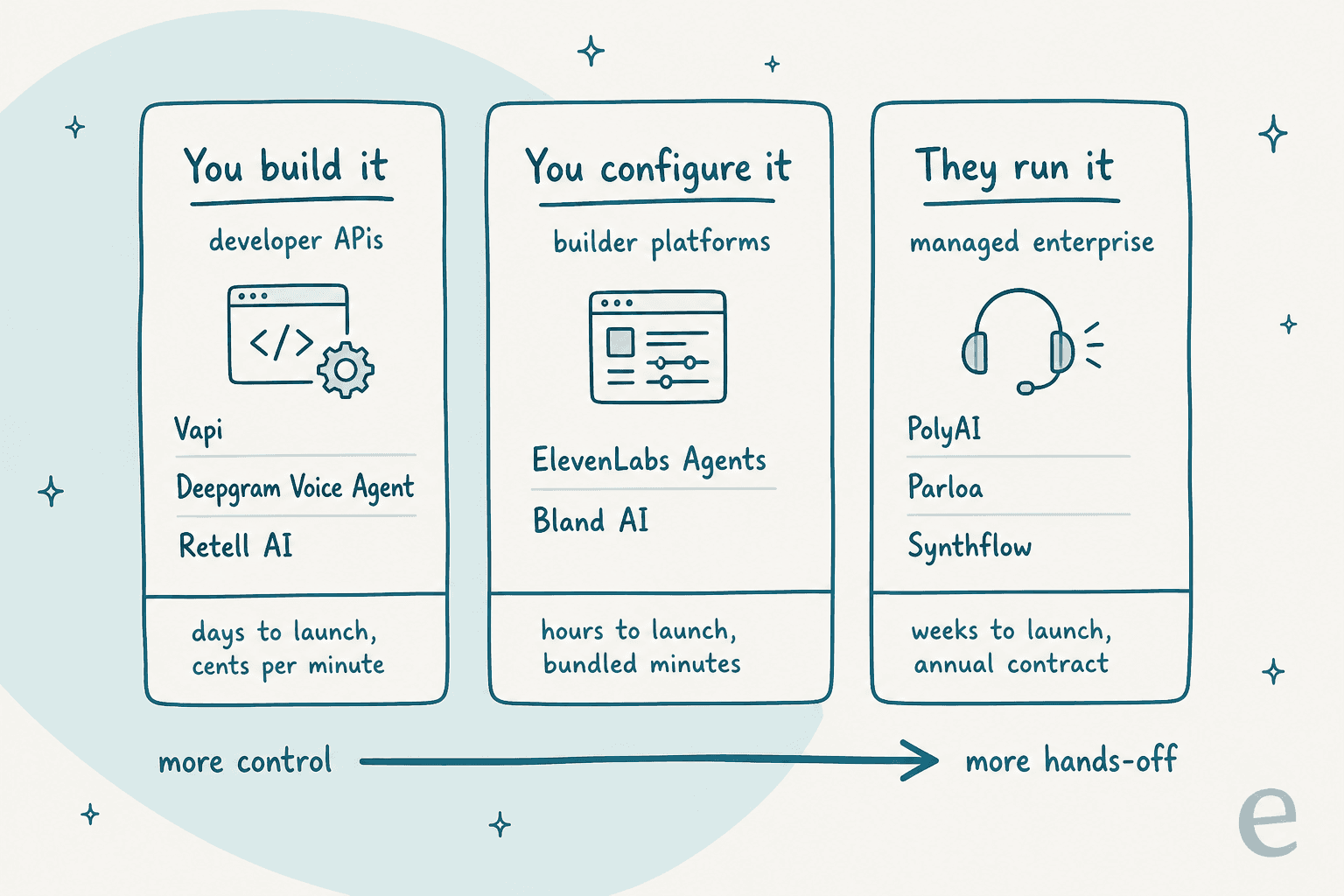
The best AI voice agents at a glance
All prices are from each vendor's own pricing page, checked 29 September 2026.
| Tool | Best for | Who runs it | Billing unit | Public entry price | LLM + voice in the rate? | Bring your own model | Free credit | Concurrency (entry) | Compliance | Uptime SLA |
|---|---|---|---|---|---|---|---|---|---|---|
| Retell AI | Teams building their own phone agent | You build | Per minute, itemized | $0.07-$0.31/min | Yes, itemized | Yes (LLM, TTS) | $10 | 20 calls | SOC 2, HIPAA-ready, BAA on Enterprise | Not published |
| ElevenLabs Agents | Voice quality with predictable minutes | You configure | Monthly minute bundles | $6/mo (75 min) | Voice yes, LLM extra | LLM choice | 15 min/mo | 6 calls | BAA on Enterprise | Custom on Enterprise |
| Vapi | Developers who want every knob | You build | $0.05/min + providers at cost | $0.05/min fee | No, passed through | Yes, full catalog | $5 | 4 calls | HIPAA $2,000/mo add-on | 99%-99.9% on paid packages |
| Deepgram Voice Agent API | Cheapest bundled API | You build | Per minute of connection | $0.075/min | Yes | Yes (LLM, TTS) | $200, no expiry | 45 calls | SOC 2 Type 2, GDPR, BAA on Enterprise | Not published |
| Bland AI | One flat all-in rate | You configure | Per minute, flat | $0.14/min | Yes | No | Not published | 10 calls | SOC 2 Type II, HIPAA with BAA, PCI DSS | 99.9% all tiers |
| PolyAI | Managed enterprise voice | They run it | Per minute, quoted | Quote only | Yes | No (own Raven model) | No | Custom | SOC 2, HIPAA, GDPR, PCI DSS | 99.9% on phone lines |
| Parloa | European, multilingual contact centres | They run it | Quoted | Quote only | Yes | Yes (STT, TTS, LLM) | No | Custom | SOC 2, ISO 27001, GDPR | Not published |
| Synthflow | Sales-led rollout with GoHighLevel or HubSpot | They run it | Annual contract | From $30,000/yr | Yes | Not published | No | Custom | SOC 2, GDPR, HIPAA, ISO 27001 badges | Scoped in contract |
What a month of calls actually costs
Headline rates aren't really comparable (which is a problem across AI customer service costs generally), because each vendor packs a different amount inside the minute. Pick a volume below and you can see the platform cost for each option at the same number of call minutes.
Monthly platform cost by call volume
Same minutes, eight vendors. Phone line costs excluded (add roughly $0.008-$0.015 per minute).
| Vendor | Monthly cost | How it adds up |
|---|---|---|
| Deepgram | $75 | Standard Voice Agent API at $0.075/min |
| Retell AI | $70-$230 | $0.07/min bare floor up to Retell's own $0.23/min worked example |
| Vapi | $82-$129 | Vapi's own estimate: $50 fee plus transcriber, LLM and voice at cost |
| ElevenLabs Agents | ~$100 | Pro plan $99 (1,238 min) plus about $1 of LLM |
| Bland AI | $140 | Start plan at $0.14/min, no platform fee |
| Synthflow | $2,500+ | $30,000/yr contract floor, whatever the volume |
| PolyAI, Parloa | Quote | No public rate |
| Vendor | Monthly cost | How it adds up |
|---|---|---|
| Retell AI | $350-$1,150 | $0.07/min floor up to the $0.23/min worked example |
| Deepgram | $375 | Standard Voice Agent API at $0.075/min |
| ElevenLabs Agents | ~$406 | Scale plan $299 (3,738 min) + 1,262 min at $0.08 + about $6 of LLM |
| Vapi | $410-$645 | Vapi's per-1,000-minute estimate scaled up; more than 4 concurrent calls needs a paid package |
| Bland AI | $700 | Start plan at $0.14/min |
| Synthflow | $2,500+ | $30,000/yr contract floor |
| PolyAI, Parloa | Quote | No public rate |
| Vendor | Monthly cost | How it adds up |
|---|---|---|
| Retell AI | $1,400-$4,600 | $0.07/min floor up to the $0.23/min worked example |
| Deepgram | $1,500 | $0.075/min pay-as-you-go ($0.068 on a $4K+/yr Growth plan) |
| ElevenLabs Agents | ~$1,624 | Business plan $990 (12,375 min) + 7,625 min at $0.08 + about $24 of LLM |
| Vapi | $1,640-$2,580 | Scaled estimate, before a concurrency package |
| Bland AI | $2,699 | Build plan: $299 fee + $0.12/min (Start caps at 100 calls a day) |
| Synthflow | $2,500+ | $30,000/yr contract floor |
| PolyAI, Parloa | Quote | No public rate |
Sources: each vendor's pricing page, 29 September 2026. LLM cost for ElevenLabs uses its listed Gemini 2.5 Flash rate of $0.0012/min.
The pattern here is that at low volume the cheapest options are the pay-as-you-go APIs, and bundles like ElevenLabs end up within a few percent of Deepgram once you're at about 5,000 minutes and up. Retell's range is wide for one reason: the LLM you choose moves the bill more than anything else does, and in its own example the LLM is $0.160 of a $0.230 minute. Even at the top of these ranges a minute of AI is still a fraction of a staffed minute, which is the math behind the AI vs human agent cost breakdown.
The 8 best AI voice agents in 2026
Every pick follows the same shape so you can compare across them: who it's best for and what stood out, then pros, cons, pricing and my take.
1. Retell AI
Best for: teams that want to build their own phone agent without assembling every piece by hand.
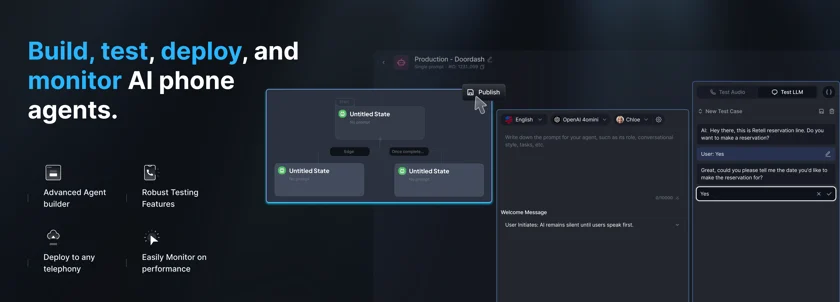
Retell AI sits in the sweet spot between a raw API and a no-code builder. You design flows on a canvas or in a prompt and test them in the browser, then pick your LLM and voice from a menu. As a builder, the part I like is that Retell's pricing page itemizes every layer, so it's easy to see exactly where a minute goes: voice infrastructure $0.055, TTS from $0.015, telephony $0.015 on Retell numbers, and whatever LLM you pick.
The add-ons are small, and the page is honest about them. A knowledge base adds $0.005 a minute and PII removal $0.01, while AI QA (automatic call scoring) is $0.10 a minute after the first 100 free. You also get 20 concurrent calls for free, which is generous when you put it next to Vapi's 4.
On Reddit, the praise that comes up most is about conversational handling. One builder who compared Bland, Synthflow and Retell said the difference "was in how it handled interruptions and off-script stuff" in an r/AI_Agents test. Even the happy users flag the bill, though:
"The pricing can also become expensive when scaling or doing many test calls during development."

Pros
- Every cost layer is itemized, so budgeting is predictable once you've picked a model
- 20 free concurrent calls and $10 in credits to start
- Swap LLMs and voices (including ElevenLabs voices at $0.040/min) without rebuilding
Cons
- The range is wide: a premium LLM can push a minute from $0.07 to $0.23 or beyond
- No named helpdesk integrations on the pricing page; ticketing goes through webhooks and the API
- BAA and SSO sit on custom Enterprise terms
Pricing
| Item | Price |
|---|---|
| Voice agents (pay as you go) | $0.07-$0.31/min |
| Worked example on Retell's page | $0.230/min (LLM $0.160 + voice infra $0.055 + TTS $0.015) |
| Telephony on Retell numbers | $0.015/min (free with your own SIP) |
| Phone number | $2/mo |
| Extra concurrency | $8 per call per month |
| AI QA | $0.10/min, first 100 min free |
| Enterprise | Custom, from 50+ concurrent calls |
There's more detail in my Retell AI pricing breakdown. For user sentiment the Retell AI reviews roundup covers it, and there's a separate list of Retell AI alternatives too.
My take: Retell is the default I'd point most teams at. Pick it if you have one technical person and want to ship in days. Skip it if nobody on your team wants to own the prompts and testing, because that part stays on you. The deciding factor is your LLM choice, so price that one first.
2. ElevenLabs Agents
Best for: teams that care most about how the agent sounds and want a predictable monthly bill.
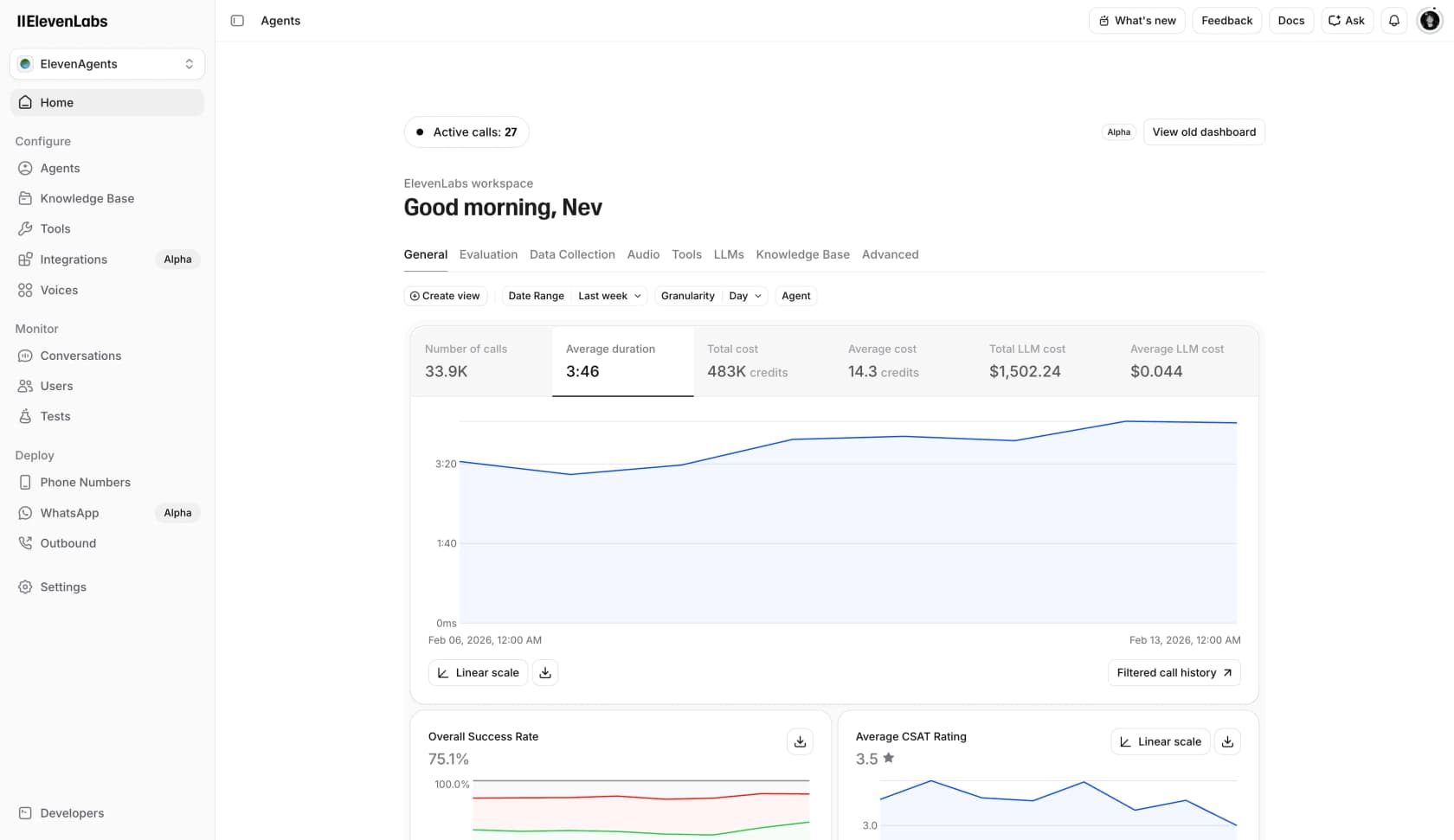
ElevenLabs built its name on text-to-speech, and its agents platform (ElevenAgents) carries that reputation over. What surprised me, though, was the evidence on task success rather than on voice. In Artificial Analysis' Speech Agent Arena, where paid participants hold blind live calls with two systems on the same scenario, ElevenLabs Agents scores 90.5% tool-call success across 773 samples, which is the highest of any full agent platform in the arena.
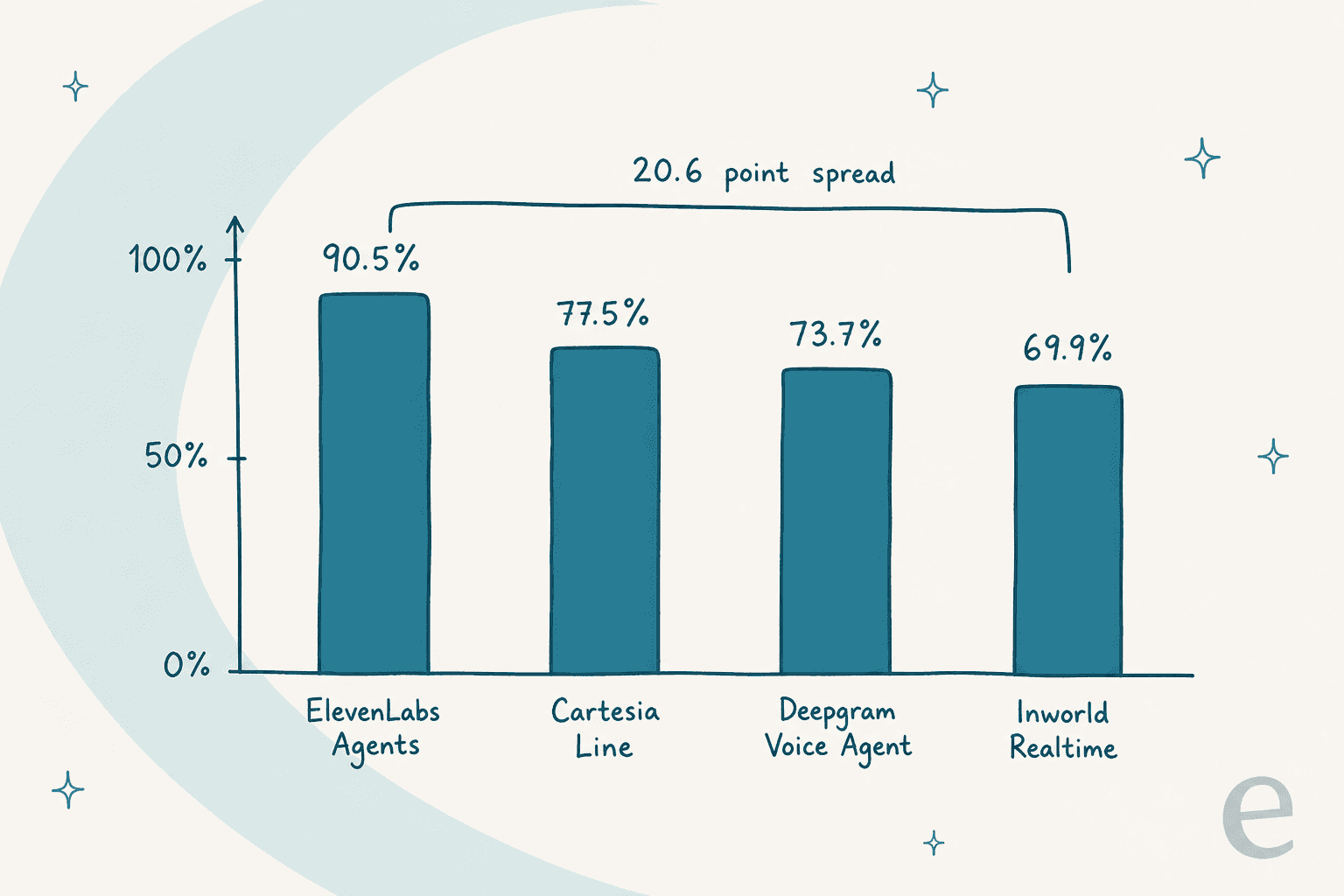
That 20.6-point spread between platforms on the same live calls is the best argument I have seen so far that the platform matters, and not only the model inside it.
Pricing comes as a set of monthly minute bundles. Every paid tier works out to about $0.08 per included minute and overage is also $0.08 a minute, then going past your concurrency limit bills "burst" minutes at $0.16. On top of that the LLM is billed by model (Gemini 2.5 Flash is listed at $0.0012 a minute), and the phone line is yours to bring through Twilio or SIP.
The complaint worth knowing about before you launch is about the transfer step. One builder on Reddit was quite blunt about transfer_to_number not forwarding calls:
"I am telling I am suffering from the clients, complaining that they cannot transfer, this is really bad from ElevenLabs"

Whatever platform you pick, test the human handoff on day one.
Pros
- Highest tool-call success of any agent platform in the live arena (90.5%)
- Voice quality and voice library are the strongest on this list
- A real free tier (15 minutes a month) and a $6 starter plan
Cons
- Every bundle works out to about $0.08 a minute, so there's no volume discount below Enterprise
- Burst minutes cost double, so spiky call volume needs a bigger plan than average volume suggests
- SOC 2 and data residency aren't stated on the agents pricing page; BAAs are Enterprise-only
Pricing
| Plan | Price/mo | Included minutes | Concurrency |
|---|---|---|---|
| Free | $0 | 15 | 4 |
| Starter | $6 | 75 | 6 |
| Creator | $22 ($11 first month) | 275 | 10 |
| Pro | $99 | 1,238 | 20 |
| Scale | $299 | 3,738 | 30 |
| Business | $990 | 12,375 | 40 |
| Enterprise | Custom | Custom | Elevated |
Overage $0.08/min, burst $0.16/min, text $0.003/message, per ElevenLabs' agents pricing. The ElevenLabs pricing guide goes deeper, and the ElevenLabs alternatives list covers close rivals.
My take: Pick ElevenLabs if the agent is the voice of your brand and your volume is steady. Skip it if your calls come in sharp spikes, since burst pricing is hard on exactly that pattern. The deciding factor is whether your monthly minutes sit near a bundle boundary.
3. Vapi
Best for: developers who want to choose every provider and pay the lowest possible platform fee.
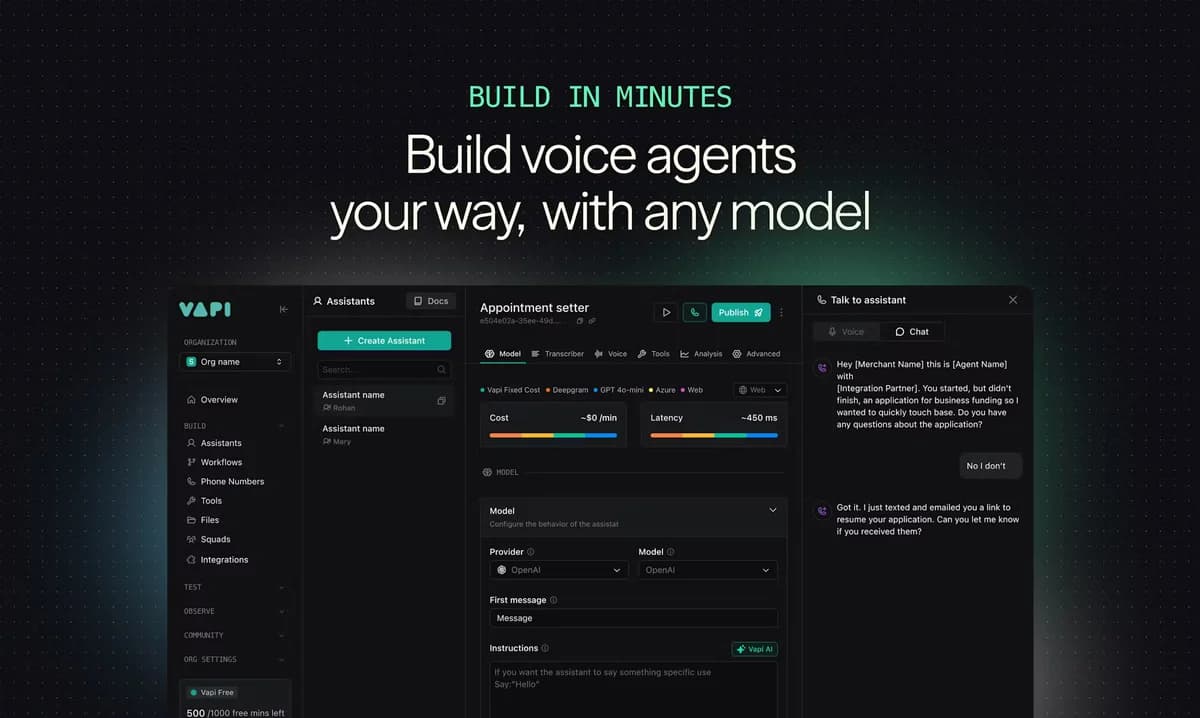
Vapi is an orchestration layer. It charges a $0.05-a-minute hosting fee, and each model provider (transcriber, LLM, voice) gets passed through "at cost" without markup. By Vapi's own estimator a realistic 1,000 minutes comes to $82-$129 a month, and that is made up of the $50 fee, about $10 of Deepgram, $8-$45 of OpenAI and $15-$24 of ElevenLabs.
The catch is that the cheap tier is small, with 4 concurrent calls and 14 days of data retention, plus one phone number. Growing past that means buying a "Success Package": Core at $29 a month for 10 calls, or Pro at 10% of your hosting fee with a $999 monthly minimum for 30 calls and a 99% uptime SLA. HIPAA sits on top as a $2,000-a-month add-on.
What reviewers praise is mostly the flexibility. The sharpest complaint I found was about that same HIPAA add-on, and it came from a team that left for Cartesia:
"They doubled the price for HIPAA compliance overnight with no warning (from $1K/month to $2K/month), and their support was terrible."
Pros
- Lowest platform fee on this list, with no markup on model costs
- Full model catalog: swap any transcriber, LLM or voice
- Free Vapi SIP and WebRTC transport
Cons
- Only 4 concurrent calls before you buy a package
- Latency depends on the providers you chain together, and reviewers report it varying
- HIPAA costs $2,000 a month on top
Pricing
| Item | Price |
|---|---|
| Hosting fee | $0.05/min |
| Models | Provider cost, no markup |
| Core package | $29/mo (10 concurrent calls, 30-day retention) |
| Pro package | 10% of hosting fee, $999/mo minimum (30 calls, 99% SLA) |
| Premier | Contact sales (99.9% SLA, SSO) |
| HIPAA | $2,000/mo |
| Extra concurrency | $10 per line per month |
| Twilio telephony | $0.008/min inbound, $0.014/min outbound |
My take: Vapi is for engineering teams that treat the voice agent as their own product. Pick it if you want to switch models the week a better one ships. Skip it if you need production concurrency and compliance on a small budget, because the packages and HIPAA add up quickly. The deciding factor is concurrency.
4. Deepgram Voice Agent API
Best for: teams that want one API for the whole voice loop at the lowest bundled price.
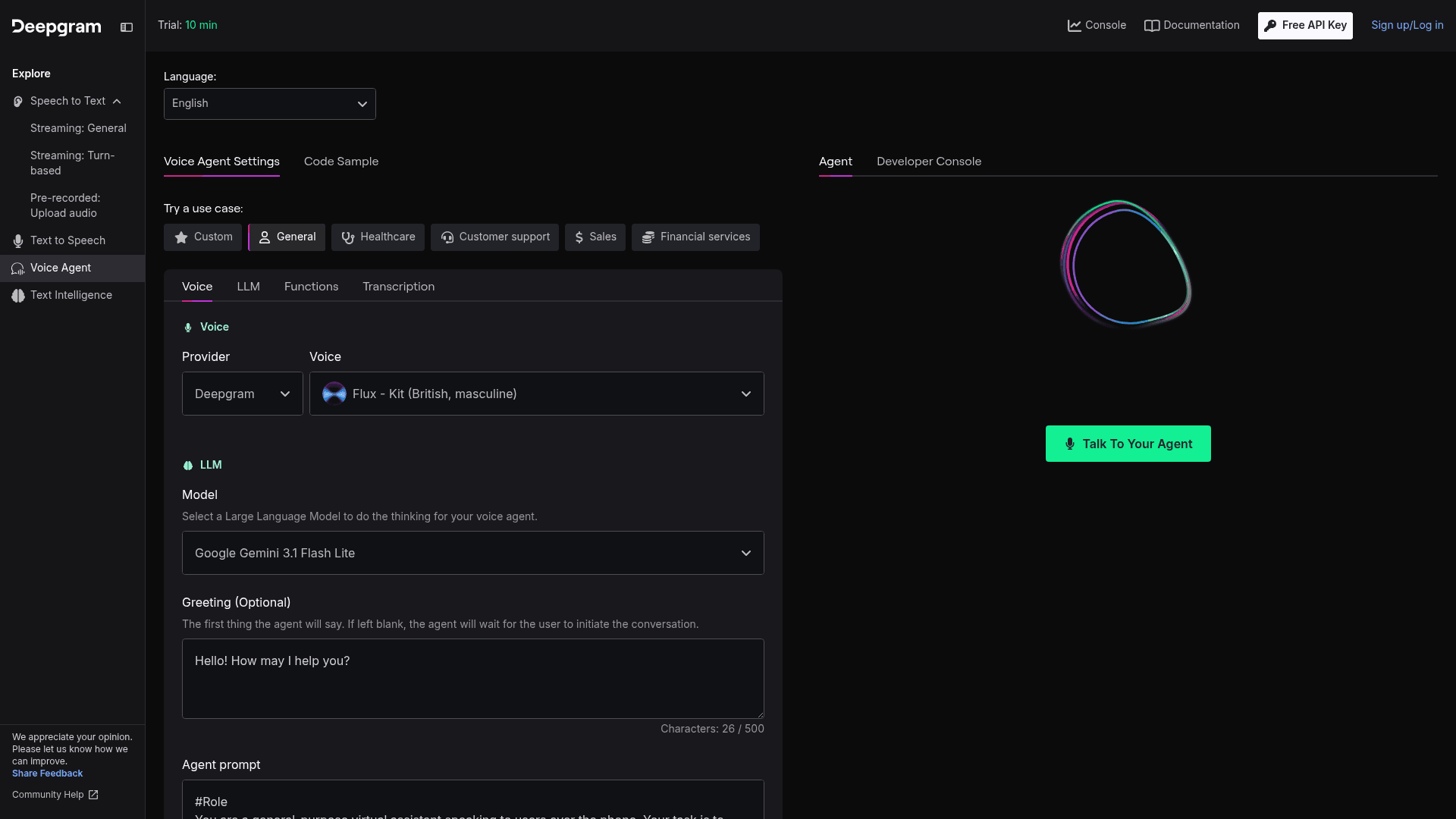
Deepgram makes the speech-to-text models that many other platforms quietly run on, and its Voice Agent API bundles the listening and thinking, and the speaking too, into one websocket. Pricing is $4.50 an hour, or $0.075 a minute, with the LLM and voice included, and if you bring your own LLM and voice it drops to $0.050.
For a no-cost test this is the most generous start on the list, since Deepgram's pricing includes $200 of credit that doesn't expire and doesn't need a card. Pay-as-you-go supports 45 concurrent agent sessions. With the playground above you can try the customer support and sales presets in the browser before you write any code.
Where it trails is in the arena. Deepgram Voice Agent ranks 18th in the Speech Agent Arena with 73.7% tool-call success, which puts it about 17 points behind ElevenLabs Agents on the same kind of calls.
Pros
- Cheapest bundled rate on the list at $0.075/min, lower with your own models
- $200 of non-expiring free credit
- SOC 2 Type 1 and 2, GDPR with an EU endpoint, and self-hosting on Enterprise
Cons
- Lower arena task success (73.7%) than ElevenLabs Agents
- It's an API, so testing, analytics and handoff are yours to build
- HIPAA BAA and self-hosting are Enterprise-only
Pricing
| Tier | Pay as you go | Growth ($4K+/yr) |
|---|---|---|
| Standard | $0.075/min | $0.068/min |
| Standard, your own TTS | $0.065/min | $0.051/min |
| Your own LLM + TTS | $0.050/min | $0.041/min |
| Advanced | $0.163/min | $0.146/min |
Billed on websocket connection time.
My take: Deepgram is the value pick for developers. Pick it if cost per minute is the constraint and you're comfortable building the rest. Skip it if what you want is a finished platform with testing and dashboards. The deciding factor is how much of the product around the API you're willing to build.
5. Bland AI
Best for: teams that want one flat per-minute rate with the model included.
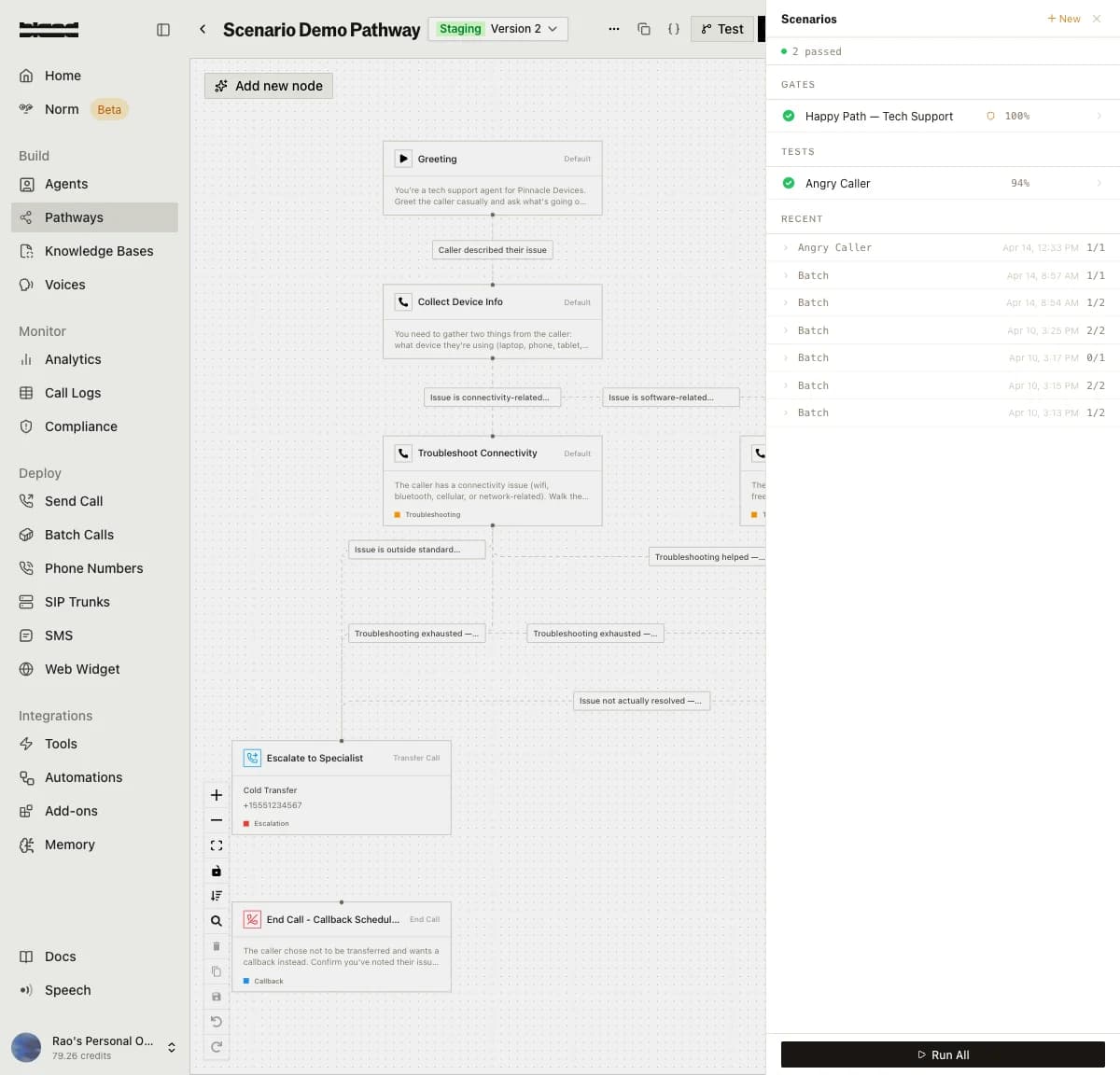
Bland AI sells simplicity: "No token charges," per its pricing page, with the LLM, transcription and voice all inside the minute. Start is $0.14 a minute and has no platform fee. Build is $0.12 a minute plus $299 a month, which only comes out ahead of Start once you pass 14,950 minutes a month. Bland also lists a 99.9% SLA on every tier, the free one included, and nobody else here does that.
Its Pathways editor builds call flows as nodes, and the docs are refreshingly open about where agents break, to the point that one of Bland's own analytics screens shows a tool error rate of 34.8%.
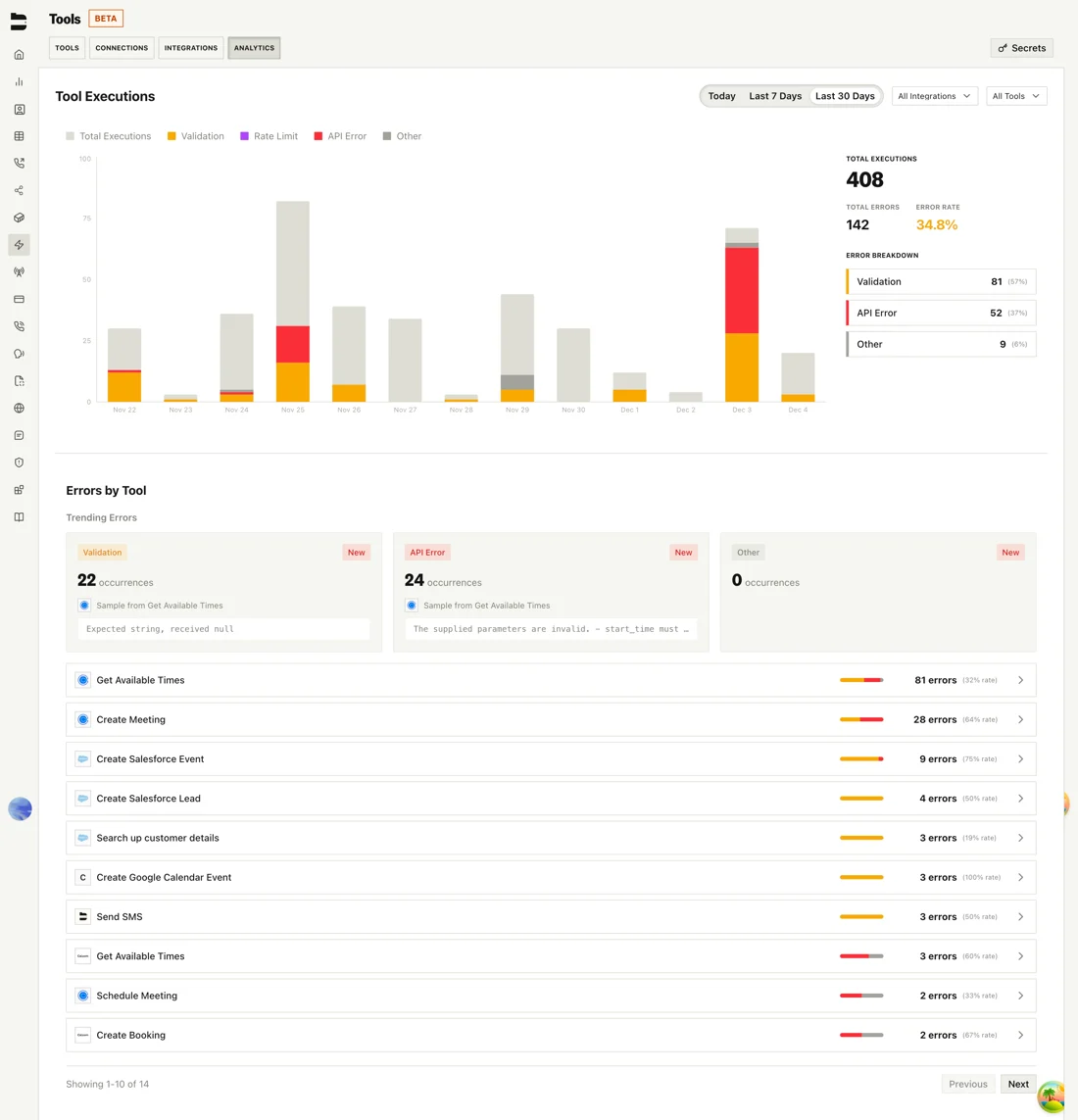
That is the honest version of what every vendor's agent does when it calls into your systems, and it's the metric I would watch in any pilot. On G2, reviewers mostly praise how fast and responsive Bland is when things break:
"There was a point where v2 voices were kind of singing on calls instead of speaking, like they were doing a little bit of voice hallucination - this too was fixed quite quickly. The team is super responsive."
Pros
- One all-in rate, no model pass-throughs to track
- 99.9% SLA on every tier
- SOC 2 Type I and II, HIPAA-eligible with a BAA, GDPR and PCI DSS listed
Cons
- No model choice; you get Bland's bundle
- Start caps at 10 concurrent calls and 100 calls a day
- BAA, SSO, data residency and on-prem are Enterprise-only
Pricing
| Plan | Per minute | Platform fee | Concurrency | Daily calls | Transfer minutes |
|---|---|---|---|---|---|
| Start | $0.14 | $0 | 10 | 100 | $0.05/min |
| Build | $0.12 | $299/mo | 50 | 2,000 | $0.04/min |
| Enterprise | Custom | Custom | Unlimited | Unlimited | Custom |
Telephony is billed separately, through your own Twilio or SIP or Bland's at pass-through cost.
My take: Pick Bland if finance wants one number per minute and you don't care which model sits underneath. Skip it if you want to keep riding the model race. The deciding factor is whether you'd rather have simplicity or swap-ability.
6. PolyAI
Best for: enterprise contact centres that want a vendor to build, run and tune the agent, without a call center automation project of their own.
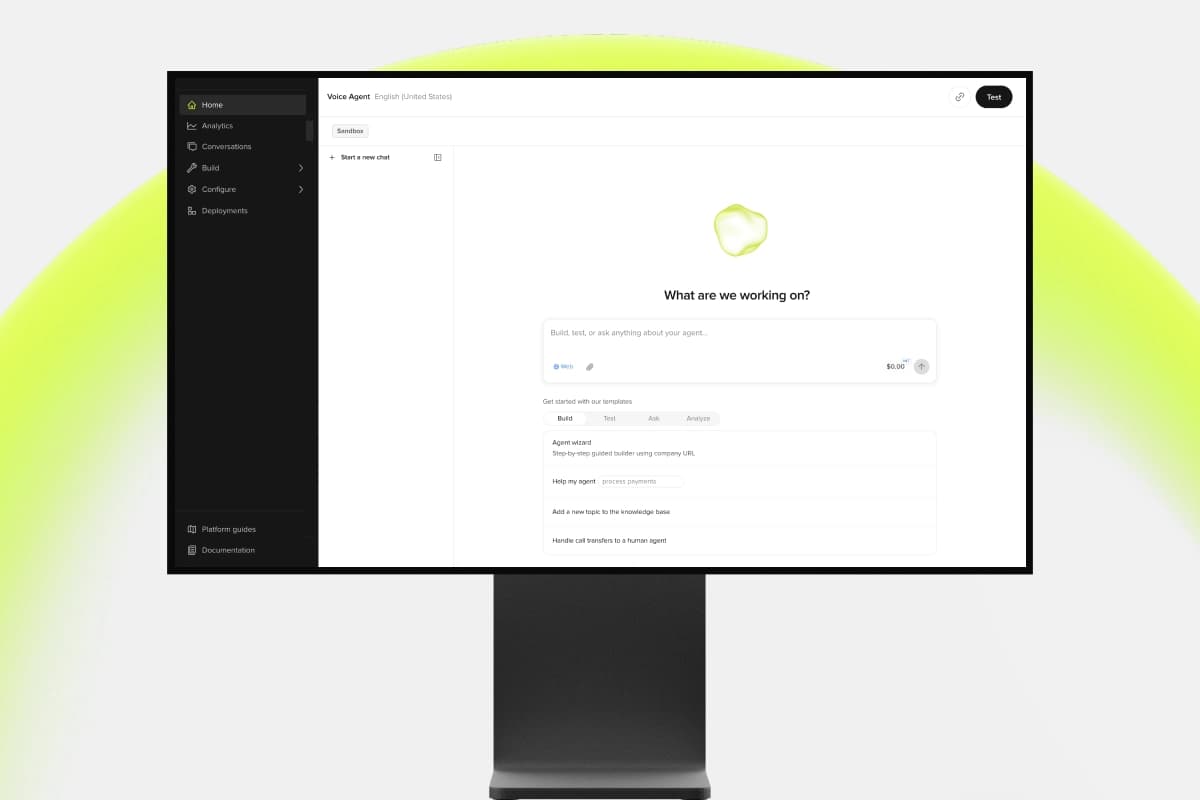
PolyAI is the most hands-off option on this list. It runs its own voice model, Raven, which it says is "trained on 1B+ enterprise conversations," and it offers two build paths on the same runtime, Agent Builder for non-technical teams and an ADK for the developers. Pricing is per minute but quote-only, and according to PolyAI's pricing page the rate covers ongoing performance improvements and maintenance, as well as support.
What you get in return is service. Every plan includes a 24/7/365 emergency support phone line and a 99.9% uptime SLA on your phone lines, and SOC 2, HIPAA, GDPR and PCI DSS are listed as standard rather than tier-gated. On the results side, PolyAI's homepage quotes a hotel and casino brand's CMO saying the agent is "on track to add just over $7M in incremental revenue," and since that is the vendor's own customer story, I'd read it as a best case.
Pros
- Fully managed, including ongoing tuning and 24/7 emergency support
- Compliance certifications included on every plan
- 99.9% SLA on phone lines
Cons
- No public price; you need a sales cycle to learn the rate
- You can't swap in a newer third-party model; you're on Raven
- Integrations and testing tools aren't documented on its public pages
Pricing
| Item | Detail |
|---|---|
| Billing | Per minute, quoted by annual call volume |
| Included | Improvements, maintenance, 24/7 support, 99.9% phone-line SLA |
| Public rate | None |
My take: Pick PolyAI if you're a large contact centre and want an outcome, not a project. Skip it if you want to see a price before any demo, or to switch models yourself. The deciding factor is whether you'd rather buy a service or build a capability.
7. Parloa
Best for: European and multilingual contact centres that want enterprise management with model choice.
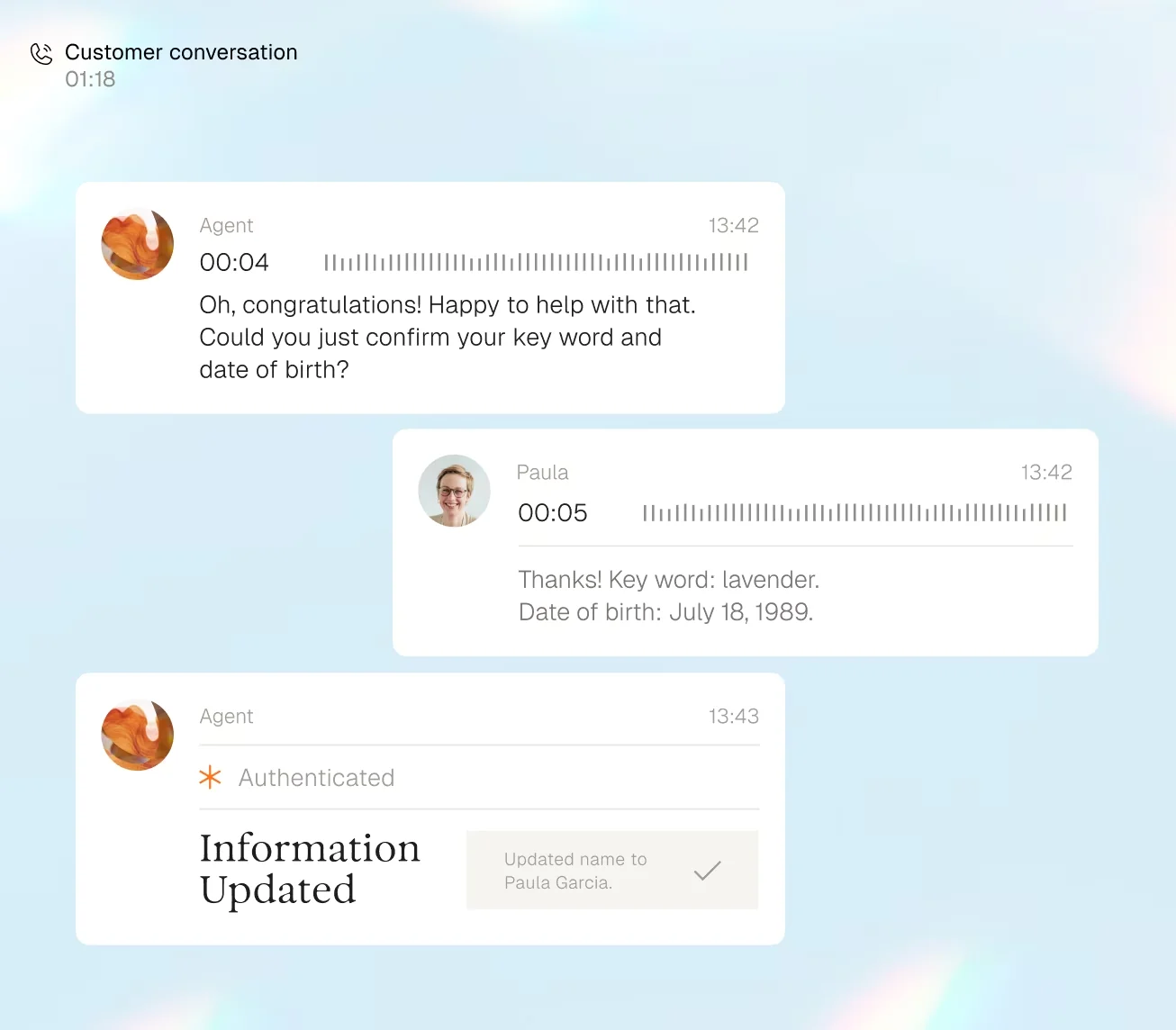
Parloa calls its product an AI Agent Management Platform, and it covers design, testing, deployment and monitoring. There are two things that set it apart from PolyAI. First, it lets you bring your own speech-to-text, text-to-speech and LLM, per Parloa's platform page, so you aren't stuck on one model. Second, testing is treated as a first-class stage, with Simulations, Evaluations and Versioning built in.
Its customer page is full of hard numbers. GESOBAU reports 66% of qualified calls resolved automatically, MEG automates 42% of customer calls, HSE answers 3 million calls a year, and AUTO1 went live in 9 countries and 7 languages in 9 weeks. These are vendor-published numbers, but they are specific, and I will take that over a vague "up to 80%" any day. The fair counterpoint comes from a G2 reviewer who otherwise likes the product:
"It's great when the conversation follows a predictable path, but once a user provides a lot of context or has an issue that doesn't fit neatly into the expected flow, it sometimes requires more human involvement."
Pros
- Bring your own STT, TTS and LLM on an enterprise platform
- Built-in simulations and evaluations before go-live
- Strong multilingual track record, with GDPR, ISO 27001 and SOC 2
Cons
- Quote-only pricing
- Heavier than a self-serve tool; this is an enterprise rollout
- Helpdesk integrations aren't listed on the pages I checked
Pricing
| Item | Detail |
|---|---|
| Billing | Quoted, contact sales |
| Public rate | None |
For cost detail, see Parloa pricing. The Parloa review and the Sierra vs Parloa comparison go deeper on fit.
My take: Pick Parloa if you run a multilingual contact centre and want to keep model choice. Skip it if you're a small team needing something live this week. The deciding factor is scale and languages.
8. Synthflow
Best for: larger teams that want a sales-led rollout tied into GoHighLevel, HubSpot or Salesforce.
Synthflow used to be the no-code option small agencies reached for, and that has changed. Synthflow's pricing page now lists a single Enterprise plan, and contracts start at $30,000 a year, scoped around call volume, concurrency, telephony and integrations. No self-serve tiers are published, and no per-minute rates either.
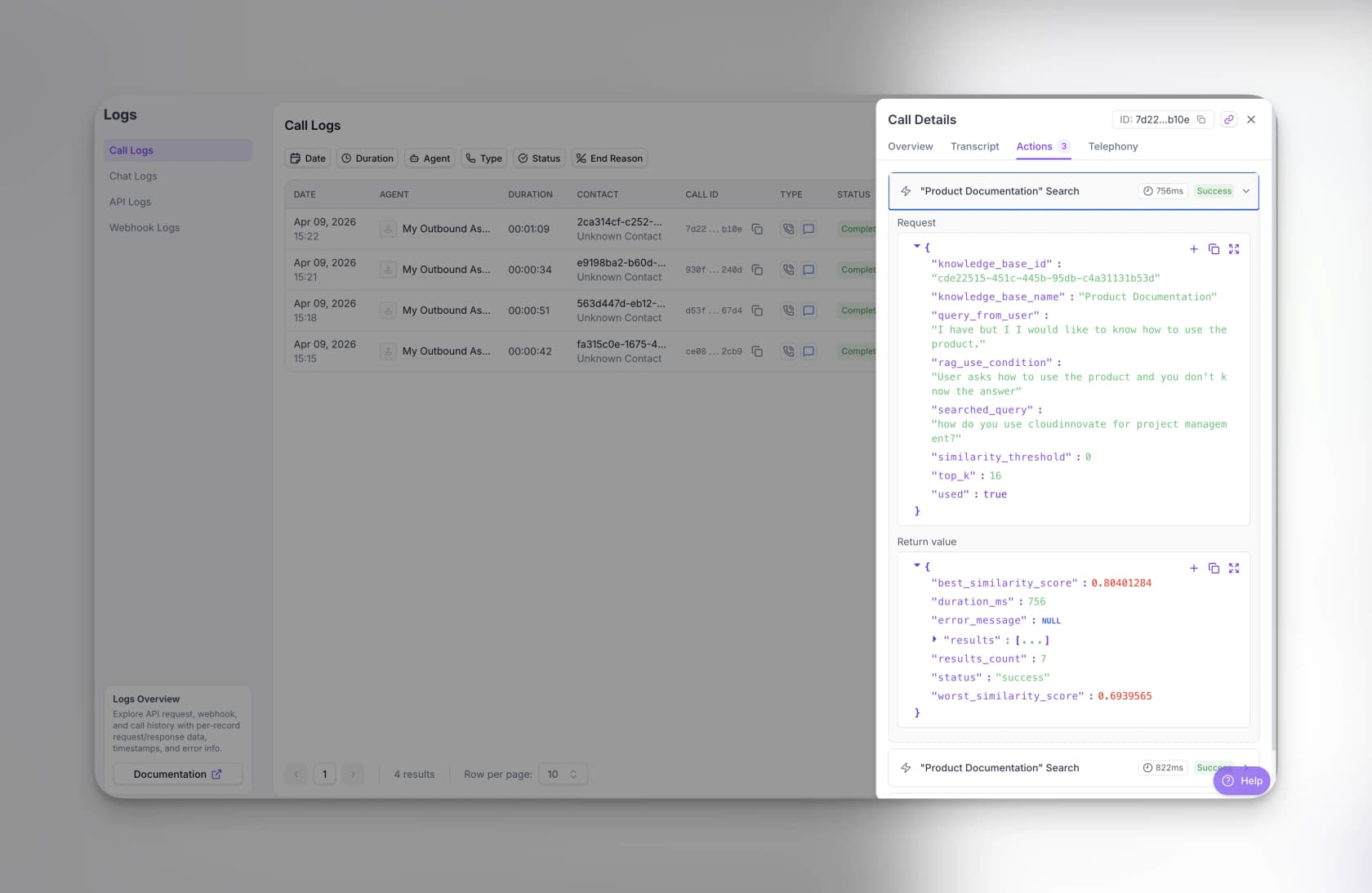
What you get in exchange is implementation support, native telephony or SIP, custom concurrency planning and MSA/DPA support. The call logs are a nice touch for debugging, since the drawer above shows the knowledge base search behind each answer, right down to the similarity score. On the pricing page there are SOC 2, GDPR, HIPAA and ISO 27001 badges plus EU and US hosting, and it names Cal.com, GoHighLevel, HubSpot, Salesforce and Zapier as integrations.
Pros
- Implementation and onboarding included
- Clear call-level debugging in the logs
- EU and US hosting options
Cons
- $30,000-a-year floor rules out small teams
- No published minutes, concurrency or uptime numbers
- No helpdesk named among its integrations
Pricing
| Item | Detail |
|---|---|
| Plan | Enterprise only |
| Minimum | $30,000/yr |
| SLA | Scoped in contract |
My take: Pick Synthflow if you're already on GoHighLevel or HubSpot and want a vendor to stand the agent up. Skip it if your voice budget is under $30,000 a year, where Retell or ElevenLabs will do the same job. The deciding factor is budget.
What your voice agent can't do: the ticket after the call
Every tool above ends up at the same place. When the agent isn't confident, or when the caller wants something it can't do, the call gets transferred or it turns into a follow-up. Even the best model on tau-Voice still leaves roughly 31% of calls unresolved, and in real queues the share is usually higher.
Those calls don't just disappear. They become tickets in Zendesk, Freshdesk or Gorgias, often with the transcript attached, and a Freshdesk AI or Gorgias AI setup handles them the same way it handles email. The second half of the work happens there, and it is text work rather than voice work. If you get it wrong, the voice agent can actually make your team slower:
"shipped a billing/tracking bot, decent containment, but AHT on escalated calls went up. agents had to read the transcript, figure out what the bot already tried, re-ask half of it anyway."
For setting up the handoff, the guide to summarizing calls into tickets and the piece on AI call center agents cover the plumbing side.
This is also the point where the confidence problem from the top of the post comes back in. A voice agent that guesses on a refund call does the same damage as a chatbot guessing in a ticket, so whatever you buy, ask to test it on your own past calls or tickets before launch, and not on scenarios the vendor wrote.
Try eesel for the tickets your voice agent hands off
eesel is an AI teammate platform, and the teammate that fits here is the AI helpdesk one. It joins your existing helpdesk queue the way a new hire would (the Zendesk integration is the most common, with Freshdesk and Gorgias also supported). From there it learns from your past tickets and help center, then drafts or sends replies to the tickets your voice agent creates. Before it answers a single customer, you can run it against hundreds of your historical tickets and see what it would have said.
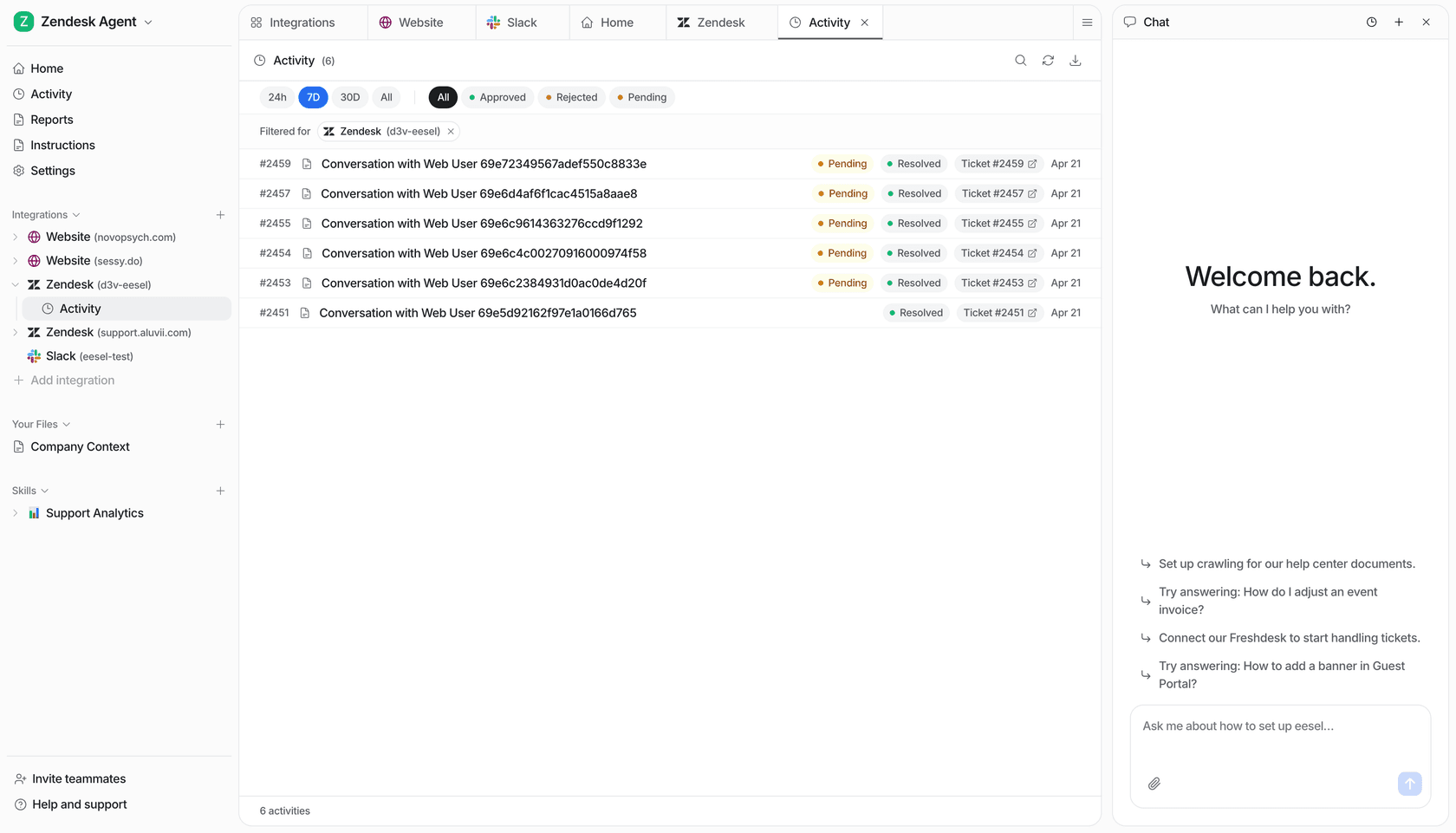
eesel doesn't answer the phone, and I would rather say that plainly. Paired with any voice agent above, it handles the half of the work that lands in your helpdesk, which is where most customer service automation pays off anyway. The free plan includes 100 credits with no card needed, so you can try eesel on your own queue today.
Frequently Asked Questions
What are the best AI voice agents in 2026?
How much does an AI voice agent cost per minute?
Which AI voice agent has the best benchmark score?
Can an AI voice agent replace my phone support team?
Do AI voice agents integrate with Zendesk or Freshdesk?
Which AI voice agents are HIPAA compliant?
Is there a free AI voice agent?
What's the difference between a voice agent platform and a voice model?


Article by
Rama Adi Nugraha
Rama is a software engineer at eesel AI with two years of experience writing about B2B SaaS, AI tools, and customer support technology. Based in Bali, Indonesia, he brings a developer's perspective to product comparisons — cutting through marketing copy to what the integrations and APIs actually do.