
The full Grok Voice rate card, as published today
Here is everything on the Voice API section of xAI's rate card, plus the telephony line that lives on the Voice Agent Builder announcement instead. I have included the standalone transcription and synthesis rates too, because plenty of teams still run a stitched pipeline and want to compare the two shapes.
| Line item | Rate |
|---|---|
Speech to speech, grok-voice-think-fast-2.0 | $0.08 / min ($4.80 / hr) |
Speech to speech, grok-voice-think-fast-1.0 | $0.05 / min ($3.00 / hr) |
Text input, per conversation.item.create | $0.004 / message |
| Provisioned phone number (telephony) | +$0.01 / min |
| Speech to text, REST | $0.10 / hr |
| Speech to text, streaming | $0.20 / hr |
| Text to speech | $15.00 / 1M characters |
web_search or x_search | $5 / 1k calls |
collections_search / file_search | $2.50 / 1k calls |
attachment_search | $10 / 1k calls |
code_execution | $5 / 1k calls |
| Collection storage | $0.10 / GiB / day |
Two things about that table are worth saying out loud, because they are the parts people get wrong when they budget.
The audio meter is described on the model card as billing per minute of audio "sent or received," which reads like it could double-count a two-way conversation. It does not appear to. Artificial Analysis measured cost per hour of input audio at exactly $4.80 for this model, which is $0.08 times sixty, so in their run the meter behaved like a single session-duration count rather than summing both directions. I would still watch the first invoice rather than take my word for it.
The text-input meter is narrower than it looks too. xAI bills $0.004 per conversation.item.create event you send, but function_call_output items are not billed and response.create is not a billable event at all. So a chatty tool-using agent does not rack up text-input charges for every tool result it hands back, which is the assumption I started with and got wrong.
The August 5 flip, in dollars
This is the whole reason this post exists today rather than last week.
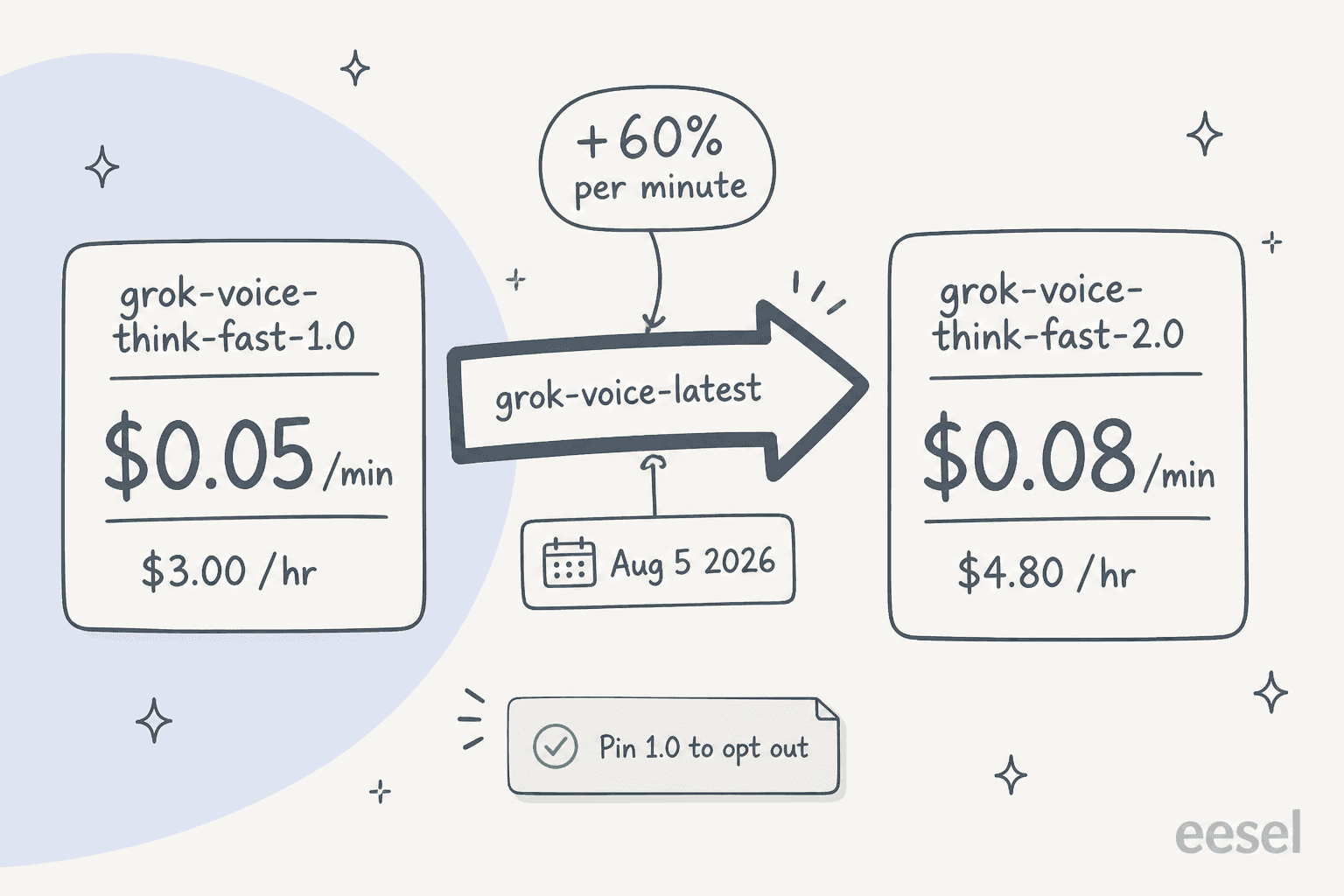
xAI's own launch note is direct about it: on August 5, 2026, grok-voice-latest moves from grok-voice-think-fast-1.0 to grok-voice-think-fast-2.0, no action needed to upgrade, and to stay on the old model you pin grok-voice-think-fast-1.0 before then. What the note does not do is put a percentage next to it, and the percentage is 60% per minute.
The docs are currently mid-flip, which I found quietly funny. The model table on the speech-to-speech guide still describes the alias as pointing at 1.0 and updating on August 5, while a paragraph further down the same page already says it "always points to the newest model (currently grok-voice-think-fast-2.0)." Both were true on different days. Neither tells you what it does to your invoice.
Sitting right beside all of it, in the same launch post, is the sentence xAI opens its pricing section with: "We believe pricing should be predictable and transparent." I actually think that is defensible here. They left 1.0 published at its old rate, gave a dated notice, and documented the opt-out. That is more warning than most model repricings get. It is just not the same thing as your bill being predictable, because the default path moved and the default is where most production traffic lives.
What the sticker price leaves out
Every voice rate card in this category has the same tell: the headline number is the one thing on the invoice that is not a surprise. Here is a single six-minute support call, costed line by line.
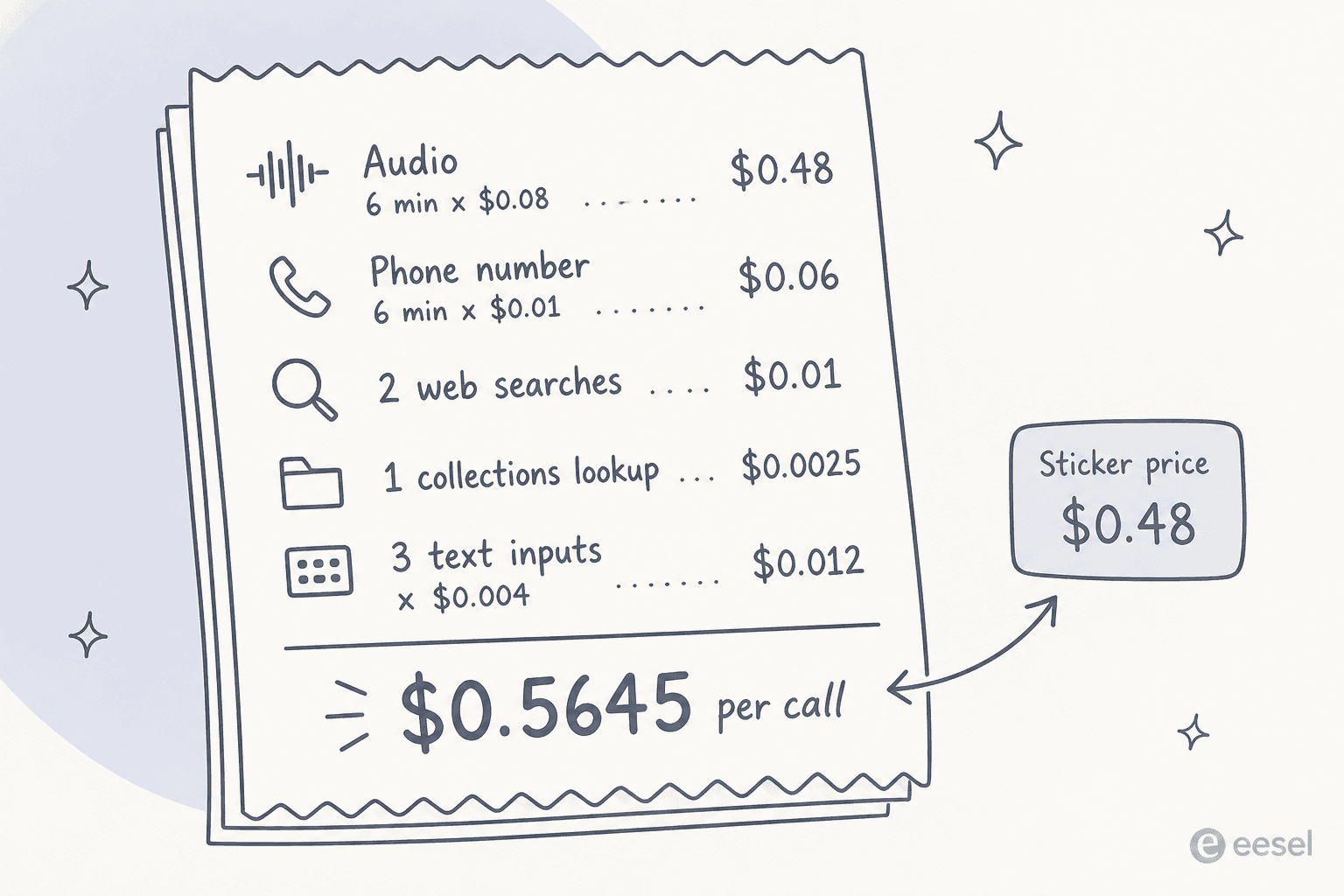
- Audio: 6 min x $0.08 = $0.48
- Provisioned phone number: 6 min x $0.01 = $0.06
- Two web searches: 2 x $0.005 = $0.01
- One collections lookup: 1 x $0.0025 = $0.0025
- Three text inputs: 3 x $0.004 = $0.012
That is $0.5645 against a $0.48 sticker, about 18% over. Not catastrophic, and honestly one of the better ratios in this category, because xAI's tool rates are cheap and its voice rate is flat. But it scales linearly, and 18% on a $3,200 monthly voice line is $576 nobody put in the forecast.
The line I would model hardest is web_search. At $5 per 1,000 calls it looks like rounding, and then you remember an agentic model decides for itself how many tools to call. xAI says so plainly on the pricing page: costs scale with query complexity because the agent chooses. Reasoning effort defaults to "high" on this model, and while reasoning tokens are not separately metered on the voice meter, a model thinking harder is a model reaching for more tools.
What the extra three cents actually buys
I would not pay 60% more for a rounder benchmark, so here is the honest read on what moves.
| Measure | Think Fast 2.0 | Think Fast 1.0 | Change |
|---|---|---|---|
| Cost per hour of input audio | $4.80 | $3.00 | +60% |
| Speech-to-speech index | 82.9% | 75.7% | +7.2 pts |
| Agentic performance (τ-voice) | 56.5% | 52.1% | +4.4 pts |
| Conversational dynamics | 95.1% | 77.8% | +17.3 pts |
| Speech reasoning | 97.2% | 97.1% | flat |
| Time to first audio | 0.70s | 1.25s | 44% faster |
Read that column of changes as a shape, not a score. Speech reasoning did not move, so if your agent's job is to understand a sentence and read back an answer, you are paying 60% more for nothing you will notice. What moved is conversational dynamics, up 17.3 points, which is interruption handling, barge-in, knowing when the caller has finished, and latency, down to 0.70 seconds. Those are the two things that make a phone call feel like a phone call rather than a kiosk.
Agentic performance moved 4.4 points, to 56.5%. That is the highest published number in the Artificial Analysis speech-to-speech table and it is still a 43.5% failure rate on hard agentic scenarios, which is the figure I would put in front of anyone budgeting for full automation. It is also the reason the resolution rate you plan around should come from your own traffic, not a leaderboard.
Two developers on Hacker News landed on the same read from opposite directions. One rated the model on feel:
"Grok voice is the best voice AI voice assistant and it's not even close. The speed + intelligence tradeoff is just right."

And on the Think Fast 2.0 thread itself, the top comment framed it against the incumbent specialist:
"Don't know why this post isn't more popular, this is a SOTA voice model, beating dedicated labs like ElevenLabs"
Which is a good bridge, because beating ElevenLabs on quality is a different question from beating it on price, and as of today those two answers diverge.
Grok Voice pricing against the rest of the field
Artificial Analysis publishes measured cost per hour of input audio for the whole speech-to-speech category, which is the only apples-to-apples column available when half the vendors bill per token and half bill per minute.
| Model | S2S index | Measured $/hr | Time to first audio |
|---|---|---|---|
| Qwen Audio 3.0 Realtime Plus | 84.1% | $4.42 | 4.02s |
| Grok Voice Think Fast 2.0 | 82.9% | $4.80 | 0.70s |
| GPT-Realtime-2.1 High | 79.1% | $10.75 | 1.21s |
| GPT-Realtime-2 High | 77.2% | $4.14 | 1.14s |
| Qwen Audio 3.0 Realtime Flash | 76.3% | $4.77 | 4.16s |
| Grok Voice Think Fast 1.0 | 75.7% | $3.00 | 1.25s |
| GPT-Realtime-2.1 Minimal | 72.5% | $11.31 | 0.97s |
| Gemini 3.1 Flash High | 69.5% | $1.75 | 2.99s |
| Deepslate Opal | 62.8% | $6.48 | 0.44s |
Four things in that table are worth more than the ranking.
Grok is not the cheapest good model, and it is not the best model either. Alibaba's Qwen Audio 3.0 Realtime Plus scores higher at 84.1% and measures cheaper at $4.42/hr. Its problem is the last column: 4.02 seconds to first audio, against 0.70. On a phone line that is dead air a caller will talk over. Grok's actual claim is the combination of index and latency, and on that combination it has no peer in the table.
The flat rate is the underrated feature. Grok's measured $4.80 is identical to its list price, because the list price is flat per minute. OpenAI's GPT-Realtime-2 lists $1.15 per hour of audio input and $4.61 per hour of output, and measures $4.14 all-in, so the input rate you would quote a CFO is about 28% of what you actually pay. That gap is not a trick, it is just what per-token audio billing does, and it is why GPT-Realtime budgets tend to be estimates rather than numbers.
Turning reasoning down does not reliably save money. GPT-Realtime-2.1 Minimal measures $11.31/hr, more than the High variant's $10.75, while scoring 6.6 points lower. If you assumed a lower effort dial was a cost lever on voice, that row is the counterexample.
Latency has its own price floor. Deepslate Opal is the fastest thing measured at 0.44s and costs $6.48/hr while scoring 62.8%. Fast is purchasable on its own; fast and smart is what the Grok rate is for.
Worth noting what this table does not contain: the platform layer. Orchestration vendors like Retell AI charge a platform fee on top of whichever model they route to, so their per-minute figure and the numbers above are not the same kind of number.
Vapi and Hume price the same way. I have costed both in the AI voice companies roundup, and the pattern holds: a model rate and a platform rate are different products wearing the same units.
The ElevenLabs comparison deserves its own paragraph because it is the one that flipped today. Its agent plans are prepaid minute allotments: $6 for 75 minutes, $22 for 275, $99 for 1,238, $299 for 3,738, $990 for 12,375. Divide any of them and you land on almost exactly $0.08 per included minute across every paid tier, which is Grok's new rate to the cent. Until this morning Grok undercut that by 37.5%. What is left is a difference in billing shape rather than price: ElevenLabs minutes are prepaid and expire, Grok's are pay-as-you-go, so a line with spiky or seasonal volume still comes out ahead on Grok, and a line running flat out all month is now a coin flip. On Cartesia Sonic 3 and the rest of the specialist field, the same shape question applies.
The limits that cost more than the rate card
I care about these more than the per-minute number, because a rate you can forecast is easier to live with than a ceiling you hit at 4pm on Black Friday.
Ten concurrent sessions per team. That is the published default on the model card, with higher limits on request. Ten simultaneous calls is a small inbound queue. If you are sizing a real phone line, the concurrency request goes in before the credit card does, not after.
120-minute maximum session. Fine for support, worth knowing if you had ideas about long-running assistants.
No batch discount and no priority tier on voice. xAI's 20% batch discount applies to specific text models only, and Priority Processing at 2x is limited to Chat Completions and Responses. Voice has neither a discount lane nor a paid fast lane, which is consistent with a flat real-time meter but removes two levers you might have on the text side.
Storage bills separately if your agent does retrieval. Collections are $0.10 per GiB per day, files $0.025, downloads $0.20 per GiB. Small on a small knowledge base, and worth a line in the model if you are syncing a whole help center for multilingual support.
There is a $0.05 fee for blocked requests. If a Responses API request is caught violating usage guidelines before generation, xAI charges $0.05. Not a voice-specific line, but it is the kind of thing that shows up as an unexplained rounding error on a big invoice.
One region. Speech to speech runs in us-east-1 only, which is a latency and data-residency fact rather than a price, though it becomes a price the moment a procurement review asks about it.
Where the pricing question actually lands
Here is the decision I would make with all of this on the table.
If you run an inbound phone line where callers interrupt, change their mind, and expect the agent to actually do something, the $0.08 rate is fair and the alias flip is a raise worth taking. Conversational dynamics up 17.3 points and 0.70-second latency are the two things callers feel, and no other model in the table pairs them with an 82.9% index.
If your voice agent reads out order statuses, pin grok-voice-think-fast-1.0 today and keep the $0.05 rate. Speech reasoning was already 97.1% on 1.0. You are not leaving quality on the table for the workload you actually have, and at 10,000 minutes a month pinning is worth $300.
If you have not built the line yet, the number to model is not per-minute at all. It is cost per resolved issue, and that means knowing what fraction of calls end without a human. That is the same arithmetic behind any call center ROI case, and it is worth putting next to the AI versus human agent cost baseline before you sign anything.
One softer number belongs in that model too. A faster, less interruptible agent moves CSAT, and CSAT is what stops a cheap automated line from quietly costing you customers. It is the hardest line to forecast and the easiest to notice once it slips.
The voice bill is the small half of the problem
I build eesel's SEO and I read the sales notes, and the pricing conversations that go wrong almost never go wrong over a per-minute rate. They go wrong over the unit.
I have heard it from both ends of the volume curve. An ops lead at a payouts and money-transfer fintech on Zendesk, running 7,000 to 8,000 escalated tickets a month, told me per-interaction pricing was a non-starter next to session-based billing, because at roughly four exchanges per ticket the meter counts the conversation four times. A multi-company e-commerce operator scaling toward 150,000 tickets a month projected around $30,000 a month at 20 cents a ticket and spent most of a call trying to work out whether the unit was an interaction or a ticket. Neither of those was an argument about whether the rate was too high. Both were arguments about what the rate was counting.
That is the lens I would take to Grok's rate card, and it comes out looking good on it. A flat per-minute audio meter is the most legible unit in this category. It is also, structurally, a unit that bills you for time rather than outcomes, which is exactly the right unit for a phone call and exactly the wrong one for a ticket queue.
Costing a Grok Voice line? The other half of that spreadsheet is the email and chat volume that never rings the phone, and it does not price per minute. eesel is an AI helpdesk agent that bills per ticket actually resolved, connects to Freshdesk or Gorgias in a few minutes, and trains on your past tickets rather than a website crawl.
The part that matters for a forecast: it runs a deflection simulation against your real ticket history before it answers a live customer, so the resolution rate you put in the spreadsheet is one you measured on your own queue instead of one you borrowed from a leaderboard. Try eesel free, or see the pricing first, since that is apparently the page that decides everything.
What I would do before the invoice arrives
Three concrete moves, in the order I would make them.
- Grep for
grok-voice-latest. If it is in production code, you are on the new rate as of today. Decide whether that is what you want, then pin a version either way, because xAI's own docs recommend pinning for production and this is exactly why. - Re-forecast with tool calls in the model. Take last month's minutes, add 15% to 20% for tool invocations and telephony, and check the number against the calculator above. The audio line is never the whole line.
- Ask for the concurrency raise before you need it. Ten concurrent sessions is the default, not the ceiling. Raising it is a request, and requests take longer than traffic spikes do.
None of that is a reason to avoid the model. Think Fast 2.0 is the strongest agentic voice model with published numbers, and at $4.80 an hour measured it is less than half what OpenAI's best realtime tier costs. It is only a reason to know which of your model strings is a moving target, and what your bill does when it moves. The same discipline applies to escalation handling and to preventing wrong answers: the default is rarely the setting you would have picked on purpose.
For the rest of this cluster, the Think Fast 2.0 overview covers what changed in the model itself. The Voice Agent Builder pricing post covers the no-code platform sitting on top of it, and there is a hands-on Builder review if you want the workflow rather than the rate card.
Still deciding whether voice is the right channel at all? Start with can AI answer support calls, then the wider AI phone calls explainer.
If your callers already reach you through a helpdesk phone product like Zendesk Talk, the build-versus-buy question comes before the per-minute one. My support automation roundup is the shortcut through it.
Frequently Asked Questions
How much does Grok Voice Think Fast 2.0 cost per minute?
Why did Grok Voice pricing go up 60%?
grok-voice-latest moved from 1.0 to 2.0 on August 5, 2026, so anyone on the alias picked up the higher rate with no deploy. Pinning the version is the fix, and it is the same version-pinning discipline that preventing bad AI answers depends on.Is Grok Voice Think Fast 2.0 cheaper than OpenAI's Realtime API?
Is there a free tier for Grok Voice Think Fast 2.0?
What does a real Grok Voice support call actually bill?
web_search or x_search calls, $2.50 per 1,000 collections lookups, $10 per 1,000 attachment searches. Model the tool calls, not just the minutes, the same way you would when costing call center automation.How does Grok Voice pricing compare to ElevenLabs Agents?
What are the rate limits on the Grok Voice API?
Is Grok Voice Think Fast 2.0 worth the extra 3 cents a minute?


Article by
Kurnia Kharisma Agung Samiadjie
Kurnia is a software engineer and writer at eesel AI with two years of SEO experience, writing about AI tools, helpdesk software, and customer support. He pairs a developer's understanding of how these products are built with search-driven research into what actually ranks and resonates with the people searching for them.