


Why "$0.08 a minute" is the wrong number to budget with
I write and do SEO at eesel, so a big part of my job is the gap between what people type and what they actually mean by it. Nobody who search "Grok Voice 3.0 pricing" wants the rate card alone, that one is a single line. What they want to know is what the phone line will cost per call and per month once it is live, which is a different number, and it's the one this post is about. It's also the number every rate card leaves out, the xAI pricing page included.
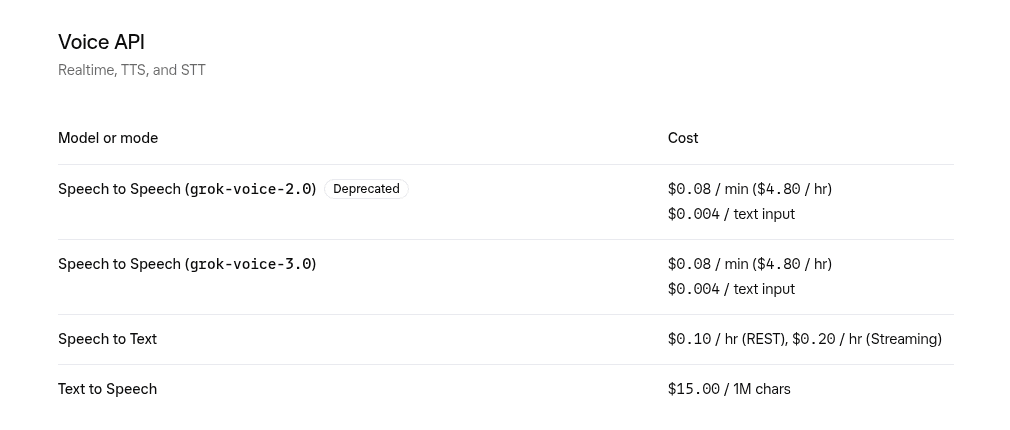
The rate card itself is short. Straight from the xAI pricing page, last updated October 10, 2026:
| Line item | Price | Billing unit |
|---|---|---|
Speech to speech, grok-voice-3.0 | $0.08 / min ($4.80 / hr) | Per minute of conversation |
| Text input into a voice session | $0.004 | Per text input |
file_search / collections_search tool | $2.50 | Per 1,000 calls |
web_search tool | $5 | Per 1,000 calls |
x_search tool | $5 / 1k posts, $10 / 1k profiles | Per item fetched |
| Remote MCP tools | No invocation fee | Token-based |
| Collection storage (your uploaded docs) | $0.10 | Per GiB per day |
| Speech to text (separate API) | $0.10 / hr REST, $0.20 / hr streaming | Per hour of audio |
| Text to speech (separate API) | $15.00 | Per 1M characters |
There is two things I would underline in this table. First, the minute rate is the same whatever the model does inside the minute. xAI lists a single rate for grok-voice-3.0, there is no cheaper line for reasoning.effort set to none and no surcharge for a long think. Second, the price did not move with the upgrade. The Grok Voice 3.0 launch post says it plainly: same price as 2.0, and anyone on the grok-voice-latest alias got switched over automatically. When I covered Grok Voice 2.0 pricing in August, the story was a 60% jump from 1.0. This time the story is the opposite, you get the better model for the same money.
What the table doesn't have is a phone line, and that is where the real bill starts.
What one support call actually costs
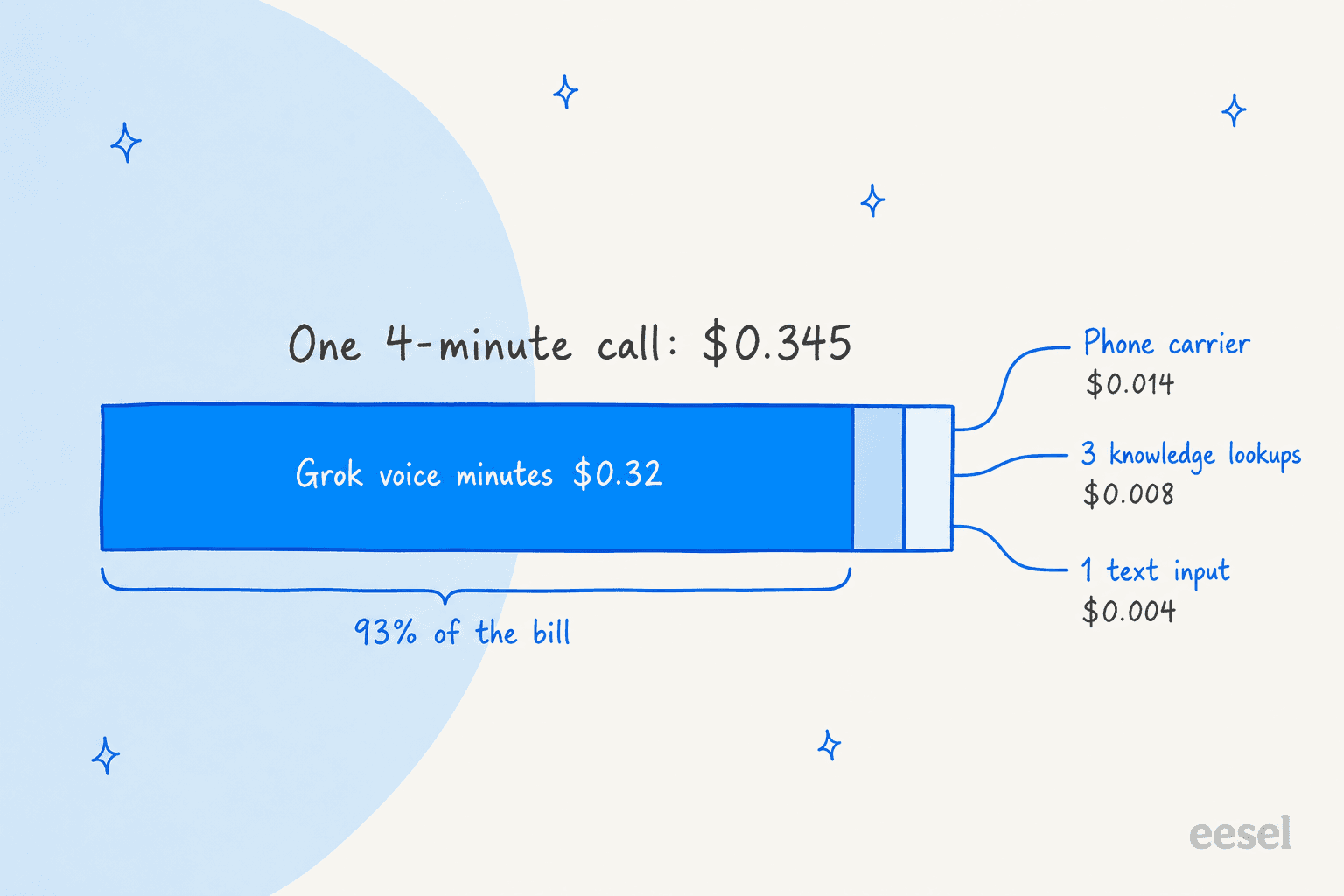
Let me build one call from the ground up. The shape I'm using is a common one on support lines: four minutes of talk, the agent searches your help docs three times, and your app injects one text message (say, the caller's order history) at the start.
| Piece of the call | Rate | Cost for one call |
|---|---|---|
| Grok talk time, 4 min | $0.08 / min | $0.3200 |
| Twilio inbound SIP, local number, 4 min | $0.0034 / min | $0.0136 |
3 x file_search | $2.50 / 1,000 | $0.0075 |
| 1 x text input | $0.004 each | $0.0040 |
| Total | $0.3451 |
That's $0.086 per talk minute, or about 8% above the sticker.
The Grok minutes are 93% of the call. Everything people call a "hidden fee" sits in the last 7%. It doesn't mean the add-ons are free. It means they're not the place where a budget goes wrong, but I'll go through each one anyway since a couple of them has a catch.
The carrier: you bring your own
Grok Voice 3.0 takes phone calls over SIP, and the SIP guide is clear that you register a number you already own with origin: "byo_trunk". Provisioning SpaceXSI phone numbers through the API isn't supported, so a carrier account is a requirement, not an option. The guide has setup steps for Twilio and Telnyx and works with any SIP provider.
The carrier bills you directly on its own invoice. Here's what the two carriers named in the docs are charging for US calls, from their own pricing pages:
| Carrier | Inbound, local | Inbound, toll-free | Outbound, US | Number rental |
|---|---|---|---|---|
| Twilio Elastic SIP Trunking | $0.0034 / min | $0.0130 / min | $0.0100 / min (48 states) | $1.15 / mo local, $2.15 / mo toll-free |
| Telnyx SIP Trunking | from $0.0032 / min | from $0.015 / min | from $0.005 / min | Billed separately |
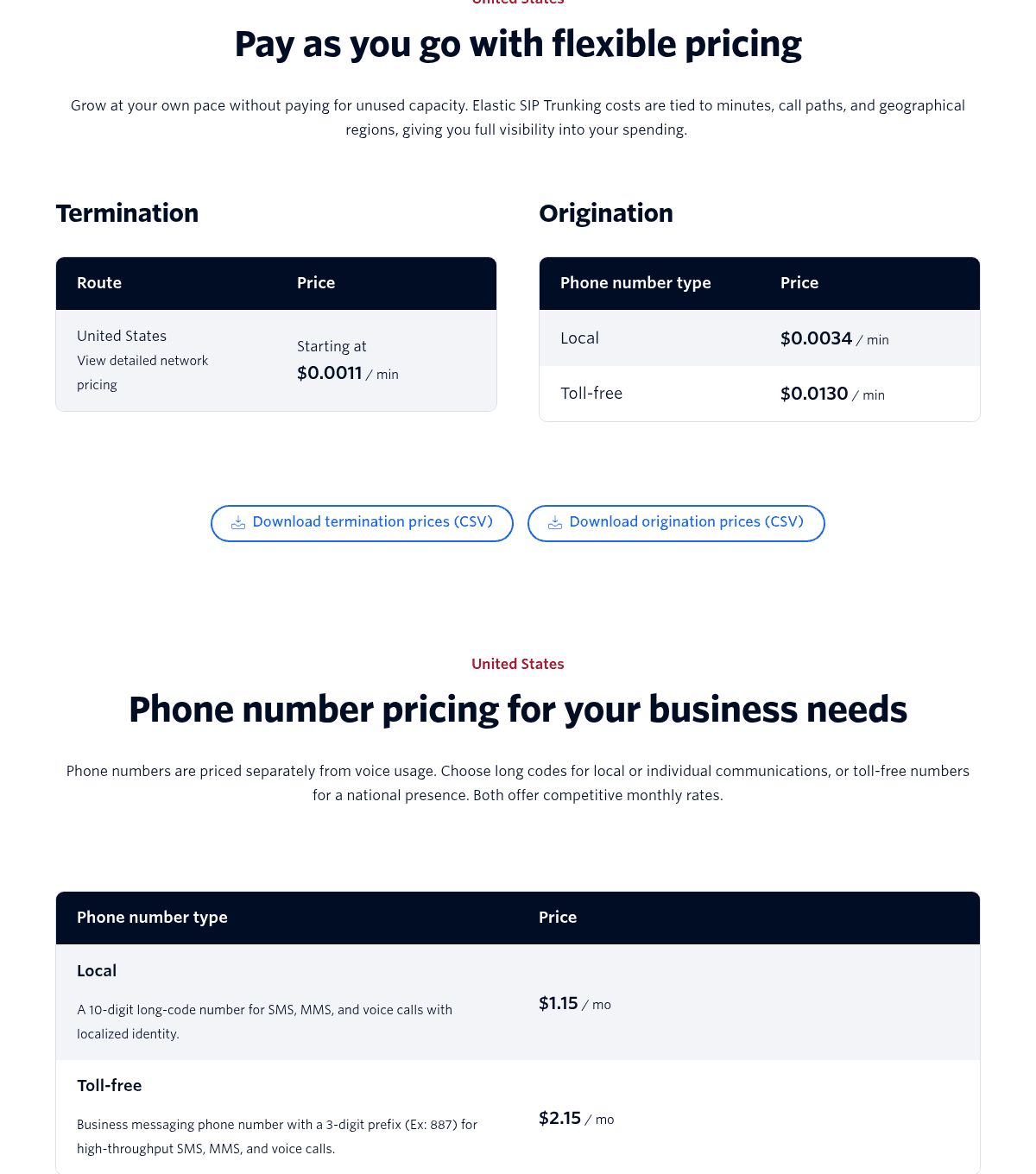
The choice that matters here is local versus toll-free, not Twilio versus Telnyx. A toll-free number on Twilio SIP costs almost 4x more per inbound minute than a local one, which moves the 4-minute call from $0.345 to about $0.384. For most support lines that's still small, but if you run a big toll-free 800 line, it's the one carrier detail worth to model properly. Twilio also charges $0.0025 a minute for call recording if you switch it on, and emergency calling is a per-number monthly fee on both ($0.75 on Twilio, $1.5 on Telnyx). If your team already runs on Twilio's contact center, my Twilio Flex pricing post covers the seat side of that bill.
One more thing for a contact-center buyer. If callers reach you through a web widget or your own app instead of a phone number, then there is no carrier at all, Grok also takes WebSocket and WebRTC sessions. The wire format is compatible with the OpenAI Realtime API, so my Realtime API vs WebRTC explainer applies to that choice too.
The tools: cheap per call, priced per thousand
Tools are how a voice agent stops only talking and starts doing something, and anyone who built on realtime tool calls knows they're the heart of a support agent. xAI bills its server-side tools per invocation:
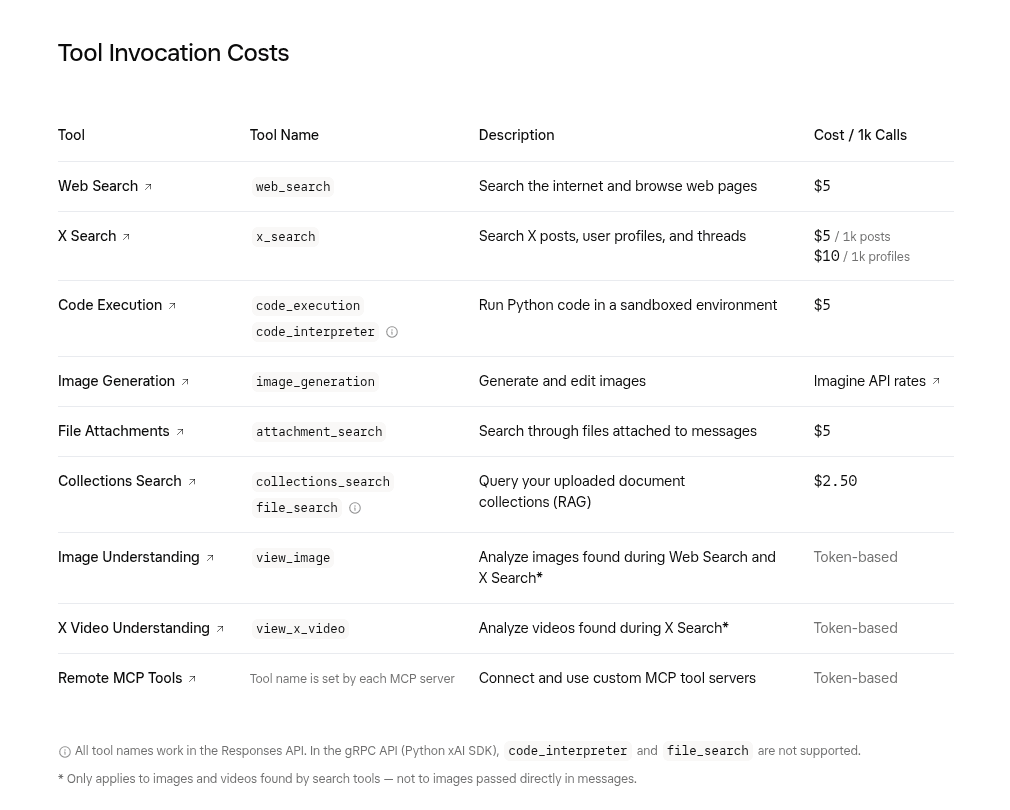
Couple of things fell out of this table for me. file_search at $2.50 per 1,000 is half the price of web_search, so an agent that answers from your own uploaded docs is cheaper per lookup than one that browses your public site. For remote MCP tools, xAI says you aren't charged for the invocation, only for any tokens used. Your own function tools have no xAI fee at all, the cost of those lives on your own servers.
The one storage cost to keep an eye on is the collections, at $0.10 per GiB per day. A help center is rarely a gigabyte of text, so for most of teams this is cents a month, but it is a daily meter and it runs whether the phone rings or not.
Text inputs: four tenths of a cent each
Every text message your app pushes into a live session costs $0.004. That's the price of injecting context mid-call: the caller's account status, a CRM lookup result, a "this customer is VIP" flag. One per call is nothing. A pattern where your app streams a text update every few seconds is where this line start to show up, so I'd batch the context into one message at the start of call.
What it costs per month at support volumes
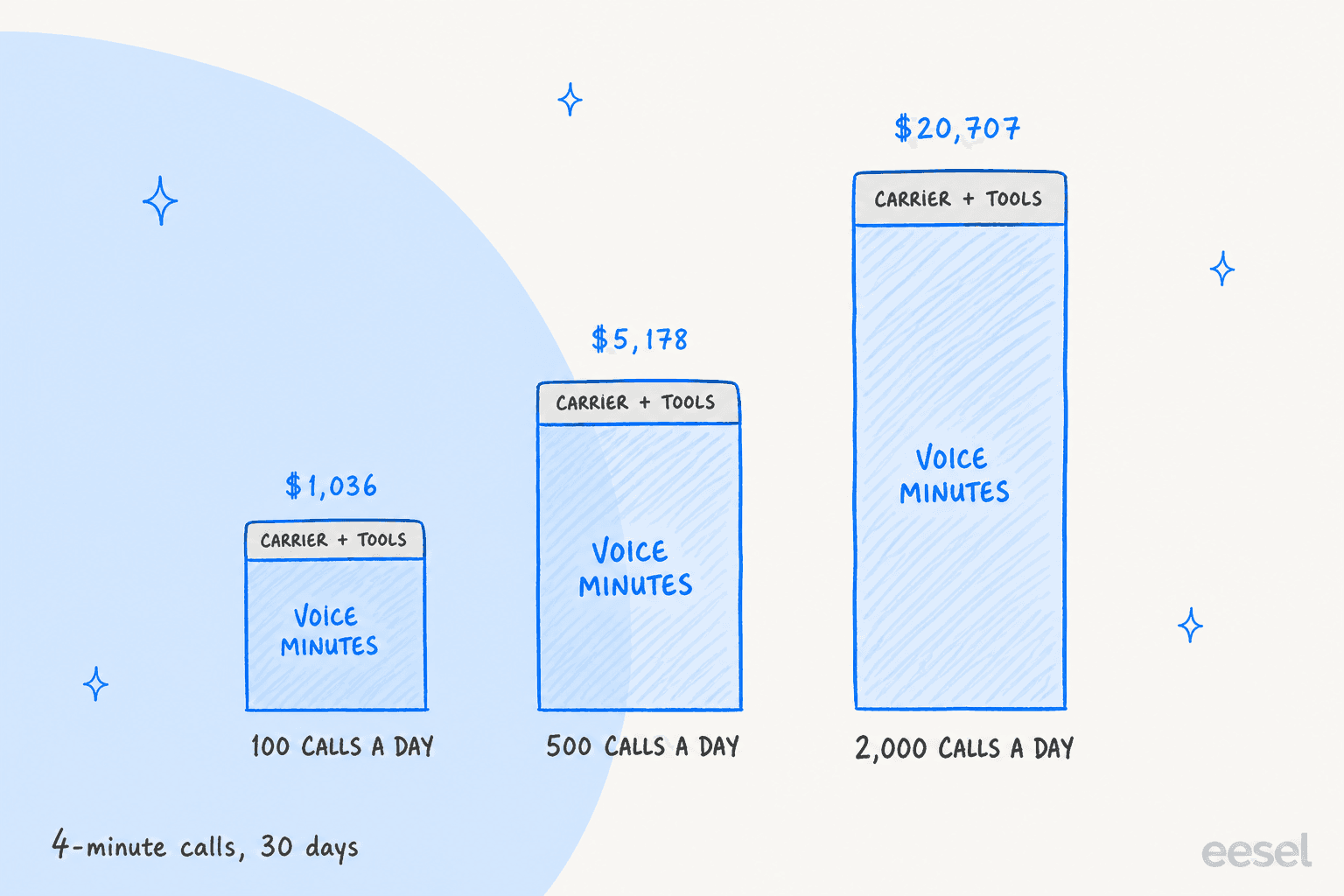
Scale the same call shape (4 minutes, Twilio local, three lookups, one text input, 30 days) to three common team sizes:
| Calls per day | Minutes per month | Grok minutes | Carrier | Tools + text | Number | Monthly total |
|---|---|---|---|---|---|---|
| 100 | 12,000 | $960 | $40.80 | $34.50 | $1.15 | $1,036 |
| 500 | 60,000 | $4,800 | $204 | $172.50 | $1.15 | $5,178 |
| 2,000 | 240,000 | $19,200 | $816 | $690 | $1.15 | $20,707 |
That's the clean version. The messy version has dead air in it, and in my opinion this is the line which most budgets miss. A support call don't end the moment the problem is solved. There's the "anything else?", the caller who wanders off to find a receipt, the five seconds of silence before somebody hangs up. xAI prices the session by the minute and its docs don't carve out silence, so I'd budget as if every open minute is billed.
Run the numbers at 500 calls a day: 20 seconds of dead air per call adds about $400 a month, which is more than the carrier, the tools and the text inputs put together ($376.50). The model has a setting for exactly this, idle_timeout_ms re-engages a silent caller after a set pause, and the SIP guide documents a hangup call your app can fire when the conversation is over. Wiring both of them up is the cheapest cost optimization in the whole post.
Plug your own numbers in. This estimator is different from the one in my colleague's Grok Voice 3.0 review, which sizes your concurrency tier: this one prices the full call, splits out every line item, and also gives the cost per call the AI actually resolves.
The last number, cost per AI-resolved call, is the one I'd put in front of a finance team. At a 50% resolution rate, the default case works out to about $0.75 per resolved call, because you also pay for the calls that end in a handoff. xAI says Starlink's call centers resolve roughly 70% of 20,000 daily calls with no human, but that's a sister company reporting on itself, so I'd start my own forecast lower and move it up with real data. My cost per resolution breakdown explains why this is the metric that survives a budget review, and the AI vs human agent cost comparison puts it next to a salary.
Concurrency tiers: a prepayment, not a fee
The one cost on Grok Voice 3.0 that feels like a hidden fee isn't one. Concurrent sessions, the number of calls you can run at the same time, scale with your lifetime spend on the xAI API since January 1, 2026, per the rate limits page:
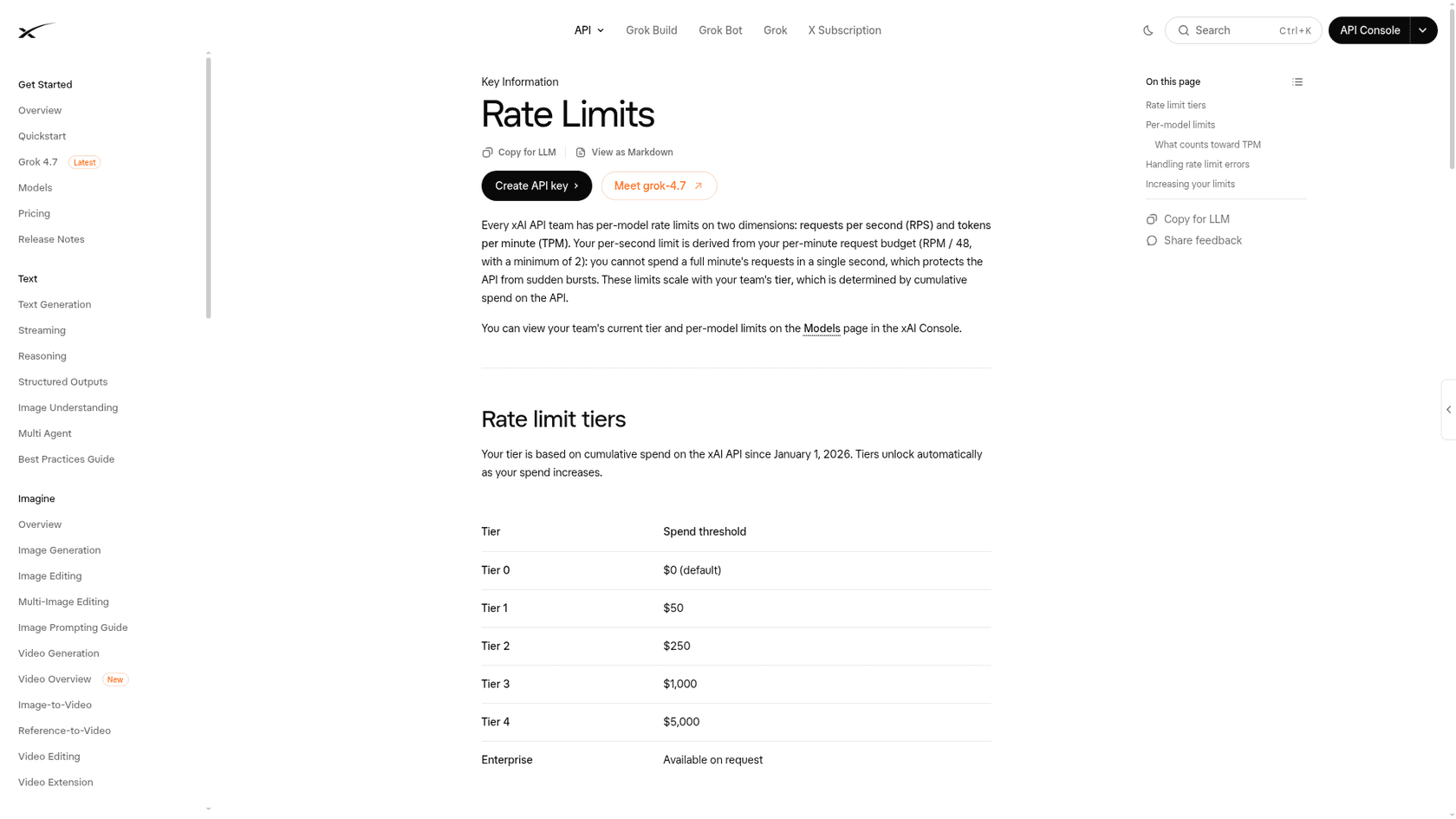
| Tier | Lifetime API spend | Concurrent voice sessions | Minutes that spend buys at $0.08 |
|---|---|---|---|
| Tier 0 | $0 | 10 | 0 |
| Tier 1 | $50 | 20 | 625 |
| Tier 2 | $250 | 50 | 3,125 |
| Tier 3 | $1,000 | 100 | 12,500 |
| Tier 4 | $5,000 | 200 | 62,500 |
| Enterprise | On request | Custom | n/a |
Tiers count prepaid credit purchases and paid invoices, and they never downgrade. So the money that unlocks a tier is money you would spend on calls anyway, it's a cash-flow question more than an extra cost. At 500 calls a day you pass $5,000 inside your first month and the ceiling stops mattering.
Where it does bite is in the pilot. A brand-new account that wants to load-test 50 simultaneous calls has to put $250 of credit in first. That's a small number, but I've seen on our own sales calls how fast test usage runs: one buyer I spoke with burned through 200 interactions in a single test day and started worrying about the per-interaction cost at scale before the pilot was even done. Metered pricing makes testing feel expensive even when it isn't, so set a test budget up front and treat it as the cost of learning.
How Grok's price compares with other voice APIs
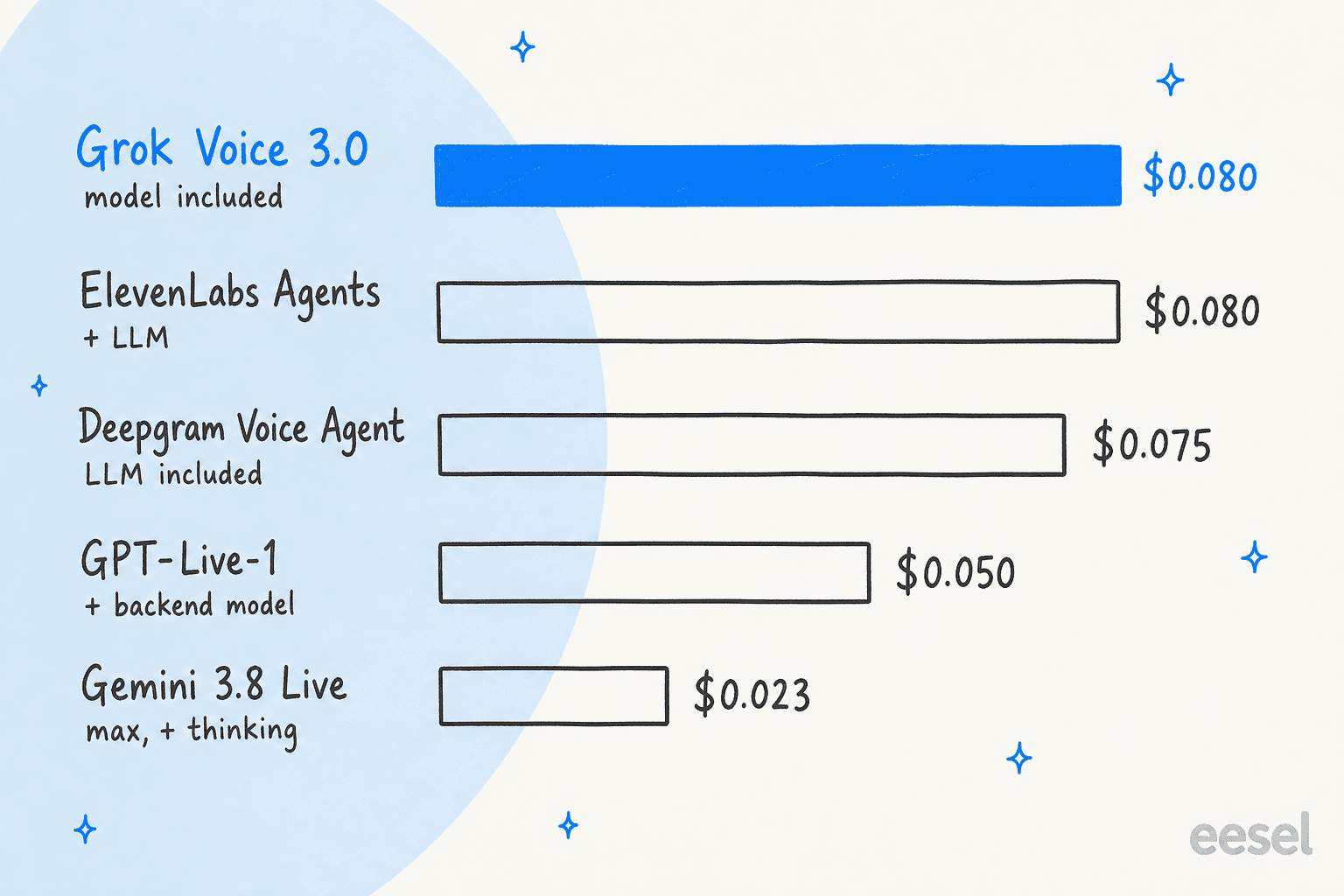
Here's where I think the launch coverage gets the comparison wrong, and in both directions. Every number below comes from the vendor's own pricing page:
| Voice API | Listed price | Billing unit | Reasoning model included? | Billed on top |
|---|---|---|---|---|
| Grok Voice 3.0 | $0.08 / min | Per minute, plus $0.004 per text input | Yes | Server-side tools, carrier |
| GPT-Live-1 | $0.05 / min | Per second, no rounding up | No | "Backend model and tool usage is charged separately" |
| GPT-Realtime-2.1 | $32 in / $64 out per 1M audio tokens | Per token | Yes | Text and image tokens |
| Gemini 3.8 Live | $0.005 / min audio in, $0.018 / min audio out | Per minute of audio, each direction | Thinking billed as output tokens | $4.50 per 1M text output; Search grounding $14 per 1,000 after 5,000 free |
| ElevenLabs Agents | $0.08 / min ($0.16 burst) | Per call minute, $0.003 per text message | No | LLM "based on usage", telephony excluded |
| Deepgram Voice Agent, Standard | $0.075 / min ($0.163 Advanced) | Websocket connection time | Yes | Nothing for the bundled LLM |
Gemini's figure needs one line of explanation. Google prices audio in and audio out separately, so a minute where the caller streams audio the whole time and the agent also speaks the whole time would cost at most $0.023. In a real call the agent talks maybe half the time, which brings it nearer $0.014 a minute, before thinking tokens. On sticker alone, that's a fraction of Grok.
So is Grok expensive? Not once you are pricing the same work. GPT-Live-1's $0.05 buys the voice layer only, and you pick and pay for the model behind it, which my GPT-Live-1 pricing post walks through. ElevenLabs is the same shape at $0.08 plus an LLM, my ElevenLabs pricing breakdown has the plan details. Deepgram's Standard tier is the closest like-for-like bundle, 0.5 cents cheaper per minute.
Artificial Analysis, which benchmarks these models on the same tasks, measured the all-in cost of running each one and found the spread much tighter than the stickers suggest:
"Grok Voice 3.0 costs $4.80 per hour of input audio, the same as Grok Voice 2.0. That is above GPT-Live-1 (Sol, low) at $4.47 and Gemini 3.8 Live Extended Thinking (High) at $3.50, below GPT-Live-1 (Astra, medium) at $5.83, and ~2.2x cheaper than GPT-Realtime-2.1 High ($10.75)."
That's the honest read. Once reasoning is counted, Grok lands in the middle of the frontier pack on cost, not at the top or bottom, and xAI's own launch post frames its edge as cost per task on that benchmark rather than cost per minute. Note too that Artificial Analysis says its cost figure doesn't include tool calls, so add the tools section above to any of these numbers.
If you'd rather buy a whole platform than an API, the pricing model changes again. Retell AI pricing and Vapi layer their own per-minute platform fee over the model, and xAI's own Voice Agent Builder is the no-code route on the same voice.
If you live inside a helpdesk, check what it ships natively before any of this, Zendesk voice AI agents is one example. My roundup of the best AI voice agents compares the packaged options.
Four ways to lower a Grok Voice bill
Because 93% of the bill is minutes, almost every saving is also about minutes. These are the ones I'd actually do, in order of the effort:
- Stop paying for silence. Set
idle_timeout_msand fire thehangupendpoint once the caller is done. On the 500-calls-a-day line, this alone is worth more than every other add-on combined. - Inject context once. Send the caller's account details as one text input at the start, not a stream of updates. Each message is $0.004.
- Answer from your own docs.
file_searchat $2.50 per 1,000 is half the price ofweb_search, and an agent that reads your own policies is also the one that gives the right answer. Keep the uploaded collection lean, since storage is a daily meter. - Use local numbers where you can. Toll-free inbound on Twilio SIP is about 4x the local rate. For a national support line that's a branding call, but it's worth knowing the price of it.
What I wouldn't do is to chase a cheaper per-minute model only to save one cent. A model that fails more calls makes the call longer and pushes more of them to a human, which costs far more than the difference in rate. The AI agent handoff on a failed call is where the real money is.
Is Grok Voice 3.0 worth the price?
For a team putting an AI on the phones, I think yes, and the call center ROI math usually agrees. You get the top model on the Artificial Analysis speech index, a flat rate that includes reasoning, and no platform fee, which makes forecasting easy. The total cost of a 4-minute call is about 35 cents, and the extras you were warned about are a rounding error next to talk time.
It's weaker fit if you need the lowest possible sticker for short and simple calls (Gemini 3.8 Live and GPT-Live-1 both list lower and let you pick a lighter model), or if you want a no-code platform with analytics on top. For those cases, my Grok Voice 2.0 alternatives list and the wider xAI alternatives piece still map the field, and can AI answer support calls is a good gut check before any of it.
The thing no voice price includes is knowledge. Every number above pays for a model to hold a conversation, and none of it tells the model your refund window or which customers get the goodwill credit. A cheap, fast voice reading out the wrong policy is still the wrong policy, and that's the most common failure I see in voice support rollouts. For ecommerce lines specifically, my guide to AI phone support goes into which calls to hand over first.
Grok prices the minute. eesel handles what gets said.
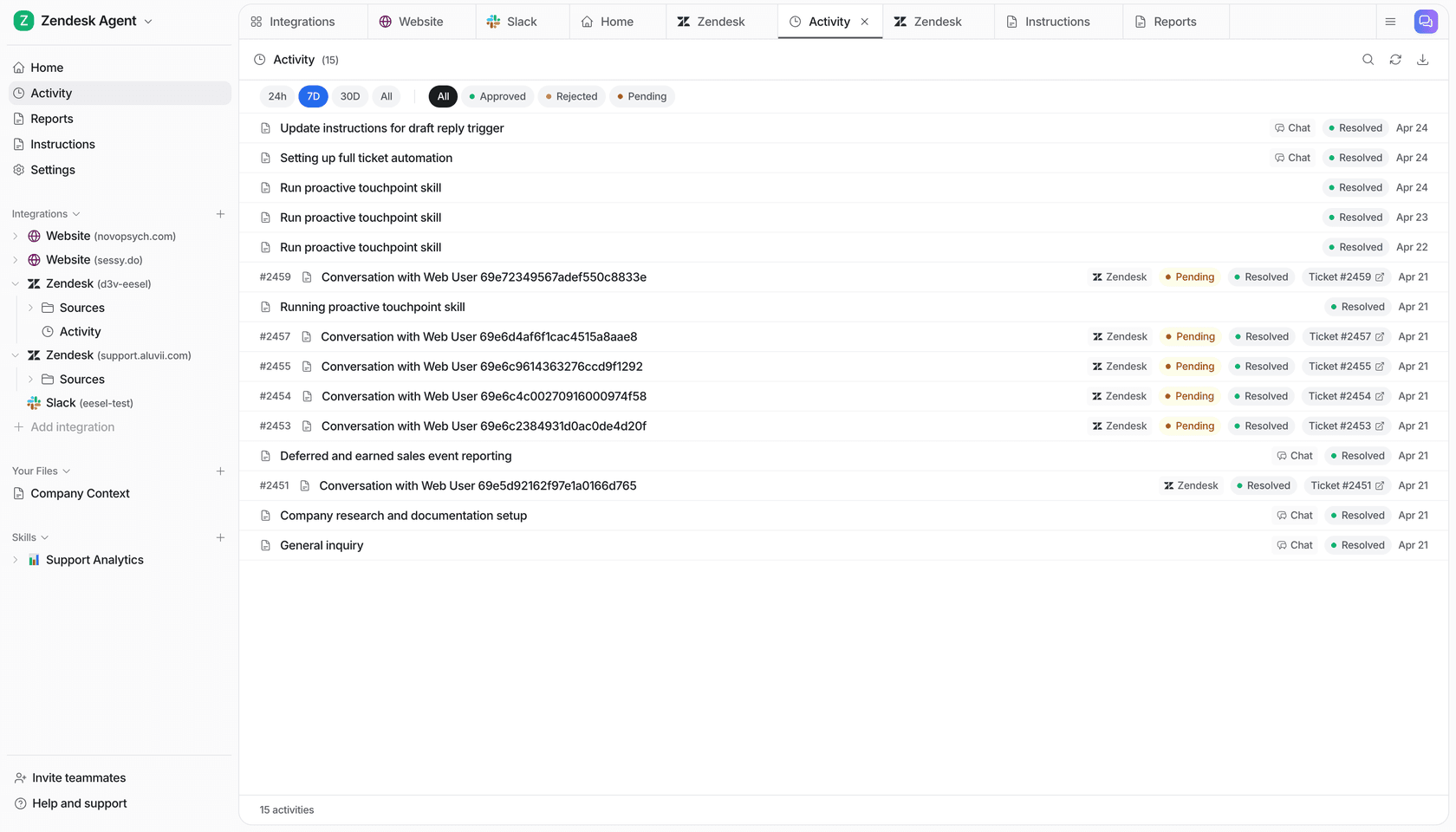
If your phone line sits in front of a ticket queue, the voice model is half the system. eesel is the other half: an AI helpdesk teammate that joins Zendesk, Freshdesk or Gorgias and learns from your past tickets and help center. It works the email and chat queue which every phone call eventually spill into. Before it goes live you can run it against your own historical tickets and see how its answers compare with what your team actually sent, which is how I'd want to test anything that talks to customers.
For builders, the two can meet in the middle. Grok's mcp tool takes a server URL and headers, and every eesel workspace is also an MCP server: the eesel CLI command eesel mcp token prints what an MCP client needs to connect. The same CLI lets you script the agent from a terminal or hand it to a coding agent like Claude Code. I haven't run that pairing on a live phone line, so treat it as a promising build, and remember that remote MCP calls on xAI carry no invocation fee.
The pricing is a different shape from a voice API, too: eesel is a fixed monthly credit plan, $299 a month for 500 credits, where a ticket or chat counts as one credit, with 100 free credits to try it. You pay per ticket handled, not per minute of talk. Try eesel on a slice of your queue before your next voice pilot, so the agent on the phone has something worth saying.