

What Fish Audio charges for Drama 3
Drama 3 is Fish Audio's directable text-to-speech model, released on 13 October 2026 as open weights, in the web and mobile apps, and on the API. If you want the model itself, my Drama 3 overview and Drama 3 review cover it. This post is only about the bill.
I build eesel's integrations, so a lot of my week is spent reading other companies' API billing docs closely enough to predict the invoice before it arrives. eesel moved its own pricing to credit plans this year, which means I've sat on both sides of the "credits or metered usage?" argument. Fish Audio sells Drama 3 both ways at once, and the two price sheets don't always agree with each other.
Here is everything Fish Audio publishes, all checked on 14 October 2026:
| How you pay | Price | Billing unit | Source |
|---|---|---|---|
| API, Drama 3 launch offer (Oct 13 to Nov 12) | $10 | per 1M characters | Launch post |
| API, Drama 3 list price | $50 | per 1M characters | Launch post |
| API, S2.1 Pro | $15 | per 1M UTF-8 bytes | API pricing docs |
| API, S2.1 Pro Free | $0 | per 1M UTF-8 bytes | API pricing docs |
| Web app plans | $0 / $15 / $100 / $999 a month | credits, same rate as S2.1 Pro | Plans page |
| Self-hosted open weights | Free under US$500K annual revenue | license | Launch post |
One oddity first: the official API pricing table still doesn't list drama-3. As of today it shows s2.1-pro, s2.1-pro-free, s2-pro and the deprecated s1, all priced per UTF-8 byte. The launch post is the only place Fish Audio states the Drama 3 number.
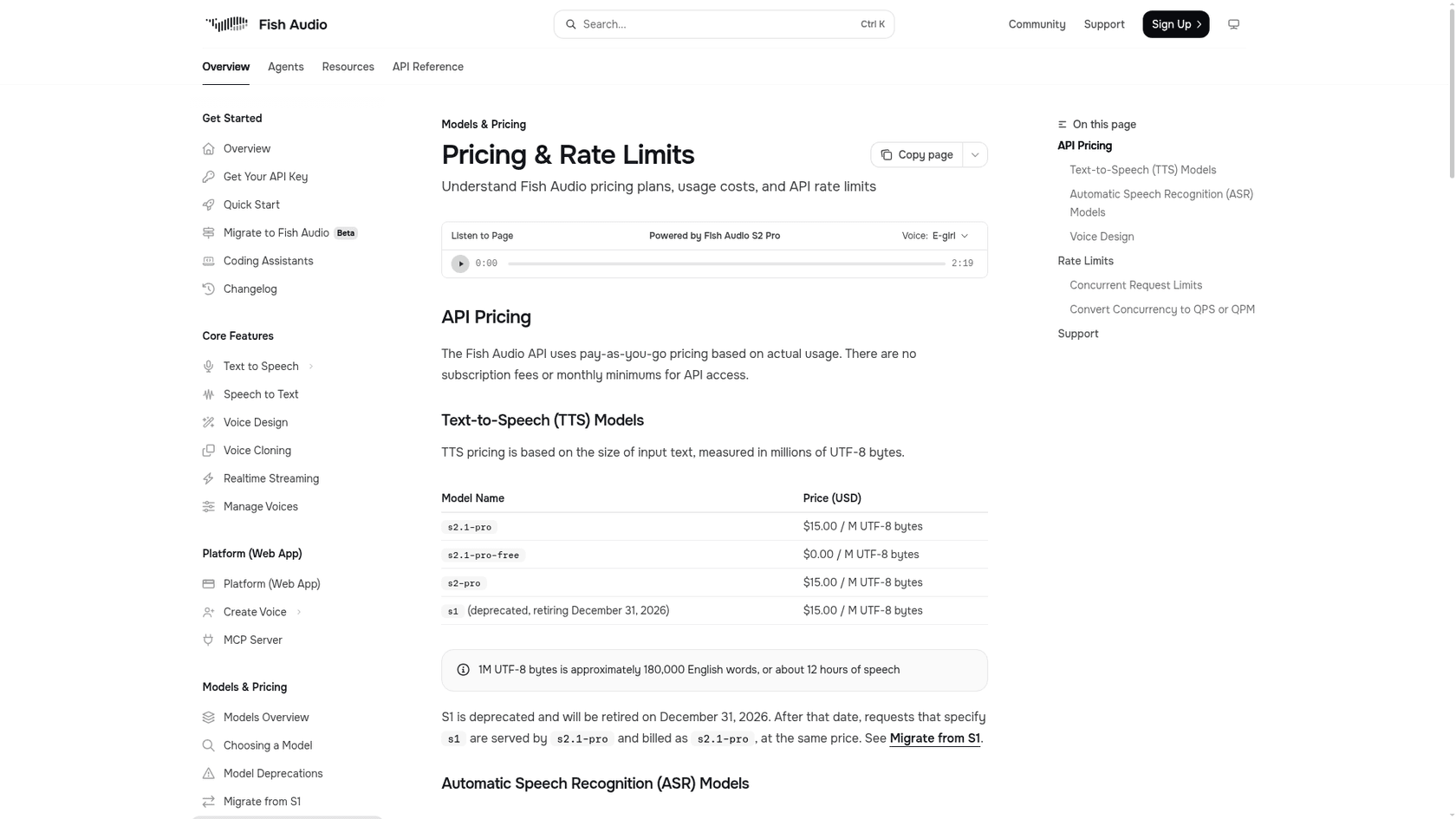
The API itself is pay-as-you-go: "no subscription fees or monthly minimums," per the docs. You top up a balance and requests draw it down.
What an hour of audio actually costs
Per-million-character prices are hard to feel. Fish Audio gives a conversion in its docs: 1M UTF-8 bytes is roughly 180,000 English words, or about 12 hours of speech. For English, one character is one byte, so 1M characters works out to about 83,000 characters per hour of audio. Using that ratio, here is what each way of paying costs per hour:
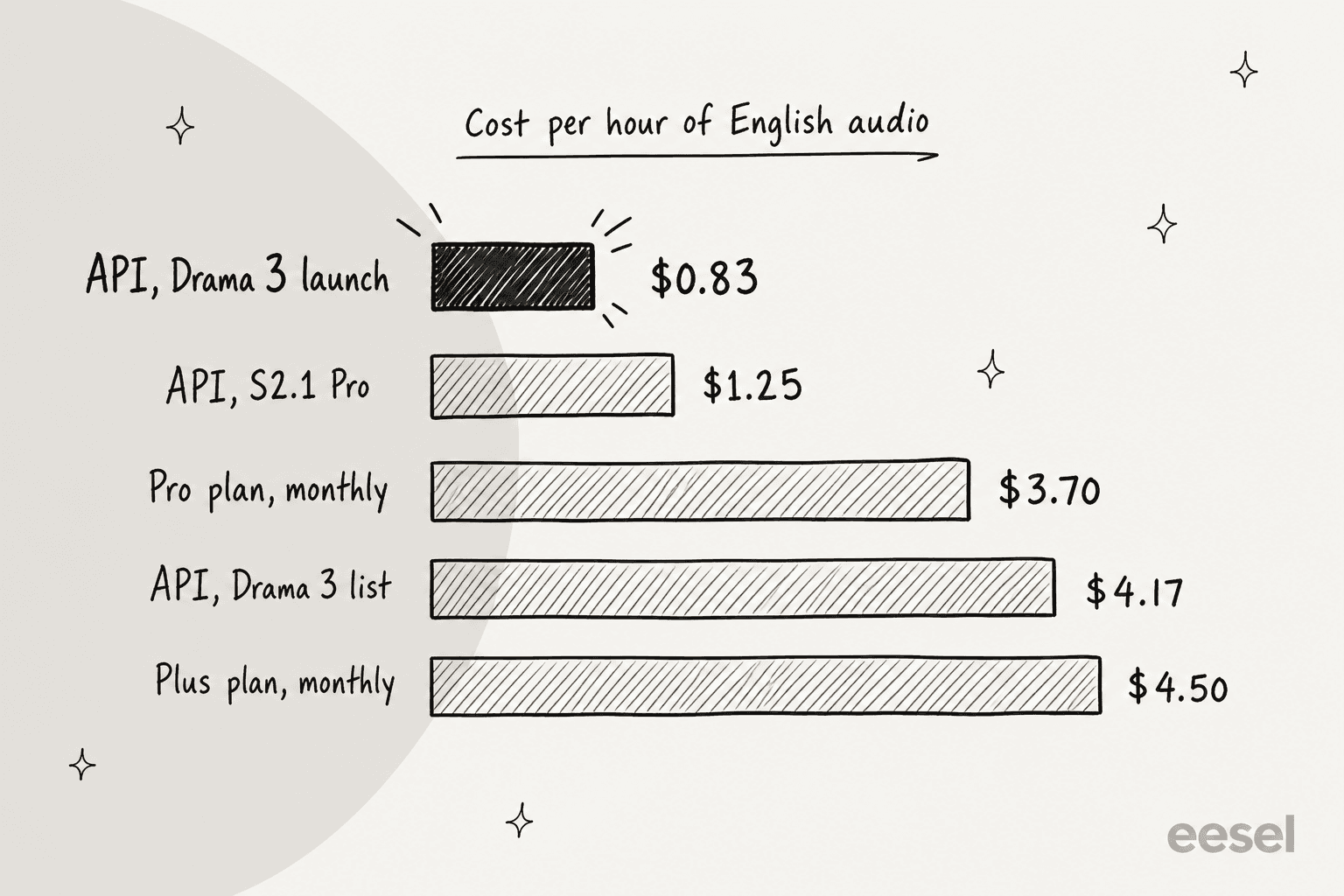
Two things jump out. During the launch window, Drama 3 on the API is cheaper per hour than every plan and even cheaper than S2.1 Pro, the older model it replaces. After November 12, the API at list price lands right between the Pro and Plus plans, so the "API is always cheaper" instinct stops being true.
A caution on comparing vendors by the hour: each vendor assumes its own reading speed. ElevenLabs' API page converts 1,000 characters to about one minute, which is 60,000 characters an hour, while Fish Audio's figure works out to about 83,000. Compare per character, as the calculator below does, and treat any per-hour figure as a ballpark.
The November 12 price cliff
Fish Audio's launch post runs two separate promotions until November 12, and they behave very differently.
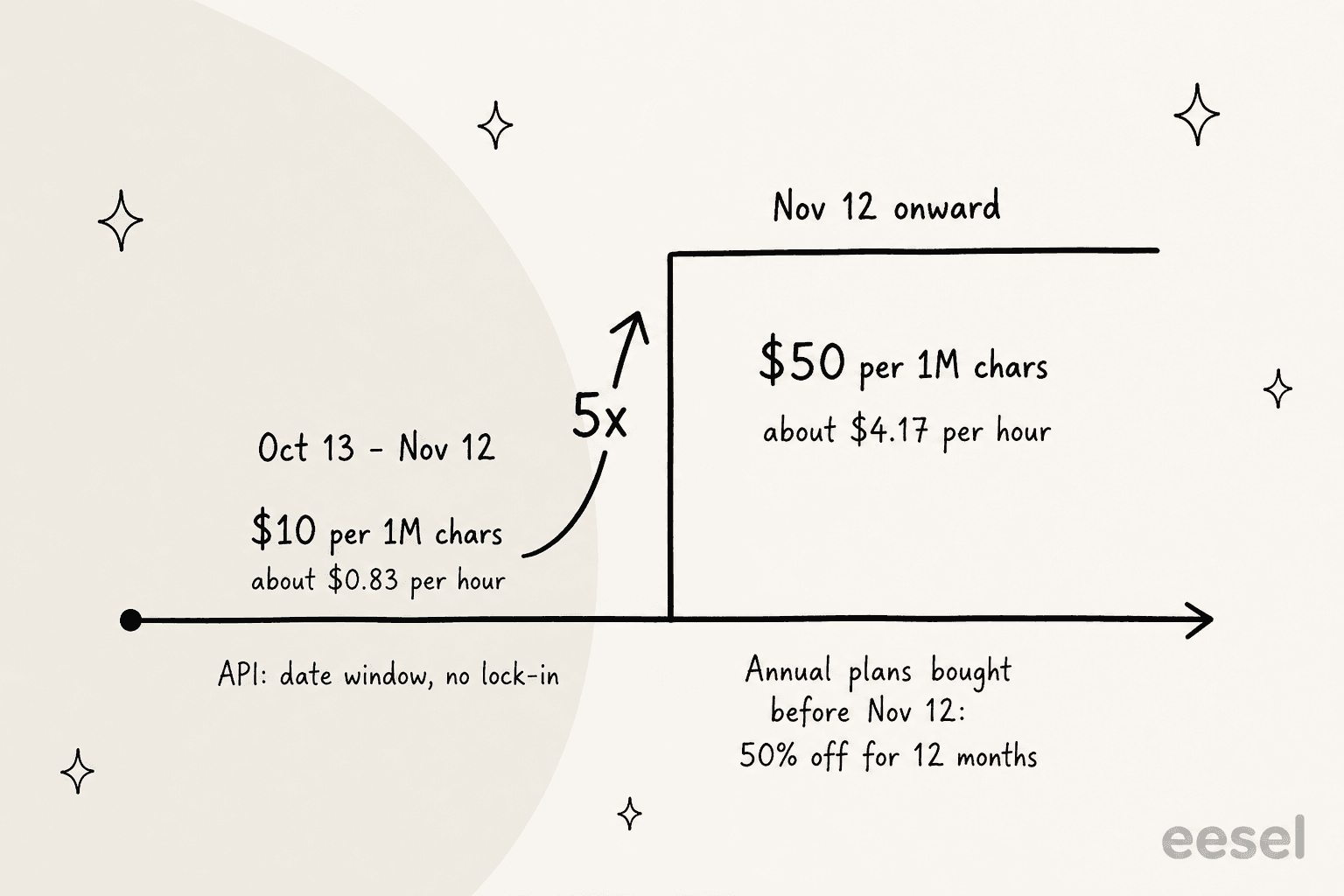
- For developers: the API is $10 per million characters from October 13 to November 12, 80% off the $50 list price. Fish Audio describes this as a date window, so I'd assume every request after November 12 bills at $50, whenever you topped up your balance.
- For creators: a new Plus, Pro or Max plan is 50% off the first month on monthly billing, or the first year on annual billing. That one sticks: buy an annual Pro plan before the deadline and you pay $450 for twelve months instead of $900.
Fish Audio also says, in its launch press release, that enterprises switching from another voice provider get their first three months free. If you're a large ElevenLabs or Cartesia customer, that's worth a sales call before you run your own numbers.
My practical read: if you have a backlog of scripts to voice, the next four weeks are the cheapest Drama 3 will be. Render the back catalogue now; budget the steady state at $50.
Plug in your own numbers
The calculator below uses Fish Audio's published rates and lets you add the two costs most people forget: bracket directions and retakes. Pick your script type too, because that changes the S2.1 Pro price (more on why in the next section).
Three worked examples, all English, one take, no directions:
| Use case | Characters a month | Audio | Drama 3 launch | Drama 3 list | S2.1 Pro | Eleven v4 API |
|---|---|---|---|---|---|---|
| A 90,000-word audiobook, once | 500,000 | about 6 hours | $5 | $25 | $7.50 | $40 |
| A YouTube channel, 20 videos of 1,500 words | about 167,000 | about 2 hours | $1.67 | $8.33 | $2.50 | $13.33 |
| A platform voicing 50M characters | 50,000,000 | about 600 hours | $500 | $2,500 | $750 | $4,000 |
The audiobook row is where retakes bite. Fish Audio's own advice is "takes vary, so render a few and keep the one that plays," and every take is billed. Three takes per chapter plus 20% of text in directions turns the $25 list-price audiobook into $90. If you produce AI video scripts or long-form narration at volume, budget on takes, not on word count.
Characters vs bytes: the trap for non-English scripts
This is the detail I'd most want a product manager to know before signing off a voice budget. Fish Audio prices S2.1 Pro per million UTF-8 bytes and Drama 3 per million characters. For English text those are identical. For other scripts they aren't, because UTF-8 stores most Latin letters in 1 byte, Cyrillic, Arabic, Hebrew and Greek in 2, and Chinese, Japanese, Korean, Hindi and Thai in 3.
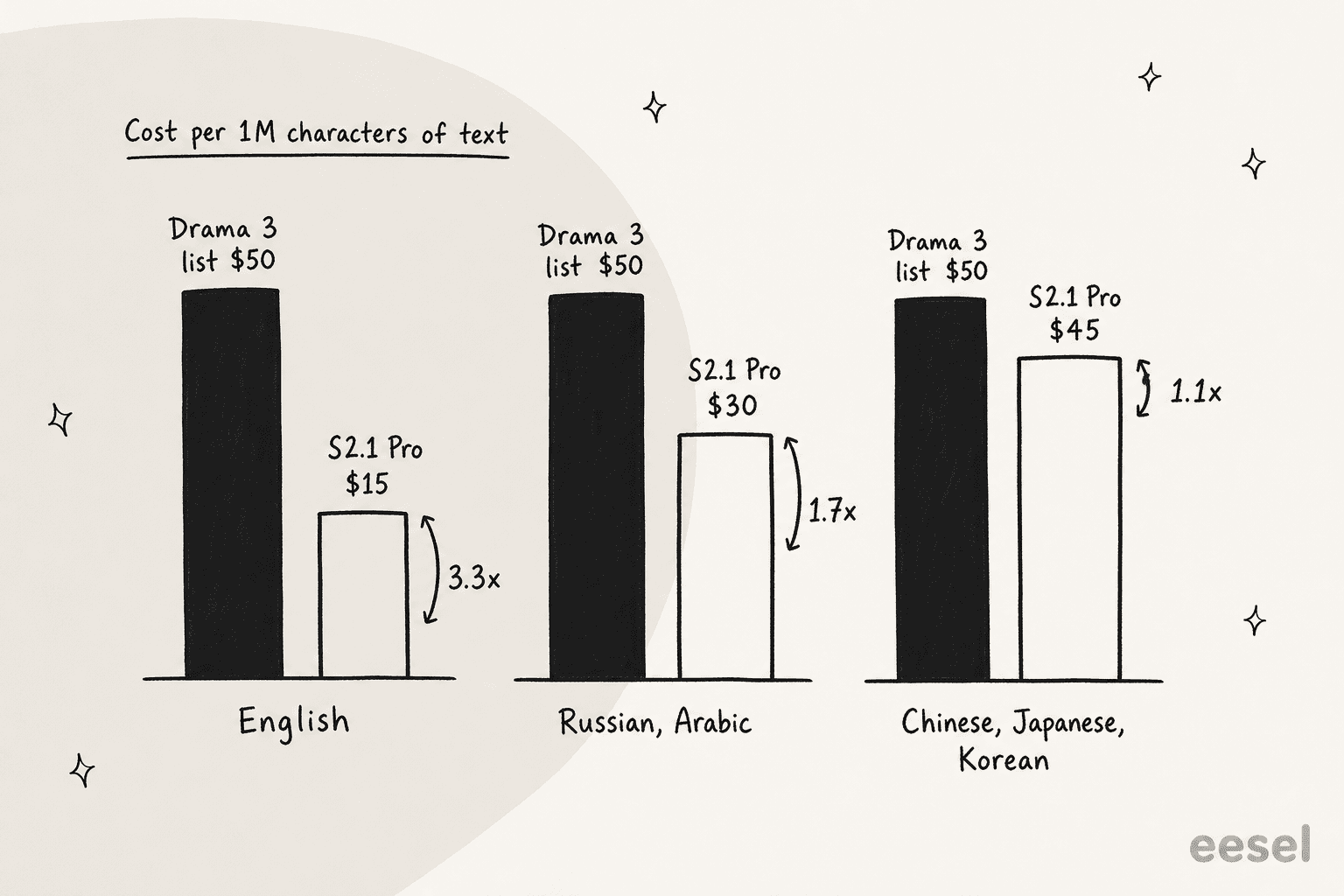
So the "Drama 3 costs 3.3x more than S2.1 Pro" line you'll see in English-language coverage, including my own review, only holds for English. For a Japanese or Korean script, Drama 3 at list price costs just 1.1x what S2.1 Pro does, and during the launch window it costs less than a quarter.
Two honest caveats. Fish Audio hasn't added a drama-3 row to its docs table, so how the billing system counts a "character" isn't documented. And a Chinese character carries more speech than an English letter, so per-hour costs aren't comparable across languages. If you voice localized content, send one test request in each language and read your usage page before you scale. The same per-language discipline I recommend for multilingual QA applies to voice budgets too.
The other line items: directions, speaker tags and add-ons
Drama 3's headline feature is that you direct the read in plain words. Fish Audio's docs say TTS pricing "is based on the size of input text," and the directions are input text. As far as the docs describe it, they're billed.
| Line | Characters | What you're paying for |
|---|---|---|
I'm fine. | 9 | The words |
[barely holding it together] I'm fine. | 38 | The words plus a 28-character direction |
<|speaker:0|> | 13 | One speaker tag, once per turn in a multi-voice scene |
That example is extreme, since one short line with one long direction quadruples its cost. Across a real script, light direction adds something like 10 to 25%. It's a small tax, but it's the reason I'd write directions short ("[tired]" rather than "[sounding tired after a long day]") once a pipeline runs at volume.
The other API prices Fish Audio publishes, from the pricing docs:
- Speech to text:
transcribe-1-proandtranscribe-1at $0.36 per audio hour, billed per second, silence included. - Voice Design:
voice-design-1at $0.01 per successful request, even when it returns several candidates. - Concurrency is tied to spend: 5 concurrent requests under $100 paid, 15 from $100, 50 from $1,000. Prepaying unlocks the tier immediately, so a production launch may mean topping up $1,000 just for throughput.
And one billing trap from the Drama 3 docs: if the model header is missing or misspelled, the request doesn't fail. It quietly falls back to s2.1-pro, and you're billed for S2.1 Pro audio that never had Drama 3's acting. During the launch window that's actually the more expensive model in English, so a typo costs you twice.
Fish Audio plans: credits, minutes and which one is worth it
If you'd rather work in the fish.audio web app than call the API, you pay a monthly plan in credits. Fish Audio says Drama 3 costs the same credits as S2.1 Pro.
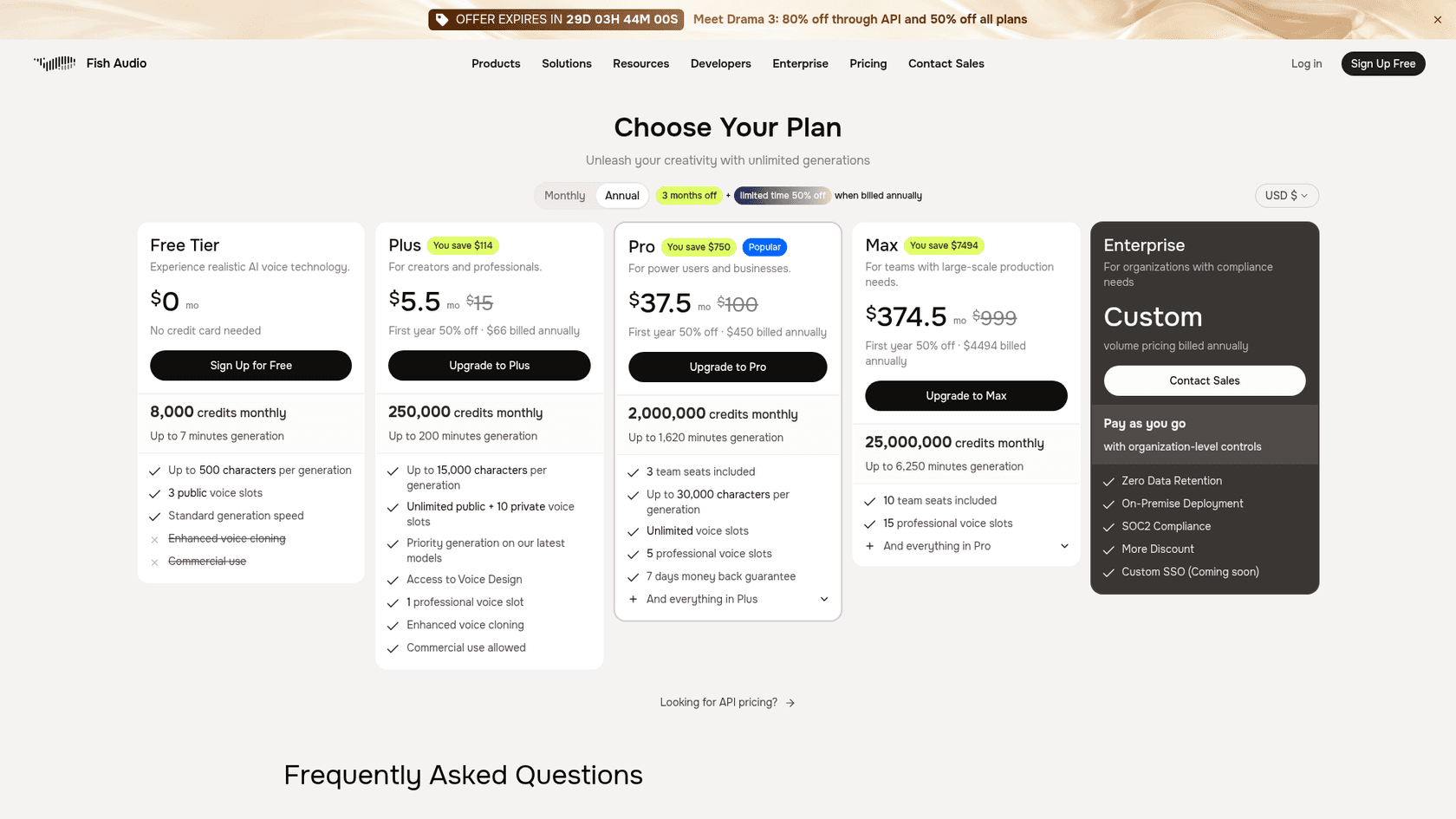
| Plan | Monthly | Annual, standard | Annual, first year before Nov 12 | Credits a month | Minutes on the plan card | Cost per hour, monthly | Worth knowing |
|---|---|---|---|---|---|---|---|
| Free | $0 | $0 | $0 | 8,000 | Up to 7 | n/a | 500 characters per generation, no voice cloning, no commercial use |
| Plus | $15 | $132 | $66 | 250,000 | Up to 200 | $4.50 | 15,000 characters per generation, commercial use, Voice Design, 1 professional voice slot |
| Pro | $100 | $900 | $450 | 2,000,000 | Up to 1,620 | $3.70 | 3 team seats, 30,000 characters per generation, 5 professional voice slots, 7-day money back |
| Max | $999 | $8,988 | $4,494 | 25,000,000 | Up to 6,250 | $9.59 | 10 team seats, 15 professional voice slots |
| Enterprise | Custom | Volume, billed annually | n/a | Custom | Custom | n/a | Zero data retention, on-premise deployment, SOC 2 |
Unused credits don't roll over, per the plan FAQ.
Here's the part that made me read the page three times. The same FAQ says each minute of generation costs "roughly 600 to 625 credits". At 625 credits a minute, Plus would buy 400 minutes, Pro 3,200 and Max 40,000. The plan cards say 200, 1,620 and 6,250. The two don't agree, and the gap is widest on Max: by credits it's the cheapest plan per hour (about $1.50), by the printed minutes it's the most expensive ($9.59).
I can't tell from the outside which number is right for Drama 3. My advice: budget on the minutes printed on the card, treat the FAQ as an upside, and ask Fish Audio sales to confirm before you commit to Max. On the cards as printed, Pro is the sweet spot, and an annual Pro plan bought before November 12 brings it to about $1.39 an hour for the first year.
Self-hosting: free weights, with a revenue cap
The third way to pay is not to. Drama 3 ships as open weights on Hugging Face under the Fish Audio Community License v1.0. Per the launch post, it's free for research and non-commercial use, and free for commercial use if you and your affiliates have less than US$500,000 in annual revenue. Making finished audio for clients is explicitly fine. Above the cap, or to offer Drama 3 to others as a TTS, voice-cloning or inference API, you need a license from Fish Audio.
Fish Audio hasn't published what that license costs for Drama 3. For its earlier open models, the developers page lists self-hosting as an Enterprise engagement at $10,000 a month, with an "effective floor" of $120,000 to $150,000 a year. I wouldn't assume Drama 3 is priced the same, but it tells you the order of magnitude.
The community take on the license was mixed but pragmatic:
"License is a bit lame but I understand they need to make money too lol"

The other half of self-hosting cost is hardware. Drama 3 is a 35B-parameter mixture-of-experts model with about 3B active per token. One Reddit user ran it on two RTX 3090s at about 39 GB of VRAM with help from Claude Opus 5.5, and others expect quantized builds to fit smaller cards:
"it's a 35A3B, it will probably run on way smaller cards at the cost of some quality (quants)"
My rule of thumb: at the $10 launch price, $100 buys 10M characters, roughly 120 hours of English audio, and no self-hosted setup beats that for a month. At the $50 list price, self-hosting starts to make sense once you're voicing hundreds of hours a month, already own the GPUs, or need the audio to stay on your own servers. If you're new to running open models, my Hugging Face pricing guide covers what hosted inference costs instead.
How Drama 3 pricing compares
Here is Drama 3 against the voice APIs people are most likely to price it against, using only prices from each vendor's own page.
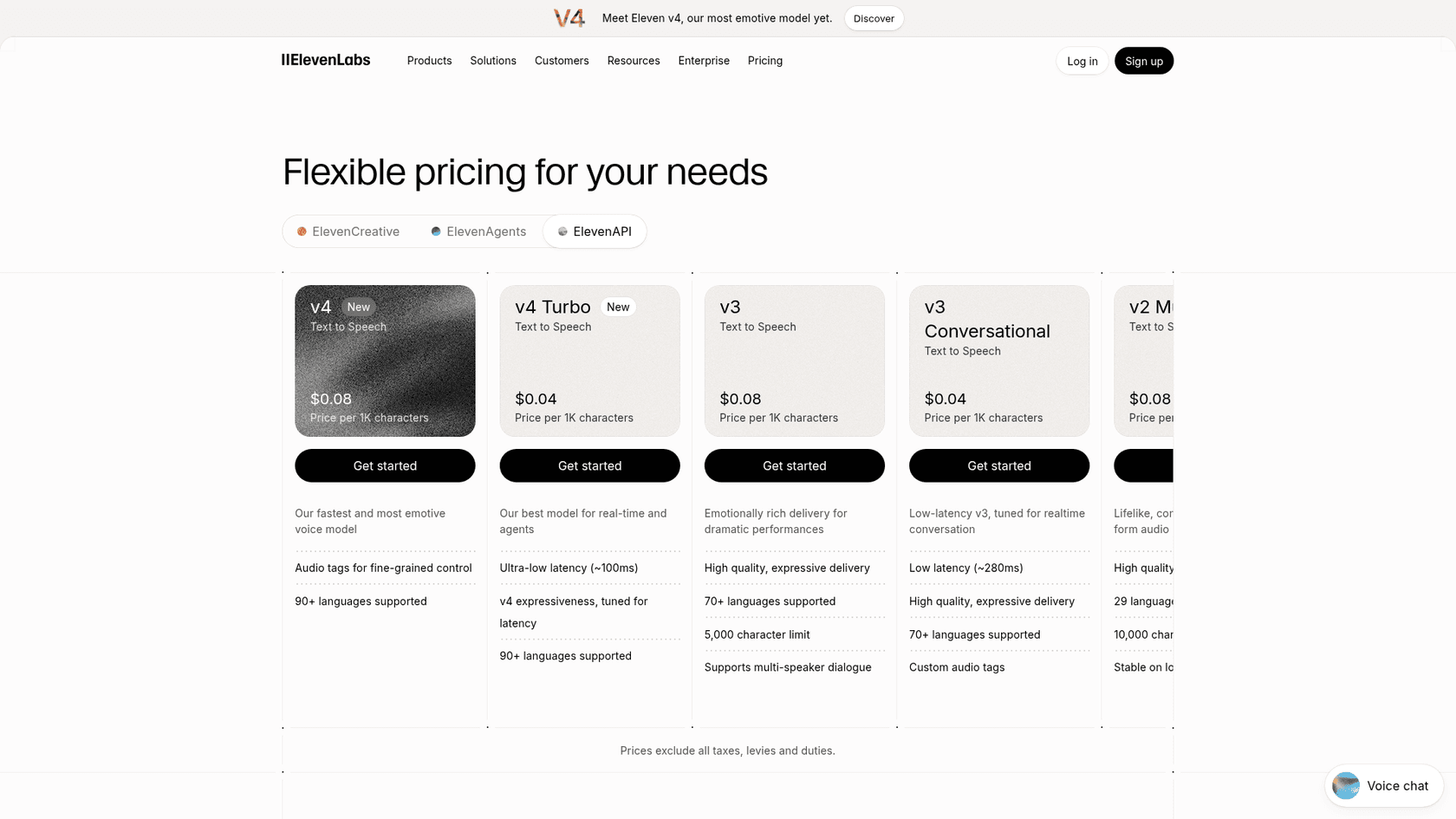
| Model | Price per 1M characters (English) | Open weights | Free API option | More detail |
|---|---|---|---|---|
| Fish Audio Drama 3, launch (to Nov 12) | $10 | Yes, revenue-capped | No | Drama 3 review |
| Fish Audio Drama 3, list | $50 | Yes, revenue-capped | No | Drama 3 overview |
| Fish Audio S2.1 Pro | $15 (per 1M bytes) | S2 family, research license | Yes, S2.1 Pro Free | This post |
| Eleven v4 | $80 | No | Free plan credits | Eleven v4 pricing |
| Eleven v4 Turbo | $40 | No | Free plan credits | ElevenLabs pricing |
At list price, Drama 3 is still about 38% cheaper per character than Eleven v4, and it's the one in the table you can download. On Artificial Analysis' pronunciation test it also scored higher (93.2% vs 91.7%), though it ranked 10th on voice preference, which matters if your listeners pick voices by ear. One X reply summed up the surprise on the pricing-and-quality side:
"open weights beating eleven on pronunciation is wild"
For the rest of the field, I've broken down Gemini 3.8 Flash TTS pricing, Hume AI pricing and Cartesia Sonic 3 separately.
If you're on OpenAI's stack, the OpenAI speech API and the wider OpenAI API pricing guide are the baseline.
My ElevenLabs alternatives roundup and the list of AI voice companies cover the vendors I haven't priced here.
Which way to pay for Drama 3
Putting it together, here's what I'd do in each situation:
- You have a backlog to voice: use the API before November 12. At about $0.83 an hour it's the cheapest Drama 3 will ever be.
- You're a solo creator in the web app: buy an annual Plus or Pro plan before the deadline. The first-year 50% off is the only discount that survives November 12.
- You voice English plain narration at volume: S2.1 Pro at $15 per million bytes stays the better buy after November 12. You'd be paying 3.3x for acting you don't use.
- You voice Chinese, Japanese or Korean: Drama 3 at list costs only about 11% more than S2.1 Pro per character, so the upgrade is close to free. Test the billing first.
- You're under US$500,000 in revenue with GPUs on hand: self-host the open weights, and keep the API as overflow.
- You're building live voice support: this is the wrong model and the wrong price question. Fish Audio says Drama 3 does its best work on scripted lines you render once and keep. Look at purpose-built AI voice agents and the Grok Voice Think Fast 2 pricing breakdown instead, and remember from the support side that the hard part is a correct answer, not a pretty voice. My voice support roundup goes deeper.
If you're still mapping out how text-to-speech and speech-to-text models fit together, Whisper vs TTS API is a good primer.
eesel for the script before the voice
Every number in this post is a price per character of script. Drama 3 reads what you hand it, and you pay for every word, every direction and every retake. The cheapest way to cut a voice bill is a tighter, better script that needs fewer takes.
That's the job eesel's AI blog writer is hired for. It's an AI teammate that researches a topic from primary sources, writes the long-form post in your brand voice, generates the images, and hands you a draft ready to publish or to repurpose into audio and podcast scripts. eesel has run it as its own content engine for months, and one customer's SEO content lead, at an AI phone-support startup, put it simply:
"this is definitely the best seo tool I've used so far"
If you're about to spend a launch-window budget voicing a content backlog, write the backlog well first. See what it costs on the pricing page, read my AI blog writer review for the honest version, then Try eesel.