


How much does Meta Muse Wonder cost?
Muse Wonder launched on October 12, 2026, as Meta Superintelligence Labs' first frontier model family. I'm a software engineer with a couple of years in SEO, and when I looked at what people search right after the launch, "Muse Wonder pricing" was really two questions at once: what does a token cost, and which Wonder do I actually get for that money. This post answers both, straight from Meta's own pricing and rate limits page, model docs and subscription terms.
Here's the full API rate card for muse-wonder-1.0:
| What you're billed for | Muse Wonder (Standard mode) | Contributor mode |
|---|---|---|
| Input | $4.00 per 1M tokens | Not available |
| Cached input | $0.20 per 1M tokens | Not available |
| Output (includes reasoning) | $20.00 per 1M tokens | Not available |
| Web search grounding | $2.50 per 1,000 queries | Not available |
| Long-context premium | None | n/a |
| Rate limit | 3,000 requests and 4M tokens per minute, per team | n/a |
Two things make this card different from most frontier model pricing. Meta charges the same rate whether your 1,048,576-token context window is "mostly empty or almost full", and the steering context Meta injects into every prompt is "not billed". OpenRouter lists Wonder at the same $4/$20 and the same $2.50 search fee, so going through a router doesn't change the math.
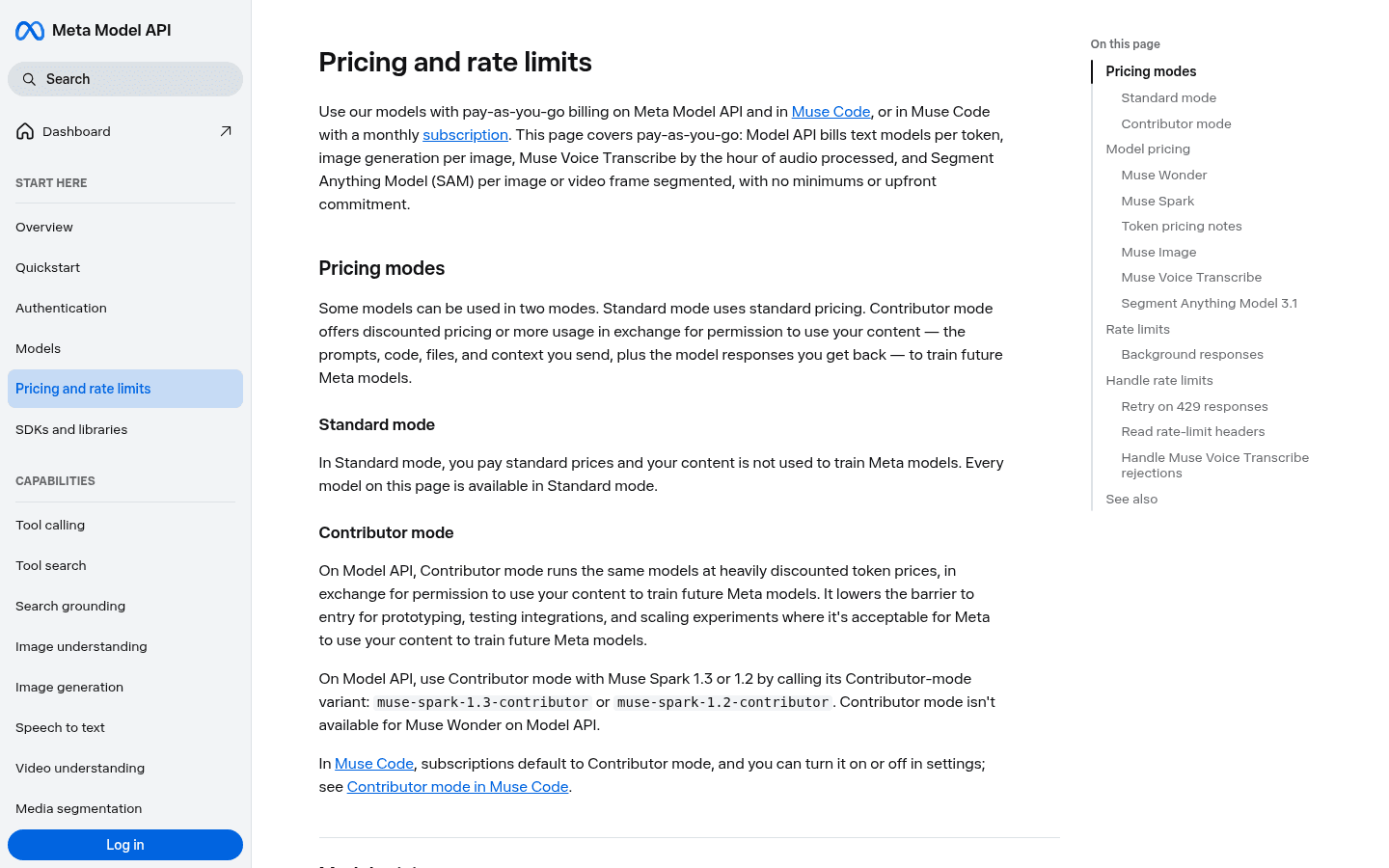
The missing tier is the real story. On Muse Spark 1.3, Contributor mode cuts the price to $0.10 in and $0.20 out if you let Meta train on your content. Meta's page says plainly that "Contributor mode isn't available for Muse Wonder on Model API." For the first time, Meta isn't the cheap option in the room.
What a Muse Wonder bill is actually made of
A token price only tells you the rate. Your bill depends on which tokens you produce, and with a reasoning model that's mostly output.
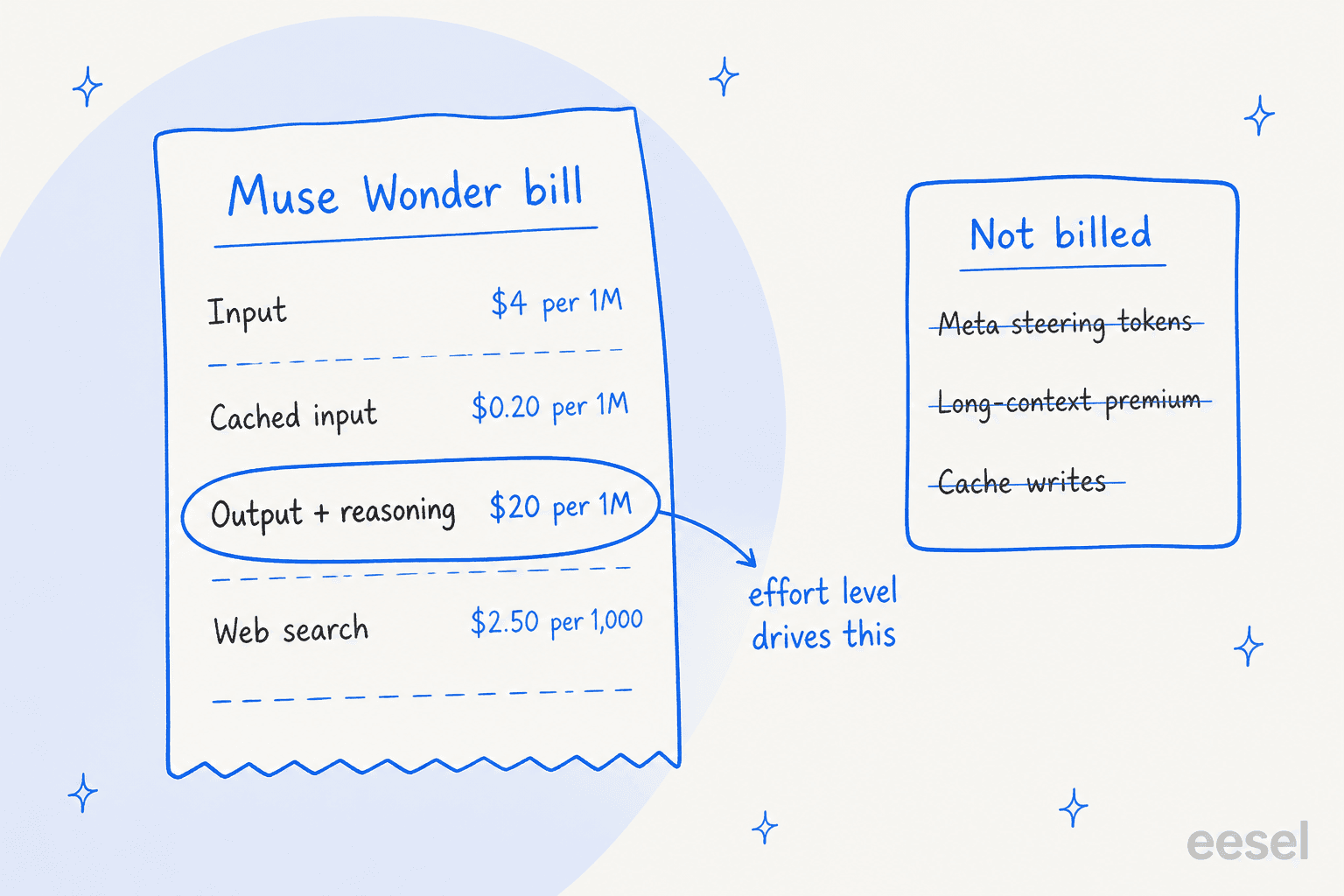
Meta's reasoning docs spell out three rules worth knowing before you budget:
- Reasoning tokens bill as output. "Reasoning tokens are billed at the same rate as visible output tokens." They don't appear in the response, but they show up as
reasoning_tokensin the usage object and cost $20 per million. - You can't turn reasoning off. Setting effort to "none" returns an HTTP 400 on Wonder. The cheapest setting is "minimal", and the scale runs up through low, medium, high, xhigh and max.
- Max costs more, not more per token. The "max" level uses "more reasoning tokens at the same per-token price." And on the API, max does not unlock Wonder Full.
So effort level is the biggest price dial you control, far more than the input side. Meta doesn't publish how many reasoning tokens each level burns on Wonder, so measure it on your own prompts before you commit to a monthly estimate. Meta's own advice is to use "the lowest level that gives you acceptable results."
Caching works in your favor here. Meta's prompt caching is automatic: no flags, no cache keys required, and no extra charge to store a prefix. Repeated system prompts and conversation history drop from $4 to $0.20 per million, a 95% cut on that slice of input. Put stable content first and the variable message last, and most of a long chat's input ends up at the cached rate.
Same sticker as Claude Opus 5.5, different bill
At launch, one Hacker News commenter summed up the pricing reaction in a line:
"$4/$20 in vs out making it higher than Sol and on par with Opus."

On paper that's exactly right. Muse Wonder and Claude Opus 5.5 share $4 input, $0.20 cache reads and $20 output. But the two rate cards treat everything around those numbers differently, and that's where your invoice moves.
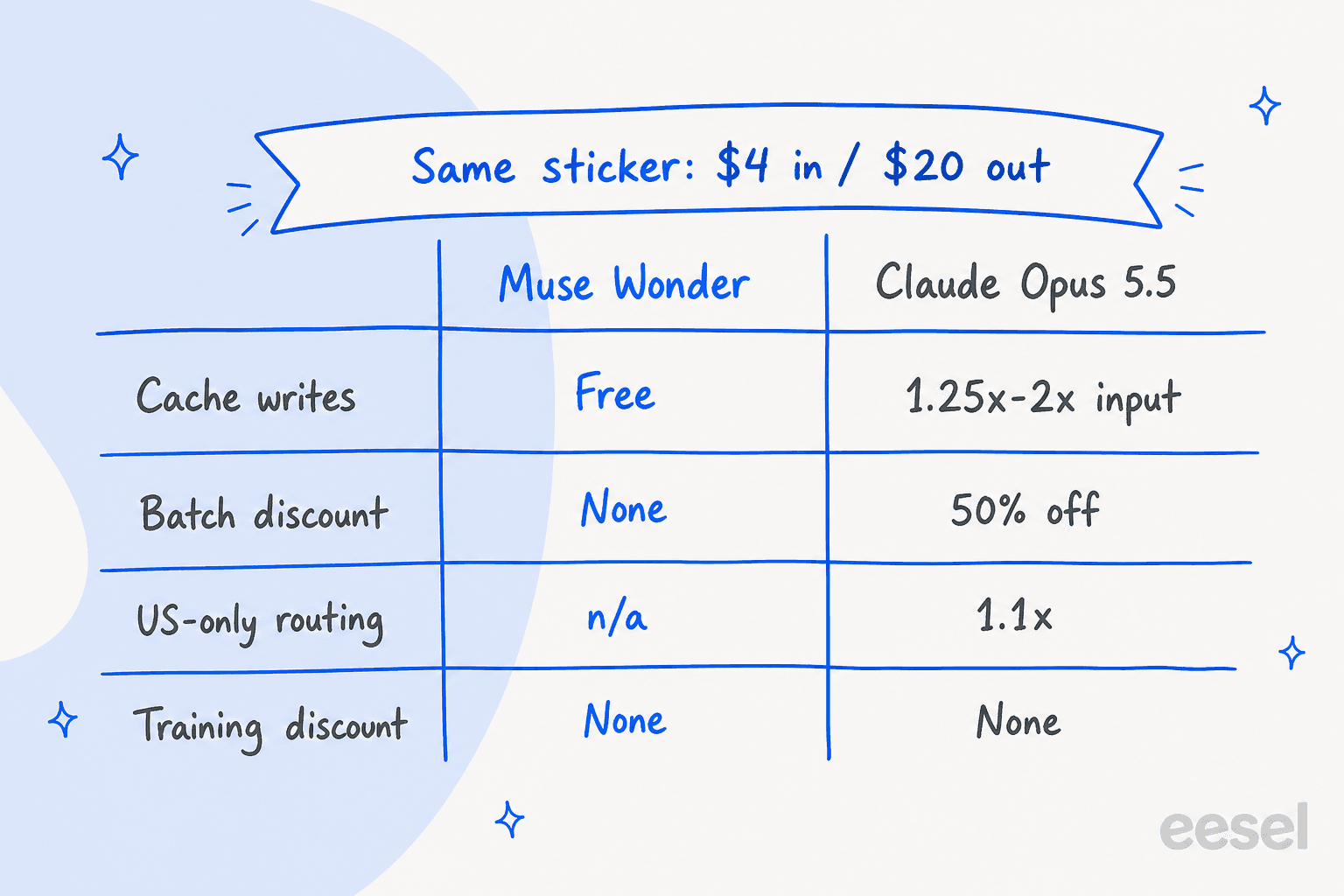
| Pricing detail | Muse Wonder | Claude Opus 5.5 |
|---|---|---|
| Input / cached / output per 1M | $4.00 / $0.20 / $20.00 | $4.00 / $0.20 / $20.00 |
| Writing to cache | No charge | $5 per 1M (5-minute) or $8 per 1M (1-hour) |
| Batch discount | None listed | 50% off: $2 in, $10 out |
| Faster output option | None listed | Fast mode at $8 in, $40 out |
| Region-locked routing | None listed | 1.1x for US-only inference |
| Long-context premium | None | None |
| Data-sharing discount | None | None |
The Opus figures come from Anthropic's pricing page. Read the table as two trade-offs:
- Interactive, cache-heavy work leans Wonder. Every time Opus 5.5 writes a prefix to cache, it charges 1.25x or 2x the input price for those tokens. Wonder doesn't. On a chat app or coding agent that rebuilds its cache often, that's a small but real saving.
- Anything that can wait leans Opus. Anthropic's Batch API halves both input and output. Meta's rate card lists no batch discount (its background responses feature has a submission limit, not a lower price). A nightly job that summarizes 100M tokens of documents and writes 5M tokens back costs $500 on Wonder and $250 on Opus 5.5 batch.
The other lens is capability per dollar. On the Artificial Analysis index Meta shows in its launch post, the API model scores 52 and Opus 5.5 scores 58 at the same price. My Muse Wonder review goes through all 14 benchmark rows, but the short version is that the model winning six of them, Wonder Full, isn't the one on this rate card.
Here's how Wonder sits against the rest of the field, all at standard rates from each vendor's own page:
| Model | Input per 1M | Cached input per 1M | Output per 1M | Batch discount |
|---|---|---|---|---|
| Muse Wonder | $4.00 | $0.20 | $20.00 | None listed |
| Claude Opus 5.5 | $4.00 | $0.20 | $20.00 | 50% |
| GPT-6 Astra | $10.00 | $1.00 | $50.00 | 50% |
| Claude Fable 5.1 | $10.00 | $0.25 | $50.00 | 50% |
| Muse Spark 1.3 | $1.25 | $0.15 | $4.25 | None listed |
| Muse Spark 1.3 Contributor | $0.10 | $0.002 | $0.20 | None listed |
Plug your own monthly volume into the calculator below. The last box, work that can wait a day, is the one most launch coverage skips.
Muse Wonder Full pricing: only through Muse Code
If the benchmark chart is why you're here, the token price above doesn't apply to you. Meta's model docs list Wonder Full as "Not available" on the Model API. It's sold only inside Meta's coding agent, Muse Code, on the two top subscription plans.
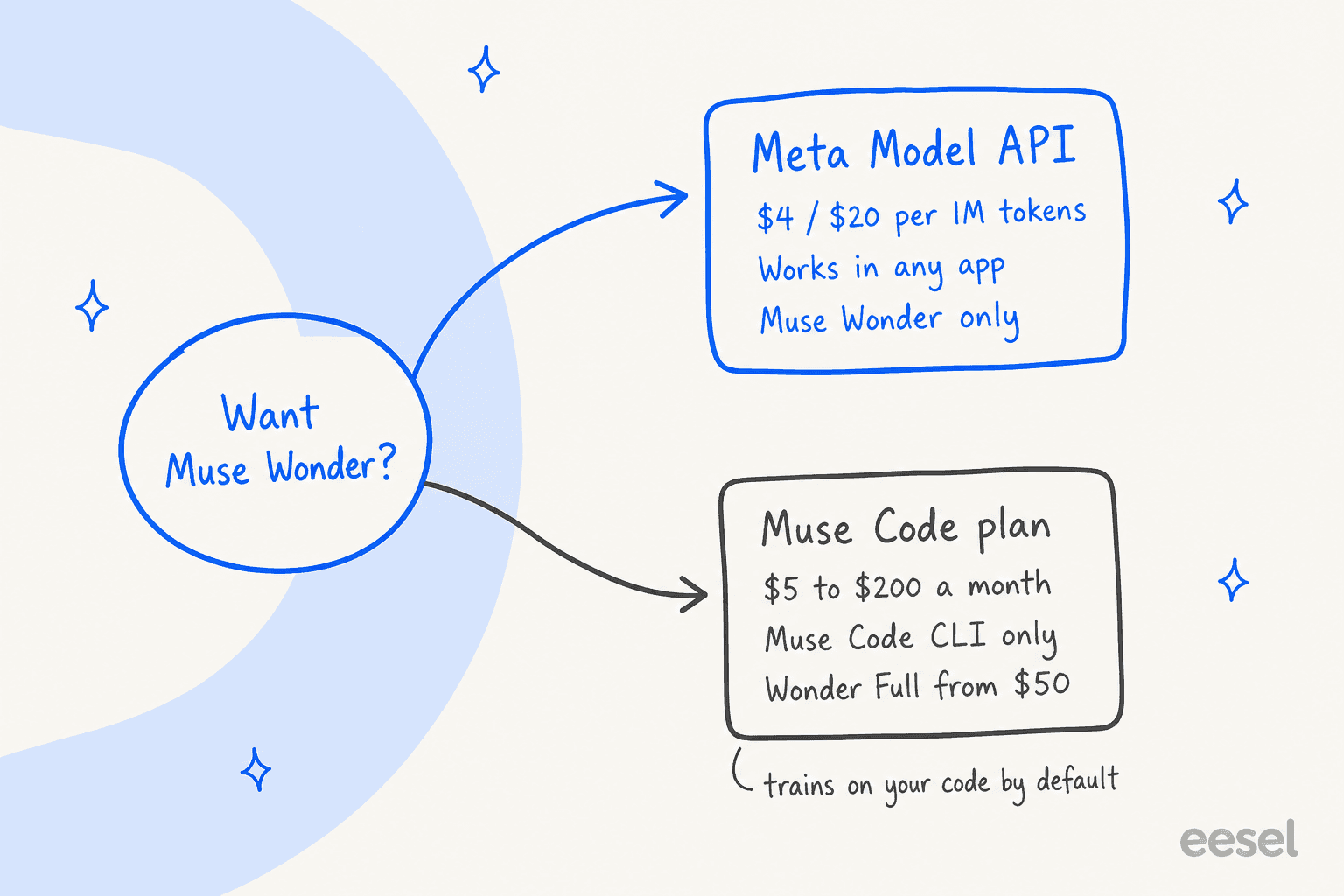
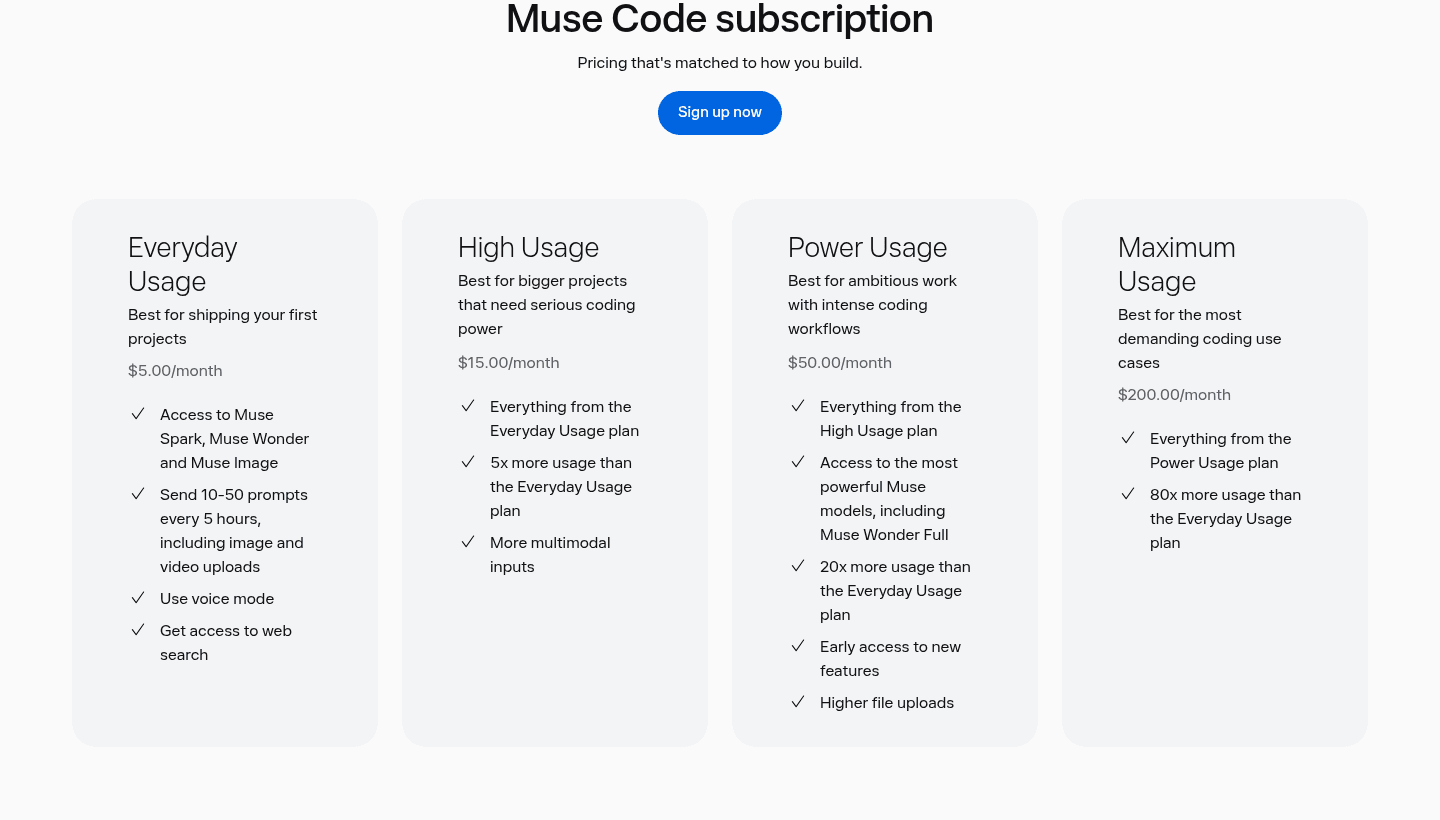
| Plan | Price | Usage allowance | Muse Wonder | Wonder Full |
|---|---|---|---|---|
| Everyday Usage | $5/month | 10-50 prompts every 5 hours | Yes | No |
| High Usage | $15/month | 5x Everyday | Yes | No |
| Power Usage | $50/month | 20x Everyday | Yes | Yes |
| Maximum Usage | $200/month | 80x Everyday | Yes | Yes |
Prices are from the Muse Code page. The subscription rules carry five details that change the real cost:
- The key only works in Muse Code. A subscription "works only through the Muse Code CLI." Any other API key you create bills pay-as-you-go, so a $50 plan can't power your own product.
- Contributor mode is on by default. Plans "default to Contributor mode", which gives you more usage in exchange for Meta training on your prompts, code and files. You can switch it off any time.
- Limits are prompts, not tokens. Hit your cap and you either upgrade or wait for the refresh. On Maximum Usage, there's nowhere left to upgrade, so you wait.
- Upgrades are prorated, downgrades wait. An upgrade "takes effect immediately" with a prorated charge; a downgrade starts next billing cycle.
- No refunds. Cancel and you keep access to the end of the cycle, with no credit back "unless required by law". You need to be 18 or over, and availability "may vary by region".
On the entry plan, one early user found the allowance thin:
"The usage limits on their basic $5 code plan to try things out are ludicrously low?"
For a full look at the coding agent's costs beyond Wonder, see my Muse Code pricing guide, and compare it with Claude Code pricing at the same budgets.
What Muse Wonder costs in practice: three worked examples
Rates are easy to compare and bills are not, so here are three illustrative workloads. The token volumes are my assumptions, chosen to be round and realistic, not figures Meta publishes. All prices are Meta's and Anthropic's standard rates.
1. A solo developer on a coding agent. Say 150M input tokens a month, 90% of it cached (your repo context gets reused constantly), and 4M output tokens including reasoning.
| Muse Wonder API | Muse Code Power Usage | |
|---|---|---|
| Uncached input (15M) | $60 | Included |
| Cached input (135M) | $27 | Included |
| Output (4M) | $80 | Included |
| Monthly total | $167 | $50 flat |
| Model you get | Muse Wonder | Muse Wonder and Wonder Full |
If your usage fits inside Power's allowance, the plan wins on price and gets you the stronger model. The catch is that you're inside Meta's CLI, sharing code with Meta by default, and capped by prompts. One paying user on HN also reported the Muse Code sandbox never worked on their Mac or Linux machines, so test it inside the first billing cycle. If you're weighing other tools at the same budget, my best AI coding assistants roundup and the Muse Code alternatives are good places to start.
2. A nightly document job. 100M input tokens with no cache reuse, 5M output, and nobody needs the results before morning.
| Model | Monthly cost |
|---|---|
| Muse Wonder | $500 |
| Claude Opus 5.5 (Batch API) | $250 |
| Muse Spark 1.3 | $146.25 |
This is where Wonder's missing batch tier hurts. Unless Wonder's output is clearly better for your documents, Opus 5.5 does the same overnight job for half the price, and Meta's own docs point high-volume work to Muse Spark anyway. Anthropic's batch rules are covered in my Anthropic API pricing guide, and OpenAI's in the Batch API reference.
3. An in-house support agent. 5,000 tickets a month. Each ticket sends about 20,000 input tokens (15,000 of them a cached system prompt and help-center context) and generates 2,000 output tokens.
| Line item | Volume | Muse Wonder cost |
|---|---|---|
| Uncached input | 25M tokens | $100 |
| Cached input | 75M tokens | $15 |
| Output and reasoning | 10M tokens | $200 |
| Total | 5,000 tickets | $315, about $0.06 a ticket |
The same volume costs $85 on Muse Spark 1.3 and $825 on GPT-6 Astra. So the model bill for support is small at any of these prices. I'll come back to why that's misleading in the next section.
Is Muse Wonder worth the price?
My take, by buyer:
- Developers building agents. Wonder's API price is fair, but at the same rate Opus 5.5 scores higher on Meta's own chart and offers batch pricing. I'd A/B the two on your real tasks, and only switch if Wonder's long-context memory (it wins MemoryBench at 85.6) shows up in your results. If you want more options, the Opus 5.5 alternatives and a cross-vendor API comparison are useful next reads.
- Individual developers who want the best Meta model. The $50 Power Usage plan is the real deal here: Wonder Full plus a flat bill. Turn Contributor mode off on day one if it's a work repo.
- High-volume, cost-sensitive teams. Don't start with Wonder. Meta's own docs steer "high-volume, latency-sensitive, or cost-sensitive work" to Muse Spark, and the cheaper DeepSeek V4 Flash price card is worth a look too. So is Kimi K3 at $3/$15.
- Teams that need a second frontier vendor. Wonder's clean rate card (no long-context premium, unbilled steering tokens, free cache writes) makes it an easy addition next to Gemini 4 Argon. It's also worth pricing against GPT-6.1 Sol. Remember it's still labelled preview.
Muse Wonder pricing for support teams: the token bill is the small part
Worked example 3 put the model cost of 5,000 support tickets at about $315 a month. That number is real, and it's also why so many teams decide to build their own support bot. I've heard that exact reasoning from a churned mid-market eesel customer, who left for a cheaper tool and wrote:
"But long term we will just build our own, which is so possible now with AI."
They also said they'd have stayed if eesel's support had been faster, which is fair, and I'd rather quote that than leave it out. But the $315 covers the model only. The rest of the project is a helpdesk connection to Zendesk or Freshdesk, keeping the knowledge in sync, deciding when to hand off to a human, testing answers before they reach customers, and someone owning it when it breaks.
My notes on wiring Muse into Zendesk show how much glue that takes. Picking the best model for support tickets is only step one; the Muse for customer support breakdown covers the rest.
The pricing unit also changes the risk. On tokens, a ticket that loops through ten tool calls at "high" effort can cost many times what a one-line answer does. On a per-ticket plan, it's one ticket either way. That predictability is a big part of what you pay for in an AI support agent, and why it behaves differently from a chatbot you wire up yourself.
Hire eesel instead of pricing tokens
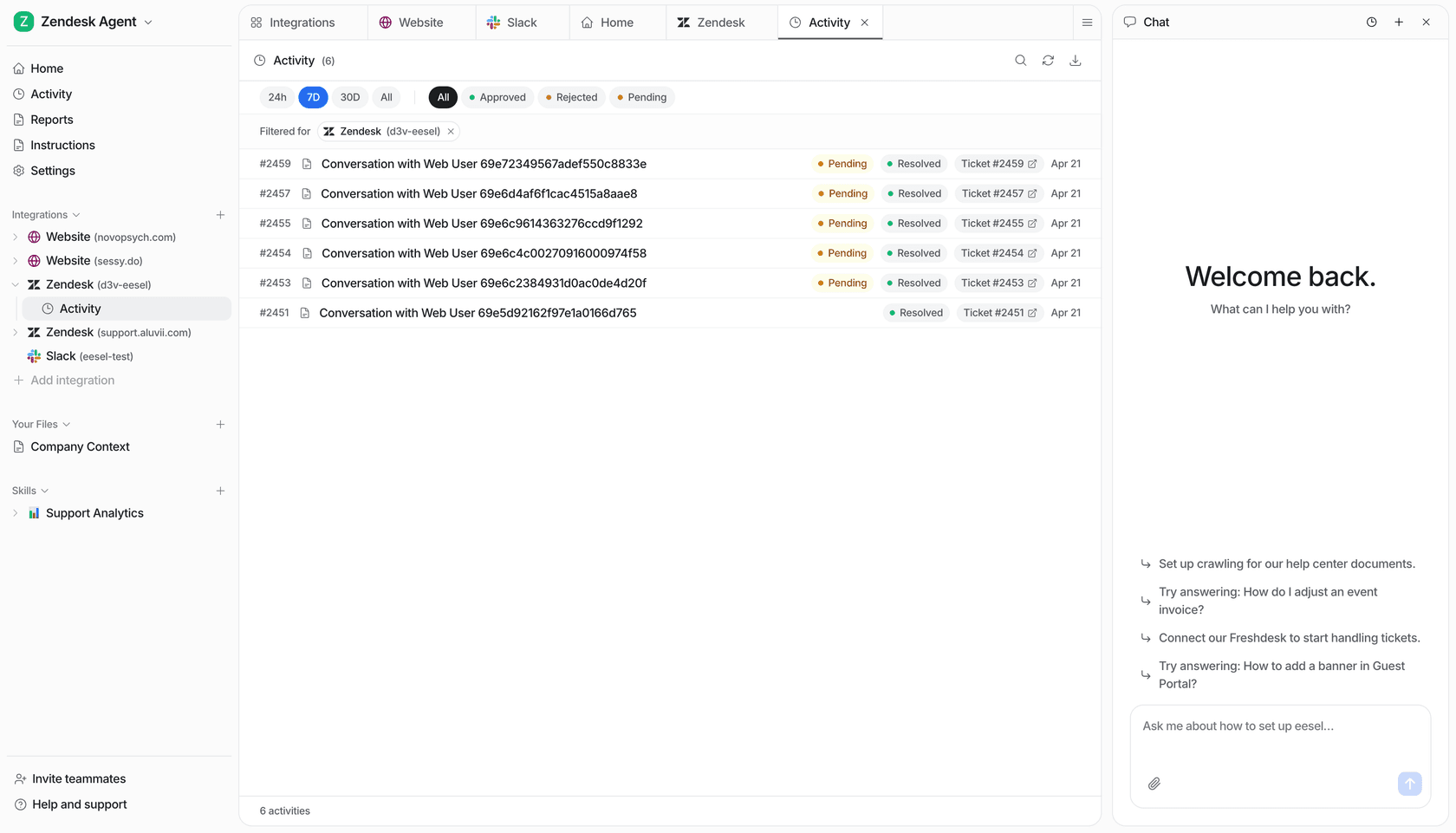
Muse Wonder is a model you rent by the token; eesel is the teammate that does the job. eesel is an AI teammate platform where you hire ready-to-work teammates for specific roles, and today that's an AI helpdesk teammate and an AI blog writer.
The helpdesk teammate plugs into Zendesk, Freshdesk, Gorgias and more, learns from your past tickets, help center and docs, and answers only from what you've approved. Before it replies to a single customer, you can simulate it on your historical tickets and read exactly what it would have said. Pricing is per ticket, not per token: one ticket or chat is one credit, starting at $299 a month for 500 credits, with 100 free credits to try it, per the eesel pricing page.
If you were pricing Muse Wonder to put AI on your support queue, skip the token math. Try eesel free and watch it draft replies on your own tickets.