

Gemini 4 Argon pricing at a glance
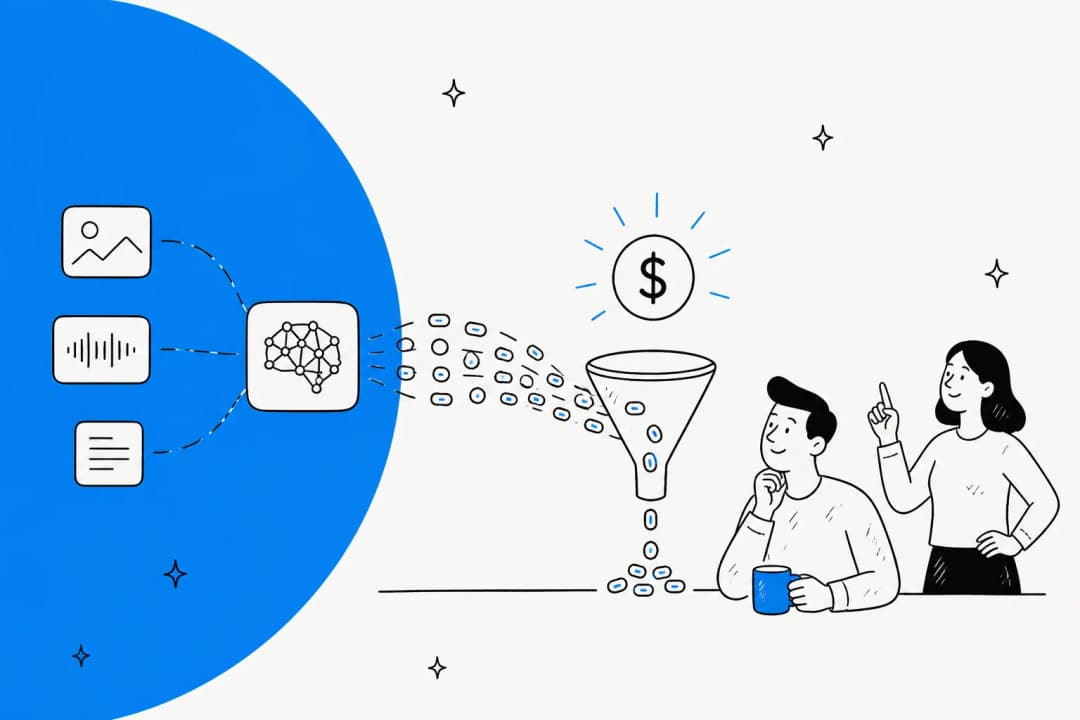
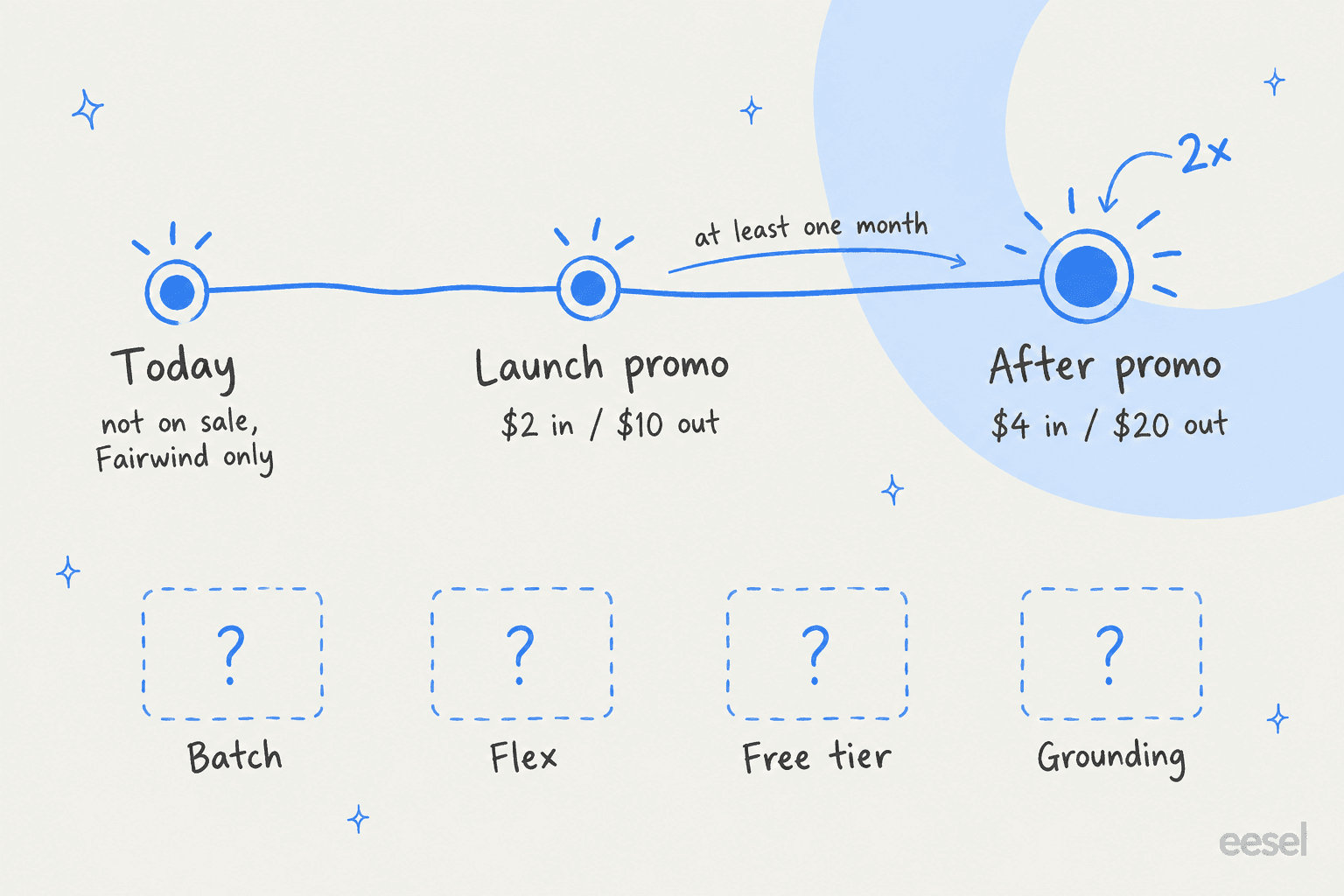
Google announced Argon on 30 September 2026. The whole price lives in a single line of the launch post plus one footnote. Here is all of what Google has published so far, put in one table:
| Introductory price | After the promo | |
|---|---|---|
| Input, per 1M tokens | $2.00 | $4.00 |
| Cached input, per 1M tokens | $0.10 (95% off) | $0.20 (95% off) |
| Output, per 1M tokens (thinking included) | $10.00 | $20.00 |
| Long-context surcharge | None published | None published |
| Batch / Flex / Priority | Not published | Not published |
| Free tier | Not published | Not published |
| Context window / max output | 1M / 1M tokens | 1M / 1M tokens |
| Who can buy | Nobody yet | Paid API customers first |
The footnote itself says: "After the introductory period expires, the price of $4 per 1M input tokens and $20 per 1M output tokens will apply." The $0.20 post-promo cache rate comes from my own arithmetic on Google's "95% off input token price," and it lines up with the figure in Artificial Analysis's own cost breakdown. Artificial Analysis describes the discount as a 50% promotion "for at least one month" and it also notes the cache discount went up from 90% on Gemini 3.8 Flash.
If you want the specs behind the price (benchmarks and safety, plus who's in the Fairwind Program), my Gemini 4 Argon overview covers it. Here I'm sticking to the money.
Can you actually pay for it yet?
No. That's worth knowing before you type any number into a spreadsheet. Argon is "rolling out to a set of trusted cyber defenders" through Google's Fairwind Program. Paid API customers and Google AI Ultra subscribers are next in line, and Google didn't give a date for either group.
I checked it again on 1 October 2026. A generateContent call to gemini-4-argon on my Gemini API key returned 404 NOT_FOUND, and there was no Argon anywhere in the model list. The Gemini Developer API pricing page still stops at 3.8 Flash and 3.1 Pro:
On the consumer side it's not any closer. The Gemini subscriptions page lists Google AI Plus at $4.99 a month, Google AI Pro at $19.99, and Ultra at $99.99 (5x Pro limits) or $199.99 (20x), and the top model it names is still 3.1 Pro. If consumer access is what you're after, Ultra is the only tier Google has named. Still, nothing on that page promises Argon to anyone yet.
How Gemini 4 Argon compares on price per token
Looking at the rate card alone, Argon lands in an odd spot: its promo price is GPT-6.1 Sol's price, and its standard price is Claude Opus 5.5's. Below are the published API rates for every model in Google's comparison table, and also the cheaper ones people really weigh it against. The full OpenAI API pricing and Anthropic API pricing guides have the rest:
| Model | Input / 1M | Cached input / 1M | Output / 1M | Source |
|---|---|---|---|---|
| Gemini 4 Argon (promo) | $2.00 | $0.10 | $10.00 | |
| Gemini 4 Argon (standard) | $4.00 | $0.20 | $20.00 | |
| GPT-6.1 Sol | $2.00 | $0.10 | $10.00 | OpenAI |
| GPT-6 Astra | $10.00 | $1.00 | $50.00 | OpenAI |
| Claude Opus 5.5 | $4.00 | $0.20 | $20.00 | Anthropic |
| Claude Fable 5.1 | $10.00 | $0.25 | $50.00 | Anthropic |
| Claude Sonnet 5.5 | $2.00 | $0.20 | $10.00 | Anthropic |
| Gemini 3.8 Flash | $0.75 | $0.075 | $3.75 |
A couple of things stand out. First, the Hacker News reaction ("5x cheaper than Astra") is correct per token, and that's exactly the comparison Google wants you making. Next to GPT-6 Astra and Claude Fable 5.1, promo Argon costs a fifth as much.
Second, the gap closes quickly. At standard pricing Argon is still 40% of Astra's per-token rate, but it's dead level with Opus 5.5, which sits about 5 points higher on the Artificial Analysis index at max effort. Gemini 3.8 Flash is on its own clock too: Google's pricing page says its $0.75/$3.75 doubles to $1.50/$7.50 on 1 January 2027. So for anyone building a Google-only budget for next year, both lines are going up.
There's a smaller detail that matters if you do long-document work. Gemini 3.1 Pro charges $4/$18 once a prompt goes over 200K tokens, and OpenAI bills prompts over 272K at 2x input. Google hasn't published any long-context surcharge for Argon. Maybe that's a real feature, maybe it's just not written down yet. Check the final rate card before you rely on it.
The number that matters: cost per task
A per-token price tells you what a word costs. It says nothing about how many words the model uses, and Argon uses plenty. Artificial Analysis ran its full index on Argon and found 62K output tokens per task, against 27K for GPT-6 Astra. Over the whole index it produced 110M tokens, while the median model uses 82M.
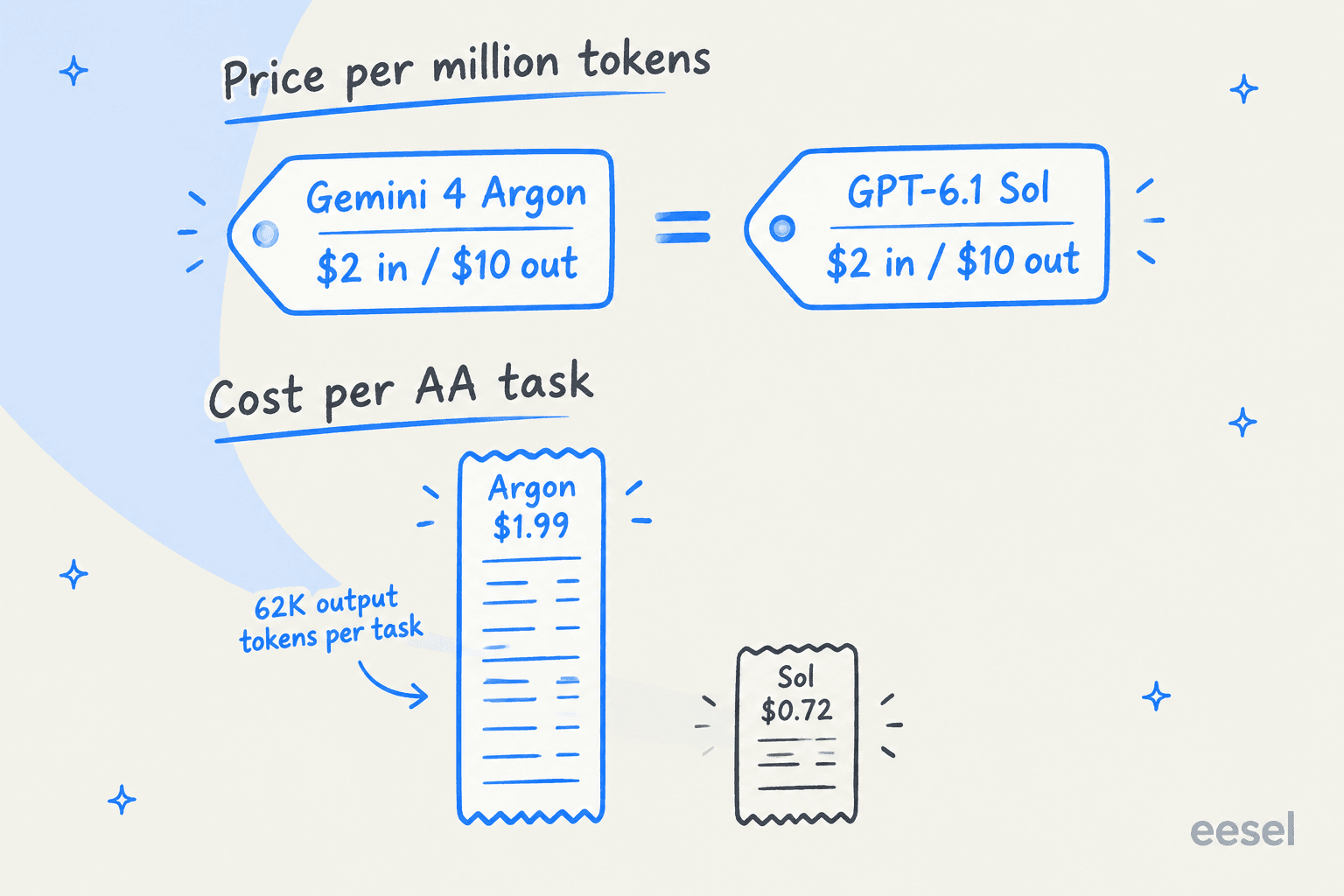
This is how one rate card ends up producing very different bills. Here's what Artificial Analysis measured for each index task:
| Model and setting | AA Intelligence Index | Cost per task |
|---|---|---|
| GPT-6.1 Sol (max) | 52 | $0.72 |
| Claude Opus 5.5 (high) | 54 | $1.82 |
| Gemini 4 Argon (high), promo price | 53 | $1.99 |
| GPT-6 Astra (max) | 53 | $3.26 |
| Gemini 4 Argon (high), standard price | 53 | $3.98 |
The Sol, Astra, and Argon rows come from the Artificial Analysis write-up; the Opus 5.5 high row is the figure a Hacker News commenter pulled from the same AA chart on launch day. The way I read it: Argon and Sol pay identical per-token prices, so the 2.7x gap is almost all down to Argon writing more.
Artificial Analysis also put out a waterfall chart showing where Argon's cost comes from. It starts at Gemini 3.1 Pro Preview at $0.67 a task:
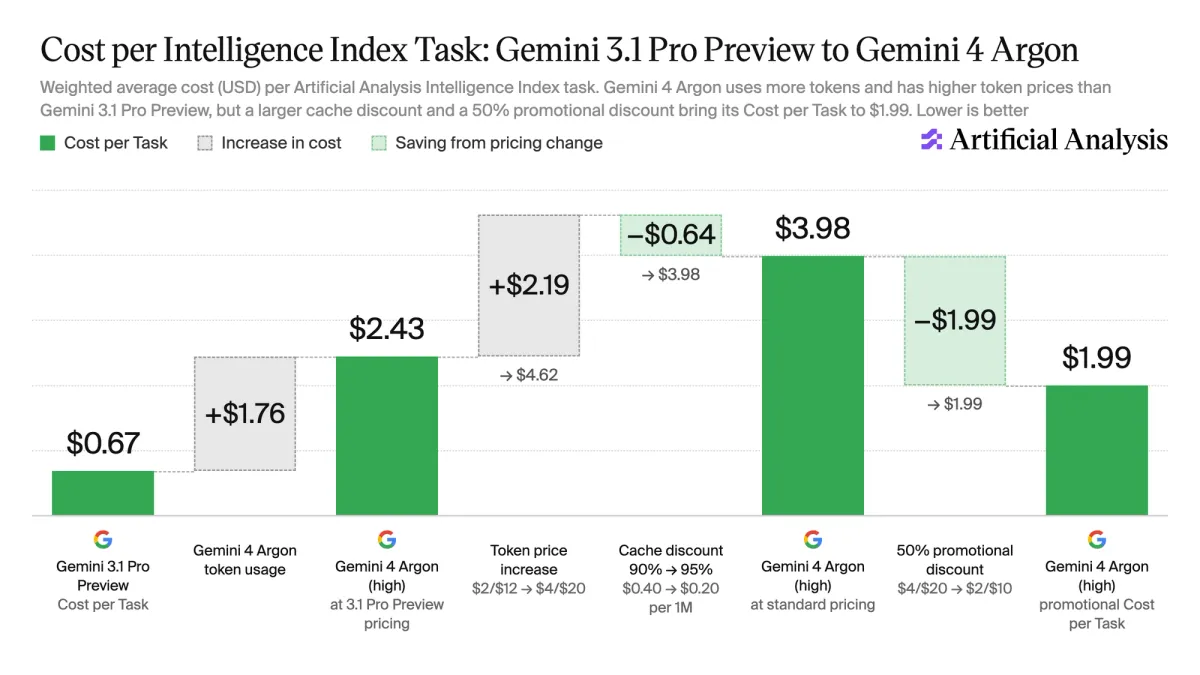
The first bar is the one I'd show a finance lead. Even on 3.1 Pro's old prices, the extra tokens by themselves would push a task from $0.67 to $2.43. After that, the promo hides most of the price rise. Take the promo away and a task costs about 6x what the previous Pro model did.
One Hacker News commenter saw this coming before the AA numbers were even out:
"watch it somehow use 20x more tokens tho"
It's not 20x, it's closer to 2.3x Astra's output. The instinct was right though, and it matches what I saw with Gemini 3.8 Flash, which also ran verbose on the index.
Worked examples: what Argon costs on real workloads
Sticker prices make more sense once you put a few concrete runs next to them. Each example below uses Google's published rates and the same token counts for every model. That flatters Argon a little, since it tends to write more.
1. A heavy agent run. Picture an agent that reads 200K tokens of context and writes 60K output tokens, which is close to Argon's 62K average. At promo pricing that's $0.40 in plus $0.60 out, so $1.00 a run. If you cache the context, the input side drops to $0.02 and the run costs $0.62. At 1,000 runs a month, the promo ending moves you from $620 to $1,240.
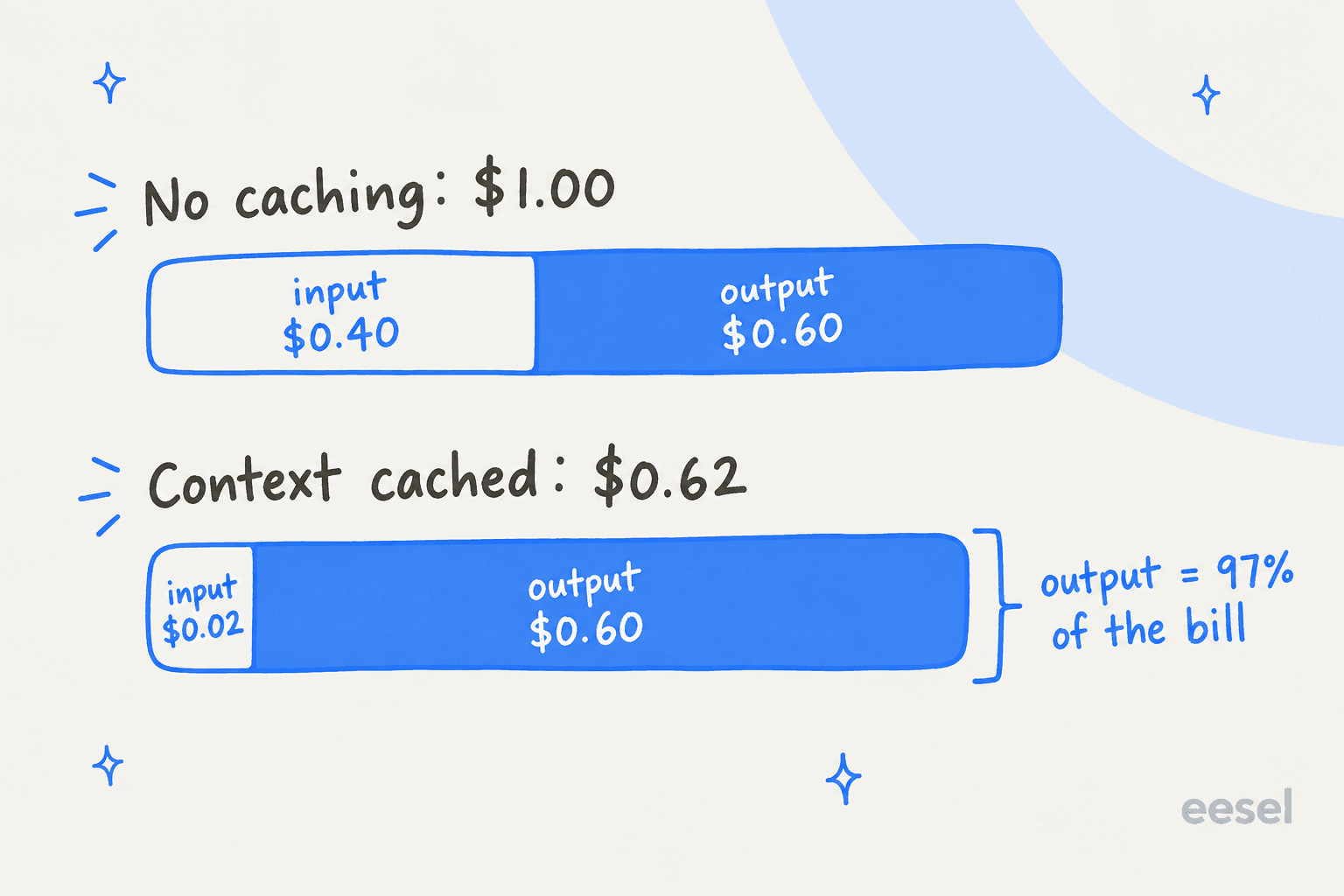
This is the usual pattern for agent work: once caching kicks in, output is about 97% of the bill. The 95% cache discount is generous, but it only applies to the part of the bill that was already small. To make Argon cheaper, go after shorter outputs, not more caching.
2. A long-document review. Imagine sending an 800K-token contract bundle and getting a 10K-token summary back, 500 times a month. Argon at promo: $1.60 + $0.10 = $1.70 a run, $850 a month. At standard pricing, $1,700. On Gemini 3.1 Pro's over-200K rates the same run is $3.38, and GPT-6.1 Sol's over-272K rate gives $3.35. So if Google keeps Argon free of a long-context surcharge, this is where it is cheapest relative to the field, even at full price.
3. A support ticket. This one I can back with a real test. Earlier this week I ran 15 support tickets through GPT-6.1 Sol for my GPT-6.1 Sol review. On average each one used about 545 input tokens and 70 output tokens, and the batch cost about $1.80 per 1,000 tickets. Promo Argon has the exact same rate card, so those same tokens cost the same $1.80. If Argon writes 2.7x the output, like the AA gap suggests, you get about $3 per 1,000 tickets. After the promo, double both numbers. For comparison, GPT-6 Astra measured $9.09 per 1,000 in the same test.
I couldn't run Argon itself, since the API returns 404. So treat the third example as a repricing and not a test result. Once paid access opens I'll rerun the same tickets.
Gemini 4 Argon cost calculator
Put in your own token counts. The presets line up with the three examples above. Prices are per Google, OpenAI, and Anthropic's published rate cards, for prompts under 200K tokens.
A couple of things to watch for while you play with it. Set the output tokens high and Argon promo ties Sol and halves Opus 5.5, but tick the 2.3x box and most of that lead disappears. On the long-document preset, Argon having no published surcharge does more for the bill than any discount does.
The hidden costs and open questions
The rate card is short, so a bigger share of the real cost is still unknown. These are the things I'd watch before committing a budget:
- The promo end date. "At least one month" per Artificial Analysis, no date from Google. Any forecast that runs past the end of October should use $4/$20.
- Verbosity. 62K output tokens per AA task. Your workload might be different, but output is where the bill lives, so measure that first.
- Missing tiers. No Batch, Flex, or Priority rate yet. On Gemini 3.8 Flash Batch and Flex are 50% off and Priority is 1.8x, so offline jobs could get a lot cheaper once Google publishes them.
- Grounding. Google Search grounding on Gemini 3.x is 5,000 free requests a month, then $14 per 1,000. For Argon, there's no published rate yet.
- Cache storage. Gemini 3.8 Flash charges per million tokens per hour of cache storage on top of cache reads. Argon's storage rate isn't out either, and with a 1M-token context that could add up.
The Hacker News thread got to the promo point fast. Someone praised the $10 output price, and the reply was short:
"That is a promotional price. The regular price is double that."
Others jumped straight to cost per task, which I think is the better instinct:
"It's also more token hungry than similar models, so does it really make a big difference in the end?"
Is Gemini 4 Argon worth the price?
For some workloads, yes, even at $4/$20. Long-document work is the clearest case: Argon tops Google's table on 256K to 1M context retrieval (84.2% vs the 60s and low 70s for rivals) and has no published long-context surcharge, so a contract or filings pipeline gets a better model and also a cheaper bill than it would on 3.1 Pro. Legal and finance agents have a case too, because Argon leads Harvey's Legal Agent Benchmark by about 3x.
For general agent work and coding, I'd hold off until there are real numbers. At promo prices, you're paying 2.7x GPT-6.1 Sol per task to get one more point on the AA index. At standard prices, you pay Opus 5.5's rate card for a model that trails Opus 5.5 on Terminal-Bench 4.0 by 9 points in Google's own table. If you need a cheaper frontier model today, the GPT-6.1 Sol alternatives and Gemini alternatives roundups cover what's on sale today.
For customer support, Argon's price hardly matters. At a few dollars per 1,000 tickets, the model is the smallest line in an AI customer service cost breakdown. Argon's 15% hallucination rate on AA-Omniscience, against 51% for GPT-6 Astra, is the more interesting number for support. Even that only helps if the agent around it reads the right knowledge and hands off when it doesn't know the answer. The guide to AI hallucinations in support covers that part.
What this means if you run a support team
I've spent a long time putting AI on live support queues at eesel, and model price has almost never been what decided whether a rollout worked. What decides it is everything around the model: the help center and past tickets it learns from, how it connects to Zendesk or Freshdesk, and whether it got tested on real tickets before it ever touched a customer. The cost per resolution is mostly people and process, not tokens.
Where a promo like Argon's does make a difference is predictability. If you build your own bot on raw tokens, you now own a bill that doubles on a date nobody has announced, and you're also tracking which model is best this month. For an engineering team running agents, that's fine. For a support lead who needs a number for next quarter's budget, it's a poor fit.
Try eesel
If you're pricing Gemini 4 Argon because you want AI answering tickets, you can skip the token maths. Argon is infrastructure; eesel is the employee. The eesel AI helpdesk teammate learns from your past tickets and help center and plugs into the helpdesk you already use. It also runs a simulation on your real past tickets so you can check its answers before it replies to a customer.
Pricing is a fixed monthly credit plan where one ticket or chat is one credit. Every feature and unlimited seats are included, and there's a free plan with 100 credits and no card. If a model's promo ends underneath you, your bill stays the same. Try eesel on a slice of your queue and see how it handles your own tickets.
Frequently Asked Questions
How much does Gemini 4 Argon cost?
When does the Gemini 4 Argon promo price end?
Can I pay for Gemini 4 Argon today?
gemini-4-argon and the model isn't on Google's API pricing page. It's rolling out to cyber defenders first, then paid API customers and Google AI Ultra subscribers, with no date.Is Gemini 4 Argon cheaper than GPT-6.1 Sol?
Is Gemini 4 Argon cheaper than Claude Opus 5.5?
Does Gemini 4 Argon have batch or free tier pricing?
What would Gemini 4 Argon cost for customer support?


Article by
Kira
Kira is a writer at eesel AI with a Computer Science background and over a year of hands-on experience evaluating AI-powered customer service tools. She focuses on breaking down how helpdesk platforms and AI agents actually work so that support teams can make better buying decisions.