

What Gemini 3.7 Flash actually is
Gemini 3.7 Flash is the newest workhorse model in the Gemini AI line. It ships as gemini-3.7-flash and is marked GA rather than preview. The framing from Google is blunt: "our most intelligent workhorse model yet for coding and agents."
It carries a 1M token context window with a 64k output ceiling. Input can be text, image, video, audio and PDF, but the output stays text-only. Six surfaces have it live, which includes AI Studio and the Gemini API, and also Google Antigravity, where it is now the default model sitting behind the Antigravity agent.
One piece of the context matters for reading everything below. There is currently no stable Gemini 3 Pro. gemini-3-pro-preview is marked shut down, and the only Pro left on the list is 3.1 Pro in preview, which is a real change from the Gemini 3 launch shape. So Flash carries more weight in the lineup than a model with "Flash" in the name normally would, and this explains a lot on how it has been positioned and priced.
The API changed more than the model did
This is the part which will actually cost you an afternoon, and almost nobody is leading with it.
If you are migrating from Gemini 3.5 Flash, Gemini 3 Flash Preview, or Gemini 3.1 Pro, then Google's migration checklist tells you to strip temperature, top_p, top_k and candidate_count, replace the numeric thinking_budget with a thinking_level string, remove prefilled model turns, and move multi-turn history to a server-side previous_interaction_id. Gemini 3.6 Flash had already dropped the sampling parameters, so a 3.6 to 3.7 move comes nearly free. Everyone else, the full cleanup.
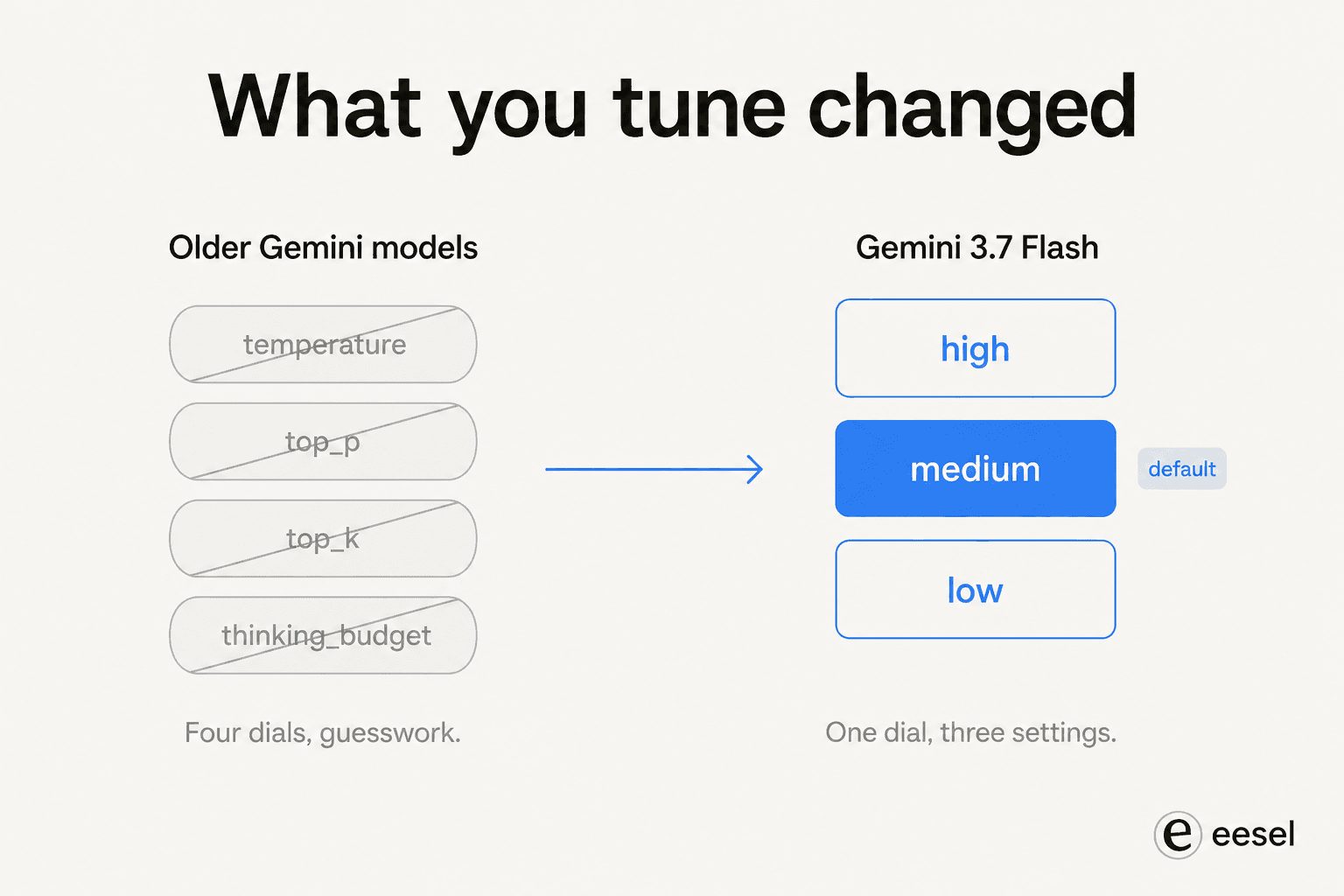
In the place of four dials you now get one, with three settings, and it sets inside generation_config:
| Level | What Google says it is for | Cost profile |
|---|---|---|
low | Latency-critical work: incident response, real-time chat, drafts, fast data analysis | Cheapest available floor |
medium (default) | Complex code and agentic use, with higher first-pass accuracy | Default if you set nothing |
high | Hard math, the most difficult coding and agent tasks, extended tool use | "Higher token consumption and cost" |
Here is the regression which nobody put into a press release. Gemini 3.6 Flash, 3.5 Flash, 3.5 Flash-Lite and 3 Flash Preview all accept a fourth level, minimal. Gemini 3.7 Flash does not. In a 347-comment launch thread, Simon Willison was the only person who flagged it:
"The 'introductory pricing' for this 3.7 Flash model is really weird.
It's scheduled to double in price on December 31, 2026, but who would anticipate still using this model five months from now? Especially since 3.6 Flash came out just three weeks ago!"

Losing minimal matters more than what it sounds. If you were running Flash for OCR and tagging, or for ticket classification, minimal was the setting which made the economics work. low is a real floor. It is not the same floor.
The other quiet change: every code sample on the page now uses the Interactions API, which went GA alongside the model, instead of generateContent. Worth to know this before you copy a snippet into a codebase that was built on the old shape.
How fast it is, and how that speed is distributed
Speed is where 3.7 Flash stays uncontested. Artificial Analysis clocks it at 340.1 output tokens per second, which ranks first out of the 188 models they track, against a class median of 68.6. Intelligence Index lands on 56, seventeenth of 188, well above the class median of 34.
Real-world numbers is less flattering, and more useful. OpenRouter shows a P50 of 93 tokens per second at 1.85 seconds latency. The split by provider is stark here: Google AI Studio serves 124 tokens per second at 1.74 seconds, where Vertex manages 84 at 2.02 seconds.
Time to first token is the weak spot, and this depends entirely on which thinking level you picked. Artificial Analysis measures a median of 9.83 seconds to first token on high effort, with a p95 of 49.5 seconds, against a class median of 2.88. At low it drops to 0.74 seconds. That is a difference between a usable interactive latency and the one your users will complain about.
Which surfaces the most practical finding in the whole of the dataset:
| Thinking level | Intelligence Index | Time to first token | Cost per benchmark task |
|---|---|---|---|
high | 56.0 | 9.83s | $0.40 |
medium | 53.5 | 4.22s | $0.26 |
low | 50.9 | 0.74s | $0.16 |
At low effort it still scores 50.9, within a point of Gemini 3.6 Flash at full high effort, for 40% of the cost per task and roughly a thirteenth of the wait. So if you migrate from 3.6 Flash and then leave the default sitting on medium, probably you are overpaying for a reasoning which you did not need.
The odd part is that 93.1% of OpenRouter traffic goes to Vertex, the slower endpoint, because that one is carrying a 50% platform discount. People trade latency away for price, which tells you what they are actually buying this model for.
There is also a strong counter-argument against the whole speed story, and it arrives with numbers. Artificial Analysis measured that with high reasoning, 3.7 Flash increases token use by around 40% over 3.6 Flash, averaging 37k output tokens per task. Tokens per second and time to answer, these are not the same thing:
"Sol high is almost the same speed if you take into account drastically lower token use. Look at the artificial analysis speed vs token use. Gemini is 7x faster but 5x more tokens. And that's with Sol high being a substantially better model."
That 40% token increase is a price increase wearing a speed badge. The rate card did not move. What moved is the number of billable output tokens per task, and thinking tokens ride along there at the output rate too. Keep this in the mind for the calculator below.
The benchmarks, including the ones Google did not lead with
Google published a 21-row comparison against Gemini 3.6 Flash, Claude Sonnet 5, GPT-5.6 Terra and Muse Spark 1.2. To their credit they published the losses also. Here are the rows which matter most:
| Benchmark | Gemini 3.7 Flash | Gemini 3.6 Flash | Claude Sonnet 5 | GPT-5.6 Terra | Muse Spark 1.2 |
|---|---|---|---|---|---|
| Input price, $/1M | $0.75 | $0.75 | $2.00 | $2.00 | $1.25 |
| Output price, $/1M | $3.75 | $3.75 | $10.00 | $12.00 | $4.25 |
| AA Intelligence Index | 56 | 52 | 55 | 57 | 57 |
| FrontierCode 1.1 Main | 43.6% | 34.4% | 42.7% | 41.3% | - |
| DeepSWE v1.1 | 65.3% | 48.6% | 53.8% | 69.6% | 54.9% |
| Code Arena (Elo) | 1588 | 1538 | 1541 | 1523 | 1535 |
| Terminal-bench 2.1 | 85.8% | 78.0% | 80.4% | 87.4% | 82.9% |
| Terminal-bench 3.0 | 14.9% | 5.4% | 14.6% | 20.8% | - |
| AutomationBench (private) | 30.4% | 17.0% | 10.7% | 23.6% | - |
| GDPVal-AA v2 (Elo) | 1525 | 1422 | 1598 | 1578 | 1628 |
| Harvey LAB-AA (legal) | 90.7% | 85.1% | 90.1% | 85.2% | - |
| GDP.pdf (PDF comprehension) | 34.0% | 22.0% | 28.0% | 24.7% | 16.0% |
| CharXiv Reasoning (no tools) | 84.5% | 85.2% | 77.0% | 85.9% | - |
| CharXiv Reasoning (with tools) | 88.7% | 89.4% | 88.3% | - | - |
| LVBench (long video) | 85.4% | 84.2% | 68.5% | 78.9% | - |
| GDM-MRCR v2 @128k | 97.0% | 91.8% | 81.5% | 93.5% | - |
| OSWorld-2.0 (computer use) | 47.9% | 33.8% | - | 50.2% | - |
| HLE-Verified | 53.6% | 51.2% | 31.0% | 51.1% | - |
Some honest readings of that table.
The jumps against its own predecessor are large and real. DeepSWE going from 48.6% to 65.3%, and AutomationBench from 17.0% to 30.4%, this is not rounding. Google's own prose quotes DeepSWE at 49.0% rather than 48.6% for 3.6 Flash, a small discrepancy in between the copy and the chart, though the direction is not in a doubt.
GPT-5.6 Terra still owns agentic terminal work. Terminal-bench 2.1, Terminal-bench 3.0, DeepSWE and OSWorld-2.0 all go to Terra. If your workload is a long-horizon coding agent chewing through a real repo, then that is four of the four benchmarks which matter, and it is the reason several people on Hacker News read this one as a Terra competitor instead of a budget pick.
It lost two rows to Gemini 3.6 Flash. Both of them are CharXiv chart reasoning, 84.5 against 85.2 without tools and 88.7 against 89.4 with them. Small. But it means "3.7 beats 3.6 at everything" is not a true statement, and if charts are your workload then you should check this before you migrate.
There is one more number which only shows up in the independent testing. Artificial Analysis measures a hallucination rate of 64.5% for 3.7 Flash against 55.6% for 3.6 Flash. Accuracy went up, and hallucination went up together with it.
To be fair on Google, that number looks very different depending which baseline you take. A reader working through the same data over on Reddit put it into a longer context:
"Flash 3 had 93 % hallucination but also very good world knowledge. 3.7 Flash has 65 %. This is a considerable improvement but it still lacks behind 3.1 Pro. […] Both Gemini Flash and GPT Sol are very good at getting the right answer, better than all other models except Claude Fable and Opus. It's just that when they don't get it right hallucination is likely or almost guaranteed."

So: much better than Flash 3. Slightly worse than the model which it directly replaces, and still behind 3.1 Pro. That last one is the part that matters, and I come back later to why it keeps me awake.
Two caveats about the sourcing. Artificial Analysis has no 3.7 Flash score for SWE-Bench Verified, AIME, LiveCodeBench or MMLU-Pro, so whatever figure you see circulating for those is Google's own chart and not an independent run. Also the context window disagrees in between sources, with Artificial Analysis saying 1,000,000 where Google's Vertex card says 1,048,576.
What it costs, and the date that price ends
The headline says $0.75 per 1M input tokens and $3.75 per 1M output. The asterisk is the whole of the story.
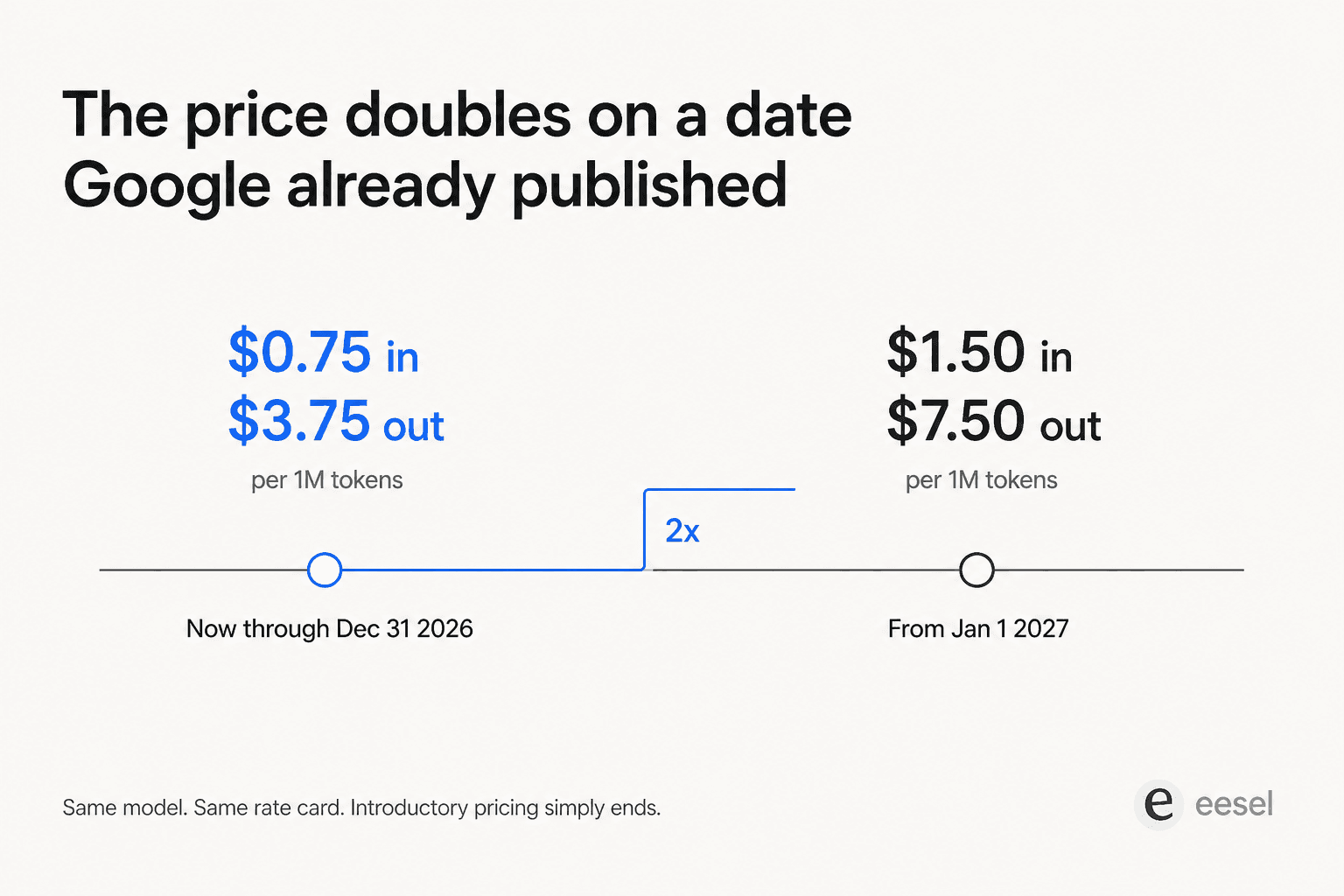
Here is the full rate card, taken from Google's pricing page:
| Line item | Through Dec 31, 2026 | From Jan 1, 2027 |
|---|---|---|
| Input, per 1M tokens | $0.75 | $1.50 |
| Output (including thinking), per 1M | $3.75 | $7.50 |
| Batch mode input / output | $0.375 / $1.875 | $0.75 / $3.75 |
| Flex mode | Same as batch | Same as batch |
| Priority mode | $1.35 / $6.75 | $2.70 / $13.50 |
| Context cache read, per 1M | $0.075 | $0.15 |
| Context cache storage, per 1M per hour | $0.50 | $1.00 |
| Google Search grounding | 5,000 free requests/month across all 3.x models, then $14 per 1,000 | Same |
A few things worth to pull out. There is no context-length price step, so a 900k-token prompt costs the same per token like a 900-token one does, unlike on 3.1 Pro Preview. There is no modality surcharge either, audio and video input bill at the same rate as text, where 3 Flash Preview charges double for the audio. And grounding got much cheaper across the 3.x generation, dropping from $35 per 1,000 requests down to $14.
The part which reads strangely is that Gemini 3.6 Flash is now priced identically to 3.7 Flash, the same introductory rate and the same expiry, and the same standard price afterwards too. Google's prose describes 3.7 Flash as roughly half of the original 3.6 Flash cost, true against list price, not true against what 3.6 Flash costs you today. There is no premium on the newer model, which mostly means no reason to stay on 3.6 unless CharXiv or minimal is load-bearing for you. Our 3.6 Flash pricing breakdown still holds, because now it is the same rate card.
Plug in your own volume here:
You are paying for thinking you never see
This is the line item which surprises people, and it stands stated plainly in Google's thinking docs: "When thinking is turned on, response pricing is the sum of output tokens and thinking tokens."
Then the sharper sentence, few paragraphs down: "Pricing is based on the full thought tokens the model needs to generate, despite only the summary being output from the API."
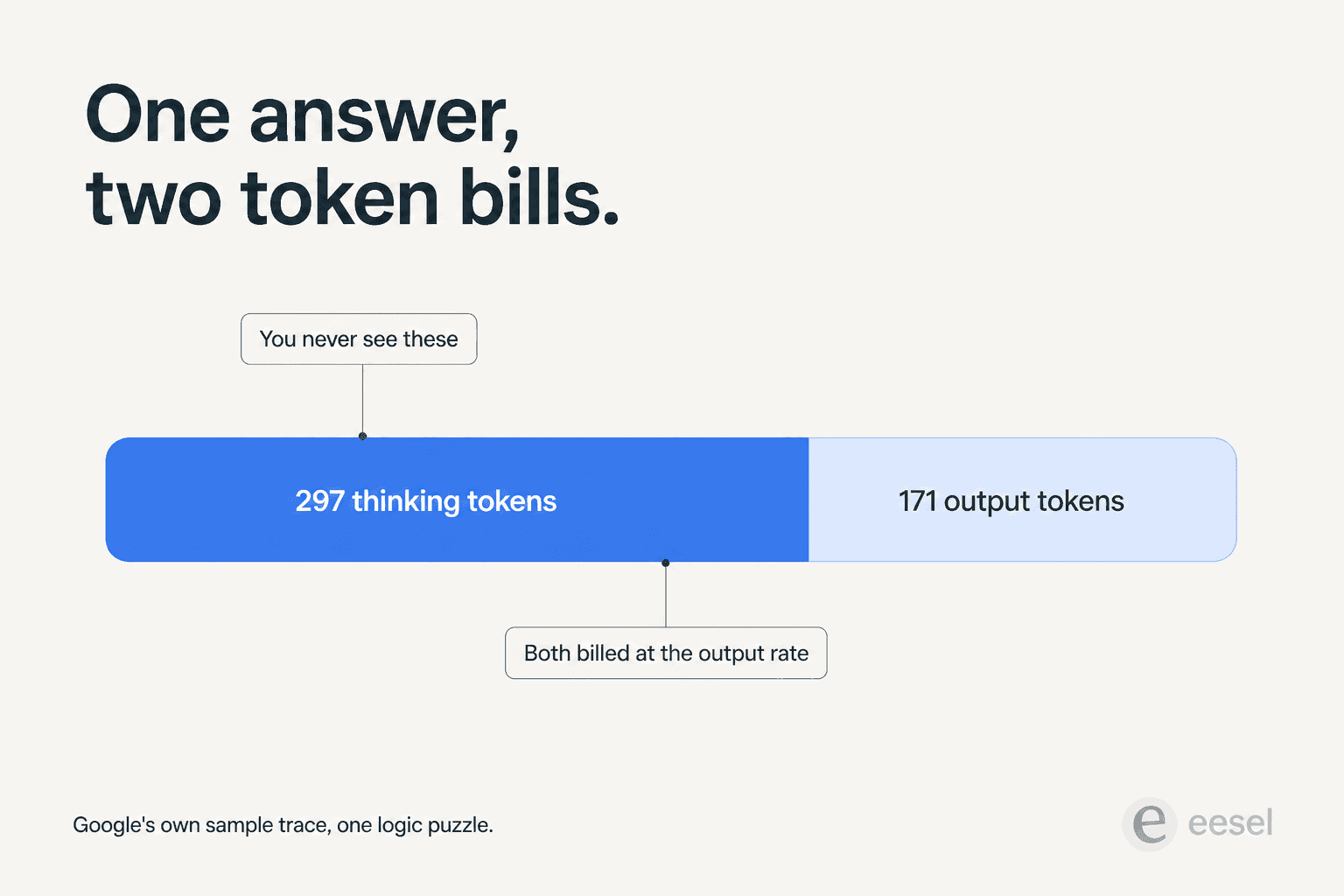
Google's own sample trace on a three-clue logic puzzle spends 297 thinking tokens against 171 output tokens. So nearly two thirds of that response's output bill was a reasoning which the caller never receives, only a summary of it. The count is exposed as usage.total_thought_tokens, so measuring is possible, but you have to go looking for it. If you run several models side by side, this is exactly the kind of thing which LLM tracking tools exist to catch.
Multiply that across a production workload and medium being the default becomes a real decision instead of a shrug. It is also the reason why the thinking-overhead slider in the calculator above sits set on 75% and not zero.
Some developers finds the summarised approach worse than useless. From the launch thread:
"I really, really like DSv4 Flash because you see the full, real thinking text. That's been so useful for helping steer the model; as well as seeing its thoughts and correcting any errors, or expanding on it. It's so difficult for me to use closed models with no or summarised thinking now."
What developers are actually saying
The launch thread hit 621 points and 347 comments in about the eight hours, and the shape of it is more interesting than the score is.
The most-quoted number in the whole thread turns out to be a competitor's price:
"Ever since the insane discount with GPT-5.6 Luna, not much excites me anymore. I mean just look at the benchmarks, even though Gemini 3.7 Flash performs well on the DeepSWE 1.1, Luna (Max) still performs way better.
> Starting January 1, 2027, $1.50/1M input tokens and $7.50/1M output tokens will apply.
Compare this to Luna which is at $0.2/1M input ($0.02 cached) and $1.2/1M output."
The positioning correction came few comments later, and this is the most useful thing in the whole thread:
"They need to release benchmarks against Luna/Terra. Luna is much cheaper which feels like it undercuts the need for Flash.
I've always considered the Flash series of models to be for low-cost, high-volume, mostly text-based use cases (e.g. summarization, parsing, formatting), emphasis on low-cost."
That is the reframe. Flash is no longer competing at the bottom of the market; Flash-Lite is. If you loved Flash because of it being cheap, then the model you actually want next sits a tier down, or outside of the Google family entirely.
The obvious places for looking are Qwen and Kimi. If a Western host on a similar budget is what you need, then Mistral pricing makes the closest comparison.
The sharpest hands-on verdict came out of an image-to-HTML test which was run through opencode, pitting 3.7 Flash against Claude Opus 5 and Grok:
"It's not a bad model by any means, but I just don't know what situation I'd reach for 3.7 Flash first for. Google really needs a differentiator, especially given how hard it is to get an API key from them. They can't be high friction and non-pareto."
That last clause opened the largest subthread of the day, and the model was not its subject at all. The subject was whether Google is buyable. One commenter reported the error string "Failed to create project, The request is suspicious. Please try again" on a fresh key; another reported the same thing on a ten-year-old Cloud account which only started working two days after. The most operationally painful one:
"There are places where you CAN set a limit. This seems great until you are at the center of a huge traffic spike because of good pr and so you try to change it to a larger number only to be told you need to wait 24 hours for the setting to change.
Biggest traffic day of the decade and our site was down because of google."
In the fairness, this gets disputed downthread. One commenter created a key on a fresh account in two clicks and without leaving the page, plus Google now does ship spend caps on the Gemini API. So the friction is real for some people and a non-issue for the others, which is its own kind of a problem. For a contrast, OpenAI rate limits and GPT-5 Pro API pricing are documented in a way that most people get through without any support ticket.
Where Flash still wins outright
Vision, and documents. This is the one axis where even the critics in the thread conceded the point.
Look back at the benchmark table: GDP.pdf at 34.0% against Terra's 24.7%, LVBench at 85.4% against 68.5% for Sonnet 5, then the 128k long-context needle test at 97.0%. That reads as a coherent picture and not as three lucky rows. One commenter put the practical version better than any benchmark could do, describing Gemini which correctly diagnosed a plant problem from a photo, after a text-first model had got it wrong.
"That's been my association as well. I see Flash get brought up a lot in relation to things like OCR and PDF processing frequently, and a lot of other routine multimodal workloads."
There is also a scale argument, and it surprised me:
"did you try to ingest 1M documents per hour with any provider except GCP with Flash? None work at scale. Deepseek, Luna, Mistral all fail. 1 in 3 requests is a fail. I stopped trying. The only thing that works at scale is gemini flash."
Cheap per token and reliable at volume are two different things, and that is a distinction which the price-comparison threads mostly skip.
Google's named customers lands in the same place. Browser Use co-founder Gregor Zunic reports the agent was "35% cheaper than 3.6 Flash, with a +8% observed prompt-cache hit rate and fewer tool errors." Worth to read that one as total spend and not as rate card, because the two models bill identically today; the saving comes out of cache hits and fewer retried tool calls. Harvey's Niko Grupen reports +2.6 points all-pass on their Legal Agent Bench. Nunu.ai's Kyrill Hux calls it on par with GPT-5.6 Terra "at around half the cost." These are vendor-supplied quotes sitting on a launch page, so weight them accordingly.
The most useful third-party read came from Cognition, who put it inside of Devin and then were specific about where it fits:
"On FrontierCode 1.1, it reaches Claude Sonnet 5-level performance at less than half the cost, with the low latency the Flash series is known for. […] Within Devin, Gemini 3.7 Flash performs particularly well on tightly scoped refactors, where it delivers minimal diffs that match repo conventions."
"Tightly scoped refactors" is a precise and honest boundary, and it matches to what the terminal-agent benchmarks say about the long-horizon end.
Who should use Gemini 3.7 Flash, and who should not
Reach for it if you are doing document extraction, PDF and chart work, long-context retrieval, video understanding, or web and UI code generation from mocks. Code Arena's 1588 Elo is the top score sitting in Google's table, and the document benchmarks are not close ones. It is also the right pick when you are already on Antigravity, since there it is the default now.
Skip it if your workload is a long-horizon terminal coding agent, where GPT-5.6 Terra wins those four benchmarks which measure exactly that. Skip it also if you came to Flash for the price floor. In between losing minimal, and thinking tokens billing as output, plus a rate which doubles in January, the cheap-tier argument has quietly moved over to Flash-Lite and to competitors an order of magnitude below on output.
Wait if you sit on 3.6 Flash and CharXiv-style chart reasoning is load-bearing for you. You would pay identical money for two benchmark rows which get slightly worse.
If you still weigh the field, the roundups worth of your time are Gemini alternatives, Gemini 3 alternatives and Claude alternatives.
On tooling, the model matters less than the harness which you run it inside. Most people reading this will meet 3.7 Flash through an editor and not through a raw API call, and our notes on best AI coding assistants, agentic coding CLIs and Cursor pricing covers that layer.
What this means if you are putting a model on a support queue
Now back to the hallucination number, because here is where my day job starts.
Artificial Analysis measures Gemini 3.7 Flash hallucinating at 64.5%, against 55.6% for 3.6 Flash. Accuracy improved, and hallucination got worse, at the same time. That combination is no contradiction; it is the normal shape of a model which has been tuned for committing to answers instead of hedging. Great for a coding agent that a compiler can correct. A liability when the output goes straight onto a customer.
Someone who runs exactly this workload in production drew the boundary better than I could do:
"Yeah we use it for auto-triage of incidents, attempts to auto-remediate, and escalation to human. But for actual development, it's not a viable option for us."
Triage, then attempt, then escalate. That is the correct shape, and note how a human is the last step there and not an afterthought.
We have spent years running AI agents on live helpdesks at real volume, this includes a lender pushing 100,000+ German-language tickets a month through Zendesk and an e-commerce team handling 50,000+ a month on Freshdesk. What that experience teaches is that a benchmark score tells you almost nothing about how a model behaves on your tickets. Two teams on the same model, the same helpdesk and the same industry, they get different answers, because their knowledge bases are different shapes.
So the model choice matters less than the things which sit around it. Retrieval that actually finds the right document, and this is a RAG problem rather than a model problem. Confidence routing, so a low-confidence answer turns into a draft instead of a send. And then a dry run against your own ticket history, before any customer ever sees a word of it, which is the step that most support automation rollouts skip.
Notice how not one of those is the model itself. Most of the reasons an AI chatbot answers incorrectly are content and retrieval failures, and not the model being insufficiently clever, and fixing the knowledge base usually moves the number further than swapping over to whatever launched this week.
That last one is the whole of the argument. You cannot read a 64.5% hallucination rate off a leaderboard and then predict what your customers will get. What you can do is run the agent over 500 of your closed tickets and read the answers yourself. It is also the only honest way for comparing ticket automation tools, or for picking between AI helpdesk platforms, because every vendor's demo is built on their data and not on yours.
If the reason you price tokens at all is a support budget, then the cheaper comparison for running first is AI agent vs human cost, which tends to dwarf the difference in between $3.75 and $7.50 per million. We put numbers onto that in AI savings in support.
Try eesel
If you got here because you are evaluating Gemini 3.7 Flash for powering support, the honest advice is to stop comparing model cards and to start testing on your own tickets. That is what eesel is built for doing: it connects to Zendesk, Freshdesk, Gorgias, HubSpot, Front or Slack in a few minutes, it learns from the tickets you already solved and not only from your help center, then it runs a simulation over your ticket history, so you see the exact answers which it would have sent, per theme, before anything at all goes live.
It is usage-based at $0.40 per ticket with no per-seat fee, so the maths compares against a token bill easier than what most vendors make it. One customer resolved 73% of tier-1 requests in the first month, and the results were visible inside a seven-day trial.
Try eesel free, run it over your last few hundred tickets, then let the simulation tell you if the model is good enough or not. That answer is worth more than any benchmark table on this page, mine included.
Frequently Asked Questions
How much does Gemini 3.7 Flash cost?
Is Gemini 3.7 Flash better than Gemini 3.6 Flash?
What is the Gemini 3.7 Flash context window?
Does Gemini 3.7 Flash still support temperature and top_p?
Is Gemini 3.7 Flash good for customer support?
What is the cheapest way to run Gemini 3.7 Flash?
How does Gemini 3.7 Flash compare to Claude and GPT?


Article by
Rama Adi Nugraha
Rama is a software engineer at eesel AI with two years of experience writing about B2B SaaS, AI tools, and customer support technology. Based in Bali, Indonesia, he brings a developer's perspective to product comparisons — cutting through marketing copy to what the integrations and APIs actually do.