

The way people find information is changing, and it's changing fast. For years, we've all been focused on ranking on Google. But now, a lot of people are just skipping the search results and asking an AI like ChatGPT, Perplexity, or Gemini for answers directly.
This is a pretty big shift for brands. All the effort you put into SEO doesn't mean as much if your customers are getting their info from a chatbot. It leaves you wondering: Are we being recommended? Are our competitors? Is the AI saying accurate things about us? Your traditional SEO analytics can't answer any of this, leaving you in the dark.
This is where a new type of software comes into play: LLM tracking tools. These are becoming essential for any marketing team that wants to stay visible. They show you exactly how your brand is being discussed in this new AI-first world.
Of course, tracking is just step one. The real value comes when you use those insights to create content that gets cited by AI, a practice known as Answer Engine Optimization (AEO). It’s how you go from being invisible to being the authority. Tools like the eesel AI blog writer are designed to help you turn those tracking insights into actual content.
What are LLM tracking tools?
So, what are these tools, really? Think of LLM tracking tools as a way to peek inside models like ChatGPT and Gemini. They are specialized software built to monitor how your brand, products, or any topic you care about is mentioned in the responses from Large Language Models (LLMs).
Basically, these tools run hundreds or thousands of questions (prompts) across different AI models. They then collect the answers and organize the data so you can see how often you were mentioned, if the tone was positive or negative, and which sources the AI used to formulate its answer.
What to look for in LLM tracking tools
- Multi-engine coverage: The AI world isn't dominated by a single player. You don't want a tool that only tracks ChatGPT. The best options cover a wide range of models, including Google's AI Overviews, Perplexity, Claude, and whatever comes next. The more models you can track, the clearer your picture of the market.
- Actionable insights: A massive spreadsheet of mentions isn't very useful on its own. Look for a tool with a clean dashboard that provides real insights. This should include features like sentiment analysis, share of voice metrics (how often you're mentioned versus competitors), and a detailed breakdown of the sources the AI is citing.
- Persona-based tracking: This is a more advanced feature, but it's very powerful. Some tools, like Gumshoe AI, let you simulate questions from specific buyer personas. This helps you understand how different types of customers see your brand and what questions they’re asking.
- Scale and data accuracy: The tool needs to handle a lot of prompts reliably. The more data it can gather, the more accurate your view of reality will be. The best tools also try to mimic real user interactions to get results that aren't skewed by robotic prompting.
- Pricing model: You'll find a few different models. Some charge per prompt, others have tiered monthly subscriptions, and a few use a pay-as-you-go system. Think about how you'll use it. If you need constant monitoring, a subscription is probably best. If you're doing occasional research projects, pay-as-you-go could save you money.
From tracking to ranking: How to create AEO content with the eesel AI blog writer
Figuring out you have a visibility problem with an LLM tracking tool is only half the battle. Now you have to fix it. This is where Answer Engine Optimization (AEO) comes in. AEO is all about creating content that is specifically designed to be easily understood, trusted, and cited by AI models.
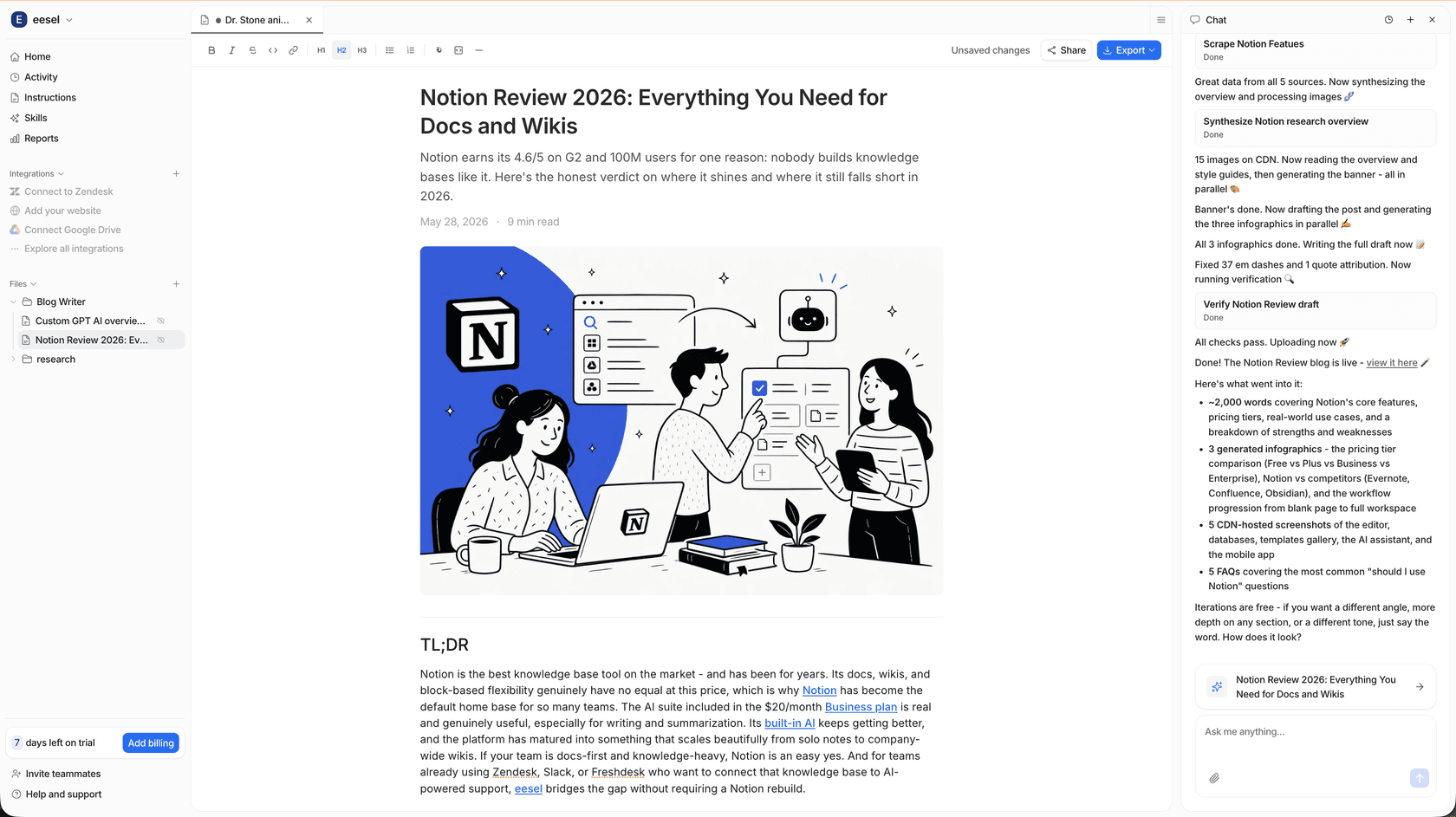
So, how does it help with AEO?
- Context-aware research: Instead of just generating generic text, it researches the topic to create thorough content. LLMs prefer depth and detail because it gives them more confidence in their answers.
- Automatic asset generation: The tool automatically includes things like tables, charts, and infographics. These structured elements are often pulled directly into AI-generated answers, like Google's AI Overviews.
- Social proof integration: It finds and embeds real Reddit quotes and relevant YouTube videos. AI models often see these as signals of authenticity and cite them as sources.
A workflow diagram showing how the eesel AI blog writer uses research, asset generation, and social proof to create content that ranks in AI answers, a key strategy for LLM tracking tools.
This approach has practical applications. We used the eesel AI blog writer to scale our own AEO content, and it took our blog from 70k to over 750k impressions in just three months. Once you know where you need to show up, it’s the fastest way to create the content that will get you there.
Comparison of the top LLM tracking tools
To give you a quick overview, here’s a high-level comparison of the tools we’re about to cover. This should help you see how they stack up at a glance.
| Feature | Semrush | Peec AI | Gumshoe AI | Otterly AI |
|---|---|---|---|---|
| Best For | All-in-one SEO & AEO | Startups & Agencies | Persona-Based Research | Affordable Monitoring |
| LLMs Covered | Extensive (9+) | Core 3 + Add-ons | Extensive (6+) | Core 4 + Add-ons |
| Pricing Model | Tiered Subscription | Tiered Subscription | Pay-as-you-go | Tiered Subscription |
| Standout Feature | Deep SEO data integration | Unlimited seats & countries | Persona-driven prompt generation | Low entry price |
4 notable LLM tracking tools in 2026
Alright, let's get into the specifics. I spent some time with each of these platforms to figure out what they do best and where they could improve. Here are the top contenders.
1. Semrush AI Visibility Toolkit
Semrush is a household name in search analytics, so it's no surprise they've expanded into AI visibility. Their toolkit is a strong option for larger teams that want a single platform to manage both their traditional SEO and new AEO efforts. It connects everything in one place.
- Pros: The biggest plus is its deep integration with Semrush's massive amount of SEO data. You can see how web signals like backlinks and domain authority might influence AI answers. The platform is robust, powerful, and covers a lot of LLMs.
- Cons: It can be a bit overwhelming if you're new to it, and it's one of the pricier options. If your team is only focused on LLM tracking, it might be more than you need.
- Pricing:
- AI Visibility Toolkit: This add-on starts at $99 per month for tracking one domain.
- Semrush One: Bundled plans that include both SEO and AI tools start at $165.17 per month when billed annually.
- Key features: Prompt research, competitor analysis, AI site audits to check for AEO readiness, and brand sentiment tracking across models.
2. Peec AI
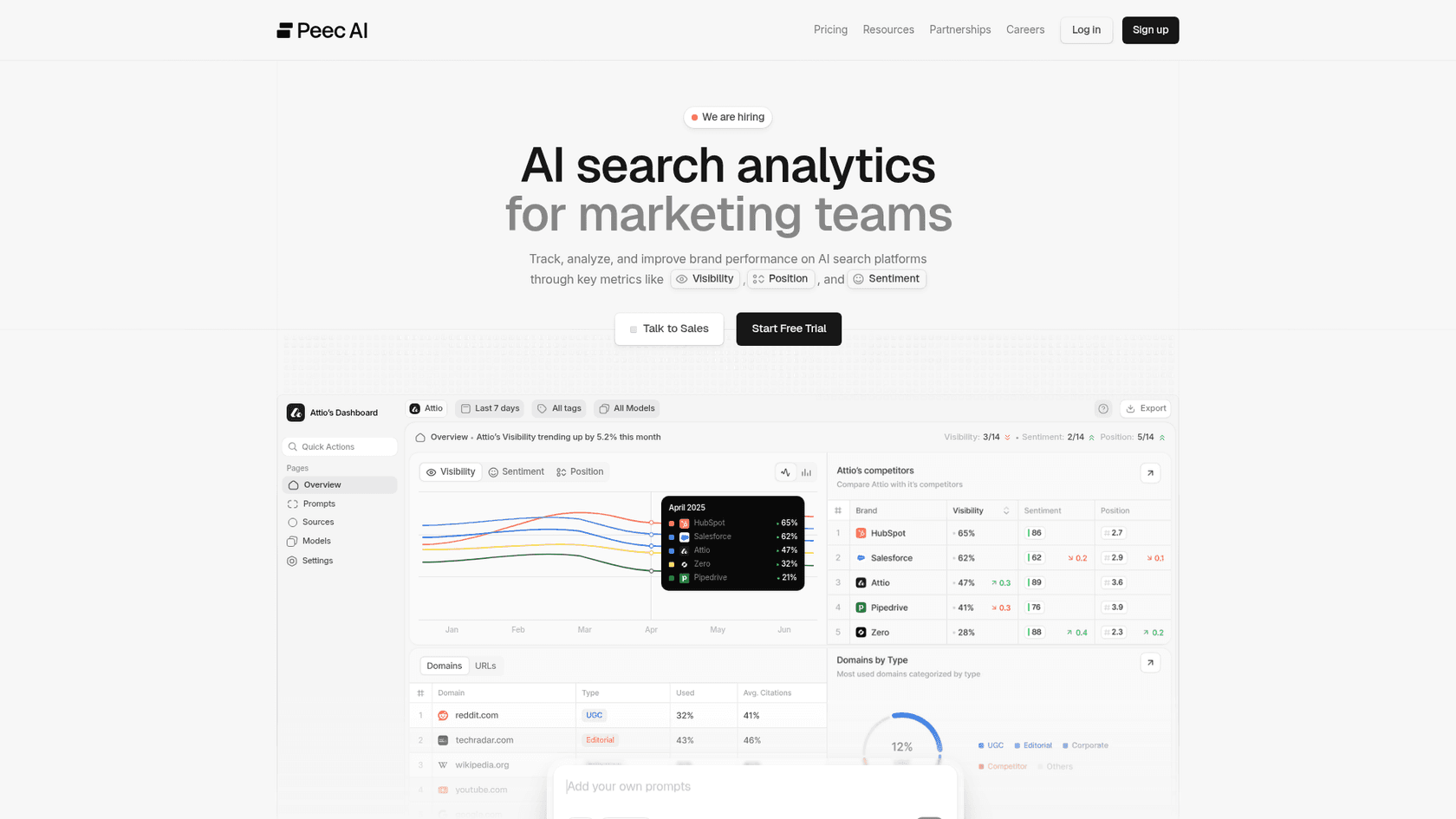
Peec AI is a newer tool that’s focused on doing one thing really well: providing clean, focused, and affordable AI search analytics. Its simple interface and flexible pricing make it a suitable choice for startups and agencies that want to scale their monitoring as they grow.
- Pros: The user interface is excellent, it's very clean and easy to get started with. I also appreciate that all plans come with unlimited user seats and country tracking, which is pretty rare. The ability to pay for extra LLM coverage via add-ons is a smart way to avoid paying for models you don't need.
- Cons: The base plans are limited to three core models (Google US, ChatGPT 3.5, and Perplexity). If you want to track more, like Gemini or other regional models, you have to pay extra for each one.
- Pricing:
- Starter: €89 per month for 25 prompts.
- Pro: €199 per month for 100 prompts.
- Enterprise: Custom plans start at €499 per month for 300+ prompts.
- Key features: Tracks visibility, position, and sentiment across prompts. It also includes a handy Google Looker Studio connector for building custom reports.
3. Gumshoe AI
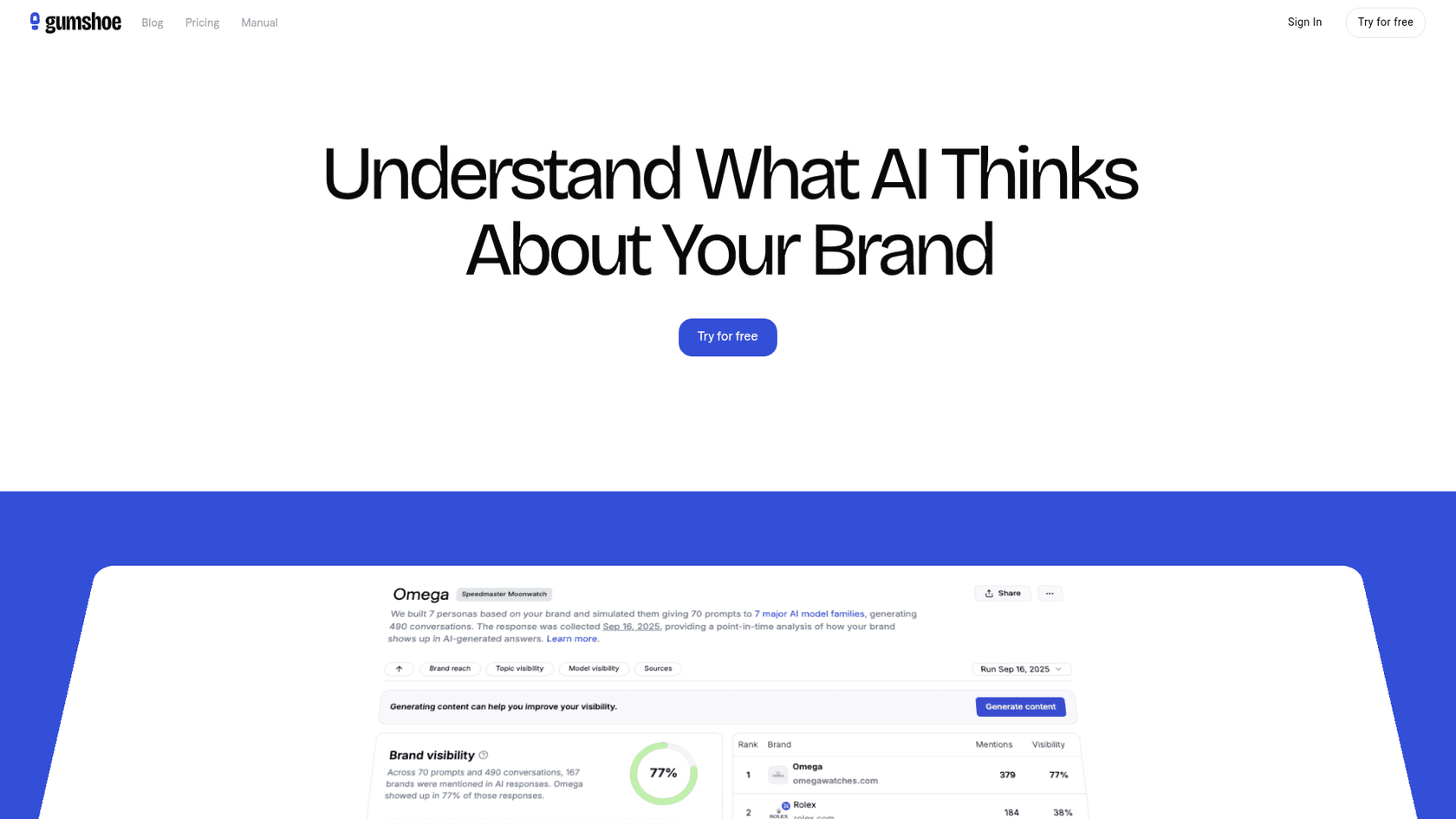
Gumshoe AI takes a completely different and interesting approach. Instead of making you come up with a list of prompts to track, it starts with user personas. You tell it who your target audience is, and it works backward to figure out the questions they're most likely to ask an AI. It's a very strategy-first tool, useful for teams focused on understanding user intent.
- Pros: The persona-based method is a real differentiator for AI search research. It helps you uncover what your audience actually cares about in a structured way. The pay-as-you-go model is also nice for one-off research projects without a long-term commitment.
- Cons: Because it's pay-as-you-go, the costs can be unpredictable if you need constant, high-volume monitoring. It's less suited for daily tracking and more for deep strategic dives.
- Pricing:
- Free: You get 3 free report runs to try it out.
- Pay as You Go: $0.10 per conversation run.
- Enterprise: Custom pricing is available for high-volume needs.
- Key features: Covers a wide range of models including Google Gemini, OpenAI GPT-5, Perplexity, Claude, and even X's Grok.
4. Otterly AI
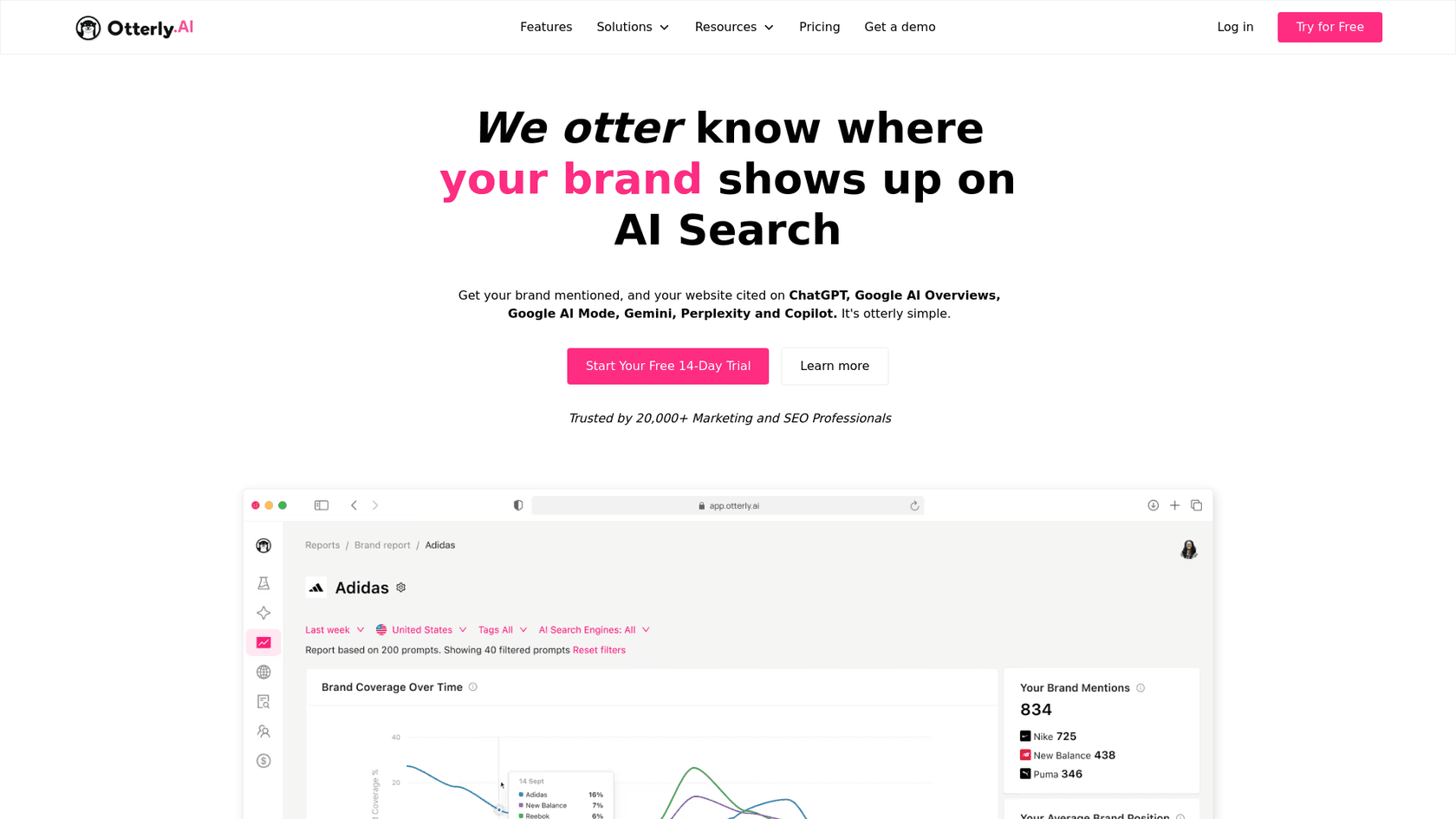
According to a recent market analysis by Semrush, Otterly AI is a simple, no-frills tool for small teams, freelancers, and agencies that just need basic monitoring at a low cost. It's a good starting point for anyone wanting to test the waters of AI visibility tracking without a big budget.
- Pros: The low starting price is its biggest draw. At $29 a month, it's very accessible. It also includes GEO audits to check your website for on-page AI-readiness and offers unlimited team members on all plans.
- Cons: It's a more basic tool. It lacks the deep analytics, advanced features, and broad LLM coverage of the more enterprise-focused platforms.
- Pricing:
- Lite: Starts at $29 per month for 15 prompts.
- Standard: $189 per month for 100 prompts.
- Premium: $489 per month for 400 prompts.
- Key features: AI keyword research to help generate prompt ideas, citation analysis to see what sources are being used, and unlimited team members.
How to choose the right LLM tracking tools for your business
- For large enterprises or teams already deep in SEO: Consider Semrush. Its integrated solution connects your existing SEO work with your new AEO efforts.
- For agencies or startups that need flexibility: Peec AI is a suitable choice. The unlimited seats and scalable pricing make it easy to grow with, and the friendly interface is a plus.
- For teams focused on strategy and user intent: Gumshoe AI is worth considering. Its unique persona-based approach will give you insights you can't get anywhere else.
- For freelancers or small teams on a tight budget: Otterly AI offers an affordable way to get started with the basics of LLM tracking.
To see these concepts in action, this video provides a great overview of the difference between traditional rank tracking and the new world of LLM citation tracking.
Start tracking, then start creating
The shift to AI-powered answers is happening now. Your brand is being defined and discussed in these new channels, whether you're paying attention or not. It's a shift worth paying attention to.
The first step is to get visibility. Pick one of these LLM tracking tools and start to understand how you appear in the AI-native world. The next step is to act on those insights. You need to create high-quality, comprehensive, AEO-optimized content that establishes you as the definitive source in your field.
Once you know where you need to show up, use the eesel AI blog writer to generate publish-ready articles designed to rank in AI answers. Try it for free today and turn your insights into traffic.




