

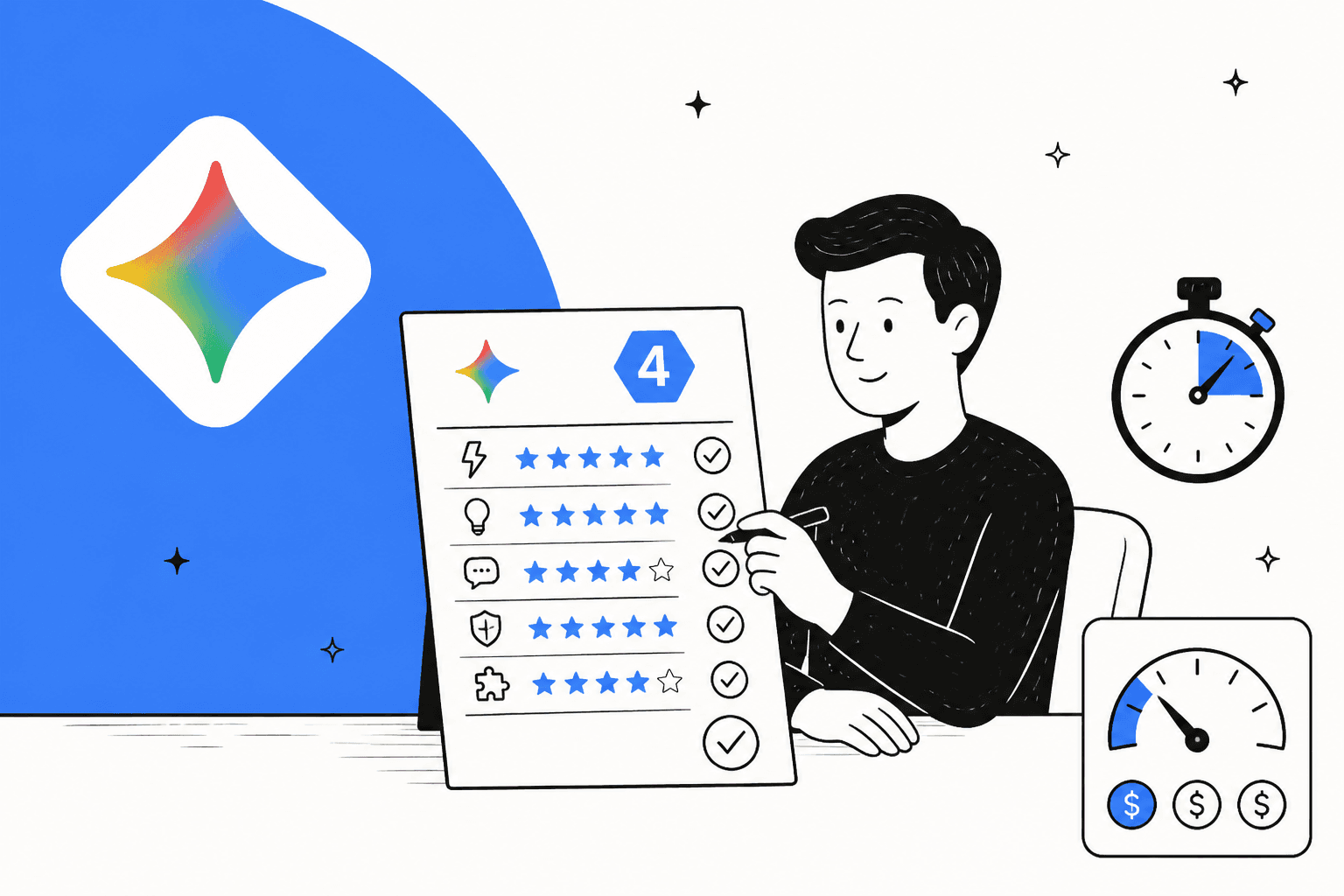
Gemini 4 Hydrogen is Google's new everyday model, and it's the best value in the Gemini 4 lineup. On its default high setting it scores 51 on the Artificial Analysis index for $1.87 a task, about a quarter of what Gemini 4 Carbon costs per task, and edges out Gemini 4 Argon.
It's not the cheapest model at that score: GPT-6.1 Terra matches 51 for $0.96, though Hydrogen finishes the same work in roughly 60% of the time. And moving from 3.8 Flash isn't a one-line change, with five API habits that break.
My verdict: 4/5. For a support team, this is a strong candidate for the model behind live chat. eesel cares less about the model than about testing your AI teammate on your past tickets first, and the eesel CLI lets a coding agent upload your help articles and check test answers before anything goes live.
How I reviewed Gemini 4 Hydrogen
Google launched Hydrogen on 12 November, so this review is one day in. I worked from three kinds of evidence, in this order of trust:
- Google's own documentation. The what's new page and model card, plus the pricing page and the Antigravity launch post, both linked further down.
- Independent measurement. Artificial Analysis ran Hydrogen at all four thinking levels through its v5 index, which gives cost per task, time per task, and token counts on the same scale as every rival.
- Early users. The Hacker News launch thread passed 380 points on day one, with a few people already posting their own eval numbers.
I didn't run my own benchmark suite. I build the AI agents at eesel, so where I give an opinion it comes from how these numbers map onto the jobs I know: models answering customers, drafting replies, and calling tools inside a helpdesk. If you want the launch overview first, my colleague's Gemini 4 Carbon review covers the big sibling, and the Gemini 4 Argon review covers the middle one.
What is Gemini 4 Hydrogen?
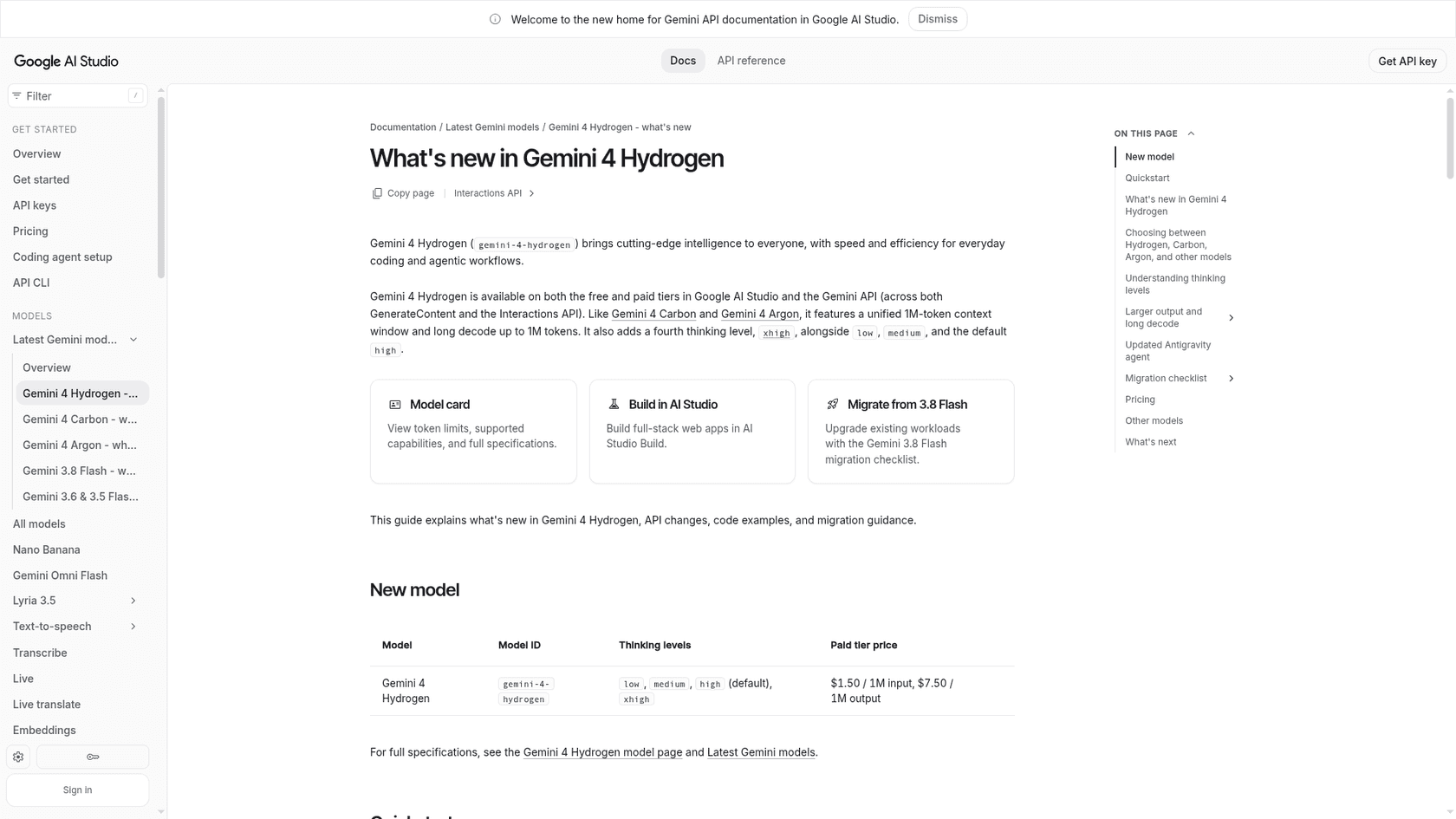
Gemini 4 Hydrogen (gemini-4-hydrogen) is the small, fast member of the Gemini 4 family, built for "everyday coding and agentic workflows" according to Google. It takes over the job Gemini 3.8 Flash used to do, and Google calls it the recommended upgrade from 3.8 Flash and every earlier Gemini 3 and 2.5 model.
The names confuse everyone, so here's the lineup in plain order of size and price:
| Model | What Google uses it for | Price per 1M tokens (input / output) | Default thinking |
|---|---|---|---|
| Gemini 4 Carbon | Hardest reasoning, security audits, architecture | $2 / $10 until 30 Nov, then $4 / $20 | medium |
| Gemini 4 Argon | Most advanced long-horizon tasks, fewer tokens than Carbon | $2 / $10 until 30 Nov, then $4 / $20 | medium |
| Gemini 4 Hydrogen | Everyday coding, agents, documents, subagents | $1.50 / $7.50, flat | high |
| Gemini 3.5 Flash-Lite | High-volume classification and routing | see the pricing page | n/a |
Prices are from Google's pricing page. Like its siblings, Hydrogen has a unified 1,048,576-token window shared by input, thinking, and output, with up to 65,536 output tokens per request and long outputs up to 1M through background execution. It reads text, images, audio, video, and PDFs, and its knowledge cutoff is March 2026.
One Hacker News commenter summed up the naming problem better than I can:
"Nobody is going to intuitively understand 'Oh yes, Hydrogen is smaller than Carbon', even though it is."

What Gemini 4 Hydrogen does well
Four things stood out, and the first is the one that matters most.
Best score for the money in the Gemini 4 lineup
Artificial Analysis ran Hydrogen at every thinking level. Here's what it measured:
| Thinking level | Index score | Cost per task | Time per task | Time to first answer token | Tokens to run the index |
|---|---|---|---|---|---|
| low | 27 | $0.29 | 1.3 min | 5.7 s | 20.3M |
| medium | 41 | $0.80 | 3.7 min | 11.8 s | 54.4M |
| high (default) | 51 | $1.87 | 8.3 min | 18.9 s | 110M |
| xhigh | 54 | $3.16 | 13.0 min | 41.1 s | 304M |
The default is the sweet spot. Going from high to xhigh buys three points for 69% more cost and nearly three times the tokens, and Google's own docs warn that xhigh "can cause overthinking on simpler prompts." Going down to medium saves about a dollar a task but costs ten points, which is the gap between a model that finishes agent tasks and one that stalls halfway.
Now put the default next to its neighbours:
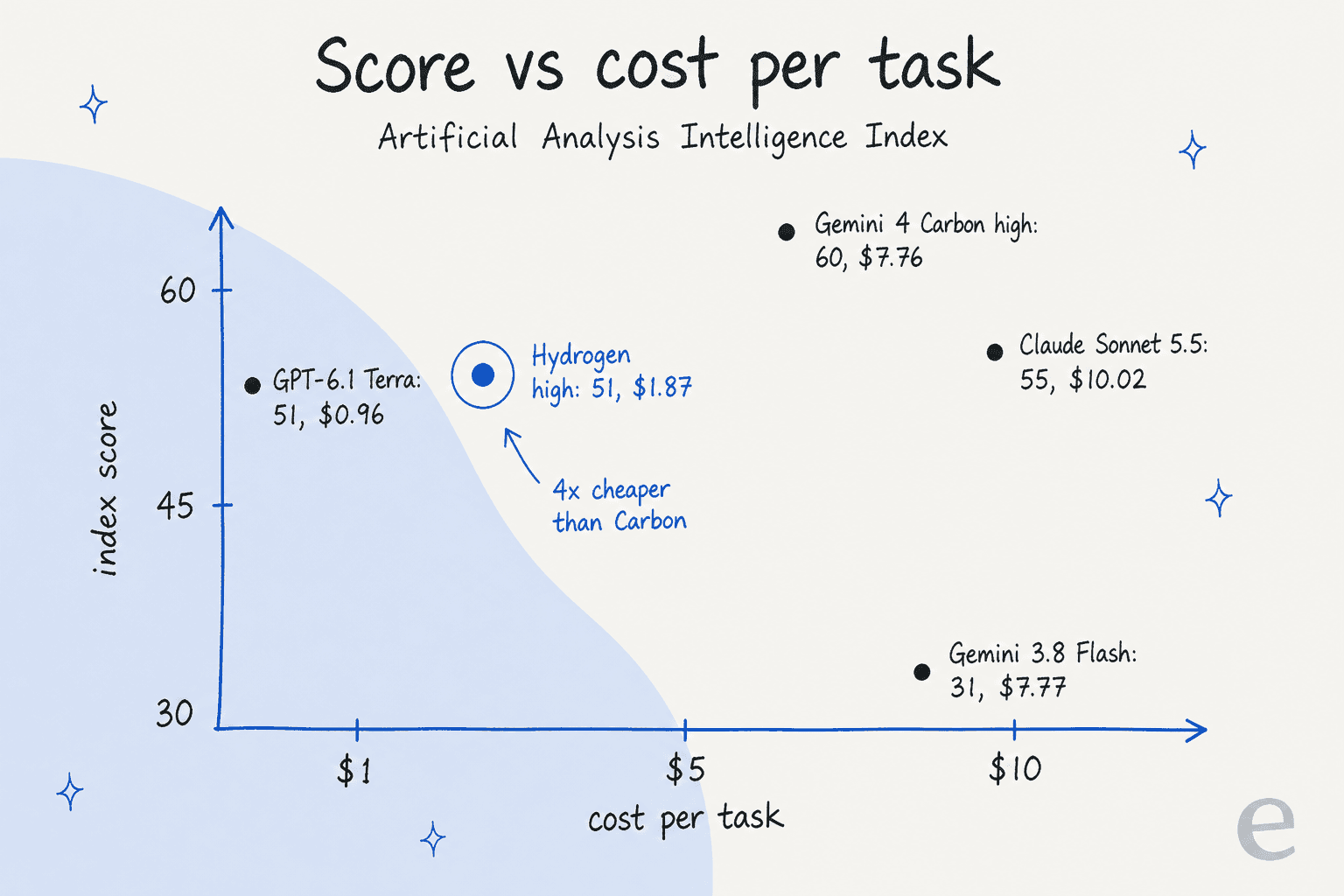
The comparison numbers come from Artificial Analysis pages for GPT-6.1 Terra, Claude Sonnet 5.5, and Gemini 3.8 Flash, all checked on 12 November. The Carbon figure is the high-thinking run Artificial Analysis published on 11 November. Two readings matter:
- Against Carbon, Hydrogen gives you 85% of the score for about a quarter of the cost per task, and finishes in a third of the time (8.3 minutes against Carbon's 25.6).
- Against 3.8 Flash, Hydrogen scores 20 points higher and still comes out cheaper per task, because 3.8 Flash burned through 126M tokens and 14.8 minutes per task to get its 31.
That second point surprised early testers too. One Hacker News user noticed the same thing: "it's much cheaper per task than 3.8 flash," wrote wasabi991011, before admitting they didn't understand how.
It's quick where people actually wait
Speed is the reason this tier exists, and Hydrogen delivers. Google says it finishes tasks 2.5 times faster than 3.8 Flash at the default setting, and the independent numbers back the direction: 8.3 minutes per index task against 14.2 for GPT-6.1 Terra and 33 for Claude Sonnet 5.5.
The most useful early report came from someone who ran their own evals:
"Nice upgrade from 3.8 flash. My use case benchmarks 37% more expensive per task but 40-60% of the total time per task (median and p90 had the same improvement). Both models were smart enough to complete all eval tasks, speed was the main thing we were struggling with."
Note the "37% more expensive" in there. Your workload isn't the Artificial Analysis index, and on a simple task that 3.8 Flash already handled cheaply, Hydrogen's higher per-token price can win out over its efficiency. More on that in the pricing section.
Agents and tool calls
This is where Google put most of its effort, and the model card shows it. Against Claude Sonnet 5.5 and GPT-6.1 Terra, Hydrogen leads on most of the agent and knowledge-work rows:
| Benchmark (Google's model card) | Gemini 4 Hydrogen | Claude Sonnet 5.5 | GPT-6.1 Terra |
|---|---|---|---|
| SWE-sweep (find and fix bugs without breaking code) | 13.5% | 3.1% | 5.8% |
| Terminal-Bench 4.1 (cheating-adjusted) | 57.0% | 63.9% | not reported |
| Agents' Last Exam v1.1 | 71.6% | 60.4% | 69.8% |
| AutomationBench-AA (SaaS workflows) | 76.1% | 71.8% | 60.2% |
| Vending-Bench 2 (bank balance) | $14,549 | $11,165 | $9,107 |
| OSWorld-2.1 (computer use, offline subset) | 77.6% | 83.9% | 74.2% |
| MKA (multimodal knowledge agent) | 53.4% | 52.0% | 43.8% |
| HLE-Diamond (reasoning) | 58.8% | 53.3% | 47.3% |
These are Google's own numbers, so treat them as the vendor's best case. Still, two behaviours in Google's notes are the kind I care about when a model is calling tools inside a helpdesk. Hydrogen batches file reads and searches in parallel instead of one by one, and it "adapts cleanly when a tool call fails or a search returns empty." Google also says it cuts fabricated claims by more than 5x against 3.8 Flash by "flagging missing context instead of guessing." For an agent that looks up orders, that's the difference between "I can't find that order" and an invented tracking number.
AutomationBench-AA is the row I'd weight most for support work, since it tests multi-step workflows across SaaS tools. Hydrogen's 76.1% leads both rivals.
It pairs well with Carbon
The other big launch was Orchestrator in Google Antigravity, a model option that hands one task back and forth between Carbon and Hydrogen. Carbon explores and plans, Hydrogen writes the edits and runs the tests, and when Hydrogen "hits friction" it hands back to Carbon to repair the plan.
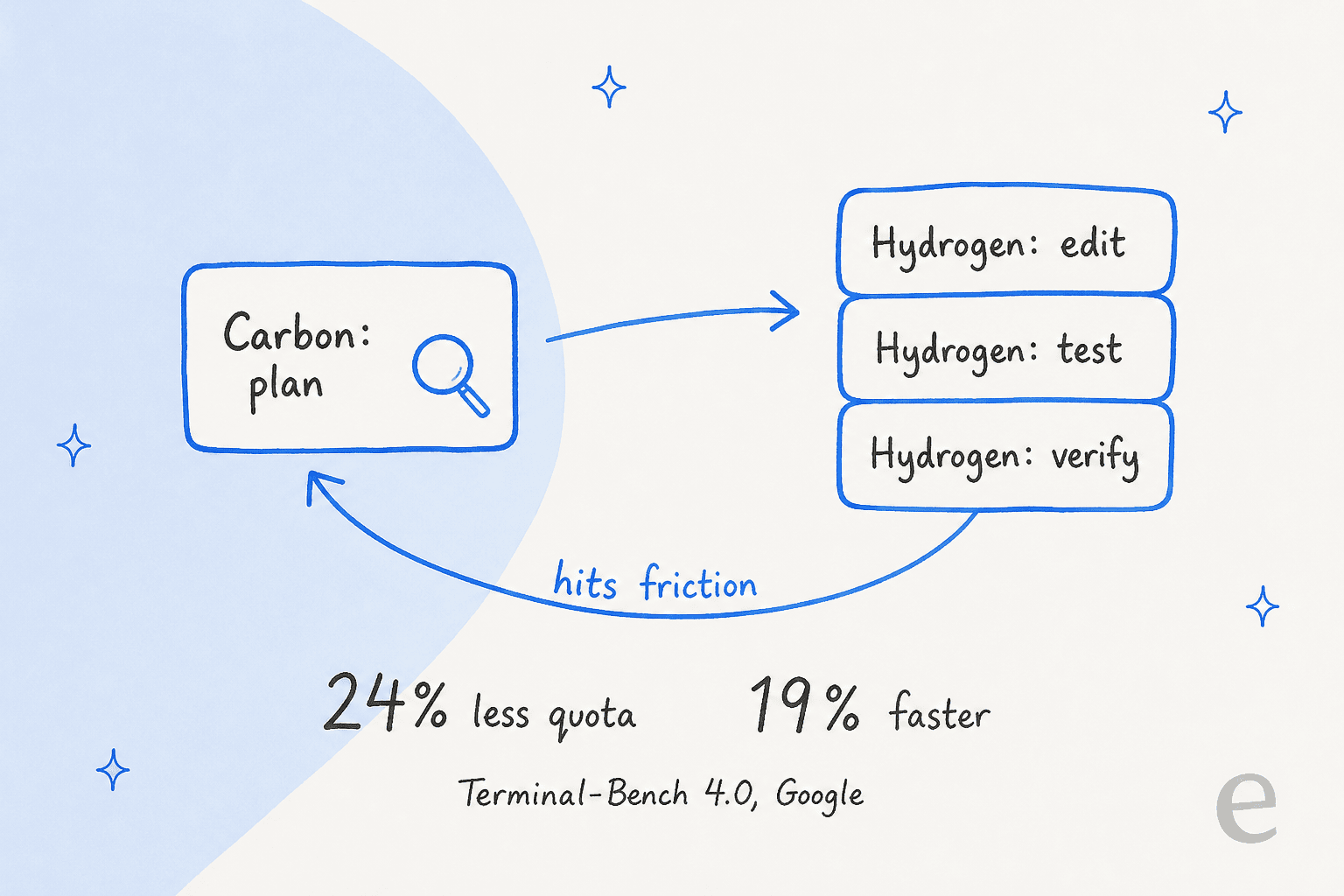
On Terminal-Bench 4.0, Google says Orchestrator reached near-Carbon success rates while using 24% less quota and finishing 19% faster. The catch: Orchestrator is rolling out to Google AI Ultra subscribers first. If you're on the API, you can wire the same split yourself by sending planning turns to gemini-4-carbon and execution turns to gemini-4-hydrogen in one session.
"The orchestrator in Antigravity might be the most important part of this release. I'm excited that this is being built natively into harnesses."
Where Gemini 4 Hydrogen falls short
Hydrogen is a good model with a few real limits. Here they are, plainly.
GPT-6.1 Terra is cheaper at the same score
On the Artificial Analysis index, GPT-6.1 Terra also scores 51, for $0.96 a task against Hydrogen's $1.87. If your jobs are batch work that nobody watches, Terra is the cheaper answer. Hydrogen wins back the difference only where time matters: it finished the index tasks in 8.3 minutes to Terra's 14.2, and its first answer token arrived in about 19 seconds to Terra's 165.
One reader on the launch thread put the tradeoff neatly: "at high reasoning it's smarter than Terra but somewhat more expensive," wrote modeless. The GPT-6.1 Terra pricing post has the full rate card if you want to run the numbers.
Twice the per-token price of today's 3.8 Flash
Until 31 December, 3.8 Flash costs $0.75 input and $3.75 output per million tokens on its promotional rate. Hydrogen is exactly double. Some teams on simple, high-volume flows will feel that:
"If this is Google's strategy we'll have to migrate to Luna, because costs are already high for our workload on 3.8 Flash (which in itself was already a 40% increase compared to 3.7 flash due to being more verbose and thinking more) and this now doubles cost once again."
The fair context: 3.8 Flash's own price rises to $1.50 and $7.50 on 1 January 2027, the same as Hydrogen. So the doubling is a seven-week gap, not a permanent one. And if your work is pure classification or routing, Google itself points you at Gemini 3.5 Flash-Lite instead.
Migrating from 3.8 Flash breaks five habits
This is the part most launch coverage skips. Hydrogen uses the Gemini 4 API design, and the migration checklist lists changes that will bite a production app that only swaps the model string:
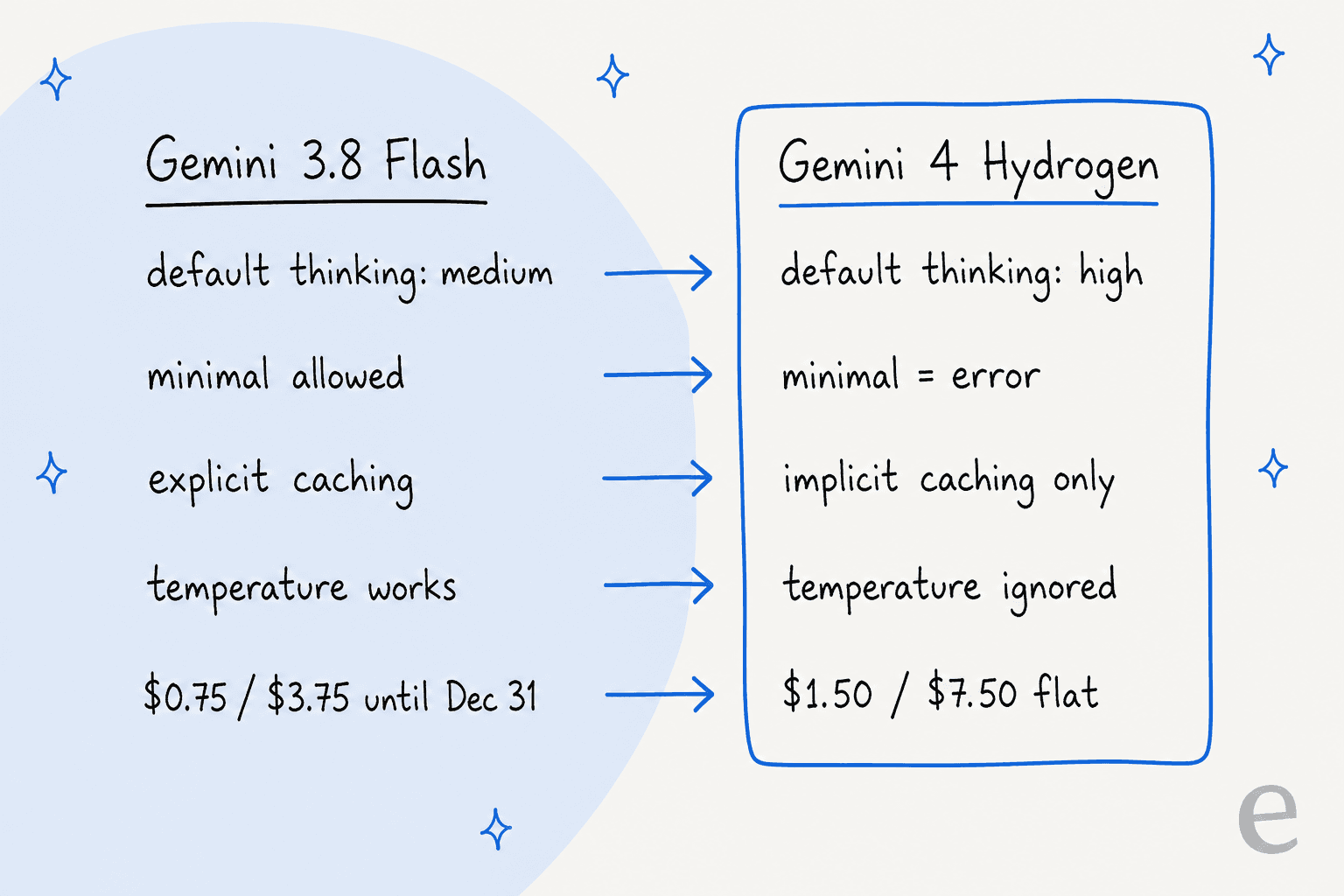
- The default thinking level is now high, not medium. Same prompt, more thinking tokens, a bigger bill. Set
thinking_levelexplicitly. minimalreturns an error. If you pinned 3.8 Flash to minimal for speed, that request fails until you change it tolow.- No explicit caching.
cachedContentsandcaches.createaren't supported. Implicit caching kicks in on prompts of at least 4,096 tokens and gives a 95% discount on cache hits, but you can't pin a cache yourself. temperature,top_p, andtop_kare ignored. If your reply style relied on a low temperature, test it again.- Raw-text JSON tool calls can fail. Prompting the model to emit its own JSON with no declared tools can return
MALFORMED_FUNCTION_CALL. Declare tools natively or use structured outputs.
Google also notes that the old 64K output budget is now part of the shared 1M window, so hardcoded caps like 8,192 should come out. None of this is hard. It just isn't free, and a support bot that silently switches from medium to high thinking can double its token use overnight.
Some early users report overreach
Not every early report was positive. One long-time Gemini user posted a pointed complaint:
"Pretty big Gemini fan, but my initial results with Hydrogen and Carbon are disappointing. They are trading improvements on pass@1 pointless benchmarks for worse disasters at p90/99 that you're going to hit every week in agentic workflows (if not daily): overreach (doing more than asked), overwork (when it should have failed fast)..."
Google claims the opposite in its safety notes: up to 81% less overreach and 79% less under-service than 3.8 Flash, and a 96.7% honesty rate on its internal agent honesty test. One day in, both sides are anecdote and vendor data. The model card's own table does show one regression worth knowing: unjustified refusals rose 5.57 percentage points against 3.8 Flash on Google's automated test, where lower is better. If your bot handles health or finance questions, test for over-cautious replies.
Access is still a maze
The API story is simple: free (rate-limited) and paid tiers, both live. Consumer access is not. Free Gemini app users only get Hydrogen when auto model selection picks it, while Pro and Ultra subscribers can choose it, and Orchestrator is Ultra-only for now. Hydrogen also now powers Google Search for all users. As one commenter put it, "Why are there 7 different ways to call this model from Google?" (sergiotapia). For API users, it doesn't matter. For teams deciding on a Google AI Ultra seat, it does.
How much does Gemini 4 Hydrogen cost in practice?
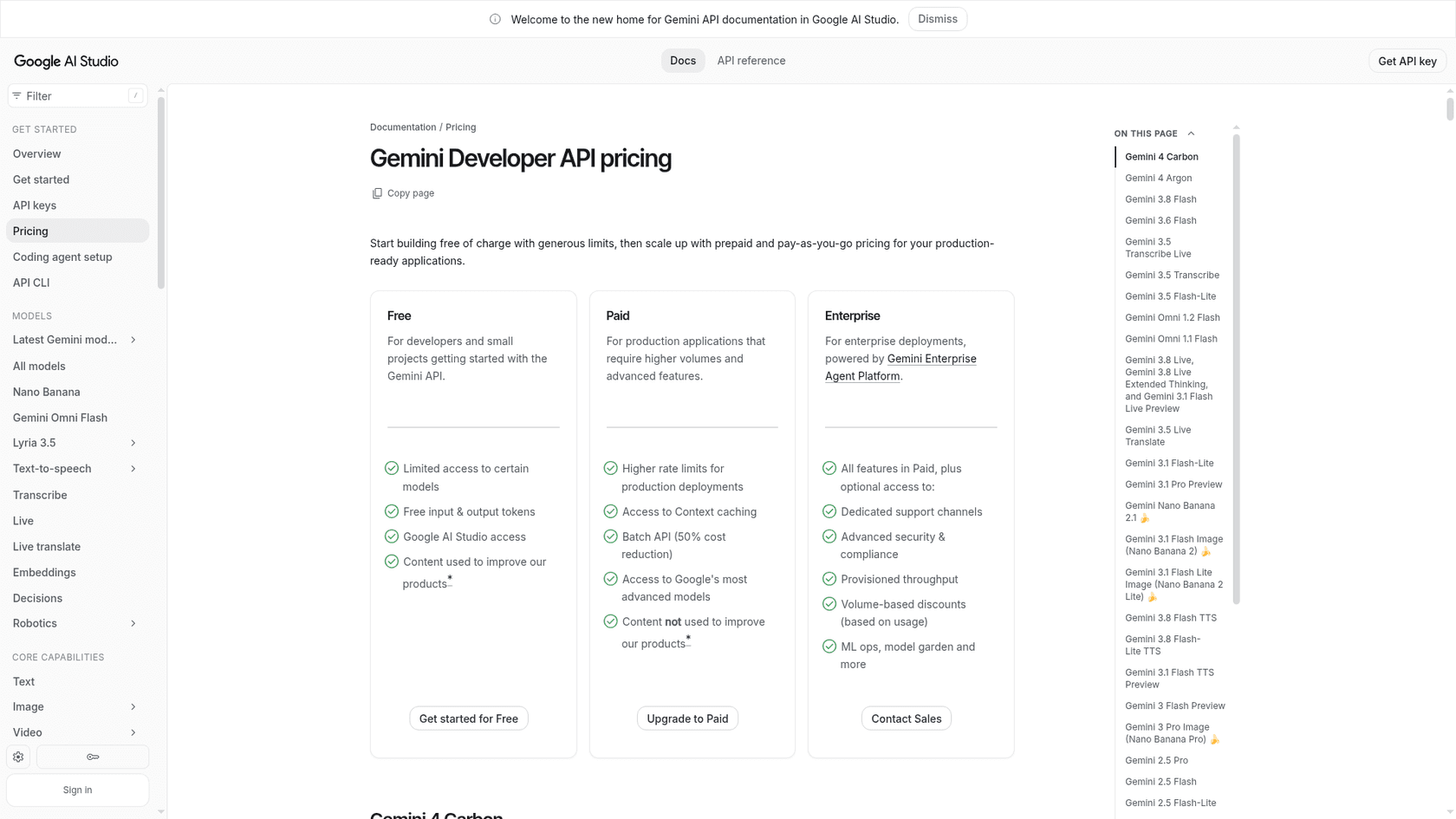
The rate card is short. From the Gemini API pricing page:
| Item | Free tier | Paid tier |
|---|---|---|
| Input, per 1M tokens | Free of charge | $1.50 |
| Output, including thinking, per 1M tokens | Free of charge | $7.50 |
| Cached input, per 1M tokens | Free of charge | $0.075 (implicit caching only) |
| Grounding with Google Search | Not available | 5,000 free requests a month across Gemini 3 and newer, then $14 per 1,000 |
| Grounding with Google Maps | Not available | 5,000 free requests a month, then $14 per 1,000 |
| Data used to improve Google's products | Yes | No |
The price is flat across the whole 1M window, with no long-context surcharge. The page also lists Batch, Flex, and Priority modes, and Google's paid plan advertises a 50% cost reduction on the Batch API.
Per-token prices don't tell you much on their own, because thinking tokens are billed as output and every level thinks a different amount. Cost per task is the better number. Here's a quick calculator built on the Artificial Analysis per-task costs:
At 2,000 tasks a month on high, Hydrogen comes to about $3,740 against roughly $15,520 for Carbon on high. That's the case for the Orchestrator idea in one number: let the expensive model plan, and let the cheap one do the volume. If you want a deeper cost breakdown for support specifically, the AI customer service cost guide walks through it.
Gemini 4 Hydrogen vs 3.8 Flash, Argon, Terra, and Sonnet 5.5
Here's the whole picture on one table:
| Gemini 4 Hydrogen (high) | Gemini 3.8 Flash | Gemini 4 Argon | GPT-6.1 Terra | Claude Sonnet 5.5 | |
|---|---|---|---|---|---|
| AA index score | 51 | 31 | 50 (per Google) | 51 | 55 |
| Cost per AA task | $1.87 | $7.77 | not checked | $0.96 | $10.02 |
| Time per AA task | 8.3 min | 14.8 min | not checked | 14.2 min | 33.0 min |
| First answer token | 18.9 s | 17.3 s | not checked | 164.7 s | 259.1 s |
| Price per 1M tokens | $1.50 / $7.50 | $0.75 / $3.75 (rises 1 Jan) | $2 / $10 (rises 1 Dec) | see Terra pricing | see Sonnet pricing |
| Free API tier | Yes | Yes | No | n/a | n/a |
My read:
- Choose Hydrogen over 3.8 Flash almost always. Higher score, faster, and on Artificial Analysis cheaper per task. Budget for the migration work.
- Choose Hydrogen over Argon for most everyday work. Similar score, lower price, faster. Keep Argon (or Carbon) for the long, hard jobs.
- Choose Terra over Hydrogen for background batch jobs where nobody waits and cost per task is all that matters.
- Choose Sonnet 5.5 over Hydrogen when terminal-heavy coding and computer use are the job. It leads on Terminal-Bench 4.1 and OSWorld, at more than five times the cost per task.
If you're weighing a wider set, the best AI model for support tickets roundup and the ChatGPT vs Gemini comparison go broader.
What are people saying about Gemini 4 Hydrogen?
Day-one sentiment splits three ways. The naming draws the most comments by far. The pricing draws the sharpest ones, mostly from teams who ran 3.8 Flash at the promotional rate. And the people who actually ran workloads mostly report it works:
"I don't believe so. From my use I think it is a Flash model through and through. I have found it a good subagent workhorse for code implementation, with some higher level model doing the spec and review."
On Google's launch post, customers who tested early were, unsurprisingly, upbeat. Box reported accuracy "significantly improved when compared to Gemini 3.8 Flash, while running about twice as fast and using 12% fewer tokens," per Google's announcement. Vendor-selected quotes are a best case, but the token and speed numbers line up with the independent runs.
Who should use Gemini 4 Hydrogen?
Here's my verdict by use case:
| Use case | Score | Why |
|---|---|---|
| Everyday coding and subagents | 4.5/5 | Fast, parallel tool calls, leads SWE-sweep; pair with Carbon for planning |
| Tool-using agents and SaaS workflows | 4.5/5 | Leads AutomationBench-AA, adapts when a tool call fails |
| Documents, PDFs, charts, video | 4/5 | Leads MKA and Chartography among its peers, 1M window |
| Live chat and support replies | 4/5 | Sub-6-second first token on low, 19 seconds on high; test refusals |
| Cheapest batch processing | 3/5 | Terra is half the cost per task at the same score |
| Hardest reasoning and research | 3/5 | Carbon and Argon still lead; Hydrogen is the worker, not the planner |
Overall: 4/5. It's the model I'd default to in the Gemini lineup this week, with a migration checklist taped to the monitor.
What this review means for support teams
Here's the part I care about, since my day job is building the agents that sit inside helpdesks. A support bot has two speed problems. The customer waiting in website chat gives up after a few seconds, and the agent that drafts email replies has to clear a queue before the morning shift. Hydrogen is one of the first models this month that handles both, with a first token under 6 seconds on low and 19 seconds on high.
The model is still the smaller half of the job. We've spent years putting AI agents on live support queues, and the failures that hurt are rarely about raw model smarts. On one sales call, a B2B technical support team told us their bot had happily confirmed it supported a customer's product because the knowledge base said "we support all models," when the product wasn't in their database at all. Benchmarks don't catch that. What catches it is testing the agent on your own past tickets before it talks to customers, and handing off to a person when the answer isn't in your docs. Our guide on AI hallucinations in support covers the patterns.
That's how eesel works. You hire an AI helpdesk teammate that joins your existing helpdesk, learns from your help center, macros, and past replies, and gets simulated against historical tickets first. Model launches like this one change what runs underneath, not how you set it up.
Two customers show the shape of it. SamCart, an ecommerce software company for digital products, runs one eesel agent on Freshdesk tickets and another in the website chat bubble, answering from 280 help center articles. smava, a German loan comparison company, handles about 27,000 Zendesk tickets a month across two brands; eesel categorised 14,600 of them and prepared 15,300 draft replies in a month. Neither team had to pick a model.
If you want a closer look at the plumbing, the MCP for customer support guide explains how agents reach your tools, and the AI agent CLI post covers driving agents from a terminal. For the cost side, the AI vs human agent comparison runs the numbers.
Try eesel
Hydrogen makes a fast, cheap model easy to call. Turning it into a support teammate that knows your refund policy and hands off at the right moment is the harder part, and that's what eesel does. It plugs into Freshdesk, Zendesk, and the other major helpdesks, learns from your past tickets, and you can watch it answer real historical conversations before it goes live. Pricing is a fixed monthly credit plan, not per seat.
Developers can drive the same workspace from the eesel CLI: a coding agent uploads approved knowledge such as exported help articles and saved replies, adjusts the agent's instructions, and runs test questions to check the answers. Connecting the helpdesk itself still needs someone with admin access to approve it.
Try eesel free, or book a demo to see it run on your own tickets.